


Matthew 22:45
- εἰeiIfG1487CONDConjunction
- οὖνounthereforeG3767CONJConjunction
- ΔαυὶδDauidDavidG1138N-NSM-PNoun Nominative Singular Masculine Individual
- καλεῖkaleicallsG2564V-PAI-3SVerb Present Active Indicative 3rd Singular
- αὐτὸνautonHimG846P-ASMPersonal pronoun Accusative Singular Masculine
- κύριονkurionLordG2962N-ASM-TNoun Accusative Singular Masculine Title
- πῶςpōshowG4459PRT-IInterrogative Particle Interrogative
- υἱὸςhuiossonG5207N-NSMNoun Nominative Singular Masculine
- αὐτοῦautouof himG846P-GSMPersonal pronoun Genitive Singular Masculine
- ἐστιν;estinis He?G1510V-PAI-3SVerb Present Active Indicative 3rd Singular
English is a literal word-by-word gloss of the Greek, not the KJV's wording. Why?
This is the original text the KJV's translators worked from — each Greek word with its own literal English meaning in this verse, prepared by scholars at Tyndale House, Cambridge. The KJV translates whole sentences, not word by word, so its wording differs: one Greek word can become several English words, and the KJV may choose “charity” where the gloss reads “love”. Both are faithful — they answer different questions. For the KJV's own rendering, switch to the KJV text.
Details
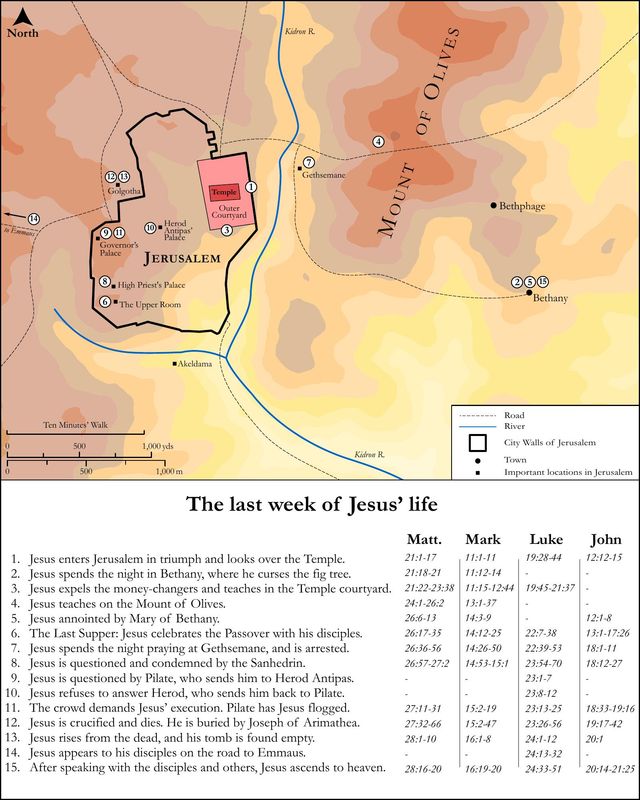
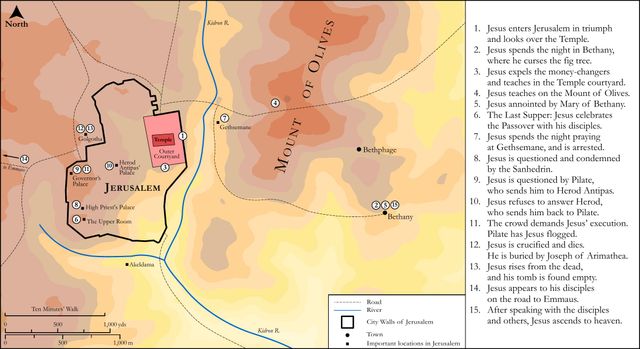
See on the biblical-era map

Study this verse
Historical interpretation
Nine Centuries of Reception
10 surviving comments on this verse. Each one is dated, so this reads as a timeline rather than a list.
Select a marker to jump to its quote. Markers stagger vertically where authors wrote within a few decades of each other.
Then since He had answered, He asks also in turn, "What think ye of Christ, whose Son is He? They say unto Him, The Son of David."
See after how many miracles, after how many signs, after how many questions, after how great a display of His unanimity with the Father, as well in words, as in deeds; after having praised this man that said, that there is one God, He asks the question, that they may not be able to say, that He did miracles indeed, yet was an adversary to the law, and a foe to God.
Therefore, after so many things, He asks these questions, secretly leading them on to confess Him also to be God. And the disciples He asked first what the others say, and then themselves; but these not so; for surely they would have said a deceiver, and a wicked one, as speaking all things without fear. So for this cause He inquires for the opinion of these men themselves.
For since He was now about to go on to His passion, He sets forth the prophecy that plainly proclaims Him to be Lord; and not as having come to do this without occasion, nor as having made this His aim, but from a reasonable cause.
For having asked them first, since they answered not the truth concerning Him (for they said He was a mere man), to overthrow their mistaken opinion, He thus introduces David proclaiming His Godhead. For they indeed supposed that He was a mere man, wherefore also they said, "the Son of David;" but He to correct this brings in the prophet witnessing to His being Lord, and the genuineness of His Sonship, and His equality in honor with His Father.
And not even at this doth He stop, but in order to move them to fear, He adds what followeth also, saying, "Till I make Thine enemies Thy footstool;" that at least in this way He might gain them over.
And that they may not say, that it was in flattery he so called Him, and that this was a human judgment, see what He saith, "How then doth David in spirit call Him Lord?" See how submissively He introduces the sentence and judgment concerning Himself. First, He had said, "What think ye? Whose Son is He?" so by a question to bring them to an answer. Then since they said, "the Son of David," He said not, "And yet David saith these things," but again in this order of a question, "How then doth David in spirit call Him Lord?" in order that the sayings might not give offense to them.
And He Himself too in like manner for this cause introduces the doctrine in the way of question and inference, saying, "How then doth David in spirit call Him Lord, saying, The Lord said unto my Lord, Sit Thou on my right hand, until I make Thy foes Thy footstool;" and again, "If David then call Him Lord, how is He then his Son," not taking away the fact that He is his Son, away with the thought; for He would not then have reproved Peter for this, but to correct their secret thoughts. So that when He saith, "How is He his Son?" He meaneth this, not so as ye say. For they said, that He is Son only, and not also Lord. And this after the testimony, and then submissively, "If David then call Him Lord, how is He his Son?"
But, nevertheless, even when they had heard these things, they answered nothing, for neither did they wish to learn any of the things that were needful. Wherefore He Himself addeth and saith, that "He is his Lord." Or rather not even this very thing doth He say without support, but having taken the prophet with Him, because of His being exceedingly distrusted by them, and evil reported of amongst them. To which fact we ought to have especial regard, and if anything be said by Him that is lowly and submissive, not to be offended, for the cause is this, with many other things also, that He talks with them in condescension.
Wherefore now also He delivers His doctrine in the manner of question and answer; but He darkly intimates even in this way His dignity. For it was not as much to be called Lord of the Jews, as of David.
But mark thou also, I pray thee, how seasonable it is. For when He had said, "There is one Lord," then He spake of Himself that He is Lord, and showed it by prophecy, no more by His works only. And He showeth the Father Himself taking vengeance upon them in His behalf, for He saith, "Until I make Thine enemies Thy footstool;" and great unanimity even hereby on the part of Him that begat Him towards Himself, and honor. And upon His reasonings with them He doth set this end high and great, and sufficient to close fast their mouths.
"If David then call Him Lord, how is He then his Son," not taking away the fact that He is his Son, away with the thought; for He would not then have reproved Peter for this, but to correct their secret thoughts. So that when He saith, "How is He his Son?" He meaneth this, not so as ye say. For they said, that He is Son only, and not also Lord. And this after the testimony, and then submissively, "If David then call Him Lord, how is He his Son?"
But, nevertheless, even when they had heard these things, they answered nothing, for neither did they wish to learn any of the things that were needful. Wherefore He Himself addeth and saith, that "He is his Lord." Or rather not even this very thing doth He say without support, but having taken the prophet with Him, because of His being exceedingly distrusted by them, and evil reported of amongst them.
(Hom. lxxi.) He first asked His disciples what others said of Christ, and then what they themselves said; but not so to these. For they would have said that He was a deceiver, and wicked. They thought that Christ was to be mere man, and therefore they say unto Him, The Son of David. To reprove this, He brings forward the Prophet, witnessing His dominion, proper Sonship, and His joint honour with His Father.
But He rests not with this, but that they may fear, He adds, Till I make thine enemies thy footstool; that at least by terror He might gain them.
This conclusion He put to their questionings, as final, and sufficient to stop their mouth. Henceforward accordingly they held their peace, not by their own good-will, but from not having aught to say.
This passage is out of the 109th Psalm. Christ is therefore called David's Lord, not in respect of His descent from him, but in respect of His eternal generation from the Father, wherein He was before His fleshly Father. And he calls Him Lord, not by a mere chance, nor of his own thought, but by the Holy Spirit.
This question is still available for us against the Jews; for these who believe that Christ is yet to come, assert that He is a mere man, though a holy one, of the race of David. Let us then thus taught by the Lord ask them, If He be mere man, and only the Son of David, how does David call Him his Lord? To evade the truth of this question, the Jews invent many frivolous answers. They allege Abraham's steward, he whose son was Eliezer of Damascus, and say that this Psalm was composed in his person, when after the overthrow of the five kings, the Lord God said to his lord Abraham, Sit thou on my right hand, till I make thine enemies thy footstool. Let us ask how Abraham could say the things that follow, and compel them to tell us how Abraham was born before Lucifer, and how he was a Priest after the order of Melchisedech, for whom Melchisedech brought bread and wine, and of whom he received tithes of the spoil?
(verses 41 onwards) But when the Pharisees were gathered together, Jesus questioned them, saying, 'What do you think about the Christ, whose son is he?' They said to him, 'David.' He said to them, 'How then does David in the Spirit call him Lord, saying, "The Lord said to my Lord, Sit at my right hand, until I make your enemies your footstool?" If David then calls him Lord, how is he his son?' Those who had gathered together to test Jesus and tried to capture the truth through deceitful questioning, gave an opportunity for their own refutation. They are asked (or, it is asked) about Christ whose son he is. The questioning of Jesus benefits us even today against the Jews. And indeed those who confess that Christ is to come assert that he is a simple man and a holy man from the lineage of David. Let us therefore question those who are taught by the Lord: if he is a simple man and only a son of David, how does David call him his Lord? Not by uncertain error or personal will, but in the Holy Spirit (or, but in the Holy Spirit, he is silent). The testimony, however, which he presents, is taken from the one hundred and ninth Psalm. Therefore, David is called Lord, not according to what he was born, but according to what he always was, born from the Father, surpassing his own Father in the flesh. The Jews, in order to evade the truth of the question, invent many idle things, asserting that the native of Abraham, whose son was Damascus Eliezer, and that the psalm was written from that person's perspective, in which the Lord God said to his lord, Abraham, after the slaughter of the five kings: Sit at my right hand, until I make thy enemies thy footstool. (Genesis 14). Whom should we ask: How did God say to Abraham these things that follow: With you is the beginning in the day of your power, in the splendors of the saints, I have begotten you before Lucifer; and: The Lord has sworn, and will not regret it; you are a priest forever, according to the order of Melchizedek? And we should try to answer how Abraham was born before Lucifer and was a priest according to the order of Melchizedek: regarding whom Melchizedek offered bread and wine, and from whom he received tithes of the spoils.
Here then there is need for caution, lest Christ himself be thought to have denied that he was the Son of David. He did not deny that he was the Son of David, but he probed his detractors on the particular way this can be. You have said that Christ is the Son of David. I do not deny it. But “if David thus calls him Lord, how is he his Son?” Tell me how he could be his son who is also his Lord? They did not answer him but were dumbfounded.Let us then answer them by the explanation given by Christ himself. Where given? Through his apostle. By what source can we prove that Christ himself has explained it? The apostle says, “Would you receive a proof of Christ who speaks in me?” So it is through the apostle’s voice that Christ has allowed this question to be solved. In the first place, do you remember what Christ said, speaking by the apostle to Timothy? “Remember Jesus Christ, raised from the dead, descended from David. This is my gospel.” So it is easy to see that Christ is the Son of David. But how is he also David’s Lord? Let the apostle again tell us of the one who, “though he was in the form of God, did not count equality with God a thing to be grasped.” Acknowledge David’s Lord. If you acknowledge David’s Lord, our Lord, the Lord of heaven and earth, the Lord of the angels, equal with God, in the form of God, how is he David’s Son? Note what follows. The apostle shows you David’s Lord by saying, “Who being in the form of God, thought it not robbery to be equal with God.” And how is he David’s Son? “But he emptied himself, taking the form of a servant, being made in the likeness of men; and being found in human form, he humbled himself, having become obedient unto death, even the death of the cross. Therefore God has also highly exalted him.” Christ “of the seed of David,” the Son of David, rose again because “he emptied himself.” How did he empty himself? By taking upon himself that which he was not, not by losing that which he was. He emptied himself. He “humbled himself.” Though he was God, he appeared as a man. He was despised as he walked on earth, he who made the heaven. He was despised as though a mere man, as though of no power. He was not only despised but also killed! He was that stone that was laid aside on the ground, which the Jews stumbled against and were shaken. And what does he himself say? “He who falls on this stone will be broken to pieces, but he on whom it falls, it shall grind him to powder.” First he was laid low, and they stumbled against him. He shall come from above, and he will “grind” them that have been shaken “to powder.”
Thus you have heard that Christ is both David’s Son and David’s Lord: David’s Lord always, David’s Son in time. David’s Lord, born of the substance of his Father; David’s Son, born of the Virgin Mary, conceived by the Holy Spirit. Let us hold fast both. The one of them will be our eternal habitation; the other is our deliverance from our present exile.
The Jews tempted Christ, supposing Him to be mere man; had they believed Him to be the Son of God, they would not have tempted Him. Christ therefore, willing to show that He knew the treachery of their hearts, and that He was God, yet would not declare this truth to them plainly, that they might not take occasion thence to charge Him with blasphemy, and yet would not totally conceal this truth; because to that end had He come that He should preach the truth; He therefore puts a question to them, such as should declare to them who He was; What think ye of Christ? whose Son is He?
I suppose that He formed this question, not only against the Pharisees, but also against the heretics; for according to the flesh He was truly David's Son, but his Lord according to His Godhead.
That He says, Sit thou on my right hand, is not to be taken as though God had a body, and either a right hand or a left hand; but to sit on the right hand of God is to abide in the honour and equality of the Father's majesty.
But till is used for indefinite time, that the meaning be, Sit Thou for ever, and for ever hold thine enemies beneath thy feet.
Hence we learn that the poison of jealousy may be overcome, but can hardly of itself rest at peace.
(ap. Anselm.) That it is by the Father that the enemies are put under the Son, denotes not the Son's weakness, but the union of His nature with His Father. For the Son also puts under Him the Father's enemies, when He glorifies His name upon earth. He concludes from this authority, If David then call Him Lord, how is He his son?
Continue studying Matthew 22:45 across the web’s major study libraries — every link below opens this exact verse, chapter, or book on the destination site.
Read & Compare
 BibleGatewayThis verse in more than 200 translations and 70 languages.
 Bible.comThe YouVersion reader — hundreds of translations, reading plans, and highlights.
 ESV.orgCrossway's official English Standard Version reader.
 NET BibleThe NET translation with 60,000+ translators' notes on every rendering decision.
 STEP BibleTyndale House's free study tool — original text, vocabulary, and scholarly resources.
 BibliaLogos Bible Software's free web reader.
 USCCBThe New American Bible (Revised Edition) with the U.S. bishops' study notes.
Commentaries
 BibleHub CommentariesDozens of classic commentaries on this verse, gathered on one page.
 StudyLightMore than 100 commentary sets — the largest collection on the web.
 BibleRefPlain-English commentary on what this verse means, verse by verse.
 Enduring WordDavid Guzik's free commentary on this chapter, widely used by Bible teachers.
 Bible Study ToolsVerse commentary alongside Greek and Hebrew study aids.
Original Language & Research
- BibleHub InterlinearThe verse word by word — original language, transliteration, and English.
- BibleHub LexiconEvery word's original-language definition and Strong's entry.
 Blue Letter BibleDeep-study tools — Strong's numbers, concordance, and word studies.
 CNTR CollationThe earliest Greek manuscripts of this verse, collated letter by letter.
Sermons, Hymns & Audio


TrulyRandomVerse is not affiliated with these sites and doesn’t control their content. They’re linked because they’re genuinely useful.
Summary
Matthew 22:45 presents Jesus's climactic rhetorical question to the Pharisees, challenging their limited understanding of the Messiah's identity. By quoting Psalm 110:1, where David refers to his descendant, the Messiah, as "Lord," Jesus forces His opponents to confront the paradox of a human ancestor calling his future human descendant his divine superior. This question exposes the Pharisees' inability to reconcile the Messiah's anticipated human lineage from David with His pre-existent, divine nature, thereby asserting Jesus's own claim to be both the Son of David and the sovereign Lord.
Context
ShowHideLiterary Context
Matthew 22:45 serves as the culmination of a series of intense public debates between Jesus and various Jewish religious factions in Jerusalem, just days before His crucifixion. Following attempts by the Pharisees to trap Him with questions about paying tribute to Caesar (Matthew 22:15-22), and the Sadducees' challenge regarding the resurrection and marriage (Matthew 22:23-33), a lawyer among the Pharisees then tested Jesus with a question about the greatest commandment (Matthew 22:34-40). Having silenced all His opponents with His wisdom and authority, Jesus then takes the offensive, turning the tables by posing His own question to the assembled Pharisees in Matthew 22:42: "What think ye of Christ? whose son is he?" When they correctly respond, "The son of David," Jesus presses further by quoting Psalm 110:1 in Matthew 22:44, where David himself calls the Messiah "Lord." Verse 45 then delivers the piercing rhetorical question that highlights the profound paradox and reveals the Pharisees' limited understanding of the Messiah's true identity.
Historical & Cultural Context
First-century Judaism held a strong expectation for the Messiah to be a descendant of King David, fulfilling ancient prophecies (e.g., 2 Samuel 7:12-16). This expectation was primarily for a human king who would restore Israel's political sovereignty and usher in a golden age. The concept of the Messiah also possessing a divine, pre-existent nature was less understood or accepted by many, particularly the Pharisees, who were meticulous in their adherence to the Law but often missed the deeper spiritual truths about God's redemptive plan. The use of "Lord" (Hebrew: Adonai or Yahweh; Greek: Kyrios) was significant. While Adonai could be a respectful address for a human master, Yahweh (represented by "LORD" in all caps in English translations of the Old Testament) was the ineffable, proper name for God. Jesus's question, drawing from Psalm 110:1, forces the Pharisees to grapple with David, Israel's greatest king, referring to his future descendant not merely as a human ruler, but as his Lord in a sense implying divine authority and supremacy.
Key Themes
ShowHideThis verse is central to several profound theological and narrative themes within Matthew's Gospel and broader biblical theology. Firstly, it underscores the Messiah's Dual Nature, presenting Jesus as both fully human (the Son of David, fulfilling the Davidic covenant) and fully divine (David's Lord, pre-existent and sovereign). The Pharisees' inability to answer highlights their spiritual blindness to this crucial truth, which is foundational to Christian Christology. Secondly, the passage powerfully demonstrates Jesus's Authority and Wisdom. By posing this unanswerable question, Jesus not only silences His critics but also asserts His superior understanding of Scripture and His divine insight, revealing Himself as the ultimate interpreter of God's Word. Thirdly, it emphasizes the Fulfillment of Prophecy, as Jesus strategically uses Psalm 110:1, a widely recognized messianic psalm, to point directly to His own identity as the prophesied Lord, thus affirming His messianic claims. Lastly, the encounter reveals the Spiritual Blindness and Hypocrisy of the Religious Leaders, who, despite their extensive knowledge of the Law and Prophets, failed to recognize God's promised Messiah standing before them, because their understanding was constrained by human tradition and political expectation rather than divine revelation.
Exposition and Analysis
ShowHideKey Word Analysis
ShowHideRefers to King David, the revered ancestor of the Israelite monarchy and the promised lineage from which the Messiah was prophesied to come. His identity as the one speaking in Psalm 110:1 is crucial, as it is David himself who acknowledges the Messiah as his "Lord," thereby elevating the Messiah's status above his own.
Implies not just a verbal utterance, but an act of acknowledging, recognizing, or designating. When David "calls" the Messiah "Lord," it signifies an authoritative declaration of the Messiah's true nature and supreme status, not merely a casual address.
This is the pivotal word. Derived from a root signifying "supremacy," kýrios denotes one who is supreme in authority, a controller, or a master. In the Septuagint and New Testament, it is used to translate both the divine name Yahweh and the respectful title Adonai. Jesus's use of kýrios here forces the Pharisees to confront the idea that David, a king, would refer to his future descendant with a title implying divine sovereignty or ultimate mastery, a status far exceeding that of a mere human king or son.
Refers to a male descendant, emphasizing the biological and genealogical connection. The Pharisees correctly understood the Messiah to be the "son of David" in this literal, ancestral sense. Jesus's question highlights the apparent contradiction: how can a son, a descendant, simultaneously be the Lord (superior, master) of his own ancestor?
Verse Breakdown
ShowHide"If David then call him Lord"
This clause sets up the premise, drawing directly from Psalm 110:1. Jesus establishes that David, the revered patriarch and king, prophetically recognized the Messiah as his "Lord." The "then" (G3767, oûn) emphasizes the logical consequence or inference drawn from this premise. This is not a hypothetical scenario but a statement of established scriptural fact, challenging the Pharisees to reconcile it with their own understanding.
"how is he his son?"
This is the rhetorical question that exposes the theological dilemma. If the Messiah is merely a human descendant ("son") of David, how could David, his ancestor and a king, legitimately call him "Lord" (master, sovereign) in a way that implies divine authority or preeminence? The question forces the Pharisees to confront the inadequacy of their purely human, earthly understanding of the Messiah and points to a greater, divine dimension of His identity.
Literary Devices
ShowHideThe primary literary device employed in Matthew 22:45 is a Rhetorical Question. Jesus does not expect a literal answer from the Pharisees, but rather uses the question to expose the limitations of their theological understanding and to challenge their rigid, earthly conception of the Messiah. The question functions as a powerful teaching tool, designed to provoke deeper thought and reveal the inherent Paradox in their messianic expectations: how could the Messiah be both David's human descendant and David's divine Lord? This apparent contradiction highlights the mystery of Christ's dual nature. Furthermore, the passage demonstrates Intertextuality, as Jesus directly quotes and interprets Psalm 110:1, a significant messianic psalm, to make His point. By skillfully weaving Old Testament prophecy into His argument, Jesus asserts His authority as the true interpreter of Scripture and reveals how the ancient texts foreshadow His unique identity.
Theological and Thematic Connections
ShowHideMatthew 22:45 is a profound theological statement on the nature of Jesus Christ. It asserts His unique identity as both the human descendant of David, fulfilling the long-awaited Davidic covenant, and the pre-existent, divine Lord who transcends human lineage. This paradox is central to Christian Christology, affirming that Jesus is truly God incarnate—fully God and fully man. The Pharisees' inability to answer this question reveals their limited, earthly understanding of the Messiah, rooted in political and nationalistic aspirations rather than a full grasp of God's redemptive plan. Jesus, by contrast, demonstrates His divine wisdom and authority, revealing Himself as the one who perfectly embodies this dual nature, thereby fulfilling all messianic prophecy. This truth is foundational to our understanding of salvation, as it is only through the sacrifice of the God-man, the divine Lord who became human, that humanity can be reconciled to God.
Reflection and Application
ShowHideMatthew 22:45 is a timeless challenge to all who seek to understand Jesus. It compels us to move beyond superficial or incomplete understandings of His identity and to embrace the profound truth that He is not merely a historical figure, a wise teacher, or a prophet, but the divine Lord, sovereign over all creation, who condescended to become human for our salvation. This understanding should profoundly impact our worship, moving us to adoration for His majesty and humility. It calls us to absolute obedience, recognizing His supreme authority in every area of our lives. Furthermore, it encourages us to trust implicitly in His power and wisdom, knowing that the one who is both David's son and David's Lord is fully capable of accomplishing His redemptive purposes. The encounter also serves as a reminder to approach Scripture with humility, allowing it to challenge our preconceptions and reveal new, deeper truths about God's nature and His plan, rather than forcing it to conform to our limited human expectations.
Questions for Reflection
ShowHideFAQ
ShowHideWhy was this question so difficult for the Pharisees to answer?
ShowHideThe question was difficult for the Pharisees because it exposed a fundamental flaw in their understanding of the Messiah. They correctly understood that the Messiah would be a human descendant of David (the "son of David"), a king who would restore Israel's earthly kingdom. However, they struggled to reconcile this with the idea that the Messiah could also be divine—David's "Lord"—a figure of supreme authority and pre-existence, transcending mere human lineage. Their messianic expectations were primarily earthly and political, preventing them from grasping the spiritual and divine nature of the promised Christ. Jesus's question, by quoting Psalm 110:1, forced them to confront a paradox that their theology could not resolve without acknowledging Jesus's dual nature as both human and divine, a truth they were unwilling to accept. Their spiritual blindness and resistance to Jesus's claims prevented them from seeing the clear implications of the very Scriptures they claimed to uphold.
What is the significance of Psalm 110:1 in this context?
ShowHidePsalm 110:1 is one of the most frequently quoted Old Testament passages in the New Testament, and it is profoundly significant here. The psalm begins: "The LORD said unto my Lord, Sit thou at my right hand, until I make thine enemies thy footstool." In the original Hebrew, the first "LORD" is Yahweh (the divine name of God), and the second "Lord" is Adonai (a term for master or lord, but often used for God). Jesus's use of this psalm forces the Pharisees to consider why David, inspired by the Holy Spirit, would call his future descendant (the Messiah) his "Lord" in a way that implies divine authority and preeminence. This points to the Messiah being more than just a human king; He is the divine co-regent with Yahweh. By quoting this verse, Jesus subtly yet powerfully identifies Himself as this divine "Lord" whom David prophetically acknowledged, thereby asserting His own deity and messianic claims in a way that was unassailable by the Pharisees' limited interpretation of Scripture.
Christ-Centered Fulfillment
ShowHideMatthew 22:45 finds its ultimate Christ-centered fulfillment in the person and work of Jesus Christ, who perfectly embodies the paradox presented in the question. Jesus is indeed the "Son of David," tracing His human lineage directly back to the great king, fulfilling the ancient prophecies that the Messiah would come from David's royal line (Matthew 1:1 and Romans 1:3). Yet, as this verse powerfully asserts, He is simultaneously David's "Lord"—the pre-existent, eternal God who existed before David and indeed before all creation (John 1:1-3). The incarnation of Jesus Christ, where the divine Son took on human flesh (John 1:14), is the ultimate resolution to the theological dilemma posed to the Pharisees. He is the unique God-man, fully divine and fully human, who humbled Himself to become a servant, even to death on a cross (Philippians 2:5-8), before being exalted to the highest place, where every knee will bow and every tongue confess that He is Lord (Philippians 2:9-11). Thus, Jesus is not merely a king from David's line, but the King of Kings and Lord of Lords (Revelation 19:16), who reigns eternally at the right hand of the Father, having accomplished salvation for all who believe in His name.