


Joshua 4:21
Bible text: King James Version (1769 Blayney text) · Public domain
Bible text: Berean Standard Bible · Public domain
Bible text: American Standard Version (1901) · Public domain
Bible text: World English Bible, Messianic edition · Public domain
Bible text: Geneva Bible (1599) · Public domain
Bible text: Young's Literal Translation · Public domain
- וַיֹּאמֶרvai·Yo·merand he saidH559Conj-w ¦ V-Qal-ConsecImperf-3msVerb Qal Consecutive Imperfect 3rd Singular Masculineוַandיֹּאמֶרhe said
- אֶל'eltoH413PrepPreposition
- בְּנֵיbe·Nei[the] people ofH1121N-mpcNoun Plural Masculine Construct
- יִשְׂרָאֵלYis·ra·'ElIsraelH3478N-properNoun Proper Location
- לֵאמֹרle·Mor<to> sayingH559Prep-l ¦ V-Qal-InfVerb Qal Infinitive Constructלֵ<to>אמֹרsaying
- אֲשֶׁר'a·SherthatH834RelParticle Relative
- יִשְׁאָלוּןyish·'a·Lunthey will ask !H7592V-Qal-Imperf-3mp ¦ SfxVerb Qal Imperfect 3rd Plural Masculineיִשְׁאָלוּthey will askן!
- בְּנֵיכֶםbe·nei·Khemyour childrenH1121N-mpc ¦ 2mpNoun Plural Masculine Constructבְּנֵיchildrenכֶםyour
- מָחָרma·ChartomorrowH4279N-msNoun Singular Masculine Absolute
- אֶת'et<obj.>H853DirObjMParticle Object Indicator
- אֲבוֹתָם'a·vo·Tamtheir fathersH1N-fpc ¦ 3mpNoun Plural Feminine Constructאֲבוֹתָfathersםtheir
- לֵאמֹרle·Mor<to> sayingH559Prep-l ¦ V-Qal-InfVerb Qal Infinitive Constructלֵ<to>אמֹרsaying
- מָהmahwhat?H4100InterrogPronoun Interrogative
- הָאֲבָנִיםha·'a·va·Nim[are] the stonesH68Art ¦ N-fpNoun Plural Feminine Absoluteהָ[are] theאֲבָנִיםstones
- הָאֵלֶּהha·'E·leh<the> theseH428Art ¦ PrtParticle Demonstrativeהָ<the>אֵלֶּהthese
English is a literal word-by-word gloss of the Hebrew, not the KJV's wording. Why?
This is the original text the KJV's translators worked from — each Hebrew word with its own literal English meaning in this verse, prepared by scholars at Tyndale House, Cambridge. The KJV translates whole sentences, not word by word, so its wording differs: one Hebrew word can become several English words, and the KJV may choose “the LORD” where the gloss reads “Yahweh”. Both are faithful — they answer different questions. For the KJV's own rendering, switch to the KJV text.
Details
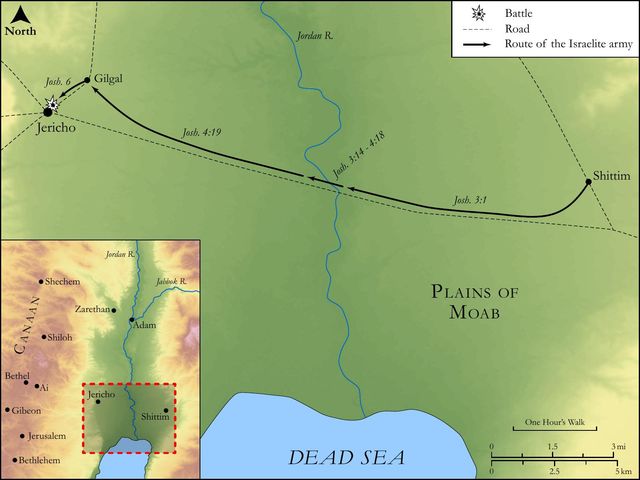
See on the biblical-era map
Study this verse
Public-domain commentary
Matthew Henry
From his Commentary on the Whole Bible. Henry comments on passages, not single verses — this entry covers Joshua 4:20–24. His three-level outline is real structure in the source text, so it is rendered as structure.
The twelve stones which were laid down in Gilgal (Jos 4:8) are here set up either one upon another, yet so as that they might be distinctly counted, or one by another in rows; for after they were fixed they ar not call a heap of stones, but these stones.
I.It is here taken for granted that posterity would enquire into the meaning of them, supposing them intended for a memorial:
Your children shall ask their fathers (for who else should they ask?) What mean these stones? Notes, Those that will be wise when they are old must be inquisitive when they are young. Our Lord Jesus, though he had in himself the fulness of knowledge, has by his example taught children and young people to hear and ask questions, Luk 2:46. Perhaps when John was baptizing in Jordan at Bethabara (the house of passage, where the people passed over) he pointed at these very stones, while saying (Mat 3:9) God is able of these stones (which were at first set up by the twelve tribes) to raise up children unto Abraham. The stones being the memorial of the miracle, the children's question gave occasion for the improvement of it; but our Saviour says (Luk 10:40), If the children should hold their peace, the stones would immediately cry out; for one way or other the Lord will be glorified in his works of wonder.
II.The parents are here directed what answer to give to this enquiry (Jos 4:22):
"You shall let your children know that which you have yourselves learned from the written word and from your fathers." Note, It is the duty of parents to acquaint their children betimes with the word and works of God, that they may be trained up in the way they should go.
1.They must let their children know that Jordan was driven back before Israel, who went through it upon dry land, and that this was the very place where they passed over. They saw how deep and strong a stream Jordan now was, but the divine power put a stop to it, even when it overflowed all its banks - "and this for you, that live so long after." Note, God's mercies to our ancestors were mercies to us; and we should take all occasions to revive the remembrance of the great things God did for our fathers in the days of old. The place thus marked would be a memorandum to them: Israel came over this Jordan. A local memory would be of use to them, and the sight of the place remind them of that which was done there; and not only the inhabitants of that country, but strangers and travellers, would look upon these stones and receive instruction. Many, upon the sight of the stones, would go to their Bibles, and there read the history of this wondrous work; and some perhaps, upon reading the history, though living at a distance, would have the curiosity to go and see the stones.
2.They must take that occasion to tell their children of the drying up of the Red Sea forty years before: As the Lord your God did to the Red Sea. Note.
(1.)It greatly magnifies later mercies to compare them with former mercies, for, by making the comparison, it appears that god is the same yesterday, today, and for ever.
(2.)Later mercies should bring to remembrance former mercies, and revive our thankfulness for them.
3.They must put them in the way of making a good use of these works of wonder, the knowledge whereof was thus carefully transmitted to them, Jos 4:24.
(1.)The power of God was hereby magnified. All the world was or might be convinced that the hand of the Lord is mighty, that nothing is too hard for God to do; nor can any power, no, not that of nature itself, obstruct what God will effect. The deliverances of God's people are instructions to all people, and fair warnings not to contend with Omnipotence.
(2.)The people of God were engaged and encouraged to persevere in his service "That you might fear the Lord your God, and consequently do your duty to him, and this for ever," or all days (margin), "every day, all the days of your lives, and your seed throughout your generations." The remembrance of this wonderful work should effectually restrain them from the worship of other gods, and constrain them to abide and abound in the service of their own God. Note, In all the instructions and informations parents give their children, they should have this chiefly in their eye, to teach and engage them to fear God for ever. Serious godliness is the best learning.
Continue studying Joshua 4:21 across the web’s major study libraries — every link below opens this exact verse, chapter, or book on the destination site.
Read & Compare
 BibleGatewayThis verse in more than 200 translations and 70 languages.
 Bible.comThe YouVersion reader — hundreds of translations, reading plans, and highlights.
 ESV.orgCrossway's official English Standard Version reader.
 NET BibleThe NET translation with 60,000+ translators' notes on every rendering decision.
 STEP BibleTyndale House's free study tool — original text, vocabulary, and scholarly resources.
 BibliaLogos Bible Software's free web reader.
 USCCBThe New American Bible (Revised Edition) with the U.S. bishops' study notes.
Commentaries
 BibleHub CommentariesDozens of classic commentaries on this verse, gathered on one page.
 StudyLightMore than 100 commentary sets — the largest collection on the web.
 BibleRefPlain-English commentary on what this verse means, verse by verse.
 Enduring WordDavid Guzik's free commentary on this chapter, widely used by Bible teachers.
 Bible Study ToolsVerse commentary alongside Greek and Hebrew study aids.
Original Language & Research
- BibleHub InterlinearThe verse word by word — original language, transliteration, and English.
- BibleHub LexiconEvery word's original-language definition and Strong's entry.
 Blue Letter BibleDeep-study tools — Strong's numbers, concordance, and word studies.
 SefariaThe Hebrew text with Rashi and centuries of Jewish commentary.
Sermons, Hymns & Audio


TrulyRandomVerse is not affiliated with these sites and doesn’t control their content. They’re linked because they’re genuinely useful.
Summary
Joshua 4:21 captures a pivotal moment in Israel's history, immediately following their miraculous crossing of the Jordan River into the Promised Land. This verse records Joshua's prophetic instruction to the Israelites, anticipating a future time when their children would inquire about the twelve memorial stones erected at Gilgal. It underscores God's intention for these physical markers to serve as a perpetual reminder of His mighty intervention, ensuring that the miraculous nature of the Jordan crossing and His covenant faithfulness would be diligently passed down through generations, fostering a deep and enduring faith in the God who keeps His promises and actively works in the lives of His people.
Context
ShowHideLiterary Context
Joshua 4:21 serves as the interpretive culmination of the Jordan River crossing narrative, directly following the miraculous event itself and the command to erect the twelve memorial stones. Chapters 3 and 4 are intrinsically linked, forming a continuous account that begins with the divine command for Israel to cross the Jordan, the miraculous parting of its waters as the priests bearing the ark of the covenant stepped in, and the subsequent dry-ground passage for the entire nation. This echoes the earlier, foundational deliverance at the Red Sea, establishing a pattern of divine intervention. Following the crossing, God explicitly commanded twelve men, one from each tribe, to take a stone from the riverbed where the priests stood and set them up at Gilgal. Verse 21, therefore, provides the crucial theological rationale for these actions, explaining their enduring purpose not merely for the generation that witnessed the miracle, but as a pedagogical tool for all future generations of Israel. It firmly roots Israel's identity and their impending conquest of Canaan in God's powerful acts of deliverance and covenant faithfulness.
Historical & Cultural Context
The crossing of the Jordan River marked Israel's definitive and long-awaited entry into the land of Canaan, fulfilling centuries of divine promise made to Abraham, Isaac, and Jacob. This momentous event occurred after forty years of wilderness wandering, signifying the end of a nomadic era and the commencement of their settled existence as a nation in their promised inheritance. The practice of setting up memorial stones was a custom already known to the patriarchs, as in Jacob's pillar at Bethel and the heap of witness at Galeed, often employed to commemorate covenants, significant battles, or other pivotal historical events. However, for Israel, these memorials carried a distinct theological weight: they were not merely historical markers but tangible testimonies to Yahweh's unique power, His active presence, and His unwavering faithfulness to His covenant. The chosen location, Gilgal, would become Israel's primary encampment and a vital spiritual center during the initial phases of the conquest, serving as a base for military campaigns and a place for covenant renewal and worship. The cultural emphasis on oral tradition and intergenerational teaching, deeply ingrained in Israelite society (as explicitly commanded in Deuteronomy 6:7), made the anticipated question, "What mean these stones?", a natural and divinely orchestrated pedagogical moment.
Key Themes
ShowHideThis verse contributes profoundly to several overarching themes woven throughout the book of Joshua and the broader Pentateuch. Primarily, it underscores the theme of Remembrance and Memorial, emphasizing the absolute necessity of not forgetting God's mighty acts. The stones serve as a physical anchor for the collective memory of God's faithfulness and power in fulfilling His covenant promises, particularly the promise of the land (e.g., Deuteronomy 1:8). Secondly, it powerfully highlights Intergenerational Teaching and Discipleship. The anticipated inquiry from the children provides a divinely appointed opportunity for parents to transmit the foundational story of God's deliverance and covenant loyalty, thereby ensuring that the next generation fully understands their identity as God's redeemed and chosen people. This pedagogical pattern finds strong parallels in the instructions for the Passover celebration found in Exodus 12:26-27. Finally, the verse powerfully reinforces the theme of God's Sovereignty and Power, as the explanation for the stones will inevitably point back to the Lord's miraculous drying of the Jordan River, a clear and undeniable demonstration of His supreme control over creation and His active, redemptive involvement in the history of His people, reminiscent of the Red Sea parting.
Exposition and Analysis
ShowHideKey Word Analysis
ShowHideThis term (H1121) is derived from a root meaning "to build," signifying a son as a builder of the family name. In its widest sense, it encompasses literal and figurative relationships, including offspring, descendants, or even a nation. In this context, it refers to the future generations of Israel, emphasizing the continuity of the covenant community and the vital role of the young in perpetuating the national memory and faith. Their inquiry is the catalyst for the intergenerational teaching.
This primitive root (H7592) means "to inquire," "to request," or "to demand." Here, it implies a genuine curiosity and a desire for understanding from the children. It is not a casual query but an invitation for a profound explanation, highlighting the proactive role of the younger generation in seeking knowledge about their heritage and faith. The use of shâʼal sets up a divinely intended pedagogical dynamic, where the children's inquiry triggers the parents' recounting of God's mighty deeds.
This word (H68) refers literally to a physical rock or stone. However, in this context, "stones" carry profound symbolic weight. They are not merely geological formations but consecrated objects, transformed into a "sign" or "memorial." Their ordinariness contrasts sharply with the extraordinary divine act they commemorate, emphasizing that God often uses common elements to convey profound spiritual truths and to serve as tangible, enduring reminders of His intervention in human history.
Verse Breakdown
ShowHide"And he spake unto the children of Israel, saying,"
This opening clause establishes Joshua as the authoritative voice, acting as God's chosen leader and conveying a divine mandate. It underscores that the instructions regarding the memorial stones are not merely human suggestions but are integral to God's overarching plan for His people. Joshua serves as the direct conduit for this crucial directive concerning intergenerational memory and faith transmission.
"When your children shall ask their fathers in time to come, saying,"
This phrase introduces a powerful prophetic anticipation, looking forward to future generations who would not have been eyewitnesses to the miracle. It reveals God's foresight and His unwavering commitment to ensuring that His mighty acts are remembered, understood, and cherished by those who did not witness them firsthand. The specific emphasis on "fathers" highlights the primary responsibility of paternal figures in the diligent transmission of faith and historical memory within the family unit, a foundational principle in Israelite society.
"What [mean] these stones?"
This is the pivotal question, divinely designed to prompt the retelling of the Jordan crossing miracle and its profound significance. It signifies a divinely orchestrated moment of inquiry, where physical objects (the stones) serve as powerful triggers for spiritual and historical education. The question is simple yet profound, inviting a comprehensive narrative of God's power, faithfulness, and His enduring covenant relationship with Israel, ensuring that the miracle's purpose is continually unpacked and understood.
Literary Devices
ShowHideJoshua 4:21 employs several effective literary devices to convey its profound message. Anticipation is central, as the verse deliberately looks forward to a future scenario where children will inquire about the stones, thereby setting up a divinely ordained pedagogical opportunity. This forward-looking perspective highlights God's long-term vision for His people's remembrance and spiritual continuity. The verse also powerfully utilizes Didacticism, as its primary purpose is to instruct the Israelites on the crucial method for transmitting their faith and national history to the succeeding generation. The very structure of the anticipated question-and-answer dynamic is a fundamental didactic tool, designed to engage and educate. Furthermore, the stones themselves function as potent Symbolism, representing God's unwavering faithfulness, His absolute power over nature, and the fulfillment of His covenant promises. They are tangible symbols of an invisible God's mighty and miraculous deeds. Finally, the verse is a clear example of a Question-and-Answer Format (or erotapokrisis), a common biblical teaching method, where a specific question is posed to elicit a detailed, educational response, thereby actively engaging the learner and embedding the lesson more deeply into their understanding and memory.
Theological and Thematic Connections
ShowHideJoshua 4:21 serves as a profound theological statement on the absolute necessity of remembering God's past faithfulness and actively transmitting that memory across generations. It reveals God's deep desire for His people to understand their identity not as a matter of chance or human achievement, but as a direct result of His powerful, sovereign, and covenantal intervention in history. The stones are not merely historical markers but are imbued with profound theological significance, pointing to a God who is both omnipotent (demonstrated by drying the Jordan) and intimately involved in the lives of His people (leading them into the promised land). This intergenerational transmission of faith ensures the continuity of the covenant, prevents spiritual amnesia, and constantly reminds Israel that their existence, their land, and their prosperity are rooted entirely in God's grace and power, not their own might or merit.
Reflection and Application
ShowHideJoshua 4:21 is a timeless and urgent call to intentional intergenerational discipleship within our families, churches, and communities. In a world increasingly prone to historical amnesia and spiritual drift, this verse challenges us to proactively create and maintain "memorials" in our lives—not necessarily physical stones, but practices, stories, and traditions that serve as tangible reminders of God's unwavering faithfulness. Whether it involves recounting personal testimonies of God's provision, celebrating spiritual milestones, sharing stories of biblical heroes, or simply living a life visibly dependent on God, we are called to anticipate and warmly welcome the "What mean these?" questions from the next generation. Our lives should be lived in such a way that our children, grandchildren, and those around us are prompted to inquire about the source of our hope, peace, resilience, and joy. This verse profoundly reminds us that faith is not merely a private, personal journey but a rich, shared heritage, meant to be diligently passed on, ensuring that the mighty acts of God continue to shape the identity, worldview, and trajectory of future believers, fostering a living faith that endures through the ages.
Questions for Reflection
ShowHideFAQ
ShowHideWhy were the stones important if the people had just witnessed the miracle?
ShowHideWhile the generation that directly witnessed the Jordan crossing miracle certainly experienced God's power firsthand, the stones served a crucial, forward-looking purpose for future generations who would not have been present. They were a tangible, permanent memorial designed to trigger questions and provide a concrete reference point for the retelling of God's powerful intervention. Just as the Passover celebration served as an annual, ritualized reminder of the Exodus, these stones at Gilgal ensured that the memory of God miraculously drying up the Jordan would not fade into mere folklore, but would be actively taught, explained, and preserved. This continuous teaching connected every new generation to the foundational acts of their covenant God, ensuring that the miracle was not just a past event but a living testimony for all time, continually pointing to God's faithfulness and power.
Christ-Centered Fulfillment
ShowHideThe memorial stones of Joshua 4:21, commemorating God's power to make a way where there was no way, find their ultimate and profound fulfillment in Jesus Christ. The Jordan crossing, a type of new Exodus into the Promised Land, powerfully foreshadows the greater spiritual deliverance accomplished through Christ. While the stones pointed to a physical crossing and a temporal salvation into an earthly land, Christ is the ultimate and living "memorial" of God's faithfulness and power. He is the Lamb of God who takes away the sin of the world, whose sacrificial death and glorious resurrection are the definitive acts of God's salvation, making a way for humanity to enter into the true spiritual Promised Land of eternal life and communion with God. The questions anticipated in Joshua 4:21 about the meaning of the stones are answered fully and definitively in the Gospel. Why did God perform such mighty deeds for Israel? To reveal His power and faithfulness, ultimately culminating in the sending of His Son as the perfect and final sacrifice for sin, demonstrating His love beyond measure (John 3:16). The New Testament church, rather than erecting physical stones, remembers Christ's sacrifice through the sacred ordinances of baptism and communion, which serve as spiritual memorials, prompting believers to continually recount the story of God's ultimate deliverance through His Son. As 1 Corinthians 11:26 states regarding communion, "For as often as you eat this bread and drink the cup, you proclaim the Lord's death until he comes." Thus, Christ Himself is the living memorial, the ultimate answer to every "What mean this?" question, ensuring that God's greatest act of salvation is proclaimed, remembered, and lived out until His glorious return.