


Joshua 4:23
Bible text: King James Version (1769 Blayney text) · Public domain
Bible text: King James Version with Strong's numbers · Public domain
Bible text: Berean Standard Bible · Public domain
Bible text: American Standard Version (1901) · Public domain
Bible text: World English Bible, Messianic edition · Public domain
Bible text: Geneva Bible (1599) · Public domain
Bible text: Young's Literal Translation · Public domain
- אֲשֶׁר'a·SherthatH834RelParticle Relative
- הוֹבִישׁho·Vishhe dried upH3001V-Hiphil-Perf-3msVerb Hiphil Perfect 3rd Singular Masculine
- יְהוָהYah·wehYahwehH3068N-properNoun Proper Title
- אֱלֹהֵיכֶם'e·lo·hei·Khemyour GodH430N-mpc ¦ 2mpNoun Plural Masculine ConstructאֱלֹהֵיGodכֶםyour
- אֶת'et<obj.>H853DirObjMParticle Object Indicator
- מֵיmei[the] waters ofH4325N-mpcNoun Plural Masculine Construct
- הַיַּרְדֵּןhai·yar·Denthe JordanH3383Art ¦ N-properNoun Proper LocationהַtheיַּרְדֵּןJordan
- מִפְּנֵיכֶםmi·pe·nei·Khemfrom before youH6440Prep-m ¦ N-mpc ¦ 2mpNoun Plural Masculine Constructמִfromפְּנֵיbeforeכֶםyou
- עַד'aduntilH5704PrepPreposition
- עָבְרְכֶם'a·ve·re·Khemhad passed over youH5674V-Qal-Inf ¦ 2mpVerb Qal Infinitive Constructעָבְרְhad passed overכֶםyou
- כַּאֲשֶׁרka·'a·Sherjust asH834Prep-k ¦ RelParticle Relativeכַּjustאֲשֶׁרas
- עָשָׂה'a·Sahhe didH6213V-Qal-Perf-3msVerb Qal Perfect 3rd Singular Masculine
- יְהוָהYah·wehYahwehH3068N-properNoun Proper Title
- אֱלֹהֵיכֶם'e·lo·hei·Khemyour GodH430N-mpc ¦ 2mpNoun Plural Masculine ConstructאֱלֹהֵיGodכֶםyour
- לְיַםle·yamto [the] sea ofH3220Prep-l ¦ N-mscNoun Singular Masculine Constructלְtoיַם[the] sea of
- סוּףsufreed[s]H5488N-msNoun Title Singular Masculine Absolute
- אֲשֶׁר'a·SherwhichH834RelParticle Relative
- הוֹבִישׁho·Vishhe dried upH3001V-Hiphil-Perf-3msVerb Hiphil Perfect 3rd Singular Masculine
- מִפָּנֵינוּmi·pa·Nei·nufrom before usH6440Prep-m ¦ N-mpc ¦ 1cpNoun Plural Masculine Constructמִfromפָּנֵיbeforeנוּus
- עַד'aduntilH5704PrepPreposition
- עָבְרֵנוּ'a·ve·Re·nuwe had passed overH5674V-Qal-Inf ¦ 1cpVerb Qal Infinitive Constructעָבְרֵhad passed overנוּwe
English is a literal word-by-word gloss of the Hebrew, not the KJV's wording. Why?
This is the original text the KJV's translators worked from — each Hebrew word with its own literal English meaning in this verse, prepared by scholars at Tyndale House, Cambridge. The KJV translates whole sentences, not word by word, so its wording differs: one Hebrew word can become several English words, and the KJV may choose “the LORD” where the gloss reads “Yahweh”. Both are faithful — they answer different questions. For the KJV's own rendering, switch to the KJV text.
Details
See on the biblical-era map
Study this verse
Public-domain commentary
Matthew Henry
From his Commentary on the Whole Bible. Henry comments on passages, not single verses — this entry covers Joshua 4:20–24. His three-level outline is real structure in the source text, so it is rendered as structure.
The twelve stones which were laid down in Gilgal (Jos 4:8) are here set up either one upon another, yet so as that they might be distinctly counted, or one by another in rows; for after they were fixed they ar not call a heap of stones, but these stones.
I.It is here taken for granted that posterity would enquire into the meaning of them, supposing them intended for a memorial:
Your children shall ask their fathers (for who else should they ask?) What mean these stones? Notes, Those that will be wise when they are old must be inquisitive when they are young. Our Lord Jesus, though he had in himself the fulness of knowledge, has by his example taught children and young people to hear and ask questions, Luk 2:46. Perhaps when John was baptizing in Jordan at Bethabara (the house of passage, where the people passed over) he pointed at these very stones, while saying (Mat 3:9) God is able of these stones (which were at first set up by the twelve tribes) to raise up children unto Abraham. The stones being the memorial of the miracle, the children's question gave occasion for the improvement of it; but our Saviour says (Luk 10:40), If the children should hold their peace, the stones would immediately cry out; for one way or other the Lord will be glorified in his works of wonder.
II.The parents are here directed what answer to give to this enquiry (Jos 4:22):
"You shall let your children know that which you have yourselves learned from the written word and from your fathers." Note, It is the duty of parents to acquaint their children betimes with the word and works of God, that they may be trained up in the way they should go.
1.They must let their children know that Jordan was driven back before Israel, who went through it upon dry land, and that this was the very place where they passed over. They saw how deep and strong a stream Jordan now was, but the divine power put a stop to it, even when it overflowed all its banks - "and this for you, that live so long after." Note, God's mercies to our ancestors were mercies to us; and we should take all occasions to revive the remembrance of the great things God did for our fathers in the days of old. The place thus marked would be a memorandum to them: Israel came over this Jordan. A local memory would be of use to them, and the sight of the place remind them of that which was done there; and not only the inhabitants of that country, but strangers and travellers, would look upon these stones and receive instruction. Many, upon the sight of the stones, would go to their Bibles, and there read the history of this wondrous work; and some perhaps, upon reading the history, though living at a distance, would have the curiosity to go and see the stones.
2.They must take that occasion to tell their children of the drying up of the Red Sea forty years before: As the Lord your God did to the Red Sea. Note.
(1.)It greatly magnifies later mercies to compare them with former mercies, for, by making the comparison, it appears that god is the same yesterday, today, and for ever.
(2.)Later mercies should bring to remembrance former mercies, and revive our thankfulness for them.
3.They must put them in the way of making a good use of these works of wonder, the knowledge whereof was thus carefully transmitted to them, Jos 4:24.
(1.)The power of God was hereby magnified. All the world was or might be convinced that the hand of the Lord is mighty, that nothing is too hard for God to do; nor can any power, no, not that of nature itself, obstruct what God will effect. The deliverances of God's people are instructions to all people, and fair warnings not to contend with Omnipotence.
(2.)The people of God were engaged and encouraged to persevere in his service "That you might fear the Lord your God, and consequently do your duty to him, and this for ever," or all days (margin), "every day, all the days of your lives, and your seed throughout your generations." The remembrance of this wonderful work should effectually restrain them from the worship of other gods, and constrain them to abide and abound in the service of their own God. Note, In all the instructions and informations parents give their children, they should have this chiefly in their eye, to teach and engage them to fear God for ever. Serious godliness is the best learning.
Continue studying Joshua 4:23 across the web’s major study libraries — every link below opens this exact verse, chapter, or book on the destination site.
Read & Compare
 BibleGatewayThis verse in more than 200 translations and 70 languages.
 Bible.comThe YouVersion reader — hundreds of translations, reading plans, and highlights.
 ESV.orgCrossway's official English Standard Version reader.
 NET BibleThe NET translation with 60,000+ translators' notes on every rendering decision.
 STEP BibleTyndale House's free study tool — original text, vocabulary, and scholarly resources.
 BibliaLogos Bible Software's free web reader.
 USCCBThe New American Bible (Revised Edition) with the U.S. bishops' study notes.
Commentaries
 BibleHub CommentariesDozens of classic commentaries on this verse, gathered on one page.
 StudyLightMore than 100 commentary sets — the largest collection on the web.
 BibleRefPlain-English commentary on what this verse means, verse by verse.
 Enduring WordDavid Guzik's free commentary on this chapter, widely used by Bible teachers.
 Bible Study ToolsVerse commentary alongside Greek and Hebrew study aids.
Original Language & Research
- BibleHub InterlinearThe verse word by word — original language, transliteration, and English.
- BibleHub LexiconEvery word's original-language definition and Strong's entry.
 Blue Letter BibleDeep-study tools — Strong's numbers, concordance, and word studies.
 SefariaThe Hebrew text with Rashi and centuries of Jewish commentary.
Sermons, Hymns & Audio


TrulyRandomVerse is not affiliated with these sites and doesn’t control their content. They’re linked because they’re genuinely useful.
Summary
Joshua 4:23 stands as a profound declaration of Yahweh's unwavering power and faithfulness, recounting the miraculous drying of the Jordan River to allow Israel's entry into the Promised Land. This pivotal event is explicitly paralleled with the earlier, equally astounding parting of the Red Sea during the Exodus, serving to underscore God's consistent, covenant-keeping nature across generations and to affirm His sovereign ability to overcome any obstacle in fulfilling His promises to His people.
Context
ShowHideLiterary Context
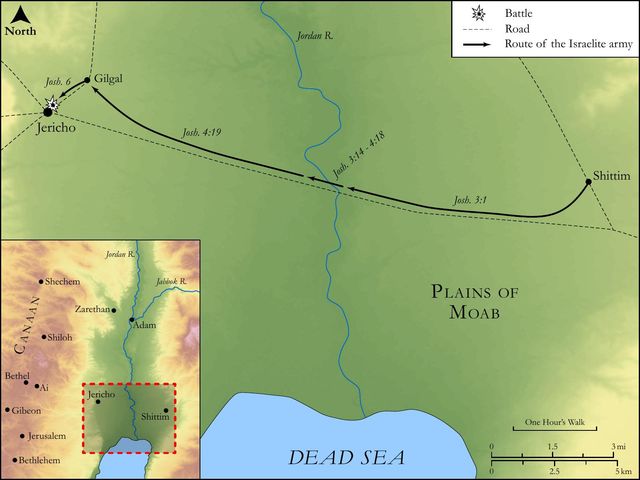
Joshua 4:23 is situated within the dramatic narrative of Israel's entry into the land of Canaan, immediately following their forty-year wilderness wandering. The preceding chapters detail God's command for Israel to cross the Jordan River, which was at flood stage during the harvest season, as noted in Joshua 3:15. The miracle itself, where the waters "stood in a heap" far upstream, allowing the priests carrying the Ark of the Covenant to stand firm in the dry riverbed while the entire nation passed over on dry ground, is vividly described in Joshua 3:13-17. Chapter 4 then focuses on the establishment of a memorial: twelve stones taken from the riverbed were set up at Gilgal, and twelve more were placed in the river itself, explicitly to serve as a perpetual sign for future generations, as commanded in Joshua 4:6-7. Verse 23, therefore, functions as a divine explanation and theological summation of the Jordan miracle, directly linking it to the foundational event of the Exodus, thereby reinforcing its significance and purpose for Israel's ongoing covenant relationship with God, a purpose further elaborated in Joshua 4:24.
Historical & Cultural Context
The crossing of the Jordan marked a monumental transition for Israel, moving from a nomadic existence in the wilderness to settling in the Promised Land. The Jordan River, particularly at flood stage during the spring harvest (around March/April), presented a formidable natural barrier, making the crossing humanly impossible for such a vast multitude without significant loss of life. This historical reality amplifies the miraculous nature of God's intervention. Culturally, the memory of the Exodus and the parting of the Red Sea was foundational to Israel's identity and faith, serving as the ultimate demonstration of Yahweh's power to deliver His people from bondage and lead them to freedom. By explicitly drawing this parallel, Joshua 4:23 taps into this deep-seated historical and theological memory, assuring the new generation entering Canaan that the same God who delivered their ancestors from Egypt was still actively working on their behalf. The act of entering the land was not merely a military conquest but a divinely orchestrated fulfillment of ancient promises made to Abraham, Isaac, and Jacob.
Key Themes
ShowHideThis verse powerfully articulates several core themes central to the book of Joshua and the broader Old Testament narrative. Firstly, it highlights Divine Sovereignty and Power, showcasing God's absolute control over creation as He manipulates natural elements (water) to achieve His redemptive purposes. Secondly, it emphasizes God's Unchanging Faithfulness to His Covenant Promises, demonstrating that the God who promised the land to Abraham (see Genesis 12:7) and delivered Israel from Egypt (as recounted in Exodus 14) is the same God who now brings them into their inheritance. Thirdly, the explicit comparison to the Red Sea underscores Historical Continuity of God's Salvific Acts, linking the foundational event of the Exodus to the present fulfillment, thereby teaching Israel that their God is consistent across generations. Finally, the miracle served to Confirm Joshua's Leadership in the eyes of all Israel, much as the Exodus miracles affirmed Moses' authority (compare Joshua 3:7).
Exposition and Analysis
ShowHideKey Word Analysis
ShowHideThis is the Tetragrammaton, H3068 (Yᵉhôvâh), the personal, covenant name of God, often translated as "the self-Existent or Eternal." Its repeated use in Joshua 4:23 ("the LORD your God") emphasizes that the miracles at both the Jordan and the Red Sea were not random occurrences but deliberate acts of the sovereign, covenant-keeping God of Israel. This name underscores His unique identity and His active involvement in the history of His people, affirming His unchanging character and faithfulness across generations.
The verb H3001 (yâbêsh) signifies "to dry up" or "to wither," conveying a complete and thorough desiccation. In the context of the Jordan and Red Sea, it means the water was supernaturally removed, creating a truly dry path, rather than merely receding. This same powerful verb is notably used to describe the drying of the Red Sea in Exodus 14:21, highlighting the identical nature of God's intervention in both monumental events.
The phrase H3220 (yâm) H5488 (çûwph), literally "Sea of Reeds," refers to the body of water miraculously parted during the Exodus. This specific designation serves as a potent theological and historical anchor, immediately invoking the most significant deliverance event in Israel's collective memory. By explicitly naming it, the text draws an undeniable parallel, asserting that the God who performed that foundational miracle for the previous generation is the same God performing a similar, equally astounding miracle for this new generation entering the land.
Verse Breakdown
ShowHide"For the LORD your God dried up the waters of Jordan from before you, until ye were passed over,"
This opening clause directly attributes the miracle of the Jordan crossing to Yahweh, emphasizing His active and direct intervention ("the LORD your God"). The phrase "dried up" highlights the supernatural nature of the event, transforming an impassable river at flood stage into a dry path. The purpose clause "until ye were passed over" underscores that God's action was precisely for the benefit and safe passage of His people, enabling them to fulfill His command to enter the land. This divine act demonstrates God's power to remove any obstacle in the path of His covenant promises.
"as the LORD your God did to the Red sea,"
This is the crucial comparative clause, drawing an explicit and intentional parallel between the Jordan miracle and the parting of the Red Sea. The repetition of "the LORD your God" reinforces the identity of the divine agent, assuring the new generation that the same powerful and faithful God who delivered their ancestors is now at work among them. This comparison elevates the Jordan crossing from a mere logistical feat to a sign of profound theological significance, linking it to the very foundation of Israel's national identity and covenant relationship with Yahweh. It serves as a powerful reminder of God's consistent character and methods.
"which he dried up from before us, until we were gone over:"
This concluding clause reiterates the Red Sea event, using the same language ("dried up," "gone over") as the Jordan description, solidifying the parallel. The shift from "you" (referring to the present generation at Jordan) to "us" (referring to the previous generation at the Red Sea) highlights the continuity of God's redemptive work across generations, emphasizing that the God of their fathers is still their God. It serves as a powerful reminder of God's consistent method of overcoming insurmountable obstacles for His people, ensuring their safe passage into His promised blessings and demonstrating His unwavering commitment to His covenant.
Literary Devices
ShowHideJoshua 4:23 masterfully employs several literary devices to enhance its theological impact and underscore its central message. The most prominent is Analogy or Comparison, explicitly drawing a parallel between the drying of the Jordan and the earlier, foundational parting of the Red Sea. This comparison is not merely descriptive; it is deeply theological, asserting that the God of the Exodus is the same God leading Israel into Canaan, thereby reinforcing His unchanging power and faithfulness. Repetition is also key, with the phrase "the LORD your God" appearing twice, underscoring the singular divine agency behind both miracles. The repeated structure "dried up... until we were passed over/gone over" further solidifies the thematic link between the two events and emphasizes the completeness of God's salvific work. The verse also functions as a form of Divine Explanation, providing the theological rationale for the Jordan miracle, ensuring that Israel understands it as a direct act of God intended to confirm His covenant promises and His abiding presence among them. This retrospective explanation transforms a historical event into a timeless lesson about God's character and His commitment to His people.
Theological and Thematic Connections
ShowHideJoshua 4:23 is a theological linchpin, connecting the foundational narrative of the Exodus to the fulfillment of God's covenant promises in the Promised Land. It unequivocally declares God's active presence and unwavering commitment to His people across generations. The parallel between the Red Sea and the Jordan highlights a consistent pattern in God's redemptive history: He overcomes seemingly insurmountable obstacles to bring His people into their inheritance. This verse teaches that God's past faithfulness is a guarantee of His future actions, building faith and trust in His ongoing sovereignty. It reminds Israel, and us, that miracles are not random acts but purposeful signs designed to reveal God's character, confirm His word, and establish His authority. The passage ultimately points to God as the initiator and sustainer of His covenant, demonstrating that His promises are always fulfilled, even if they require supernatural intervention.
Reflection and Application
ShowHideJoshua 4:23 offers profound encouragement for believers today, serving as a powerful reminder that the God who acted mightily in the past is the same God who is active in our present and future. When we face "Jordan-like" obstacles—challenges that seem impassable, overwhelming, or beyond our human capacity—this verse calls us to remember God's historical interventions, both in the grand narrative of Scripture and in our personal testimonies. Just as God cleared the path for Israel, He is able to make a way where there seems to be no way, fulfilling His purposes and promises in our lives. It challenges us to cultivate a deep-seated trust in His unchanging power and faithfulness, to share the stories of His mighty acts with the next generation, and to live with the confidence that our God is sovereign over all circumstances, always working for the good of those who love Him and are called according to His purpose. This passage invites us to reflect on how God's historical faithfulness informs our contemporary faith, empowering us to face future uncertainties with courage rooted in His proven character.
Questions for Reflection
ShowHideFAQ
ShowHideWhy was it important for God to dry up the Jordan River, especially since Israel had already been delivered from Egypt?
ShowHideThe drying of the Jordan River was crucial for several reasons, even after the Exodus. Firstly, it served as a powerful confirmation to the new generation of Israelites, many of whom had not personally witnessed the Red Sea miracle, that the same God who delivered their parents was still actively with them. It reinforced God's covenant faithfulness in bringing them into the Promised Land, a direct fulfillment of promises made to Abraham (Genesis 12:7) and Moses (Deuteronomy 1:8). Secondly, the Jordan was at flood stage (Joshua 3:15), making a natural crossing impossible for such a large multitude, thus highlighting the miraculous nature of God's intervention and His absolute sovereignty over creation. Thirdly, it served to exalt Joshua's leadership in the eyes of all Israel, just as God had exalted Moses (Joshua 3:7), solidifying his authority as God's chosen leader for the conquest. Finally, and perhaps most importantly, it was a sign to the surrounding Canaanite nations, instilling fear and demonstrating that the God of Israel was the one true God (Joshua 5:1), preparing the way for their conquest.
What is the significance of comparing the Jordan crossing to the Red Sea parting?
ShowHideThe explicit comparison of the Jordan crossing to the Red Sea parting (Exodus 14) is profoundly significant. It establishes a theological continuity, demonstrating that the God who initiated Israel's deliverance from bondage in Egypt is the same God who is now bringing them into their inheritance in Canaan. This link reminds Israel of their foundational identity as a people redeemed by Yahweh. It emphasizes God's unchanging character—His power, faithfulness, and commitment to His covenant promises—across generations. It also serves as a powerful pedagogical tool, instructing the new generation about the consistency of God's miraculous intervention on behalf of His people, reinforcing their faith as they faced the challenges of conquering the land. This comparison elevates the Jordan event to a status equal to the Exodus, affirming God's ongoing redemptive work in their history.
Christ-Centered Fulfillment
ShowHideJoshua 4:23, with its powerful depiction of God making a way through an impassable barrier, finds its ultimate and most profound fulfillment in Jesus Christ. The physical crossing of the Jordan into the Promised Land foreshadows the spiritual "crossing over" from death to life, from the wilderness of sin to the inheritance of eternal life, made possible through Christ. Just as God supernaturally opened the Jordan, Jesus, the true Lamb of God who takes away the sin of the world, is the ultimate "way" through the impassable chasm of sin and death (John 14:6). His death and resurrection represent the ultimate "drying up" of the power of sin and the grave, allowing all who believe to "pass over" into newness of life (Romans 6:4 and Colossians 2:12). The Red Sea and Jordan crossings were physical deliverances into a temporal land; Christ's work provides spiritual deliverance into a heavenly inheritance (Ephesians 1:11-14) and the promise of eternal rest (Hebrews 4:9-11). He is the greater Joshua, leading His people not merely into a geographical territory, but into the very presence of God, through the "new and living way" consecrated by His blood (Hebrews 10:19-20). In Christ, the pattern of God overcoming obstacles for His people reaches its glorious climax, securing for us an eternal dwelling.