


Acts 7:7
Bible text: King James Version (1769 Blayney text) · Public domain
Bible text: King James Version with Strong's numbers · Public domain
Bible text: Berean Standard Bible · Public domain
Bible text: American Standard Version (1901) · Public domain
Bible text: World English Bible, Messianic edition · Public domain
Bible text: Geneva Bible (1599) · Public domain
Bible text: Young's Literal Translation · Public domain
- καὶkaiAndG2532CONJConjunction
- τὸtotheG3588T-ASNDefinite article Accusative Singular Neuter
- ἔθνοςethnosnationG1484N-ASNNoun Accusative Singular Neuter
- ᾧhōto whichG3739R-DSNRelative pronoun Dative Singular Neuter
- ἐὰνeanthenG1437CONDConjunction
- δουλεύσουσινdouleusousinthey will be in bondageG1398V-FAI-3PVerb Future Active Indicative 3rd Plural
- κρινῶkrinōwill judgeG2919V-FAI-1SVerb Future Active Indicative 1st Singular
- ἐγώegōI myselfG1473P-1NSPersonal pronoun Nominative 1st Singular
- ὁho<the>G3588T-NSMDefinite article Nominative Singular Masculine
- θεὸςtheosGodG2316N-NSM-TNoun Nominative Singular Masculine Title
- εἶπενeipensaidG2036V-2AAI-3SVerb 2nd Aorist Active Indicative 3rd Singular
- καὶkaiandG2532CONJConjunction
- μετὰmetaafterG3326PREPPreposition
- ταῦταtautathese thingsG3778D-APNDemonstrative pronoun Accusative Plural Neuter
- ἐξελεύσονταιexeleusontaithey will come forthG1831V-FDI-3PVerb Future Middle Deponent Indicative 3rd Plural
- καὶkaiandG2532CONJConjunction
- λατρεύσουσίνlatreusousinthey will serveG3000V-FAI-3PVerb Future Active Indicative 3rd Plural
- μοιmoiMeG3165P-1DSPersonal pronoun Dative 1st Singular
- ἐνeninG1722PREPPreposition
- τῷtō<the>G3588T-DSMDefinite article Dative Singular Masculine
- τόπῳtopōplaceG5117N-DSMNoun Dative Singular Masculine
- τούτῳtoutōthis.’G3778D-DSMDemonstrative pronoun Dative Singular Masculine
English is a literal word-by-word gloss of the Greek, not the KJV's wording. Why?
This is the original text the KJV's translators worked from — each Greek word with its own literal English meaning in this verse, prepared by scholars at Tyndale House, Cambridge. The KJV translates whole sentences, not word by word, so its wording differs: one Greek word can become several English words, and the KJV may choose “charity” where the gloss reads “love”. Both are faithful — they answer different questions. For the KJV's own rendering, switch to the KJV text.
Details
See on the biblical-era maps
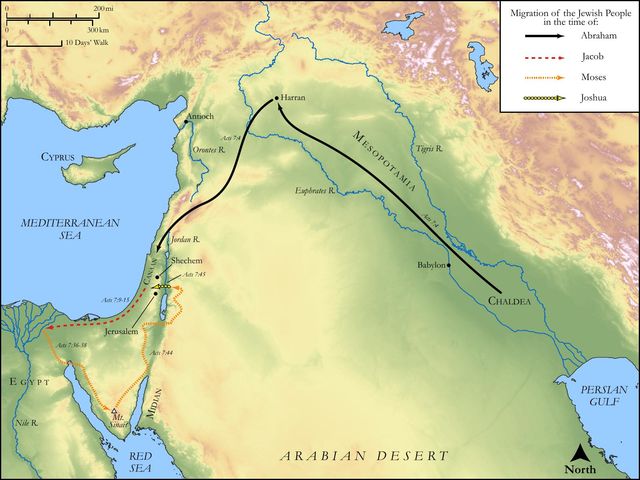
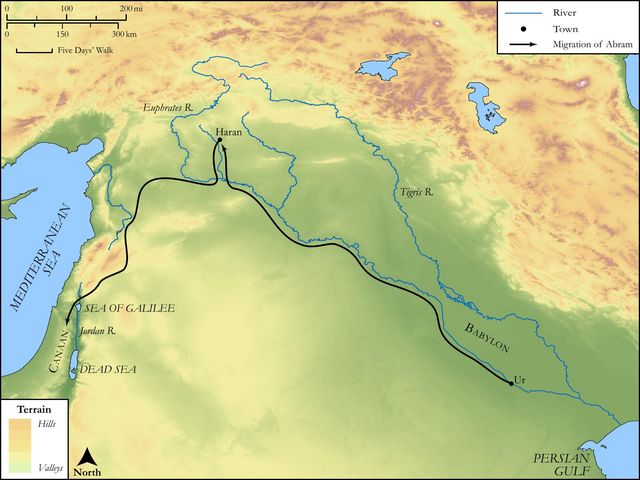
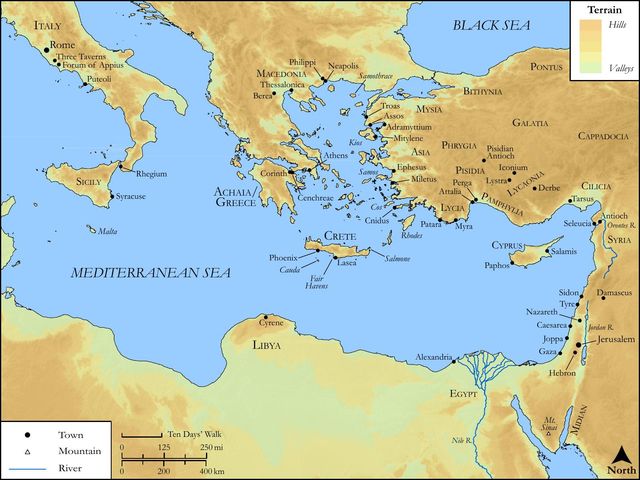
Study this verse
Public-domain commentary
Matthew Henry
From his Commentary on the Whole Bible. Henry comments on passages, not single verses — this entry covers Acts 7:1–16. His four-level outline is real structure in the source text, so it is rendered as structure.
Stephen is now at the bar before the great council of the nation, indicted for blasphemy: what the witnesses swore against him we had an account of in the foregoing chapter, that he spoke blasphemous words against Moses and God; for he spoke against this holy place and the law. Now here,
I.The high priest calls upon him to answer for himself, Act 7:1.
He was president, and, as such, the mouth of the court, and therefore he saith, "You, the prisoner at the bar, you hear what is sworn against you; what do you say to it? Are these things so? Have you ever spoken any words to this purport? If you have, will you recant them, or will you stand to them? Guilty or not guilty?" This carried a show of fairness, and yet seems to have been spoken with an air of haughtiness; and thus far he seems to have prejudged the cause, that, if it were so, that he had spoken such and such words, he shall certainly be adjudged a blasphemer, whatever he may offer in justification or explanation of them.
II.He begins his defence, and it is long; but it should seem by his breaking off abruptly, just when he came to the main point (Act 7:50), that it would have been much longer if his enemies would have given him leave to say all he had to say. In general we may observe,
1.That in this discourse he appears to be a man ready and mighty in the scriptures, and thereby thoroughly furnished for every good word and work. He can relate scripture stories, and such as were very pertinent to his purpose, off-hand without looking in his Bible. He was filled with the Holy Ghost, not so much to reveal to him new things, or open to him the secret counsels and decrees of God concerning the Jewish nation, with them to convict these gainsayers; no, but to bring to his remembrance the scriptures of the Old Testament, and to teach him how to make use of them for their conviction. Those that are full of the Holy Ghost will be full of the scripture, as Stephen was.
2.That he quotes the scriptures according to the Septuagint translation, by which it appears he was one of the Hellenist Jews, who used that version in their synagogues. His following this, occasions divers variations from the Hebrew original in this discourse, which the judges of the court did not correct, because they knew how he was led into them; nor is it any derogation to the authority of that Spirit by which he spoke, for the variations are not material. We have a maxim, Apices juris non sunt jura - Mere points of law are not law itself. These verses carry on this his compendium of church history to the end of the book of Genesis. Observe,
(1.)His preface: Men, brethren, and fathers, hearken. He gives them, though not flattering titles, yet civil and respectful ones, signifying his expectation of fair treatment with them; from men he hopes to be treated with humanity, and he hopes that brethren and fathers will use him in a fatherly brotherly way. They are ready to look upon him as an apostate from the Jewish church, and an enemy to them. But, to make way for their conviction to the contrary, he addresses himself to them as men, brethren, and fathers, resolving to look on himself as one of them, though they would not so look on him. He craves their attention: Hearken; though he was about to tell them what they already knew, yet he begs them to hearken to it, because, though they knew it all, yet they would not without a very close application of mind know how to apply it to the case before them.
(2.)His entrance upon the discourse, which (whatever it may seem to those that read it carelessly) is far from being a long ramble only to amuse the hearers, and give them a diversion by telling them an old story. No; it is all pertinent and ad rem - to the purpose, to show them that God had no this heart so much upon that holy place and the law as they had; but, as he had a church in the world many ages before that holy place was founded and the ceremonial law given, so he would have when they should both have had their period.
[1.]He begins with the call of Abraham out of Ur of the Chaldees, by which he was set apart for God to be the trustee of the promise, and the father of the Old Testament church. This we had an account of (Gen 12:1, etc.), and it is referred to, Neh 9:7, Neh 9:8. His native country was an idolatrous country, it was Mesopotamia, (Act 7:2), the land of the Chaldeans (Act 7:4); thence God brought him at two removes, not too far at once, dealing tenderly with him; he first brought him out of the land of the Chaldeans to Charran, or Haran, a place midway between that and Canaan (Gen 11:31), and thence five years after, when his father was dead, he removed him into the land of Canaan, wherein you now dwell. It should seem, the first time that God spoke to Abraham, he appeared in some visible display of the divine presence, as the God of glory (Act 7:2), to settle a correspondence with him: and then afterwards he kept up that correspondence, and spoke to him from time to time as there was occasion, without repeating his visible appearances as the God of glory.
First, From this call of Abraham we may observe, 1. That in all our ways we must acknowledge God, and attend the directions of his providence, as of the pillar of cloud and fire. It is not said, Abraham removed, but, God removed him into this land wherein you now dwell, and he did but follow his Leader. 2. Those whom God takes into covenant with himself he distinguishes from the children of this world; they are effectually called out of the state, out of the land, of their nativity; they must sit loose to the world, and live above it and every thing in it, even that in it which is most dear to them, and must trust God to make it up to them in another and better country, that is, the heavenly, which he will show them. God's chosen must follow him with an implicit faith and obedience.
Secondly, But let us see what this is to Stephen's case. 1. They had charged him as a blasphemer of God, and an apostate from the church; therefore he shows that he is a son of Abraham, and values himself upon his being able to say, Our father Abraham, and that he is a faithful worshipper of the God of Abraham, whom therefore he here calls the God of glory. He also shows that he owns divine revelation, and that particularly by which the Jewish church was founded and incorporated. 2. They were proud of their being circumcised; and therefore he shows that Abraham was taken under God's guidance, and into communion with him, before he was circumcised, for that was not till Act 7:8. With this argument Paul proves that Abraham was justified by faith, because he was justified when he was in uncircumcision: and so here. 3. They had a mighty jealousy for this holy place, which may be meant of the whole land of Canaan; for it was called the holy land, Immanuel's land; and the destruction of the holy house inferred that of the holy land. "Now," says Stephen, "you need not be so proud of it; for," (1.) "You came originally out of Ur of the Chaldees, where your fathers served other gods (Jos 24:2), and you were not the first planters of this country. Look therefore unto the rock whence you were hewn, and the holy of the pit out of which you were digged;" that is, as it follows there, "look unto Abraham your father, for I called him alone (Isa 51:1, Isa 51:2) - think of the meanness of your beginnings, and how you are entirely indebted to divine grace, and then you will see boasting to be for ever excluded. It was God that raised up the righteous man from the east, and called him to his foot. Isa 41:2. But, if his seed degenerate, let them know that God can destroy this holy place, and raise up to himself another people, for he is not a debtor to them." (2.) "God appeared in his glory to Abraham a great way off in Mesopotamia, before he came near Canaan, nay, before he dwelt in Charran; so that you must not think God's visits are confined to this land; no; he that brought the seed of the church from a country so far east can, if he pleases, carry the fruit of it to another country as far west." (3.) "God made no haste to bring him into this land, but let him linger some years by the way, which shows that God has not his heart so much upon this land as you have yours, neither is his honour, nor the happiness of his people, bound up in it. It is therefore neither blasphemy nor treason to say, It shall be destroyed,"
[2.]The unsettled state of Abraham and his seed for many ages after he was called out of Ur of the Chaldees. God did indeed promise that he would give it to him for a possession, and to his seed after him, Act 7:5. But, First, As yet he had no child, nor any by Sarah for many years after. Secondly, He himself was but a stranger and a sojourner in that land, and God gave him no inheritance in it, no, not so much as to set his foot on; but there he was as in a strange country, where he was always upon the remove, and could call nothing his own. Thirdly, His posterity did not come to the possession of it for a long time: After four hundred years they shall come and serve me in this place, and not till then, Act 7:7. Nay, Fourthly, They must undergo a great deal of hardship and difficulty before they shall be put into the possession of that land: they shall be brought into bondage, and ill treated in a strange land: and this, not as the punishment of any particular sin, as their wandering in the wilderness was, for we never find any such account given of their bondage in Egypt; but so God had appointed, and it must be. And at the end of four hundred years, reckoning from the birth of Isaac, that nation to whom they shall be in bondage will I judge, saith God. Now this teaches us, 1. That known unto God are all his works beforehand. When Abraham had neither inheritance nor heir, yet he was told he should have both, the one a land of promise, and the other a child of promise; and therefore both had, and received, by faith. 2. That God's promises, though they are slow, are sure in the operation of them; they will be fulfilled in the season of them, though perhaps not so soon as we expect. 3. That though the people of God may be in distress and trouble for a time, yet God will at length both rescue them and reckon with those that do oppress them; for, verily there is a God that judgeth in the earth.
But let us see how this serves Stephen's purpose. 1. The Jewish nation, for the honour of which they were so jealous, was very inconsiderable in its beginnings; as their common father Abraham was fetched out of obscurity in Ur of the Chaldees, so their tribes, and the heads of them, were fetched out of servitude in Egypt, when they were the fewest of all people, Deu 7:7. And what need is there of so much ado, as if their ruin, when they bring it upon themselves by sin, must be the ruin of the world, and of all God's interests in it? No; he that brought them out of Egypt can bring them into it again, as he threatened (Deu 28:68), and yet be no loser, while he can out of stones raise up children unto Abraham. 2. The slow steps by which the promise made to Abraham advanced towards the performance, and the many seeming contradictions here taken notice of, plainly show that it had a spiritual meaning, and that the land principally intended to be conveyed and secured by it was the better country, that is, the heavenly; as the apostle shows from this very argument that the patriarchs sojourned in the land of promise, as in a strange country, thence inferring that they looked for a city that had foundations, Heb 11:9, Heb 11:10. It was therefore no blasphemy to say, Jesus shall destroy this place, when at the same time we say, "He shall lead us to the heavenly Canaan, and put us in possession of that, of which the earthly Canaan was but a type and figure."
[3.]The building up of the family of Abraham, with the entail of divine grace upon it, and the disposals of divine Providence concerning it, which take up the rest of the book of Genesis.
First, God engaged to be a God to Abraham and his seed; and, in token of this, appointed that he and his male seed should be circumcised, Gen 17:9, Gen 17:10. He gave him the covenant of circumcision, that is, the covenant of which circumcision was the seal; and accordingly, when Abraham had a son born, he circumcised him the eighth day (Act 7:8), by which he was both bound by the divine law and interested in the divine promise; for circumcision had reference to both, being a seal of the covenant both on God's part - I will be to thee a God all-sufficient, and on man's part - Walk before me, and be thou perfect. And then when effectual care was thus taken for the securing of Abraham's seed, to be a seed to serve the Lord, they began to multiply: Isaac begat Jacob, and Jacob the twelve patriarchs, or roots of the respective tribes.
Secondly, Joseph, the darling and blessing of his father's house, was abused by his brethren; they envied him because of his dreams, and sold him into Egypt. Thus early did the children of Israel begin to grudge those among them that were eminent and outshone others, of which their enmity to Christ, who, like Joseph, was a Nazarite among his brethren, was a great instance.
Thirdly, God owned Joseph in his troubles, and was with him (Gen 39:2, Gen 39:21), by the influence of his Spirit, both on his mind, giving him comfort, and on the minds of those he was concerned with, giving him favour in their eyes. And thus at length he delivered him out of his afflictions, and Pharaoh made him the second man in the kingdom, Psa 105:20-22. And thus he not only arrived at great preferment among the Egyptians, but became the shepherd and stone of Israel, Gen 49:24.
Fourthly, Jacob was compelled to go down into Egypt, by a famine which forced him out of Canaan, a dearth (which was a great affliction), to that degree that our fathers found no sustenance in Canaan, Act 7:11. That fruitful land was turned into barrenness. But, hearing that there was corn in Egypt (treasured up by the wisdom of his own son), he sent out our fathers first to fetch corn, Act 7:12. And the second time that they went, Joseph, who at first made himself strange to them, made himself known to them, and it was notified to Pharaoh that they were Joseph's kindred and had a dependence upon him (Act 7:13), whereupon, with Pharaoh's leave, Joseph sent for his father Jacob to him into Egypt, with all his kindred and family, to the number of seventy-five souls, to be subsisted there, Act 7:13. In Genesis they are said to be seventy souls, Gen 46:27. But the Septuagint there makes them seventy-five, and Stephen or Luke follows that version, as Luk 3:36, where Cainan is inserted, which is not in the Hebrew text, but in the Septuagint. Some, by excluding Joseph and his sons, who were in Egypt before (which reduces the number to sixty-four), and adding the sons of the eleven patriarch, make the number seventy-five.
Fifthly, Jacob and his sons died in Egypt (Act 7:15), but were carried over to be buried in Canaan, Act 7:16. A very considerable difficulty occurs here: it is said, They were carried over into Sychem, whereas Jacob was buried not in Sychem, but near Hebron, in the cave of Machpelah, where Abraham and Isaac were buried, Gen 50:13. Joseph's bones indeed were buried in Sychem (Jos 24:32), and it seems by this (though it is not mentioned in the story) that the bones of all the other patriarchs were carried with his, each of them giving the same commandment concerning them that he had done; and of them this must be understood, not of Jacob himself. But then the sepulchre in Sychem was bought by Jacob (Gen 33:19), and by this it is described, Jos 24:32. How then is it here said to be bought by Abraham? Dr. Whitby's solution of this is very sufficient. He supplies it thus: Jacob went down into Egypt and died, he and our fathers; and (our fathers) were carried over into Sychem; and he, that is, Jacob, was laid in the sepulchre that Abraham brought for a sum of money, Gen 23:16. (Or, they were laid there, that is, Abraham, Isaac, and Jacob.) And they, namely, the other patriarchs, were buried in the sepulchre bought of the sons of Emmor, the father of Sychem.
Let us now see what this is to Stephen's purpose. 1. He still reminds them of the mean beginning of the Jewish nation, as a check to their priding themselves in the glories of that nation; and that it was by a miracle of mercy that they were raised up out of nothing to what they were, from so small a number to be so great a nation; but, if they answer not the intention of their being so raised, they can expect no other than to be destroyed. The prophets frequently put them in mind of the bringing of them out of Egypt, as a aggravation of their contempt of the law of God, and here it is urged upon them as an aggravation of their contempt of the gospel of Christ. 2. He reminds them likewise of the wickedness of those that were the patriarchs of their tribes, in envying their brother Joseph, and selling him into Egypt; and the same spirit was still working in them towards Christ and his ministers. 3. Their holy land, which they doted so much upon, their fathers were long kept out of the possession of, and met with dearth and great affliction in it; and therefore let them not think it strange if, after it has been so long polluted with sin, it be at length destroyed. 4. The faith of the patriarchs in desiring to be buried in the land of Canaan plainly showed that they had an eye to the heavenly country, to which it was the design of this Jesus to lead them.
Historical interpretation
Historical reception
2 surviving comments on this verse. Each one is dated, so this reads as a timeline rather than a list.
This is suitable to be said here also: that God is rich in ways and means to bring us up from hence. For this above all showed the riches of God's resources, that in its very reverses the nation increased, while enslaved, while evil-entreated, and sought to be exterminated. And this is the greatness of the Promise. For had it increased in its own land, it had not been so wonderful. And besides, it was not for a short time, either, that they were in the strange land: but for four hundred years. Hence we learn a great lesson of philosophic endurance: they did not treat them as masters use slaves, but as enemies and tyrants--and he foretold that they should be set in great liberty: for this is the meaning of that expression, "They shall serve Me: and they shall come up hither again"; and with impunity.
See, what a number of years the Promise has been given, and the manner of the Promise, and nowhere sacrifice, nowhere circumcision! He here shows, how God Himself suffered them to be afflicted, not that He had anything to lay to their charge. "And they shall bring them into bondage," etc. But nevertheless, they did not these things with impunity. "And the nation to whom they shall be in bondage I will judge, said God." For, to show that they are not to go by this, in estimating who are pious (by reason of their saying, "He trusted in God, let Him deliver Him")--He, the Same that promised, He that gave the land, first permits the evils. So also now, though He has promised a Kingdom, yet He suffers us to be exercised in temptations. If here the freedom was not to be till after four hundred years, what wonder, with regard to the Kingdom? Yet he performed it, and lapse of time availed not to falsify His word. Moreover, it was no ordinary bondage they underwent. And the matter does not terminate solely in the punishment of those (their oppressors); but they themselves also, He saith, shall enjoy a mighty salvation. Here he reminds them too of the benefit which they enjoyed.
Continue studying Acts 7:7 across the web’s major study libraries — every link below opens this exact verse, chapter, or book on the destination site.
Read & Compare
 BibleGatewayThis verse in more than 200 translations and 70 languages.
 Bible.comThe YouVersion reader — hundreds of translations, reading plans, and highlights.
 ESV.orgCrossway's official English Standard Version reader.
 NET BibleThe NET translation with 60,000+ translators' notes on every rendering decision.
 STEP BibleTyndale House's free study tool — original text, vocabulary, and scholarly resources.
 BibliaLogos Bible Software's free web reader.
 USCCBThe New American Bible (Revised Edition) with the U.S. bishops' study notes.
Commentaries
 BibleHub CommentariesDozens of classic commentaries on this verse, gathered on one page.
 StudyLightMore than 100 commentary sets — the largest collection on the web.
 BibleRefPlain-English commentary on what this verse means, verse by verse.
 Enduring WordDavid Guzik's free commentary on this chapter, widely used by Bible teachers.
 Bible Study ToolsVerse commentary alongside Greek and Hebrew study aids.
Original Language & Research
- BibleHub InterlinearThe verse word by word — original language, transliteration, and English.
- BibleHub LexiconEvery word's original-language definition and Strong's entry.
 Blue Letter BibleDeep-study tools — Strong's numbers, concordance, and word studies.
 CNTR CollationThe earliest Greek manuscripts of this verse, collated letter by letter.
Sermons, Hymns & Audio


TrulyRandomVerse is not affiliated with these sites and doesn’t control their content. They’re linked because they’re genuinely useful.
Summary
Acts 7:7, embedded within Stephen's powerful defense before the Sanhedrin, recounts a pivotal moment in God's covenant history with Abraham, specifically detailing the divine prophecy concerning Israel's future bondage in Egypt and their subsequent miraculous liberation. This verse underscores God's absolute sovereignty over human history, His unwavering commitment to His covenant promises, and His righteous judgment against oppressors, all leading to the ultimate purpose of His people's worship and service in the promised land.
Context
ShowHideLiterary Context
Acts 7:7 is a direct quotation or summary from God's ancient promise to Abraham, forming a crucial part of Stephen's lengthy historical discourse (Acts 7:2-53). Stephen, accused of blasphemy against the Temple and the Law, strategically uses Israel's history to demonstrate God's consistent presence and work outside of the Temple, and the nation's repeated resistance to divine revelation. This particular verse, referencing the Egyptian bondage and Exodus, serves to highlight God's faithfulness despite dire circumstances, setting the stage for Stephen's argument that Israel's rejection of Jesus was a continuation of their historical pattern of resisting God's chosen messengers. It connects directly to the preceding verses that establish Abraham's call and the covenant, and it foreshadows the subsequent narrative of Moses and the Exodus.
Historical & Cultural Context
Stephen's speech takes place in Jerusalem before the Sanhedrin, the supreme Jewish judicial and religious council. This setting is charged with tension, as Stephen's Hellenistic Jewish background and his bold proclamation of Jesus as Messiah challenged the traditional interpretations of the Law and Temple held by the Jewish authorities. The prophecy cited in Acts 7:7, originally found in Genesis 15:13-14, was a foundational narrative for the Jewish people, representing their miraculous deliverance from slavery in Egypt. By quoting this, Stephen grounds his argument in their shared sacred history, reminding his accusers of God's active involvement in their past, including His judgment on oppressors and His provision for their freedom to worship Him. The reference to "this place" would resonate with the Jewish audience as the Promised Land, specifically Jerusalem, where the Temple stood, though Stephen subtly redefines "place" to emphasize God's presence not being confined to a physical structure.
Key Themes
ShowHideThis verse powerfully contributes to several overarching themes within Acts and the broader biblical narrative. It emphasizes Divine Sovereignty and Foreknowledge, illustrating that God's plan for His people unfolds precisely as He declares, even across centuries of hardship. The theme of God's Justice and Judgment is prominent, as He promises to "judge" the nation that would oppress His chosen people, a theme vividly demonstrated in the plagues upon Egypt and the Red Sea crossing. Furthermore, the verse highlights Covenant Faithfulness, showing God's unwavering commitment to the promises made to Abraham, ensuring the eventual liberation and establishment of His people. Finally, it underscores the theme of Deliverance for a Purpose, as freedom from bondage is not an end in itself but is explicitly for the purpose of serving God in the land He promised, pointing to the ultimate goal of worship and obedience, as seen in the instructions given at Mount Sinai.
Exposition and Analysis
ShowHideKey Word Analysis
ShowHideThis term primarily refers to a race or tribe, often implying a foreign or non-Jewish people, and by implication, pagan. In this context, it specifically denotes Egypt, the foreign nation that would enslave Abraham's descendants. Stephen's use of this term highlights the distinct identity of God's chosen people versus those who would oppress them, setting up the divine judgment that follows.
This word signifies more than merely distinguishing or deciding; it carries the weight of judicial action, including trying, condemning, and punishing. Here, it denotes God's active, punitive intervention against the oppressive nation of Egypt. It underscores God's righteous character as the ultimate arbiter of justice, who does not overlook the suffering of His people but actively intervenes to rectify wrongs and execute divine retribution.
This verb means to minister to God, rendering religious homage, service, or worship. It implies a devoted, worshipful service. The promise that Israel would "serve me in this place" reveals the ultimate purpose of their liberation: not just freedom for its own sake, but freedom for the sake of worship and obedience to God. This term emphasizes the spiritual dimension of their deliverance, pointing to a covenant relationship centered on devotion.
Verse Breakdown
ShowHide"And the nation to whom they shall be in bondage"
This clause directly refers to the prophecy given to Abraham concerning his descendants' future enslavement. The "nation" is Egypt, and "they" are the Israelites. It establishes the context of severe oppression and servitude that God's people would endure, setting the stage for the divine intervention that follows.
"will I judge, said God"
This is a powerful declaration of divine sovereignty and justice. God Himself, the supreme Divinity (G2316), states His intention to bring judgment upon the oppressive nation. The verb "judge" (G2919) implies a decisive, punitive action, not merely a legal verdict, demonstrating God's active role in history to avenge His people and right injustices.
"and after that shall they come forth"
This phrase points to the miraculous liberation of the Israelites from Egyptian bondage, specifically the Exodus. "After that" (G3326, G5023) emphasizes the sequential fulfillment of God's prophecy, occurring precisely at His appointed time following the period of servitude and judgment. "Come forth" (G1831) highlights their emergence from oppression into freedom.
"and serve me in this place"
This final clause reveals the ultimate divine purpose behind the liberation. The freedom granted was not an end in itself but was for the specific purpose of worshiping and serving God ("serve me," G3000, G3427). "In this place" (G1722, G5129, G5117) refers to the Promised Land, specifically where God's presence would dwell and where His people would establish their covenant relationship with Him through worship and obedience.
Literary Devices
ShowHideStephen's use of Acts 7:7 is rich in literary devices that enhance its theological impact. Foremost is Prophecy, as the verse directly quotes or summarizes a future event declared by God centuries before its fulfillment. This highlights God's Divine Sovereignty and Foreknowledge, demonstrating His absolute control over the unfolding of human history and His ability to declare the end from the beginning. The precise fulfillment of this prophecy, from bondage to judgment to liberation and service, serves as compelling evidence of God's faithfulness and power. Furthermore, the passage employs Covenant Language, as the entire statement is framed within the context of God's promises to Abraham, reinforcing the unbreakable bond between God and His chosen people. The contrast between the "nation to whom they shall be in bondage" and "serve me" also creates a powerful Antithesis, emphasizing the shift from forced servitude under an oppressor to willing, worshipful service under God.
Theological and Thematic Connections
ShowHideActs 7:7 stands as a profound testament to God's active involvement in the affairs of humanity, demonstrating His unwavering commitment to His covenant people and His righteous character as judge of all the earth. Theologically, it affirms God's perfect foreknowledge and His sovereign orchestration of history, even through periods of intense suffering for His chosen ones. It underscores that God's justice is not merely passive but actively intervenes to deliver the oppressed and punish the oppressor. The ultimate purpose of this deliverance, to "serve me," reveals that freedom is always for the sake of relationship and worship, a principle that transcends the Old Covenant and finds its ultimate expression in the New. This historical precedent also sets the stage for understanding God's continued work through Christ, where liberation from sin's bondage leads to a life of devoted service to Him.
Reflection and Application
ShowHideActs 7:7 offers profound encouragement and a clear call to purpose for believers today. It reminds us that even in seasons of profound difficulty, oppression, or waiting, God remains sovereign and faithful to His promises. Just as He foreknew and orchestrated Israel's deliverance from Egyptian bondage, so too does He work all things according to His divine purpose in our lives and in the world. We can find deep comfort in the knowledge that God sees injustice and will bring His righteous judgment in His perfect timing, whether in this life or in the age to come. Furthermore, this verse reorients our understanding of freedom: it is not merely an escape from hardship, but a liberation for a higher purpose – to serve God. For the Christian, our deliverance from the bondage of sin through Christ is not an end in itself, but the beginning of a life dedicated to worship, obedience, and ministry to God and others. Our very existence, our freedom, is meant to be an act of grateful service and devotion to the One who set us free.
Questions for Reflection
ShowHideFAQ
ShowHideWhat is the significance of "this place" in Acts 7:7?
ShowHideThe phrase "this place" (G5117, tópos) in Acts 7:7 refers to the Promised Land, specifically the land of Canaan, which God had covenanted to Abraham and his descendants. While Stephen's audience would immediately connect "this place" to Jerusalem and the Temple, Stephen's broader argument in Acts 7 subtly redefines God's presence as not being confined to a physical building or location. For the Israelites, coming forth to "serve me in this place" meant entering the land where they would establish their nation, build the Tabernacle and later the Temple, and live in covenant relationship with God, offering Him worship and obedience as outlined in the Law. It signifies the fulfillment of God's promise to bring them into a land where they could freely worship Him, contrasting with their forced labor in Egypt.
Christ-Centered Fulfillment
ShowHideActs 7:7, though rooted in Old Testament prophecy, finds profound Christ-centered fulfillment in the person and work of Jesus Christ. The prophecy of liberation from bondage and subsequent service to God prefigures the ultimate spiritual Exodus accomplished by Christ. Humanity, enslaved not by a physical nation but by the dominion of sin and death (Romans 6:6-7), is liberated by the atoning sacrifice of the Lamb of God. Just as God judged Egypt for its oppression, so too does Christ's cross represent God's decisive judgment against sin and evil, breaking its power over believers (Colossians 2:13-15). The purpose of Israel's deliverance was to "serve me in this place," and similarly, our redemption in Christ is not merely for freedom's sake, but to enter into a new covenant relationship where we are called to serve God in spirit and truth (John 4:23-24). Believers are now a "holy priesthood" (1 Peter 2:9), called to offer spiritual sacrifices of worship and obedience, serving God not in a physical land or temple, but as living temples of the Holy Spirit, wherever we are (1 Corinthians 6:19-20). Thus, Christ is the ultimate deliverer, and through Him, we find our true "place" of worship and service.