


1 Corinthians 9:15
- ἐγὼegōI myselfG1473P-1NSPersonal pronoun Nominative 1st Singular
- δὲdehoweverG1161CONJConjunction
- κέχρημαιkechrēmaihave usedG5530V-RNI-1SVerb Perfect Middle Or Passive Deponent Indicative 1st Singular
- οὐδενὶoudeninot anyG3762A-DSMAdjective Dative Singular Masculine
- τούτων·toutōnof theseG3778D-GPNDemonstrative pronoun Genitive Plural Neuter
- οὐκoukNeitherG3756PRT-NNegative Particle Negative
- ἔγραψαegrapsahave I writtenG1125V-2AAI-1SVerb 2nd Aorist Active Indicative 1st Singular
- δὲdenowG1161CONJConjunction
- ταῦταtautathese thingsG3778D-APNDemonstrative pronoun Accusative Plural Neuter
- ἵναinathatG2443CONJConjunction
- οὕτωςhoutōsthusG3779ADVAdverb
- γένηταιgenētaiit may becomeG1096V-2ADS-3SVerb 2nd Aorist Middle Deponent Subjunctive 3rd Singular
- ἐνenwithG1722PREPPreposition
- ἐμοί·emoime myselfG1473P-1DSPersonal pronoun Dative 1st Singular
- καλὸνkalongoodG2570A-NSNAdjective Nominative Singular Neuter
- γάρgarforG1063CONJConjunction
- μοιmoimeG3165P-1DSPersonal pronoun Dative 1st Singular
- μᾶλλονmallonratherG3123ADVAdverb
- ἀποθανεῖνapothaneinto dieG599V-2AANVerb 2nd Aorist Active Infinitive
- ἢēthanG2228CONJConjunction
- τὸtotheG3588T-ASNDefinite article Accusative Singular Neuter
- καύχημάkauchēmaboastingG2745N-ASNNoun Accusative Singular Neuter
- μουmouof mineG3165P-1GSPersonal pronoun Genitive 1st Singular
- ἵναinaso thatG2443CONJConjunction
- οὐδεὶςoudeisno [one]G3762A-NSMAdjective Nominative Singular Masculine
- κενώσειkenōseiwill make voidG2758V-FAI-3SVerb Future Active Indicative 3rd Singular
English is a literal word-by-word gloss of the Greek, not the KJV's wording. Why?
This is the original text the KJV's translators worked from — each Greek word with its own literal English meaning in this verse, prepared by scholars at Tyndale House, Cambridge. The KJV translates whole sentences, not word by word, so its wording differs: one Greek word can become several English words, and the KJV may choose “charity” where the gloss reads “love”. Both are faithful — they answer different questions. For the KJV's own rendering, switch to the KJV text.
Details
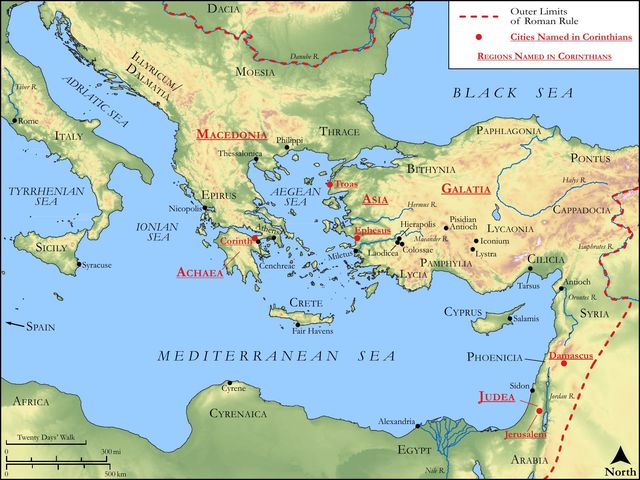
See on the biblical-era map

Study this verse
Public-domain commentary
Matthew Henry
From his Commentary on the Whole Bible. Henry comments on passages, not single verses — this entry covers 1 Corinthians 9:15–18.
Here he tells them that he had, notwithstanding, waived his privilege, and lays down his reason for doing it.
I.He tells them that he had neglected to claim his right in times past:
I have used none of these things, Co1 9:15. He neither ate nor drank himself at their cost, nor led about a wife to be maintained by them, nor forbore working to maintain himself. From others he received a maintenance, but not from them, for some special reasons. Nor did he write this to make his claim now. Though he here asserts his right, yet he does not claim his due; but denies himself for their sakes, and the gospel.
II.We have the reason assigned of his exercising this self-denial.
He would not have his glorying made void: It were better for his to die than that any man should make his glorying void, Co1 9:15. This glorying did imply nothing in it of boasting, or self-conceit, or catching at applause, but a high degree of satisfaction and comfort. It was a singular pleasure to him to preach the gospel without making it burdensome; and he was resolved that among them he would not lose this satisfaction. His advantages for promoting the gospel were his glory, and he valued them above his rights, or his very life: Better were it for him to die than to have his glorying made void, than to have it justly said that he preferred his wages to his work. No, he was ready to deny himself for the sake of the gospel. Note, It is the glory of a minister to prefer the success of his ministry to his interest, and deny himself, that he may serve Christ, and save souls. Not that in so doing he does more than he ought; he is still acting within the bounds of the law of charity. But he acts upon truly noble principles, he brings much honour to God in so doing; and those that honour him he will honour. It is what God will approve and commend, what a man may value himself for and take comfort in, though he cannot make a merit of it before God.
III.He shows that this self-denial was more honourable in itself, and yielded him much more content and comfort, than his preaching did:
"Though I preach the gospel, I have nothing whereof to glory; for necessity is laid upon me; yea, woe is unto me, if I preach not the gospel, Co1 9:16. It is my charge, my business; it is the work for which I am constituted an apostle, Co1 1:17. This is a duty expressly bound upon me. It is not in any degree a matter of liberty. Necessity is upon me. I am false and unfaithful to my trust, I break a plain and express command, and woe be to me, if I do not preach the gospel." Those who are set apart to the office of the ministry have it in charge to preach the gospel. Woe be to them if they do not. From this none is excepted. But it is not given in charge to all, nor any preacher of the gospel, to do his work gratis, to preach and have no maintenance out of it. It is not said, "Woe be to him if he do not preach the gospel, and yet maintain himself." In this point he is more at liberty. It may be his duty to preach at some seasons, and under some circumstances, without receiving a maintenance for it; but he has, in the general, a right to it, and may expect it from those among whom he labours. When he renounces this right for the sake of the gospel and the souls of men, though he does not supererogate, yet he denies himself, waives his privilege and right; he does more than his charge and office in general, and at all times, obliges him to. Woe be to him if he do not preach the gospel; but it may sometimes be his duty to insist on his maintenance for so doing, and whenever he forbears to claim it he parts with his right, though a man may sometimes be bound to do so by the general duties of love to God and charity to men. Note, It is a high attainment in religion to renounce our own rights for the good of others; this will entitle to a peculiar reward from God. For,
IV.The apostle here informs us that doing our duty with a willing mind will meet with a gracious recompence from God:
If I do this thing, that is, either preach the gospel or take no maintenance, willingly, I have a reward. Indeed, it is willing service only that is capable of reward from God. It is not the bare doing of any duty, but the doing of it heartily (that is, willingly and cheerfully) that God has promised to reward. Leave the heart out of our duties, and God abhors them: they are but the carcasses, without the life and spirit, of religion. Those must preach willingly who would be accepted of God in this duty. They must make their business a pleasure, and not esteem it a drudgery. And those who, out of regard to the honour of God or good of souls, give up their claim to a maintenance, should do this duty willingly, if they would be accepted in it or rewarded for it. But whether the duty of the office be done willingly or with reluctance, whether the heart be in it or averse from it, all in office have a trust and charge from God, for which they must be accountable. Ministers have a dispensation of the gospel, or stewardship - oikonomia (Luk 16:2), committed to them. Note, Christ's willing servants shall not fail of a recompence, and that proportioned to their fidelity, zeal, and diligence; and his slothful and unwilling servants shall all be called to an account. Taking his name, and professing to do his business, will make men accountable at his bar. And how sad an account have slothful servants to give!
V.The apostle sums up the argument, by laying before them the encouraging hope he had of a large recompence for his remarkable self-denial:
What is my reward then? Co1 9:18. What is it I expect a recompence from God for? That when I preach the gospel I may make it without charge, that I abuse not my power in the gospel. Or, "not so to claim my rights as to make them destroy the great intentions and ends of my office, but renounce them for the sake of these." It is an abuse of power to employ it against the very ends for which it is given. And the apostle would never use his power, or privilege of being maintained by his ministry, so as to frustrate the ends of it, but would willingly and cheerfully deny himself for the honour of Christ and the interest of souls. That ministers who follows his example may have cheerful expectations of a full recompence.
Historical interpretation
Two Centuries of Reception
7 surviving comments on this verse. Each one is dated, so this reads as a timeline rather than a list.
Select a marker to jump to its quote. Markers stagger vertically where authors wrote within a few decades of each other.
Of this he boasted, and suffered no man to rob him of such glory -certainly with no view of destroying the law, which he proved that another man might use.
And, "(I think) God hath selected us the apostles (as) hindmost, like men appointed to fight with wild beasts; since we have been made a spectacle to this world, both to angels and to men: "And, "We have been made the offscourings of this world, the refuse of all: "And, "Am I not free? am I not an apostle? have I not seen Christ Jesus our Lord? " With what kind of superciliousness, on the contrary, was he compelled to declare, "But to me it is of small moment that I be interrogated by you, or by a human court-day; for neither am I conscious to myself (of any guilt); "and, "My glory none shall make empty." "Know ye not that we are to judge angels? " Again, of how open censure (does) the free expression (find utterance), how manifest the edge of the spiritual sword, (in words like these): "Ye are already enriched! ye are already satiated! ye are already reigning!" and, "If any thinks himself to know, he knoweth not yet how it behaves him to know I" Is he not even then "smiting some one's face," in saying, "For who maketh thee to differ? What, moreover, hast thou which thou hast not received? Why gloriest thou as if thou have not received? " Is he not withal "smiting them upon the mouth," (in saying): "But some, in (their) conscience, even until now eat (it) as if (it were) an idol-sacrifice.
“It is better that I die” than that they ravish and plunder some of my brothers and by sly verbal deception lead captive the “little children” and sucklings in Christ.
Paul says he would rather die because he knew it would be better from the standpoint of his future salvation.
"But I have used none of these things:"
What then if thou hast not used them now, saith one, but intendest to use them at a future time, and on this account sayest these things. Far from it; for he speedily corrected the notion, thus saying; "And I write not these things that it may be so done in my case."
And see with what vehemence he disavows and repels the thing: "For it were good for me rather to die, than that any man should make my glorying void."
And not once nor twice, but many times he uses this expression. For above he said, "We did not use this right:" and after this again, "that I abuse not my right:" and here, "but I have used none of these things." "These things;" what things? The many examples. That is to say, many things giving me license; the soldier, the husbandman, the shepherd, the Apostles, the law, the things done by us unto you, the things done by you unto the others, the priests, the ordinance of Christ; by none of these have I been induced to abolish my own law, and to receive. And speak not to me of the past: (although I could say, that I have endured much even in past times on this account,) nevertheless I do not rest on it alone, but likewise concerning the future I pledge myself, that I would choose rather to die of hunger than be deprived of these crowns.
"For it were good for me rather to die," saith he, "than that any man should make my glorying void."
He said not, "that any man should abolish my law," but, "my glorying." For lest any should say, "he doth it indeed but not cheerfully, but with lamentation and grief," willing to show the excess of his joy and the abundance of his zeal, he even calls the matter "glorying." So far was he from vexing himself that he even glories, and chooses rather to die than to fall from this "glorying." So much dearer to him even than life itself was that proceeding of his.
“For the laborer deserves his hire.” He showed that this practice was permitted, though not commanded, lest perhaps a disciple who took some compensation for his personal needs from those to whom he was preaching might think he was doing wrong. That it was more commendable to omit this practice is shown clearly in the life of the apostle … [who] declared: “Nevertheless I have not used this right.” … He possessed the right, but he did not bind his followers by a command. Since we are, then, unable to comprehend many passages, we gather from the deeds of the saints how to understand those passages which may easily be misinterpreted if reference is not made to the example set by the saints.
“The Lord directed that those who preach the gospel should have their living from the gospel. But I for my part have appealed to none of these rights.” … What is clearer than this? What is more definite? My only fear is that, when I discuss the passage in an attempt to explain it, I may obscure that which is of itself patent and forceful. For, they who do not understand these words, or pretend that they do not understand them, understand mine much less.
Continue studying 1 Corinthians 9:15 across the web’s major study libraries — every link below opens this exact verse, chapter, or book on the destination site.
Read & Compare
 BibleGatewayThis verse in more than 200 translations and 70 languages.
 Bible.comThe YouVersion reader — hundreds of translations, reading plans, and highlights.
 ESV.orgCrossway's official English Standard Version reader.
 NET BibleThe NET translation with 60,000+ translators' notes on every rendering decision.
 STEP BibleTyndale House's free study tool — original text, vocabulary, and scholarly resources.
 BibliaLogos Bible Software's free web reader.
 USCCBThe New American Bible (Revised Edition) with the U.S. bishops' study notes.
Commentaries
 BibleHub CommentariesDozens of classic commentaries on this verse, gathered on one page.
 StudyLightMore than 100 commentary sets — the largest collection on the web.
 BibleRefPlain-English commentary on what this verse means, verse by verse.
 Enduring WordDavid Guzik's free commentary on this chapter, widely used by Bible teachers.
 Bible Study ToolsVerse commentary alongside Greek and Hebrew study aids.
Original Language & Research
- BibleHub InterlinearThe verse word by word — original language, transliteration, and English.
- BibleHub LexiconEvery word's original-language definition and Strong's entry.
 Blue Letter BibleDeep-study tools — Strong's numbers, concordance, and word studies.
 CNTR CollationThe earliest Greek manuscripts of this verse, collated letter by letter.
Sermons, Hymns & Audio


TrulyRandomVerse is not affiliated with these sites and doesn’t control their content. They’re linked because they’re genuinely useful.
Summary
The Apostle Paul makes a profound declaration in this verse, asserting his deliberate choice to forgo his legitimate apostolic right to financial support from the Corinthian church. He emphasizes that his decision is not a subtle plea for future remuneration, but rather an unwavering commitment to preserve the integrity and unimpeded progress of the Gospel message. So deeply does he value the unique "boast" of preaching without charge that he would rather face death than allow anyone to nullify or diminish this distinguishing mark of his ministry.
Context
ShowHideLiterary Context
This verse serves as a crucial turning point in Paul's extensive defense of his apostolic authority and rights, a discussion initiated in 1 Corinthians 9:1. Leading up to 1 Corinthians 9:15, Paul meticulously constructs an argument for the right of those who minister the Gospel to receive financial support. He employs various analogies, including soldiers, farmers, and shepherds, and appeals to both the Mosaic Law (e.g., Deuteronomy 25:4) and the established practice of temple priests (1 Corinthians 9:13). He culminates this argument by stating in 1 Corinthians 9:14 that "the Lord commanded that those who preach the gospel should live from the gospel." However, with the emphatic "But I have used none of these things," Paul immediately pivots, shifting from defending his right to explaining his voluntary renunciation of that right, thereby highlighting his conscious strategic choice for the sake of the Gospel's wider acceptance and unhindered proclamation.
Historical & Cultural Context
In the Greco-Roman world, it was a common practice for various public figures, including philosophers, rhetoricians, and religious teachers, to charge fees for their instruction or services. While accepted, this practice often exposed them to accusations of sophistry or mercenary motives, which could undermine the perceived sincerity or truthfulness of their message. Paul, who often supported himself through his trade as a tentmaker (Acts 18:3), was acutely aware of these cultural perceptions. His deliberate decision to preach without charge was a counter-cultural act that sharply differentiated him from the itinerant teachers of his day. This choice effectively preempted any potential accusations that he was motivated by financial gain, particularly in a wealthy, commercial city like Corinth, where financial transactions and social status were highly valued. Paul's self-sufficiency thus served as a powerful testament to the Gospel's freeness and the purity of his motives.
Key Themes
ShowHideThis verse profoundly contributes to several overarching themes within 1 Corinthians and Paul's broader theological framework. Firstly, it powerfully illustrates the theme of Voluntary Self-Denial for the sake of the Gospel, showcasing Paul's unwavering commitment to prioritize the spiritual good of others over his personal rights or comfort, a principle he further elaborates in 1 Corinthians 10:33. Secondly, it underscores the critical importance of Integrity and Purity of Ministry, revealing Paul's earnest desire to eliminate any potential stumbling block that might impede the reception of the Gospel message. His refusal of financial support was a strategic maneuver to ensure that his message of God's free grace remained untainted by any perception of greed. Finally, the verse introduces the unique concept of Paul's "glorying" or "boast" (Greek: kauchema), which is not rooted in personal achievement but in the Unimpeded Proclamation of the Gospel. This "glorying" becomes a central motif in his defense, revealing his deep passion for the Gospel's unhindered advance, even to the point of declaring he would rather die than have this precious privilege nullified, a sentiment echoed in his willingness to count all things loss for Christ in Philippians 3:7-8.
Exposition and Analysis
ShowHideKey Word Analysis
ShowHideThis verb signifies "to employ, to make use of, or to act towards one in a given manner." In this context, Paul states he has "used none of these things," referring to the legitimate rights to financial support he has just meticulously outlined. His choice of chráomai emphasizes a deliberate, active decision not to avail himself of these provisions, highlighting his conscious self-restraint and strategic renunciation of a valid privilege.
Derived from the verb kaucháomai (to boast), kaúchēma refers to "a boast, ground for boasting, or object of pride." For Paul, this was not a boast in worldly accomplishments or personal gain, but a profound, holy zeal for his unique privilege of preaching the Gospel without charge. It was his distinctive mark, a source of spiritual joy and a testament to the Gospel's inherent worth and freeness, which he valued above all else.
This verb means "to make empty, to abase, neutralize, or falsify." Paul's declaration that he would rather die than have his "glorying void" reveals the intense depth of his commitment. To make his glorying void would be to nullify, empty, or render ineffective the very thing he considered his most cherished spiritual distinction – the unhindered, uncompensated proclamation of the Gospel. It implies a fear that accepting payment would undermine the purity and power of his message.
Verse Breakdown
ShowHide"But I have used none of these things"
Paul immediately contrasts his personal practice with the legitimate rights he has just established for Gospel ministers. Despite having a valid claim to financial support as an apostle and preacher, he has deliberately chosen not to exercise this right, setting the stage for his explanation of this radical self-denial.
"neither have I written these things, that it should be so done unto me"
This clause clarifies Paul's motive for discussing his rights. He is not writing to subtly solicit support from the Corinthians, nor is he laying groundwork for them to provide for him. His intention is not to receive, but to explain his principled decision to not receive, ensuring his motives are transparent and beyond reproach.
"for [it were] better for me to die"
Paul introduces a dramatic and emphatic declaration of his conviction. The phrase "better for me to die" is a powerful expression of hyperbole, conveying the extreme importance he places on his principle. It signifies that the alternative—having his "glorying" nullified—is so abhorrent that death would be preferable.
"than that any man should make my glorying void."
This climactic statement reveals the core of Paul's motivation. His "glorying" is the unique boast or privilege of preaching the Gospel freely, without financial burden to his hearers. To "make it void" would mean to nullify, empty, or render ineffective this precious aspect of his ministry, perhaps by forcing him to accept payment, or by creating a perception that his motives were impure, thereby hindering the Gospel's power.
Literary Devices
ShowHidePaul employs several powerful literary devices in 1 Corinthians 9:15 to underscore the intensity of his commitment. The most striking is Hyperbole, evident in his declaration, "it were better for me to die, than that any man should make my glorying void." This extreme statement is not meant to be taken literally as a death wish, but rather to dramatically emphasize the profound value Paul places on his uncompensated ministry and the abhorrence he feels towards anything that would compromise its integrity. The term "glorying" itself functions as a form of Metonymy, where his "boast" or "pride" stands in for the specific practice of preaching the Gospel without charge. This "glorying" is not self-aggrandizement but a holy zeal for the Gospel's unimpeded progress. Furthermore, the entire passage, following Paul's detailed defense of his rights, creates a powerful Antithesis between what is permissible (receiving support) and what Paul chooses to do (forgo support), highlighting his radical self-sacrifice for the sake of the Gospel.
Theological and Thematic Connections
ShowHidePaul's radical commitment to preach the Gospel without charge in 1 Corinthians 9:15 is a profound theological statement on the nature of ministry and the Gospel itself. It underscores that the Gospel is a message of God's free grace, priceless and unpurchasable, and therefore its proclamation should ideally reflect this freeness. His willingness to sacrifice a legitimate right for the sake of the Gospel's unhindered advance exemplifies the principle of putting the spiritual welfare of others above personal gain or comfort. This act of voluntary self-denial serves as a powerful model for all believers, demonstrating that true spiritual "glorying" is found not in what one receives, but in what one gives up for the sake of Christ and His Kingdom. It reveals a deep understanding of stewardship, where Paul sees his ministry as a sacred trust to be guarded from anything that might diminish its effectiveness or bring reproach upon the name of Christ.
Reflection and Application
ShowHidePaul's declaration in 1 Corinthians 9:15 challenges us to critically examine our own motivations and priorities in service, whether in formal ministry or daily life. His "glorying" was not in personal comfort, recognition, or financial gain, but in the unhindered proclamation of the Gospel. This prompts us to consider what we truly boast in, what we are willing to sacrifice, and what we would rather die than see compromised. For those in ministry, it is a powerful call to integrity, reminding us that while support is legitimate, the purity of motive and the effectiveness of the message must always take precedence over personal entitlements. For all believers, it is an invitation to radical selflessness, encouraging us to identify and remove potential stumbling blocks that might hinder others from receiving the Good News, and to prioritize the advancement of God's Kingdom above our own perceived rights or comforts. Paul's example calls us to a higher standard of sacrificial love, mirroring the very nature of the Gospel we proclaim.
Questions for Reflection
ShowHideFAQ
ShowHideWhy did Paul refuse financial support when he clearly stated he had a right to it?
ShowHidePaul's refusal of financial support, despite asserting his legitimate apostolic right to it, was a strategic and deeply principled decision. He explains this throughout 1 Corinthians 9. His primary motivation was to remove any potential stumbling block or accusation that he was preaching for personal gain, thereby ensuring the Gospel message would be received without prejudice. In a culture where many teachers charged fees, Paul's self-sufficiency distinguished him and powerfully demonstrated that the Gospel was a message of free grace, not a commodity. He considered this uncompensated ministry his unique "glorying" or boast, valuing its integrity so highly that he would rather die than see it compromised.
What does Paul mean by "my glorying"?
ShowHideWhen Paul refers to "my glorying" (Greek: kaúchēma), he is not speaking of a boast in personal achievement or worldly success. Rather, it refers to his unique and cherished privilege, his spiritual "boast," of being able to preach the Gospel of Jesus Christ without imposing any financial burden on those to whom he ministered. This was a source of profound joy and satisfaction for him because it underscored the freeness and priceless nature of the Gospel. It was a distinguishing mark of his ministry, demonstrating his pure motives and preventing any accusation that he was motivated by greed. He valued this aspect of his ministry so highly that he declared he would rather die than have this "glorying" nullified or taken away.
Christ-Centered Fulfillment
ShowHidePaul's radical self-denial in 1 Corinthians 9:15 finds its ultimate and most profound fulfillment in the person and work of Jesus Christ. Paul's willingness to "make himself void" of his rights for the sake of the Gospel directly mirrors Christ's own kenosis, His self-emptying, as described in Philippians 2:5-8. Just as Paul, though having the right to support, chose not to use it, so Christ, "who, though he was in the form of God, did not count equality with God a thing to be grasped, but emptied himself, by taking the form of a servant, being born in the likeness of men." Christ voluntarily relinquished the prerogatives of His divine glory and heavenly comforts, not for personal gain, but to become a human, suffer, and die on the cross for the salvation of humanity. His ultimate "glorying" was in accomplishing the Father's will and securing redemption through His selfless sacrifice, a "boast" that could never be made void. Paul's ministry, characterized by a similar spirit of sacrificial love and a desire for the unhindered spread of the message, becomes a powerful echo of the Lord he serves, demonstrating that true spiritual authority and effectiveness flow from a posture of humble, Christ-like self-giving for the glory of God and the good of others, as Jesus Himself taught in Mark 10:45.