


Matthew 15:30
- καὶkaiAndG2532CONJConjunction
- προσῆλθονprosēlthoncameG4334V-2AAI-3PVerb 2nd Aorist Active Indicative 3rd Plural
- αὐτῷautōto HimG846P-DSMPersonal pronoun Dative Singular Masculine
- ὄχλοιochloicrowdsG3793N-NPMNoun Nominative Plural Masculine
- πολλοὶpolloigreatG4183A-NPMAdjective Nominative Plural Masculine
- ἔχοντεςechonteshavingG2192V-PAP-NPMVerb Present Active Participle Nominative Plural Masculine
- μεθ᾽meth᾽withG3326PREPPreposition
- ἑαυτῶνhe'autōnthemselvesG1438F-3GPMReflexive pronoun Genitive 3rd Plural Masculine
- χωλούςchōlouslameG5560A-APMAdjective Accusative Plural Masculine
- τυφλούςtuphlousblindG5185A-APMAdjective Accusative Plural Masculine
- κυλλούςkullouscrippledG2948A-APMAdjective Accusative Plural Masculine
- κωφούςkōphousmuteG2974A-APMAdjective Accusative Plural Masculine
- καὶkaiandG2532CONJConjunction
- ἑτέρουςheterousothersG2087A-APMAdjective Accusative Plural Masculine
- πολλοὺςpollousmanyG4183A-APMAdjective Accusative Plural Masculine
- καὶkaiandG2532CONJConjunction
- ἔρριψανerripsanthey placedG4496V-AAI-3PVerb Aorist Active Indicative 3rd Plural
- αὐτοὺςautousthemG846P-APMPersonal pronoun Accusative Plural Masculine
- παρὰparaatG3844PREPPreposition
- τοὺςtoustheG3588T-APMDefinite article Accusative Plural Masculine
- πόδαςpodasfeetG4228N-APMNoun Accusative Plural Masculine
- αὐτοῦautouof HimG846P-GSMPersonal pronoun Genitive Singular Masculine
- Ἰησοῦ·IēsouJesusG2424N-GSM-PNoun Genitive Singular Masculine Individual
- καὶkaiandG2532CONJConjunction
- ἐθεράπευσενetherapeusenHe healedG2323V-AAI-3SVerb Aorist Active Indicative 3rd Singular
- αὐτοὺςautousthemG846P-APMPersonal pronoun Accusative Plural Masculine
English is a literal word-by-word gloss of the Greek, not the KJV's wording. Why?
This is the original text the KJV's translators worked from — each Greek word with its own literal English meaning in this verse, prepared by scholars at Tyndale House, Cambridge. The KJV translates whole sentences, not word by word, so its wording differs: one Greek word can become several English words, and the KJV may choose “charity” where the gloss reads “love”. Both are faithful — they answer different questions. For the KJV's own rendering, switch to the KJV text.
Details
See on the biblical-era map
Study this verse
Public-domain commentary
Matthew Henry
From his Commentary on the Whole Bible. Henry comments on passages, not single verses — this entry covers Matthew 15:29–39. His four-level outline is real structure in the source text, so it is rendered as structure.
Here is, I. A general account of Christ's cures, his curing by wholesale. The tokens of Christ's power and goodness are neither scarce nor scanty; for there is in him an overflowing fulness. Now observe,
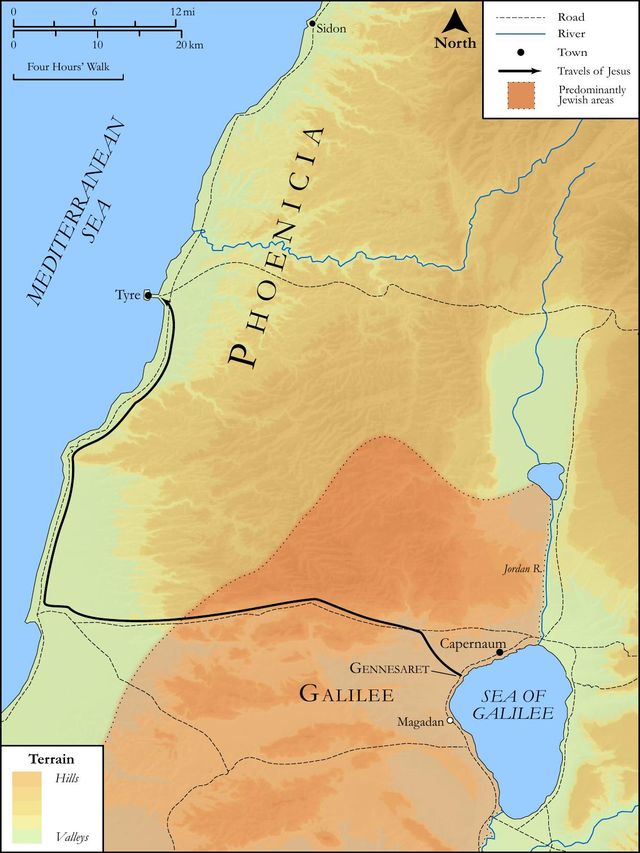
1.The place where these cures were wrought; it was near the sea of Galilee, a part of the country Christ was much conversant with. We read not of any thing he did in the coasts of Tyre and Sidon, but the casting of the devil out of the woman of Canaan's daughter, as if he took that journey on purpose, with that in prospect. Let not ministers grudge their pains to do good, though but to few. He that knows the worth of souls, would go a great way to help to save one from death and Satan's power.
But Jesus departed thence. Having let fall that crumb under table, he here returns to make a full feast for the children. We may do that occasionally for one, which we may not make a constant practice of. Christ steps into the coast of Tyre and Sidon, but he sits down by the sea of Galilee (Mat 15:29), sits down not on a stately throne, or tribunal of judgment, but on a mountain: so mean and homely were his most solemn appearances in the days of his flesh! He sat down on a mountain, that all might see him, and have free access to him; for he is an open Saviour. He sat down there, as one tired with his journey, and willing to have a little rest; or rather, as one waiting to be gracious. He sat, expecting patients, as Abraham at his tent-door, ready to entertain strangers. He settled himself to this good work.
2.The multitudes and maladies that were healed by him (Mat 15:30); Great multitudes came to him; that the scripture might be fulfilled, Unto him shall the gathering of the people be, Gen 49:10. If Christ's ministers could cure bodily diseases as Christ did, there would be more flocking to them than there is; we are soon sensible of bodily pain and sickness, but few are concerned about their souls and their spiritual diseases.
Now, (1.) Such was the goodness of Christ, that he admitted all sorts of people; the poor as well as the rich are welcome to Christ, and with him there is room enough for all comers. He never complained of crowds or throngs of seekers, or looked with contempt upon the vulgar, the herd, as they are called; for the souls of peasants are as precious with him as the souls of princes.
(2.)Such was the power of Christ, that he healed all sorts of diseases; those that came to him, brought their sick relations and friends along with them, and cast them down at Jesus' feet, Mat 15:30. We read not of any thing they said to him, but they laid them down before him as objects of pity, to be looked upon by him. Their calamities spake more for them than the tongue of the most eloquent orator could. David showed before God his trouble, that was enough, he then left it with him, Psa 142:2. Whatever our case is, the only way to find ease and relief, is, to lay it at Christ's feet, to spread it before him, and refer it to his cognizance, and then submit it to him, and refer it to his disposal. Those that would have spiritual healing from Christ, must lay themselves at his feet, to be ruled and ordered as he pleaseth.
Here were lame, blind, dumb, maimed, and many others, brought to Christ. See what work sin has made! It has turned the world into a hospital: what various diseases are human bodies subject to! See what work the Saviour makes! He conquers those hosts of enemies to mankind. Here were such diseases as a flame of fancy could contribute neither to the cause of nor to the cure of; as lying not in the humours, but in the members of the body; and yet these were subject to the commands of Christ. He sent his word, and healed them. Note, All diseases are at the command of Christ, to go and come as he bids them. This is an instance of Christ's power, which may comfort us in all our weaknesses; and of his pity, which may comfort us in all our miseries.
3.The influence that this had upon the people, Mat 15:31.
(1.)They wondered, and well they might. Christ's works should be our wonder. It is the Lord's doing, and it is marvellous, Psa 118:23. The spiritual cures that Christ works are wonderful. When blind souls are made to see by faith, the dumb to speak in prayer, the lame to walk in holy obedience, it is to be wondered at. Sing unto the Lord a new song, for thus he has done marvellous things.
(2.)They glorified the God of Israel, whom the Pharisees, when they saw these things, blasphemed. Miracles, which are the matter of our wonder, must be the matter of our praise; and mercies, which are the matter of our rejoicing, must be the matter of our thanksgiving. Those that were healed, glorified God; if he heal our diseases, all that is within us must bless his holy name; and if we have been graciously preserved from blindness, and lameness, and dumbness, we have as much reason to bless God as if we had been cured of them; nay, and the standers-by glorified God. Note, God must be acknowledged with praise and thankfulness in the mercies of others as in our own. They glorified him as the God of Israel, his church's God, a God in covenant with his people, who hath sent the Messiah promised; and this is he. See Luk 1:68. Blessed be the Lord God of Israel. This was done by the power of the God of Israel, and no other could do it.
II.Here is a particular account of his feeding four thousand men with seven loaves, and a few little fishes, as he had lately fed five thousand with five loaves. The guests indeed were now not quite so many as then, and the provision a little more; which does not intimate that Christ's arm was shortened, but that he wrought his miracles as the occasion required, and not for ostentation, and therefore he suited them to the occasion: both then and now he took as many as were to be fed, and made use of all that was at hand to feed them with. When once the utmost powers of nature are exceeded, we must say, This is the finger of God; and it is neither here nor there how far they are outdone; so that this is no less a miracle than the former.
Here is, 1. Christ's pity (Mat 15:32); I have compassion on the multitude. He tells his disciples this, both to try and to excite their compassion. When he was about to work this miracle, he called them to him, and made them acquainted with his purpose, and discoursed with them about it; not because he needed their advice, but because he would give an instance of his condescending love to them. He called them not servants, for the servant knows not what his Lord doeth, but treated them as his friends and counsellors. Shall I hide from Abraham the thing that I do? Gen 18:17. In what he said to them, Observe,
(1.)The case of the multitude; They continue with me now three days, and have nothing to eat. This is an instance of their zeal, and the strength of their affection to Christ and his word, that they not only left their callings, to attend upon him on week-days, but underwent a deal of hardship, to continue with him; they wanted their natural rest, and, for aught that appeared, lay like soldiers in the field; they wanted necessary food, and had scarcely enough to keep life and soul together. In those hotter countries they could better bear long fasting than we can in these colder climates: but though it could not but be grievous to the body, and might endanger their health, yet the zeal of God's house thus ate them up, and they esteemed the words of Christ more than their necessary food. We think three hours too much to attend upon public ordinances; but these people staid together three days, and yet snuffed not at it, nor said, Behold, what a weariness is it! Observe, With what tenderness Christ spoke of it; I have compassion on them. It had become them to have compassion on him, who took so much pains with them for three days together, and was so indefatigable in teaching and healing; so much virtue had gone out of him, and yet for aught that appears he was fasting too: but he prevented them with his compassion. Note, Our Lord Jesus keeps an account how long his followers continue their attendance on him, and takes notice of the difficulty they sustain in it (Rev 2:2); I know thy works, and thy labour, and thy patience: and it shall in no wise lose its reward.
Now the exigence the people were reduced to serves to magnify. [1.] The mercy of their supply: he fed them when they were hungry; and then food was doubly welcome. He treated them as he did Israel of old; he suffered them to hunger, and then fed them (Deu 8:3); for that is sweet to the hungry soul, which the full soul loathes. [2.] The miracle of their supply: having been so long fasting, their appetites were the more craving. If two hungry meals make the third a glutton, what would three hungry days do? And yet they did all eat and were filled. Note, There are mercy and grace enough with Christ, to give the most earnest and enlarged desire an abundant satisfaction; Open thy mouth wide, and I will fill it. He replenisheth even the hungry soul.
(2.)The care of our master concerning them; I will not send them away fasting, lest they should faint by the way; which would be a discredit to Christ and his family, and a discouragement both to them and to others. Note, It is the unhappiness of our present state, that when our souls are in some measure elevated and enlarged, our bodies cannot keep pace with them in good duties. The weakness of the flesh is a great grievance to the willingness of the spirit. It will not be so in heaven, where the body shall be made spiritual, where they rest not, day and night, from praising God, and yet faint not; where they hunger no more, nor thirst any more, Rev 7:16.
Here is, 2. Christ's power. His pity of their wants sets his power on work for their supply. Now observe,
(1.)How his power was distrusted by his disciples (Mat 15:23); whence should we have so much bread in the wilderness? A proper question, one would think, like that of Moses (Num 11:22). Shall the flocks and the herds be slain to suffice them? But it was here an improper question, considering not only the general assurance the disciples had of the power of Christ, but the particular experience they lately had of a seasonable and sufficient provision by miracle in a like case; they had been not only the witnesses, but the ministers, of the former miracle; the multiplied bread went through their hands; so that it was an instance of great weakness for them to ask, Whence shall we have bread? Could they be at a loss, while they had their Master with them? Note, Forgetting former experiences leaves us under present doubts.
Christ knew how slender the provision was, but he would know it from them (Mat 15:34); How many loaves have ye? Before he would work, he would have it seen how little he had to work on, that his power might shine the brighter. What they had, they had for themselves, and it was little enough for their own family; but Christ would have them bestow it all upon the multitude, and trust Providence for more. Note, it becomes Christ's disciples to be generous, their Master was so: what we have, we should be free of, as there is occasion; given to hospitality; not like Nabal (Sa1 25:11), but like Elisha, Kg2 4:42. Niggardliness today, out of thoughtfulness for tomorrow, is a complication of corrupt affection that ought to be mortified. If we be prudently kind and charitable with what we have, we may piously hope that God will send more. Jehovah-jireh, The Lord will provide. The disciples asked, Whence should we have bread? Christ asked, How many loaves have ye? Note, When we cannot have what we would, we must make the best of what we have, and do good with it as far as it will go; we must not think so much of our wants as of our havings. Christ herein went according to the rule he gave to Martha, not to be troubled about many things, nor cumbered about much serving. Nature is content with little, grace with less, but lust with nothing.
(2.)How his power was discovered to the multitude, in the plentiful provision he made for them; the manner of which is much the same as before, Mat 14:18, etc. Observe here,
[1.]The provision that was at hand; seven loaves, and a few fishes: the fish not proportionable to the bread, for bread is the staff of life. It is probable that the fish was such as they had themselves taken; for they were fishers, and were now near the sea. Note, It is comfortable to eat the labour of our hands (Psa 128:2), and to enjoy that which is any way the product of our own industry, Pro 12:27. And what we have got by God's blessing on our labour we should be free of; for therefore we must labour, that we may have to give, Eph 4:28.
[2.]The putting of the people in a posture to receive it (Mat 15:35); He commanded the multitude to sit down on the ground. They saw but very little provision, yet they must sit down, in faith that they should have a meal's meat out of it. They who would have spiritual food from Christ, must sit down at his feet, to hear his word, and expect it to come in an unseen way.
[3.]The distributing of the provision among them. He first gave thanks - eucharistēsas. The word used in the former miracle was eulogēse - he blessed. It comes all to one; giving thanks to God is a proper way of craving a blessing from God. And when we come to ask and receive further mercy, we ought to give thanks for the mercies we have received. He then broke the loaves (for it was in the breaking that the bread multiplied) and gave to his disciples, and they to the multitude. Though the disciples had distrusted Christ's power, yet he made use of them now as before; he is not provoked, as he might be, by the weakness and infirmities of his ministers, to lay them aside; but still he gives to them, and they to his people, of the word of life.
[4.]The plenty there was among them (Mat 15:37). They did all eat, and were filled. Note, Those whom Christ feeds, he fills. While we labour for the world, we labour for that which satisfieth not (Isa 55:2); but those that duly wait on Christ shall be abundantly satisfied with the goodness of his house, Psa 65:4. Christ thus fed people once and again, to intimate that though he was called Jesus of Nazareth, yet he was of Bethlehem, the house of bread; or rather, that he was himself the Bread of Life.
To show that they had all enough, there was a great deal left - seven baskets full of broken meat; not so much as there was before, because they did not gather after so many eaters, but enough to show that with Christ there is bread enough, and to spare; supplies of grace for more than seek it, and for those that seek more.
[5.]The account taken of the guests; not that they might pay their share (here was no reckoning to be discharged, they were fed gratis), but that they might be witnesses to the power and goodness of Christ, and that this might be some resemblance of that universal providence that gives food to all flesh, Psa 136:25. Here were four thousand men fed; but what were they to that great family which is provided for by the divine care every day? God is a great Housekeeper, on whom the eyes of all the creatures wait, and he giveth them their food in due season, Psa 104:27; Psa 145:15.
[6.]The dismission of the multitude, and Christ's departure to another place (Mat 15:39). He sent away the people. Though he had fed them twice, they must not expect miracles to be their daily bread. Let them now go home to their callings, and to their own tables. And he himself departed by ship to another place; for, being the Light of the world, he must be still in motion, and go about to do good.
Historical interpretation
Ten Centuries of Reception
8 surviving comments on this verse. Each one is dated, so this reads as a timeline rather than a list.
Select a marker to jump to its quote. Markers stagger vertically where authors wrote within a few decades of each other.
Again Jesus went up on the mountain where he sat down. Not only people who were healthy but also those suffering from various disorders went up on the mountain where Jesus was sitting. Think of this mountain to which Jesus went up and sat as the church. It has been set up through the word of God over the rest of the world, and all sorts of people come to it. To this assembly have come not only the disciples, as if they were leaving behind the multitudes, as they did in the case of the Beatitudes. Rather, there are great crowds here, many of whom are deaf or suffer from many afflictions. Look at the crowds who come to this mountain where the Son of God sits. Some of them have become deaf to the things that have been promised. Others have become blind in soul, not looking toward the true light. Others are lame and not able to walk according to reason. Others are maimed and unable to work profitably. Each of these who are suffering in soul from such things go up along with the multitudes into the mountain where Jesus sits.Some who do not draw near to the feet of Jesus are not healed. But those who are brought by the multitude and cast at his feet are being healed. Even those who come only to the edges, just the extremities of the body of Christ, who feel themselves unworthy to obtain such things, are being healed. So now you come into the congregation of what is more commonly called the church.
See the catechumens? They are, as it were, cast in the far side or back of those who are the extreme end of the body, as if they were coming merely to the feet of the body of Jesus—the church. They are coming to it with their own deafness and blindness and lameness and crookedness. In time they will be cured according to the Word. Observing this you would not be wrong in saying that these people have gone up with the multitudes into the church, up to the mountain where Jesus sits, and have been cast at his feet and are being healed. And so the multitudes are astonished at beholding the transformations that are taking place. They behold those who are being converted from such great evils to that which is so much better.
"And Jesus departed from thence, and came nigh unto the sea of Galilee; and went up into the mountain, and sat down there. And great multitudes came unto Him, having with them those that were lame, blind, maimed, dumb; and cast them at His feet; and He healed them, insomuch that the multitudes wondered, when they saw the dumb to speak, the maimed to be whole, the lame to walk, and the blind to see, and they glorified the God of Israel."
Now He goes about Himself, now sits awaiting the diseased, and hath the lame brought up unto the mountain. And no longer do they touch so much as His garment, but advance a higher step, being cast at His feet: and they showed their faith doubly, first, by going up into the mountain though lame, then by wanting nothing else but to be cast at His feet only.
And great was the marvel and strange, to see them that were carried walking, the blind needing not any to lead them by the hand. Yea, both the multitude of the healed, and the facility of their cure amazed them.
Seest thou, how the woman indeed He healed with so much delay, but these immediately? not because these are better than she is, but because she is more faithful than they. Therefore, while in her case He defers and delays, to manifest her constancy; on these He bestows the gift immediately, stopping the mouths of the unbelieving Jews, and cutting away from them every plea. For the greater favors one hath received, so much the more is he liable to punishment, if he be insensible, and the very honor make him no better.
It should be considered that sometimes the Lord goes about to heal the sick, sometimes He sits and waits for them to come; and accordingly here it is added, And there came great multitudes unto him, having with them those that were dumb, lame, blind, maimed, and many others.
These showed their faith in two points especially, in that they went up the mountain, and in that they believed that they had need of nothing beyond but to cast themselves at Jesus' feet; for they do not now touch the hem even of His garment, but have attained to a loftier faith; And cast them down at Jesus' feet. The woman's daughter He healed with great slackness, that He might show her virtue; but to these He administers healing immediately, not because they were better than that woman, but that He might stop the mouths of the unbelieving Jews, as it follows, and he healed them all. But the multitude of those that were healed, and the ease with which it was done, struck them with astonishment. Insomuch that the multitude wondered when they saw the dumb to speak,
Having healed the daughter of this Chananæan, the Lord returns into Judæa, as it follows, And Jesus departed from thence, and came nigh unto the sea of Galilee.
What the Latin translator calls 'debiles' (maimed), is in the Greek χυλλοὺς which is not a general term for a maimed person, but a peculiar species, as he that is lame in one foot is called 'claudus,' so he that is crippled in one hand is called χυλλός.
He said nothing concerning the maimed, because there was no one word which was the opposite of thisa.
He goes up into the mountain, that as a bird He may entice the tender nestlings to fly.
(Verse 29, 30.) And when Jesus had passed on from there, he came near the Sea of Galilee; and going up on the mountain, he sat there. And great crowds came to him, bringing with them the mute, the blind, the lame, the weak, and many others. And they threw them down at his feet. In the place where the Latin interpreter translated, 'weak' is written in Greek as 'κυλλοὺς', which is not a general term for weakness, but the name for a specific infirmity: just as someone is called lame when they limp with one foot, so 'κυλλὸς' is used to describe someone who has a weak hand. We do not have the property of this word. Therefore, the evangelist explained the healings of the others in the following passages, but he was silent about these. For what follows?
This sea is called by various names; the sea of Galilee, because of its neighbourhood to Galilee; the sea of Tiberias, from the town of Tiberias. And going up into a mountain, he sat down there.
Also whosoever has his conscience polluted with the defilement of any sin, has a daughter sorely vexed by a dæmon. Also whosoever has defiled any good that he has done by the plague of sin, has a daughter tossed by the furies of an unclean spirit, and has need to fly to prayers and tears, and to seek the intercessions and aids of the saints.
Mystically; Having in the daughter of this Chauanæan prefigured the salvation of the Gentiles, He came into Judæa; because, when the fulness of the Gentiles shall have entered in, then shall all Israel be saved. (Rom. 11:25.)
Thus raising his hearers to meditate on heavenly things. He sat down there to show that rest is not to be sought but in heavenly things. And as He sits on the mountain, that is, in the heavenly height, there come unto Him multitudes of the faithful, drawing near to Him with devoted mind, and bringing to Him the dumb, and the blind, & c. and cast them down at Jesus' feet; because they that confess their sins are brought to be healed by Him alone. These He so heals, that the multitudes marvel and magnify the God of Israel; because the faithful when they see those that have been spiritually sick richly endued with all manner of works of virtuousness, sing praise to God.
(ap. Anselm.) The sea near to which Jesus came signifies the turbid swellings of this world; it is the sea of Galilee when men pass from virtue to vice.
(ord.) The dumb are they that do not praise God; the blind, they who do not understand the paths of life; the deaf, they that obey not; the lame, they that walk not firmly through the difficult ways of good works; the maimed, they that are crippled in their good works.
Continue studying Matthew 15:30 across the web’s major study libraries — every link below opens this exact verse, chapter, or book on the destination site.
Read & Compare
 BibleGatewayThis verse in more than 200 translations and 70 languages.
 Bible.comThe YouVersion reader — hundreds of translations, reading plans, and highlights.
 ESV.orgCrossway's official English Standard Version reader.
 NET BibleThe NET translation with 60,000+ translators' notes on every rendering decision.
 STEP BibleTyndale House's free study tool — original text, vocabulary, and scholarly resources.
 BibliaLogos Bible Software's free web reader.
 USCCBThe New American Bible (Revised Edition) with the U.S. bishops' study notes.
Commentaries
 BibleHub CommentariesDozens of classic commentaries on this verse, gathered on one page.
 StudyLightMore than 100 commentary sets — the largest collection on the web.
 BibleRefPlain-English commentary on what this verse means, verse by verse.
 Enduring WordDavid Guzik's free commentary on this chapter, widely used by Bible teachers.
 Bible Study ToolsVerse commentary alongside Greek and Hebrew study aids.
Original Language & Research
- BibleHub InterlinearThe verse word by word — original language, transliteration, and English.
- BibleHub LexiconEvery word's original-language definition and Strong's entry.
 Blue Letter BibleDeep-study tools — Strong's numbers, concordance, and word studies.
 CNTR CollationThe earliest Greek manuscripts of this verse, collated letter by letter.
Sermons, Hymns & Audio


TrulyRandomVerse is not affiliated with these sites and doesn’t control their content. They’re linked because they’re genuinely useful.
Summary
Matthew 15:30 vividly portrays Jesus' boundless compassion and divine authority as vast crowds bring their afflicted—the lame, blind, dumb, and maimed—to Him in the Decapolis region. This powerful scene highlights the desperate faith of the people who lay their loved ones at His feet, culminating in Jesus' immediate and complete healing of every single one, demonstrating His unparalleled power over all forms of human suffering and physical limitation.
Context
ShowHideLiterary Context
This verse immediately follows Jesus' withdrawal from the Phoenician coast (Tyre and Sidon) and His interaction with the Syrophoenician woman, where He commended her great faith and healed her daughter from a distance (Matthew 15:21-28). Prior to this, Jesus had engaged in a significant discourse with the Pharisees and scribes regarding true defilement, emphasizing that inner corruption, not external rituals, defiles a person (Matthew 15:1-20). His journey into the Decapolis, a predominantly Gentile area east of the Sea of Galilee (Matthew 15:29), sets the stage for this widespread healing, underscoring that His ministry of compassion extends beyond the traditional boundaries of Israel, reaching all who seek Him.
Historical & Cultural Context
The Decapolis was a region of ten Hellenistic cities, largely Gentile in population and culture, situated mainly east of the Jordan River and the Sea of Galilee. Jesus' presence and widespread healing ministry in this area would have been highly significant, as it demonstrated the universal scope of His mission, foreshadowing the inclusion of Gentiles into God's kingdom. The act of "casting them down at Jesus' feet" was a culturally understood gesture of profound humility, desperate supplication, and complete surrender. In ancient Near Eastern cultures, approaching a revered figure or deity by prostrating oneself or laying burdens at their feet signified absolute dependence and recognition of their authority and power to intervene. This was not merely a physical act but a spiritual posture of faith.
Key Themes
ShowHideMatthew 15:30 powerfully contributes to several overarching themes in Matthew's Gospel. Firstly, it underscores Jesus' Messianic Authority and Divine Power, clearly demonstrating His dominion over sickness and physical infirmity, fulfilling Old Testament prophecies about the coming Messiah who would bring healing and restoration (Isaiah 35:5-6). Secondly, it highlights Jesus' Profound Compassion and Accessibility, showing that He is moved by the suffering of humanity and is readily available to all who come to Him, regardless of their background or the severity of their condition. This echoes His earlier widespread healing ministries described in Matthew 4:23-25 and Matthew 8:16-17). Lastly, the scene emphasizes the Importance of Faith and Humility in approaching Jesus, as the crowds' act of bringing their afflicted and laying them at His feet speaks volumes about their trust in His ability to heal and their humble recognition of His divine power.
Exposition and Analysis
ShowHideKey Word Analysis
ShowHideTranslated as "cast down," this verb conveys a sense of flinging or throwing, often with urgency or a quick toss. In this context, it suggests a deliberate, perhaps even desperate, act of laying the afflicted individuals before Jesus. It implies not a gentle placement, but an earnest and perhaps unceremonious depositing of their burdens, signifying the immediacy of their need and their complete reliance on Jesus' power.
Translated as "maimed," this word describes someone crippled or disfigured, particularly in their feet or hands, indicating a severe physical disability that would have rendered them unable to perform daily tasks or earn a living. Its inclusion alongside "lame, blind, dumb" emphasizes the comprehensive nature of the physical ailments Jesus healed, showcasing His power over even the most severe and debilitating conditions.
Translated as "healed," this verb means to wait upon menially, to adore, or specifically, to relieve of disease. Here, it signifies a complete and thorough restoration to health, not merely a temporary alleviation of symptoms. The use of this word underscores the miraculous and comprehensive nature of Jesus' healing, indicating a divine act that brought full wholeness to those who were suffering.
Verse Breakdown
ShowHide"And great multitudes came unto him"
This phrase emphasizes the vast number of people drawn to Jesus, indicating His widespread renown and the magnetic appeal of His ministry, even in a predominantly Gentile region. It highlights the collective anticipation and desperate hope of those seeking His intervention.
"having with them [those that were] lame, blind, dumb, maimed, and many others"
This clause provides a comprehensive list of severe physical afflictions, showcasing the diverse and profound suffering present among the crowds. The inclusion of "many others" suggests that the list is not exhaustive, further emphasizing the wide array of human ailments that Jesus encountered and addressed, from mobility issues to sensory impairments and disfigurements.
"and cast them down at Jesus' feet"
This action signifies a posture of profound humility, desperate supplication, and complete surrender. It implies that the people had exhausted all other options and placed their full trust and hope in Jesus' divine power to heal. Laying someone at the feet of another was a powerful gesture of submission and reliance on the authority of the one being approached.
"and he healed them"
This concise yet powerful declaration affirms Jesus' immediate and complete restoration of all who were brought to Him. The simple past tense indicates a swift and decisive action, underscoring His absolute authority over sickness and disease, and confirming His identity as the promised Messiah who brings wholeness.
Literary Devices
ShowHideMatthew 15:30 employs several powerful literary devices to convey its message. The use of Hyperbole is evident in the phrase "great multitudes" and "many others," which emphasizes the overwhelming number of people and the vast array of their afflictions, underscoring the immense scale of Jesus' healing ministry. Symbolism is present in the act of "casting them down at Jesus' feet." The feet, in biblical and ancient cultures, often symbolize authority, submission, and the place of worship or supplication. This action powerfully symbolizes the people's humble recognition of Jesus' divine authority and their complete surrender to His will and power. Furthermore, the verse demonstrates Divine Pathos, as Jesus' immediate and comprehensive healing response to such widespread suffering reveals His deep compassion and empathy for humanity's brokenness, embodying God's loving desire for restoration.
Theological and Thematic Connections
ShowHideMatthew 15:30 serves as a profound theological statement about the nature of Jesus as the Christ. His ability to heal every single person, regardless of their ailment's severity or the multitude of sufferers, unequivocally declares His divine power and Messianic identity. This event is not merely a display of supernatural ability but a tangible manifestation of the Kingdom of God breaking into the human realm, bringing restoration and wholeness. It underscores that Jesus' compassion extends to all, transcending social, ethnic, or physical barriers, and that His power is sufficient for every human need. The scene points to the ultimate hope of a new creation where all suffering will be eradicated, a promise foundational to Christian eschatology.
Reflection and Application
ShowHideThe scene in Matthew 15:30 offers enduring encouragement and a profound model for our own faith journey. Just as the great multitudes, driven by desperation and hope, brought their loved ones—those who were lame, blind, dumb, and maimed—and laid them at Jesus' feet, so too are we invited to bring our burdens, our brokenness, and our deepest needs to Him. This includes not only physical ailments but also emotional wounds, spiritual struggles, and the seemingly "maimed" parts of our lives that feel beyond repair. The verse reminds us that Jesus' compassion is unwavering and His power is undiminished. He does not turn away from our suffering but embraces it with a desire to bring wholeness. Our posture should be one of humble surrender, acknowledging His supreme authority and trusting in His ability to heal and restore. This passage challenges us to cultivate a faith that is active, bringing our needs directly to the source of all healing, and to remember that Jesus remains accessible and ready to meet us in our places of greatest vulnerability.
Questions for Reflection
ShowHideFAQ
ShowHideWhy did "great multitudes" follow Jesus into a predominantly Gentile region like Decapolis?
ShowHideThe "great multitudes" following Jesus into Decapolis, a largely Gentile area, underscore the widespread impact of His ministry and the universal appeal of His miraculous power. Despite ethnic and religious boundaries, news of Jesus' healings and teachings had spread far and wide, drawing people from all backgrounds. This demonstrates that human need and the desire for divine intervention transcended cultural divides, and people were willing to travel great distances to encounter the one who could offer hope and healing. It also subtly foreshadows the future inclusion of Gentiles into the Christian faith, as Jesus' compassion and power were not limited to Israel.
What is the significance of "casting them down at Jesus' feet"?
ShowHideThe act of "casting them down at Jesus' feet" is deeply significant. It symbolizes a posture of profound humility, desperate supplication, and complete surrender. In ancient cultures, placing oneself or others at the feet of a revered figure was an act of submission, acknowledging their authority and seeking their mercy or intervention. For the multitudes, it represented their exhausted human efforts and their absolute reliance on Jesus' divine power. It was a visible expression of faith, demonstrating that they believed Jesus possessed the unique ability to heal, and they were willing to entrust their most vulnerable loved ones entirely to Him. This gesture highlights the accessibility of Jesus to all who approach Him with humble faith.
Does Jesus still heal today, and how does this passage relate to contemporary healing?
ShowHideYes, the Christian faith affirms that Jesus continues to heal today, though not always in the same immediate and physical ways described in the Gospels. Matthew 15:30 serves as a timeless testament to Jesus' unchanging nature as a compassionate healer with ultimate authority over all infirmity. While physical healing may occur, contemporary understanding often broadens "healing" to include emotional, psychological, and spiritual restoration. Jesus' work on the cross provides ultimate healing from sin and its effects (1 Peter 2:24), and the Holy Spirit continues to bring comfort, transformation, and sometimes miraculous physical restoration according to God's sovereign will (James 5:14-16). This passage encourages believers to bring all their brokenness to Jesus, trusting in His compassion and power for wholeness in every dimension of life.
Christ-Centered Fulfillment
ShowHideMatthew 15:30, with its powerful portrayal of Jesus healing all who were brought to Him, serves as a profound Christ-centered fulfillment of Old Testament prophecies and a tangible demonstration of the Kingdom of God. This scene is not merely a historical account of miraculous power but a living illustration of who Jesus is: the compassionate Savior who embodies God's redemptive purpose. His willingness to heal the lame, blind, dumb, and maimed, especially in a Gentile region, foreshadows His ultimate work on the cross, where He bore the infirmities and sins of all humanity (Isaiah 53:4-5). Just as He took their physical ailments upon Himself, He ultimately took our spiritual brokenness, offering complete healing and reconciliation with God. The act of "casting them down at Jesus' feet" prefigures the posture of worship and surrender that all believers are called to adopt before the exalted Christ, who, though divine, humbled Himself to the point of death to bring us life (Philippians 2:8). This passage points forward to the new heaven and new earth, where, through Christ's finished work, there will be no more sorrow, pain, or sickness, and God will wipe away every tear (Revelation 21:4). Thus, Matthew 15:30 is a powerful glimpse into the restorative and redemptive heart of Christ, revealing His mission to bring wholeness to a broken world.