


Luke 6:19
- καὶkaiAndG2532CONJConjunction
- πᾶςpasallG3956A-NSMAdjective Nominative Singular Masculine
- ὁhotheG3588T-NSMDefinite article Nominative Singular Masculine
- ὄχλοςochlosmultitudeG3793N-NSMNoun Nominative Singular Masculine
- ἐζήτουνezētounwere seekingG2212V-IAI-3PVerb Imperfect Active Indicative 3rd Plural
- ἅπτεσθαιhaptesthaito touchG681V-PMNVerb Present Middle Infinitive
- αὐτοῦautouHimG846P-GSMPersonal pronoun Genitive Singular Masculine
- ὅτιhotibecauseG3754CONJConjunction
- δύναμιςdunamispowerG1411N-NSFNoun Nominative Singular Feminine
- παρ᾽par᾽fromG3844PREPPreposition
- αὐτοῦautouHimG846P-GSMPersonal pronoun Genitive Singular Masculine
- ἐξήρχετοexērchetowas going outG1831V-INI-3SVerb Imperfect Middle Or Passive Deponent Indicative 3rd Singular
- καὶkaiandG2532CONJConjunction
- ἰᾶτοiatowas healingG2390V-INI-3SVerb Imperfect Middle Or Passive Deponent Indicative 3rd Singular
- πάνταςpantasallG3956A-APMAdjective Accusative Plural Masculine
English is a literal word-by-word gloss of the Greek, not the KJV's wording. Why?
This is the original text the KJV's translators worked from — each Greek word with its own literal English meaning in this verse, prepared by scholars at Tyndale House, Cambridge. The KJV translates whole sentences, not word by word, so its wording differs: one Greek word can become several English words, and the KJV may choose “charity” where the gloss reads “love”. Both are faithful — they answer different questions. For the KJV's own rendering, switch to the KJV text.
Details
See on the biblical-era map

Study this verse
Public-domain commentary
Matthew Henry
From his Commentary on the Whole Bible. Henry comments on passages, not single verses — this entry covers Luke 6:12–19. His two-level outline is real structure in the source text, so it is rendered as structure.
In these verses, we have our Lord Jesus in secret, in his family, and in public; and in all three acting like himself.
I.In secret we have him praying to God, Luk 6:12.
This evangelist takes frequent notice of Christ's retirements, to give us an example of secret prayer, by which we must keep up our communion with God daily, and without which it is impossible that the soul should prosper. In those days, when his enemies were filled with madness against him, and were contriving what to do to him, he went out to pray; that he might answer the type of David (Psa 109:4), For my love, they are my adversaries; but I give myself unto prayer. Observe,
1.He was alone with God; he went out into a mountain, to pray, where he might have no disturbance or interruption given him; we are never less alone than when we are thus alone. Whether there was any convenient place built upon this mountain, for devout people to retire to for their private devotions, as some think, and that that oratory, or place of prayer, is meant here by hē proseuchē tou theou, to me seems very uncertain. He went into a mountain for privacy, and therefore, probably, would not go to a place frequented by others.
2.He was long alone with God: He continued all night in prayer. We think one half hour a great deal to spend in the duties of the closet; but Christ continued a whole night in meditation and secret prayer. We have a great deal of business at the throne of grace, and we should take a great delight in communion with God, and by both these we may be kept sometimes long at prayer.
II.In his family we have him nominating his immediate attendants, that should be the constant auditors of his doctrine and eye-witnesses of his miracles, that hereafter they might be sent forth as apostles, his messengers to the world, to preach his gospel to it, and plant his church in it, Luk 6:13. After he had continued all night in prayer, one would have thought that, when it was day, he should have reposed himself, and got some sleep. No, as soon as any body was stirring, he called unto him his disciples. In serving God, our great care should be, not to lose time, but to make the end of one good duty the beginning of another. Ministers are to be ordained with prayer more than ordinarily solemn. The number of the apostles was twelve. Their names are here recorded; it is the third time that we have met with them, and in each of the three places the order of them differs, to teach both ministers and Christians not to be nice in precedency, not in giving it, much less in taking it, but to look upon it as a thing not worth taking notice of; let it be as it lights. He that in Mark was called Thaddeus, in Matthew Lebbeus, whose surname was Thaddeus, is here called Judas the brother of James, the same that wrote the epistle of Jude. Simon, who in Matthew and Mark was called the Canaanite, is here called Simon Zelotes, perhaps for his great zeal in religion. Concerning these twelve here named we have reason to say, as the queen of Sheba did of Solomon's servants, Happy are thy men, and happy are these thy servants, that stand continually before thee, and hear thy wisdom; never were men so privileged, and yet one of them had a devil, and proved a traitor (Luk 6:16); yet Christ, when he chose him, was not deceived in him.
III.In public we have him preaching and healing, the two great works between which he divided his time, Luk 6:17.
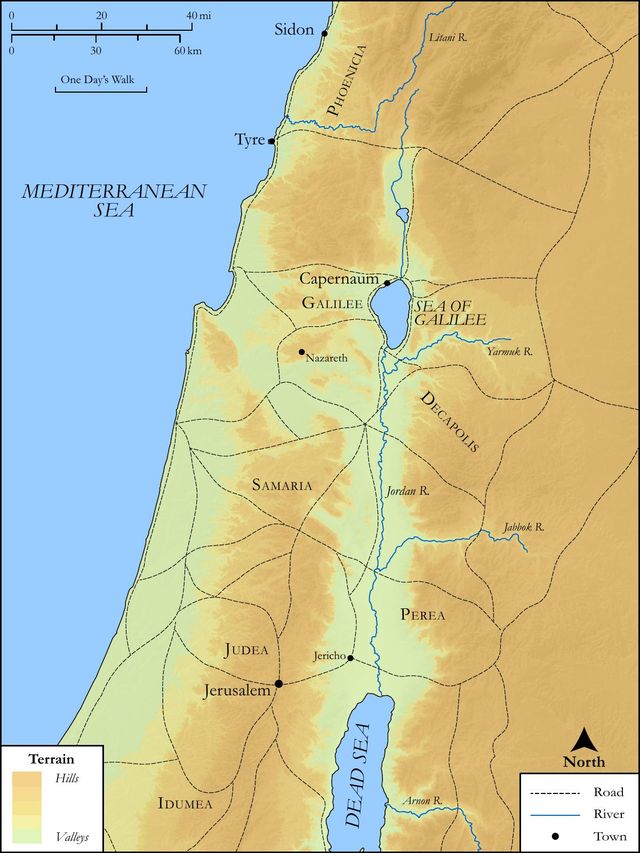
He came down with the twelve from the mountain, and stood in the plain, ready to receive those that resorted to him; and there were presently gathered about him, not only the company of his disciples, who used to attend him, but also a great multitude of people, a mixed multitude out of all Judea and Jerusalem. Though it was some scores of miles from Jerusalem to that part of Galilee where Christ now was, - though at Jerusalem they had abundance of famous rabbin, that had great names, and bore a mighty sway, - yet they came to hear Christ. They came also from the sea-coast of Tyre and Sidon. Though they who lived there were generally men of business, and though they bordered upon Canaanites, yet there were some well affected to Christ; such there were dispersed in all parts, here and there one.
1.They came to hear him and he preached to them. Those that have not good preaching near them had better travel far for it than be without it. It is worth while to go a great way to hear the word of Christ, and to go out of the way of other business for it.
2.They came to be cured by him, and he healed them. Some were troubled in body, and some in mind; some had diseases, some had devils; but both the one and the other, upon their application to Christ, were healed, for he has power over diseases and devils (Luk 6:17, Luk 6:18), over the effects and over the causes. Nay, it should seem, those who had no particular diseases to complain of yet found it a great confirmation and renovation to their bodily health and vigour to partake of the virtue that went out of him; for (Luk 6:19) the whole multitude sought to touch him, those that were in health as well as those that were sick, and they were all, one way or other, the better for him: he healed them all; and who is there that doth not need, upon some account or other, to be healed? There is a fulness of grace in Christ, and healing virtue in him, and ready to go out from him, that is enough for all, enough for each.
Historical interpretation
Nine Centuries of Reception
8 surviving comments on this verse. Each one is dated, so this reads as a timeline rather than a list.
Select a marker to jump to its quote. Markers stagger vertically where authors wrote within a few decades of each other.
Now, He has not merely related to us a story respecting a poor man and a rich one; but He has taught us, in the first place, that no one should lead a luxurious life, nor, living in worldly pleasures and perpetual feastings, should be the slave of his lusts, and forget God. "For there was," He says, "a rich man, who was clothed in purple and fine linen, and delighted himself with splendid feasts."
But observe all things carefully, how He both ascends with His Apostles and descends to the multitude; for how could the multitude see Christ but in a lowly place. It follows him not to the lofty places, it ascends not the heights. Lastly, when He descends, He finds the sick, for in the high places there can be no sick.
Note all things carefully. He ascends with the apostles and descends to the crowds. How would a crowd see Christ, except at a low level? It does not follow him to the heights; it does not climb to majestic places. So when he descends, he finds the weak, for the weak cannot be high up. Thus also Matthew teaches that the weak were healed down below. First each was healed, so that little by little, with increasing virtue, he could ascend to the mountain. On the plain he heals each, that is, he calls them back from recklessness. He turns away the harm of blindness. He descends to heal our wounds, so that in an effective and abundant manner he makes us partakers in his heavenly nature.
When the ordination of the Apostles was accomplished, and great numbers were collected together from the country of Judæa, and from the sea coast of Tyre and Sidon, (who were idolaters,) he gave the Apostles their commission to be the teachers of the whole world, that they might recal the Jews from the bondage of the law, but the worshippers of devils from their Gentile errors to the knowledge of the truth. Hence it is said, And he came down with them, and stood in the plain, and a great multitude from Judæa, and the sea coast, &c.
But after that the High Priest had made publicly known His choice of Apostles, He did many and great miracles, that the Jews and Gentiles who had assembled might know that these were invested by Christ with the dignity of the Apostleship, and that He Himself was not as another man, but rather was God, as being the Incarnate Word. Hence it follows, And the whole multitude sought to touch him, for there went virtue out of him. For Christ did not receive virtue from others, but since he was by nature God, sending out His own virtue upon the sick, He healed them all.
When he had appointed the holy apostles, he performed very many wonderful miracles, rebuking demons, delivering from incurable diseases whoever drew near to him, and displaying his own most divine power. He did these works so that both the Jews, who had run together to him, and those from the country of the Greeks might know that Christ was not some ordinary man of those in our degree but, on the contrary, God. He honored these chosen disciples with the dignity of the apostolate. He was the Word that was made man but retained nevertheless his own glory. "For power went forth from him and healed all." Christ did not borrow strength from some other person, but being himself God by nature, even though he had become flesh, he healed them all, by the demonstration of power over the sick.
By the sea coast he does not refer to the neighbouring sea of Galilee, because this would not be accounted wonderful, but it is so called from the great sea, and therein also Tyre and Sidon may be comprehended, of which it follows, Both of Tyre and Sidon. And these states being Gentile, are purposely named here, to indicate how great was the fame and power of the Saviour which had brought even the citizens of the coast to receive His healing and teaching. Hence it follows, Which came to hear him.
You will scarcely find any where that the multitudes follow our Lord to the higher places, or that a sick person is healed on a mountain; but having quenched the fever of lust and lit the torch of knowledge, each man approaches by degrees to the height of the virtues. But the multitudes which were able to touch the Lord are healed by the virtue of that touch, as formerly the leper is cleansed when our Lord touched him. The touch of the Saviour then is the work of salvation, whom to touch is to believe on Him, to be touched is to be healed by His precious gifts.
And all the crowd sought to touch him, because power went out from him and healed all. And before, the leper was cleansed by the Lord's touch, and here, the whole crowd that could touch him is healed by the power of his spirit. The touch of the Savior, therefore, is the work of salvation. To touch him is to believe in him faithfully. To be touched by him is to be strengthened by his gift. But each person abounds in their own understanding. The crowds that come from afar to hear are cured by the touch of the Lord descending into the plain. The disciples who are already trained in lesser things are brought to greater things upon the mountaintop. From these, there are also chosen those who will secretly witness his transfiguration on the mount. One above all, as if to be inebriated from the fountain of higher wisdom, rests upon the master's chest. And you will rarely find either crowds following the Lord to higher things, or anyone sick being cured on the mount, but with the fever of lust extinguished, and the light of knowledge kindled, each one gradually climbs to the pinnacle of virtues. For in the Old Testament, Moses alone ascended the mountain of God with Joshua; to govern the people in the plain until they returned, he appointed Aaron and Hur. Aaron, indeed, who is interpreted as "mountain of strength," signifies the unparalleled excellence of the Lord's Incarnation. Hur, who is called "fire," represents the gift of the Holy Spirit. For many in the Church, though they cannot accompany the teachers to penetrate the mysteries of the highest Divinity, can nonetheless be redeemed by the sacraments of the Lord's Incarnation and be marked by the fervor of the Holy Spirit.
That is, for the cure of their souls; and that they might be healed of their diseases, that is, for the cure of their bodies.
Continue studying Luke 6:19 across the web’s major study libraries — every link below opens this exact verse, chapter, or book on the destination site.
Read & Compare
 BibleGatewayThis verse in more than 200 translations and 70 languages.
 Bible.comThe YouVersion reader — hundreds of translations, reading plans, and highlights.
 ESV.orgCrossway's official English Standard Version reader.
 NET BibleThe NET translation with 60,000+ translators' notes on every rendering decision.
 STEP BibleTyndale House's free study tool — original text, vocabulary, and scholarly resources.
 BibliaLogos Bible Software's free web reader.
 USCCBThe New American Bible (Revised Edition) with the U.S. bishops' study notes.
Commentaries
 BibleHub CommentariesDozens of classic commentaries on this verse, gathered on one page.
 StudyLightMore than 100 commentary sets — the largest collection on the web.
 BibleRefPlain-English commentary on what this verse means, verse by verse.
 Enduring WordDavid Guzik's free commentary on this chapter, widely used by Bible teachers.
 Bible Study ToolsVerse commentary alongside Greek and Hebrew study aids.
Original Language & Research
- BibleHub InterlinearThe verse word by word — original language, transliteration, and English.
- BibleHub LexiconEvery word's original-language definition and Strong's entry.
 Blue Letter BibleDeep-study tools — Strong's numbers, concordance, and word studies.
 CNTR CollationThe earliest Greek manuscripts of this verse, collated letter by letter.
Sermons, Hymns & Audio


TrulyRandomVerse is not affiliated with these sites and doesn’t control their content. They’re linked because they’re genuinely useful.
Summary
Luke 6:19 encapsulates a pivotal moment in Jesus' public ministry, vividly portraying the immense need of the gathered crowds and the boundless, inherent power of Christ to meet that need. It describes how a vast multitude, driven by desperation and hope, actively sought physical contact with Jesus, believing in His capacity to heal. The verse then affirms that divine power, described as "virtue," emanated from Him, resulting in the complete healing of everyone who came to Him, demonstrating His universal compassion and authority over all affliction.
Context
ShowHideLiterary Context
This verse is strategically placed within Luke's narrative immediately following the selection of the twelve apostles (Luke 6:12-16) and the commencement of Jesus' significant "Sermon on the Plain" (Luke 6:17-49). Having established His authoritative teaching and chosen His core disciples, Luke transitions to a powerful demonstration of Jesus' divine authority through miraculous healing. The preceding verses (Luke 6:17-18) set the scene, detailing the diverse origins of the crowd—from Judea, Jerusalem, and the coastal regions of Tyre and Sidon—all drawn by the dual desire to hear His teaching and be healed. Verse 19 serves as the climactic summary of this healing outpouring, illustrating the direct and immediate outcome of the multitude's active pursuit of Jesus.
Historical & Cultural Context
In first-century Palestine, illness and disease were often viewed through a spiritual lens, frequently attributed to sin or demonic influence. Medical understanding was rudimentary, and effective cures were rare, leading people to seek divine intervention or the aid of spiritual healers. The widespread reputation of Jesus as a miracle worker, particularly one who healed all manner of diseases and cast out demons, would have traveled quickly, drawing vast crowds from across geographical and social divides. The act of "touching" a revered figure for healing was not uncommon in ancient cultures, reflecting a belief in the transference of power or blessing through physical contact. This context highlights the desperation and earnest hope of the people, who saw in Jesus their only recourse for relief from suffering, a hope rooted in the Old Testament prophecies of a Messiah who would bring healing and restoration, as seen in passages like Isaiah 35:5-6.
Key Themes
ShowHideLuke 6:19 powerfully contributes to several overarching themes in Luke's Gospel and the broader biblical narrative. Central is the theme of Divine Authority and Power, manifested in Jesus' ability to heal all who came to Him, underscoring His unique identity as the Son of God. This healing power, referred to as "virtue" (Greek: dynamis), is not merely a moral quality but a tangible, inherent divine energy. Another prominent theme is Compassion and Universal reach, as Jesus "healed them all," demonstrating His boundless mercy and willingness to extend His grace to everyone, regardless of their background or the nature of their affliction. This universal healing foreshadows the expansive nature of the Kingdom of God, open to all who respond in faith. Finally, the "whole multitude sought to touch him" highlights the theme of Active Faith and Seeking, even if rudimentary, as the people's earnest pursuit and belief in Jesus' capacity to heal were prerequisites for receiving His transformative touch. This echoes the broader call to seek God with all one's heart, as encouraged in Jeremiah 29:13.
Exposition and Analysis
ShowHideKey Word Analysis
ShowHideThis verb means "to seek (literally or figuratively); specially, (by Hebraism) to worship (God), or (in a bad sense) to plot (against life)." In this context, it denotes an active, earnest pursuit by the multitude, indicating their strong desire and intention to find Jesus and experience His power. It implies more than casual curiosity; it suggests a determined effort to draw near to Him for a specific purpose.
This significant term derives from δύναμαι, meaning "force (literally or figuratively); specially, miraculous power (usually by implication, a miracle itself)." It is the root of English words like "dynamic" and "dynamite." Here, "virtue" does not refer to moral goodness but to an inherent, active, and miraculous divine power or energy that emanated from Jesus, capable of producing supernatural effects, specifically healing.
This is a middle voice verb meaning "to cure (literally or figuratively); heal, make whole." It signifies a complete restoration to health, encompassing not just the cessation of symptoms but a holistic making whole. The use of this verb emphasizes the effectiveness and completeness of Jesus' work.
Verse Breakdown
ShowHide"And the whole multitude sought to touch him"
This clause emphasizes the overwhelming number of people ("the whole multitude," G3956 pâs and G3793 óchlos, indicating a vast, undifferentiated crowd) and their collective, determined action. Their "seeking to touch him" (G2212 zētéō and G680 háptomai) signifies a desperate, active pursuit, reflecting a belief that physical proximity or contact with Jesus would bring about healing. This act of seeking and touching was an expression of their rudimentary, yet potent, faith and hope.
"for there went virtue out of him"
This explanatory clause (introduced by "for," G3754 hóti) reveals the source and mechanism of the healing. It was not merely a passive wish or a placebo effect, but a tangible, active "virtue" (G1411 dýnamis – divine, miraculous power) that "went out" (G1831 exérchomai) from Jesus. This implies an active, intentional, or inherent outflow of divine energy from His person, confirming His unique, supernatural nature as the fount of all healing power.
"and healed [them] all"
This final clause highlights the comprehensive and universal nature of Jesus' healing work. The phrase "healed them all" (G2390 iáomai and G3956 pâs) underscores that no one was turned away, and every individual who sought Him received complete restoration. This demonstrates Jesus' boundless compassion, His unlimited capacity, and His absolute authority over all forms of sickness and affliction, leaving no one unhealed.
Literary Devices
ShowHideLuke 6:19 is rich in literary devices that amplify its message. The phrase "the whole multitude" employs Hyperbole, emphasizing the vast, almost uncountable number of people drawn to Jesus, conveying the overwhelming impact of His ministry. The use of "virtue" for divine power is a form of Metonymy, where a quality (virtue) stands for the inherent power or essence of Jesus' being. The act of "touching him" functions as Symbolism, representing not just physical contact but an act of desperate faith and belief in Jesus' healing capacity, a tangible expression of their desire to connect with the source of power. The complete healing of "them all" is an example of Totalization, stressing the comprehensive and absolute nature of Jesus' power and compassion, leaving no one untouched by His restorative work. This scene also serves as a Theophany, a visible manifestation of God's presence and power, as Jesus' healing acts reveal His divine nature and authority.
Theological and Thematic Connections
ShowHideLuke 6:19 provides a profound theological statement about the person and power of Jesus Christ. It unequivocally asserts His divine authority over all sickness and disease, portraying Him as the ultimate source of healing and wholeness. The "virtue" emanating from Him is not a limited resource but an inexhaustible wellspring of divine dynamis, demonstrating that His power is inherent, not derived. This passage underscores God's active involvement in human suffering, revealing a compassionate God who draws near to His people in their brokenness. It also highlights the principle that while God's power is sovereign, human seeking and faith, however expressed, often precede the experience of His miraculous intervention. The universal scope of "healed them all" points to God's non-discriminatory love and His desire for the complete restoration of humanity, foreshadowing the comprehensive nature of salvation offered through Christ.
Reflection and Application
ShowHideLuke 6:19 offers enduring encouragement and a profound challenge for contemporary believers. It reminds us that Jesus Christ, the same yesterday, today, and forever, possesses an inexhaustible wellspring of divine power, a "virtue" capable of addressing every human need—physical, emotional, and spiritual. Just as the multitude in Luke's day pressed in to touch Him, we are invited to draw near to Christ with expectant faith, believing that His power is still available to heal, restore, and make whole. This passage calls us to move beyond passive observation to active seeking, to bring our deepest needs and our most desperate prayers before the One who has demonstrated boundless compassion and unlimited capacity to heal "all." It compels us to trust in His sovereignty and goodness, even when healing manifests in ways we don't anticipate, knowing that His ultimate purpose is our wholeness in Him.
Questions for Reflection
ShowHideFAQ
ShowHideWhat does "virtue" mean in this verse, and is it different from moral virtue?
ShowHideIn Luke 6:19, "virtue" (Greek: dýnamis, G1411) does not refer to moral excellence or goodness in the way we typically use the word "virtue" today. Instead, it signifies inherent power, strength, or miraculous ability. It's the same root word from which we get "dynamic" or "dynamite." In this context, it describes a tangible, divine energy or force that emanated from Jesus, enabling Him to perform miracles and heal. It underscores that Jesus' healing was not merely a psychological effect but a supernatural outflow of His divine nature, as seen also in Mark 5:30 when He perceived that "virtue is gone out of me" after the woman with the issue of blood touched His garment.
Why did the multitude seek to "touch" Jesus for healing?
ShowHideThe act of "touching" Jesus was a common expression of faith and desperation in the ancient world, reflecting a belief that physical contact with a holy or powerful person could transmit healing or blessing. In the Gospels, touching is often a conduit for Jesus' power, as seen in numerous healing accounts. It symbolized a tangible connection to the source of power and a deep conviction in His ability to heal. For the multitude, it was an active step of faith, however rudimentary, demonstrating their belief that proximity to Jesus and physical contact would bring the desired restoration. This is similar to the woman with the issue of blood who believed that merely touching Jesus' garment would make her well (Luke 8:44).
Does Jesus still heal today, and how can we experience His "virtue"?
ShowHideYes, the Bible teaches that Jesus Christ is "the same yesterday, and to day, and for ever" (Hebrews 13:8). His power and compassion are undiminished. While physical healing may not always manifest in the exact same way as in the Gospels, God continues to heal through various means, including medical science, prayer, and miraculous intervention according to His sovereign will. We can experience His "virtue" by drawing near to Him in faith through prayer, studying His Word, participating in Christian community, and trusting in His unfailing love and power for our holistic well-being—spiritually, emotionally, and physically. The ultimate healing He offers is spiritual transformation and eternal life, which is available to all who believe in Him (John 3:16).
Christ-Centered Fulfillment
ShowHideLuke 6:19, with its vivid portrayal of Jesus' boundless healing power, finds its ultimate Christ-centered fulfillment not merely in physical restoration but in the comprehensive salvation He accomplished through His life, death, and resurrection. The "virtue" (Greek: dýnamis) that flowed from Jesus to heal every physical ailment foreshadows the infinitely greater power that flowed from Him on the cross to heal the deepest spiritual malady of humanity: sin. Isaiah prophesied that the Messiah would bear our sicknesses and carry our pains (Isaiah 53:4), a prophecy Matthew explicitly connects to Jesus' healing ministry (Matthew 8:17). However, the ultimate fulfillment of this bearing of infirmities is found in His atoning sacrifice, where "by whose stripes ye were healed" (1-peter/2-24), referring primarily to spiritual healing from sin. Jesus, the Great Physician, did not just mend broken bodies; He came to reconcile broken humanity to a holy God, offering eternal wholeness. His earthly ministry of healing was a tangible signpost, pointing to His ultimate mission to conquer sin, death, and the devil, thereby offering a more profound and lasting healing for the human soul. The comprehensive healing of "them all" in Luke 6:19 is a beautiful microcosm of the universal scope of the gospel, inviting all people to come to the One who has power to save and to make all things new (Revelation 21:5).