


Job 38:25
Bible text: King James Version (1769 Blayney text) · Public domain
Bible text: Berean Standard Bible · Public domain
Bible text: American Standard Version (1901) · Public domain
Bible text: World English Bible, Messianic edition · Public domain
Bible text: Geneva Bible (1599) · Public domain
Bible text: Young's Literal Translation · Public domain
- מִיmiwho?H4310InterrogPronoun Interrogative
- פִלַּגfi·Lagdoes he divideH6385V-Piel-Perf-3msVerb Piel Perfect 3rd Singular Masculine
- לַשֶּׁטֶףla·She·teffor the floodH7858Prep-l ¦ N-msNoun Singular Masculine Absoluteלַfor theשֶּׁטֶףflood
- תְּעָלָהte·'a·Laha channelH8585N-fsNoun Singular Feminine Absolute
- וְדֶרֶךְve·De·rekhand a pathH1870Conj-w ¦ N-csNoun Singular common gender Absoluteוְandדֶרֶךְa path
- לַחֲזִיזla·cha·Zizfor [the] storm ofH2385Prep-l ¦ N-mscNoun Singular Masculine Constructלַforחֲזִיז[the] storm of
- קֹלוֹתko·Lotthunder clapsH6963N-fpNoun Plural Feminine Absolute
English is a literal word-by-word gloss of the Hebrew, not the KJV's wording. Why?
This is the original text the KJV's translators worked from — each Hebrew word with its own literal English meaning in this verse, prepared by scholars at Tyndale House, Cambridge. The KJV translates whole sentences, not word by word, so its wording differs: one Hebrew word can become several English words, and the KJV may choose “the LORD” where the gloss reads “Yahweh”. Both are faithful — they answer different questions. For the KJV's own rendering, switch to the KJV text.
Details
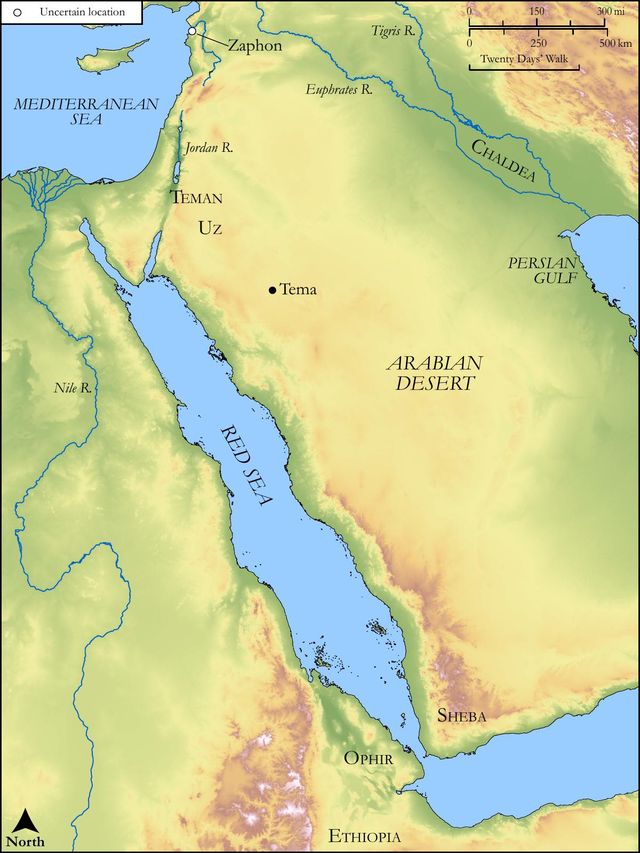
See on the biblical-era map
Study this verse
Public-domain commentary
Matthew Henry
From his Commentary on the Whole Bible. Henry comments on passages, not single verses — this entry covers Job 38:25–41. His four-level outline is real structure in the source text, so it is rendered as structure.
Hitherto God had put such questions to Job as were proper to convince him of his ignorance and short-sightedness. Now he comes, in the same manner, to show his impotency and weakness. As it is but little that he knows, and therefore he ought not to arraign the divine counsels, so it is but little that he can do, and therefore he ought not to oppose the proceedings of Providence. Let him consider what great things God does, and try whether he can do the like, or whether he thinks himself an equal match for him.
I.God has thunder, and lightning, and rain, and frost, at command, but Job has not, and therefore let him not dare to compare himself with God, or to contend with him. Nothing is more uncertain than what weather it shall be, nor more out of our reach to appoint; it shall be what weather pleases God, not what pleases us, unless, as becomes us, whatever pleases God pleases us. Concerning this observe here,
1.How great God is.
(1.)He has a sovereign dominion over the waters, has appointed them their course, even then when they seem to overflow and to be from under his check, Job 38:25. He has divided a water-course, directs the rain where to fall, even when the shower is most violent, with as much certainty as if it were conveyed by canals or conduit-pipes. Thus the hearts of kings are said to be in God's hand; and as the rains, those rivers of God, he turns them whithersoever he will. Every drop goes as it is directed. God has sworn that the waters of Noah shall no more return to cover the earth; and we see that he is able to make good what he has promised, for he has the rain in a water-course.
(2.)He has dominion over the lightning and the thunder, which go not at random, but in the way that he directs them. They are mentioned here because he prepares the lightnings for the rain, Psa 135:7. Let not those that fear God be afraid of the lightning or the thunder, for they are not blind bullets, but go the way that God himself, who means no hurt to them, directs.
(3.)In directing the course of the rain he does not neglect the wilderness, the desert land (Job 38:26, Job 38:27), where no man is.
[1.]Where there is no man to be employed in taking care of the productions. God's providence reaches further than man's industry. If he had not more kindness for many of the inferior creatures than man has, it would go ill with them. God can make the earth fruitful without any art or pains of ours, Gen 2:5, Gen 2:6. When there was not a man to till the ground, yet there went up a mist and watered it. But we cannot make it fruitful without God; it is he that gives the increase.
[2.]Where there is no man to be provided for nor to take the benefit of the fruits that are produced. Though God does with very peculiar favour visit and regard man, yet he does not overlook the inferior creatures, but causes the bud of the tender herb to spring forth for food for all flesh, as well as for the service of man. Even the wild asses shall have their thirst quenched, Psa 104:11. God has enough for all, and wonderfully provides even for those creatures that man neither has service from nor makes provision for.
(4.)He is, in a sense, the Father of the rain, Job 38:28. It has no other father. He produces it by his power; he governs and directs it, and makes what use he pleases of it. Even the small drops of the dew he distils upon the earth, as the God of nature; and, as the God of grace, he rains righteousness upon us and is himself as the dew unto Israel. See Hos 14:5, Hos 14:6; Mic 5:7.
(5.)The ice and the frost, by which the waters are congealed and the earth incrustrated, are produced by his providence, Job 38:29, Job 38:30. These are very common things, which lessens the strangeness of them. But, considering what a vast change is made by them in a very little time, how the waters are hid as with a stone, as with a grave-stone, laid upon them (so thick, so strong, is the ice that covers them), and the face even of the deep is sometimes frozen, we may well ask, "Out of whose womb came the ice? What created power could produce such a wonderful work?" No power but that of the Creator himself. Frost and snow come from him, and therefore should lead our thoughts and meditations to him who does such great things, past finding out. And we shall the more easily bear the inconveniences of winter-weather if we learn to make this good use of it.
2.How weak man is. Can he do such things as these? Could Job? No, v. 34, 35.
(1.)He cannot command one shower of rain for the relief of himself or his friends: "Canst thou lift up thy voice to the clouds, those bottles of heaven, that abundance of waters may cover thee, to water thy fields when they are dry and parched?" If we lift up our voice to God, to pray for rain, we may have it (Zac 10:1); but if we lift up our voice to the clouds, to demand it, they will soon tell us they are not at our beck, and we shall go without it, Jer 14:22. The heavens will not her the earth unless God hear them, Hos 2:21. See what poor, indigent, depending creatures we are; we cannot do without rain, nor can we have it when we will.
(2.)He cannot commission one flash of lightning, if he had a mind to make use of it for the terror of his enemies (Job 38:35): "Canst thou send lightnings, that they may go on thy errand, and do the execution thou desirest? Will they come at thy call, and say unto thee, Here we are?" No, the ministers of God's wrath will not be ministers of ours. Why should they, since the wrath of man works not the righteousness of God? See Luk 9:55.
II.God has the stars of heaven under his command and cognizance, but we have them not under ours.
Our meditations are now to rise higher, far above the clouds, to the glorious lights above. God mentions particularly, not the planets, which move in lower orbs, but the fixed stars, which are much higher. It is supposed that they have an influence upon this earth, notwithstanding their vast distance, not upon the minds of men or the events of providence (men's fate is not determined by their stars), but upon the ordinary course of nature; they are set for signs and seasons, for days and years, Gen 1:14. And if the stars have such a dominion over this earth (Job 38:33), though they have their place in the heavens and are but mere matter, much more has he who is their Maker and ours, and who is an Eternal Mind. Now see how weak we are.
1.We cannot alter the influences of the stars (Job 38:31), not theirs that are instrumental to produce the pleasures of the spring: Canst thou loose the bands of Orion? - that magnificent constellation which makes so great a figure (none greater), and dispenses rough and unpleasing influences, which we cannot control nor repel. Both summer and winter will have their course. God can change them when he pleases, can make the spring cold, and so bind the sweet influences of Pleiades, and the winter warm, and so loose the bands of Orion; but we cannot.
2.It is not in our power to order the motions of the stars, nor are we entrusted with the guidance of them. God, who calls the stars by their names (Psa 147:4), calls them forth in their respective seasons, appointing them the time of their rising and setting. But this is not our province; we cannot bring forth Mazzaroth - the stars in the southern signs, nor guide Arcturus - those in the northern, Job 38:32. God can bring forth the stars to battle (as he did when in their courses they fought against Sisera) and guide them in the attacks they are ordered to make; but man cannot do so.
3.We are not only unconcerned in the government of the stars (the government they are under, and the government they are entrusted with, for they both rule and are ruled), but utterly unacquainted with it; we know not the ordinances of heaven, Job 38:33. So far are we from being able to change them that we can give no account of them; they are a secret to us. Shall we then pretend to know God's counsels, and the reasons of them? If it were left to us to set the dominion of the stars upon the earth, we should soon be at a loss. Shall we then teach God how to govern the world?
III.God is the author and giver, the father and fountain, of all wisdom and understanding, Job 38:36.
The souls of men are nobler and more excellent beings than the stars of heaven themselves, and shine more brightly. The powers and faculties of reason with which man is endued, and the wonderful performances of thought, bring him into some alliance to the blessed angels; and whence comes this light, but from the Father of lights? Who else has put wisdom into the inner parts of man, and given understanding to the heart?
1.The rational soul itself, and its capacities, come from him as the God of nature; for he forms the spirit of man within him. We did not make our own souls, nor can we describe how they act, nor how they are united to our bodies. He only that made them knows them, and knows how to manage them. He fashioneth men's hearts alike in some things, and yet unlike in others.
2.True wisdom, with its furniture and improvement, comes from him as the God of grace and the Father of every good and perfect gift. Shall we pretend to be wiser than God, when we have all our wisdom from him? Nay, shall we pretend to be wise above our sphere, and beyond the limits which he that gave us our understanding sets to it? He designed we should with it serve God and do our duty, but never intended we should with it set up for directors of the stars or the lightning.
IV.God has the clouds under his cognizance and government, but so have not we, Job 38:37.
Can any man, with all his wisdom, undertake to number the clouds, or (as it may be read) to declare and describe the nature of them? Though they are near us, in our own atmosphere, yet we know little more of them than of the stars which are at so great a distance. And when the clouds have poured down rain in abundance, so that the dust grows into solid mire and the clods cleave fast together (Job 38:38), who can stay the bottles of heaven? Who can stop them, that it may not always rain? The power and goodness of God are herein to be acknowledged, that he gives the earth rain enough, but does not surfeit it, softens it, but does not drown it, makes it fit for the plough, but not unfit for the seed. As we cannot command a shower of rain, so we cannot command a fair day, without God; so necessary, so constant, is our dependence upon him.
V.God provides food for the inferior creatures, and it is by his providence, not by any care or pains of ours, that they are fed.
The following chapter is wholly taken up with the instances of God's power and goodness about animals, and therefore some transfer to it the last three verses of this chapter, which speak of the provision made,
1.For the lions, Job 38:39, Job 38:40. "Thou dost not pretend that the clouds and stars have any dependence upon thee, for they are above thee; but on the earth thou thinkest thyself paramount; let us try that then: Wilt thou hunt the prey for the lion? Thou valuest thyself upon thy possessions of cattle which thou wast once owner of, the oxen, and asses, and camels, that were fed at thy crib; but wilt thou undertake the maintenance of the lions, and the young lions, when they couch in their dens, waiting for a prey? No, needest not do it, they can shift for themselves without thee: thou canst not do it, for thou hast not wherewithal to satisfy them: thou darest not do it; shouldst thou come to feed them, they would seize upon thee. But I do it." See the all-sufficiency of the divine providence: it has wherewithal to satisfy the desire of every living thing, even the most ravenous. See the bounty of the divine Providence, that, wherever it has given life, it will give livelihood, even to those creatures that are not only not serviceable, but dangerous, to man. And see its sovereignty, that it suffers some creatures to be killed for the support of other creatures. The harmless sheep are torn to pieces, to fill the appetite of the young lions, who yet sometimes are made to lack and suffer hunger, to punish them for their cruelty, while those that fear God want no good thing.
2.For the young ravens, Job 38:41. As ravenous beasts, so ravenous birds, are fed by the divine Providence. Who but God provides for the raven his food? Man does not; he takes care only of those creatures that are, or may be, useful to him. But God has a regard to all the works of his hands, even the meanest and least valuable. The ravens' young ones are in a special manner necessitous, and God supplies them, Psa 147:9. God's feeding the fowls, especially these fowls (Mat 6:26), is an encouragement to us to trust him for our daily bread. See here,
(1.)What distress the young ravens are often in: They wander for lack of meat. The old ones, they say, neglect them, and do not provide for them as other birds do for their young: and indeed those that are ravenous to others are commonly barbarous to their own, and unnatural.
(2.)What they are supposed to do in that distress: They cry, for they are noisy clamorous creatures, and this is interpreted as crying to God. It being the cry of nature, it is looked upon as directed to the God of nature. The putting of so favourable a construction as this upon the cries of the young ravens may encourage us in our prayers, though we can but cry, Abba, Father.
(3.)What God does for them. Some way or other he provides for them, so that they grow up, and come to maturity. And he that takes this care of the young ravens certainly will not be wanting to his people or theirs. This, being but one instance of many of the divine compassion, may give us occasion to think how much good our God does, every day, beyond what we are aware of.
Historical interpretation
Historical reception
2 surviving comments on this verse. Each one is dated, so this reads as a timeline rather than a list.
47. But if, as we said before, that persecution in the regions of Judaea is designated by the name of divided heat, because this very fierceness of persecution kept not from their office of preaching, through any fear, the holy preachers, who were assisted by the gift from on high, He fitly subjoins; Who hath given a course for the most violent showers? As if He were saying, Except Myself. For to have given a course to the most violent showers, when the heat was divided, is to have strengthened the force of preaching, amid the very difficulties of persecution, in order that the power of preachers might the more increase, the more the cruelty of persecutors stood in their way, so that they might bedew the thirsty hearts of their hearers with drops of rain, and water more abundantly the drought of unbelief; and that though the heat of cruelty was glowing against them, yet the voice of grace might not through them be silent. Paul was both enduring and watering this heat of persecution, when saying, I labour even to bonds, as an evil doer, but the word of God is not bound. [2 Tim. 2, 9] Of this shower it is said elsewhere; I will command the clouds that they rain no rain upon it. [Is. 5, 6] Of this course of the shower which is going on in the hearts of the Elect, the Psalmist witnesses, saying; His word runneth swiftly. [Ps. 147, 15] But it is generally a shower only, and has no course; because preaching comes to the ears, but inward grace not acting, it passes not through to the hearts of the hearers. And of the words of this preaching it is said, on account of the Elect; For thine arrows passed through. [Ps. 77, 17] For the arrows of God pass through, when the words of His preaching descend from the ears to the hearts. And because this is effected solely by Divine grace, the Lord witnesses that He has given a course to the shower.
48. But I see it must be observed, that He calls this same shower not ‘violent,’ but ‘most violent.’ A violent shower is great force; but a most violent one, is the boundless power of preaching. For it was a violent shower, when holy preachers were advising the belief of eternal joy. But ‘most violent,’ when they were advising men that on account of their hope their interest should be abandoned, all visible objects despised on account of invisible, and that the pains and tortures of this present world should be tolerated for the sake of the joys they have heard of. But when so many of the Elect, having learned the faith, abandoned their possessions, when the heat of persecution was raging, forgot their carnal affection, and exposed their limbs to torture for joy of spirit; what else did the Lord do, but make a course for even the most violent shower, which by bodily words so watered the invisible recesses of the heart, that it performed even the highest commands? Where it is also fitly subjoined;
And a way for the sounding thunder?
49. For what is understood by ‘thunder’ except the preaching of heavenly terror? And when the hearts of men feel this terror, they are shaken. But sometimes by thunder is set forth the Incarnate Lord Himself, Who was brought to our knowledge by the concurrent prophecy of the ancient fathers, as if by the clashing together of clouds; Who, appearing visibly among us, sounded forth awfully those things which were above us. Whence also the Holy Apostles themselves begotten by His grace were called Boanerges, that is, sons of thunder. [Mark 3, 17] But sometimes, as has been said, ‘thunder’ is taken for their preaching, by which the terror of the heavenly judgments is heard. But because any preacher can present words to the ears, but cannot open the hearts, and since, unless Almighty God alone grant the words of preachers a hearing invisibly by inward grace in the hearts of their hearers, that preaching is received in vain by the ear of the hearer, which is prevented by his deaf heart from reaching to his inmost soul; the Lord asserts that He grants a way to the sounding thunder: for when He vouchsafes the words of preaching, He pierces the heart with terror. Paul, the illustrious preacher, when he was awfully sounding forth the heavenly mysteries, seeing that he could not possess this way by himself, admonished his disciples, saying, Withal praying also for us that God would open to us a door of utterance, to speak the mystery of Christ. [Col. 4, 3] He therefore who was speaking mysteries, but was praying for a door to be opened by the Lord for these same mysteries in the heart of his hearers, possessed indeed the thunder already, but was seeking for a way to be granted it from above. John, who was saying, Ye need not that any man teach you, but as His anointing teacheth you of all things, [1 John 2, 27] knew that he could not give this way. Paul again taught Who could give this way, saying, For neither is he that planteth any thing, neither he that watereth, but God that giveth the increase. [1 Cor. 3, 7] Let us hear then what this shower and thunder effect, when the way has been granted them.
But these things that have been stated generally of the Gentile world, we see taking place, if we carefully examine them, in individuals within the bosom of holy church. For there are many, grievously insensible to the words of God, who are counted under the name of faith, who hear the words of life with their ears but do not permit them to pass through to the inward places of their heart. What else are these than desert land? And that land in truth has no human vitality, because their mind is void of the sense of reason. And no mortal dwells in this land, because if thoughts of reasonable meanings ever spring up in their conscience, they do not remain there. For evil desires find a resting place in their hearts, but if good desires have ever come there, they pass away, as if urged on. But when the merciful God deigns to give a course to his shower and a way to the sounding thunder, being stung with grace within, they open the ears of their heart to the words of life. And the pathless land is filled, for while it grants a hearing to the world, it is overwhelmed with mystery. And it brings forth green herbs, because when watered by the grace of compunction, it not only willingly receives the words of preaching but also returns them with abundant increase; so that it is now eager to speak what it could not hear, and that which had become dry, even within, through not listening, feeds with its verdure as many as are hungry.
Continue studying Job 38:25 across the web’s major study libraries — every link below opens this exact verse, chapter, or book on the destination site.
Read & Compare
 BibleGatewayThis verse in more than 200 translations and 70 languages.
 Bible.comThe YouVersion reader — hundreds of translations, reading plans, and highlights.
 ESV.orgCrossway's official English Standard Version reader.
 NET BibleThe NET translation with 60,000+ translators' notes on every rendering decision.
 STEP BibleTyndale House's free study tool — original text, vocabulary, and scholarly resources.
 BibliaLogos Bible Software's free web reader.
 USCCBThe New American Bible (Revised Edition) with the U.S. bishops' study notes.
Commentaries
 BibleHub CommentariesDozens of classic commentaries on this verse, gathered on one page.
 StudyLightMore than 100 commentary sets — the largest collection on the web.
 BibleRefPlain-English commentary on what this verse means, verse by verse.
 Enduring WordDavid Guzik's free commentary on this chapter, widely used by Bible teachers.
 Bible Study ToolsVerse commentary alongside Greek and Hebrew study aids.
Original Language & Research
- BibleHub InterlinearThe verse word by word — original language, transliteration, and English.
- BibleHub LexiconEvery word's original-language definition and Strong's entry.
 Blue Letter BibleDeep-study tools — Strong's numbers, concordance, and word studies.
 SefariaThe Hebrew text with Rashi and centuries of Jewish commentary.
Sermons, Hymns & Audio


TrulyRandomVerse is not affiliated with these sites and doesn’t control their content. They’re linked because they’re genuinely useful.
Summary
Job 38:25 is a powerful rhetorical question from God's whirlwind discourse, directly challenging Job's finite human understanding of creation and unequivocally asserting divine omnipotence over creation. This verse highlights God's meticulous and deliberate orchestration of formidable natural phenomena, specifically the routing of torrential floods and the trajectory of lightning. It presents these forces not as chaotic or random, but as precisely governed elements within God's grand design, serving as an awe-inspiring testament to the Creator's incomparable wisdom, sovereign control, and providential ordering of the entire natural world.
Context
ShowHideLiterary Context
This profound verse is situated within God's inaugural speech to Job, which begins in Job 38:1. Following prolonged debates between Job and his friends concerning the nature of suffering and divine justice, God intervenes not to explain Job's plight directly, but to re-establish His own transcendent wisdom and unparalleled power. The divine discourse is characterized by a relentless series of unanswerable rhetorical questions that sweep across the vastness of creation, from the foundational elements of the earth (Job 38:4-7) to the containment of the tumultuous sea (Job 38:8-11), and the profound mysteries of light and darkness (Job 38:19-21). Immediately preceding Job 38:25, verses Job 38:22-24 specifically inquire about God's dominion over atmospheric phenomena like snow, hail, and the distribution of light and wind, thereby setting the stage for the specific control over watercourses and lightning detailed in verse 25. The cumulative effect of this entire section is to underscore the immense chasm between human comprehension and God's absolute knowledge and control over all creation.
Historical & Cultural Context
Among the nations round about, natural phenomena such as thunderstorms, flash floods, and lightning were frequently perceived as direct manifestations of divine power, often attributed to various polytheistic deities or chaotic forces. Storm gods, like Baal in Canaanite mythology, were revered for their purported control over rain and fertility, yet also feared for their destructive potential. The geographical region associated with Job, likely Edom or northern Arabia, is characterized by arid landscapes punctuated by wadis (dry riverbeds) that could instantaneously transform into raging torrents after sudden, intense rainfall, and fierce thunderstorms were a common, awe-inspiring, and often terrifying occurrence. Against this prevailing backdrop of polytheistic and often superstitious understandings of nature, the book of Job powerfully asserts the singular, unparalleled sovereignty of Yahweh over all creation. It directly challenges any notion of chaotic forces or competing deities, unequivocally declaring that the one true God meticulously directs even the most unpredictable and formidable elements of nature, thereby demonstrating His unique wisdom and might to a people intimately acquainted with these powerful forces.
Key Themes
ShowHideThe overarching theme permeating God's majestic speech in Job 38 is the incomparable wisdom and omnipotent control of God over all creation. Job 38:25 specifically contributes to this by highlighting God's precise orchestration of seemingly chaotic and destructive natural forces. It profoundly underscores the divine order within creation, demonstrating that even the overwhelming power of floods and the instantaneous flash of lightning are not random occurrences but follow "a watercourse" and "a way" meticulously designed and directed by the Creator. This deliberate design points to God's meticulous providence, demonstrating that His governance extends to every intricate detail of the natural world. Consequently, the verse also powerfully reinforces the theme of man's limited understanding and the imperative for humility before the vastness of divine knowledge. By posing questions that Job cannot answer, God reveals the immense chasm between human wisdom and His own, encouraging Job—and indeed all readers—to place their trust implicitly in the One who holds all things securely in His hands, even when His ways are beyond human comprehension, as profoundly articulated in Isaiah 55:8-9.
Exposition and Analysis
ShowHideKey Word Analysis
ShowHideFrom a primitive root meaning "to split (literally or figuratively)," this verb signifies an active, deliberate act of separating, channeling, or distributing. In the context of "watercourse," it implies a precise, intentional engineering or carving out of a path for the waters, much like an irrigation channel or a riverbed that has been specifically shaped and directed. This emphasizes God's active and precise control over the movement of vast quantities of water, even in their most overwhelming and destructive forms, demonstrating His purposeful design rather than random occurrence.
This noun refers to a "channel" or "conduit" into which water is raised or directed, often for irrigation. Its inclusion here underscores the idea of a designed, purposeful path for water, even for "overflowing waters." It suggests a system, a pre-ordained route, rather than an uncontrolled, chaotic deluge. God is depicted as the master engineer who not only initiates the rain but also meticulously directs its flow, even in its most powerful manifestations.
This common Hebrew noun signifies a "path," "road," or "course." When applied to lightning, it denotes a pre-ordained or directed trajectory, rather than a haphazard, unpredictable flash. The implication is that even the erratic and sudden burst of lightning has a "way" or a course determined by God. This reinforces the idea of divine order and control extending to the most instantaneous, unpredictable, and powerful natural phenomena, leaving nothing to chance.
Verse Breakdown
ShowHide"Who hath divided a watercourse for the overflowing of waters,"
This clause refers to God's sovereign control over torrential downpours and flash floods. The "overflowing of waters" (Hebrew: sheṭeph, H7858) speaks of a sudden, overwhelming deluge, often associated with destruction. The rhetorical question asks who but God could possibly "divide" or channel such immense, potentially destructive forces, guiding their path and limiting their scope. It highlights God's power to bring order to chaos, even within the most powerful hydrological events, ensuring they serve His purposes rather than operating randomly or uncontrollably.
"or a way for the lightning of thunder;"
This second clause extends the divine challenge to atmospheric phenomena, specifically lightning. Lightning, often perceived as an unpredictable and terrifying force, is here presented as having a "way" or a directed path. The "thunder" (Hebrew: qôwl, H6963, meaning "voice" or "sound," often specifically "thunder") is intrinsically linked, emphasizing the awesome power and audible majesty of the storm. The question posits that only God possesses the wisdom and power to direct the instantaneous, destructive bolts of lightning, demonstrating His absolute mastery over the most formidable and swift elements of nature.
Literary Devices
ShowHideThe primary literary device employed throughout God's speech in Job 38, and powerfully exemplified in verse 25, is the Rhetorical Question. God poses a series of questions that Job cannot possibly answer, not because He seeks information, but to underscore the vast disparity between divine omnipotence and human limitation. This technique serves to humble Job and highlight God's unparalleled wisdom and power. Additionally, there is a subtle yet profound use of Personification in the idea of "dividing a watercourse" or providing "a way" for lightning. These natural forces are implicitly portrayed as obedient entities that follow God's commands and predetermined paths, thereby imbuing nature with a sense of purpose and subservience to the Creator. Finally, Imagery is vividly employed, painting a picture of overwhelming floods and searing lightning—forces that evoke both profound awe and primal terror—thereby emphasizing the immense, uncontainable power of the One who holds them in meticulous control.
Theological and Thematic Connections
ShowHideJob 38:25 powerfully articulates the biblical doctrine of God's absolute sovereignty over creation, extending even to the most chaotic and destructive elements of the natural world. This is not merely a display of raw power, but an demonstration of His infinite wisdom, as He meticulously orders and directs phenomena that appear random or uncontrollable to human eyes. This divine control ensures that all of creation, from the gentle rain to the raging storm, ultimately serves His purposes, reflecting His providential care and His ultimate authority over all things. It challenges any worldview that attributes natural events to chance or to lesser deities, firmly establishing Yahweh as the sole and supreme orchestrator of all creation, whose ways are beyond human comprehension but always purposeful.
Reflection and Application
ShowHideJob 38:25 calls us to a profound sense of awe, humility, and unwavering trust before the Creator. In a world that often seeks to explain everything through purely naturalistic processes, this verse serves as a powerful reminder of the divine hand behind the intricate workings of the universe. It encourages us to trust implicitly in the God who orchestrates even the most unpredictable and formidable forces of nature, knowing that His wisdom and power are infinitely beyond our comprehension. This trust can bring immense comfort and stability in times of personal uncertainty, chaos, or suffering, reminding us that the same God who channels the floodwaters and directs the lightning also holds our lives, our circumstances, and our future securely in His sovereign hands. It invites us to surrender our limited understanding and anxieties to the One whose control is absolute and whose purposes are always good, even when we cannot discern them.
Questions for Reflection
ShowHideFAQ
ShowHideWhat is the main purpose of God's questions to Job in this chapter?
ShowHideThe main purpose of God's extensive rhetorical questions in Job 38 is not to provide a direct explanation for the specific reasons behind Job's suffering. Instead, it is to profoundly demonstrate God's incomparable wisdom, omnipotent power, and absolute sovereignty over all creation. By challenging Job with phenomena that only the Creator could possibly comprehend or control, God places Job's limited human understanding into proper perspective, humbling him and reminding him of the vast, unbridgeable chasm between divine and human knowledge. This discourse ultimately re-establishes God's supreme authority and wisdom as the ultimate, sufficient answer to Job's questioning and his desire for an explanation.
How does Job 38:25 challenge or relate to modern scientific understanding of natural phenomena?
ShowHideJob 38:25 does not deny the existence of natural laws or scientific explanations for phenomena like the formation of watercourses or the physics of lightning. Rather, it asserts that behind these observable laws and processes is a divine orchestrator and sustainer. While science meticulously describes how nature operates, this verse speaks to who established, sustains, and directs those operations. It challenges a purely materialistic or random view of the universe, suggesting that the profound order, precision, and immense power observed in nature are compelling evidence of an intelligent, sovereign Creator who "divided" and "made a way" for these forces. It invites us to perceive the divine hand in the very mechanisms that science investigates, pointing to a God who is both transcendent above His creation and intimately involved in its every detail, as powerfully articulated in Colossians 1:17.
Christ-Centered Fulfillment
ShowHideJob 38:25, with its majestic depiction of God's sovereign control over the elements and the very fabric of creation, finds its ultimate fulfillment and clearest revelation in the person of Jesus Christ. The New Testament unequivocally reveals Jesus as the very Son of God, the pre-existent Word through whom all things were created and by whom all things are continually sustained (Colossians 1:16-17). The divine power to "divide a watercourse" or make "a way for the lightning" is perfectly embodied in Jesus, who demonstrated His inherent authority over nature during His earthly ministry. We witness this most vividly when He calmed a furious storm on the Sea of Galilee with a mere word, rebuking the wind and commanding the waves, "Peace, be still!" (Mark 4:39). This miraculous act was not merely a display of power but a profound affirmation of His divine identity, mirroring the Creator's dominion described in Job. Jesus, as the "wisdom of God" and the "power of God" (1 Corinthians 1:24), is the one through whom the intricate design and ordering of creation, including the precise paths of water and lightning, were established and are maintained. His dominion extends beyond physical creation to the spiritual realm, offering the definitive "way" through the chaos of sin and death, ultimately bringing divine order, reconciliation, and new life through His atoning sacrifice and glorious resurrection (John 14:6).