


Job 37:3
Bible text: King James Version (1769 Blayney text) · Public domain
Bible text: Berean Standard Bible · Public domain
Bible text: American Standard Version (1901) · Public domain
Bible text: World English Bible, Messianic edition · Public domain
Bible text: Geneva Bible (1599) · Public domain
Bible text: Young's Literal Translation · Public domain
- תַּחַתta·chatunderH8478N-mscNoun Singular Masculine Construct
- כָּלkolallH3605N-mscNoun Singular Masculine Construct
- הַשָּׁמַיִםha·sha·Ma·yimthe heavensH8064Art ¦ N-mpNoun Plural Masculine Absoluteהַtheשָּׁמַיִםheavens
- יִשְׁרֵהוּyish·Re·huhe lets loose itH8281V-Qal-Imperf-3ms ¦ 3msVerb Qal Imperfect 3rd Singular Masculineיִשְׁרֵhe lets looseהוּit
- וְאוֹרוֹve·'o·Roand his lightH216Conj-w ¦ N-fsc ¦ 3msNoun Singular Feminine Constructוְandאוֹרlightוֹhis
- עַל'altoH5921PrepPreposition
- כַּנְפוֹתkan·Fot[the] corners ofH3671N-fpcNoun Plural Feminine Construct
- הָאָרֶץha·'A·retzthe earthH776Art ¦ N-fsNoun Singular Feminine Absoluteהָtheאָרֶץearth
English is a literal word-by-word gloss of the Hebrew, not the KJV's wording. Why?
This is the original text the KJV's translators worked from — each Hebrew word with its own literal English meaning in this verse, prepared by scholars at Tyndale House, Cambridge. The KJV translates whole sentences, not word by word, so its wording differs: one Hebrew word can become several English words, and the KJV may choose “the LORD” where the gloss reads “Yahweh”. Both are faithful — they answer different questions. For the KJV's own rendering, switch to the KJV text.
Details
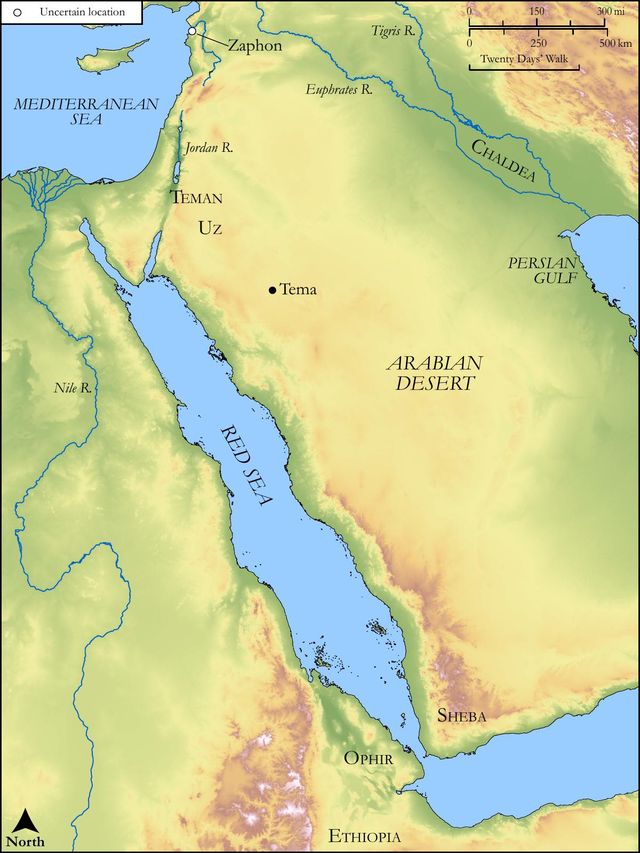
See on the biblical-era map
Study this verse
Public-domain commentary
Matthew Henry
From his Commentary on the Whole Bible. Henry comments on passages, not single verses — this entry covers Job 37:1–5.
Thunder and lightning, which usually go together, are sensible indications of the glory and majesty, the power and terror, of Almighty God, one to the ear and the other to the eye; in these God leaves not himself without witness of his greatness, as, in the rain from heaven and fruitful seasons, he leaves not himself without witness of his goodness (Act 14:17), even to the most stupid and unthinking. Though there are natural causes and useful effects of them, which the philosophers undertake to account for, yet they seem chiefly designed by the Creator to startle and awaken the slumbering world of mankind to the consideration of a God above them. The eye and the ear are the two learning senses; and therefore, though such a circumstance is possible, they say it was never known in fact that any one was born both blind and deaf. By the word of God divine instructions are conveyed to the mind through the ear, by his works through the eye; but, because those ordinary sights and sounds do not duly affect men, God is pleased sometimes to astonish men by the eye with his lightnings and by the ear with his thunder. It is very probable that at this time, when Elihu was speaking, it thundered and lightened, for he speaks of the phenomena as present; and, God being about to speak (Job 38:1), these were, as afterwards on Mount Sinai, the proper prefaces to command attention and awe. Observe here, 1. How Elihu was himself affected, and desired to affect Job, with the appearance of God's glory in the thunder and lightning (Job 37:1, Job 37:2): "For my part," says Elihu, "my heart trembles at it; though I have often heard it, often seen it, yet it is still terrible to me, and makes every joint of me tremble, and my heart beat as if it would move out of its place." Thunder and lightning have been dreadful to the wicked: the emperor Caligula would run into a corner, or under a bed, for fear of them. Those who are very much astonished, we say, are thunder-struck. Even good people think thunder and lightning very awful; and that which makes them the more terrible is the hurt often done by lightning, many having been killed by it. Sodom and Gomorrah were laid in ruins by it. It is a sensible indication of what God could do to this sinful world, and what he will do, at last, by the fire to which it is reserved. Our hearts, like Elihu's should tremble at it for fear of God's judgments, Psa 119:120. He also calls upon Job to attend to it (Job 37:2): Hear attentively the noise of his voice. Perhaps as yet it thundered at a distance, and could not be heard without listening: or rather, Though the thunder will be heard, and whatever we are doing we cannot help attending to it, yet, to apprehend and understand the instructions God thereby gives us, we have need to hear with great attention and application of mind. Thunder is called the voice of the Lord (Psa 29:3, etc.), because by it God speaks to the children of men to fear before him, and it should put us in mind of that mighty word by which the world was at first made, which is called thunder. Psa 104:7, At the voice of thy thunder they hasted away, namely, the waters, when God said, Let them be gathered into one place. Those that are themselves affected with God's greatness should labour to affect others. 2. How he describes them. (1.) Their original, not their second causes, but the first. God directs the thunder, and the lightning is his, Job 37:3. Their production and motion are not from chance, but from the counsel of God and under the direction and dominion of his providence, though to us they seem accidental and ungovernable. (2.) Their extent. The claps of thunder roll under the whole heaven, and are heard far and near; so are the lightnings darted to the ends of the earth; they come out of the one part under heaven and shine to the other, Luk 17:24. Though the same lightning and thunder do not reach to all places, yet they reach to very distant places in a moment, and there is no place but, some time or other, has these alarms from heaven. (3.) Their order. The lightning is first directed, and after it a voice roars, Job 37:4. The flash of fire, and the noise it makes in a watery cloud, are really at the same time; but, because the motion of light is much quicker than that of sound, we see the lightning some time before we hear the thunder, as we see the firing of a great gun at a distance before we hear the report of it. The thunder is here called the voice of God's excellency, because by it he proclaims his transcendent power and greatness. He sends forth his voice and that a mighty voice, Psa 68:33. (4.) Their violence. He will not stay them, that is, he does not need to check them, or hold them back, lest they should grow unruly and out of his power to restrain them, but lets them take their course, says to them, Go, and they go - Come, and they come - Do this, and they do it. He will not stay the rains and showers that usually follow upon the thunder (which he had spoken of, Job 36:27, Job 36:29), so some, but will pour them out upon the earth when his voice is heard. Thunder-showers are sweeping rains, and for them he makes the lightnings, Psa 135:7. (5.) The inference he draws from all this, Job 37:5. Does God thunder thus marvellously with his voice? We must then conclude that his other works are great, and such as we cannot comprehend. From this one instance we may argue to all, that, in the dispensations of his providence, there is that which is too great, too strong, for us to oppose or strive against, and too high, too deep, for us to arraign or quarrel with.
Historical interpretation
Two Centuries of Reception
3 surviving comments on this verse. Each one is dated, so this reads as a timeline rather than a list.
Select a marker to jump to its quote. Markers stagger vertically where authors wrote within a few decades of each other.
35. As if it were plainly said; He who rules over the highest things, forsakes not even the most remote. Because His watchful rule is so directed towards the greatest concerns, as not to be kept from those which are little. For He Who is every where present, and every where equal, is not unlike Himself, even in unlike circumstances. He therefore equally regards all things, equally disposes all things, Who, though present in all places, is not locally confined, nor varied by attending to various concerns. But if we understand by the heavens, holy preachers, (as the Prophet attests who says, The heavens declare the glory of God;) [Ps. 19, 1] after the coming of the Holy Spirit is designated by the sound of the mouth, it is rightly subjoined, He Himself considereth under all the heavens, and His light is over the ends of the earth.
36. For there are some, who, when they hear the wonderful works of the Apostles, (that they raised the dead by the Holy Spirit which they had received, cast out devils from the possessed, removed infirmities by their shadow, foretold future events by prophecy, and, speaking in the tongue of all nations, preached the Only Begotten Word of God;) because they do not see these powers now in the Church, suspect that the grace of heaven has been already withdrawn from the Church, forgetting to consider that it is written, An assister in needful times, in tribulation. [Ps. 9, 9] For Holy Church required then the assistance of miracles, when the tribulation of persecution oppressed her. For after she has overcome the pride of unbelief, she requires no longer the signs of miracles, but the merits of deeds alone, though she displays even them by many persons, when opportunity demands. For it is written, Tongues are for a sign not to them that believe, but to them that believe not. [1 Cor. 14, 22] Where then all are faithful, what cause demands signs to be displayed? On which head perhaps we the more readily give satisfaction, if we make some mention of the Apostolic dispensation.
37. For Paul, the illustrious preacher, coming to Melite, and knowing the island to be full of unbelievers, healed by his prayers the father of Publius, afflicted with dysentery and fevers; [Acts 28, 8] and yet advised Timothy when sick, saying, Use a little wine for thy stomach’s sake, and thine often infirmities. [1 Tim. 5, 23] Why is it, O Paul, that thou restorest the sick unbeliever to health by thy prayers, and yet healest so great a defender of the Gospel by food, like a physician? except that outward miracles are wrought, in order that the minds of men may be brought to inward truths; that so by the wonder which is visibly displayed, those invisible truths, which are more wonderful, may be believed? For the father of Publius required to be healed by a sign of power, in order that he might revive in mind, while returning to health by a miracle. But no miracle needed to be manifested outwardly to Timothy, because he was already full of life within. What wonder is it then, that miracles are not frequently displayed, when the faith has been spread abroad, when even the Apostles themselves performed them not in the case of some who already believed? The heavens, then, having been raised up, the Lord considers inferior objects; because, when the greatest preachers have been taken away, He constantly regards even the lowliness of our infirmity. And His light beholds, as it were, the ends of the earth, under the heavens; because, after the sublime doings of those who have gone before, He embraces the ways and doings even of sinners by the illumination of His grace. And though He does not now frequently manifest miraculous signs, by the life of believers, He yet departs not from these same believers by the virtue of works. But His light over the ends of the earth can also be thus understood; that whilst the preaching of heavenly Grace gathers the nations to the faith, it has embraced within itself the boundaries of the world.
38. Or, certainly, the ends of the earth are the ends of sinful men. And it is often the case, that many forsake God, and waste the seasons of their life in carnal desires. But yet, when looked down upon by Divine Grace, they turn to God at their latter end, they learn what are the eternal judgments, and punish with tears all the evil deeds they remember to have committed; and prove by their upright conduct that they are sincerely prosecuting these. And when righteousness succeeds, their former sin is surely entirely forgiven. For hence Hannah says by the spirit of prophecy, The Lord shall judge the ends of the earth; [1 Sam. 2, 10] because doubtless God does not judge the former life of sinners, when, by a look of affection from above, He enlightens their latter end. Hence Moses says, The firstling of an ass thou shall exchange for a sheep. [Ex. 13, 13] For, by an ass is designated uncleanness, but by a sheep, innocence. To exchange then the firstling of an ass for a sheep, is to convert the beginnings of an impure life into the simplicity of innocence; in order that a sinner, after having committed those deeds which the Lord rejects as unclean, may now display such conduct, as He can offer to God as a sacrifice. Because then a sinner is converted after his sins, and is brought back at last from the darkness of his misdeeds, at the end of his life, it is now rightly said, And His light is over the ends of the earth. But that very grace, which fills the mind after sins, affects it with great grief. For it recals evil deeds to the memory, and shows a man how justly he is to be condemned. Whence it comes to pass, that he bewails with daily floods of tears every sin which he remembers to have committed, and the more he is now able to discern what is righteous, the more ardently does he desire to punish his own wicked self with groans.
“Behind him the thunder will roar.” Certainly God transforms into tears the life of him whom he filled with his illumination, and the more he reminds the illuminated soul of eternal punishments, the harder he submits it to the groans for its past wickedness; and so a person feels the pain for what he has been, because he begins by now to see the good he did not do, he hates himself for what he has been, and he loves himself for what he should have been.… “He will thunder with the voice of his greatness.” God thunders with the voice of his greatness when he suggests to us, who are now well disposed through our tears, how great he is there on high.… “And after hearing his voice, nobody will be able to investigate.” The voice of God is heard when the soul perceives the inspiration of his grace.… But not even the soul illuminated by it can investigate this voice of the Spirit, which reaches and penetrates the ear of the heart.
[By] the words “the judgment that comes from his mouth; under the whole heaven he will be praised,” [the author] speaks about the thunder that is produced in the instant itself, in which punishment is inflicted on sinners; it is heard everywhere and everyone who hears it praises God.
Continue studying Job 37:3 across the web’s major study libraries — every link below opens this exact verse, chapter, or book on the destination site.
Read & Compare
 BibleGatewayThis verse in more than 200 translations and 70 languages.
 Bible.comThe YouVersion reader — hundreds of translations, reading plans, and highlights.
 ESV.orgCrossway's official English Standard Version reader.
 NET BibleThe NET translation with 60,000+ translators' notes on every rendering decision.
 STEP BibleTyndale House's free study tool — original text, vocabulary, and scholarly resources.
 BibliaLogos Bible Software's free web reader.
 USCCBThe New American Bible (Revised Edition) with the U.S. bishops' study notes.
Commentaries
 BibleHub CommentariesDozens of classic commentaries on this verse, gathered on one page.
 StudyLightMore than 100 commentary sets — the largest collection on the web.
 BibleRefPlain-English commentary on what this verse means, verse by verse.
 Enduring WordDavid Guzik's free commentary on this chapter, widely used by Bible teachers.
 Bible Study ToolsVerse commentary alongside Greek and Hebrew study aids.
Original Language & Research
- BibleHub InterlinearThe verse word by word — original language, transliteration, and English.
- BibleHub LexiconEvery word's original-language definition and Strong's entry.
 Blue Letter BibleDeep-study tools — Strong's numbers, concordance, and word studies.
 SefariaThe Hebrew text with Rashi and centuries of Jewish commentary.
Sermons, Hymns & Audio


TrulyRandomVerse is not affiliated with these sites and doesn’t control their content. They’re linked because they’re genuinely useful.
Summary
Job 37:3, a powerful declaration within Elihu's discourse, vividly portrays God's absolute sovereignty and meticulous control over the natural world. Through the striking imagery of lightning, Elihu emphasizes that divine power is not merely immense but precisely directed, extending its reach across all creation, from the highest heavens to the farthest corners of the earth. This verse serves as a profound testament to God's omnipresence and omnipotence, revealing His active agency in creation as an undeniable display of His unsearchable wisdom, majesty, and purposeful governance.
Context
ShowHideLiterary Context
Elihu's speeches, spanning Job 32-37, serve as a crucial theological bridge, preparing Job and his friends for God's climactic appearance. Unlike the rigid retribution theology espoused by Job's three friends, Elihu offers a more profound and nuanced perspective on divine justice, wisdom, and the redemptive purpose of suffering, often illustrating these truths through God's majestic power in creation. Chapter 37 specifically focuses on the awe-inspiring forces of nature—thunder, lightning, clouds, and storms—as direct, irrefutable demonstrations of God's might and detailed orchestration. Job 37:3, immediately following Elihu's description of the terrifying sound of God's voice in the thunder (Job 37:2), specifically points to the precise direction of lightning. This vivid imagery sets the stage for the grand divine revelation that commences with God's first speech from the whirlwind in Job 38:1, aiming to humble humanity before the incomprehensible greatness and wisdom of the Almighty.
Historical & Cultural Context
The narrative of Job is set in the land of Uz, a region likely situated east of Israel, indicating a non-Israelite, yet God-fearing, cultural backdrop. Among the nations round about, natural phenomena such as storms, thunder, and lightning were frequently attributed to a pantheon of deities, often perceived as capricious or chaotic. However, the biblical worldview consistently presents a singular, sovereign God, Yahweh, who exercises absolute and purposeful control over all creation. For the original audience of Job, whether contemporary or later readers, Elihu's vivid descriptions would resonate deeply with their direct experience of powerful, often destructive, weather events. The emphasis on God's "directing" these forces would have stood in stark contrast to polytheistic notions of arbitrary divine power, affirming Yahweh's unique and ultimate authority over all natural processes, thereby underscoring His transcendence, immanence, and unparalleled might.
Key Themes
ShowHideJob 37:3 powerfully contributes to several overarching themes within the book of Job and broader biblical theology. Firstly, it emphatically underscores God's Absolute Sovereignty and Meticulous Control. The verse asserts that natural forces are not random or chaotic but are precisely guided by divine will, highlighting God's active, intentional, and personal involvement in the world. Even in seemingly destructive events like lightning, His meticulous governance over all creation is evident. Secondly, the expansive phrase "under the whole heaven, and his lightning unto the ends of the earth" emphasizes the Universal Reach of Divine Power. God's authority is not confined to one region or people but extends globally, demonstrating His omnipresence and omnipotence, a concept beautifully echoed in passages such as Jeremiah 23:24. Thirdly, Elihu, like other biblical writers, uses the natural world as a powerful witness to God's character, illustrating the theme of Divine Revelation Through Creation. The immense power and vast scope of lightning serve as a visible, undeniable testimony to the Creator's might, wisdom, and glory, a truth celebrated profoundly in Psalm 19:1.
Exposition and Analysis
ShowHideKey Word Analysis
ShowHideThis primitive root means "to be straight or even; figuratively, to be (causatively, to make) right, pleasant, prosperous; direct, fit, seem good (meet), [phrase] please (will), be (esteem, go) right (on), bring (look, make, take the) straight (way), be upright(-ly)." In the context of God directing lightning, it emphasizes not merely a sending forth, but a precise, purposeful, and righteous guidance. It conveys the idea that God makes the path of the lightning straight and true to His intention, highlighting His absolute control and the intentionality behind its manifestation.
This word denotes "illumination or (concrete) luminary (in every sense, including lightning, happiness, etc.); bright, clear, [phrase] day, light (-ning), morning, sun." While translated as "lightning" here, the broader meaning of "light" emphasizes its dazzling, illuminating, and awe-inspiring visual aspect rather than solely its destructive power or accompanying sound. Elihu uses this "light" to illustrate God's glory, majesty, and the sudden, powerful manifestation of His presence and power that spans the sky.
This word signifies "an edge or extremity; specifically (of a bird or army) a wing, (of a garment or bedclothing) a flap, (of the earth) a quarter, (of a building) a pinnacle; [phrase] bird, border, corner, end, feather(-ed), [idiom] flying, [phrase] (one an-) other, overspreading, [idiom] quarters, skirt, [idiom] sort, uttermost part, wing(-ed)." When used in the phrase "ends of the earth," it refers to the uttermost limits or extremities of the known world. It powerfully conveys the idea of universal reach and boundless extent, emphasizing that God's power is not confined but extends to every conceivable corner of creation.
Verse Breakdown
ShowHide"He directeth it under the whole heaven,"
This initial clause firmly establishes God ("He") as the active, sovereign agent. The verb "directeth" (from yâshar) implies intentional, precise, and purposeful guidance, indicating that the lightning (the "it") is not a random phenomenon but a divinely orchestrated event. The phrase "under the whole heaven" signifies the vast expanse of the sky, encompassing the entire visible heavens. This conveys that God's command over this powerful element is total and unrestricted, leaving no part of the celestial realm unregulated by His will.
"and his lightning unto the ends of the earth."
This second clause expands upon the universal reach of God's power. The possessive "his lightning" explicitly links the phenomenon to God's ownership and direct command, underscoring that it is an extension of His will. "Unto the ends of the earth" is a powerful hyperbole, signifying the furthest geographical boundaries and the uttermost limits of human comprehension. Together, these clauses paint a magnificent picture of a God whose power is not only immense in its scope, reaching from the heavens above to the farthest points below, but also meticulous in its application, demonstrating His absolute and purposeful sovereignty over all creation.
Literary Devices
ShowHideElihu's discourse in Job 37:3 is rich with compelling literary devices that amplify its theological impact. The vivid depiction of "his lightning unto the ends of the earth" employs powerful Imagery, creating a striking mental picture of immense, far-reaching power and divine presence. The phrase "under the whole heaven, and his lightning unto the ends of the earth" utilizes Merism, a rhetorical device where two contrasting or complementary parts represent a complete whole (heaven and earth encompassing all creation), effectively conveying the totality and universality of God's dominion. The expression "unto the ends of the earth" also functions as Hyperbole, emphasizing the boundless extent of God's power beyond any literal geographical limits, underscoring its infinite reach. Furthermore, the verse serves as a form of Theophany, albeit indirect, where God's attributes—His power, sovereignty, and omnipresence—are powerfully revealed through the awe-inspiring forces of the natural world, subtly foreshadowing His direct appearance to Job in the whirlwind. The language itself is profoundly Didactic, serving Elihu's overarching purpose of instructing Job and his friends about the unsearchable wisdom, might, and righteous governance of God.
Theological and Thematic Connections
ShowHideJob 37:3 profoundly contributes to the biblical understanding of divine sovereignty and the revelatory nature of creation. It asserts that God is not a distant, deistic clockmaker who set the universe in motion and then withdrew, but an intimately involved, active orchestrator of every natural phenomenon. This verse challenges any notion of nature as autonomous, random, or chaotic, instead presenting it as a meticulously governed realm under God's direct command and purposeful direction. Theologically, it powerfully undergirds the concept of God's omnipotence and omnipresence, demonstrating that His power knows no bounds, spatially or temporally. It also aligns with the broader biblical theme that creation itself testifies eloquently to the Creator's attributes, serving as a constant, undeniable, and universal witness to His glory, wisdom, and eternal power, thereby leaving humanity without excuse regarding His existence and majesty.
Reflection and Application
ShowHideJob 37:3 calls believers to a profound posture of awe, humility, and trust before the God of creation. In a world increasingly prone to rationalizing away the miraculous, reducing divine action to mere natural processes, or even attributing chaos to fate, this verse stands as a powerful reminder of God's active, personal, and meticulous involvement in every aspect of His universe. It encourages us to look beyond the surface of natural phenomena and perceive the divine hand at work, fostering a deeper sense of worship, reverence, and profound dependence. When we witness the raw power of a storm, the sudden flash of lightning, or the vastness of the heavens, this verse invites us to remember that these are not random occurrences but precise expressions of God's sovereign will, directed for His ultimate purposes. Such a realization should cultivate unwavering trust in His control over our own lives, even amidst chaos, suffering, or uncertainty, knowing that the God who directs lightning with such precision also holds our every moment, our every breath, and our eternal destiny in His mighty, benevolent hand.
Questions for Reflection
ShowHideFAQ
ShowHideWhy does Elihu focus so much on natural phenomena in his speeches?
ShowHideElihu uses natural phenomena as a primary means to demonstrate God's unsearchable power, wisdom, and sovereignty. Unlike Job's friends, who primarily focused on sin and retribution as the cause of suffering, Elihu aims to humble Job and his listeners by showcasing God's incomprehensible greatness through the undeniable majesty of creation. He argues that if humanity cannot fully grasp or control the weather, how much less can they comprehend God's justice, question His ways, or understand His purposes in suffering? This approach serves to prepare Job for God's own majestic appearance and discourse from the whirlwind in Job 38, which similarly draws heavily on the wonders of creation.
Does this verse imply that God directly causes every lightning strike?
ShowHideYes, the language "He directeth it" (from the Hebrew root yâshar, implying "He makes it straight" or "He guides it purposefully") strongly implies God's direct and intentional agency. It's not merely that God established natural laws and now lets them run autonomously; rather, this verse emphasizes His immediate control and specific purpose behind such events. It reinforces His absolute sovereignty over all creation, suggesting that even seemingly random or destructive natural occurrences are under His precise command and serve His divine will, as seen in passages like Psalm 148:8, which states that fire and hail, snow and mist, and stormy wind "fulfill his word."
Christ-Centered Fulfillment
ShowHideWhile Job 37:3 speaks of God's general revelation through creation, its ultimate fulfillment and deepest meaning are profoundly unveiled in the person and work of Jesus Christ. The very "He" who directs lightning "under the whole heaven" is the Father, who, in the New Testament, reveals His full power, wisdom, and glory in His Son. Jesus, as the incarnate Word, is the one through whom "all things were created, in heaven and on earth, visible and invisible, whether thrones or dominions or rulers or authorities—all things were created through him and for him" (Colossians 1:16). The immense power displayed in a lightning bolt, spanning the "ends of the earth," pales in comparison to the inherent power of Christ who calmed raging storms with a mere word (Mark 4:39) and who, as the true light, came into the world to illuminate every person with divine truth (John 1:9). Furthermore, the "lightning" that flashes from "one part under heaven to the other" is used by Jesus Himself to describe the sudden, undeniable, and universal nature of His glorious second coming (Matthew 24:27), demonstrating that the sovereign control over creation, so vividly portrayed by Elihu, is fully vested in the Son, "upholding all things by the word of his power" (Hebrews 1:3). Thus, the majesty of God revealed in a single lightning strike in Job points forward to the supreme majesty, authority, and ultimate revelation of God's power and wisdom found in Christ, the Lord of all creation.