


Hosea 2:21
Bible text: King James Version (1769 Blayney text) · Public domain
Bible text: Berean Standard Bible · Public domain
Bible text: American Standard Version (1901) · Public domain
Bible text: World English Bible, Messianic edition · Public domain
Bible text: Geneva Bible (1599) · Public domain
Bible text: Young's Literal Translation · Public domain
- וְהָיָהve·ha·Yahand it will beH1961Conj-w ¦ V-Qal-ConsecPerf-3msVerb Qal Consecutive Perfect 3rd Singular Masculineוְandהָיָהit will be
- בַּיּוֹםbai·Yomin the dayH3117Prep-b ¦ N-msNoun Singular Masculine Absoluteבַּin theיּוֹםday
- הַהוּאha·Hu'<the> thatH1931Art ¦ Pro-3msPronoun Personal 3rd Singular Masculineהַ<the>הוּאthat
- אֶעֱנֶה'e·'e·NehI will answerH6030V-Qal-Imperf-1csVerb Qal Imperfect 1st Singular common gender
- נְאֻםne·'um[the] utterance ofH5002N-mscNoun Singular Masculine Construct
- יְהוָהYah·wehYahwehH3068N-properNoun Proper Title
- אֶעֱנֶה'e·'e·NehI will answerH6030V-Qal-Imperf-1csVerb Qal Imperfect 1st Singular common gender
- אֶת'et<obj.>H853DirObjMParticle Object Indicator
- הַשָּׁמָיִםha·sha·Ma·yimthe heavensH8064Art ¦ N-mpNoun Plural Masculine Absoluteהַtheשָּׁמָיִםheavens
- וְהֵםve·Hemand theyH1992Conj-w ¦ Pro-3mpPronoun Personal 3rd Plural Masculineוְandהֵםthey
- יַעֲנוּya·'a·Nuthey will answerH6030V-Qal-Imperf-3mpVerb Qal Imperfect 3rd Plural Masculine
- אֶת'et<obj.>H853DirObjMParticle Object Indicator
- הָאָרֶץha·'A·retzthe earthH776Art ¦ N-fsNoun Singular Feminine Absoluteהָtheאָרֶץearth
English is a literal word-by-word gloss of the Hebrew, not the KJV's wording. Why?
This is the original text the KJV's translators worked from — each Hebrew word with its own literal English meaning in this verse, prepared by scholars at Tyndale House, Cambridge. The KJV translates whole sentences, not word by word, so its wording differs: one Hebrew word can become several English words, and the KJV may choose “the LORD” where the gloss reads “Yahweh”. Both are faithful — they answer different questions. For the KJV's own rendering, switch to the KJV text.
Details
See on the biblical-era map
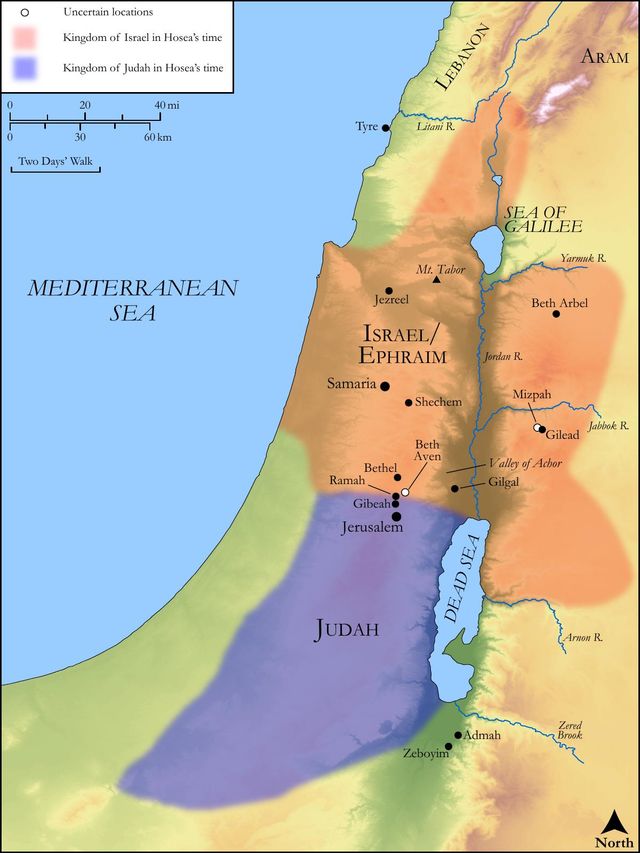
Study this verse
Public-domain commentary
Matthew Henry
From his Commentary on the Whole Bible. Henry comments on passages, not single verses — this entry covers Hosea 2:14–23. His three-level outline is real structure in the source text, so it is rendered as structure.
The state of Israel ruined by their own sin did not look so black and dismal in the former part of the chapter, but that the state of Israel, restrained by the divine grace, looks as bright and pleasant here in the latter part of the chapter, and the more surprisingly so as the promises follow thus close upon the threatenings; nay, which is very strange, they are by a note of connexion joined to, and inferred from, that declaration of their sinfulness upon which the threatenings of their ruin are grounded: She went after her lovers, and forgot me, saith the Lord; therefore I will allure her. Fitly therefore is that therefore which is the note of connexion immediately followed with a note of admiration: Behold I will allure her! When it was said, She forgot me, one would think it should have followed, "Therefore I will abandon her, I will forget her, I will never look after her more." No, Therefore I will allure her. Note, God's thoughts and ways of mercy are infinitely above ours; his reasons are all fetched from within himself, and not from any thing in us; nay, his goodness takes occasion from man's badness to appear so much the more illustrious, Isa 57:17, Isa 57:18. Therefore, because she will not be restrained by the denunciations of wrath, God will try whether she will be wrought upon by the offers of mercy. Some think it may be translated, Afterwards, or nevertheless, I will allure her. It comes all to one; the design is plainly to magnify free grace to those on whom God will have mercy purely for mercy's sake. Now that which is here promised to Israel is,
I.That though now they were disconsolate, and ready to despair, they should again be revived with comforts and hopes, Hos 2:14, Hos 2:15.
This is expressed here with an allusion to God's dealings with that people when he brought them out of Egypt, through the wilderness to Canaan, as their forlorn and deplorable condition in their captivity was compared to their state in Egypt in the day that they were born, Hos 2:3. They shall be new-formed by such miracles of love and mercy as they were first-formed by, and such a transport of joy shall they be in as they were in then. It is hard to say when this had its accomplishment in the kingdom of the ten tribes; but it principally aims, no doubt, at the bringing in both of Jews and Gentiles into the church by the gospel of Christ; and it is applicable, nay, we have reason to think it was designed that it should be applied, to the conversion of particular souls to God. Now observe,
1.The gracious methods God will take with them.
(1.)He will bring them into the wilderness, as he did at first when he brought them out of Egypt, where he instructed them, and took them into covenant with himself. The land of their captivity shall be to them now, as that wilderness was then, the furnace of affliction, in which God will choose them. See Eze 20:35, Eze 20:36, I will bring you into the wilderness of the people, and there will I plead with you. God had said that he would make them as a wilderness (Hos 2:3), which was a threatening; now, when it is here made part of a promise that he would bring them into the wilderness, the meaning may be that he would by his grace bring their minds to their condition: "They shall have humble hearts under humbling providences; being poor, they shall be poor in spirit, shall accept of the punishment of their iniquity, and then they are prepared to have comfort spoken to them." When God delivered Israel out of Egypt he led them into the wilderness, to humble them and prove them, that he might do them good (Deu 8:2, Deu 8:3, Deu 8:15, Deu 8:16), and so he will do again. Note, Those whom God has mercy in store for he first brings into a wilderness - into solitude and retirement, that they may the more freely converse with him out of the noise of this world, - into distress of mind, through sense of guilt and dread of wrath, which brings a soul to be quite at a loss in itself and bewildered, and by those convictions he prepares for consolations, - and sometimes into outward distress and trouble, thereby to open the ear to discipline.
(2.)He will then allure them and speak comfortably to them, will persuade them and speak to their hearts, that is, he will by his word and Spirit incline their hearts to return to him, and encourage them to do so. He will allure them with the promises of his favour, as before he had terrified them with the threatenings of his wrath, will speak friendly to them, both by his prophets and by his providences, as before he had spoken roughly, Isa 40:1, Isa 40:2. By the hand of my servants the prophets I will speak comfort to her heart; so the Chaldee. This refers to the gospel of Christ, and the offers of divine grace in the gospel, by which we are allured to forsake our sins and to turn to God, and which speaks to the heart of a convinced sinner that which is every way suited to his case, speaks abundant consolation to those that sorrow for sin and lament after the Lord. And when by the Spirit it is indeed spoken to the heart effectually, and so as to reach the conscience (which it is God's prerogative to do), O what a blessed change is wrought by it! Note, The best way of reducing wandering souls to God is by fair means. By the promise of rest in Christ we are invited to take his yoke upon us; and the work of conversion may be forwarded by comforts as well as by convictions.
(3.)He will give her her vineyards thence. From that time and from that place where he has afflicted her, and brought her to see her folly and to humble herself, thenceforward he will do her good; not only speak comfortably to her, but do well for her, and undo what he had done against her. He had destroyed her vines (Hos 2:12), but now he will give her whole vineyards, as if for every vine destroyed she should have a vineyard restored, and so be repaid with interest; she shall not only have corn for necessity, but vineyards for delight. These denote the privileges and comforts of the gospel, which are prepared for those that come up out of the wilderness leaning upon Christ as their beloved, Sol 8:5. Note, God has vineyards of consolation ready to bestow on those who repent and return to him; and he can give vineyards out of a wilderness, which are of all others the most welcome, as rest to the weary.
(4.)He will give her the valley of Achor for a door of hope. The valley of Achor was that in which Achan was stoned; it signifies the valley of trouble, because he troubled Israel, and there God troubled him. This was the beginning of the wars of Canaan; and their putting away the accursed thing in that place gave them ground to hope that God would continue his presence with them and complete their victories. So when God returns to his people in mercy, and they to him in duty, it will be to them as happy an omen as any thing. If they put away the accursed thing from among them, if by mortifying sin they stone the Achan that has troubled their camp, their subduing that enemy within themselves is an earnest to them of victory over all the kings of Canaan. Or, if the allusion be to the name, it intimates that trouble for sin, if it be sincere, opens a door of hope; for that sin which truly troubles us shall not ruin us. The valley of Achor was a very fruitful pleasant valley, some think the same with the valley of Engedi, famous for vineyards, Sol 1:14. This God gave to Israel as a pattern and pledge of the whole land of Canaan; so "God will by his gospel give to all believers such gifts, graces, and comforts in this life, as shall be a taste of those more perfect good things of the kingdom of heaven, and shall give them as assured hope of a full possession of them in due time." So the learned Dr. Pocock expounds it; and, to the same purport, this whole context.
2.The great rejoicing with which they shall receive God's gracious returns towards them: She shall sing there as in the days of her youth. This plainly refers to that triumphant and prophetic song which Moses and the children of Israel sang at the Red Sea, Exo 15:1. When they are delivered out of captivity they shall repeat that song, and to them it shall be a new song, because sung upon a new occasion, not inferior to the former. God had said (Hos 2:11) that he would cause all her mirth to cease, but now he would cause it to revive: She shall sing as in the day that she came out of Egypt. Note, When God repeats former mercies we must repeat former praises; we find the song of Moses sung in the New Testament, Rev 15:3. This promise of Israel's singing has its accomplishment in the gospel of Christ, which furnishes us with abundant matter for joy and praise, and wherever it is received in its power enlarges the heart in joy and praise; and this is that land flowing with milk and honey which the valley of Achor opens a door of hope to. We rejoice in tribulation.
II.That, though they had been much addicted to the worship of Baal, they should now be perfectly weaned from it, should relinquish and abandon all appearances of idolatry and approaches towards it, and cleave to God only, and worship him as he appoints, Hos 2:16, Hos 2:17. Note, The surest pledge and token of God's favour to any people is his effectual parting between them and their beloved sins. The worship of Baal was the sin that did most easily beset the people of Israel; it was their own iniquity, the sin that had dominion over them; but now that idolatry shall be quite abolished, and there shall not be the least remains of it among them.
1.The idols of Baal shall not be mentioned, not any of the Baals that in the days of Baalim had made so great a noise with, O Baal! hear us; O Baal! hear us. The very names of Baalim shall be taken out of their mouths; they shall be so disused that they shall be quite forgotten, as if their names had never been known in Israel; they shall be so detested that people will not bear to mention them themselves, nor to hear others mention them, so that posterity shall scarcely know that ever there were such things. They shall be so ashamed of their former love to Baal that they shall do all they can to blot out the remembrance of it. They shall tie themselves up to the strictest literal meaning of that law against idolatry (Exo 23:13), Make no mention of the names of other gods, neither let it be heard out of thy mouth, as David, Psa 16:4. Thus the apostle expresses the abhorrence we ought to have of all fleshly lusts: Let them not be once named among you, Eph 5:3. But how can such a change of the Ethiopian's skin be wrought? It is answered, The power of God can do it, and will. I will take away the names of Baalim; as Zac 13:2, I will cut off the names of the idols. Note, God's grace in the heart will change the language by making that iniquity to be loathed which was beloved. Zep 3:9, I will turn to the people a pure language. One of the rabbin says, This promise relates to the Gentiles, by the gospel of Christ, from the idolatries which they had been wedded to, Th1 1:9.
2.The very word Baal shall be laid aside, even in its innocent signification. God says, Thou shalt call me Ishi, and call me no more Baali; both signify my husband, and both had been made use of concerning God. Isa 54:5, Thy Maker is thy husband, thy Baal (so the word is), thy owner, patron, and protector. It is probable that many good people had, accordingly, made use of the word Baali in worshipping the God of Israel; when their wicked neighbours bowed the knee to Baal they gloried in this, that God was their Baal. "But," says God, "you shall call me so no more, because I will have the very names of Baalim taken away." Note, That which is very innocent in itself should, when it has been abused to idolatry, be abolished, and the very use of it taken away, that nothing may be done to keep idols in remembrance, much less to keep them in reputation. When calling God Ishi will do as well, and signify as much, as Baali, let that word be chosen rather, lest, by calling him Baali, others should be put in mind of their quondam Baals. Some think that there is another reason intimated why God would be called Ishi and not Baali; they both signify my husband, but Ishi is a compellation of love, and sweetness, and familiarity, Baali of reverence and subjection. Ishi is vir meus - my man; Baali is dominus meus - my lord. In gospel-times God has so revealed himself to us as to encourage us to come boldly to the throne of his grace, and to use a holy humble freedom there; we ought to call God our Master, for so he is, but we are more taught to call him our Father. Ishi is a man the Lord (Gen 4:1), and intimates that in gospel-times the church's husband shall be the man Christ Jesus, made like unto his brethren, and therefore they shall call him Ishi, not Baali.
III.That though they had been in continual troubles, as if the whole creation had been at war with them, now they shall enjoy perfect peace and tranquillity, as if they were in a league of friendship with the whole creation (Hos 2:18): In that day, when they have forsaken their idols, and put themselves under the divine protection, I will make a covenant for them.
1.They shall be protected from evil; nothing shall hurt them, nor do them any mischief. Tranquillus Deus tranquillat amnia - When God is at peace with us he makes every creature to be so too. The inferior creatures shall do them no harm, as they had done when the beasts of the field ate up their vineyards (Hos 2:12) and when noisome beasts were one of God's sore judgments, Eze 14:15. The fowl and the creeping things are taken into this covenant; for they also, when God makes use of them as the instruments of his justice, may be come very hurtful, but they shall be no more so; nay, by virtue of this covenant, they shall be made serviceable to them and brought into their interests. Note, God has the command of the inferior creatures, and brings them into what covenant he pleases; he can make the beasts of the field to honour him (so he has promised, Isa 43:20) and to contribute to his people's comfort. And, if the inferior creatures are thus laid under an engagement to serve us, it is our part of the covenant not to abuse them, but to serve God with them. Some think that this had its accomplishment in the miraculous power Christ gave his disciples to take up serpents, Mar 16:17, Mar 16:18. It agrees with the promises made particularly to Israel, in their return out of captivity (Eze 34:25, I will cause the evil beasts to cease out of the land), and the more general ones to all the saints. Job 5:22, Job 5:23, The beasts of the field shall be at peace with thee; and Psa 91:13, Thou shalt tread upon the lion and the adder. But this is not all; men are more in danger from one another than from the brute beast, and therefore it is further promised that God will make wars to cease, will disarm the enemy: I will break the bow, and sword, and battle. He can do it when he pleases (Psa 44:9), and will do it for those whose ways please him, for he makes even their enemies to be at peace with them, Pro 16:7. This agrees with the promise that in gospel-times swords shall be beaten into plough-shares, Isa 2:4.
2.They shall be quiet from the fear of evil. God will not only keep them safe, but make them to lie down safely, as those that know themselves to be under the protection of Heaven, and therefore are not afraid of the powers of hell.
IV.That, though God had given them a bill of divorce for their whoredoms, yet, upon their repentance, he would again take them into covenant with himself, into a marriage-covenant, Hos 2:19, Hos 2:20. God's making a covenant for them with the inferior creatures was a great favour; but it was nothing to this, that he took them into covenant with himself and engaged himself to do them good. Observe,
1.The nature of this covenant; it is a marriage-covenant, founded in choice and love, and founding the nearest relation: I will betroth thee unto me; and again, and a third time, I will betroth thee. Note, All that are sincerely devoted to God are betrothed to him; God gives them the most sacred and inviolable security imaginable that he will love them, protect them, and provide for them, that he will do the part of a husband to them, and that he will incline their hearts to join themselves to him and will graciously accept of them in so doing. Believing souls are espoused to Christ, Co2 11:2. The gospel-church is the bride, the Lamb's wife; and they would never come into that relation to him if he did not by the power of his grace betroth them to himself. The separation begins on our side; we alienate ourselves from God. The coalition begins on his side; he betroths us to himself.
2.The duration of this covenant: "I will betroth thee for ever. The covenant itself shall be inviolable; God will not break it on his part, and you shall not on yours; and the blessings of it shall be everlasting." One of the Jewish rabbin says, This is a promise that she shall attain to the life of the world to come, which is absolute eternity or perpetuity.
3.The manner in which this covenant shall be made. (1.) In righteousness and judgment, that is, God will deal sincerely and uprightly in covenant with them; they have broken covenant, and God is righteous. "But," says God, "I will renew the covenant in righteousness." The matter shall be so ordered that God may receive even these backsliding children into his family again, without any reflection upon his justice, nay, his justice being satisfied by the Mediator of this covenant very much to the honour of it. But what reason can there be why God should take a people into covenant with him that had so often dealt treacherously? Will it not reflect upon his wisdom? "No," says God; "I will do it in judgment, not rashly, but upon due consideration; let me alone to give a reason for it and to justify my own conduct." (2.) In lovingkindness and in mercies. God will deal tenderly and graciously in covenanting with them; and will be not only as good as his word, but better; and, as he will be just in keeping covenant with them, so he will be merciful in keeping them in the covenant. They are subject to many infirmities, and, if he be extreme to mark what they do amiss, they will soon lose the benefit of the covenant. He therefore promises that it shall be a covenant of grace, made in a compassionate consideration of their infirmities, so that every transgression in the covenant shall not throw them out of covenant; he will gather with everlasting lovingkindness. (3.) In faithfulness. Every article of the covenant shall be punctually performed. Faithful is he that has called them, who also will do it; he cannot deny himself.
4.The means by which they shall be kept tight and faithful to the covenant on their part: Thou shalt know the Lord. This is not only a promise that God will reveal himself to them more fully and clearly than ever, but that he will give them a heart to know him; they shall know more of him, and shall know him in another manner than ever yet. The ground of their apostasy was their not knowing God to be their benefactor (Hos 2:8); therefore, to prevent the like, they shall all be taught of God to know him. Note, God keeps up his interest in men's souls by giving them a good understanding and a right knowledge of things, Heb 8:11.
V.That, though the heavens had been to them as brass, and the earth as iron, now the heavens shall yield their dews, and by that means the earth its fruits, Hos 2:21, Hos 2:22. God having betrothed the gospel-church and in it all believers to himself, how shall he not with himself and with his Son freely give them all things, all things pertaining both to life and godliness, all things they need or can desire? All is theirs, for they are Christ's, betrothed to him; and with the righteousness of the kingdom of God, which they seek first, all other things shall be added unto them. And yet this promise of corn and wine is to be taken also in a spiritual sense (so the learned Dr. Pocock thinks): it is an effusion of those blessings and graces which relate to the soul that is here promised under the metaphor of temporal blessings, the dew of heaven, as well as the fatness of the earth, and that put first, as in the blessing of Jacob, Gen 27:28. God had threatened (Hos 2:9) that he would take away the corn and the wine; but now he promises to restore them, and that in the common course and order of nature. While they lay under the judgment of famine they called to the earth for corn and wine for the support of themselves and their families. Very gladly would the earth have supplied them, but she cannot give unless she receive, cannot produce corn and wine unless she be enriched with the river of God (Psa 65:9); and therefore she calls to the heavens for rain, the former and latter rain in their season, grapes for it, and by her melancholy aspect when rain is denied pleads for it. "But," say the heavens, "we have no rain to give unless he who has the key of the clouds unlock them, and open these bottles; so that, if the Lord do not help you, we cannot." But, when God takes them into covenant with himself, then the wheel of nature shall be set a-going again in favour of them, and the streams of mercy shall flow in the usual channel: Then I will hear, saith the Lord; I will receive your prayers (so the Chaldee interprets the first hearing); God will graciously take notice of their addresses to him. And then I will hear the heavens; I will answer them (so it may be read); and then they shall hear and answer the earth, and pour down seasonable rain upon it; and then the earth shall hear the corn and vines, and supply them with moisture, and they shall hear Jezreel, and be nourishment and refreshment for those that inhabit Jezreel. See here the coherence of second causes with one another, as links in a chain, and the necessary dependence they all have upon God, the first Cause. Note, We must expect all our comforts from God in the usual method and by the appointed means; and, when we are at any time disappointed in them, we must look up to God, above the hills and the mountains, Psa 121:1, Psa 121:2. See how ready the creatures are to serve the people of God, how desirous of the honour: the corn cries to the earth, the earth to the heavens, the heavens to God, and all that they may supply them. And see how ready God is to give relief: I will hear, saith the Lord, yea, I will hear. And, if God will hear the cry of the heavens for his people, much more will he hear the intercession of his Son for them, who is made higher than the heavens. See what a peculiar delight those that are in covenant with God may take in their creature-comforts, as seeing them all come to them from the hand of God; they can trace up all the streams to the fountain, and taste covenant-love in common mercies, which makes them doubly sweet.
VI.That whereas they were now dispersed, not only, as Simeon and Levi, divided in Jacob and scattered in Israel, but divided and scattered all the world over, God will turn this curse, as he did that, into a blessing: "I will not only water the earth for her, but will sow her unto me in the earth; her dispersion shall be not like that of the chaff in the floor, which the wind drives away, but like that of the seed in the field, in order to its greater increase; wherever they are scattered they shall take root downward and bear fruit upward. The good seed are the children of the kingdom. I will sow her unto me." This alludes to the name of Jezreel, which signifies sown of God, or for God; as she was scattered of him (which is one signification of the words) so she shall be sown of him; and to what he sows he will give the increase. When in all parts of the world Christianity got footing, and every where there were professors of it, then this promise was fulfilled, I will sow her unto me in the earth. Note, The greatest blessing of this earth is that God has a church in it, and from that arises all the tribute of glory which he has out of it; it is what he has sown to himself, and what he will therefore secure to himself.
VII.That, whereas they had been Lo-ammi - not a people, and Lo-ruhamah - not finding mercy with God, now they shall be restored to his favour and taken again into covenant with him (Hos 2:23): They had not obtained mercy, but seemed to be abandoned; they were not my people, not distinguished, not dealt with, as my people, but left to lie in common with the nations. This was the case with the rejected Jews; and the same, or more deplorable, was that of the Gentile world (to whom the apostle applies this, Rom 9:24, Rom 9:25), that had no hope, and was without God in the world; but when great multitudes both of Jews and Gentiles were, upon their believing in Christ, incorporated into a Christian church, then,
1.God had mercy on those who had not obtained mercy. Those found favour with God, and became the children of his love, who had been long out of favour and the children of his wrath, and, if infinite mercy had not interposed, would have been for ever so. Note, God's mercy must not be despaired of any where on this side hell.
2.He took those into a covenant-relation to himself who had been strangers and foreigners. He says to them, "Thou art my people, whom I will own and bless, protect and provide for;" and they shall say, "Thou art my God, whom I will serve and worship, and to whose honour I will be entirely and for ever devoted." Note,
(1.)The sum total of the happiness of believers is the mutual relation that is between them and God, that he is theirs and they are his; this is the crown of all the promises.
(2.)This relation is founded in free grace. We have not chosen him, but he has chosen us. He first says, They are my people, and makes them willing to be so in the day of his power, and then they avouch him to be theirs.
(3.)As we need desire no more to make us happy than to be the people of God, so we need desire no more to make us easy and cheerful than to have him to assure us that we are so, to say unto us, by his Spirit witnessing with ours, Thou art my people.
(4.)Those that have accepted the Lord for their God must avouch him to be so, must go to him in prayer and tell him so, Thou art my God, and must be ready to make profession before men.
(5.)It adds to the comfort of our covenant with God that in it there is a communion of saints, who, though they are many, yet here are one. It is not, I will say to them, You are my people, but, Thou art; for he looks upon them as all one in Christ, and, as such in him, he speaks to them and covenants with them; and they also do not say, Thou art our God, for they look upon themselves as one body, and desire with one mind and one mouth to glorify him, and therefore say, Thou art my God. Or it intimates that such a covenant as God made of old with his people Israel, in general, now under the gospel he makes with particular believers, and says to each of them, even the meanest, with as much pleasure as he did of old to the thousands of Israel, Thou art my people, and invites and encourages each of them to say, Thou art my God, and to triumph therein, as Moses and all Israel did. Exo 15:2, He is my God, and my father's God.
Historical interpretation
Fourteen Centuries of Reception
2 surviving comments on this verse. Each one is dated, so this reads as a timeline rather than a list.
Select a marker to jump to its quote. Markers stagger vertically where authors wrote within a few decades of each other.
"And it shall come to pass in that day: I will hear, saith the Lord, I will hear the heavens, and they shall hear the earth. And the earth shall hear the corn, and the wine, and the oil, and they shall hear Jezrael. And I will sow her unto me in the earth, and I will have mercy on her that was without mercy. And I will say to that which was not my people: Thou art my people: and they shall say: Thou art my God." LXX: "And it shall come to pass in that day, saith the Lord, I will hear the heavens, and they shall hear the earth; and the earth shall hear the corn, and the wine, and the oil; and they shall hear Jezreel. And I will sow her unto me in the earth; and I will have mercy upon her that had not obtained mercy; and I will say to them which were not my people, Thou art my people; and they shall say, Thou art my God." On that day and at that time when I will espouse you to me in faith, and you will know that I am the Lord, I will hear the heavens, which declare the glory of God (Ps. 18), and the heavens will hear the earth, that it may be watered with heavenly rain, and the earth, from which truth arises (Ps. 84) , and into whose field the householder goes forth to sow his seeds (Matt. 13, 3), will yield wheat and wine and oil, of which we have spoken above, and all these things shall hear Jezrael, which is, the seed of God, that is, the abundance and fertility of all things may be attributed to the seed of God, who is Christ, that it is sown in the earth to bring forth manifold fruits, a hundredfold, sixtyfold, and thirtyfold (Ibid, 8). And that prostitute, who had been joined to God, and had borne three children, two males and one female; the first named Jezrael, the second, Without mercy; the third, not my people, may she see that the words of things have been changed because of the seed of God, and in the faith of Christ have obtained mercy, which was without mercy, and being called the people of God, who before were not called the people. From this we see that all that has been said can be referred both to the ten tribes called Israel, and under the name of the prostitute, they have borne three children, and to every people of Jewish name. On the hearing of heaven and earth, and of wheat, wine, and oil, and Jezrael, this is what some people believe, that after Christ's coming, everything runs in its own order, and the whole creature serves the usefulness of men, as it was established from the beginning. All of which Jews and Judaizers among us wait for corporally after Antichrist at the end of the world.
Hear the heavens: All shall conspire in favour of the church, which in the following verse is called Jezrahel, that is, the seed of God.
Continue studying Hosea 2:21 across the web’s major study libraries — every link below opens this exact verse, chapter, or book on the destination site.
Read & Compare
 BibleGatewayThis verse in more than 200 translations and 70 languages.
 Bible.comThe YouVersion reader — hundreds of translations, reading plans, and highlights.
 ESV.orgCrossway's official English Standard Version reader.
 NET BibleThe NET translation with 60,000+ translators' notes on every rendering decision.
 STEP BibleTyndale House's free study tool — original text, vocabulary, and scholarly resources.
 BibliaLogos Bible Software's free web reader.
 USCCBThe New American Bible (Revised Edition) with the U.S. bishops' study notes.
Commentaries
 BibleHub CommentariesDozens of classic commentaries on this verse, gathered on one page.
 StudyLightMore than 100 commentary sets — the largest collection on the web.
 BibleRefPlain-English commentary on what this verse means, verse by verse.
 Enduring WordDavid Guzik's free commentary on this chapter, widely used by Bible teachers.
 Bible Study ToolsVerse commentary alongside Greek and Hebrew study aids.
Original Language & Research
- BibleHub InterlinearThe verse word by word — original language, transliteration, and English.
- BibleHub LexiconEvery word's original-language definition and Strong's entry.
 Blue Letter BibleDeep-study tools — Strong's numbers, concordance, and word studies.
 SefariaThe Hebrew text with Rashi and centuries of Jewish commentary.
Sermons, Hymns & Audio


TrulyRandomVerse is not affiliated with these sites and doesn’t control their content. They’re linked because they’re genuinely useful.
Summary
Hosea 2:21 is a profound declaration of God's future restoration and providential care for His covenant people, Israel, following a period of judgment for their unfaithfulness. It vividly portrays a divinely orchestrated chain of responsiveness within creation, where God's attentive ear to the heavens leads the heavens to respond to the earth's needs, culminating in abundant provision and renewal for His beloved nation. This verse encapsulates the promise of a revitalized relationship and a flourishing land, demonstrating God's ultimate sovereignty and unwavering commitment to His redemptive purposes.
Context
ShowHideLiterary Context
Hosea 2:21 is situated within a pivotal section of the book of Hosea, specifically within chapter 2, which masterfully employs the metaphor of marriage to depict the tumultuous relationship between Yahweh and Israel. The preceding verses (Hosea 2:1-13) detail Israel's spiritual adultery through idolatry and their consequent judgment, portraying God's intention to strip away her blessings and lead her into a wilderness of desolation. However, a dramatic shift in tone occurs from Hosea 2:14, where God promises to "allure her, and bring her into the wilderness, and speak comfortably unto her." This verse initiates a glorious promise of restoration, renewal of the covenant, and a return to intimacy. Verse 21, along with Hosea 2:22, forms the climax of this restoration narrative, illustrating the tangible, physical blessings that flow from a renewed spiritual relationship, where even creation participates in God's redemptive plan.
Historical & Cultural Context
The prophet Hosea ministered in the Northern Kingdom of Israel (Ephraim) during the 8th century BCE, a period marked by political instability, oppression, and rampant idolatry, particularly the worship of Baal, the Canaanite god of fertility and rain. The people had forsaken Yahweh, their true Husband, for false gods, believing that Baal was the source of their agricultural prosperity. Consequently, God threatened to withhold rain and cause barrenness, directly challenging the Baal cult's claims. In this context, Hosea 2:21 directly counters the Baal narrative by asserting Yahweh's exclusive control over the heavens and the earth, demonstrating that true fertility and abundance come only from Him. The promise of the heavens hearing the earth and providing rain would have been a profound assurance of Yahweh's power and a direct refutation of the false gods Israel had pursued.
Key Themes
ShowHideThe verse powerfully contributes to several overarching themes in Hosea and the broader prophetic literature. Foremost is the theme of Divine Responsiveness and Providence. The repeated phrase "I will hear, saith the LORD" underscores God's active attentiveness and willingness to intervene on behalf of His repentant people, demonstrating His character as a faithful provider who cares deeply for His creation and His covenant partners. This echoes the broader biblical truth of God's attentiveness to the cries of His people, as seen in passages like Psalm 34:17. Another significant theme is the Restoration of Creation and Abundance. The promise of the heavens hearing the earth and yielding its produce signifies a reversal of the curses associated with disobedience, particularly drought and barrenness (Deuteronomy 28:23-24). This points to a holistic renewal, where the natural order is restored to bless God's people, ensuring agricultural prosperity and physical sustenance. Finally, the verse highlights the Interconnectedness of God's Creation, depicting a beautiful chain of command and response within the natural world—God hears the heavens, the heavens hear the earth, and the earth responds with fruitfulness. This intricate orchestration, all initiated and sustained by God, illustrates His sovereign control over every aspect of creation for the benefit of His people when they are in right relationship with Him, a concept also found in Psalm 147:8.
Exposition and Analysis
ShowHideKey Word Analysis
ShowHideThis word, derived from an unused root meaning "to be hot," refers to a literal day (from sunrise to sunset or sunset to sunset) or, as used here, figuratively as "a space of time defined by an associated term." The phrase "in that day" (בַּיּוֹם הַהוּא, bāyyōm hahūʼ) is a common prophetic idiom referring to a future, significant time, often associated with divine intervention, judgment, or, as in this context, salvation and restoration. It points to a specific, divinely appointed moment when God's promises of renewal will be realized.
A primitive root meaning "to eye or (generally) to heed, i.e. pay attention; by implication, to respond; by extension to begin to speak; specifically to sing, shout, testify, announce." This word is crucial as it appears three times in the verse, signifying more than mere auditory perception. When God "hears," it implies active attention, understanding, and an effective, responsive action. When the heavens "hear" the earth, or the earth "hears" the grain, it denotes a responsive yielding and compliance to the divine command, resulting in the desired outcome (rain, produce).
From the root "to be," this is the self-Existent or Eternal One, the Jewish national name of God, Jehovah. The use of this covenant name emphasizes God's faithfulness to His promises and His unchanging character as the one who was, and is, and is to come. It underscores that the powerful, restorative action described in the verse originates from the sovereign, covenant-keeping God of Israel, not from any false deity.
Verse Breakdown
ShowHide"And it shall come to pass in that day,"
This opening phrase serves as a prophetic marker, signaling a future, divinely appointed time of significant spiritual and physical transformation. It sets the stage for the dramatic reversal of Israel's fortunes and the fulfillment of God's restorative promises, moving beyond the period of judgment into an era of blessing.
"I will hear, saith the LORD,"
This is the foundational declaration, emphasizing God's initiative and His active, attentive posture. The repetition of "I will hear" (which is then expanded in the following clauses) underscores God's deep engagement and responsiveness to the needs of His people. The divine pronouncement "saith the LORD" (נְאֻם יְהוָה, nᵉʼum Yᵉhôvâh) authenticates the promise, affirming its divine origin and absolute certainty.
"I will hear the heavens,"
This clause specifies the first object of God's hearing and action. The "heavens" (שָׁמַיִם, shâmayim), the sky and atmosphere, are the source of rain and dew, essential for agricultural life in the land of Israel. God's hearing of the heavens implies His command and orchestration of meteorological forces, ensuring that they respond according to His will to provide sustenance.
"and they shall hear the earth;"
This completes the chain of divine providence. The heavens, having been "heard" and commanded by God, will in turn "hear" the earth. This signifies the heavens' responsive action in providing the necessary rain to the parched ground, allowing the earth to yield its produce. It illustrates a harmonious, responsive relationship within creation, all orchestrated by God for the benefit of His people.
Literary Devices
ShowHideHosea 2:21 is rich in literary devices that enhance its message of divine restoration. The most prominent is Personification, where inanimate objects—the heavens and the earth—are given the human capacity to "hear." This imbues the natural world with a sense of active participation and responsiveness to God's command, creating a vivid image of a living, interconnected creation. This personification also serves as a powerful Metaphor for the restoration of order and harmony, contrasting sharply with the previous state of desolation and barrenness caused by Israel's sin. The verse also employs Repetition ("I will hear," "they shall hear") to emphasize the certainty and effectiveness of God's promise and the comprehensive nature of the divine chain of command. Finally, the entire passage functions as a form of Prophetic Oracle, a divine pronouncement of future events, characterized by the authoritative declaration "saith the LORD," which lends weight and infallibility to the promised restoration.
Theological and Thematic Connections
ShowHideHosea 2:21 offers a profound theological statement about God's sovereign control over creation and His unwavering commitment to His covenant people, even after their unfaithfulness. It reveals a God who is not distant but intimately involved in the affairs of His world, orchestrating natural processes to fulfill His redemptive purposes. This divine responsiveness and providential care extend beyond mere physical provision; it symbolizes a holistic spiritual renewal, where the relationship between God and Israel is restored to a state of intimacy and blessing, mirroring the harmony re-established in creation. The verse underscores that true abundance, both physical and spiritual, flows directly from a right relationship with Yahweh, the only true source of life and blessing.
Reflection and Application
ShowHideHosea 2:21 serves as a powerful beacon of hope and a profound reminder of God's enduring faithfulness, even in the face of human infidelity. For believers today, this verse offers deep encouragement, assuring us that our God is not only attentive to our cries but actively orchestrates all of creation to work for our good when we are in right relationship with Him. In seasons of spiritual dryness, personal hardship, or even global challenges, we can find solace in knowing that the Lord "hears" and responds. Just as He promised to restore the natural order for Israel's physical sustenance, He also promises spiritual renewal and provision for our lives, demonstrating His comprehensive care. This verse invites us to cultivate a posture of trust and confident prayer, knowing that the sovereign God who commands the heavens and the earth also hears our petitions and acts according to His perfect will. It challenges us to examine our own faithfulness and to return to Him, confident in His readiness to restore and bless.
Questions for Reflection
ShowHideFAQ
ShowHideWhat is the significance of the repeated phrase "I will hear" in Hosea 2:21?
ShowHideThe threefold repetition of "I will hear" (or its derivative, "they shall hear") emphasizes the certainty, comprehensive nature, and divine origin of the promised restoration. When God says "I will hear," it signifies much more than simply perceiving sound; it implies active attention, understanding, and a resolute intention to respond effectively. The subsequent clauses—God hearing the heavens, and the heavens hearing the earth—illustrate a chain of divine command and responsive action that ensures the complete fulfillment of His promise. This repetition underscores God's unwavering commitment to reverse the curses of barrenness and bring forth abundance for His people. It highlights His active involvement in orchestrating even the natural world to achieve His redemptive purposes, as seen in His control over the weather patterns described in Job 38:25-27.
Christ-Centered Fulfillment
ShowHideHosea 2:21, with its promise of a restored relationship and abundant provision, finds its ultimate and most profound fulfillment in Jesus Christ. While the immediate context speaks to Israel's physical and spiritual restoration, the New Testament reveals that the true "day" of ultimate blessing and covenant renewal dawns with the coming of Christ. He is the one through whom God's people are truly reconciled to Him, moving from spiritual adultery to a renewed, intimate union. In Christ, the curse of sin and barrenness is definitively broken, and the "heavens" of God's grace pour out spiritual blessings upon all who believe. Just as the heavens respond to God and the earth responds to the heavens, so too in Christ, all things in heaven and on earth are being reconciled to God, and believers receive every spiritual blessing in the heavenly places (Ephesians 1:3). Jesus, as the "Lamb of God" (John 1:29), brings about the ultimate "hearing" and response from God, securing not just physical sustenance but eternal life and spiritual abundance for His church, the new Israel. Through His atoning work, the broken relationship between God and humanity is fully restored, and the promise of a flourishing spiritual life, yielding the "fruit of the Spirit" (Galatians 5:22-23), is realized for all who are united with Him.