


Genesis 4:13
Bible text: King James Version (1769 Blayney text) · Public domain
Bible text: Berean Standard Bible · Public domain
Bible text: American Standard Version (1901) · Public domain
Bible text: World English Bible, Messianic edition · Public domain
Bible text: Geneva Bible (1599) · Public domain
Bible text: Young's Literal Translation · Public domain
- וַיֹּאמֶרvai·Yo·merand he saidH559Conj-w ¦ V-Qal-ConsecImperf-3msVerb Qal Consecutive Imperfect 3rd Singular Masculineוַandיֹּאמֶרhe said
- קַיִןKa·yinCainH7014N-proper-mNoun Proper Masculine
- אֶל'eltoH413PrepPreposition
- יְהוָהYah·wehYahwehH3068N-properNoun Proper Title
- גָּדוֹלga·Dol[is too] greatH1419Adj-msAdjective Singular Masculine Absolute
- עֲוֹנִי'a·vo·Nimy punishmentH5771N-msc ¦ 1csNoun Singular Masculine Constructעֲוֹנִpunishmentיmy
- מִנְּשֹׂאmi·ne·So'for bearingH5375Prep-m ¦ V-Qal-InfVerb Qal Infinitive Constructמִforנְּשֹׂאbearing
English is a literal word-by-word gloss of the Hebrew, not the KJV's wording. Why?
This is the original text the KJV's translators worked from — each Hebrew word with its own literal English meaning in this verse, prepared by scholars at Tyndale House, Cambridge. The KJV translates whole sentences, not word by word, so its wording differs: one Hebrew word can become several English words, and the KJV may choose “the LORD” where the gloss reads “Yahweh”. Both are faithful — they answer different questions. For the KJV's own rendering, switch to the KJV text.
Details
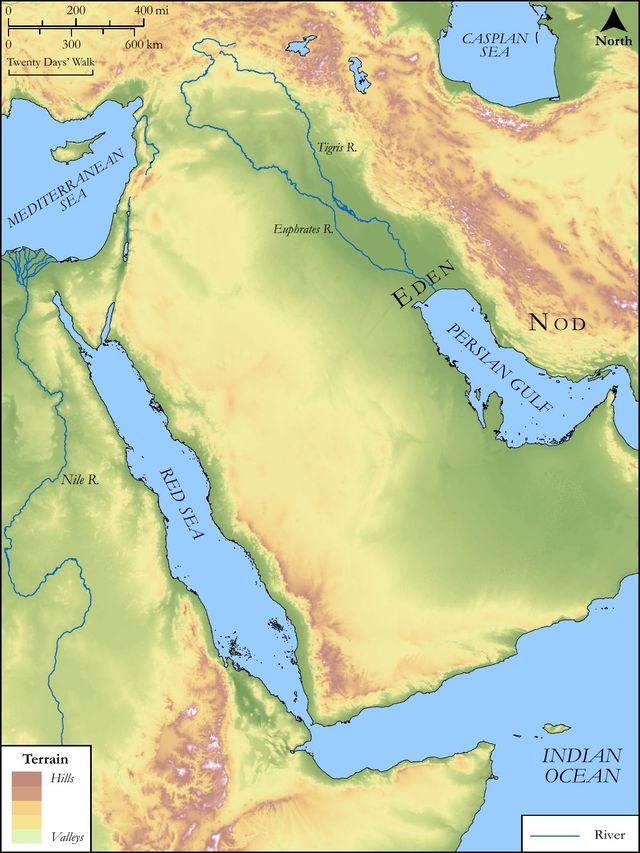
See on the biblical-era maps


Study this verse
Public-domain commentary
Matthew Henry
From his Commentary on the Whole Bible. Henry comments on passages, not single verses — this entry covers Genesis 4:13–15. His two-level outline is real structure in the source text, so it is rendered as structure.
We have here a further account of the proceedings against Cain.
I.Here is Cain's complaint of the sentence passed upon him, as hard and severe.
Some make him to speak the language of despair, and read it, My iniquity is greater than that it may be forgiven; and so what he says is a reproach and affront to the mercy of God, which those only shall have the benefit of that hope in it. There is forgiveness with the God of pardons for the greatest sins and sinners; but those forfeit it who despair of it. Just now Cain made nothing of his sin, but now he is in the other extreme: Satan drives his vassals from presumption to despair. We cannot think too ill of sin, provided we do not think it unpardonable. But Cain seems rather to speak the language of indignation: My punishment is greater than I can bear; and so what he says is a reproach and affront to the justice of God, and a complaint, not of the greatness of his sin, but of the extremity of his punishment, as if this were disproportionable to his merits. Instead of justifying God in the sentence, he condemns him, not accepting the punishment of his iniquity, but quarrelling with it. Note, Impenitent unhumbled hearts are therefore not reclaimed by God's rebukes because they think themselves wronged by them; and it is an evidence of great hardness to be more concerned about our sufferings than about our sins. Pharaoh's care was concerning this death only, not this sin (Exo 10:17); so was Cain's here. He is a living man, and yet complains of the punishment of his sin, Lam 3:39. He thinks himself rigorously dealt with when really he is favourably treated; and he cries out of wrong when he has more reason to wonder that he is out of hell. Woe unto him that thus strives with his Maker, and enters into judgment with his Judge. Now, to justify this complaint, Cain descants upon the sentence.
1.He sees himself excluded by it from the favour of his God, and concludes that, being cursed, he is hidden from God's face, which is indeed the true nature of God's curse; damned sinners find it so, to whom it is said, Depart from me you cursed. Those are cursed indeed that are forever shut out from God's love and care and from all hopes of his grace.
2.He sees himself expelled from all the comforts of this life, and concludes that, being a fugitive, he is, in effect, driven out this day from the face of the earth. As good have no place on earth as not have a settled place. Better rest in the grave than not rest at all.
3.He sees himself excommunicated by it, and cut off from the church, and forbidden to attend on public ordinances. His hands being full of blood, he must bring no more vain oblations, Isa 1:13, Isa 1:15. Perhaps this he means when he complains that he is driven out from the face of the earth; for being shut out of the church, which none had yet deserted, he was hidden from God's face, being not admitted to come with the sons of God to present himself before the Lord.
4.He seen himself exposed by it to the hatred and ill-will of all mankind: It shall come to pass that every one that finds me shall slay me. Wherever he wanders, he goes in peril of his life, at least he thinks so; and, like a man in debt, thinks every one he meets a bailiff. There were none alive but his near relations; yet even of them he is justly afraid who had himself been so barbarous to his brother. Some read it, Whatsoever finds me shall slay me; not only, "Whosoever among men," but, "Whatsoever among all the creatures." Seeing himself thrown out of God's protection, he sees the whole creation armed against him. Note, Unpardoned guilt fills men with continual terrors, Pro 28:1; Job 15:20, Job 15:21; Psa 53:5. It is better to fear and not sin than to sin and then fear. Dr. Lightfoot thinks this word of Cain should be read as a wish: Now, therefore, let it be that any that find me may kill me. Being bitter in soul, he longs for death, but it comes not (Job 3:20-22), as those under spiritual torments do, Rev 9:5, Rev 9:6.
II.Here is God's confirmation of the sentence; for when he judges he will overcome, Gen 4:15. Observe,
1.How Cain is protected in wrath by this declaration, notified, we may suppose, to all that little world which was then in being: Whosoever slayeth Cain, vengeance shall be taken on him seven-fold, because thereby the sentence he was under (that he should be a fugitive and a vagabond) would be defeated. Condemned prisoners are under the special protection of the law; those that are appointed sacrifices to public justice must not be sacrificed to private revenge. God having said in Cain's case, Vengeance is mine, I will repay, it would have been a daring usurpation for any man to take the sword out of God's hand, a contempt put upon an express declaration of God's mind, and therefore avenged seven-fold. Note, God has wise and holy ends in protecting and prolonging the lives even of very wicked men. God deals with some according to that prayer, Slay them not, lest my people forget; scatter them by thy power, Psa 59:11. Had Cain been slain immediately, he would have been forgotten (Ecc 8:10); but now he lives a more fearful and lasting monument of God's justice, hanged in chains, as it were.
2.How he is marked in wrath: The Lord set a mark upon Cain, to distinguish him from the rest of mankind and to notify that he was the man that murdered his brother, whom nobody must hurt, but every body must hoot at. God stigmatized him (as some malefactors are burnt in the cheek), and put upon him such a visible and indelible mark of infamy and disgrace as would make all wise people shun him, so that he could not be otherwise than a fugitive and a vagabond, and the off-scouring of all things.
Historical interpretation
Three Centuries of Reception
7 surviving comments on this verse. Each one is dated, so this reads as a timeline rather than a list.
Select a marker to jump to its quote. Markers stagger vertically where authors wrote within a few decades of each other.
Do you, who have but lately come to the catechesis, wish to see the loving kindness of God? Would you want to behold the loving kindness of God and the extent of his forbearance? Listen to the story of [Cain].… Cain, the firstborn man, became a fratricide, from whose wicked designings first stemmed murder and envy. Yet consider his sentence for slaying his brother. “Groaning and trembling shall you be upon the earth.” Though the sin was great, the sentence was light.
Therefore as a slave he received a sign, but even thus he could not escape death. Thus the sinner is a slave to fear, to cupidity, to avarice, to lust, to malice, to anger, nay, he is a greater slave than if he were set under tyrants.
Indeed, it was not without reason that the mark was set upon Cain, that no one might kill him. Thus it was indicated that evil is not destroyed or removed from the earth. Cain was afraid that he might be killed, because he did not know how to flee. For evil is augmented and amassed by the practice of evil, and it exists without moderation or limit, fights through guile and deceit and is revealed by its deeds and by the blood of the slain, even as Cain also was revealed.
The punishment of which God spoke seems to be excessively harsh, but rightly understood it gives us a glimpse of his great solicitude. God wanted men of later times to exercise self-control. Therefore, he designed the kind of punishment that was capable of setting Cain free from his sin. If God had immediately destroyed him, Cain would have disappeared, his sin would have stayed concealed, and he would have remained unknown to men of later times. But as it is, God let him live a long time with that bodily tremor of his. The sight of Cain’s palsied limbs was a lesson for all he met. It served to teach all men and exhort them never to dare do what he had done, so that they might not suffer the same punishment. And Cain himself became a better man again. His trembling, his fear, the mental torment that never left him, his physical paralysis kept him, as it were, shackled. They kept him from leaping again to any other like deed of bold folly. They constantly reminded him of his former crime. Through them he achieved greater self-control in his soul.
You see, since Cain perpetrated practically the same evil as the serpent, which like an instrument served the devil’s purposes, and as the serpent introduced mortality by means of deceit, in like manner Cain deceived his brother, led him out into open country, raised his hand in armed assault against him and committed murder. Hence, as God said to the serpent, “Cursed are you beyond all the wild animals of the earth,” so to Cain too when he committed the same evil as the serpent.
Someone may say, “Behold he has confessed, and confessed with great precision”—but all to no avail, dearly beloved: the confession comes too late. You see, he should have done this at the right time when he was in a position to find mercy from the judge.
My iniquity is greater than that I may deserve pardon. Behold, you cast me out today from your presence, and I shall be hidden from your face and from the face of the earth, and I shall be a wanderer and a fugitive on the earth. I am cast out, he says, from your sight, and the consciousness of my crime not enduring the very light itself, I shall be hidden to lie in concealment. Or certainly you cast me out from the face of the earth, namely that in any region of the lands, among any inhabitants of this world, I may not be allowed to remain safe and free, and also hidden from your face, that I may no longer deserve to see it, which until today, by often beholding and hearing your voice, I lived more happily.
Continue studying Genesis 4:13 across the web’s major study libraries — every link below opens this exact verse, chapter, or book on the destination site.
Read & Compare
 BibleGatewayThis verse in more than 200 translations and 70 languages.
 Bible.comThe YouVersion reader — hundreds of translations, reading plans, and highlights.
 ESV.orgCrossway's official English Standard Version reader.
 NET BibleThe NET translation with 60,000+ translators' notes on every rendering decision.
 STEP BibleTyndale House's free study tool — original text, vocabulary, and scholarly resources.
 BibliaLogos Bible Software's free web reader.
 USCCBThe New American Bible (Revised Edition) with the U.S. bishops' study notes.
Commentaries
 BibleHub CommentariesDozens of classic commentaries on this verse, gathered on one page.
 StudyLightMore than 100 commentary sets — the largest collection on the web.
 BibleRefPlain-English commentary on what this verse means, verse by verse.
 Enduring WordDavid Guzik's free commentary on this chapter, widely used by Bible teachers.
 Bible Study ToolsVerse commentary alongside Greek and Hebrew study aids.
Original Language & Research
- BibleHub InterlinearThe verse word by word — original language, transliteration, and English.
- BibleHub LexiconEvery word's original-language definition and Strong's entry.
 Blue Letter BibleDeep-study tools — Strong's numbers, concordance, and word studies.
 SefariaThe Hebrew text with Rashi and centuries of Jewish commentary.
Sermons, Hymns & Audio


TrulyRandomVerse is not affiliated with these sites and doesn’t control their content. They’re linked because they’re genuinely useful.
Summary
Genesis 4:13 captures Cain's despairing lament to the LORD following the pronouncement of divine judgment for the murder of his brother, Abel. His cry, "My punishment is greater than I can bear," reveals not genuine contrition for his heinous sin, but an overwhelming preoccupation with the crushing consequences and the profound isolation that now awaits him. This verse starkly portrays the immediate, internal burden of unconfessed guilt and the external weight of divine justice, highlighting humanity's inherent inability to fully bear the wages of sin.
Context
ShowHideLiterary Context
This verse is a pivotal moment immediately following God's direct confrontation with Cain and the pronouncement of his curse. The preceding verses detail the world's first murder, where Cain, driven by jealousy and unrighteous anger, slew his brother Abel after God accepted Abel's offering but not his own (Genesis 4:3-8). God, omniscient and just, confronts Cain, asking about Abel's whereabouts, a question designed to elicit confession rather than reveal information. When Cain feigns ignorance and defiance, God reveals that Abel's blood cries out from the ground, and pronounces a severe curse: the ground will no longer yield its strength to Cain, and he will become a restless wanderer on the earth (Genesis 4:9-12). Cain's response in verse 13 is his first verbal reaction to the specific terms of this judgment, revealing his self-centered focus on the severity of his penalty rather than the enormity of his crime.
Historical & Cultural Context
The narrative of Cain and Abel is set in the earliest post-Fall period, depicting humanity's rapid moral decline. Among the descendants of Adam, blood was considered sacred, representing life itself, and the shedding of innocent blood was a grave offense, often believed to defile the land and cry out for vengeance or justice. The concept of "blood guilt" was deeply ingrained, requiring expiation. Furthermore, the idea of being a "fugitive and a vagabond" (verse 12) meant losing one's connection to the land, which was foundational to identity, sustenance, and security in an agrarian society. To be cast out was to lose one's community, protection, and livelihood, becoming exceptionally vulnerable in a world where tribal loyalties and kinship provided the primary forms of safety. Cain's fear, therefore, is rooted in a very real understanding of the harsh realities of exile and vulnerability in his cultural context.
Key Themes
ShowHideGenesis 4:13 contributes significantly to several overarching themes in the book of Genesis and the broader biblical narrative. It underscores the consequences of sin, demonstrating how transgression leads to alienation—from God, from the land, and from human community. It highlights the theme of divine justice, showing God's active involvement in moral governance and His righteous response to human wickedness. Simultaneously, it subtly introduces the theme of divine mercy, as God, despite the severity of the judgment, provides a measure of protection for Cain in the subsequent verse (Genesis 4:15), preventing immediate retribution. The verse also deepens the understanding of human depravity and the burden of guilt, illustrating how sin, even when unrepented, weighs heavily on the human spirit, leading to despair and a sense of being overwhelmed, a theme that echoes through the subsequent narratives of human rebellion and divine patience, such as in the account of the flood in Genesis 6.
Exposition and Analysis
ShowHideKey Word Analysis
ShowHideThis word carries a dual meaning: it refers to "perversity" or "iniquity" (the sin itself) as well as the "punishment" that results from that sin. This linguistic nuance suggests that Cain's burden is not merely the external penalty imposed by God, but also the crushing weight of his own moral transgression and guilt. His lament implies that the burden of his own wrongdoing, and its resulting consequences, is too great for him to bear.
Meaning "great (in any sense)," "mighty," or "much." Here, it emphasizes the immense, overwhelming nature of the burden Cain perceives. It's not just a large punishment, but one that exceeds his capacity to endure, highlighting his profound despair and self-pity rather than an objective assessment of justice.
A primitive root meaning "to lift," "to carry," "to support," or "to endure." In this context, Cain is stating his inability to "carry" or "endure" the weight of his punishment/iniquity. This word is also used for carrying sin or guilt, suggesting that the internal burden of his sin is as significant as the external consequences.
Verse Breakdown
ShowHide"And Cain said unto the LORD,"
This opening clause sets the stage for Cain's direct address to God, emphasizing that his lament is a response to divine judgment. It underscores the personal and direct nature of the confrontation between the Creator and the first murderer, highlighting God's immediate engagement with human sin.
"My punishment is greater"
Here, Cain expresses his subjective experience of the divine judgment. The term "punishment" (Hebrew ʻâvôn') carries the weight of both the iniquity itself and its consequence. Cain perceives the severity of his situation as exceeding any reasonable or bearable limit, focusing entirely on the burden placed upon him rather than the heinousness of his crime or the righteousness of God's judgment.
"than I can bear."
This final phrase articulates Cain's utter despair and perceived inability to endure the consequences. It signifies a profound sense of being overwhelmed, suggesting that the combined weight of his guilt and the resulting divine curse is too heavy for him to carry or sustain. This highlights his self-pity and lack of genuine repentance, as his focus remains on his own suffering rather than on the offense committed against God and his brother.
Literary Devices
ShowHideThe verse employs several powerful literary devices. Cain's statement, "My punishment is greater than I can bear," can be seen as Hyperbole, an exaggeration used to emphasize the overwhelming nature of his perceived burden. While the punishment is indeed severe, his phrasing conveys a sense of utter despair and self-pity, rather than a measured assessment. There is also a strong element of Irony in Cain's complaint; he, who had no mercy on his brother, now laments the perceived lack of mercy for himself. His focus on his own suffering, rather than his sin, creates a stark Contrast with the expected response of repentance. Furthermore, this verse serves as a subtle Foreshadowing of humanity's universal inability to bear the weight of sin, setting the stage for the later biblical narrative of redemption and the necessity of a Savior who can bear the burden of sin for others.
Theological and Thematic Connections
ShowHideCain's lament profoundly illustrates the crushing weight of unconfessed sin and its consequences, demonstrating that the burden of guilt and divine judgment is ultimately unbearable for humanity. His self-pitying cry, devoid of genuine remorse, sharply distinguishes between lamenting the painful outcomes of sin and true repentance for the offense against God. This narrative emphasizes God's unwavering justice in response to sin, yet it also subtly introduces the theme of His surprising mercy, as seen in the subsequent protection afforded to Cain. The event further underscores the rapid and pervasive impact of the Fall, revealing humanity's innate rebellion and the profound brokenness introduced into the world.
Reflection and Application
ShowHideCain's desperate cry serves as a profound and timeless warning: sin carries a crushing weight that no human can truly bear on their own. It forces us to confront our own responses to wrongdoing and the consequences that inevitably follow. Do we, like Cain, lament only the painful repercussions of our actions, focusing on our own discomfort and perceived injustice? Or do we, with a broken and contrite heart, genuinely repent of the sin itself, acknowledging our offense against a holy God and seeking His forgiveness? True peace and spiritual freedom are not found in attempting to escape deserved punishment or in wallowing in self-pity, but in humbly confessing our transgressions and casting our unbearable burdens upon the One who is mighty to save. This verse calls us to examine the depth of our repentance and the direction of our gaze: towards our own suffering, or towards the God who offers grace and reconciliation.
Questions for Reflection
ShowHideFAQ
ShowHideWhat does "My punishment is greater than I can bear" truly mean?
ShowHideWhile it literally refers to the severity of the consequences God imposed upon him (being a fugitive and a vagabond, cursed from the ground), the Hebrew word 'avon (H5771) can also mean "iniquity" or "guilt." This dual meaning suggests that Cain is not just lamenting the external penalty, but also the overwhelming internal burden of his own moral transgression and guilt, which he feels is too great to endure or even to be forgiven. It's a cry of despair over the totality of his predicament, both external and internal.
Does Cain show any genuine repentance in this verse?
ShowHideNo. Cain's words express self-pity and fear of the consequences of his actions (isolation, vulnerability, loss of livelihood) rather than remorse for murdering his brother or for offending God. His focus is entirely on his own suffering and the perceived disproportionate nature of his punishment, not on the sin itself or the pain he inflicted upon Abel and God. This contrasts sharply with later biblical examples of true repentance, such as David's confession in Psalm 51.
Why didn't God just kill Cain for his sin?
ShowHideThis verse, immediately followed by God's placement of a protective mark on Cain (Genesis 4:15), demonstrates God's sovereign mercy even in the midst of severe judgment. While God is perfectly just and sin demands a penalty, His character also includes a measure of compassion and long-suffering. God's decision to spare Cain's life, though condemning him to a life of wandering, highlights His prerogative to extend grace even to the unrighteous, affirming that He is "slow to anger and abounding in steadfast love" (Psalm 103:8).
How does Cain's burden relate to the concept of human suffering?
ShowHideCain's experience highlights that sin inevitably leads to profound internal and external suffering, a burden that humanity is ill-equipped to carry alone. It underscores the universal human condition of being weighed down by guilt, shame, and the consequences of our fallen nature. This theme of an unbearable burden due to sin is echoed throughout Scripture, from Paul's cry of despair in Romans 7:24 to the broader narrative of humanity's need for redemption from the bondage of sin and death.
Christ-Centered Fulfillment
ShowHideCain's desperate cry, "My punishment is greater than I can bear," powerfully foreshadows humanity's universal inability to bear the crushing weight of sin and its eternal consequences. Every person, like Cain, carries a burden of guilt and the stain of iniquity that is ultimately too great for them to atone for or overcome on their own. This verse therefore sets the stage for the profound and indispensable need for a Savior. Jesus Christ is the only one who truly bore the full wrath and punishment for sin, taking upon Himself the unbearable burden that humanity could not carry (as prophesied in Isaiah 53:4-6). Through His atoning sacrifice on the cross, Christ offers true forgiveness, reconciliation with God, and the lifting of the unbearable burden of guilt, providing the peace and spiritual freedom that Cain so desperately lacked. He invites all who are weary and burdened to come to Him, promising rest for their souls (Matthew 11:28-30). In Christ, the unbearable becomes bearable, and the unatonable is fully atoned for, fulfilling the ultimate need expressed in this ancient lament.