


Acts 19:32
- ἄλλοιalloiOthersG243A-NPMAdjective Nominative Plural Masculine
- μὲνmenindeedG3303PRTParticle or Disjunctive
- οὖνounthereforeG3767CONJConjunction
- ἄλλοallosomeG243A-ASNAdjective Accusative Singular Neuter
- τιtithingG5100X-ASNIndefinite pronoun Accusative Singular Neuter
- ἔκραζον·ekrazonwere crying outG2896V-IAI-3PVerb Imperfect Active Indicative 3rd Plural
- ἦνēnwasG1510V-IAI-3SVerb Imperfect Active Indicative 3rd Singular
- γὰρgarforG1063CONJConjunction
- ἡhētheG3588T-NSFDefinite article Nominative Singular Feminine
- ἐκκλησίαekklēsiaassemblyG1577N-NSFNoun Nominative Singular Feminine
- συγκεχυμένηsugkechumenēconfusedG4797V-RPP-NSFVerb Perfect Passive Participle Nominative Singular Feminine
- καὶkaiandG2532CONJConjunction
- οἱhoi<the>G3588T-NPMDefinite article Nominative Plural Masculine
- πλείουςpleiousmostG4183A-NPM-CAdjective Nominative Plural Masculine Comparative
- οὐκouknotG3756PRT-NNegative Particle Negative
- ᾔδεισανēdeisandid knowG1492V-2LAI-3PVerb Pluperfect Active Indicative 3rd Plural
- τίνοςtinosfor whatG5101I-GSNInterrogative pronoun Genitive Singular Neuter
- ἕνεκαhenekacauseG1752PREPPreposition
- συνεληλύθεισανsunelēlutheisanthey had assembledG4905V-2LAI-3PVerb Pluperfect Active Indicative 3rd Plural
English is a literal word-by-word gloss of the Greek, not the KJV's wording. Why?
This is the original text the KJV's translators worked from — each Greek word with its own literal English meaning in this verse, prepared by scholars at Tyndale House, Cambridge. The KJV translates whole sentences, not word by word, so its wording differs: one Greek word can become several English words, and the KJV may choose “charity” where the gloss reads “love”. Both are faithful — they answer different questions. For the KJV's own rendering, switch to the KJV text.
Details
See on the biblical-era map
Study this verse
Public-domain commentary
Matthew Henry
From his Commentary on the Whole Bible. Henry comments on passages, not single verses — this entry covers Acts 19:21–41. His four-level outline is real structure in the source text, so it is rendered as structure.
I.Paul is here brought into some trouble at Ephesus, just when he is forecasting to go thence, and to cut out work for himself elsewhere. See here,
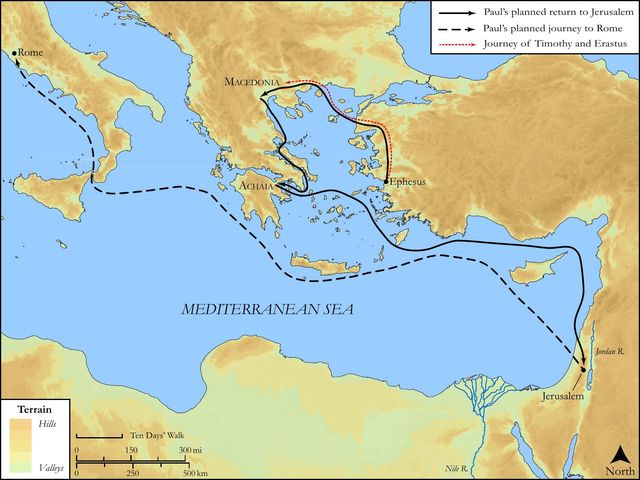
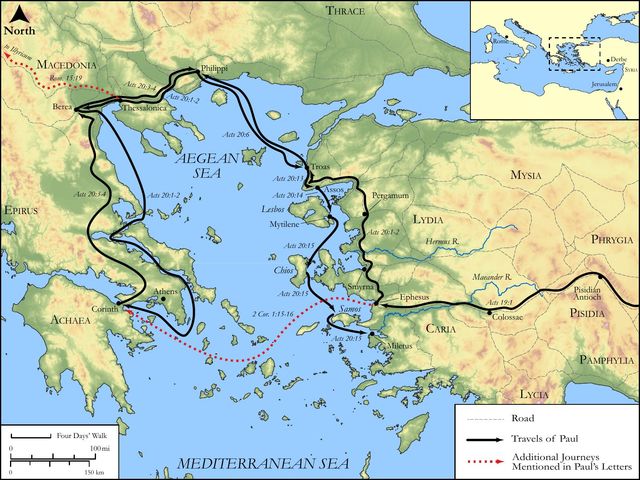
1.How he laid his purpose of going to other places, Act 19:21, Act 19:22. He was a man of vast designs for God, and was for making his influences as widely diffusive as might be. Having spent above two years at Ephesus,
(1.)He designed a visit to the churches of Macedonia and Achaia, especially of Philippi and Corinth, the chief cities of those provinces, Act 19:21. There he had planted churches, and now is concerned to visit them. He purposed in the spirit, either in his own spirit, not communicating his purpose as yet, but keeping it to himself; or by the direction of the Holy Spirit, who was his guide in all his motions, and by whom he was led. He purposed to go and see how the work of God went on in those places, that he might rectify what was amiss and encourage what was good.
(2.)Thence he designed to go to Jerusalem, to visit the brethren there, and give an account to them of the prospering of the good pleasure of the Lord in his hand; and thence he intended to go to Rome, to go and see Rome; not as if he designed only the gratifying of his curiosity with the sight of that ancient famous city, but because it was an expression people commonly used, that they would go and see Rome, would look about them there, when that which he designed was to see the Christians there, and to do them some service, Rom 1:11. The good people at Rome were the glory of the city which he longed for a sight of. Dr. Lightfoot supposes that it was upon the death of the emperor Claudius, who died the second year of Paul's being at Ephesus, that Paul thought of going to Rome, because while he lived the Jews were forbidden Rome, Act 18:2.
(3.)He sent Timothy and Erastus into Macedonia, to give them notice of the visit he intended them, and to get their collection ready for the poor saints at Jerusalem. Soon after he wrote the first epistle to the Corinthians, designing to follow it himself, as appears Co1 4:17, Co1 4:19, I have sent to you Timotheus; but I will myself come to you shortly, if the Lord will. For the present, he staid in Asia, in the country about Ephesus, founding churches.
2.How he was seconded in his purpose, and obliged to pursue it by the troubles which at length he met with at Ephesus. It was strange that he had been quiet there so long; yet it should seem he had met with trouble there not recorded in this story, for in his epistle written at this time he speaks of his having fought with beasts at Ephesus (Co1 15:32), which seems to be meant of his being put to fight with wild beasts in the theatre, according to the barbarous treatment they sometimes gave the Christians. And he speaks of the trouble which came to them in Asia, near Ephesus, when he despaired of life, and received a sentence of death within himself, Co2 1:8, Co2 1:9.
II.But, in the trouble here related, he was worse frightened than hurt.
In general, there arose no small stir about that way, Act 19:23. Some historians say that the famous impostor Apollonius Tyanaeus, who set up for a rival with Christ, and gave out himself, as Simon Magus, to be some great one, was at Ephesus about this time that Paul was there. But it seems the opposition he gave to the gospel was so insignificant that St. Luke did not think it worth taking notice of. The disturbance he gives an account of was of another nature: let us view the particulars of it. Here is,
1.A great complaint against Paul and the other preachers of the gospel for drawing people off from the worship of Diana, and so spoiling the trade of the silversmiths that worked for Diana's temple.
(1.)The complainant is Demetrius, a silversmith, a principal man, it is likely, of the trade, and one that would be thought to understand and consult the interests of it more than others of the company. Whether he worked in other sorts of plate or no we are not told; but the most advantageous branch of his trade was making silver shrines for Diana, Act 19:24. Some think these were medals stamped with the effigies of Diana, or her temple, or both; others think they were representations of the temple, with the image of Diana in it in miniature, all of silver, but so small that people might carry them about with them, as the papists do their crucifixes. Those that came from far to pay their devotions at the temple of Ephesus, when they went home bought these little temples or shrines, to carry home with them, for the gratifying of the curiosity of their friends, and to preserve in their own minds the idea of that stately edifice. See how craftsmen, and crafty men too above the rank of silversmiths, make an advantage to themselves of people's superstition, and serve their worldly ends by it.
(2.)The persons he appeals to are not the magistrates, but the mob; he called the craftsmen together, with the workmen of like occupation (a company of mechanics, who had no sense of any thing but their worldly interest), and these he endeavoured to incense against Paul, who would be actuated as little by reason and as much by fury as he could desire.
(3.)His complaint and representation are very full.
[1.]He lays it down for a principle that the art and mystery of making silver shrines for the worshippers of Diana was very necessary to be supported and kept up (Act 19:25): "You know that by this craft we have not only our subsistence, and our necessary food, but our wealth. We grow rich, and raise estates. We live great, and have wherewithal to maintain our pleasures; and therefore, whatever comes of it, we must not suffer this craft to grow into contempt." Note, It is natural for men to be jealous for that, whether right or wrong, by which they get their wealth; and many have, for this reason alone, set themselves against the gospel of Christ, because it calls men off from those crafts which are unlawful, how much wealth soever is to be obtained by them.
[2.]He charges it upon Paul that he had dissuaded men from worshipping idols. The words, as they are laid in the indictment, are, that he had asserted, Those are no gods which are made with hands, Act 19:26. Could any truth be more plain and self-evident than this, or any reasoning more cogent and convincing than that of the prophets, The workman made it, therefore it is not God? The first and most genuine notion we have of God is, that he had his being of himself, and depends upon none; but that all things have their being from him, and their dependence on him: and then it must follow that those are no gods which are the creatures of men's fancy and the work of men's hands. Yet this must be looked upon as an heretical and atheistical notion, and Paul as a criminal for maintaining it; not that they could advance any thing against this doctrine itself, but that the consequence of it was that not only at Ephesus, the chief city, but almost throughout all Asia, among the country people, who were their best customers, and whom they thought they were surest of, he had persuaded and turned away much people from the worship of Diana; so that there was not now such a demand for the silver shrines as had been, nor were such good rates given for them. There are those who will stickle for that which is most grossly absurd and unreasonable, and which carries along with it its own conviction of falsehood, as this does, that those are gods which are made with hands, if it have but human laws, and worldly interest and prescription, on its side.
[3.]He reminds them of the danger which their trade was in of going to decay. Whatever touches this touches them in a sensible tender part: "If this doctrine gains credit, we are all undone, and may even shut up shop; this our craft will be set at nought, will be convicted, and put into an ill name as superstition, and a cheat upon the world, and every body will run it down. This our part" (so the word is), "our interest or share of trade and commerce," kinduneuei hēmin to meros, "will not only come into danger of being lost, but it will bring us into danger, and we shall become not only beggars, but malefactors." [4.] He pretends a mighty zeal for Diana, and a jealousy for her honour: Not only this our craft is in danger; if that were all, he would not have you think that he would have spoken with so much warmth, but all his care is lest the temple of the great goddess Diana should be despised, and her magnificence should be destroyed; and he would not, for all the world, see the diminution of the honour of that goddess, whom all Asia and the world worship. See what the worship of Diana had to plead for itself, and what was the utmost which the most zealous bigots for it had to say in its behalf. First, That it had pomp on its side; the magnificence of the temple was the thing that charmed them, the thing that chained them; they could not bear the thoughts of any thing that tended to the diminution, much less to the destruction, of that. Secondly, That it had numbers on its side; All Asia and the world worship it; and therefore it must needs be the right way of worship, let Paul say what he will to the contrary. Thus, because all the world wonders after the beast, therefore the dragon, the devil, the god of this world, gives him his power, and his seat, and great authority, Rev 13:2, Rev 13:3.
2.The popular resentment of this complaint. The charge was managed by a craftsman, and was framed to incense the common people, and it had the desired effect; for on this occasion they showed,
(1.)A great displeasure against the gospel and the preachers of it. They were full of wrath (Act 19:28), full of fury and indignation, so the word signifies. The craftsmen went stark mad when they were told that their trade and their idol were both in danger.
(2.)A great jealousy for the honour of their goddess: They cried out, "Great is Diana of the Ephesians; and we are resolved to stand by her, and live and die in the defence of her. Are there any that expose her to contempt, or threaten her destruction? Let us alone to deal with them. Let Paul say ever so much to prove that those are no gods which are made with hands, we will abide by it that, whatever becomes of other gods and goddesses, Great is Diana of the Ephesians. We must and will stand up for the religion of our country, which we have received by tradition from our fathers." Thus all people walked every one in the name of his god, and all thought well of their own; much more should the servants of the true God do so, who can say, This God is our God for ever and ever.
(3.)A great disorder among themselves (Act 19:29): The whole city was full of confusion - he common and natural effect of intemperate zeal for a false religion; it throws all into confusion, dethrones reason, and enthrones passion; and men run together, not only not knowing one another's minds, but not knowing their own.
3.The proceedings of the mob under the power of these resentments, and how far they were carried.
(1.)They laid hands on some of Paul's companions, and hurried them into the theatre (Act 19:29), some think with design there to make them fight with beasts, as Paul had sometimes done; or perhaps they intended only to abuse them, and to make them a spectacle to the crowd. Those whom they seized were Gaius and Aristarchus, of both of whom we read elsewhere. Gaius was of Derbe, Act 20:4. Aristarchus is also there spoken of, and Col 4:10. They came with Paul from Macedonia, and this was their only crime, that they were Paul's companions in travel, both in services and sufferings.
(2.)Paul, who had escaped being seized by them, when he perceived his friends in distress for his sake, would have entered in unto the people, to sacrifice himself, if there were no other remedy, rather than his friends should suffer upon his account; and it was an evidence of a generous spirit, and that he loved his neighbour as himself.
(3.)He was persuaded from it by the kindness of his friends, who overruled him.
[1.]The disciples suffered him not, for it better became him to offer it than it would have become them to suffer it. They had reason to say to Paul, as David's servants did to him, when he was for exposing himself in a piece of public service, Thou art worth ten thousand of us, Sa2 18:3.
[2.]Others of his friends interposed, to prevent his throwing himself thus into the mouth of danger. They would treat him much worse than Gaius and Aristarchus, looking upon him as the ringleader of the party; and therefore better let them bear the brunt of the storm than that he should venture into it, Act 19:31. They were certain of the chief of Asia, the princes of Asia - Asiarchai. The critics tell us they were the chief of their priests; or, as others, the chief of their players. Whether they were converts to the Christian faith (and some such there were even of their priests and governors), or whether they were only well-wishers to Paul, as an ingenuous good man, we are not told, only that they were Paul's friends. Dr. Lightfoot suggests that they kept up a respect and kindness for him ever since he fought with beasts in their theatre, and were afraid he should be abused so again. Note, It is a friendly part to take more care of the lives and comforts of good men than they do themselves. It would be a very hazardous adventure for Paul to go into the theatre; it was a thousand to one that it would cost him his life; and therefore Paul was overruled by his friends to obey the law of self-preservation, and has taught us to keep out of the way of danger as long as we can without going out of the way of duty. We may be called to lay down our lives, but not to throw away our lives. It would better become Paul to venture into a synagogue than into a theatre.
(4.)The mob was in a perfect confusion (Act 19:32): Some cried one thing and some another, according as their fancies and passions, and perhaps the reports they received, led them. Some cried, Down with the Jews; others, Down with Paul; but the assembly was confused, as not understanding one another's minds. They contradicted one another, and were ready to fly in one another's faces for it, but they did not understand their own; for the truth was the greater part knew not wherefore they had come together. They knew not what began the riot, nor who, much less what business they had there; but, upon such occasions, the greatest part come only to enquire what the matter is: they follow the cry, follow the crowd, increase like a snow-ball, and where there are many there will be more.
(5.)The Jews would have interested themselves in this tumult (in other places they had been the first movers of such riots) but now at Ephesus they had not interest enough to raise the mob, and yet, when it was raised, they had ill-will enough to set in with it (Act 19:35): They drew Alexander out of the multitude, called him out to speak on the behalf of the Jews against Paul and his companions: "You have heard what Demetrius and the silversmiths have to say against them, as enemies to their religion; give us leave now to tell you what we have to say against him as an enemy to our religion." The Jews put him forward to do this, encouraged him, and told him they would stand by him and second him; and this they looked upon as necessary in their own defence, and therefore what he designed to say is called his apologizing to the people, not for himself in particular, but for the Jews in general, whom the worshippers of Diana looked upon to be as much their enemies as Paul was. Now they would have them know that they were as much Paul's enemies as they were; and those who are thus careful to distinguish themselves from the servants of Christ now, and are afraid of being taken for them, shall have their doom accordingly in the great day. Alexander beckoned with the hand, desiring to be heard against Paul; for it had been strange if a persecution had been carried on against the Christians and there were not Jews at one end or the other of it: if they could not begin the mischief, they would help it forward, and so make themselves partakers of other men's sins. Some think this Alexander had been a Christian, but had apostatized to Judaism, and therefore was drawn out as a proper person to accuse Paul; and that he was the Alexander the coppersmith that did Paul so much evil (Ti2 4:14), and whom he had delivered unto Satan, Ti1 1:20.
(6.)This occasioned the prosecutors to drop the prosecution of Paul's friends, and to turn it into acclamations in honour of their goddess (Act 19:34): When they knew that he was a Jew, and, as such, an enemy to the worship of Diana (for the Jews had now an implacable hatred to idols and idolatry), whatever he had to say for Paul or against him, they were resolved not to hear him, and therefore set the mob a shouting, "Great is Diana of the Ephesians; whoever runs her down, be he Jew or Christian, we are resolved to cry her up. She is Diana of the Ephesians, our Diana; and it is our honour and happiness to have her temple with us; and she is great, a famous goddess, and universally adored. There are other Dianas, but Diana of the Ephesians is beyond them all, because her temple is more rich and magnificent than any of theirs." This was all the cry for two hours together; and it was thought a sufficient confutation of Paul's doctrine, that those are not gods which are made with hands. Thus the most sacred truths are often run down with nothing else but noise and clamour and popular fury. It was said of old concerning idolaters that they were mad upon their idols; and here is an instance of it. Diana made the Ephesians great, for the town was enriched by the vast concourse of people from all parts to Diana's temple there, and therefore they are concerned by all means possible to keep up her sinking reputation with, Great is Diana of the Ephesians.
4.The suppressing and dispersing of these rioters, by the prudence and vigilance of the town-clerk; he is called, grammateus - the scribe, or secretary, or recorder; "the register of their games," the Olympic games (so others), whose business it was to preserve the names of the victors and the prizes they won. With much ado he, at length, stilled the noise, so as to be heard, and then made a pacific speech to them, and gave us an instance of that of Solomon, The words of wise men are heard in quiet more than the cry of him that rules among fools, as Demetrius did. Ecc 9:17.
(1.)He humours them with an acknowledgment that Diana was the celebrated goddess of the Ephesians, Act 19:35. They needed not to be so loud and strenuous in asserting a truth which nobody denied, or could be ignorant of: Every one knows that the city of the Ephesians is a worshipper of the great goddess Diana; is neōkoros; not only that the inhabitants were worshippers of this goddess, but the city, as a corporation, was, by its charter, entrusted with the worship of Diana, to take care of her temple, and to accommodate those who came thither to do her homage. Ephesus is the aeditua (they say that is the most proper word), or the sacrist, of the great goddess Diana. The city was more the patroness and protectress of Diana than Diana was of the city. Such great care did idolaters take for the keeping up of the worship of gods made with hands, while the worship of the true and living God is neglected, and few nations or cities glory in patronizing and protecting that. The temple of Diana at Ephesus was a very rich and sumptuous structure, but, it should seem, the image of Diana in the temple, because they thought it sanctified the temple, was had in greater veneration than the temple, for they persuaded the people that it fell down from Jupiter, and therefore was none of the gods that were made with men's hands. See how easily the credulity of superstitious people is imposed upon by the fraud of designing men. Because this image of Diana had been set up time out of mind, and nobody could tell who made it, they made the people believe it fell down from Jupiter. "Now these things," says the town-clerk very gravely (but whether seriously or no, and as one that did himself believe them, may be questioned), "cannot be spoken against; they have obtained such universal credit that you need not fear contradiction, it can do you no prejudice." Some take it thus: "Seeing the image of Diana fell down from Jupiter, as we all believe, then what is said against gods made with hands does not at all affect us."
(2.)He cautions them against all violent and tumultuous proceedings, which their religion did not need, nor could receive any real advantage from (Act 19:36): You ought to be quiet, and to do nothing rashly. A very good rule this is to be observed at all times, both in private and public affairs; not to be hasty and precipitate in our motions, but to deliberate and take time to consider: not to put ourselves or others into a heat, but to be calm and composed, and always keep reason in the throne and passion under check. This word should be ready to us, to command the peace with, when we ourselves or those about us are growing disorderly: We ought to be quiet, and to do nothing rashly; to do nothing in haste, which we may repent of at leisure.
(3.)He wipes off the odium that had been cast upon Paul and his associates, and tells them, they were not the men that they were represented to them to be (Act 19:37): "You have brought hither these men, and are ready to pull them to pieces; but have you considered what is their transgression and what is their offence? What can you prove upon them? They are not robbers of churches, you cannot charge them with sacrilege, or the taking away of any dedicated thing. They have offered no violence to Diana's temple or the treasures of it; nor are they blasphemers of your goddess; they have not given any opprobrious language to the worshippers of Diana, nor spoken scurrilously of her or her temple. Why should you prosecute those with all this violence who, though they are not of your mind, yet do not inveigh with any bitterness against you? Since they are calm, why should you be hot?" It was the idol in the heart that they levelled all their force against, by reason and argument; if they can but get that down, the idol in the temple will fall of course. Those that preach against idolatrous churches have truth on their side, and ought vigorously to maintain it and press it on men's consciences; but let them not be robbers of those churches (on the prey laid they not their hand, Est 9:15, Est 9:16), nor blasphemers of those worships; with meekness instructing, not with passion and foul language reproaching, those that oppose themselves; for God's truth, as it needs not man's lie, so it needs not man's intemperate heat. The wrath of man worketh not the righteousness of God.
(4.)He turns them over to the regular methods of the law, which ought always to supersede popular tumults, and in civilized well-governed nations will do so. A great mercy it is to live in a country where provision is made for the keeping of the peace, and the administration of public justice, and the appointing of a remedy for every wrong; and herein we of this nation are as happy as any people.
[1.]If the complaint be of a private injury, let them have recourse to the judges and courts of justice, which are kept publicly at stated times. If Demetrius and the company of the silversmiths, that have made all this rout, find themselves aggrieved, or any privilege they are legally entitled to infringed or entrenched upon, let them bring their action, take out a process, and the matter shall be fairly tried, and justice done: The law is open, and there are deputies; there is a proconsul and his delegate, whose business it is to hear both sides, and to determine according to equity; and in their determination all parties must acquiesce, and not be their own judges, nor appeal to the people. Note, The law is good if a man use it lawfully, as the last remedy both for the discovery of a right disputed and the recovery of a right denied.
[2.]If the complaint be of a public grievance, relating to the constitution, it must be redressed, not by a confused rabble, but by a convention of the states (Act 19:39): If you enquire any thing concerning other matters, that are of common concern, it shall be determined in a lawful assembly of the aldermen and common-council, called together in a regular way by those in authority. Note, Private persons should not intermeddle in public matters, so as to anticipate the counsels of those whose business it is to take cognizance of them; we have enough to do to mind our own business.
(5.)He makes them sensible of the danger they are in, and of the premunire they have run themselves into by this riot (Act 19:40): "It is well if we be not called in question for this day's uproar, if we be not complained of at the emperor's court, as a factious and seditious city, and if a quo warranto be not brought against us and our charter taken away; for there is no cause whereby we may give an account of this concourse, we have nothing to say in excuse of it. We cannot justify ourselves in breaking the peace by saying that others broke it first, and we only acted defensively; we have no colour for any such plea, and therefore let the matter go no further, for it has gone too far already." Note, Most people stand in awe of men's judgment more than of the judgment of God. How well were it if we would thus still the tumult of our disorderly appetites and passions, and check the violence of them, with the consideration of the account we must shortly give to the Judge of heaven and earth for all these disorders! We are in danger to be called in question for this day's uproar in our hearts, in our houses; and how shall we answer it, there being no cause, no just cause, or no proportionable one, whereby we may give an account of this concourse, and of this heat and violence? As we must repress the inordinacy of our appetites, so also of our passions, with this, that for all these things God will bring us unto judgment (Ecc 11:9), and we are concerned to manage ourselves as those that must give account.
(6.)When he has thus shown them the absurdity of their riotous meeting, and the bad consequences that might follow from it, he advises them to separate with all speed (Act 19:41): he dismissed the assembly, ordered the crier perhaps to give notice that all manner of persons should peaceably depart and go about their own business, and they did so. See here,
[1.]How the overruling providence of God preserves the public peace, by an unaccountable power over the spirits of men. Thus the world is kept in some order, and men are restrained from being as the fishes of the sea, where the greater devour the less. Considering what an impetuous furious thing, what an ungovernable untameable wild beast the mob is, when it is up, we shall see reason to acknowledge God's goodness that we are not always under the tyranny of it. He stills the noise of the sea, noise of her waves, and (which is no less an instance of his almighty power) the tumult of the people, Psa 65:7.
[2.]See how many ways God has of protecting his people. Perhaps this town-clerk was no friend at all to Paul, nor to the gospel he preached, yet his human prudence is made to serve the divine purpose. Many are the troubles of the righteous, but the Lord delivereth them out of them all.
Historical interpretation
Historical reception
4 surviving comments on this verse. Each one is dated, so this reads as a timeline rather than a list.
Afflictions cut us off from the sympathy we have for the present world, as appears in this, that we wish for death immediately, and cease to be loving of the body: which very thing is the greatest part of wisdom, to have no hankering, no ties to the present life. The soul which is afflicted does not wish to be concerned about many things: repose and stillness are all it desired, content for its part to have done with the things present, even though there be nothing else to follow.
A great good is affliction: and we learn this from our own children: for without affliction a boy would learn nothing useful. But we, more than they, need affliction. For if there, when the passions as yet are quiet, chastisement benefits them, how much more us, especially possessed as we are by so many! Nay, we behoove rather to have schoolmasters than they: since the faults of children cannot be great, but ours are exceeding great. Our schoolmaster is affliction. Let us then not draw it down willingly upon ourselves, but when it is come let us bear it bravely, being, as it is, always the cause of numberless good things; that so we may both obtain grace from God, and the good things which are laid up for them that love Him, in Christ Jesus our Lord.
"Some therefore cried one thing, and some another: for the assembly was confused." Such is the nature of the multitude: it recklessly follows, like fire when it has fallen upon fuel; and the more part knew not wherefore they were come together.
Seest thou how God permits trials, and by them stirs up and awakens the disciples, and makes them more energetic? Then let us not sink down under trials: for He Himself will "also make the way of escape, that we may be able to bear them." Nothing so makes friends, and rivets them so firmly, as affliction: nothing so fastens and compacts the souls of believers: nothing is so seasonable for us teachers in order that the things said by us may be heard. For the hearer when he is in ease is listless and indolent, and seems to suffer annoyance from the speaker: but when he is in affliction and distress, he falls into a great longing for the hearing. For when distressed in his soul, he seeks on all sides to find comfort for his affliction: and the preaching brings no small comfort.
Continue studying Acts 19:32 across the web’s major study libraries — every link below opens this exact verse, chapter, or book on the destination site.
Read & Compare
 BibleGatewayThis verse in more than 200 translations and 70 languages.
 Bible.comThe YouVersion reader — hundreds of translations, reading plans, and highlights.
 ESV.orgCrossway's official English Standard Version reader.
 NET BibleThe NET translation with 60,000+ translators' notes on every rendering decision.
 STEP BibleTyndale House's free study tool — original text, vocabulary, and scholarly resources.
 BibliaLogos Bible Software's free web reader.
 USCCBThe New American Bible (Revised Edition) with the U.S. bishops' study notes.
Commentaries
 BibleHub CommentariesDozens of classic commentaries on this verse, gathered on one page.
 StudyLightMore than 100 commentary sets — the largest collection on the web.
 BibleRefPlain-English commentary on what this verse means, verse by verse.
 Enduring WordDavid Guzik's free commentary on this chapter, widely used by Bible teachers.
 Bible Study ToolsVerse commentary alongside Greek and Hebrew study aids.
Original Language & Research
- BibleHub InterlinearThe verse word by word — original language, transliteration, and English.
- BibleHub LexiconEvery word's original-language definition and Strong's entry.
 Blue Letter BibleDeep-study tools — Strong's numbers, concordance, and word studies.
 CNTR CollationThe earliest Greek manuscripts of this verse, collated letter by letter.
Sermons, Hymns & Audio


TrulyRandomVerse is not affiliated with these sites and doesn’t control their content. They’re linked because they’re genuinely useful.
Summary
Acts 19:32 vividly portrays the chaotic and irrational nature of the Ephesian mob, which had gathered in the city's theater in response to Demetrius the silversmith's incitement against Paul and the spread of the Gospel. The verse highlights the profound disorganization and lack of clear purpose among the rioters, many of whom were swept up in the fervor without understanding the true cause of their assembly, illustrating the dangers of mob mentality and uninformed public sentiment.
Context
ShowHideLiterary Context
Acts 19:32 is situated within the broader narrative of Paul's ministry in Ephesus, particularly the dramatic account of the riot incited by Demetrius (Acts 19:23-41). This verse immediately follows the description of Gaius and Aristarchus being dragged into the theater and Paul's attempt to enter, which was prevented by disciples and even some Asian officials. The preceding verses detail Demetrius's economic grievance—the decline in sales of idols of Artemis due to the spread of Christianity—and his rallying cry that "the temple of the great goddess Artemis should be despised" (Acts 19:27). The confusion described in verse 32 sets the stage for the town clerk's intervention, who eventually brings order and dismisses the assembly, highlighting the volatile and unpredictable nature of the crowd before his reasoned appeal.
Historical & Cultural Context
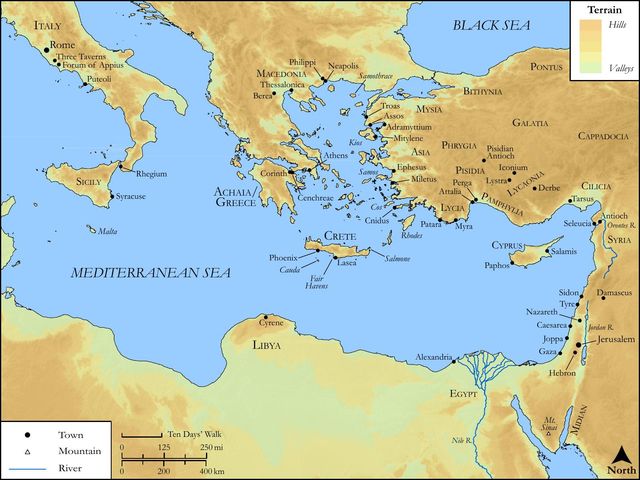
Ephesus was a prominent city in the Roman province of Asia, renowned for its magnificent Temple of Artemis (Diana), one of the Seven Wonders of the Ancient World. This temple was not only a religious center but also a significant economic hub, attracting pilgrims and supporting a thriving industry of silversmiths who crafted miniature shrines and idols. Public assemblies, or ekklesiai, were common in Greek cities, typically convened for civic discourse and decision-making. However, this particular assembly was an unscheduled, emotionally charged gathering, driven by economic fear and religious zeal, rather than orderly civic process. The crowd's diverse origins—some local, some from the surrounding region—contributed to the disunity and lack of a coherent agenda, making them susceptible to manipulation and prone to chaotic outbursts.
Key Themes
ShowHideThis verse powerfully illustrates the theme of mob mentality, where individual rationality is subsumed by collective emotion, leading to irrational and often destructive behavior. The deep confusion underscores the theme of ignorance as a catalyst for opposition; many were simply caught up in the uproar without understanding its true origins or purpose, highlighting how easily people can be manipulated when uninformed. Furthermore, it subtly reflects the broader theme of the clash between the Gospel and entrenched cultural/economic systems. While the immediate trigger was economic, the underlying tension was the challenge posed by the monotheistic, idol-rejecting message of Christianity to the deeply ingrained pagan worship of Artemis, a pattern seen throughout the book of Acts where the Gospel confronts existing powers and belief systems, as when Paul's preaching in Thessalonica caused an uproar among those who "turned the world upside down" (Acts 17:6).
Exposition and Analysis
ShowHideKey Word Analysis
ShowHideFrom a compound of ek (out) and a derivative of kaleō (to call), this word literally means "a calling out." It refers to a popular meeting, an assembly of citizens, or, in a religious context, a congregation or church. In Acts 19:32, its use for the chaotic Ephesian mob is ironic, as an ekklēsía was typically a structured gathering for deliberation. Here, it denotes a disorderly crowd, highlighting the profound disfunction and lack of true civic purpose.
Derived from syn (with) and a verb meaning "to pour," this word literally means "to commingle promiscuously" or "to pour together." Figuratively, it signifies throwing an assembly into disorder, confounding, or perplexing the mind. It describes a state of utter disarray, bewilderment, and turmoil, where rational thought is absent, perfectly capturing the scene in the Ephesian theater where different voices and purposes merged into an unintelligible clamor.
The verb eídō (to see, perceive, know) combined with the absolute negative particle ou (no, not) emphasizes a complete lack of understanding or awareness. It indicates that the "more part" of the assembly was entirely ignorant of the reason for their gathering. This is not merely a misunderstanding but a fundamental absence of knowledge, underscoring their susceptibility to emotional manipulation and the irrationality of their actions.
Verse Breakdown
ShowHide"Some therefore cried one thing, and some another"
This phrase immediately establishes the chaotic and discordant nature of the assembly. There was no unified voice or message, only a cacophony of shouts and conflicting cries, indicating a lack of leadership, common purpose, or even a basic understanding of the situation. It paints a picture of utter disorganization and emotional outburst.
"for the assembly was confused"
This clause provides the reason for the conflicting shouts. The word "confused" (Greek: synchéō) denotes a state of profound disorder and bewilderment, more than just misunderstanding. It implies a complete mixing up of ideas, purposes, and voices, resulting in a tumultuous and unintelligible scene. The assembly had lost all semblance of order or rational deliberation.
"and the more part knew not wherefore they were come together"
This final clause offers a startling revelation about the nature of the mob. A significant majority of those present were ignorant of the actual reason for the uproar. They were simply swept up by the momentum, emotion, and crowd psychology, demonstrating how easily people can be drawn into conflicts or movements without genuine comprehension or conviction, making them pawns in a larger scheme.
Literary Devices
ShowHideThe passage powerfully employs Irony by referring to the chaotic mob as an "assembly" (ekklēsía), a term typically used for an orderly civic gathering. This highlights the profound dysfunction and perversion of what should have been a structured public meeting into a scene of utter pandemonium. Furthermore, the description of the "more part" not knowing why they were there serves as a form of Hyperbole, emphasizing the extreme level of irrationality and herd mentality at play. The cumulative effect of the conflicting shouts and the widespread ignorance creates a vivid portrayal of Chaos as a central motif, underscoring the spiritual and intellectual darkness that often accompanies opposition to divine truth.
Theological and Thematic Connections
ShowHideActs 19:32 serves as a stark reminder of humanity's fallen nature and the dangers of unbridled emotion and groupthink, particularly when spiritual truth is at stake. The confusion of the Ephesian crowd illustrates how easily people can be swayed by misinformation, economic anxieties, or cultural loyalties, rather than by reasoned consideration of the Gospel. This incident highlights that opposition to God's work often stems not from a deep understanding and rejection of Christian doctrine, but from vested interests, fear of change, or sheer ignorance. It underscores the spiritual battle where the clarity of Christ's message confronts the world's inherent confusion and resistance to divine light.
Reflection and Application
ShowHideThe scene in Ephesus offers profound lessons for contemporary believers. It challenges us to cultivate discernment and intellectual rigor, refusing to be swept away by popular opinion, emotional appeals, or the clamor of the crowd without first seeking truth and understanding. In a world increasingly polarized and prone to "mob mentality" in various forms—be it social media trends, political movements, or cultural shifts—Acts 19:32 calls us to a sober assessment of motives, both our own and those of others. It reminds us that genuine faith is rooted in conviction and understanding, not in blind adherence or emotional fervor. We are called to be thoughtful participants in society, grounded in the clarity of God's Word, rather than unwitting participants in chaos. This requires intentional study, prayerful reflection, and a commitment to seeking wisdom above all else, ensuring that our actions are guided by truth, not by the prevailing winds of confusion.
Questions for Reflection
ShowHideFAQ
ShowHideWhat was the "assembly" in Acts 19:32, and why was it so confused?
ShowHideThe "assembly" (Greek: ekklēsía) in Acts 19:32 refers to the spontaneous and chaotic gathering of people in the Ephesian theater, incited by Demetrius the silversmith. It was not a formally convened civic meeting but a riotous crowd. The assembly was confused because many participants were swept up in the emotional fervor without understanding the true reason for the uproar. Demetrius had stirred up fear among the idol-makers, claiming Paul's preaching was undermining their livelihood and the worship of Artemis (Acts 19:24-27). This economic threat, combined with religious zeal, created a volatile situation where people joined the commotion out of curiosity, anger, or simply being caught in the tide, leading to a cacophony of conflicting shouts and widespread ignorance about the actual cause.
What does this verse teach us about human nature and mob mentality?
ShowHideActs 19:32 offers a powerful illustration of the dangers of mob mentality, where individual reason and critical thinking are often lost within a large, emotionally charged crowd. It highlights how easily people can be manipulated when they lack information or are driven by fear, economic concerns, or tribal loyalties rather than by truth or logic. The verse demonstrates that a significant portion of a crowd may act irrationally or violently without even knowing the core issue, simply being swept along by the collective emotion. This serves as a timeless warning about the importance of individual discernment and the potential for chaos when emotion overrides reason, echoing the human tendency to follow the crowd without true understanding, as seen in other biblical accounts of mass hysteria or unthinking conformity (Numbers 14:1-4).
Christ-Centered Fulfillment
ShowHideThe chaotic confusion of the Ephesian mob in Acts 19:32 stands in stark contrast to the order, truth, and clarity found in Jesus Christ. While the "assembly" was marked by ignorance and conflicting shouts, Christ is the very embodiment of divine wisdom and the singular voice of truth in a confused world. He is the Light that dispels spiritual darkness and the Way that brings clarity to those lost in sin's labyrinth (John 14:6). The mob's inability to discern the true cause of their gathering foreshadows humanity's spiritual blindness apart from Christ, who opens the eyes of the understanding (Ephesians 1:18). In a world prone to confusion, manipulation, and the clamor of conflicting ideologies, Christ offers a steadfast anchor, a unified purpose, and the ultimate reason for our existence, drawing us out of the world's disorder into the ordered peace of His kingdom (Colossians 1:15-20). He is the one around whom all things cohere, bringing sense and salvation to a bewildered humanity.