


2 Samuel 24:21
Bible text: King James Version (1769 Blayney text) · Public domain
Bible text: King James Version with Strong's numbers · Public domain
Bible text: Berean Standard Bible · Public domain
Bible text: American Standard Version (1901) · Public domain
Bible text: World English Bible, Messianic edition · Public domain
Bible text: Geneva Bible (1599) · Public domain
Bible text: Young's Literal Translation · Public domain
- וַיֹּאמֶרvai·Yo·merand he saidH559Conj-w ¦ V-Qal-ConsecImperf-3msVerb Qal Consecutive Imperfect 3rd Singular Masculineוַandיֹּאמֶרhe said
- אֲרַוְנָה'a·Rav·nahAraunahH728N-proper-mNoun Proper Masculine
- מַדּוּעַma·Du·a'why?H4069InterrogParticle Interrogative
- בָּאba'has he comeH935V-Qal-Perf-3msVerb Qal Perfect 3rd Singular Masculine
- אֲדֹנִי'a·do·nimy lordH113N-msc ¦ 1csNoun Singular Masculine Constructאֲדֹנִlordיmy
- הַמֶּלֶךְha·Me·lekhthe kingH4428Art ¦ N-msNoun Singular Masculine Absoluteהַtheמֶּלֶךְking
- אֶל'eltoH413PrepPreposition
- עַבְדּוֹav·Dohis servantH5650N-msc ¦ 3msNoun Singular Masculine Constructעַבְדּservantוֹhis
- וַיֹּאמֶרvai·Yo·merand he saidH559Conj-w ¦ V-Qal-ConsecImperf-3msVerb Qal Consecutive Imperfect 3rd Singular Masculineוַandיֹּאמֶרhe said
- דָּוִדda·VidDavidH1732N-proper-mNoun Proper Masculine
- לִקְנוֹתlik·Notto buyH7069Prep-l ¦ V-Qal-InfVerb Qal Infinitive Constructלִtoקְנוֹתbuy
- מֵעִמְּךָme·'i·me·Khafrom with <the> youH5973Prep-m ¦ Prep ¦ 2msPreposition Definiteמֵfromעִמְּwith <the>ךָyou
- אֶת'et<obj.>H853DirObjMParticle Object Indicator
- הַגֹּרֶןha·Go·renthe threshing floorH1637Art ¦ N-fsNoun Singular Feminine Absoluteהַtheגֹּרֶןthreshing floor
- לִבְנוֹתliv·Notto buildH1129Prep-l ¦ V-Qal-InfVerb Qal Infinitive Constructלִtoבְנוֹתbuild
- מִזְבֵּחַmiz·Be·achan altarH4196N-msNoun Singular Masculine Absolute
- לַיהוָהla·Yah·wehto YahwehH3068Prep-l ¦ N-properNoun Proper TitleלַtoיהוָהYahweh
- וְתֵעָצַרve·te·'a·Tzarso it may be restrainedH6113Conj-w ¦ V-Niphal-ConjImperf-3fsVerb Niphal Conjunction+Imperfect 3rd Singular Feminineוְsoתֵעָצַרit may be restrained
- הַמַּגֵּפָהha·ma·ge·Fahthe plagueH4046Art ¦ N-fsNoun Singular Feminine Absoluteהַtheמַּגֵּפָהplague
- מֵעַלme·'Alfrom onH5921Prep-m ¦ PrepPrepositionמֵfromעַלon
- הָעָםha·'Amthe peopleH5971Art ¦ N-msNoun Singular Masculine Absoluteהָtheעָםpeople
English is a literal word-by-word gloss of the Hebrew, not the KJV's wording. Why?
This is the original text the KJV's translators worked from — each Hebrew word with its own literal English meaning in this verse, prepared by scholars at Tyndale House, Cambridge. The KJV translates whole sentences, not word by word, so its wording differs: one Hebrew word can become several English words, and the KJV may choose “the LORD” where the gloss reads “Yahweh”. Both are faithful — they answer different questions. For the KJV's own rendering, switch to the KJV text.
Details
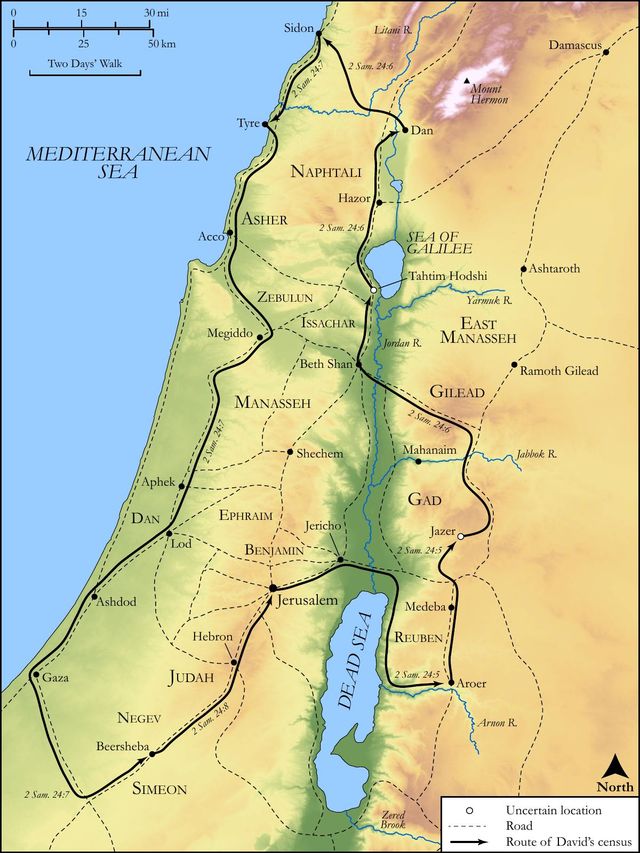
See on the biblical-era maps

Study this verse
Historical interpretation
Historical reception
1 surviving comment on this verse from the historical church.
Notice, brothers, that no place in the land of the Jews was found worthy for the altar of the Lord to be built; but in the land of the Gentiles a place is chosen where the angel is seen and the altar of the Lord is built, and thus the wrath of the almighty Lord is appeased. Then already was prefigured the fact that in the hearts of the Jews no worthy place could be found to offer spiritual victims; the land of the Gentiles, that is, the conscience of Christians, is chosen as the place for the Lord’s temple. This the apostle clearly indicates when he rebukes the Jews and says, “It was necessary that the word of God should be spoken to you first, but since you have judged yourselves unworthy of eternal life, behold, we now turn to the Gentiles.” This means [that] because you have rejected Christ and have not prepared a worthy place on which to set the Lord’s altar, we will put it in the land of the Gentiles, that is, in the hearts of all the people. For this reason the same apostle exclaims to us, “Holy is the temple of God, and you are this temple.” Now notice, dearly beloved, that the land of the Gentile king was chosen at the time when the Jewish people were struck by God’s plague. This we see fulfilled in the Lord’s passion; for when the Jewish people rejected the Lord and crucified him, then his altar was consecrated on the threshing floor of the Gentiles, that is, on every land. That is why the angel of the Lord stood on the threshing floor of the Gentile king; the true angel, Christ, visited the people of the Gentiles.
Continue studying 2 Samuel 24:21 across the web’s major study libraries — every link below opens this exact verse, chapter, or book on the destination site.
Read & Compare
 BibleGatewayThis verse in more than 200 translations and 70 languages.
 Bible.comThe YouVersion reader — hundreds of translations, reading plans, and highlights.
 ESV.orgCrossway's official English Standard Version reader.
 NET BibleThe NET translation with 60,000+ translators' notes on every rendering decision.
 STEP BibleTyndale House's free study tool — original text, vocabulary, and scholarly resources.
 BibliaLogos Bible Software's free web reader.
 USCCBThe New American Bible (Revised Edition) with the U.S. bishops' study notes.
Commentaries
 BibleHub CommentariesDozens of classic commentaries on this verse, gathered on one page.
 StudyLightMore than 100 commentary sets — the largest collection on the web.
 BibleRefPlain-English commentary on what this verse means, verse by verse.
 Enduring WordDavid Guzik's free commentary on this chapter, widely used by Bible teachers.
 Bible Study ToolsVerse commentary alongside Greek and Hebrew study aids.
Original Language & Research
- BibleHub InterlinearThe verse word by word — original language, transliteration, and English.
- BibleHub LexiconEvery word's original-language definition and Strong's entry.
 Blue Letter BibleDeep-study tools — Strong's numbers, concordance, and word studies.
 SefariaThe Hebrew text with Rashi and centuries of Jewish commentary.
Sermons, Hymns & Audio


TrulyRandomVerse is not affiliated with these sites and doesn’t control their content. They’re linked because they’re genuinely useful.
Summary
In 2 Samuel 24:21, King David confronts Araunah, a Jebusite, at his threshingfloor, revealing his urgent purpose: to purchase the land for the construction of an altar to the LORD. This action is the divinely appointed means to appease God's wrath and halt the devastating plague that has afflicted Israel as a consequence of David's unauthorized census, highlighting the king's repentance and his commitment to seeking divine reconciliation.
Context
ShowHideLiterary Context
This verse is situated at the climax of 2 Samuel 24, which recounts David's sin in taking a census and the subsequent divine judgment upon Israel. Immediately prior to this encounter, the prophet Gad, acting on the LORD's command, instructs David to go up and build an altar on Araunah's threshingfloor (2 Samuel 24:18). David's swift obedience, as depicted in his journey to Araunah, underscores his deep remorse and earnest desire to follow God's directive for atonement. The dialogue in this verse sets the stage for Araunah's generous offer to provide the land and sacrificial animals freely, which David famously refuses, declaring his unwillingness to offer to the LORD "that which doth cost me nothing" (2 Samuel 24:24). The entire chapter culminates in the successful offering of sacrifices, leading to the LORD's merciful response and the cessation of the plague, thereby resolving the narrative arc of sin, judgment, and reconciliation.
Historical & Cultural Context
The scene unfolds at a threshingfloor, typically an open, elevated area, often on a hilltop, designed for threshing and winnowing grain. Its exposed nature allowed for optimal wind conditions to separate chaff from grain, making it a prominent and accessible location. Araunah, a Jebusite, was likely one of the original inhabitants of Jerusalem who remained in the city after David's conquest (2 Samuel 5:6-9). The census, while seemingly administrative, was considered a grievous sin in this context, as it likely stemmed from David's pride and a reliance on military strength and numbers rather than on God's sovereign protection and provision for Israel (compare 1 Chronicles 21:1-7). In ancient Israelite understanding, plagues were direct manifestations of divine judgment for sin. The prescribed means of seeking atonement and appeasing God's wrath involved the building of an altar and the offering of specific sacrifices, practices deeply embedded in the Mosaic covenant and Israelite cultic life.
Key Themes
ShowHideThe narrative surrounding 2 Samuel 24:21 profoundly illustrates several enduring theological themes. Repentance and Atonement are central, as David's immediate and costly obedience demonstrates a genuine turning from sin, prompting God's provision for reconciliation and forgiveness. The principle of The Cost of True Worship is vividly portrayed through David's insistence on purchasing the threshingfloor, emphasizing that genuine devotion and sacrifice must involve personal investment and value, not merely convenient or free offerings, as articulated in his famous declaration in 2 Samuel 24:24. Furthermore, the account underscores Divine Intervention and the Cessation of Judgment, showcasing God's sovereignty over calamity and His merciful response to humble obedience and sacrificial atonement. Finally, the Significance of the Location is paramount, as this very threshingfloor later became the chosen site for Solomon's Temple, the permanent dwelling place for the Ark of the Covenant and the epicenter of Israelite worship for centuries (2 Chronicles 3:1).
Exposition and Analysis
ShowHideKey Word Analysis
ShowHideA primitive root; to erect, i.e. create; by extension, to procure, especially by purchase (causatively, sell); by implication to own; attain, buy(-er), teach to keep cattle, get, provoke to jealousy, possess(-or), purchase, recover, redeem, [idiom] surely, [idiom] verily. In this context, David's intention to "buy" (H7069) the threshingfloor demonstrates his respect for property rights and his commitment to a costly, legitimate transaction for sacred purposes, rather than mere appropriation.
A primitive root; to build (literally and figuratively); (begin to) build(-er), obtain children, make, repair, set (up), [idiom] surely. David's stated purpose to "build" (H1129) an altar signifies the physical construction of a sacred structure for worship and sacrifice, a necessary act of obedience to God's command for atonement.
A primitive root; to inclose; by analogy, to hold back; also to maintain, rule, assemble; [idiom] be able, close up, detain, fast, keep (self close, still), prevail, recover, refrain, [idiom] reign, restrain, retain, shut (up), slack, stay, stop, withhold (self). The use of "stayed" (H6113) here emphasizes God's sovereign power to actively halt or restrain the plague, indicating that its cessation is not a natural occurrence but a direct divine intervention in response to the sacrificial offering.
Verse Breakdown
ShowHide"And Araunah said, Wherefore is my lord the king come to his servant?"
Araunah's initial query is one of respectful deference and genuine curiosity. His use of "my lord the king" and "his servant" reflects the customary hierarchical address of a subject to the king, highlighting his humble posture before the monarch and his desire to understand the unexpected royal visit to his private property.
"And David said, To buy the threshingfloor of thee, to build an altar unto the LORD,"
David's response is direct, transparent, and resolute. He immediately clarifies his intention to "buy," emphasizing a legitimate transaction rather than seizure, thereby honoring Araunah's ownership. The core purpose is profoundly spiritual: to construct an altar specifically dedicated "unto the LORD" (Yahweh), demonstrating his immediate obedience to the prophet Gad's divine instruction and his clear understanding of the necessary means for reconciliation with God.
"that the plague may be stayed from the people."
This concluding clause reveals the urgent and dire motivation behind David's actions. The ultimate goal is the immediate cessation of the devastating plague, which is explicitly understood as God's judgment upon the people due to David's sin. This underscores the direct causal link between sin, divine judgment, the need for atonement, and the expectation of divine mercy through prescribed means.
Literary Devices
ShowHideThe passage employs several key literary devices to convey its profound message. The most prominent is Dialogue, which provides a direct and immediate exchange between David and Araunah. This unmediated conversation not only advances the plot but also reveals the characters' motivations and the gravity of the situation without narrative intrusion. Araunah's respectful inquiry and David's straightforward response underscore the king's earnest intent and the urgency of the crisis. There is also significant Foreshadowing in this seemingly humble threshingfloor becoming the divinely appointed site for the future Temple, the permanent dwelling place of God's presence among His people. This elevates the significance of the ordinary location to one of profound spiritual and historical importance for Israel. Furthermore, the threshingfloor itself carries rich Symbolism; traditionally a place of separation (chaff from grain), it transforms into a sacred space where judgment (the plague) is separated from mercy (the altar and atonement), and where a new, sacred beginning for Israel's worship would emerge.
Theological and Thematic Connections
ShowHideThe narrative of 2 Samuel 24:21 is deeply theological, illustrating foundational principles of God's justice, mercy, and the mechanics of atonement within the Old Covenant. David's sin brought severe judgment upon the nation, yet God, in His sovereign mercy, provided a specific means for reconciliation: the building of an altar and the offering of sacrifice. This highlights that while sin has real and often communal consequences, God always provides a path to forgiveness and restoration for those who genuinely repent and seek Him on His terms. David's insistence on a costly sacrifice underscores that true worship and atonement are not superficial or cheap; they require genuine investment, personal surrender, and a recognition of the gravity of sin and the holiness of God. This foundational principle of sacrifice as the divinely ordained means of dealing with sin permeates the entire biblical narrative, pointing forward to the ultimate sacrifice.
Reflection and Application
ShowHideThe account of David and Araunah's threshingfloor offers profound and enduring lessons for contemporary believers. It serves as a stark reminder of the serious nature of sin and the inevitable, often far-reaching, consequences it brings, not only upon individuals but frequently upon entire communities. David's immediate and costly response to God's instruction, even in the midst of national calamity, stands as a powerful model of true repentance: it is not merely sorrow or regret, but a decisive turning to obey God's will, even when that obedience demands personal sacrifice and significant cost. Furthermore, David's refusal to offer "that which doth cost me nothing" challenges us to examine the sincerity and depth of our own worship and service to God. Are we truly giving God our best, our firstfruits, and our genuine investment, or are we merely offering what is convenient, leftover, or requires no personal sacrifice? God's provision of an altar for atonement, even in the midst of judgment, speaks volumes about His enduring mercy, His faithfulness to His covenant, and His persistent desire for reconciliation with His people. We are called to respond to His boundless grace with humble, obedient, and costly devotion, recognizing that genuine worship always involves a surrender of self, resources, and will.
Questions for Reflection
ShowHideFAQ
ShowHideWhy was David's census considered a sin, and what does it tell us about trusting God?
ShowHideDavid's census was considered a sin not because counting people is inherently wrong, but because of the motive behind it. As implied in 1 Chronicles 21:1, it was likely prompted by pride and a reliance on human strength and military numbers rather than on God's divine protection and provision. It demonstrated a lack of faith in God's ability to deliver victory and security for Israel, challenging God's sovereignty and His covenant faithfulness. This act led to divine judgment in the form of a plague, teaching us that true security and strength come from trusting wholly in God, not in human resources, achievements, or self-sufficiency.
Who was Araunah, and why is his role significant?
ShowHideAraunah (also known as Ornan in 1 Chronicles 21) was a Jebusite landowner in Jerusalem. His significance lies in his generous offer to David: to give the threshingfloor, oxen, and wood for the sacrifice freely. This act of generosity highlights his respect for David and perhaps his recognition of the divine crisis unfolding. More importantly, his threshingfloor was the divinely appointed site for the altar that would stop the plague, and later, the very location where Solomon's magnificent Temple would be built (2 Chronicles 3:1). Thus, a humble Jebusite's property, acquired through David's costly obedience, became the most sacred site in Israel, symbolizing God's dwelling place among His people.
Why was the threshingfloor specifically chosen as the site for the altar and later the Temple?
ShowHideThe biblical text indicates that the angel of the Lord, who was bringing the plague upon Israel, was "by the threshingfloor of Araunah the Jebusite" when God relented and told the angel to "stay his hand" (2 Samuel 24:16). Therefore, the site was chosen by direct divine decree; it was the precise location where God's judgment was stayed and His mercy revealed. Its elevated position made it naturally suitable for an altar, a place of public sacrifice and worship. Its connection to this pivotal moment of atonement and divine intervention, where the plague was halted, sanctified it as the ideal and most appropriate location for the future Temple, symbolizing God's presence, His faithfulness to His covenant, and the central place where His people could meet with Him and find atonement for their sins.
Christ-Centered Fulfillment
ShowHideThe narrative of David at Araunah's threshingfloor, seeking to build an altar to stay the plague, profoundly foreshadows the ultimate act of atonement found in Jesus Christ. David's sin brought devastating judgment upon the people, necessitating a costly sacrifice to avert God's wrath and restore fellowship. Similarly, the sin of all humanity brought spiritual death, separation from God, and the just condemnation of His holy law, demanding a perfect, unblemished sacrifice to reconcile a fallen world to a righteous God. Just as David purchased the threshingfloor to build an altar, God Himself provided the ultimate "altar" in the cross, and the ultimate "sacrifice" in His Son. Jesus, the Lamb of God who takes away the sin of the world, offered Himself once for all, not with the blood of bulls or goats, but with His own precious blood (Hebrews 9:12). His perfect, substitutionary sacrifice on Calvary, the ultimate "threshingfloor" of divine judgment, forever stayed the plague of God's wrath against all who believe. Through His death and resurrection, Christ became our perfect and eternal atonement, providing everlasting redemption and reconciliation, a far greater and more permanent "staying" of judgment than any Old Testament sacrifice could achieve (Hebrews 10:10-14). The costly worship David demonstrated, refusing to offer what cost him nothing, finds its ultimate fulfillment in the immeasurable cost of Christ's self-giving love, which purchased our salvation not with perishable things like silver or gold, but with His very life (1 Peter 1:18-19).