


1 Kings 11:12
- אַךְ'akhonlyH389AdvAdverb
- בְּיָמֶיךָbe·ya·Mei·khain your daysH3117Prep-b ¦ N-mpc ¦ 2msNoun Plural Masculine Constructבְּinיָמֶיdaysךָyour
- לֹאlo'notH3808NegParticle Negative
- אֶעֱשֶׂנָּה'e·'e·Se·nahI will do itH6213V-Qal-Imperf-1cs ¦ 3fsVerb Qal Imperfect 1st Singular common genderאֶעֱשֶׂI will doנָּהit
- לְמַעַןle·Ma·'anfor [the] sake ofH4616PrtParticle Conditional
- דָּוִדda·VidDavidH1732N-proper-mNoun Proper Masculine
- אָבִיךָ'a·Vi·khayour fatherH1N-msc ¦ 2msNoun Singular Masculine Constructאָבִיfatherךָyour
- מִיַּדmi·Yadfrom [the] hand ofH3027Prep-m ¦ N-cscNoun Singular common gender Constructמִfromיַּד[the] hand of
- בִּנְךָbin·Khayour sonH1121N-msc ¦ 2msNoun Singular Masculine Constructבִּנְsonךָyour
- אֶקְרָעֶנָּה'ek·ra·'E·nahI will tear away itH7167V-Qal-Imperf-1cs ¦ 3fsVerb Qal Imperfect 1st Singular common genderאֶקְרָעֶI will tear awayנָּהit
English is a literal word-by-word gloss of the Hebrew, not the KJV's wording. Why?
This is the original text the KJV's translators worked from — each Hebrew word with its own literal English meaning in this verse, prepared by scholars at Tyndale House, Cambridge. The KJV translates whole sentences, not word by word, so its wording differs: one Hebrew word can become several English words, and the KJV may choose “the LORD” where the gloss reads “Yahweh”. Both are faithful — they answer different questions. For the KJV's own rendering, switch to the KJV text.
Details
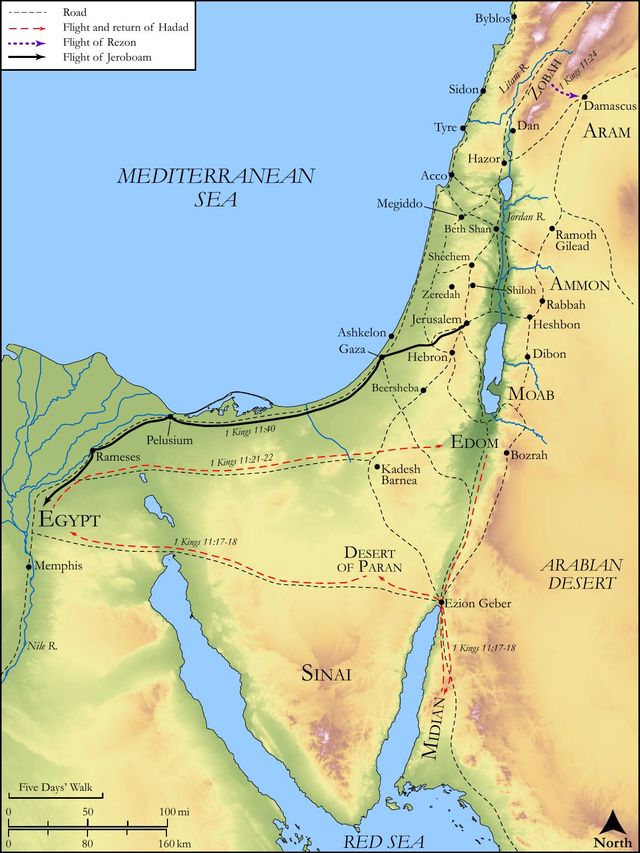
See on the biblical-era map

Study this verse
Public-domain commentary
Matthew Henry
From his Commentary on the Whole Bible. Henry comments on passages, not single verses — this entry covers 1 Kings 11:9–13. His three-level outline is real structure in the source text, so it is rendered as structure.
Here is, I. God's anger against Solomon for his sin. The thing he did displeased the Lord. Time was then the Lord loved Solomon (Sa2 12:24) and delighted in him (Kg1 10:9), but now the Lord was angry with Solomon (Kg1 11:9), for there was in his sin, 1. The most base ingratitude that could be. He turned from the Lord who had appeared unto him twice, once before he began to build the temple (Kg1 3:5) and once after he had dedicated it, Kg1 9:2. God keeps account of the gracious visits he makes us, whether we do or no, knows how often he has appeared to us and for us, and will remember it against us if we turn from him. God's appearing to Solomon was such a sensible confirmation of his faith as should have for ever prevented his worshipping any other god; it was also such a distinguishing favour, and put such an honour upon him, as he ought never to have forgotten, especially considering what God said to him in both these appearances. 2. The most wilful disobedience. This was the very thing concerning which God had commanded him - that he should not go after other gods, yet he was not restrained by such an express admonition, Kg1 11:10. Those who have dominion over men are apt to forget God's dominion over them; and, while they demand obedience from their inferiors, to deny it to him who is the Supreme.
II.The message he sent him hereupon (Kg1 11:11):
The Lord said unto Solomon (it is likely by a prophet) that he must expect to smart for his apostasy. And here,
1.The sentence is just, that, since he had revolted from God, part of his kingdom should revolt from his family; he had given God's glory to the creature, and therefore God would give his crown to his servant: "I will rend the kingdom from thee, in thy posterity, and will give it to thy servant, who shall bear rule over much of that for which thou hast laboured." This was a great mortification to Solomon, who pleased himself no doubt with the prospect of the entail of his rich kingdom upon his heirs for ever. Sin brings ruin upon families, cuts off entails, alienates estates, and lays men's honour in the dust.
2.Yet the mitigations of it are very kind, for David's sake (Kg1 11:12, Kg1 11:13), that is, for the sake of the promise made to David. Thus all the favour God shows to man is for Christ's sake, and for the sake of the covenant made with him. The kingdom shall be rent from Solomon's house, but,
(1.)Not immediately. Solomon shall not live to see it done, but it shall be rent out of the hand of his son, a son that was born to him by one of his strange wives, for his mother was an Ammonitess (Kg1 14:31) and probably had been a promoter of idolatry. What comfort can a man take in leaving children and an estate behind him if he do not leave a blessing behind him? Yet, if judgments be coming, it is a favour to us if they come not in our days, as Kg2 20:19.
(2.)Not wholly. One tribe, that of Judah, the strongest and most numerous, shall remain to the house of David (Kg1 11:13), for Jerusalem's sake, which David built, and for the sake of the temple there, which Solomon built; these shall not go into other hands. Solomon did not quickly nor wholly turn away from God; therefore God did not quickly nor wholly take the kingdom from him.
Upon this message which God graciously sent to Solomon, to awaken his conscience and bring him to repentance, we have reason to hope that he humbled himself before God, confessed his sin, begged pardon, and returned to his duty, that he then published his repentance in the book of Ecclesiastes, where he bitterly laments his own folly and madness (Ecc 7:25, Ecc 7:26), and warns others to take heed of the like evil courses, and to fear God and keep his commandments, in consideration of the judgment to come, which, it is likely, had made him tremble, as it did Felix. That penitential sermon was as true an indication of a heart broken for sin and turned from it as David's penitential psalms were, though of another nature. God's grace in his people works variously. Thus, though Solomon fell, he was not utterly cast down; what God had said to David concerning him was fulfilled: I will chasten him with the rod of men, but my mercy shall not depart from him, Sa2 7:14, Sa2 7:15. Though God may suffer those whom he loves to fall into sin, he will not suffer them to lie still in it. Solomon's defection, though it was much his reproach and a great blemish to his personal character, yet did not so far break in upon the character of his reign but that it was afterwards made the pattern of a good reign, Ch2 11:17, where the kings are said to have done well, while they walked in the way of David and Solomon. But, though we have all this reason to hope he repented and found mercy, yet the Holy Ghost did not think fit expressly to record his recovery, but left it doubtful, for warning to others not to sin upon presumption of repenting, for it is but a peradventure whether God will give them repentance, or, if he do, whether he will give the evidence of it to themselves or others. Great sinners may recover themselves and have the benefit of their repentance, and yet be denied both the comfort and credit of it; the guilt may be taken away, and yet not the reproach.
Continue studying 1 Kings 11:12 across the web’s major study libraries — every link below opens this exact verse, chapter, or book on the destination site.
Read & Compare
 BibleGatewayThis verse in more than 200 translations and 70 languages.
 Bible.comThe YouVersion reader — hundreds of translations, reading plans, and highlights.
 ESV.orgCrossway's official English Standard Version reader.
 NET BibleThe NET translation with 60,000+ translators' notes on every rendering decision.
 STEP BibleTyndale House's free study tool — original text, vocabulary, and scholarly resources.
 BibliaLogos Bible Software's free web reader.
 USCCBThe New American Bible (Revised Edition) with the U.S. bishops' study notes.
Commentaries
 BibleHub CommentariesDozens of classic commentaries on this verse, gathered on one page.
 StudyLightMore than 100 commentary sets — the largest collection on the web.
 BibleRefPlain-English commentary on what this verse means, verse by verse.
 Enduring WordDavid Guzik's free commentary on this chapter, widely used by Bible teachers.
 Bible Study ToolsVerse commentary alongside Greek and Hebrew study aids.
Original Language & Research
- BibleHub InterlinearThe verse word by word — original language, transliteration, and English.
- BibleHub LexiconEvery word's original-language definition and Strong's entry.
 Blue Letter BibleDeep-study tools — Strong's numbers, concordance, and word studies.
 SefariaThe Hebrew text with Rashi and centuries of Jewish commentary.
Sermons, Hymns & Audio


TrulyRandomVerse is not affiliated with these sites and doesn’t control their content. They’re linked because they’re genuinely useful.
Summary
First Kings 11:12 presents God's solemn declaration of judgment upon King Solomon, revealing that the united kingdom of Israel would be torn from his lineage due to his widespread idolatry and disobedience. This divine decree, however, is significantly tempered by God's unwavering faithfulness to the covenant He made with Solomon's father, David, ensuring that the kingdom's division would not occur during Solomon's lifetime but rather in the days of his son, a profound testament to the intricate interplay of divine justice, enduring mercy, and steadfast commitment to His promises.
Context
ShowHideLiterary Context
This verse serves as a pivotal divine pronouncement within the narrative of Solomon's reign, marking a dramatic shift from prosperity and unity to impending fragmentation. Immediately preceding this declaration, 1 Kings 11:1-8 meticulously details Solomon's grave apostasy, specifically his marriage to numerous foreign women who "turned away his heart after other gods" (1 Kings 11:4). He built high places for the abominable gods of his wives, including Chemosh of Moab and Molech of Ammon, directly contravening the Mosaic Law and God's explicit warnings. God had previously appeared to Solomon twice, first at Gibeon where He granted wisdom and later after the temple dedication, explicitly warning him against turning to other gods and threatening to cut off Israel if they disobeyed (1 Kings 3:5-14 and 1 Kings 9:1-9). Thus, 1 Kings 11:12 is not an arbitrary punishment but the direct, inevitable consequence of Solomon's deliberate and repeated disobedience, fulfilling the warnings previously issued. It sets the stage for the subsequent narrative of the kingdom's division under Rehoboam and the rise of Jeroboam, detailed extensively in 1 Kings 12.
Historical & Cultural Context
Solomon's reign (c. 970-931 BC) represented the zenith of Israelite power, wealth, and international influence, largely facilitated by his strategic alliances, often cemented through dynastic marriages. While these marriages brought political stability and economic prosperity, they also introduced foreign religious practices into the very heart of Israel. The worship of deities like Ashtoreth (Sidonian), Chemosh (Moabite), and Molech (Ammonite) involved practices anathema to Yahwism, including abhorrent child sacrifice in the case of Molech. The construction of "high places" (cultic sites) for these gods on the hills around Jerusalem, as explicitly mentioned in 1 Kings 11:7-8, constituted a direct affront to the exclusive worship of Yahweh at the Temple in Jerusalem. This cultural and religious syncretism, driven by Solomon's political expediency and personal indulgence, flagrantly violated the core tenets of the Mosaic covenant, which strictly forbade idolatry and intermarriage with foreign nations (Deuteronomy 7:3-4). The impending division of the kingdom was therefore not merely a political upheaval but a profound theological judgment on Israel's failure to uphold its covenantal obligations to their God.
Key Themes
ShowHideThis verse powerfully encapsulates several key themes prevalent throughout the book of 1 Kings. Firstly, it underscores the theme of Divine Judgment and Consequences, demonstrating unequivocally that even the most blessed and wise leaders are not exempt from the repercussions of disobedience. Solomon's apostasy directly leads to the tearing apart of the united kingdom, illustrating the principle that sin, particularly idolatry, has severe, national consequences. Secondly, it highlights God's Unwavering Faithfulness to His covenant promises, especially to David. Despite Solomon's profound sin, God's promise to David that his "house and your kingdom shall endure forever before me; your throne shall be established forever" (2 Samuel 7:16) remains steadfast. The judgment is tempered, not occurring in Solomon's lifetime, ensuring a "lamp" for David in Jerusalem (1 Kings 11:36). Thirdly, the verse exemplifies Delayed but Certain Justice, showcasing God's patience and long-suffering nature. The "rending" is deferred to "thy son's" reign, indicating God's reluctance to bring immediate, full judgment, yet affirming that His word of judgment will ultimately be fulfilled. Finally, it illustrates the Ripple Effect of Sin, where the personal choices and spiritual compromise of a leader have profound generational and national repercussions, directly impacting the future of Israel.
Exposition and Analysis
ShowHideKey Word Analysis
ShowHideThis word (אָב) refers to a literal and immediate father, but also extends to a figurative or remote application, such as a chief or forefather. In 1 Kings 11:12, it specifically refers to "David thy father," highlighting the direct lineage and, more importantly, the covenantal relationship God had with David. The mention of David as the "father" serves as the foundational reason for God's tempered judgment on Solomon, emphasizing God's faithfulness to His promises made to the patriarch of the royal line, even when David's descendants falter.
This verb (קָרַע) is a primitive root meaning "to tear," "to rip," "to split," or "to divide." It is a strong, violent term, often used for tearing clothes as a sign of grief or distress (e.g., Genesis 37:34). In the context of the kingdom, its use signifies a decisive, irreversible, and painful division, not a gradual erosion or peaceful separation. It foreshadows the dramatic and abrupt schism between the northern tribes (Israel) and the southern kingdom (Judah) that would occur under Rehoboam, emphasizing the severity and finality of God's judgment. The tearing motion implies a forceful act of divine intervention, directly dismantling what Solomon had built.
This term (בֵּן) broadly refers to a male offspring, encompassing literal sons, grandsons, or even descendants. In 1 Kings 11:12, it specifically points to Rehoboam, Solomon's immediate successor. The judgment is deferred to the "son" not because the son is innocent, but because of God's covenant with the "father" (David). This highlights the intergenerational consequences of sin, where the actions of one generation profoundly affect the next, and also underscores the specific targeting of the Davidic lineage for the partial loss of the kingdom, while still preserving a remnant for David's sake.
Verse Breakdown
ShowHide"Notwithstanding in thy days I will not do it"
This clause emphasizes God's forbearance and mercy towards Solomon. Despite Solomon's egregious idolatry, which certainly warranted immediate and severe punishment according to the covenant, God chooses to delay the full execution of the judgment. This delay is a demonstration of divine grace, allowing Solomon to finish his life without witnessing the direct, painful consequences of his apostasy on the united kingdom. It highlights God's long-suffering and His commitment to His prior promises, even when human beings fail.
"for David thy father's sake"
This phrase explicitly states the reason for God's delayed judgment. It underscores the enduring nature of the Davidic Covenant (2 Samuel 7:12-16), where God promised David an eternal dynasty and a perpetual throne. God's faithfulness to David, His chosen servant, takes precedence over immediate retribution against Solomon. This demonstrates that God's covenants are not contingent on human perfection but on His own steadfast character and promises. It also serves as a powerful reminder of David's righteous heart, which contrasts sharply with Solomon's later deviation.
"but I will rend it out of the hand of thy son"
This final clause declares the certain and inevitable nature of the judgment, specifying its precise timing and target. The kingdom will be "rent" or torn away, indicating a violent and decisive separation. The phrase "out of the hand of thy son" explicitly names Rehoboam as the one who will experience the consequences of his father's sin, though Rehoboam's own folly and oppressive policies would also directly contribute to the division (1 Kings 12:1-19). This establishes a clear link between Solomon's actions and the future of his lineage, showcasing the intergenerational impact of sin and the certainty of God's word.
Literary Devices
ShowHideThe passage employs several significant literary devices that amplify its theological and narrative impact. The most prominent is Divine Decree, where God directly declares His sovereign will and impending action, emphasizing His ultimate authority over human kingdoms and destinies. This decree also functions as Foreshadowing, powerfully anticipating the dramatic division of the kingdom that will unfold in the subsequent chapters of 1 Kings. The phrase "for David thy father's sake" highlights Covenantal Language, underscoring the enduring nature of God's promises to David, which act as a tempering force against immediate, full judgment. The stark contrast between "in thy days I will not do it" and "I will rend it out of the hand of thy son" creates a powerful Antithesis, emphasizing the delay of judgment due to God's grace and covenant faithfulness versus its eventual certainty due to His justice.
Theological and Thematic Connections
ShowHideFirst Kings 11:12 is a profound theological statement on the nature of God's justice, mercy, and covenant faithfulness. It reveals that while God is utterly just and will hold His people, even His chosen kings, accountable for their disobedience, His judgment is often tempered by His steadfast love and unwavering commitment to His promises. Solomon's apostasy represented a direct breach of the covenant, yet God's prior covenant with David acted as a shield, delaying the full consequences. This passage teaches that divine promises are not annulled by human failure but are upheld by God's character, even as He allows the natural and spiritual consequences of sin to unfold. It underscores the gravity of idolatry and compromise, demonstrating that even immense wisdom and blessing do not exempt one from the spiritual law of sowing and reaping, while simultaneously affirming God's ultimate sovereignty and His meticulous orchestration of history to fulfill His redemptive plan.
Reflection and Application
ShowHideThis verse serves as a potent reminder that spiritual compromise, even for those greatly blessed and gifted by God, carries severe consequences that can extend beyond one's own lifetime. Solomon's story is a cautionary tale, illustrating that wisdom and prosperity, when not anchored in unwavering devotion to God, can become avenues for spiritual drift and idolatry. It compels us to diligently guard our hearts against worldly influences and the subtle allure of syncretism, recognizing that seemingly small compromises can lead to profound spiritual deviation and national decline. Yet, amidst the stern warning, we also find profound comfort in God's enduring faithfulness. His commitment to His promises, exemplified by His grace towards David's lineage despite Solomon's failures, assures us that even when we stumble, His ultimate purposes and covenants remain secure. This should inspire both a healthy fear of God's justice and a deep trust in His unfailing love, motivating us to live lives of integrity and obedience, knowing that our choices have both immediate and generational impact on the spiritual legacy we leave behind.
Questions for Reflection
ShowHideFAQ
ShowHideWhy did God wait until Solomon's son to divide the kingdom, rather than punishing Solomon directly?
ShowHideGod's decision to delay the division of the kingdom until the reign of Solomon's son, Rehoboam, was primarily "for David thy father's sake." This highlights God's unwavering faithfulness to the covenant He made with David in 2 Samuel 7, where He promised an enduring dynasty. While Solomon's widespread idolatry certainly warranted immediate judgment according to the Mosaic Law, God's greater, unconditional promise to David took precedence in terms of the timing of the kingdom's fragmentation. This demonstrates God's long-suffering nature, His commitment to His word, and His profound mercy, even when His people fail. It shows that God's justice is always tempered with covenant loyalty and grace.
What was Solomon's primary sin that led to this judgment?
ShowHideSolomon's primary sin that led to this severe judgment was idolatry and turning his heart away from the Lord. 1 Kings 11:4 explicitly states that "his heart was not wholly true to the Lord his God, as was the heart of David his father." This apostasy was largely fueled by his numerous foreign wives, who led him to worship their gods, including Ashtoreth of the Sidonians, Chemosh of the Moabites, and Molech of the Ammonites. He even built high places for these detestable deities near Jerusalem (1 Kings 11:7-8), directly violating God's repeated warnings and the foundational command of the covenant to worship Yahweh alone.
Christ-Centered Fulfillment
ShowHideThe judgment declared in 1 Kings 11:12—the rending of the kingdom from Solomon's lineage—though a direct consequence of human sin and unfaithfulness, paradoxically serves to highlight the ultimate, enduring nature of God's covenant with David, which finds its perfect and eternal fulfillment in Jesus Christ. While the earthly kingdom of Israel was tragically divided and eventually fell, God's promise that David would always have a "lamp" in Jerusalem (1 Kings 11:36) pointed beyond the temporal, fallible kings to an eternal King. Jesus, as the son of David according to the flesh (Matthew 1:1), is the true and everlasting heir to David's throne. Unlike Solomon, whose kingdom was torn due to his unfaithfulness and idolatry, Christ's kingdom is "an everlasting kingdom" (Daniel 7:14) that "will never be destroyed" (Luke 1:32-33). The division of Israel under Rehoboam underscored the inherent fragility of human rule and the profound need for a perfect, righteous King. Jesus, the Lamb of God, through His perfect obedience, sinless life, and atoning sacrifice on the cross, establishes a spiritual kingdom that transcends earthly boundaries and human failings, gathering all who believe into an eternal, undivided reign where sin is conquered, and God's promises are fully and perfectly realized in Him (Colossians 1:13-14).