


Nehemiah 12:40
- וַתַּעֲמֹדְנָהva·ta·'a·Mo·de·nahand they took their standH5975Conj-w ¦ V-Qal-ConsecImperf-3fpVerb Qal Consecutive Imperfect 3rd Plural Feminineוַandתַּעֲמֹדְנָהthey took their stand
- שְׁתֵּיshe·Tei[the] twoH8147Adj-fdcAdjective Numerical Dual Feminine Construct
- הַתּוֹדֹתha·to·Dotthe thanksgiving choirsH8426Art ¦ N-fpNoun Plural Feminine Absoluteהַtheתּוֹדֹתthanksgiving choirs
- בְּבֵיתbe·Veitin [the] house ofH1004Prep-b ¦ N-mscNoun Singular Masculine Constructבְּinבֵית[the] house of
- הָאֱלֹהִיםha·'E·lo·Him<the> GodH430Art ¦ N-mpNoun Plural Masculine Absoluteהָ<the>אֱלֹהִיםGod
- וַאֲנִיva·'a·Niand IH589Conj-w ¦ Pro-1csPronoun Personal 1st Singular common genderוַandאֲנִיI
- וַחֲצִיva·cha·Tziand [the] half ofH2677Conj-w ¦ N-mscNoun Singular Masculine Constructוַandחֲצִי[the] half of
- הַסְּגָנִיםha·se·ga·Nimthe officialsH5461Art ¦ N-mpNoun Plural Masculine Absoluteהַtheסְּגָנִיםofficials
- עִמִּי'i·Miwith meH5973Prep ¦ 1csPrepositionעִמִּwithיme
English is a literal word-by-word gloss of the Hebrew, not the KJV's wording. Why?
This is the original text the KJV's translators worked from — each Hebrew word with its own literal English meaning in this verse, prepared by scholars at Tyndale House, Cambridge. The KJV translates whole sentences, not word by word, so its wording differs: one Hebrew word can become several English words, and the KJV may choose “the LORD” where the gloss reads “Yahweh”. Both are faithful — they answer different questions. For the KJV's own rendering, switch to the KJV text.
Details
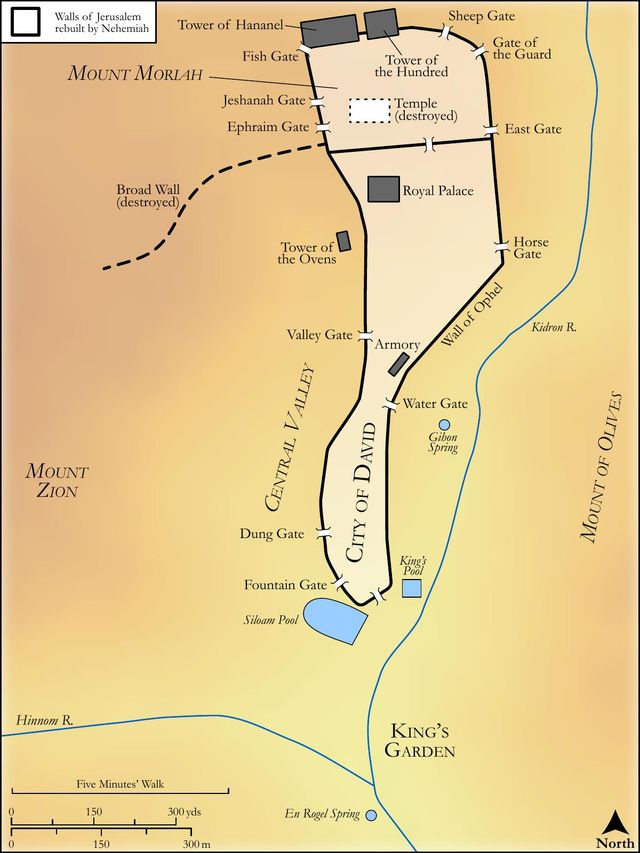
See on the biblical-era map
Study this verse
Public-domain commentary
Matthew Henry
From his Commentary on the Whole Bible. Henry comments on passages, not single verses — this entry covers Nehemiah 12:27–43.
We have read of the building of the wall of Jerusalem with a great deal of fear and trembling; we have here an account of the dedicating of it with a great deal of joy and triumph. Those that sow in tears shall thus reap.
I.We must enquire what was the meaning of this dedication of the wall; we will suppose it to include the dedication of the city too (continens pro contentothe thing containing for the thing contained), and therefore it was not done till the city was pretty well replenished, Neh 11:1. It was a solemn thanksgiving to God for his great mercy to them in the perfecting of this undertaking, of which they were the more sensible because of the difficulty and opposition they had met with in it. 2. They hereby devoted the city in a peculiar manner to God and to his honour, and took possession of it for him and in his name. All our cities, all our houses, must have holiness to the Lord written upon them; but this city was (so as never any other was) a holy city, the city of the great King (Psa 48:2 and Mat 5:35): it had been so ever since God chose it to put his name there, and as such, it being now refitted, it was afresh dedicated to God by the builders and inhabitants, in token of their acknowledgment that they were his tenants, and their desire that it might still be is and that the property of it might never be altered. Whatever is done for their safety, ease, and comfort, must be designed for God's honour and glory. 3. They hereby put the city and its walls under the divine protection, owning that unless the Lord kept the city the walls were built in vain. When this city was in possession of the Jebusites, they committed the guardianship of it to their gods, though they were blind and lame ones, Sa2 5:6. With much more reason do the people of God commit it to his keeping who is all-wise and almighty. The superstitious founders of cities had an eye to the lucky position of the heavens (see Mr. Gregory's works, p. 29, etc.); but these pious founders had an eye to God only, to his providence, and not to fortune.
II.We must observe with what solemnity it was performed, under the direction of Neh 1:1-11.
The Levites from all parts of the country were summoned to attend. The city must be dedicated to God, and therefore his ministers must be employed in the dedicating of it, and the surrender must pass through their hands. When those solemn feasts were over (ch. 8 and 9) they went home to their respective posts, to mind their cures in the country; but now their presence and assistance were again called for. 2. Pursuant to this summons, there was a general rendezvous of all the Levites, Neh 12:28, Neh 12:29. Observe in what method they proceeded. (1.) They purified themselves, Neh 12:30. We are concerned to cleanse our hands, and purify our hearts, when any work for God is to pass through them. They purified themselves and then the people. Those that would be instrumental to sanctify others must sanctify themselves, and set themselves apart for God, with purity of mind and sincerity of intention. Then they purified the gates and the wall. Then may we expect comfort when we are prepared to receive it. To the pure all things are pure (Tit 1:15); and, to those who are sanctified, houses and tables, and all their creature comforts and enjoyments, are sanctified, Ti1 4:4, Ti1 4:5. This purification was performed, it is probable, by sprinkling the water of purifying (or of separation, as it is called, Num 19:9) on themselves and the people, the walls and the gates - a type of the blood of Christ, with which our consciences being purged from dead works, we become fit to serve the living God (Heb 9:14) and to be his care. (2.) The princes, priests, and Levites, walked round upon the wall in two companies, with musical instruments, to signify the dedication of it all to God, the whole circuit of it (Neh 12:36); so that it is likely they sung psalms as they went along, to the praise and glory of God. This procession is here largely described. They had a rendezvous at one certain lace, where they divided themselves into two companies. Half of the princes, with several priests and Levites, went on the right hand, Ezra leading their van, Neh 12:36. The other half of the princes and priests, who gave thanks likewise, went to the left hand, Nehemiah bringing up the rear, Neh 12:38. At length both companies met in the temple, where they joined their thanksgivings, Neh 12:40. The crowd of people, it is likely, walked on the ground, some within the wall and others without, one end of this ceremony being to affect them with the mercy they were giving thanks for, and to perpetuate the remembrance of it among them. Processions, for such purposes, have their use. (3.) The people greatly rejoiced, Neh 12:43. While the princes, priests, and Levites, testified their joy and thankfulness by great sacrifices, sound of trumpet, musical instruments, and songs of praise, the common people testified theirs by loud shouts, which were heard afar off, further than the more harmonious sound of their songs and music: and these shouts, coming from a sincere and hearty joy, are here taken notice of; for God overlooks not, but graciously accepts, the honest zealous services of mean people, though there is in them little of art and they are far from being fine. It is observed that the women and children rejoiced; and their hosannas were not despised, but recorded to their praise. All that share in public mercies ought to join in public thanksgivings. The reason given is that God had made them rejoice with great joy. He had given them both matter for joy and hearts to rejoice; his providence had made them safe and easy, and then his grace made them cheerful and thankful. The baffled opposition of their enemies, no doubt, added to their joy and mixed triumph with it. Great mercies call for the most solemn returns of praise, in the courts of the Lord's house, in the midst of thee, O Jerusalem!
Historical interpretation
Historical reception
1 surviving comment on this verse from the historical church.
And two choirs of those praising stood in the house of God, etc. Walking before the walls and gardens of the city, in a song of joy, and with musical instruments, they return to the temple of the Lord; so that there also standing, they may render praise to the Lord with sounding trumpets, and fulfill the vows of dedication with the offered sacrifices. But that same homeland of the future life mystically signifies the house of the Lord, which both the city of the Lord also indicates, just as the present Church is customarily called in the Scriptures both the house of Christ and the city. However, there is a distinction, as the buildings of the city sing the praises with songs of gratitude and instruments; but in the house of God standing, they are reported to have praised and sung clearly. For the chosen ascend the walls of the city, which they made with the joy of the heavenly country, which they themselves made with the diligence of good works, they enter. They perceive the diversity of the gates, and the height of the towers and buildings, when entering into the house of the Father, they contemplate the difference of many mansions there according to the diverse merits of men. But they stand in the house of God, and sing more clearly, when each received into their own mansions, they remain in stable habitation in the perpetual vision of their Creator, and celebrate His praises in the age of God with an undivided voice. Where two choirs of those praising will be, either from both peoples, as we interpreted above, joined, and coupled into one modulation of divine praise; or made of angels and men, fulfilling the Lord's promise, where it is said, that men will be equal to the angels of God (Mark XII). But also in this life the just ascend into the city of the Lord with hymns of dedication, when longing with all their heart for the memory of future reward, they daily progress more and more in good works, according to that of the Psalmist: He has set ascensions in his heart in the valley of tears (Ps. LXXXIII). And again: Blessed are the undefiled in the way, who walk in the law of the Lord (Ps. CXVIII). For behold he also calls the undefiled those walking in the way in the law of the Lord, because they thus indeed hold the accepted innocence of heart and work, so that moreover they strive to grow in the merits of virtues to higher things. But they stand in the house of the Lord with praises, because in the very pursuit of good works they persevere indefatigably, according to that of blessed Elijah: The Lord lives, in whose sight I stand (III Kings XVII), that is, in whose will to be completed I remain with an indefatigable mind. But aptly it follows:
Continue studying Nehemiah 12:40 across the web’s major study libraries — every link below opens this exact verse, chapter, or book on the destination site.
Read & Compare
 BibleGatewayThis verse in more than 200 translations and 70 languages.
 Bible.comThe YouVersion reader — hundreds of translations, reading plans, and highlights.
 ESV.orgCrossway's official English Standard Version reader.
 NET BibleThe NET translation with 60,000+ translators' notes on every rendering decision.
 STEP BibleTyndale House's free study tool — original text, vocabulary, and scholarly resources.
 BibliaLogos Bible Software's free web reader.
 USCCBThe New American Bible (Revised Edition) with the U.S. bishops' study notes.
Commentaries
 BibleHub CommentariesDozens of classic commentaries on this verse, gathered on one page.
 StudyLightMore than 100 commentary sets — the largest collection on the web.
 BibleRefPlain-English commentary on what this verse means, verse by verse.
 Enduring WordDavid Guzik's free commentary on this chapter, widely used by Bible teachers.
 Bible Study ToolsVerse commentary alongside Greek and Hebrew study aids.
Original Language & Research
- BibleHub InterlinearThe verse word by word — original language, transliteration, and English.
- BibleHub LexiconEvery word's original-language definition and Strong's entry.
 Blue Letter BibleDeep-study tools — Strong's numbers, concordance, and word studies.
 SefariaThe Hebrew text with Rashi and centuries of Jewish commentary.
Sermons, Hymns & Audio


TrulyRandomVerse is not affiliated with these sites and doesn’t control their content. They’re linked because they’re genuinely useful.
Summary
Nehemiah 12:40 vividly portrays a climactic moment in the dedication of Jerusalem's rebuilt walls, depicting the convergence of two grand processional choirs of thanksgiving within the sacred precincts of the Temple. This verse encapsulates the culmination of immense labor and divine faithfulness, illustrating a profound act of corporate worship led by Nehemiah and the city's rulers. It signifies not only the physical restoration of Jerusalem's defenses but also the spiritual renewal and unified gratitude of the post-exilic community, celebrating God's provision and the successful completion of their monumental task, thereby consecrating the city and its people to the Lord.
Context
ShowHideLiterary Context
Nehemiah 12:40 is strategically placed within the latter portion of Nehemiah chapter 12, which meticulously details the lists of priests and Levites who returned from Babylonian exile, followed by the elaborate dedication ceremony of Jerusalem's newly rebuilt walls. This verse specifically describes the joyous climax of this grand celebration, where two large companies, or choirs, of thanksgiving converge at the "house of God" (the Temple). The preceding verses (Nehemiah 12:31-39) meticulously describe the formation and procession of these two companies along the top of the wall, one moving clockwise and the other counter-clockwise, ultimately meeting at the Temple. Nehemiah himself leads one company, while Ezra the scribe leads the other (Nehemiah 12:36). The verses immediately following (Nehemiah 12:41-43) further elaborate on the joyous sacrifices and loud celebrations that accompanied this momentous occasion, underscoring the overwhelming joy and unity of the people. This entire chapter serves as a celebratory capstone to the narrative of the wall's reconstruction, shifting focus from the arduous labor and opposition to the joyful worship and dedication of the city to God.
Historical & Cultural Context
The setting for Nehemiah 12:40 is the post-exilic period, specifically after the completion of Jerusalem's walls, a monumental achievement accomplished in a mere 52 days. The Jewish people had returned from seventy years of Babylonian captivity, and while the Temple had been rebuilt under Zerubbabel and Ezra (as recounted in Ezra 3:8-13), the city of Jerusalem remained vulnerable and its walls in ruins. Nehemiah, appointed governor by the Persian king, led the people in this crucial rebuilding effort amidst significant opposition from surrounding peoples (e.g., Sanballat and Tobiah). The dedication ceremony, therefore, was not merely a civic event but a profound spiritual and national celebration, marking the restoration of security, identity, and divine favor. The use of "companies of them that gave thanks" reflects ancient Near Eastern and Israelite traditions of processional worship, often involving musical instruments, singing, and sacrifices as expressions of communal gratitude and covenant renewal. The convergence at the Temple, the spiritual heart of the nation, underscored the theocentric nature of their restoration.
Key Themes
ShowHideNehemiah 12:40 powerfully encapsulates several key themes prevalent throughout the book of Nehemiah and the broader post-exilic narrative. Firstly, it highlights Corporate Worship and Thanksgiving, emphasizing the beauty and power of unified, communal praise as the appropriate response to God's faithfulness. The "two companies" signify a massive, organized outpouring of gratitude, demonstrating that major spiritual milestones are best celebrated together, echoing the joy seen at the laying of the Temple's foundation in Ezra 3:11. Secondly, it underscores Divine Faithfulness and Human Response, as the completion of the wall was a clear testament to God's unwavering faithfulness despite intense opposition, eliciting a response of profound thanksgiving from the people who recognized His hand in their success and restoration. Thirdly, the verse illustrates Leadership in Worship, with Nehemiah, the political leader, actively participating in and leading one of the companies of praise, thereby demonstrating the crucial role of leadership in fostering and engaging in genuine worship. Finally, it reinforces The Centrality of the Temple, as the convergence "in the house of God" underscores the Temple's enduring significance as the focal point for Israel's worship, their covenant relationship with God, and the expression of national identity, a theme seen throughout Israel's history, from the tabernacle to Solomon's Temple (1 Kings 8).
Exposition and Analysis
ShowHideKey Word Analysis
ShowHideThis primitive root signifies "to stand" in various relations, both literal and figurative. Here, it denotes a deliberate and established posture, suggesting that the companies took their designated positions within the Temple precincts. It implies a sense of readiness, reverence, and stability, marking the culmination of their procession and their prepared state for offering praise and sacrifices. It is not a casual standing but a purposeful taking of place.
This term, derived from a root meaning "to build," refers to a "house" in its broadest sense, encompassing a physical dwelling, a family, or, as here, a sacred edifice. In this context, "the house of God" specifically refers to the Temple in Jerusalem. Its use emphasizes the sacred space where God's presence dwelt among His people and where corporate worship was to be offered. It signifies the spiritual center of the nation, the focal point for their gratitude and covenant renewal.
From a root meaning "to extend the hand," this word primarily signifies "thanksgiving," "praise," or a "thank offering." It implies a vocal and often instrumental expression of profound gratitude, acknowledgment, and adoration directed toward God, particularly for deliverance, provision, or answered prayer. In Nehemiah 12:40, it underscores the primary purpose of the two companies: to offer a collective, public declaration of profound gratitude to God for the successful rebuilding of the wall and the restoration of Jerusalem. It goes beyond mere verbal thanks, suggesting a full-bodied, communal act of worship, often accompanied by sacrifices.
Verse Breakdown
ShowHide"So stood the two companies of them that gave thanks in the house of God"
This clause describes the culmination of the two processional choirs' journey. Having marched along the walls, they have now taken their prepared, reverent positions within the Temple area, the sacred space designated for worship. The phrase "stood" implies a deliberate and established posture for the ensuing acts of praise and sacrifice. The "two companies of them that gave thanks" specifically refers to the organized musical and vocal groups, likely comprising Levites and others trained in worship, whose purpose was to lead the people in expressing profound gratitude to God. Their presence "in the house of God" underscores the sacred nature of the celebration and the centrality of the Temple to their spiritual life and national identity.
"and I, and the half of the rulers with me"
This second clause identifies Nehemiah himself ("I") and a significant portion of Jerusalem's leadership ("the half of the rulers") as being present and actively participating in this climactic moment. This clarifies that Nehemiah was not merely an observer or organizer from a distance but was personally engaged in the act of corporate worship, leading one of the companies as described earlier in the chapter. His presence, alongside the rulers, highlights the crucial role of leadership in modeling and facilitating genuine worship and thanksgiving within the community. It also signifies the unity between spiritual and civic leadership in acknowledging God's hand in their national achievement and leading the people in their response of gratitude.
Literary Devices
ShowHideNehemiah 12:40, as part of the broader dedication narrative, employs several Literary Devices. Symbolism is prominent, as the "two companies" marching along the wall and converging at the Temple symbolize the unity of the people, the completeness of the restoration, and the all-encompassing nature of their thanksgiving. The wall itself is a powerful symbol of divine protection, renewed identity, and the re-establishment of Jerusalem as a holy city. The "house of God" (the Temple) functions as a central Motif, representing the spiritual heart of the nation and the locus of God's presence, to which all praise and gratitude ultimately converge. The entire scene is an example of Narrative Climax, as it represents the joyful culmination of the arduous rebuilding effort, shifting the narrative from conflict and labor to celebration and worship. The detailed description of the procession throughout the chapter, leading to this verse, also utilizes Descriptive Imagery, painting a vivid picture of a grand, organized, and joyous communal event that engages the senses and evokes a sense of awe and gratitude.
Theological and Thematic Connections
ShowHideNehemiah 12:40 profoundly illustrates the theological principle that all human achievement, especially those undertaken for God's glory, should culminate in corporate thanksgiving and worship. The successful completion of the wall, a testament to divine faithfulness and human perseverance, was not met with self-congratulation but with a unified outpouring of praise to the Lord. This act of communal worship, led by the very leaders who oversaw the physical reconstruction, underscores that true restoration encompasses both the physical and spiritual dimensions, with the latter being paramount. It teaches that acknowledging God as the ultimate source of strength and success is not merely an option but a mandatory, joyful response that strengthens the community's bond with Him and with one another. This dedication of the city and its people through worship serves as a powerful reminder that God's people are called to live lives of perpetual gratitude, recognizing His hand in every blessing and triumph.
Reflection and Application
ShowHideNehemiah 12:40 offers a timeless blueprint for how we, as individuals and communities of faith, should respond to God's faithfulness in our lives. Just as the Israelites celebrated the completion of the wall, we are called to intentionally celebrate God's provision, protection, and answered prayers, recognizing that every accomplishment and blessing ultimately flows from His hand. This verse reminds us that there is unique power and blessing in gathering with fellow believers to offer corporate praise and thanksgiving. Such shared expressions of faith not only strengthen the community and honor God but also serve as a powerful witness to the world, demonstrating the joy and peace found in a life centered on divine gratitude. Furthermore, the active participation of Nehemiah and the rulers challenges leaders today—whether in the church, family, or workplace—to model and engage in genuine worship, guiding others into a deeper relationship with God by their own example of gratitude and devotion. Our triumphs, whether personal or communal, should ultimately lead us to praise and thanksgiving, bringing our successes into the "house of God"—metaphorically, into His presence—with joyful and grateful hearts, allowing our gratitude to fuel our continued service and obedience.
Questions for Reflection
ShowHideFAQ
ShowHideWhat was the significance of the "two companies" in Nehemiah 12:40?
ShowHideThe "two companies" were two large, organized processional choirs or groups of people, including priests, Levites, and rulers, who marched in opposite directions along the newly rebuilt walls of Jerusalem. One company, led by Nehemiah, proceeded clockwise, and the other, led by Ezra, proceeded counter-clockwise. Their convergence "in the house of God" (the Temple) was highly symbolic. It represented the unity of the entire community in their thanksgiving, the completeness of the city's restoration, and the encompassing nature of their praise to God. It signified that all of Jerusalem, from every direction, was united in celebrating God's faithfulness and the successful completion of the wall, bringing their collective gratitude to the central place of worship. This grand procession and convergence underscored the profound joy and spiritual renewal that followed the immense labor and opposition detailed in earlier chapters of Nehemiah, highlighting that the entire city and its inhabitants were now consecrated to the Lord.
Christ-Centered Fulfillment
ShowHideNehemiah 12:40, with its grand depiction of corporate thanksgiving for a completed work, powerfully foreshadows the ultimate and perfect work of redemption accomplished in Jesus Christ. The dedication of the physical wall, which brought security and identity to ancient Israel, points to Christ as the one who builds an eternal spiritual wall of salvation around His people, securing their eternal identity in Him. The "two companies of them that gave thanks" converging in the Temple prefigure the global church—comprising both Jew and Gentile (Ephesians 2:14-16), united in Christ, offering ceaseless praise and thanksgiving for the greater work of reconciliation and new creation. Just as Nehemiah led the people in celebration of a physical restoration, Christ, our ultimate High Priest and King (Hebrews 4:14), leads His redeemed people in worship for the spiritual restoration He accomplished through His death and resurrection. The Temple, the "house of God," where the companies gathered, finds its ultimate fulfillment in Christ Himself, who declared, "Destroy this temple, and in three days I will raise it up," referring to His body. Through His sacrifice, He has opened a new and living way into the true "house of God," the very presence of the Father (Hebrews 10:19-22), where believers now stand, not with sacrifices of animals but with hearts overflowing with gratitude for the forgiveness of sins and the promise of eternal life. Our corporate worship today, as described in Hebrews 13:15, is a continuous offering of praise to His name, a direct fulfillment of the spirit of thanksgiving seen at Jerusalem's dedication, all made possible by the Lamb of God, who takes away the sin of the world (John 1:29).