


Mark 5:31
- ΚαὶKaiAndG2532CONJConjunction
- ἔλεγονelegonwere sayingG3004V-IAI-3PVerb Imperfect Active Indicative 3rd Plural
- αὐτῷautōto HimG846P-DSMPersonal pronoun Dative Singular Masculine
- οἱhoitheG3588T-NPMDefinite article Nominative Plural Masculine
- μαθηταὶmathētaidisciplesG3101N-NPMNoun Nominative Plural Masculine
- αὐτοῦ·autouof HimG846P-GSMPersonal pronoun Genitive Singular Masculine
- βλέπειςblepeisYou seeG991V-PAI-2SVerb Present Active Indicative 2nd Singular
- τὸνtontheG3588T-ASMDefinite article Accusative Singular Masculine
- ὄχλονochloncrowdG3793N-ASMNoun Accusative Singular Masculine
- συνθλίβοντάsunthlibontapressing in onG4918V-PAP-ASMVerb Present Active Participle Accusative Singular Masculine
- σεseYouG4771P-2ASPersonal pronoun Accusative 2nd Singular
- καὶkaiandG2532CONJConjunction
- λέγεις·legeisYou sayG3004V-PAI-2SVerb Present Active Indicative 2nd Singular
- τίςtisWhoG5101I-NSMInterrogative pronoun Nominative Singular Masculine
- μουmouMeG3165P-1GSPersonal pronoun Genitive 1st Singular
- ἥψατο;hēpsatotouched?G681V-ADI-3SVerb Aorist Middle Deponent Indicative 3rd Singular
English is a literal word-by-word gloss of the Greek, not the KJV's wording. Why?
This is the original text the KJV's translators worked from — each Greek word with its own literal English meaning in this verse, prepared by scholars at Tyndale House, Cambridge. The KJV translates whole sentences, not word by word, so its wording differs: one Greek word can become several English words, and the KJV may choose “charity” where the gloss reads “love”. Both are faithful — they answer different questions. For the KJV's own rendering, switch to the KJV text.
Details
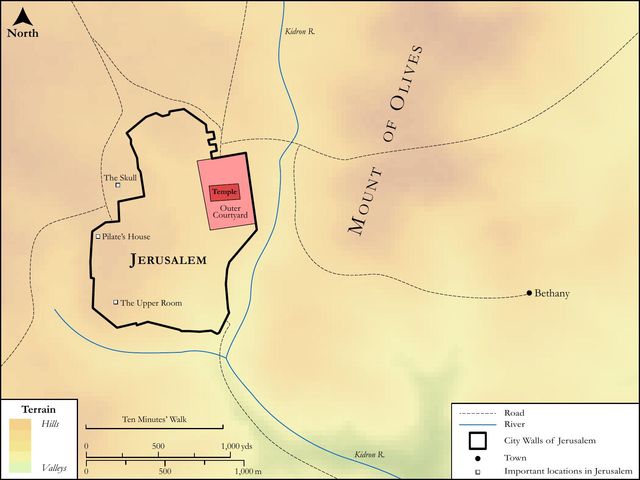
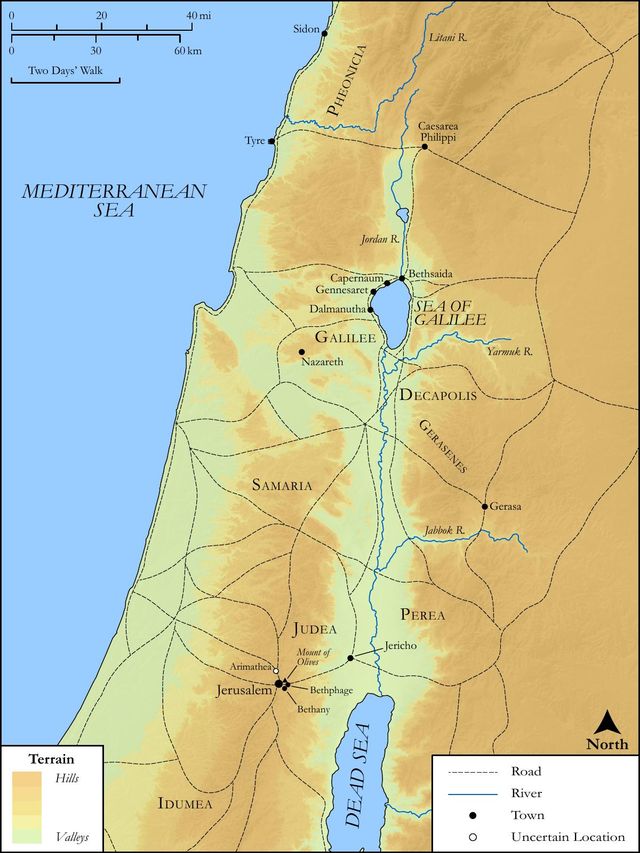
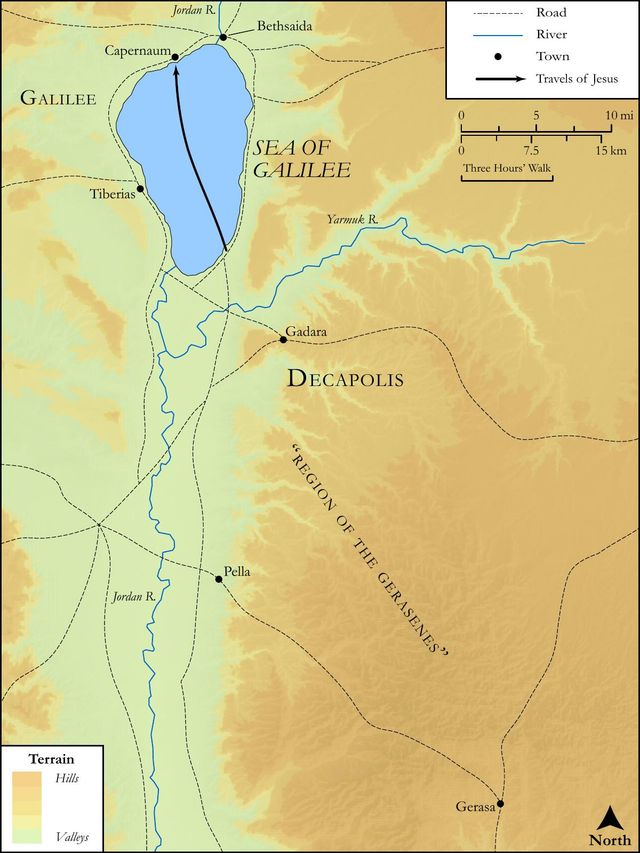
See on the biblical-era map
Study this verse
Public-domain commentary
Matthew Henry
From his Commentary on the Whole Bible. Henry comments on passages, not single verses — this entry covers Mark 5:21–34. His three-level outline is real structure in the source text, so it is rendered as structure.
The Gadarenes having desired Christ to leave their country, he did not stay to trouble them long, but presently went by water, as he came, back to the other side (Mar 5:21), and there much people gathered to him. Note, If there be some that reject Christ, yet there are others that receive him, and bid him welcome. A despised gospel will cross the water, and go where it will have better entertainment. Now among the many that applied themselves to him,
I.Here is one, that comes openly to beg a cure for a sick child; and it is no less a person than one of the rulers of the synagogue, one that presided in the synagogue-worship or, as some think, one of the judges of the consistory court, which was in every city, consisting of twenty-three. He was not named in Matthew, he is here, Jairus, or Jair, Jdg 10:3. He addressed himself to Christ, though a ruler, with great humility and reverence; When he saw him, he fell at his feet, giving honour to him as one really greater than he appeared to be; and with great importunity, he besought him greatly, as one in earnest, as one that not only valued the mercy he came for, but that knew he could obtain it no where else. The case is this, He has a little daughter, about twelve years old, the darling of the family, and she lies a dying; but he believes that if Christ will but come, and lay his hands upon her, she will return even from the gates of the grave. He said, at first, when he came, She lies a dying (so Mark); but afterward, upon fresh information sent him, he saith, She is even now dead (so Matthew); but he still prosecutes his suit; see Luk 8:42-49. Christ readily agreed, and went with him, Mar 5:24.
II.Here is another, that comes clandestinely to steal a cure (if I may so say) for herself; and she got the relief she came for.
This cure was wrought by the way, as he was going to raise the ruler's daughter, and was followed by a crowd. See how Christ improved his time, and lost none of the precious moments of it. Many of his discourses, and some of his miracles, are dates by the way-side; we should be doing good, not only when we sit in the house, but when we walk by the way, Deu 6:7. Now observe,
1.The piteous case of this poor woman. She had a constant issue of blood upon her, for twelve years, which had thrown her, no doubt, into great weakness, had embittered the comfort of her life, and threatened to be her death in a little time. She had had the best advice of physicians, that she could get, and had made use of the many medicines and methods they prescribed: as long as she had any thing to give them, they had kept her in hopes that they could cure her; but now that she had spent all she had among them, they gave her up as incurable. See here,
(1.)That skin for skin, and all that a man has, will be give for life and health; she spent all she had upon physicians.
(2.)It is ill with those patients whose physicians are their worst disease; who suffer by their physicians, instead of being relieved by them.
(3.)Those that are not bettered by medicines, commonly grow worse, and the disease gets the more ground.
(4.)It is usual with people not to apply themselves to Christ, till they have tried in vain all other helpers, and find them, as certainly they will, physicians of no value. And he will be found a sure refuge, even to those who make him their last refuge.
2.The strong faith that she had in the power of Christ to heal her; she said within herself, though it doth not appear that she was encouraged by any preceding instance to say it, If I may but touch his clothes, I shall be whole, Mar 5:28. She believed that he cured, not as a prophet, by virtue derived from God, but as the Son of God, by a virtue inherent in himself. Her case was such as she could not in modesty tell him publicly, as others did their grievances, and therefore a private cure was what she wished for, and her faith was suited to her case.
3.The wonderful effect produced by it; She came in the crowd behind him, and with much ado got to touch his garment, and immediately she felt the cure wrought, Mar 5:29. The flux of blood was dried up, and she felt herself perfectly well all over her, as well as ever she was in her life, in an instant; by this it appears that the cure was altogether miraculous; for those that in such cases are cured by natural means, recover their strength slowly and gradually, and not per saltum - all at once; but as for God, his work is perfect. Note, Those whom Christ heals of the disease of sin, that bloody issue, cannot but experience in themselves a universal change for the better.
4.Christ's enquiry after his concealed patient, and the encouragement he gave her, upon the discovery of her; Christ knew in himself that virtue had gone out of him, Mar 5:30. He knew it not by any deficiency of spirits, through the exhausting of this virtue, but rather by an agility of spirits, in the exerting of it, and the innate and inseparable pleasure he had in doing good. And being desirous to see his patient, he asked, not in displeasure, as one affronted, but in tenderness, as one concerned, Who touched my clothes? The disciples, not without a show of rudeness and indecency, almost ridiculed his question (Mar 5:31); The multitudes throng thee, and sayest thou, Who touched me? As if it had been an improper question. Christ passed by the affront, and looks around to see her that had done this thing; not that he might blame her for her presumption, but that he might commend and encourage her faith, and by his own act and deed might warrant and confirm the cure, and ratify to her that which she had surreptitiously obtained. He needed not that any should inform him, for he had presently his eye upon her. Note, As secret acts of sin, so secret acts of faith, are known to the Lord Jesus, and are under his eye. If believers derive virtue from Christ ever so closely, he knows it, and is pleased with it. The poor woman, hereupon, presented herself to the Lord Jesus (Mar 5:33), fearing and trembling, not knowing how he would take it. Note, Christ's patients are often trembling, when they have reason to be triumphing. She might have come boldly, knowing what was done in her; yet, knowing that, she fears and trembles. It was a surprise, and was not yet, as it should have been, a pleasing surprise. However, she fell down before him. Note, There is nothing better for those that fear and tremble, than to throw themselves at the feet of the Lord Jesus; to humble themselves before him, and refer themselves to him. And she told him all the truth. Note, We must not be ashamed to own the secret transactions between Christ and our souls; but, when called to it, mention, to his praise, and the encouragement of others, what he has done for our souls, and the experience we have had of healing virtue derived from him. And the consideration of this, that nothing can be hid from Christ, should engage us to confess all to him. See what an encouraging word he gave her (Mar 5:34); Daughter, thy faith hath made thee whole. Note, Christ puts honour upon faith, because faith gives honour to Christ. But see how what is done by faith on earth is ratified in heaven; Christ saith, Be whole of thy disease. Note, If our faith sets the seal of its amen to the power and promise of God, saying, "So it is, and so let it be to me;" God's grace will set the seal of its amen to the prayers and hopes of faith, saying, "So be it, and so it shall be, to thee." And therefore, "Go in peace; be well satisfied that thy cure is honestly come by, is effectually wrought, and take the comfort of it." Note, They that by faith are healed of their spiritual diseases, have reason to go in peace.
Historical interpretation
Nine Centuries of Reception
7 surviving comments on this verse. Each one is dated, so this reads as a timeline rather than a list.
Select a marker to jump to its quote. Markers stagger vertically where authors wrote within a few decades of each other.
But the man who is healed preached in Decapolis, where the Jews, who hang on the letter of the Decalogue, are being turned away from the Roman rule.
Mystically, however, Jairus comes after the healing of the woman, because when the fulness of the Gentiles has come in, then shall Israel be saved. (v. Rom. 11) Jairus means either illuminating, or illuminated, that is, the Jewish people, having cast off the shadow of the letter, enlightened by the Spirit, and enlightening others, falling at the feet of the Word, that is, humbling itself before the Incarnation of Christ, prays for her daughter, for when a man lives himself, he makes others live also. Thus Abraham, and Moses, and Samuel, intercede for the people who are dead, and Jesus comes upon their prayers.
For after she had been thus afflicted during twelve years, she was healed by the advent of the Saviour, when she had touched the border of His garment; and on this account the Saviour said, "Who touched me? "
(Hom. in Mat. 31) This woman, who was celebrated and known to all, did not dare to approach the Saviour openly, nor to come to Him, because, according to the law, she was unclean; for this reason she touched Him behind, and not in front, for that she durst not do, but only ventured to touch the hem of His garment. It was not however the hem of the garment, but her frame of mind that made her whole. There follows, For she said, If I may but touch his clothes, I shall be whole.
(Vict. Ant. e Cat. in Macr. v. Chrys. Hom. in Mat. 31.) He calls her daughter because she was saved by her faith; for faith in Christ makes us His children.
(Vict. Ant. e Cat. in Marc.) He has recorded the name on account of the Jews of that time, that it might mark the miracle. It goes on, And when he saw him, he fell at his feet, and besought him greatly, &c. Matthew indeed relates that the chief of the synagogue reported that his daughter was dead, but Mark says that she was very sick, and that afterwards it was told to the ruler of the synagogue, when our Lord was about to go with him, that she was dead. The fact then, which Matthew implies, is the same, namely, that He raised her from the dead; and it is for the sake of brevity, that he says that she was dead, which was evident from her being raised.
(Vict. Ant. e Cat. in Marc.) Now the virtues of Christ are by His own will imparted to those men, who touch Him by faith. Wherefore there follows, And Jesus, immediately knowing in himself that virtue had gone out of him, turned him about in the press, and said, Who touched my clothes? The virtues indeed of the Saviour do not go out of Him locally or corporally, nor in any respect pass away from Him. For being incorporeal, they go forth to others and are given to others; they are not however separated from Him, from whom they are said to go forth, in the same way as sciences are given by the teacher to his pupils. Therefore it says, Jesus, knowing in himself the virtue which had gone out of him, to show that with His knowledge, and not without His being aware of it, the woman was healed. But He asked, Who touched me? although He knew her who touched Him, that He might bring to light the woman, by her coming forward, and proclaim her faith, and lest the virtue of His miraculons work should be consigned to oblivion. It goes on, And his disciples said unto him, Thou seest the multitude thronging thee, and sayest thou, Who touched me? But the Lord asked, Who touched me, that is in thought and faith, for the crowds who throng Me cannot be said to touch Me, for they do not come near to Me in thought and in faith. There follows, And he looked round about to see her that had done this thing.
(Vict. Ant. e Cat. in Marc.) Or else He says, Go in peace, sending her away into that which is the final good, for God dwells in peace, that thou mayest know, that she was not only healed in body, but also from the causes of bodily pain, that is, from her sins
And His disciples said to Him, "You see the crowd pressing against You, and You say, 'Who touched Me?'" The crowd pressing around Him in every direction, one believing woman touches the Lord, because those burdened by various disordered heresies or perverse habits, only the heart faithfully venerating the Catholic Church, is honored. For just as some seeing do not see, and hearing do not hear, so too those touching do not touch, who touch Christ not with a simple but with a doubtful or feigned heart. Therefore, to a certain one loving but not yet fully believing, He Himself says: "Do not touch Me, for I have not yet ascended to My Father (John 20). Clearly stating what it means to truly touch Him, namely to believe Him equal to the Father.
(in Marc. ii. 22) Observe that the object of His question was that the woman should confess the truth of her long 1want of faith, of her sudden belief and healing, and so herself be confirmed in faith, and afford an example to others. But he said to her, Daughter, thy faith hath made thee whole; go in peace, and be whole of thy plague. He said not, Thy faith is about to make thee whole, but has made thee whole, that is, in that thou hast believed, thou hast already been made whole.
(ubi sup.) Again, the Lord going to the child, who is to be healed, is thronged by the crowd, because though He gave healthful advice to the Jewish nation, he is oppressed by the wicked habits of that carnal people; but the woman with an issue of blood, cured by the Lord, is the Church gathered together from the nations, for the issue of blood may be either understood of the pollution of idolatry, or of those deeds, which are accompanied by pleasure to flesh and blood. But whilst the word of the Lord decreed salvation to Judæa, the people of the Gentiles by an assured hope seized upon the health, promised and prepared for others.
(ubi sup.) Wherefore one believing woman touches the Lord, whilst the crowd throngs Him, because He, who is grieved by divers heresies, or by wicked habits, is worshipped faithfully with the heart of the Catholic Church alone. But the Church of the Gentiles came behind Him; because though it did not see the Lord present in the flesh, for the mysteries of His Incarnation had been gone through, yet it attained to the grace of His faith, and so when by partaking of His sacraments, it merited salvation from its sins, as it were the fountain of its blood was dried up by the touch of His garments. And the Lord looked round about to see her who had done this, because He judges that all who deserve to be saved are worthy of His look and of His pity.
After the miracle of the demoniac, the Lord works another miracle, namely, in raising up the daughter of the ruler of the synagogue; the Evangelist, before narrating this miracle, says, And when Jesus was passed over again by ship unto the other side, much people gathered unto him.
Now this man was faithful in part, inasmuch as he fell at the feet of Jesus, but in that he begged of Him to come, he did not show as much faith as he ought. For he ought to have said, Speak the word only, and my daughter shall be healed. There follows, And he went away with him, and much people followed him, and thronged him; and a woman, which had an issue of blood twelve years, &c.
Most faithful indeed is this woman, who hoped for healing from His garments. For which reason she obtains health; wherefore it goes on, And straightway the fountain of her blood was dried up, and she felt in her body that she was healed.
For the Lord wished to declare the woman, first to give His approbation to her faith, secondly to urge the chief of the synagogue to a confident hope that He could thus cure his child, and also to free the woman from fear. For the woman feared because she had stolen health; wherefore there follows, But the woman, fearing and trembling, &c.
But He saith to her, Go in peace, that is, in rest, which means, go and have rest, for up to this time thou hast been in pains and torture.
Or else, by the woman, who had a bloody flux, understand human nature; for sin rushed in upon it, which since it killed the soul, might be said to spill its blood. It could not be cured by many physicians, that is, by the wise men of this world, and of the Law and the Prophets; but the moment that it touched the hem of Christ's garment, that is, His flesh, it was healed, for whosoever believes the Son of man to be Incarnate is he who touches the hem of His garment.
Continue studying Mark 5:31 across the web’s major study libraries — every link below opens this exact verse, chapter, or book on the destination site.
Read & Compare
 BibleGatewayThis verse in more than 200 translations and 70 languages.
 Bible.comThe YouVersion reader — hundreds of translations, reading plans, and highlights.
 ESV.orgCrossway's official English Standard Version reader.
 NET BibleThe NET translation with 60,000+ translators' notes on every rendering decision.
 STEP BibleTyndale House's free study tool — original text, vocabulary, and scholarly resources.
 BibliaLogos Bible Software's free web reader.
 USCCBThe New American Bible (Revised Edition) with the U.S. bishops' study notes.
Commentaries
 BibleHub CommentariesDozens of classic commentaries on this verse, gathered on one page.
 StudyLightMore than 100 commentary sets — the largest collection on the web.
 BibleRefPlain-English commentary on what this verse means, verse by verse.
 Enduring WordDavid Guzik's free commentary on this chapter, widely used by Bible teachers.
 Bible Study ToolsVerse commentary alongside Greek and Hebrew study aids.
Original Language & Research
- BibleHub InterlinearThe verse word by word — original language, transliteration, and English.
- BibleHub LexiconEvery word's original-language definition and Strong's entry.
 Blue Letter BibleDeep-study tools — Strong's numbers, concordance, and word studies.
 CNTR CollationThe earliest Greek manuscripts of this verse, collated letter by letter.
Sermons, Hymns & Audio


TrulyRandomVerse is not affiliated with these sites and doesn’t control their content. They’re linked because they’re genuinely useful.
Summary
Mark 5:31 captures a moment of profound irony and spiritual insight, as Jesus' disciples, observing the overwhelming crowd pressing in on Him, question His seemingly obvious inquiry, "Who touched me?" This verse highlights the stark contrast between human perception, focused on the physical chaos of the multitude, and Jesus' divine awareness, which discerns a singular, faith-filled touch that drew out His healing power. It sets the stage for Jesus to reveal the woman who was healed, emphasizing the unique nature of faith that transcends mere physical proximity.
Context
ShowHideLiterary Context
This verse is situated within the dramatic narrative of Jesus' ministry in Mark's Gospel, immediately following the miraculous healing of the woman with the issue of blood. Prior to this, Jesus was on His way to heal Jairus's daughter (Mark 5:21-24). The woman, suffering for twelve years, approaches Jesus from behind in the crowd, touching His garment with faith, believing she would be healed (Mark 5:25-29). Jesus, perceiving that "power had gone out of him" (Mark 5:30), turns to ask, "Who touched my clothes?" The disciples' bewildered response in Mark 5:31 underscores the overwhelming physical reality of the crowd, making Jesus' question seem absurd from their limited perspective. The subsequent verses reveal Jesus' interaction with the woman, affirming her faith and healing (Mark 5:32-34).
Historical & Cultural Context
First-century Galilee and Judea were bustling regions, and Jesus' growing fame meant He was often surrounded by large crowds. People would travel long distances to hear His teaching and witness His miracles, creating dense, often chaotic gatherings. Public spaces, narrow streets, and open areas would become packed, making personal space virtually nonexistent. In such an environment, being "thronged" or "pressed" was a common experience. The disciples' reaction is entirely understandable given these physical realities. Furthermore, the cultural norms regarding ritual purity, especially concerning a woman with a chronic flow of blood, would have meant she was considered unclean and would have actively avoided public contact. Her desperate act of touching Jesus' garment from behind highlights her immense faith and courage in defying societal and religious strictures for healing.
Key Themes
ShowHideMark 5:31 contributes to several significant themes within Mark's Gospel and the broader biblical narrative. Firstly, it starkly contrasts Divine Perception vs. Human Perception. The disciples, operating solely on a physical plane, cannot comprehend Jesus' spiritual awareness that transcends the mere jostling of a crowd. Secondly, it illuminates the Nature of Faith, demonstrating that not all physical contact with Jesus is equal; only a touch imbued with genuine faith elicits His power. This sets the stage for Jesus' later affirmation, "Daughter, your faith has made you well" (Mark 5:34). Lastly, the passage underscores Jesus' Unique Awareness and Authority, revealing His supernatural insight into individual needs and spiritual transactions, even amidst the chaos of a multitude. This theme is consistent with other instances where Jesus demonstrates His divine knowledge, such as His awareness of Nathanael under the fig tree in John 1:48.
Exposition and Analysis
ShowHideKey Word Analysis
ShowHideDerived from a word meaning "to learn," a disciple is fundamentally a learner or pupil. In this context, it refers to Jesus' closest followers, who, despite their proximity to Him and their ongoing instruction, still struggle to grasp the spiritual depth of His actions and perceptions. Their question reveals their limited understanding, highlighting that even those closest to Jesus needed further revelation.
This term describes a throng or a crowd, often implying a large, undifferentiated mass of people. It can also carry connotations of a "rabble" or a "press." In Mark 5:31, it emphasizes the sheer density and overwhelming nature of the people surrounding Jesus, making the disciples' bewilderment at His question entirely logical from a human standpoint.
This word is a compound of "with" (syn) and "to press" (thlibō), literally meaning "to compress" or "to crowd on all sides." It vividly portrays the intense physical pressure and close proximity of the crowd, suggesting that Jesus was not merely surrounded but was being actively pressed and jostled from all directions, reinforcing the disciples' incredulity at His question about a specific touch.
Verse Breakdown
ShowHide"And his disciples said unto him,"
This opening clause establishes the speakers, Jesus' closest followers, who are positioned as observers and interpreters (albeit limited ones) of the unfolding events. Their collective voice expresses a shared bewilderment.
"Thou seest the multitude thronging thee,"
This is the core of the disciples' human-centric observation. They point to the obvious physical reality: Jesus is visibly surrounded and pressed upon by a large, undifferentiated crowd. Their statement is a rhetorical question, implying "How can you ask 'who touched me' when so many are touching you?" It reflects their inability to perceive beyond the physical surface.
"and sayest thou, Who touched me?"
This second part of their rhetorical question directly challenges Jesus' inquiry. It underscores the disciples' incredulity and highlights the fundamental disconnect between their physical understanding and Jesus' spiritual discernment. For them, a specific touch within such a chaotic environment would be impossible to identify.
Literary Devices
ShowHideThe verse employs several powerful literary devices. The primary device is Irony, specifically dramatic irony, where the audience (and Jesus) understands something the characters (the disciples) do not. The disciples' question is ironic because they state the obvious physical reality ("multitude thronging thee") while missing the profound spiritual reality of a faith-filled touch. This creates a sharp Contrast between human (disciples') and divine (Jesus') perception, emphasizing that Jesus' awareness operates on a different, supernatural plane. The disciples' statement itself functions as a Rhetorical Question, designed not to elicit an answer but to express their astonishment and disbelief at Jesus' seemingly absurd inquiry, thereby highlighting their limited understanding of His unique capabilities and the nature of spiritual interaction.
Theological and Thematic Connections
ShowHideThis passage profoundly illustrates the qualitative difference between casual physical contact and a faith-filled spiritual connection. While countless individuals pressed against Jesus, only one touch registered with Him, not because of its physical force, but because of the faith behind it. This highlights a crucial theological truth: God is not merely aware of the general "crowd" of humanity, but He intimately discerns the individual heart and responds to genuine faith. It teaches us that true engagement with the divine transcends superficial proximity or outward religious observance, demanding an intentional, believing approach. This distinction is vital for understanding how God interacts with humanity, emphasizing that His power is not indiscriminately dispensed but is often activated by a personal, trusting response.
Reflection and Application
ShowHideMark 5:31 serves as a timeless reminder that our perception of reality often falls short of God's. We, like the disciples, can be so overwhelmed by the sheer "multitude" of life's demands, distractions, and difficulties that we miss the subtle, yet profound, spiritual movements around us. This verse challenges us to cultivate a deeper spiritual sensitivity, moving beyond a superficial engagement with our faith to seek a genuine, intentional "touch" of Christ. It prompts us to ask ourselves if our interactions with God are merely casual, like being jostled in a crowd, or if they are marked by a faith that actively seeks and connects with His transformative power. In a world that often feels chaotic and overwhelming, this passage offers immense comfort: Jesus sees beyond the noise and the numbers; He perceives and responds to the individual heart of faith. Our challenge is to ensure our faith is not just a passive presence in the crowd, but an active, reaching, and believing touch.
Questions for Reflection
ShowHideFAQ
ShowHideWhy did Jesus ask "Who touched me?" if He already knew?
ShowHideJesus' question was not born of ignorance but served a multi-faceted purpose. Firstly, it created an opportunity for the woman to step forward publicly, allowing her healing to be fully affirmed and her faith to be celebrated. This public acknowledgment was crucial for her, transforming a secret, potentially shameful healing into a testimony of God's power. Secondly, it served as a teaching moment for the disciples and the crowd, demonstrating that not all contact with Jesus was the same. While many were physically "thronging" Him, only one touch was imbued with the kind of faith that drew out His divine power. This distinction between casual contact and faith-filled connection was a vital lesson for all present, highlighting the qualitative difference in how one approaches the Savior. Jesus, as the Son of God, possessed perfect knowledge, knowing "what was in man" (John 2:25), and thus He knew precisely who had touched Him and why.
Christ-Centered Fulfillment
ShowHideMark 5:31, with its profound contrast between the disciples' human perception and Jesus' divine awareness, points directly to the unique nature of Christ as the Son of God. He is not merely a prophet or a healer, but the one who possesses inherent knowledge and power, discerning beyond the superficial. His question, "Who touched me?" is not a sign of ignorance but an intentional act of revelation, drawing out the woman's faith and publicly validating her healing. This foreshadows His ultimate role as the discerning Savior, who knows the hearts of all humanity (John 2:24-25). The power that went out from Him, healing the woman, is a tangible manifestation of the divine life inherent in Him, a power that ultimately culminates in His atoning sacrifice on the cross, where He touches humanity's deepest need for salvation. Just as He discerned the one touch of faith in the crowd, He continues to discern and respond to every heart that reaches out to Him in genuine faith, offering not just physical healing but spiritual restoration and eternal life, fulfilling the promise that all who "touch" Him by faith will be made whole (Matthew 9:21-22).