


Mark 5:29
- ΚαὶKaiAndG2532CONJConjunction
- εὐθὺςeuthusimmediatelyG2112ADVAdverb
- ἐξηράνθηexēranthēwas dried upG3583V-API-3SVerb Aorist Passive Indicative 3rd Singular
- ἡhētheG3588T-NSFDefinite article Nominative Singular Feminine
- πηγὴpēgēflowG4077N-NSFNoun Nominative Singular Feminine
- τοῦtouof theG3588T-GSNDefinite article Genitive Singular Neuter
- αἵματοςaimatosbloodG129N-GSNNoun Genitive Singular Neuter
- αὐτῆςautēsof herG846P-GSFPersonal pronoun Genitive Singular Feminine
- καὶkaiandG2532CONJConjunction
- ἔγνωegnōshe knewG1097V-2AAI-3SVerb 2nd Aorist Active Indicative 3rd Singular
- τῷtōin theG3588T-DSNDefinite article Dative Singular Neuter
- σώματιsōmatibodyG4983N-DSNNoun Dative Singular Neuter
- ὅτιhotithatG3754CONJConjunction
- ἴαταιiataishe has been healedG2390V-RPI-3SVerb Perfect Passive Indicative 3rd Singular
- ἀπὸapofromG575PREPPreposition
- τῆςtēstheG3588T-GSFDefinite article Genitive Singular Feminine
- μάστιγοςmastigosafflictionG3148N-GSFNoun Genitive Singular Feminine
English is a literal word-by-word gloss of the Greek, not the KJV's wording. Why?
This is the original text the KJV's translators worked from — each Greek word with its own literal English meaning in this verse, prepared by scholars at Tyndale House, Cambridge. The KJV translates whole sentences, not word by word, so its wording differs: one Greek word can become several English words, and the KJV may choose “charity” where the gloss reads “love”. Both are faithful — they answer different questions. For the KJV's own rendering, switch to the KJV text.
Details
See on the biblical-era map
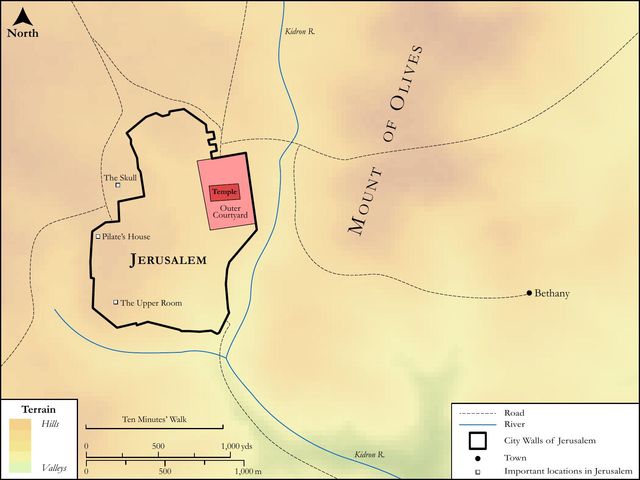
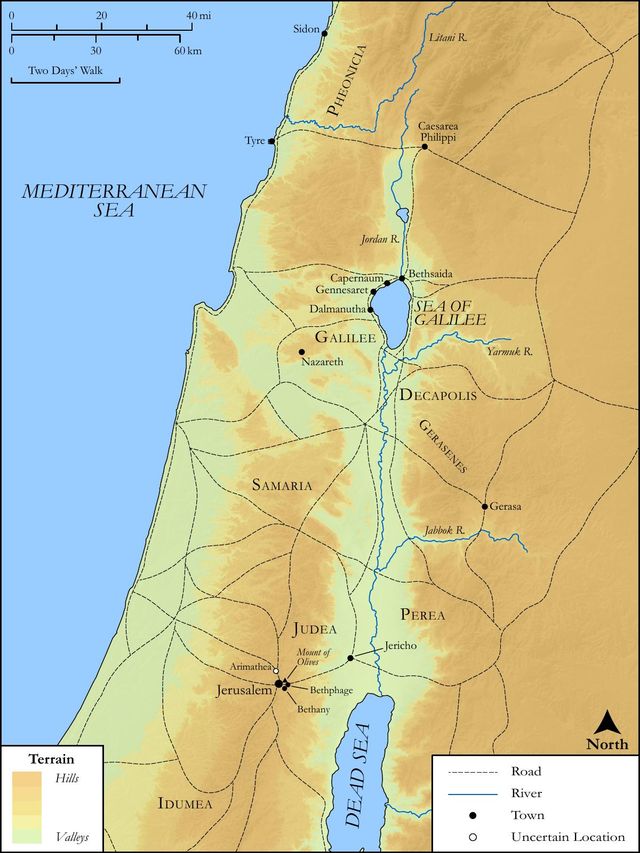
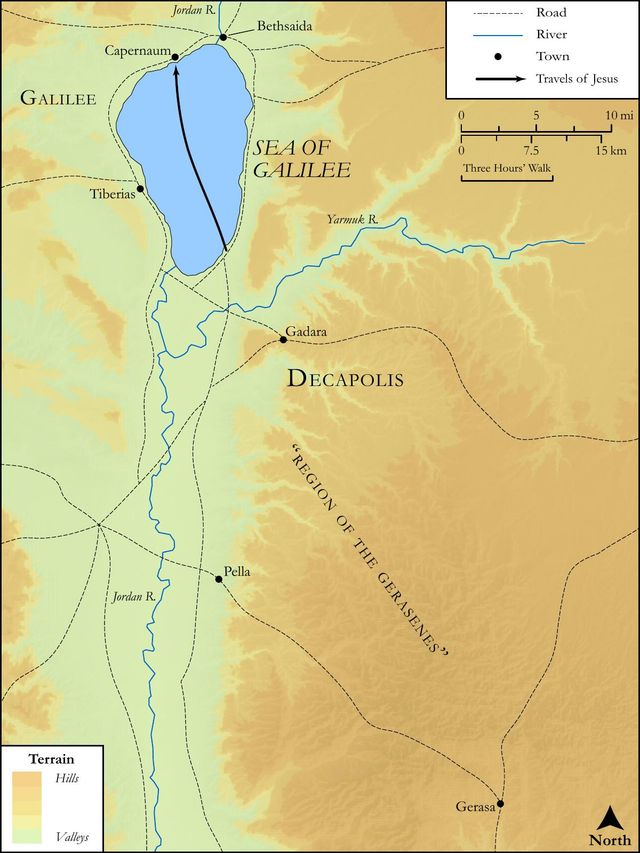
Study this verse
Public-domain commentary
Matthew Henry
From his Commentary on the Whole Bible. Henry comments on passages, not single verses — this entry covers Mark 5:21–34. His three-level outline is real structure in the source text, so it is rendered as structure.
The Gadarenes having desired Christ to leave their country, he did not stay to trouble them long, but presently went by water, as he came, back to the other side (Mar 5:21), and there much people gathered to him. Note, If there be some that reject Christ, yet there are others that receive him, and bid him welcome. A despised gospel will cross the water, and go where it will have better entertainment. Now among the many that applied themselves to him,
I.Here is one, that comes openly to beg a cure for a sick child; and it is no less a person than one of the rulers of the synagogue, one that presided in the synagogue-worship or, as some think, one of the judges of the consistory court, which was in every city, consisting of twenty-three. He was not named in Matthew, he is here, Jairus, or Jair, Jdg 10:3. He addressed himself to Christ, though a ruler, with great humility and reverence; When he saw him, he fell at his feet, giving honour to him as one really greater than he appeared to be; and with great importunity, he besought him greatly, as one in earnest, as one that not only valued the mercy he came for, but that knew he could obtain it no where else. The case is this, He has a little daughter, about twelve years old, the darling of the family, and she lies a dying; but he believes that if Christ will but come, and lay his hands upon her, she will return even from the gates of the grave. He said, at first, when he came, She lies a dying (so Mark); but afterward, upon fresh information sent him, he saith, She is even now dead (so Matthew); but he still prosecutes his suit; see Luk 8:42-49. Christ readily agreed, and went with him, Mar 5:24.
II.Here is another, that comes clandestinely to steal a cure (if I may so say) for herself; and she got the relief she came for.
This cure was wrought by the way, as he was going to raise the ruler's daughter, and was followed by a crowd. See how Christ improved his time, and lost none of the precious moments of it. Many of his discourses, and some of his miracles, are dates by the way-side; we should be doing good, not only when we sit in the house, but when we walk by the way, Deu 6:7. Now observe,
1.The piteous case of this poor woman. She had a constant issue of blood upon her, for twelve years, which had thrown her, no doubt, into great weakness, had embittered the comfort of her life, and threatened to be her death in a little time. She had had the best advice of physicians, that she could get, and had made use of the many medicines and methods they prescribed: as long as she had any thing to give them, they had kept her in hopes that they could cure her; but now that she had spent all she had among them, they gave her up as incurable. See here,
(1.)That skin for skin, and all that a man has, will be give for life and health; she spent all she had upon physicians.
(2.)It is ill with those patients whose physicians are their worst disease; who suffer by their physicians, instead of being relieved by them.
(3.)Those that are not bettered by medicines, commonly grow worse, and the disease gets the more ground.
(4.)It is usual with people not to apply themselves to Christ, till they have tried in vain all other helpers, and find them, as certainly they will, physicians of no value. And he will be found a sure refuge, even to those who make him their last refuge.
2.The strong faith that she had in the power of Christ to heal her; she said within herself, though it doth not appear that she was encouraged by any preceding instance to say it, If I may but touch his clothes, I shall be whole, Mar 5:28. She believed that he cured, not as a prophet, by virtue derived from God, but as the Son of God, by a virtue inherent in himself. Her case was such as she could not in modesty tell him publicly, as others did their grievances, and therefore a private cure was what she wished for, and her faith was suited to her case.
3.The wonderful effect produced by it; She came in the crowd behind him, and with much ado got to touch his garment, and immediately she felt the cure wrought, Mar 5:29. The flux of blood was dried up, and she felt herself perfectly well all over her, as well as ever she was in her life, in an instant; by this it appears that the cure was altogether miraculous; for those that in such cases are cured by natural means, recover their strength slowly and gradually, and not per saltum - all at once; but as for God, his work is perfect. Note, Those whom Christ heals of the disease of sin, that bloody issue, cannot but experience in themselves a universal change for the better.
4.Christ's enquiry after his concealed patient, and the encouragement he gave her, upon the discovery of her; Christ knew in himself that virtue had gone out of him, Mar 5:30. He knew it not by any deficiency of spirits, through the exhausting of this virtue, but rather by an agility of spirits, in the exerting of it, and the innate and inseparable pleasure he had in doing good. And being desirous to see his patient, he asked, not in displeasure, as one affronted, but in tenderness, as one concerned, Who touched my clothes? The disciples, not without a show of rudeness and indecency, almost ridiculed his question (Mar 5:31); The multitudes throng thee, and sayest thou, Who touched me? As if it had been an improper question. Christ passed by the affront, and looks around to see her that had done this thing; not that he might blame her for her presumption, but that he might commend and encourage her faith, and by his own act and deed might warrant and confirm the cure, and ratify to her that which she had surreptitiously obtained. He needed not that any should inform him, for he had presently his eye upon her. Note, As secret acts of sin, so secret acts of faith, are known to the Lord Jesus, and are under his eye. If believers derive virtue from Christ ever so closely, he knows it, and is pleased with it. The poor woman, hereupon, presented herself to the Lord Jesus (Mar 5:33), fearing and trembling, not knowing how he would take it. Note, Christ's patients are often trembling, when they have reason to be triumphing. She might have come boldly, knowing what was done in her; yet, knowing that, she fears and trembles. It was a surprise, and was not yet, as it should have been, a pleasing surprise. However, she fell down before him. Note, There is nothing better for those that fear and tremble, than to throw themselves at the feet of the Lord Jesus; to humble themselves before him, and refer themselves to him. And she told him all the truth. Note, We must not be ashamed to own the secret transactions between Christ and our souls; but, when called to it, mention, to his praise, and the encouragement of others, what he has done for our souls, and the experience we have had of healing virtue derived from him. And the consideration of this, that nothing can be hid from Christ, should engage us to confess all to him. See what an encouraging word he gave her (Mar 5:34); Daughter, thy faith hath made thee whole. Note, Christ puts honour upon faith, because faith gives honour to Christ. But see how what is done by faith on earth is ratified in heaven; Christ saith, Be whole of thy disease. Note, If our faith sets the seal of its amen to the power and promise of God, saying, "So it is, and so let it be to me;" God's grace will set the seal of its amen to the prayers and hopes of faith, saying, "So be it, and so it shall be, to thee." And therefore, "Go in peace; be well satisfied that thy cure is honestly come by, is effectually wrought, and take the comfort of it." Note, They that by faith are healed of their spiritual diseases, have reason to go in peace.
Historical interpretation
Seven Centuries of Reception
5 surviving comments on this verse. Each one is dated, so this reads as a timeline rather than a list.
Select a marker to jump to its quote. Markers stagger vertically where authors wrote within a few decades of each other.
But the man who is healed preached in Decapolis, where the Jews, who hang on the letter of the Decalogue, are being turned away from the Roman rule.
Mystically, however, Jairus comes after the healing of the woman, because when the fulness of the Gentiles has come in, then shall Israel be saved. (v. Rom. 11) Jairus means either illuminating, or illuminated, that is, the Jewish people, having cast off the shadow of the letter, enlightened by the Spirit, and enlightening others, falling at the feet of the Word, that is, humbling itself before the Incarnation of Christ, prays for her daughter, for when a man lives himself, he makes others live also. Thus Abraham, and Moses, and Samuel, intercede for the people who are dead, and Jesus comes upon their prayers.
(Hom. in Mat. 31) This woman, who was celebrated and known to all, did not dare to approach the Saviour openly, nor to come to Him, because, according to the law, she was unclean; for this reason she touched Him behind, and not in front, for that she durst not do, but only ventured to touch the hem of His garment. It was not however the hem of the garment, but her frame of mind that made her whole. There follows, For she said, If I may but touch his clothes, I shall be whole.
(Vict. Ant. e Cat. in Macr. v. Chrys. Hom. in Mat. 31.) He calls her daughter because she was saved by her faith; for faith in Christ makes us His children.
(Vict. Ant. e Cat. in Marc.) He has recorded the name on account of the Jews of that time, that it might mark the miracle. It goes on, And when he saw him, he fell at his feet, and besought him greatly, &c. Matthew indeed relates that the chief of the synagogue reported that his daughter was dead, but Mark says that she was very sick, and that afterwards it was told to the ruler of the synagogue, when our Lord was about to go with him, that she was dead. The fact then, which Matthew implies, is the same, namely, that He raised her from the dead; and it is for the sake of brevity, that he says that she was dead, which was evident from her being raised.
(Vict. Ant. e Cat. in Marc.) Now the virtues of Christ are by His own will imparted to those men, who touch Him by faith. Wherefore there follows, And Jesus, immediately knowing in himself that virtue had gone out of him, turned him about in the press, and said, Who touched my clothes? The virtues indeed of the Saviour do not go out of Him locally or corporally, nor in any respect pass away from Him. For being incorporeal, they go forth to others and are given to others; they are not however separated from Him, from whom they are said to go forth, in the same way as sciences are given by the teacher to his pupils. Therefore it says, Jesus, knowing in himself the virtue which had gone out of him, to show that with His knowledge, and not without His being aware of it, the woman was healed. But He asked, Who touched me? although He knew her who touched Him, that He might bring to light the woman, by her coming forward, and proclaim her faith, and lest the virtue of His miraculons work should be consigned to oblivion. It goes on, And his disciples said unto him, Thou seest the multitude thronging thee, and sayest thou, Who touched me? But the Lord asked, Who touched me, that is in thought and faith, for the crowds who throng Me cannot be said to touch Me, for they do not come near to Me in thought and in faith. There follows, And he looked round about to see her that had done this thing.
(Vict. Ant. e Cat. in Marc.) Or else He says, Go in peace, sending her away into that which is the final good, for God dwells in peace, that thou mayest know, that she was not only healed in body, but also from the causes of bodily pain, that is, from her sins
(in Marc. ii. 22) Observe that the object of His question was that the woman should confess the truth of her long 1want of faith, of her sudden belief and healing, and so herself be confirmed in faith, and afford an example to others. But he said to her, Daughter, thy faith hath made thee whole; go in peace, and be whole of thy plague. He said not, Thy faith is about to make thee whole, but has made thee whole, that is, in that thou hast believed, thou hast already been made whole.
(ubi sup.) Again, the Lord going to the child, who is to be healed, is thronged by the crowd, because though He gave healthful advice to the Jewish nation, he is oppressed by the wicked habits of that carnal people; but the woman with an issue of blood, cured by the Lord, is the Church gathered together from the nations, for the issue of blood may be either understood of the pollution of idolatry, or of those deeds, which are accompanied by pleasure to flesh and blood. But whilst the word of the Lord decreed salvation to Judæa, the people of the Gentiles by an assured hope seized upon the health, promised and prepared for others.
(ubi sup.) Wherefore one believing woman touches the Lord, whilst the crowd throngs Him, because He, who is grieved by divers heresies, or by wicked habits, is worshipped faithfully with the heart of the Catholic Church alone. But the Church of the Gentiles came behind Him; because though it did not see the Lord present in the flesh, for the mysteries of His Incarnation had been gone through, yet it attained to the grace of His faith, and so when by partaking of His sacraments, it merited salvation from its sins, as it were the fountain of its blood was dried up by the touch of His garments. And the Lord looked round about to see her who had done this, because He judges that all who deserve to be saved are worthy of His look and of His pity.
After the miracle of the demoniac, the Lord works another miracle, namely, in raising up the daughter of the ruler of the synagogue; the Evangelist, before narrating this miracle, says, And when Jesus was passed over again by ship unto the other side, much people gathered unto him.
Now this man was faithful in part, inasmuch as he fell at the feet of Jesus, but in that he begged of Him to come, he did not show as much faith as he ought. For he ought to have said, Speak the word only, and my daughter shall be healed. There follows, And he went away with him, and much people followed him, and thronged him; and a woman, which had an issue of blood twelve years, &c.
Most faithful indeed is this woman, who hoped for healing from His garments. For which reason she obtains health; wherefore it goes on, And straightway the fountain of her blood was dried up, and she felt in her body that she was healed.
For the Lord wished to declare the woman, first to give His approbation to her faith, secondly to urge the chief of the synagogue to a confident hope that He could thus cure his child, and also to free the woman from fear. For the woman feared because she had stolen health; wherefore there follows, But the woman, fearing and trembling, &c.
But He saith to her, Go in peace, that is, in rest, which means, go and have rest, for up to this time thou hast been in pains and torture.
Or else, by the woman, who had a bloody flux, understand human nature; for sin rushed in upon it, which since it killed the soul, might be said to spill its blood. It could not be cured by many physicians, that is, by the wise men of this world, and of the Law and the Prophets; but the moment that it touched the hem of Christ's garment, that is, His flesh, it was healed, for whosoever believes the Son of man to be Incarnate is he who touches the hem of His garment.
Continue studying Mark 5:29 across the web’s major study libraries — every link below opens this exact verse, chapter, or book on the destination site.
Read & Compare
 BibleGatewayThis verse in more than 200 translations and 70 languages.
 Bible.comThe YouVersion reader — hundreds of translations, reading plans, and highlights.
 ESV.orgCrossway's official English Standard Version reader.
 NET BibleThe NET translation with 60,000+ translators' notes on every rendering decision.
 STEP BibleTyndale House's free study tool — original text, vocabulary, and scholarly resources.
 BibliaLogos Bible Software's free web reader.
 USCCBThe New American Bible (Revised Edition) with the U.S. bishops' study notes.
Commentaries
 BibleHub CommentariesDozens of classic commentaries on this verse, gathered on one page.
 StudyLightMore than 100 commentary sets — the largest collection on the web.
 BibleRefPlain-English commentary on what this verse means, verse by verse.
 Enduring WordDavid Guzik's free commentary on this chapter, widely used by Bible teachers.
 Bible Study ToolsVerse commentary alongside Greek and Hebrew study aids.
Original Language & Research
- BibleHub InterlinearThe verse word by word — original language, transliteration, and English.
- BibleHub LexiconEvery word's original-language definition and Strong's entry.
 Blue Letter BibleDeep-study tools — Strong's numbers, concordance, and word studies.
 CNTR CollationThe earliest Greek manuscripts of this verse, collated letter by letter.
Sermons, Hymns & Audio


TrulyRandomVerse is not affiliated with these sites and doesn’t control their content. They’re linked because they’re genuinely useful.
Summary
Mark 5:29 describes the instantaneous and tangible healing of the woman who had suffered from a chronic hemorrhage for twelve years. Immediately upon touching Jesus' garment, the source of her bleeding dried up, and she physically perceived in her body that she was completely cured of the debilitating affliction that had plagued her for so long. This verse powerfully underscores the immediate efficacy of Jesus' divine power in response to faith.
Context
ShowHideLiterary Context
Mark 5:29 is a pivotal moment within the larger narrative of Jesus' journey to heal Jairus's daughter, found in Mark 5:21-43. The healing of the woman with the issue of blood is strategically placed as an interruption, or "intercalation," within the account of Jairus's plea. This literary device, characteristic of Mark's Gospel, serves to heighten the tension surrounding Jairus's daughter's deteriorating condition while simultaneously showcasing Jesus's sovereign power and compassion even amidst a crowd and pressing schedule. The woman's desperate act of faith in Mark 5:27-28 immediately precedes this verse, and Jesus's subsequent inquiry and affirmation of her faith in Mark 5:30-34 follow, emphasizing that her healing was not accidental but a direct response to her belief.
Historical & Cultural Context
For twelve years, this woman suffered from a chronic flow of blood, a condition that rendered her ceremonially unclean according to Mosaic Law, specifically detailed in Leviticus 15:19-30. This uncleanness meant she was perpetually isolated from communal worship, social interaction, and even physical contact with others, as anyone she touched would also become unclean. Her condition was not only physically debilitating and financially ruinous (as she had spent all her money on physicians, Mark 5:26), but also spiritually and socially ostracizing. Her act of touching Jesus' garment, while an act of profound faith, was also an act of desperation that defied social and religious norms, risking public condemnation for potentially making Jesus unclean.
Key Themes
ShowHideThis verse contributes significantly to several key themes within Mark's Gospel and the broader biblical narrative. Firstly, it highlights the Power and Authority of Jesus over sickness and physical affliction, demonstrating that His divine power is not limited by human conditions or ceremonial laws. Secondly, it powerfully illustrates the Efficacy of Faith, showing that genuine belief, even when expressed quietly or desperately, can connect an individual to God's transformative power. Jesus later confirms this connection in Mark 5:34, stating, "Daughter, thy faith hath made thee whole." Thirdly, the immediate nature of the healing underscores the Immediacy of God's Intervention, a characteristic often emphasized by Mark's frequent use of "straightway" or "immediately." Finally, it showcases Jesus' profound Compassion and Attention to the Overlooked, as He stops amidst a pressing crowd to acknowledge and affirm a woman who was considered an outcast.
Exposition and Analysis
ShowHideKey Word Analysis
ShowHideThis adverb signifies immediacy, directly, or at once. Its frequent use in Mark's Gospel (often translated "immediately") emphasizes the swiftness and decisiveness of Jesus' actions and the unfolding of events. In this verse, it highlights the instantaneous nature of the healing, underscoring the direct and powerful effect of Jesus' presence.
This term refers to a source or well, often of water, but here used metaphorically for the source of her blood flow. The drying up of this "fountain" vividly conveys the complete and definitive cessation of the hemorrhage, not just a temporary pause, indicating a radical and permanent cure.
Derived from a verb meaning "to know," "perceive," or "be aware of," this word emphasizes the woman's personal, internal, and undeniable experience of her healing. It was not merely an external observation but a profound, bodily sensation that confirmed the miracle to her, providing immediate and tangible evidence of her restoration.
Verse Breakdown
ShowHide"And straightway the fountain of her blood was dried up"
This clause describes the immediate and complete cessation of the woman's chronic hemorrhage. The use of "straightway" (Greek: euthéōs) emphasizes the instantaneous nature of the miracle, underscoring that the healing was not gradual but occurred the very moment she touched Jesus' garment. The "fountain of her blood" vividly portrays the long-standing, persistent nature of her affliction, and its "drying up" signifies a definitive and total cure.
"and she felt in [her] body"
This part highlights the subjective, experiential aspect of the healing. The woman herself perceived and knew within her physical being that a profound change had occurred. This internal sensation served as undeniable confirmation of the miracle, moving beyond mere belief to a tangible reality. It demonstrates that divine healing can be a deeply personal and physically verifiable experience.
"that she was healed of that plague"
This final clause identifies the specific outcome and the nature of her affliction. She was "healed" (Greek: iáomai), meaning made whole or cured, from "that plague" (Greek: mástix), which denotes a severe affliction or scourge. This emphasizes the gravity of her long-term suffering and the comprehensive nature of Jesus' cure, which freed her from the physical ailment that had also brought social and spiritual burdens.
Literary Devices
ShowHideMark's concise narrative in Mark 5:29 employs several powerful literary devices. Immediacy is a hallmark of Mark's Gospel, frequently conveyed by the adverb "straightway" (euthéōs), which here underscores the instantaneous nature of the healing, emphasizing Jesus' swift and decisive power. The phrase "fountain of her blood" employs Metaphor and Vivid Imagery, transforming a medical condition into a gushing source, making the cessation of the flow more dramatic and tangible. The contrast between her twelve years of suffering and the instantaneous drying up of the "fountain" creates a powerful Juxtaposition, highlighting the miraculous nature of the event. Furthermore, the inclusion of "she felt in her body" uses Sensory Language, drawing the reader into the woman's personal experience of the miracle and affirming the physical reality of her transformation. This sensory detail makes the healing concrete and undeniable, reinforcing the theme of divine power made manifest.
Theological and Thematic Connections
ShowHideMark 5:29 stands as a profound testament to the active, compassionate, and immediate power of God at work through Jesus Christ. It demonstrates that Jesus' authority extends over all forms of human suffering, even those deemed incurable or ritually defiling. The woman's healing is not merely a physical restoration but also a social and spiritual one, as she is freed from the isolation and uncleanness imposed by her condition. This miracle underscores the biblical truth that God is attentive to the cries of the lowly and that genuine faith, even a desperate touch, can be the conduit for divine intervention. It reveals Jesus as the Great Physician who brings wholeness to body, soul, and spirit, transcending human limitations and religious strictures to offer radical grace and healing.
Reflection and Application
ShowHideThe immediate and tangible healing experienced by the woman in Mark 5:29 offers profound encouragement and practical lessons for believers today. Her twelve years of suffering, marked by medical futility and social isolation, represent the chronic, seemingly insurmountable challenges we often face in life—whether physical ailments, emotional wounds, relational brokenness, or spiritual dryness. Yet, her desperate act of faith, believing that a mere touch of Jesus' garment would suffice, reminds us that our faith, no matter how small or seemingly inadequate, can connect us to an infinite source of power. We are invited to approach Jesus with similar conviction, bringing our deepest "plagues" to Him, trusting that His power is not diminished by our long-standing struggles. Just as she "felt in her body" the immediate cessation of her affliction, we too can expect to experience tangible evidence of God's transformative work in our lives, bringing restoration, peace, and wholeness where there was once only pain and despair. This passage calls us to persist in faith, even when circumstances seem hopeless, knowing that Jesus is ever-present, compassionate, and able to bring about immediate and complete healing.
Questions for Reflection
ShowHideFAQ
ShowHideWhy was the woman's condition considered a "plague" and what were its implications?
ShowHideThe term "plague" (Greek: mástix) refers to a severe affliction or scourge. Her condition, a chronic hemorrhage for twelve years, was considered a "plague" not only due to its physical debilitation but also because of its profound social and religious implications. According to Mosaic Law (Leviticus 15:19-30), any continuous bodily discharge, especially of blood, rendered a person ceremonially unclean. This meant she was isolated from her community, unable to participate in religious rituals, and anyone she touched or who touched her became unclean. This "plague" therefore encompassed physical suffering, social ostracization, and spiritual alienation, making her healing a comprehensive restoration.
Why is the immediate nature of the healing emphasized with "straightway"?
ShowHideThe word "straightway" (Greek: euthéōs) is a characteristic feature of Mark's Gospel, used frequently to convey a sense of urgency, immediacy, and divine power. In Mark 5:29, its use highlights that the healing was not a gradual process or a slow recovery, but an instantaneous and complete cessation of her long-standing affliction. This emphasis underscores Jesus's absolute authority over disease and demonstrates that His power is effective the very moment it is accessed through faith, leaving no room for doubt about the miraculous nature of the event.
Christ-Centered Fulfillment
ShowHideThe instantaneous and complete healing of the woman with the issue of blood in Mark 5:29 powerfully foreshadows and embodies the Christ-centered fulfillment of redemption. Just as her "fountain of blood" was dried up, signifying the cessation of a debilitating and defiling condition, so too does Christ's atoning work on the cross bring a definitive end to the "plague" of sin that afflicts humanity. Through His own shed blood, Jesus, the Lamb of God who takes away the sin of the world, offers not merely physical healing but ultimate spiritual cleansing and wholeness. The woman's ceremonial uncleanness, which separated her from God and community, finds its ultimate remedy in Christ, who by His sacrifice purifies us from all unrighteousness, making us clean and acceptable before God (Hebrews 9:14). Her physical restoration points to the greater spiritual restoration available to all who, by faith, "touch" Him, receiving new life and freedom from the curse of sin. Indeed, as Isaiah 53:5 prophesied, "by his stripes we are healed," a truth echoed in 1 Peter 2:24, affirming that Jesus bore our sicknesses and sorrows to bring us comprehensive healing—body, soul, and spirit—culminating in the promise of a future where all tears and pain will be wiped away (Revelation 21:4).