


Mark 12:1
- ΚαὶKaiAndG2532CONJConjunction
- ἤρξατοērxatoHe beganG757V-ADI-3SVerb Aorist Middle Deponent Indicative 3rd Singular
- αὐτοῖςautoisto themG846P-DPMPersonal pronoun Dative Plural Masculine
- ἐνeninG1722PREPPreposition
- παραβολαῖςparabolaisparablesG3850N-DPFNoun Dative Plural Feminine
- λαλεῖν·laleinto speakG2980V-PANVerb Present Active Infinitive
- ἀμπελῶναampelōnaA vineyardG290N-ASMNoun Accusative Singular Masculine
- ἄνθρωποςanthrōposa manG444N-NSMNoun Nominative Singular Masculine
- ἐφύτευσενephuteusenplantedG5452V-AAI-3SVerb Aorist Active Indicative 3rd Singular
- καὶkaiandG2532CONJConjunction
- περιέθηκενperiethēkenhe placed around [it]G4060V-AAI-3SVerb Aorist Active Indicative 3rd Singular
- φραγμὸνphragmona fenceG5418N-ASMNoun Accusative Singular Masculine
- καὶkaiandG2532CONJConjunction
- ὤρυξενōruxendugG3736V-AAI-3SVerb Aorist Active Indicative 3rd Singular
- ὑπολήνιονhupolēniona wine vatG5276N-ASNNoun Accusative Singular Neuter
- καὶkaiandG2532CONJConjunction
- ᾠκοδόμησενōkodomēsenbuiltG3618V-AAI-3SVerb Aorist Active Indicative 3rd Singular
- πύργονpurgona towerG4444N-ASMNoun Accusative Singular Masculine
- καὶkaiandG2532CONJConjunction
- ἐξέδετοexedetorented outG1554V-2AMI-3SVerb 2nd Aorist Middle Indicative 3rd Singular
- αὐτὸνautonitG846P-ASMPersonal pronoun Accusative Singular Masculine
- γεωργοῖςgeōrgoisto farmersG1092N-DPMNoun Dative Plural Masculine
- καὶkaiandG2532CONJConjunction
- ἀπεδήμησενapedēmēsentraveled abroadG589V-AAI-3SVerb Aorist Active Indicative 3rd Singular
English is a literal word-by-word gloss of the Greek, not the KJV's wording. Why?
This is the original text the KJV's translators worked from — each Greek word with its own literal English meaning in this verse, prepared by scholars at Tyndale House, Cambridge. The KJV translates whole sentences, not word by word, so its wording differs: one Greek word can become several English words, and the KJV may choose “charity” where the gloss reads “love”. Both are faithful — they answer different questions. For the KJV's own rendering, switch to the KJV text.
Details
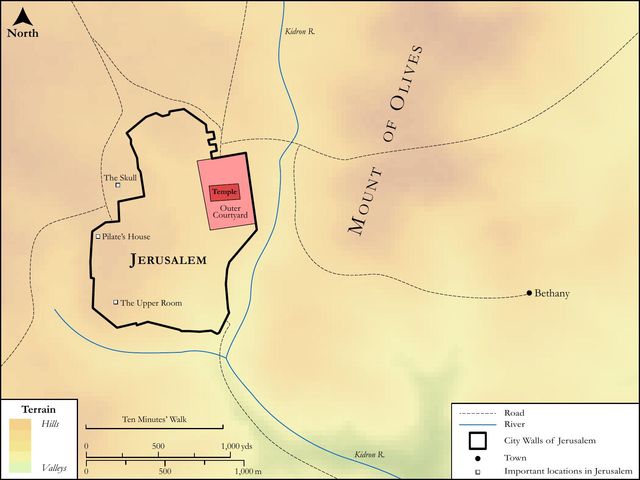
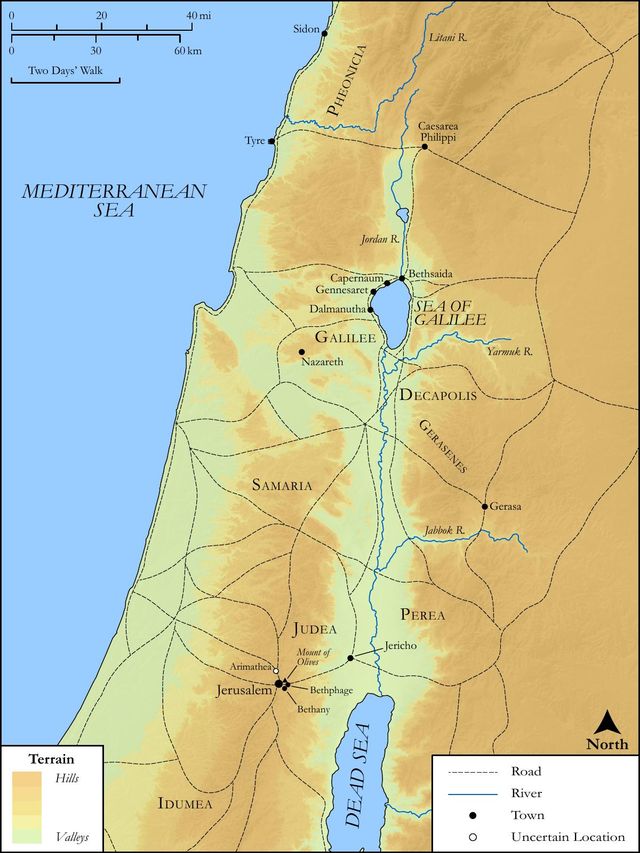
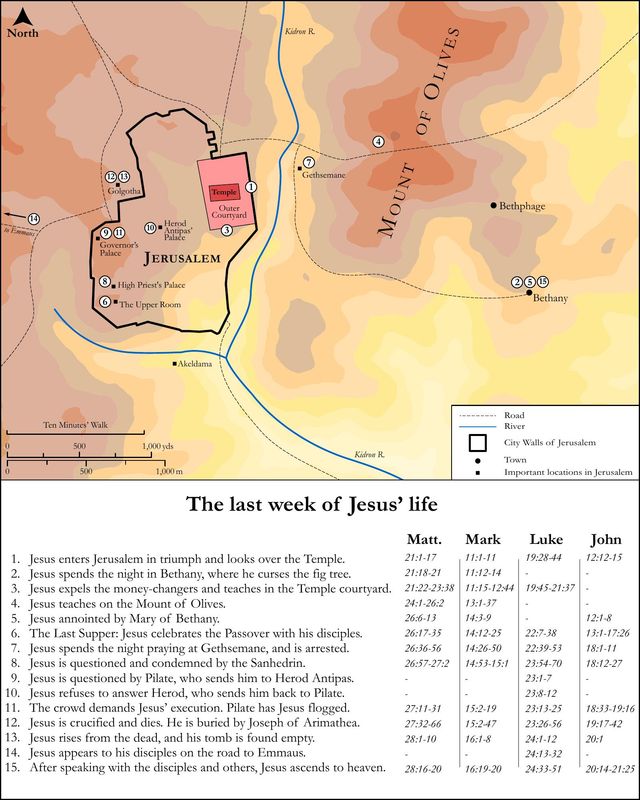
See on the biblical-era map
Study this verse
Public-domain commentary
Matthew Henry
From his Commentary on the Whole Bible. Henry comments on passages, not single verses — this entry covers Mark 12:1–12. His two-level outline is real structure in the source text, so it is rendered as structure.
Christ had formerly in parables showed how he designed to set up the gospel church; now he begins in parables to show how he would lay aside the Jewish church, which it might have been grafted into the stock of, but was built upon the ruins of. This parable we had just as we have it here, Mat 21:33. We may observe here,
I.They that enjoy the privileges of the visible church, have a vineyard let out to them, which is capable of great improvement, and from the occupiers of which rent is justly expected. When God showed his word unto Jacob, his statutes and judgments unto Israel (Psa 147:19), when he set up his temple among them, his priesthood, and his ordinances, then he let out to them the vineyard he had planted; which he hedged, and in which he built a tower, Mar 12:1. Members of the church are God's tenants, and they have both a good Landlord and a good bargain, and may live well upon it, if it be not their own fault.
II.Those whom God lets out his vineyard to, he sends his servants to, to put them in mind of his just expectations from them, Mar 12:2.
He was not hasty in his demands, nor high, for he did not send for the rent till they could make it, at the season; nor did he put them to the trouble of making money of it, but was willing to take it in specie.
III.It is sad to think what base usage God's faithful ministers have met with, in all ages, from those that have enjoyed the privileges of the church, and have not brought forth fruit answerable. The Old Testament prophets were persecuted even by those that went under the name of the Old Testament church. They beat them, and sent them empty away (Mar 12:3); that was bad: they wounded them, and sent them away shamefully entreated (Mar 12:4); that was worse: nay, at length, they came to such a pitch of wickedness, that they killed them, Mar 12:5.
IV.It was no wonder if those who abused the prophets, abused Christ himself.
God did at length send them his Son, his well-beloved; it was therefore so much the greater kindness in him to send him; as in Jacob to send Joseph to visit his brethren, Gen 37:14. And it might be expected that he whom their Master loved, they also should respect and love (Mar 12:6); "They will reverence my son, and, in reverence to him, will pay their rent." But, instead of reverencing him because he was the son and heir, they therefore hated him, Mar 12:7. Because Christ, in calling to repentance and reformation, made his demands with more authority than the prophets had done, they were the more enraged against him, and determined to put him to death, that they might engross all church power to themselves, and that all the respect and obedience of the people might be paid to them only; "The inheritance shall be ours, we will be lords paramount, and bear all the sway." There is an inheritance, which, if they had duly reverenced the Son, might have been theirs, a heavenly inheritance; but they slighted that, and would have their inheritance in the wealth, and pomp, and powers, of this world. So they took him, and killed him; they had not done it yet, but they would do it in a little time; and they cast him out of the vineyard, they refused to admit his gospel when he was gone; it would by no means agree with their scheme, and so they threw it out with disdain and detestation.
V.For such sinful and shameful doings nothing can be expected but a fearful doom (Mar 12:9); What shall therefore the Lord of the vineyard do? It is easy to say what, for nothing could be done more provoking.
1.He will come, and destroy the husbandmen, whom he would have saved. When they only denied the fruit, he did not distrain upon them for rent, nor disseize them and dispossess them for non-payment; but when they killed his servants, and his Son, he determined to destroy them; and this was fulfilled when Jerusalem was laid waste, and the Jewish nation extirpated and made a desolation.
2.He will give the vineyards to others. If he have not the rent from them, he will have it from another people, for God will be no loser by any. This was fulfilled in the taking in of the Gentiles, and the abundance of fruit which the gospel brought forth in all the world, Col 1:6. If some from whom we expected well, prove bad, it doth not follow but that others will be better. Christ encouraged himself with this in his undertaking; Though Israel be not gathered, not gathered to him, but gathered against him, yet shall I be glorious (Isa 49:5, Isa 49:6), as a Light to lighten the Gentiles.
3.Their opposition to Christ's exaltation shall be no obstruction to it (Mar 12:10, Mar 12:11); The stone which the builders rejected, notwithstanding that, is become the Head of the corner, is highly advanced as the Head-stone, and of necessary use and influence as the Corner-stone. God will set Christ as his King, upon his holy hill of Zion, in spite of their project, who would break his bands asunder. And all the world shall see and own this to be the Lord's doing, in justice to the Jews, and in compassion to the Gentiles. The exaltation of Christ was the Lord's doing, and it is his doing to exalt him in our hearts, and to set up his throne there; and if it be done, it cannot but be marvellous in our eyes.
Now what effect had this parable upon the chief priests and scribes, whose conviction was designed by it? They knew he spoke this parable against them, Mar 12:12. They could not but see their own faces in the glass of it; and one would think it showed them their sin so very heinous, and their ruin so certain and great, that it should have frightened them into a compliance with Christ and his gospel, should have prevailed to bring them to repentance, at least to make them desist from their malicious purpose against him: but, instead of that, (1.) They sought to lay hold on him, and make him their prisoner immediately, and so to fulfil what he had just now said they would do to him, Mar 12:8. (2.) Nothing restrained them from it but the awe they stood in of the people; they did not reverence Christ, nor had an fear of God before their eyes, but were afraid, if they should publicly lay hold on Christ, the mob would rise, and lay hold on them, and rescue them. (3.) They left him, and went their way; if they could not do hurt to him, they resolved he should not do good to them, and therefore they got out of the hearing of his powerful preaching, lest they should be converted and healed. Note, If men's prejudices be not conquered by the evidence of truth, they are but confirmed; and if the corruptions of the heart be not subdued by faithful reproofs, they are but enraged and exasperated. If the gospel be not a savour of life unto life, it will be a savour of death unto death.
Historical interpretation
Five Centuries of Reception
6 surviving comments on this verse. Each one is dated, so this reads as a timeline rather than a list.
Select a marker to jump to its quote. Markers stagger vertically where authors wrote within a few decades of each other.
God the Father is called a man by a human conception. The vineyard is the house of Israel; the hedge is the guardianship of Angels; the winefat is the law, the tower is the temple, and the husbandmen, the priests.
The servants who were sent were the prophets, the fruit of the vineyard is obedience; some of the prophets were beaten, others wounded, others slain. Wherefore it goes on, And they caught him, and beat him, and sent him away empty.
The well-beloved son and the last is the Only-begotten; and in that He says, They will reverence my son, He speaks in irony.
Or else, they cast Him out of the vineyard, that is, out of the people, saying Thou art a Samaritan, and hast a devil. (John 8:48) 1Or, as far as in them lay, they cast Him out of their own borders, and gave Him up to the Gentiles that they might receive Him. There follows, What then will the Lord of the vineyard do? he will come and destroy those husbandmen, and give the vineyard unto other.
Or else, the vineyard is given to others, that is, to those who come from the east, and from the west, and from the south, and from the north, and who sit down with Abraham, Isaac, and Jacob in the kingdom of heaven.
This rejected stone, which is borne by that corner where the lamb and the bread met in the supper, ending the Old and beginning the New Testament, does things marvellous in our eyes as the topaz. (Ps. 118, Ps. 127. Vulg.)
And he leased it to husbandmen. Elsewhere, he called these workers of the vineyard, who had been hired at the first, third, sixth and ninth hours. And he went away on a journey, not by changing location. For where can God be absent from, since all things are filled by him? And he who says through Jeremiah: I am a God at hand, and not a God afar off, says the Lord? But he seems to go away from the vineyard to leave the vine-dressers free will in working.
(in Marc. 3, 42) Or else, the hedge is the wall of the city, the winefat is the altar, or those winefats, by which three psalms receive their name.
(ubi sup.) Not by any change of place, but He seemed to go away from the vineyard, that He might leave the husbandmen to act on their own freewill. It goes on: And at the season he sent to the husbandmen a servant, that he might receive from the husbandmen of the fruit of the vineyard.
(ubi sup.) By the servant who was first sent, we must understand Moses, but they beat him, and sent him away empty, because they angered Moses in the tents. (Ps. 106:6) There follows, And again he sent unto them another servant, and they wounded him in the head, and sent him away shamefully handled. This other servant means David and the other Psalmists, but they wounded Him in the head and shamefully handled him, because they despised the songs of the Psalmists and rejected David himself, saying, What portion have we in David? (1 Kings 12:16) It goes on, And he sent another; and him they killed, and many others; heating some, and killing some. By the third servant and his companions, understand the band of the prophets. But which of the prophets did they not persecute? In these three kinds of servants, as the Lord Himself elsewhere pronounces, may be included in a figure all the doctors under the law, when He says, that all things must be fulfilled which were written in the Law of Moses, and in the Prophets, and in the Psalms, concerning Me. (Luke 24:44)
(ubi sup.) Or else, this is not said in ignorance, but God is said to doubt, that freedom of will may be left to man.
(ubi sup.) The Lord proves most clearly that the chiefs of the Jews did not crucify the Son of God through ignorance, but through envy; for they understood that this was He to whom it was said, I will give thee the heathen for thine inheritance. (Ps. 2:8) But these evil husbandmen strove to seize upon it by slaying Him, when the Jews crucifying Him tried to extinguish the faith which is by Him, and rather to bring forward their own righteousness which is by the Law, and to thrust it on the nations, and to imbue them with it. There follows: And they took him, and killed him, and cast him out of the vineyard.
(ubi sup.) But that this was done by Divine interposition he affirms, by immediately afterwards adding, And have ye not read this Scripture, The stone which the builders refused is become the head-stone in the corner? As if he had said, how is this prophecy to be fulfilled, save in that Christ, being rejected and slain by you, is to be preached to the Gentiles, who will believe on Him? Thus then as a corner stone, He will found the two people on Himself, and of the two people will build for Himself a city of the faithful, one temple. For the masters of the synagogue, whom He had just called husbandmen, He now calls builders, because the same persons, who seemed to cultivate His people, that they might bear the fruits of life, like a vineyard, were also commanded to construct and adorn this people, to be, as it were, a house worthy to have God for its inhabitant.
(ubi sup.) But the Chief Priests showed that those things which the Lord had spoken were true; which is proved from what follows: And they sought to lay hold on him; for He Himself is the heir, whose unjust death He said was to be revenged by the Father. Again, in a moral sense, each of the faithful, when the Sacrament of Baptism is intrusted to him, receives on hire a vineyard, which he is to cultivate. But the servant sent to him is evil intreated, beaten, and cast out, when the word is heard by him and despised, or, what is worse, even blasphemed; further, he kills, as far as in him lies, the heir, who has trampled under foot the Son of God. The evil husbandman is destroyed, and the vineyard given to another, when the humble shall be enriched with that gift of grace, which the proud man has scorned. And it happens daily in the Church, that the Chief Priests wishing to lay hands on Jesus, are held back by the multitude, when some one, who is a brother only in name, either blushes or fears to attack the unity of the faith of the Church, and of its peace, though he loves it not, on account of the number of good brethren who dwell together within it.
And he began to speak to them in parables: A man planted a vineyard, and set a hedge around it, and dug a pit, and built a tower. This man who planted the vineyard is the same who in another parable hired laborers into his vineyard. He planted the vineyard about which Isaiah speaks most fully in a song, ultimately saying: The vineyard of the Lord of hosts is the house of Israel. And in the psalm, it is said: You have transplanted a vineyard from Egypt; you expelled the nations and planted it. And he set a hedge around it, whether a city wall or the assistance of angels. And he dug a pit in it, whether a winepress, or an altar, or those winepresses whose titles are marked by three psalms, the eighth, the eightieth, and the eighty-third. And he built a tower, undoubtedly the temple about which it is said through Micah: And you, O tower of the flock, daughter of Zion.
Or, the hedge is the law, which prohibited their mingling with strangers. There follows, And went into a far country.
Or else, By the first servant, understand the prophets who lived about the time of Elias, (2 Chron. 18:23.) for Zedekiah the false prophet beat Micaiah; and by the second servant whom they wounded in the head, that is, evil entreated, we may understand the prophets who lived about the time of Hosea and Isaiah; but by the third servant understand the prophets who flourished about the time of Daniel and Ezekiel. It goes on, Having yet therefore one son, his well-beloved, he sent him also last unto them, saying, Perchance they will reverence my son.
Or else, He said this not as though He were ignorant of what was to happen, but to show what it was right and fitting that they should do. But those husbandmen said amongst themselves, This is the heir, come, let us kill him, and the inheritance will be ours.
That is, without Jerusalem, for the Lord was crucified out of the city.
The Lord of the vineyard then is the Father of the Son who was slain, and the Son Himself is He who was slain, who will destroy those husbandmen, by giving them up to the Romans, and who will give the people to other husbandmen, that is, to the Apostles. Read the Acts of the Apostles, and you will find three thousand, and five thousand on a sudden believing and bearing fruit to God.
The stone then which the builders refused, the same has become the head-stone of the corner, that is, of the Church. For the Church is, as it were, the corner, joining together Jews and Gentiles; and this corner has been made by the Lord, and is wonderful in our eyes, that is, in the eyes of the faithful; for miracles meet with detraction from the faithless. The Church indeed is wonderful, as it were resting on wonders, for the Lord worked with the Apostles, and confirmed the word with signs. And this is what is meant, when it is said, This was the Lord's doing, and it is marvellous in our eyes.
(non occ.) After the Lord had closed the mouths of His tempters by a wise question, He next shows their wickedness in a parable; wherefore it is said: And he began to speak unto them by parables. A certain man planted a vineyard.
Continue studying Mark 12:1 across the web’s major study libraries — every link below opens this exact verse, chapter, or book on the destination site.
Read & Compare
 BibleGatewayThis verse in more than 200 translations and 70 languages.
 Bible.comThe YouVersion reader — hundreds of translations, reading plans, and highlights.
 ESV.orgCrossway's official English Standard Version reader.
 NET BibleThe NET translation with 60,000+ translators' notes on every rendering decision.
 STEP BibleTyndale House's free study tool — original text, vocabulary, and scholarly resources.
 BibliaLogos Bible Software's free web reader.
 USCCBThe New American Bible (Revised Edition) with the U.S. bishops' study notes.
Commentaries
 BibleHub CommentariesDozens of classic commentaries on this verse, gathered on one page.
 StudyLightMore than 100 commentary sets — the largest collection on the web.
 BibleRefPlain-English commentary on what this verse means, verse by verse.
 Enduring WordDavid Guzik's free commentary on this chapter, widely used by Bible teachers.
 Bible Study ToolsVerse commentary alongside Greek and Hebrew study aids.
Original Language & Research
- BibleHub InterlinearThe verse word by word — original language, transliteration, and English.
- BibleHub LexiconEvery word's original-language definition and Strong's entry.
 Blue Letter BibleDeep-study tools — Strong's numbers, concordance, and word studies.
 CNTR CollationThe earliest Greek manuscripts of this verse, collated letter by letter.
Sermons, Hymns & Audio


TrulyRandomVerse is not affiliated with these sites and doesn’t control their content. They’re linked because they’re genuinely useful.
Summary
Mark 12:1 introduces Jesus' potent Parable of the Wicked Husbandmen, a pivotal teaching delivered during His final week in Jerusalem. This verse sets the scene for an allegorical narrative about a landowner who meticulously prepares a vineyard and entrusts it to tenants before departing. The parable, spoken immediately after religious leaders challenged Jesus' authority, serves as a veiled yet scathing indictment of their leadership and a prophetic declaration of their impending judgment and the transfer of God's kingdom stewardship.
Context
ShowHideLiterary Context
This parable is strategically placed in Mark's Gospel, following Jesus' triumphal entry into Jerusalem and His cleansing of the Temple. Immediately preceding Mark 12:1 is the confrontation in Mark 11:27-33, where the chief priests, scribes, and elders directly challenge Jesus' authority. Rather than offering a direct answer, Jesus responds with this parable, shifting the discourse from a debate about His credentials to a profound indictment of their stewardship and a prophetic warning about the consequences of rejecting God's messengers, culminating in the rejection of His Son. The parable's conclusion in Mark 12:12 reveals that the religious leaders understood Jesus was speaking about them, highlighting the direct and confrontational nature of His teaching.
Historical & Cultural Context
Vineyards were a common and vital part of the agricultural economy in ancient Israel, making the imagery immediately relatable to Jesus' audience. The process described—planting, hedging, digging a winefat (a rock-hewn vat for pressing grapes), and building a tower (for watchmen to guard against thieves and animals)—reflects standard, meticulous vineyard cultivation practices of the time. The practice of leasing land to "husbandmen" or tenants was also common, with agreements often involving a share of the harvest. The "far country" signifies a period of absence for the owner, during which the tenants were expected to manage the property and produce fruit. This setting provides a familiar backdrop for Jesus to convey profound spiritual truths about God's ownership, His covenant with Israel, and the responsibilities of those entrusted with His spiritual vineyard.
Key Themes
ShowHideMark 12:1 introduces several significant themes that resonate throughout the parable and the broader biblical narrative. Firstly, it establishes the theme of God's Ownership and Provision, as the "certain man" (representing God) meticulously prepares the vineyard, signifying God's diligent care and investment in His chosen people, Israel, a theme powerfully depicted in Isaiah 5:1-7. Secondly, the verse introduces the theme of Stewardship and Accountability, as the vineyard is "let out to husbandmen," highlighting the delegated responsibility given to Israel's religious leaders to care for God's people and produce spiritual fruit. Thirdly, the owner's departure "into a far country" introduces the theme of Divine Patience and Delayed Judgment, allowing time for the tenants to fulfill their duties before a reckoning. This initial verse, therefore, sets the stage for a narrative that explores themes of covenant faithfulness, the rejection of God's messengers, and the ultimate consequences of such rebellion.
Exposition and Analysis
ShowHideKey Word Analysis
ShowHideMeaning a similitude, symbolic fictitious narrative of common life conveying a moral, apothegm, or adage. Jesus frequently employed parables as a teaching method, using earthly stories to illuminate heavenly truths. In this context, the parable serves not just to illustrate but to confront and expose, allowing those with spiritual discernment to understand its deeper meaning while veiling it from those hardened in their hearts.
Meaning a vineyard. This imagery is deeply rooted in the Old Testament, where the vineyard consistently symbolizes the nation of Israel (e.g., Psalm 80:8-19 and Isaiah 5:1-7). The meticulous planting and preparation of the vineyard underscore God's special care and covenant relationship with Israel, His chosen people.
Meaning a land-worker, i.e., farmer. In the context of this parable, the husbandmen represent the religious leaders of Israel—the chief priests, scribes, and elders—who were entrusted with the spiritual care and cultivation of God's people. They were expected to manage the vineyard faithfully and yield its produce to the owner, symbolizing their responsibility to lead Israel in righteousness and obedience to God.
Verse Breakdown
ShowHide"And he began to speak unto them by parables."
This opening clause signals a shift in Jesus' teaching method in response to the religious leaders' challenge. Instead of a direct answer, Jesus employs a parable, a narrative form that allows for both revelation and concealment, enabling those with ears to hear to grasp profound truths while leaving those resistant to His message without immediate recourse for accusation. It marks the beginning of a significant, confrontational discourse.
"A certain man planted a vineyard, and set an hedge about it, and digged a place for the winefat, and built a tower,"
This detailed description emphasizes the thoroughness and generosity of the landowner (representing God). The planting of the vineyard signifies God's establishment of Israel as His chosen nation. The hedge provides protection, symbolizing God's divine providence and the Law that set Israel apart. The winefat (or winepress) represents the means for processing the vineyard's produce, indicating God's expectation of fruitfulness from His people. The tower served as a watchman's post, signifying God's vigilant care and oversight for His vineyard. These elements collectively illustrate God's complete provision and investment in His people.
"and let it out to husbandmen, and went into a far country."
This final clause highlights the delegation of stewardship and the owner's subsequent absence. "Letting it out to husbandmen" signifies God entrusting the care and management of Israel (His vineyard) to its religious and political leaders. The owner's departure "into a far country" implies a period of time and patience, during which the tenants are expected to faithfully manage the vineyard and yield its fruit. It also sets the stage for the subsequent actions of the husbandmen and the eventual return of the owner for an accounting.
Literary Devices
ShowHideThe primary literary device in Mark 12:1 and the subsequent parable is Allegory. The entire narrative functions as an extended metaphor where each element—the landowner, the vineyard, the hedge, the winefat, the tower, the husbandmen, and the "far country"—symbolizes specific entities or concepts within Israel's history and God's relationship with His people. This allegorical structure allows Jesus to convey complex theological truths and prophetic warnings in a memorable and impactful way. Closely related is Symbolism, where the vineyard explicitly symbolizes Israel, the landowner represents God, and the husbandmen symbolize the religious leaders. The meticulous preparation of the vineyard (hedge, winefat, tower) symbolizes God's comprehensive provision and protection for His people. The use of Foreshadowing is also evident, as the initial setup of the parable subtly hints at the conflict and judgment that will unfold, particularly the eventual rejection of the owner's son.
Theological and Thematic Connections
ShowHideMark 12:1 lays the groundwork for understanding God's enduring covenant relationship with Israel, His meticulous care for His people, and the profound responsibility of those entrusted with spiritual leadership. The parable's imagery, deeply rooted in Old Testament prophetic tradition, underscores God's ownership of His people and His expectation of spiritual fruitfulness. The subsequent narrative, initiated by this verse, powerfully illustrates the tragic history of Israel's leadership rejecting God's prophets and ultimately His Son, leading to a transfer of stewardship. It serves as a stark reminder that divine patience has limits and that accountability is inevitable for those who abuse their entrusted authority.
Reflection and Application
ShowHideMark 12:1, as the introduction to the Parable of the Wicked Husbandmen, speaks profoundly to the nature of stewardship and accountability in the spiritual realm. Just as God meticulously prepared the vineyard for the husbandmen, He has invested immensely in His Church and in individual believers, providing every resource necessary for spiritual growth and fruitfulness. We, as modern-day "husbandmen," are entrusted with the care of His spiritual vineyard—whether it be our local church, our personal gifts and talents, our families, or the broader mission of the gospel. This verse calls us to examine our faithfulness in stewarding what God has given us, recognizing that ultimate ownership belongs to Him. It challenges us to reflect on whether we are producing the expected fruit of righteousness, love, and obedience, or if we are, like the wicked tenants, seeking to claim for ourselves what rightfully belongs to God. The parable's warning against rejecting God's messengers and His ultimate authority serves as a timeless caution against spiritual rebellion and a call to humble, obedient service.
Questions for Reflection
ShowHideFAQ
ShowHideWhy did Jesus choose to speak in parables at this particular moment?
ShowHideJesus chose to speak in parables, especially the Parable of the Wicked Husbandmen, at this critical juncture for several reasons. Firstly, it was a common and effective teaching method, allowing Him to convey complex spiritual truths in an accessible yet profound manner. Secondly, it served as a strategic response to the religious leaders' challenge to His authority (Mark 11:27-33). Instead of directly answering their question, which would have led to a direct accusation, Jesus used the parable to expose their hypocrisy and impending judgment indirectly, yet powerfully. This method allowed those with spiritual discernment to understand His message, while simultaneously veiling it from those whose hearts were hardened, preventing them from immediately seizing Him.
What is the significance of the vineyard imagery in this parable?
ShowHideThe imagery of the vineyard is deeply significant and rich with Old Testament symbolism. In passages like Isaiah 5:1-7 and Psalm 80:8-19, the vineyard consistently represents the nation of Israel, God's chosen people. The "certain man" who plants and meticulously prepares the vineyard symbolizes God Himself, highlighting His divine ownership, His careful cultivation, and His covenant relationship with Israel. The hedge, winefat, and tower all represent God's comprehensive provision, protection, and the means for spiritual fruitfulness that He bestowed upon His people. The parable thus uses this familiar and potent symbol to indict Israel's leadership for their failure to produce fruit and their rejection of God's messengers.
Christ-Centered Fulfillment
ShowHideMark 12:1, as the opening to the Parable of the Wicked Husbandmen, finds its ultimate Christ-centered fulfillment in Jesus Himself, who is the "beloved son" and ultimate heir sent by the landowner. The repeated rejection of the servants (prophets) by the husbandmen foreshadows the consistent rejection of God's messengers throughout Israel's history, culminating in the climactic and tragic rejection of Jesus, the Son of God. Jesus identifies Himself as this beloved Son, the rightful heir to the vineyard (Israel and, by extension, God's kingdom). His crucifixion, therefore, is not merely a historical event but the very act of the "husbandmen" casting the heir out of the vineyard and killing him, hoping to seize the inheritance for themselves, as explicitly stated in the parable's unfolding narrative (Mark 12:8). However, the parable's conclusion, referencing the stone the builders rejected becoming the cornerstone (Mark 12:10-11), powerfully points to Jesus' resurrection and His exaltation as the foundation of a new spiritual house, the Church. The transfer of the vineyard to "others" (Mark 12:9) signifies the inclusion of Gentiles into God's covenant people, fulfilling prophecies of a new people of God drawn from all nations (Romans 9:25-26). Thus, Mark 12:1 sets the stage for a profound revelation of God's redemptive plan, centered on the rejected yet exalted Christ, who establishes His new kingdom and empowers His true stewards.