


Hosea 7:14
- וְלֹאve·lo'and notH3808Conj-w ¦ NegParticle Negativeוְandלֹאnot
- זָעֲקוּza·'a·Kuthey have cried outH2199V-Qal-Perf-3cpVerb Qal Perfect 3rd Plural common gender
- אֵלַי'e·Laito meH413Prep ¦ 1csPrepositionאֵלַtoיme
- בְּלִבָּםbe·li·Bamwith their heartH3820Prep-b ¦ N-msc ¦ 3mpNoun Singular Masculine Constructבְּwithלִבָּheartםtheir
- כִּיkiifH3588PrtParticle Conditional
- יְיֵלִילוּye·ye·Li·luthey wailH3213V-Hiphil-Imperf-3mpVerb Hiphil Imperfect 3rd Plural Masculine
- עַל'alonH5921PrepPreposition
- מִשְׁכְּבוֹתָםmish·ke·vo·Tamtheir bedsH4904N-fpc ¦ 3mpNoun Plural Feminine Constructמִשְׁכְּבוֹתָbedsםtheir
- עַל'alonH5921PrepPreposition
- דָּגָןda·GangrainH1715N-msNoun Singular Masculine Absolute
- וְתִירוֹשׁve·ti·Ro·oshand new wineH8492Conj-w ¦ N-msNoun Singular Masculine Absoluteוְandתִירוֹשׁnew wine
- יִתְגּוֹרָרוּyit·go·Ra·ruthey assemble themselvesH1641V-Hithpael-Imperf-3mpVerb Hithpael Imperfect 3rd Plural Masculine
- יָסוּרוּya·Su·ruthey turn asideH5493V-Qal-Imperf-3mpVerb Qal Imperfect 3rd Plural Masculine
- בִיViagainst mePrep-b ¦ 1csSuffix Personal 1st Singular common genderבִagainstיme
English is a literal word-by-word gloss of the Hebrew, not the KJV's wording. Why?
This is the original text the KJV's translators worked from — each Hebrew word with its own literal English meaning in this verse, prepared by scholars at Tyndale House, Cambridge. The KJV translates whole sentences, not word by word, so its wording differs: one Hebrew word can become several English words, and the KJV may choose “the LORD” where the gloss reads “Yahweh”. Both are faithful — they answer different questions. For the KJV's own rendering, switch to the KJV text.
Details
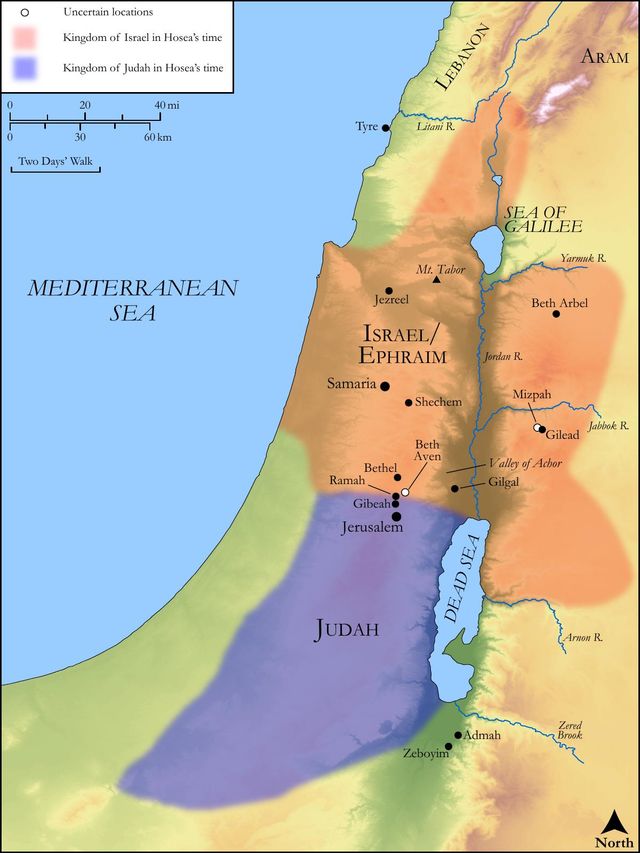
See on the biblical-era map
Study this verse
Public-domain commentary
Matthew Henry
From his Commentary on the Whole Bible. Henry comments on passages, not single verses — this entry covers Hosea 7:8–16. His three-level outline is real structure in the source text, so it is rendered as structure.
Having seen how vicious and corrupt the court was, we now come to enquire how it is with the country, and we find that to be no better; and no marvel if the distemper that has so seized the head affect the whole body, so that there is no soundness in it; the iniquity of Ephraim is discovered, as well as the sin of Samaria, of the people as well as the princes, of which here are divers instances.
I.They were not peculiar and entire for God, as they should have been, Hos 7:8.
1.They did not distinguish themselves from the heathen, as God had distinguished them: Ephraim, he has mingled himself among the people, has associated with them, and conformed himself to them, and has in a manner confounded himself with them and lost his character among them. God had said, The people shall dwell alone; but they mingled themselves with the heathen and learned their works, Psa 106:35. They went up and down among the heathen, to beg help of one of them against another (so some); whereas, if they had kept close to God, they would not have needed the help of any of them.
2.They were not entirely devoted to God: Ephraim is a cake not turned, and so is burnt on one side and dough on the other side, but good for nothing on either side. As in Ahab's time, so now, they halted between God and Baal; sometimes they seemed zealous for God, but at other times as hot for Baal. Note, It is sad to think how many, who, after a sort, profess religion, are made up of contraries and inconsistencies, as a cake not turned, a constant self-contradiction, and always in one extreme or the other.
II.They were strangely insensible of the judgments of God, which they were under, and which threatened their ruin, Hos 7:9. Observe,
1.The condition they were in. God was not to them, in his judgments, as a moth and as rottenness; they were silently and slowly drawing towards the ruin of their state partly by the encroachments of foreigners upon them: Strangers have devoured his strength, and eaten him up; they have wasted his wealth and treasure, lessened his numbers, and consumed the fruits of the earth. Some devoured them by open wars (as Kg2 13:7, when the king of Syria made them like the dust by threshing), others by pretending treaties of peace and amity, in which they extorted abundance of wealth from them, and made them pay dearly for that which did them no good, but which afterwards they paid more dearly for, as Kg2 16:9. This Ephraim got by mingling with the heathen, and suffering them to mingle with him; they devoured that which he rested upon and supported himself with. Note, Those that make not God their strength (Psa 52:7) make that their strength which will soon be devoured by strangers. They were thus reduced partly by their own mal-administrations among themselves: Yea, gray hairs are here and there upon him (are sprinkled upon him, so the word is), that is, the sad symptoms of a decaying declining state, which is waxing old and ready to vanish away, and the effects of trouble and vexation. Cura facit canos - Care turns gray. The almond-tree does not as yet flourish, but it begins to turn colour, which speaks aloud to him that the evil days are coming, and the years of which he shall say, I have no pleasure in them, Ecc 12:1, Ecc 12:5.
2.Their regardlessness of these warnings: He knows it not; he is not aware of the hand of God gone out against him; it is lifted up, but he will not see, Isa 26:11. He does not know how near his ruin is, and takes no care to prevent it. Note, Stupidity under less judgments is a presage of greater coming.
III.They went on frowardly in their wicked ways, and were not reclaimed by the rebukes they were under (Hos 7:10):
The pride of Israel still testifies to his face, as it had done before (Hos 5:5); under humbling providences their hearts were still unhumbled, their lusts unmortified; and it is through the pride of their countenance that they will not seek after God (Psa 10:4); they do not return to the Lord their God by repentance and reformation, nor do they seek him by faith and prayer for all this; though they suffer for going astray from him, though it can never be well with them till they come back to him, and though they have in vain sought to others for relief, yet they think not of applying to God.
IV.They were infatuated in their counsels, and took very wrong methods when they were in distress (Hos 7:11, Hos 7:12):
Ephraim is like a silly dove without heart. To be harmless as a dove, without gall, and not to hurt or injure others, is commendable; but to be sottish as a dove, without heart, that knows not how to defend herself and provide for her own safety, is a shame.
1.The silliness of this dove is,
(1.)That she laments not the loss of her young that are taken from her, but will make her nest again in the same place; so they have their people carried away by the enemy, and are not affected with it, but continue their dealings with those that deal barbarously with them.
(2.)That she is easily enticed by the bait into the net, and has no heart, no understanding, to discern her danger, as many other fowls do, Pro 1:17. She hastes to the snare, and knows not that it is for her life (Pro 7:23); so they were drawn into leagues with neighbouring nations that were their ruin.
(3.)That, when she is frightened, she has not courage to stay in the dove-house, where she is safe, and under the careful protection of her owner, but flutters and hovers, seeking shelter first in one place, then in another, and thereby exposes herself so much the more; so this people, when they were in distress, sought not to God, did not fly like the doves to their windows where they might have been secured from all the birds of prey that struck at them, but threw themselves out of God's protection, and then called to Egypt to help them, and went in all haste to Assyria, to seek for that aid in vain which they might, by repentance and prayer, have found nearer home, in their God. Note, It is a silly senseless thing for those who have a God in heaven to trust to creatures for the refuge and relief which are to be had in him only; and those that do so are a people of no understanding, they are without heart. Now,
2.See what becomes of this silly dove (Hos 7:12): When they shall go to Egypt and Assyria, I will spread my net upon them. Note, Those that will not abide by the mercy of God must expect to be pursued by the justice of God. Here,
(1.)They are ensnared: "I will spread my net upon them, bring them into straits, that they may see their folly and think of returning." Note, It is common for those that go away from God to find snares where they expected shelters.
(2.)They are humbled; they soar upward, proud of their foreign alliances and confiding in them; but I will bring them down, let them fly ever so high, as the fowls of heaven, that are shot flying. Note, God can and will bring those down that exalt themselves as the eagle, Oba 1:3, Oba 1:4.
(3.)They are made to smart for their folly: I will chastise them. Note, The disappointments we meet with in the creature, when we put a confidence in it, are a necessary chastisement, or discipline, that we may learn to be wiser another time.
(4.)In all this the scripture is fulfilled. It is as their congregation has heard; they have been many a time told by the word of God, read, and preached, and sung, in their religious assemblies, that "vain is the help of man, that in the son of man there is no help; they have heard both from the law and from the prophets what judgments God would bring upon them for their wickedness; and as they have heard now they shall see, they shall feel." Note, It concerns us to take notice of the word of God which we hear from time to time in the congregation, and to be governed by it, for we must shortly be judged by it; and it will justify God in the condemnation of sinners, and aggravate it to them, that they have had plain public warning given them of it; it is what their congregation has heard many a time, but they would not take warning. "Son, remember thou wast told what would come of it; and now thou seest they were not vain words." See Zac 1:6.
V.They revolted from God and rebelled against him, notwithstanding the various methods he took to retain them in their allegiance, Hos 7:13-15. Here observe,
1.How kindly and tenderly God had dealt with them, as a gracious sovereign towards a people dear unto him, and whose prosperity he had much at heart. He had redeemed them (Hos 7:13), brought them, at first, out of the land of Egypt, and, since, delivered them out of many a distress. He had bound and strengthened their arms, Hos 7:15. When their power was weakened, like an arm broken or out of joint, God set it again, and bound it, as a surgeon does a broken bone, to make it knit. God had given Israel victories over the Syrians (Kg2 13:16, Kg2 13:17), had restored their coast (Kg2 14:25, Kg2 14:26), had girded them with strength for battle. "Though I have chastened them" (so the margin reads it), "sometimes corrected them for their faults and thereby taught them, at other times strengthened their arms and relieved them, though I have used both fair means and foul to work upon them, it was all to no purpose; they were mercy-proof and judgment-proof."
2.How impudent their conduct had been towards him notwithstanding, which is described here for the conviction and humiliation of all those who have gone on in any way of wickedness, that they may see how exceedingly sinful their sin is, how heinous, how the God of heaven interprets it, how he resents it.
(1.)He had courted them to him, and taken them into covenant with himself; but they fled from him, as if he had been their dangerous enemy who had always approved himself their faithful friend. They wandered from him, as the silly dove from her nest, for those who forsake God will find no rest nor settlement in the creature, but wander endlessly. They fled from God when they forsook the worship of him, and ran away from his service, and withdrew themselves from their allegiance to him.
(2.)He had given them his laws, which were all holy, just, and good, by which he designed to keep them in the right way; but they transgressed against him; they sinned with a high hand and a stiff neck, wilfully and presumptuously (so the words signifies); they broke through the fence of the divine law, and therein thwarted the design of the divine love.
(3.)He had made known his truths to them, and given them all possible proofs of the sincerity of his good-will to them; and yet they spoke lies against him. They set up false gods in competition with him; they denied his providence and power; thus they belied the Lord, Jer 5:12. They rejected his messages sent them by his prophets, and said that they should have peace, though they went on in sin, directly against what he said. In their hypocritical professions of religion, shows of devotion, and promises of amendment, they lied to the Lord, which he took as lying against him.
(4.)He was their rightful Lord and King, and had always ruled in Jacob with equity, and for the public good; and yet they rebelled against him, Hos 7:14. They not only went off from him, but took up arms against him, would have deposed him if they could and set up another.
(5.)He designed well for them, but they imagined mischief against him, Hos 7:15. Sin is a mischievous thin; it is mischief against God, for it is treason against his crown and dignity; not that the sinners can do any thing to hurt their Creator (as one of the ancients observes on these words), but what they can they do; and it is so much the worse when it is not done by surprise, or through inadvertency, but designedly and with contrivance. The Jews have a saying, which Dr. Pocock quotes here, The thoughts of transgression are worse than the transgression. The designing of mischief is doing it, in God's account. Compassing and imagining the death of the king is treason by our law. Those that imagine an evil thing, though it prove a vain thing (Psa 2:1), will be reckoned with for the imagination.
3.How they shall be punished for this (Hos 7:13): Woe unto them! for they have fled from me. Note, Those who flee from God have woes sent after them, and are, without doubt, in a woeful case. The wrath of God is revealed from heaven against them; the word of God says, Woe to them! And observe what follows immediately, Destruction unto them! Note, The woes of God's word have real effects; destruction makes them good. The judgments of his hand shall verify the judgments of his mouth. Those whom he curses, and pronounces woeful, they are cursed, they are woeful indeed.
VI.Their shows of devotion and reformation were but shows, and in them they did but mock God.
1.They pretended devotion, but it was not sincere, Hos 7:14. When the hand of God had gone forth against them they made some sort of application to him. When he slew them, then they sought him. Lord, in trouble have they visited thee. But it was all in hypocrisy.
(1.)When they were under personal troubles, and called upon God in secret, they were not sincere in that: They have not cried unto me with their heart, when they howled upon their beds. When they were chastened with pain upon their beds, and the multitude of their bones with strong pains, perhaps ill of the wounds they received in war, they cried, and groaned, and complained in the forms of devotion, and, it may be, they used many good words, proper enough for the circumstances they were in; they cried, God help us, and, Lord, look upon us. But they did not cry with their heart, and therefore God reckons it as no crying to him. Moses is said to cry unto God when he spoke not a word, only his heart prayed with faith and fervency, Exo 14:15. These made a great noise, and said a great deal, and yet did not cry to God, because their hearts were not right with him, not subjected to his will, devoted to his honour, nor employed in his service. To pray is to lift up the soul to God, this is the essence of prayer. If this be not done, words, though ever so well chosen, are but wind; but, if it be, it is an acceptable prayer, though the groanings cannot be uttered. Note, Those do not pray to God at all that do not pray in the spirit. Nay, God is so far from approving their prayer and accepting it that he calls it howling. Some think it intimates the noisiness of their prayers (they cried to God as they used to cry to Baal, when they thought he must be awakened), or the brutish violent passions which they vented in their prayers; they snarled at the stone, and howled under the whip, but regarded not the hand. Or it denotes that their hypocritical prayers were so far from being pleasing to God that they were offensive to him; he was angry at their prayers. The songs of the temple shall be howlings, Amo 8:3. God will be so far from pitying them that he will justly laugh at their calamity, who have so often laughed at his authority.
(2.)When they were under public troubles, and met together to implore God's favour, in that also they were hypocritical; they assembled themselves, for fashion-sake, because it was usual to call a solemn assembly in times of general mourning, Zep 2:1. But it was only to pray for corn and wine that they came together, which were the things they wanted, and feared being deprived of by the want of rain, the judgment they now laboured under. They did not pray for the favour or grace of God, that God would give them repentance, pardon their sins, and turn away his wrath, but only that he would not take away from them their corn and wine. Note, Carnal hearts, in their prayers to God, covet temporal mercies only, and dread and deprecate no other but temporal judgments, for they have no sense of any other.
2.They pretended reformation, but neither was that sincere, Hos 7:16. Here is,
(1.)The sin of Israel: They return, that is, they make as if they would return; they pretend to repent and amend their doings, but they make nothing of it; they do not come home to God nor return to their allegiance, whereas God says (Jer 4:1), If thou wilt return, O Israel! return to me; do not only turn towards me, but return to me. This dissimulation of theirs makes them like a deceitful bow, which looks as if it were fit for business, and is bent and drawn accordingly, but, when strength comes to be laid to it, either the bow or the string breaks, and the arrow, instead of flying to the mark, drops at the archer's foot. Such were their essays towards repentance and reformation.
(2.)The sin of the princes of Israel. That which is charged upon them is the rage of their tongue, quarrelling with God and his providence and with all about them when they are crossed. Princes think they may say what they will, and that it is their prerogative to huff and bluster, to curse and rail, and to call names at their pleasure, but let them know there is a God above them that will call them to an account for the rage of their tongues and make their own tongues to fall upon them.
(3.)The punishment of Israel and their princes for their sin. As for the princes, they shall fall by the sword either of their enemies or of their own people, some by one and some by the other; and this shall be their derision, this is that for which they shall be derided in the land of Egypt, when they flee to the Egyptians for succour, Hos 7:11. Their sin and punishment shall make them a laughing-stock to all about them. Note, Those that are treacherous and deceitful in their dealings with God, and passionate and outrageous in their conduct towards men, will justly be made a derision to their neighbours, for they make themselves ridiculous.
Historical interpretation
Historical reception
1 surviving comment on this verse from the historical church.
They muttered about wheat and wine: they separated themselves from me, and I taught them a lesson. I strengthened their arms, and they thought evil against me. They turned back, so as to be without a yoke: they became as a deceitful bow: their princes shall fall by the sword, by the rage of their tongue: this their derision in the land of Egypt." "Over wheat and wine they were being cut to pieces; they were instructed in me, and I strengthened their arms, and they thought evil against me: they were turned into nothing, they became like a tense bow, their rulers shall fall by the sword because of their lack of understanding; this is their derision in the land of Egypt." "On account of the abundance, they said, they have fallen because of their own foolishness. Which Ezekiel also mentions was done in Sodom and Gomorrah (Ezek. XIX), that they chewed on nothing other than food and lust: for which reason the Seventy translated, "they were sliced over grain and wine," as an example of the prophets of Baal, who, with Elijah present, prayed for rain by cutting off the members (III Kings. XVIII). And at the same time, to show that they were like animals, he did not say they ate, but ruminated: and therefore they wandered from the Lord who says, "I have taught them, I have provided strength, and they have raised their necks against me; not that they can do anything and harm their Creator, but what they could do, they thought evil against me." And as they were in the beginning, before I called them by Abraham, and afterwards by Moses and Aaron, and they were without the yoke of the law and without knowledge, and mingled with all nations: so now they have returned to their former state, so as to be carried down headlong without a yoke and reins, and changed into a deceitful bow, so that having aimed at whom God had directed them, they turned their weapons against their own Lord, and sent forth arrows of blasphemy against Him. Therefore, their princes shall fall by the sword because of the rage of their tongue: this is their derision in the land of promise. They have said: "Where is he that he may reign over us?" In undisciplined pride they have pushed you away from your people, saying: "Be gone from us, for we do not desire to know your ways." And: "Would that we had died in the land of Egypt, when we sat by the fleshpots" (Exodus 32:4), and the rest. Concerning wheat and wine, and false mysteries of the body and blood of Christ, who says in the Gospel: "Unless a grain of wheat falls into the earth and dies, it remains alone" (John 12:24): And in another place: "I am the true vine" (John 15:1): And: "Unless you eat the flesh of the Son of Man and drink his blood, you have no life in you" (John 6:54). Therefore, heretics fall over this with wheat and wine and construct different tabernacles for themselves: whether they are prevented by the body of the Church, and simulate meditating and reflecting on the law of God. But those who do this depart from the Lord who taught them in the Church, and gave them the strength to fight their enemies. They, on the other hand, considered evil against the Lord, building the most impious heresies, and returning to the state of the Gentiles so that they were without the knowledge and yoke of God: or they returned to nothingness, not that they ceased to be, but that in comparison to Him who speaks to Moses, "Go, tell the people of Israel: He who sent me" (Exodus 3:14), all who are against the Lord should not be said to be (they are called). According to what we read in Esther, specifically in the Septuagint: "Do not give your scepter to those who are not worthy" (Esther XIV, 11, sec. LXX), it is undoubtedly referring to idols. For if God is truth, whatever is contrary to truth is falsehood and cannot be named. This is what heretics agree on, who, having learned from the Holy Scriptures, translate the words of the Lord of the Law, Prophets, and Gospel against Him, and they are like a deceitful and perverse bow. A deceitful and wicked is the bow that strikes its director and wounds its master. Whether they have been made like a bow drawn taut, always ready for battle and disputes, for the overthrow of those who hear them. Therefore their leaders, that is, the heresiarchs, are struck with the sword of the Lord, because of the insanity of their tongue, with which they blasphemed the Lord: doing the same thing in the false name of the Church, which they did at the time when they lived in the ages of Egypt, that is, when they were gentiles. For all the questions of heretics and Gentiles are the same, because they follow not the authority of Scripture, but the sense of human reason.
Continue studying Hosea 7:14 across the web’s major study libraries — every link below opens this exact verse, chapter, or book on the destination site.
Read & Compare
 BibleGatewayThis verse in more than 200 translations and 70 languages.
 Bible.comThe YouVersion reader — hundreds of translations, reading plans, and highlights.
 ESV.orgCrossway's official English Standard Version reader.
 NET BibleThe NET translation with 60,000+ translators' notes on every rendering decision.
 STEP BibleTyndale House's free study tool — original text, vocabulary, and scholarly resources.
 BibliaLogos Bible Software's free web reader.
 USCCBThe New American Bible (Revised Edition) with the U.S. bishops' study notes.
Commentaries
 BibleHub CommentariesDozens of classic commentaries on this verse, gathered on one page.
 StudyLightMore than 100 commentary sets — the largest collection on the web.
 BibleRefPlain-English commentary on what this verse means, verse by verse.
 Enduring WordDavid Guzik's free commentary on this chapter, widely used by Bible teachers.
 Bible Study ToolsVerse commentary alongside Greek and Hebrew study aids.
Original Language & Research
- BibleHub InterlinearThe verse word by word — original language, transliteration, and English.
- BibleHub LexiconEvery word's original-language definition and Strong's entry.
 Blue Letter BibleDeep-study tools — Strong's numbers, concordance, and word studies.
 SefariaThe Hebrew text with Rashi and centuries of Jewish commentary.
Sermons, Hymns & Audio


TrulyRandomVerse is not affiliated with these sites and doesn’t control their content. They’re linked because they’re genuinely useful.
Summary
Hosea 7:14 powerfully critiques the spiritual hypocrisy of the Northern Kingdom of Israel, revealing a people whose cries of distress were superficial and self-serving, lacking genuine heartfelt repentance towards God. Despite their outward laments during times of suffering, their true focus remained on securing material provisions like "corn and wine," demonstrating a profound rebellion against the Lord and a persistent prioritization of earthly comforts over a sincere relationship with their divine covenant partner.
Context
ShowHideLiterary Context
Hosea 7 is situated within a larger prophetic indictment against Israel (Ephraim) for its pervasive unfaithfulness to the covenant with Yahweh. The preceding verses (Hosea 7:1-10) vividly portray Israel's moral corruption, political instability, and spiritual adultery, likening them to a "heated oven" or "a cake not turned." The nation's leaders are depicted as consumed by lust and violence, while the people are spiritually blind, not recognizing God's hand in their afflictions. Verse 14 specifically delves into the nature of their response to these afflictions, exposing the hollowness of their cries and prayers, which are not directed to God with sincerity. This verse sets the stage for the subsequent condemnation of their reliance on foreign alliances (Hosea 7:11-13) and their continued defiance.
Historical & Cultural Context
The prophet Hosea ministered to the Northern Kingdom of Israel during the turbulent 8th century BC, a period marked by political assassinations, rapid succession of kings, and increasing pressure from the rising Assyrian Empire. Internally, Israel was plagued by idolatry, oppression, and a general abandonment of Mosaic Law. Culturally, "howling upon their beds" could refer to private laments for personal suffering (perhaps from illness or famine), or even pagan mourning rituals performed in seclusion, rather than seeking the Lord in the temple or through genuine repentance. Their "assembling for corn and wine" underscores their focus on basic sustenance and prosperity, which they might have sought through pagan fertility rites (e.g., Baal worship) or through desperate, self-serving political maneuvers, rather than trusting in God's provision and covenant promises.
Key Themes
ShowHideHosea 7:14 contributes significantly to several overarching themes in the book. Foremost is the theme of Superficiality vs. Sincerity, highlighting God's desire for a genuine, heartfelt relationship over outward displays of piety or distress that lack true repentance. The people's "howling" without crying "with their heart" exemplifies this spiritual disconnect, a theme echoed in Isaiah's critique of lip service over heart service. Another crucial theme is Misplaced Trust and Priorities, as Israel prioritizes "corn and wine" and earthly solutions over seeking God's intervention and forgiveness. This reflects their persistent Covenant Unfaithfulness and Rebellion, a core accusation throughout Hosea, where Israel's actions consistently violate their sacred bond with Yahweh, despite His enduring love and pursuit, as seen in the book's overarching metaphor of God as a faithful husband to an adulterous wife. Ultimately, the verse underscores God's Desire for True Repentance, a call for a return to Him with their whole being, as emphasized in passages like Jeremiah 29:13.
Exposition and Analysis
ShowHideKey Word Analysis
ShowHideThis primitive root means "to shriek (from anguish or danger); by analogy, (as a herald) to announce or convene publicly." In Hosea 7:14, the negative "not cried" in conjunction with "with their heart" indicates that while they may have made loud, distressed noises (howling), they did not utter a genuine, internal cry to God for help or repentance. Their "crying" was for their own suffering, not for their sin against God.
A form of lêbâb, this word signifies "the heart; also used (figuratively) very widely for the feelings, the will and even the intellect; likewise for the centre of anything." The absence of this "heart" in their cry is the crux of God's complaint. It means their lamentations lacked sincerity, true emotion, genuine will to turn, or intellectual understanding of their spiritual condition and God's nature. It was a superficial, external expression devoid of internal commitment.
This primitive root means "to turn off (literal or figurative); be(-head), bring, call back, decline, depart, eschew, get (you), go (aside), [idiom] grievous, lay away (by), leave undone, be past, pluck away, put (away, down), remove (to and fro), revolt, [idiom] be sour, take (away, off), turn (aside, away, in), withdraw, be without." Here, it signifies an active, deliberate turning away from God, a revolt against His authority and covenant. This rebellion is the underlying spiritual state that renders their outward cries meaningless.
Verse Breakdown
ShowHide"And they have not cried unto me with their heart,"
This clause reveals the fundamental spiritual deficiency of Israel. Despite their distress, their cries were not directed to God from a place of genuine sincerity, deep emotion, or true repentance. It signifies a lack of an internal, wholehearted turning to the Lord, indicating a superficiality in their relationship with Him.
"when they howled upon their beds:"
This describes the nature of their lament. "Howling" suggests a wailing cry of physical pain, anguish, or distress, possibly associated with sickness, famine, or the terror of impending judgment. "Upon their beds" implies a private, self-focused lament, perhaps even mimicking pagan mourning rituals, rather than a public, communal act of repentance or a sincere seeking of God in His temple. Their focus was on their own suffering, not on their sin against God.
"they assemble themselves for corn and wine,"
This clause exposes their misplaced priorities. Their gathering or collective effort was not for spiritual revival or seeking God's face, but for the most basic material provisions—"corn and wine." This highlights a profound spiritual blindness where physical sustenance and prosperity superseded their relationship with the Almighty, perhaps even leading them to engage in idolatrous practices to secure these earthly goods.
"and they rebel against me."
This final clause delivers the ultimate indictment. Despite their outward displays of distress and their desperate pursuit of material comfort, their fundamental attitude remained one of active defiance and turning away from God. This rebellion wasn't merely passive neglect but an ongoing, deliberate rejection of God's commands, His covenant, and His loving pursuit, underscoring the deep chasm between their actions and God's desire for true relationship.
Literary Devices
ShowHideHosea 7:14 employs several powerful literary devices to convey its message. The most prominent is Contrast, starkly juxtaposing "cried unto me with their heart" with "howled upon their beds." This highlights the difference between genuine, internal spiritual engagement and superficial, self-focused lamentation. The phrase "with their heart" employs Metonymy, where the "heart" represents the entirety of a person's inner being—their will, intellect, and emotions—emphasizing the absence of true sincerity. Similarly, "corn and wine" serve as Synecdoche, representing all material sustenance and earthly desires, underscoring Israel's misplaced priorities. There is also a subtle Irony in the verse: the people are in distress and "howling," yet they refuse to cry out sincerely to the very God who could deliver them, and against whom they are actively rebelling. God's lament, "they have not cried unto me," also carries an element of Anthropomorphism, portraying God with human-like emotions of disappointment and sorrow over His people's spiritual state.
Theological and Thematic Connections
ShowHideHosea 7:14 serves as a timeless theological commentary on the nature of true worship and repentance. It reveals God's profound desire for a genuine, wholehearted relationship with His people, one that transcends mere outward expressions of piety or cries of distress. The verse underscores that God is not interested in superficial lamentations or self-pity, but in a contrite spirit that acknowledges sin and seeks His forgiveness and restoration above all else. Israel's failure to cry "with their heart" exposes the danger of spiritual hypocrisy, where religious actions or expressions are divorced from an inward reality of devotion and obedience. This passage reminds us that God looks beyond our words and actions to the true intentions and affections of our hearts, demanding sincerity and an unwavering commitment to Him as the ultimate source of provision and salvation.
Reflection and Application
ShowHideHosea 7:14 offers a profound challenge for contemporary believers to examine the authenticity and depth of their own spiritual lives, particularly in moments of personal or collective distress. It compels us to ask whether our prayers and lamentations are truly directed to God with a sincere heart of repentance and trust, or if they are merely self-focused expressions of discomfort, seeking relief from circumstances without addressing the underlying spiritual condition. Are we genuinely seeking God's will and forgiveness, or are we primarily concerned with our "corn and wine"—our material needs, comfort, or earthly solutions? This verse serves as a powerful reminder that God desires a relationship rooted in truth and wholehearted devotion, not superficiality or hypocrisy. It calls us to prioritize our spiritual walk above all else, ensuring that our cries for help are accompanied by a genuine turning away from rebellion and a sincere desire for His presence and glory.
Questions for Reflection
ShowHideFAQ
ShowHideWhat is the significance of "upon their beds" in this verse?
ShowHideThe phrase "upon their beds" suggests a private, isolated, and perhaps self-pitying form of lamentation. It implies that their cries were not part of a communal, public act of repentance or a turning to God in His temple, but rather confined to their personal spaces, possibly due to sickness, fear, or a general sense of despair. This highlights that their distress was focused on their own physical or emotional suffering, rather than a spiritual brokenness that would lead them to seek God's face. It underscores the absence of a genuine, corporate movement towards repentance and reconciliation with Yahweh.
How does Israel's "rebellion" manifest in this verse, despite their apparent distress?
ShowHideIsrael's rebellion in Hosea 7:14 is subtly but powerfully revealed through their actions and inactions even amidst suffering. Firstly, their rebellion is evident in their failure to cry out to God with their heart, indicating a lack of sincere repentance and a continued turning away from Him internally. Secondly, their misplaced priorities are a manifestation of rebellion; instead of seeking God, they "assemble themselves for corn and wine," pursuing material sustenance through their own means, possibly even through idolatrous practices, rather than trusting in God's covenantal provision. This active pursuit of earthly solutions over divine intervention, coupled with their superficial laments, demonstrates a fundamental defiance of God's authority and a persistent refusal to truly return to Him, even when facing the consequences of their sin, as warned in passages like Deuteronomy 28:15.
Christ-Centered Fulfillment
ShowHideHosea 7:14, with its poignant depiction of Israel's superficial cries and deep-seated rebellion, powerfully foreshadows the profound need for a Savior who could offer genuine heart-transformation and true reconciliation with God. Israel's inability to cry out "with their heart" underscores humanity's inherent spiritual brokenness and our tendency to seek comfort in earthly provisions ("corn and wine") rather than in the Lord. This spiritual deficit is perfectly remedied in Jesus Christ, who embodies the ultimate "heart-cry" to the Father, always living in perfect obedience and submission, even to the point of death on the cross (Philippians 2:8). Unlike Israel, who rebelled, Christ perfectly fulfilled God's will, becoming the true "bread of life" (John 6:35) and the source of "living water" (John 4:14), offering spiritual sustenance far superior to any "corn and wine." Through His atoning sacrifice, Jesus addresses the very root of our rebellion, making it possible for us to approach God with a truly contrite heart, cleansed from sin, and to receive the Holy Spirit who enables genuine worship "in spirit and in truth" (John 4:24). Thus, Hosea's lament finds its ultimate answer in the perfect obedience and redemptive work of Christ, who transforms our superficial cries into a heartfelt relationship with God.