


Ezekiel 28:16
“Lamentation Over the King of Tyre”Ezekiel 28:11–19
Bible text: King James Version (1769 Blayney text) · Public domain
Bible text: King James Version with Strong's numbers · Public domain
Bible text: Berean Standard Bible · Public domain
Bible text: American Standard Version (1901) · Public domain
Bible text: World English Bible, Messianic edition · Public domain
Bible text: Geneva Bible (1599) · Public domain
Bible text: Young's Literal Translation · Public domain
- בְּרֹבbe·Roin [the] abundance ofH7230Prep-b ¦ N-mscNoun Singular Masculine Constructבְּinרֹב[the] abundance of
- רְכֻלָּתְךָre·khu·la·te·Khayour tradingH7404N-fsc ¦ 2msNoun Singular Feminine Construct with suffixרְכֻלָּתְtradingךָyour
- מָלוּma·Lupeople filledH4390V-Qal-Perf-3cpVerb Qal Perfect 3rd Plural common gender
- תוֹכְךָtokh·Kha[the] middle of youH8432N-msc ¦ 2msNoun Singular Masculine Construct with suffixתוֹכְ[the] middle ofךָyou
- חָמָסcha·MasviolenceH2555N-msNoun Singular Masculine Absolute
- וַתֶּחֱטָאva·te·che·Ta'and you sinnedH2398Conj-w ¦ V-Qal-ConsecImperf-2msVerb Qal Consecutive Imperfect 2nd Singular Masculineוַandתֶּחֱטָאyou sinned
- וָאֶחַלֶּלְךָva·'e·cha·lel·Khaand I profaned youH2490Conj-w ¦ V-Piel-ConsecImperf-1cs ¦ 2msVerb Piel Consecutive Imperfect 1st Singular common genderוָandאֶחַלֶּלְI profanedךָyou
- מֵהַרme·Harfrom [the] mountain ofH2022Prep-m ¦ N-mscNoun Singular Masculine Constructמֵfromהַר[the] mountain of
- אֱלֹהִים'E·lo·HimGodH430N-mpNoun Plural Masculine Absolute
- וָאַבֶּדְךָva·'a·bed·Khaand I destroyed youH6Conj-w ¦ V-Piel-ConsecPerf-3ms ¦ 2msVerb Piel Consecutive Perfect 3rd Singular MasculineוָandאַבֶּדְI destroyedךָyou
- כְּרוּבke·RuvO cherubH3742N-msNoun Singular Masculine Absolute
- הַסֹּכֵךְha·so·Khekh[the] [one which] coversH5526Art ¦ V-Qal-Prtcpl-msVerb Qal Participle Singular Masculine Absoluteהַ[the]סֹּכֵךְ[one which] covers
- מִתּוֹךְmi·Tokhfrom [the] middle ofH8432Prep-m ¦ N-mscNoun Singular Masculine Constructמִfromתּוֹךְ[the] middle of
- אַבְנֵי'av·nei[the] stones ofH68N-fpcNoun Plural (-îm ending) Construct
- אֵשׁ'EshfireH784N-csNoun Singular common gender Absolute
English is a literal word-by-word gloss of the Hebrew, not the KJV's wording. Why?
This is the original text the KJV's translators worked from — each Hebrew word with its own literal English meaning in this verse, prepared by scholars at Tyndale House, Cambridge. The KJV translates whole sentences, not word by word, so its wording differs: one Hebrew word can become several English words, and the KJV may choose “the LORD” where the gloss reads “Yahweh”. Both are faithful — they answer different questions. For the KJV's own rendering, switch to the KJV text.
Words in [ ] are added by the English.
Details
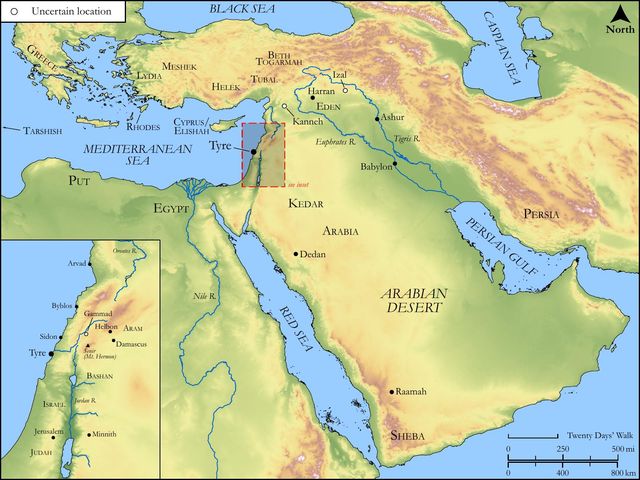
See on the biblical-era map
Study this verse
Public-domain commentary
Matthew Henry
From his Commentary on the Whole Bible. Henry wrote on whole passages, and this entry covers Ezekiel 28:11–19. He set out his notes in a four-level outline, kept here as he numbered it.
As after the prediction of the ruin of Tyre (ch. 26) followed a pathetic lamentation for it (ch. 27), so after the ruin of the king of Tyre is foretold it is bewailed.
I.This is commonly understood of the prince who then reigned over Tyre, spoken to, Ezekiel 28:2.
His name was Ethbaal, or Ithobalus, as Diodorus Siculus calls him that was king of Tyre when Nebuchadnezzar destroyed it. He was, it seems, upon all external accounts an accomplished man, very great and famous; but his iniquity was his ruin. Many expositors have suggested that besides the literal sense of this lamentation there is an allegory in it, and that it is an allusion to the fall of the angels that sinned, who undid themselves by their pride. And (as is usual in texts that have a mystical meaning) some passages here refer primarily to the king of Tyre, as that of his merchandises, others to the angels, as that of being in the holy mountain of God. But, if there be any thing mystical in it (as perhaps there may), I shall rather refer it to the fall of Adam, which seems to be glanced at, Ezekiel 28:13. Thou hast been in Eden the garden of God, and that in the day thou wast created.
II.Some think that by the king of Tyre is meant the whole royal family, this including also the foregoing kings, and looking as far back as Hiram, king of Tyre. The then governor is called prince (Ezekiel 28:2); but he that is here lamented is called king. The court of Tyre with its kings had for many ages been famous; but sin ruins it. Now we may observe two things here: -
1.What was the renown of the king of Tyre. He is here spoken of as having lived in great splendour, Ezekiel 28:12-15. He as a man, but it is here owned that he was a very considerable man and one that made a mighty figure in his day.
(1.)He far exceeded other men. Hiram and other kings of Tyre had done so in their time; and the reigning king perhaps had not come short of any of them: Thou sealest up the sum full of wisdom and perfect in beauty. But the powers of human nature and the prosperity of human life seemed in him to be at the highest pitch. He was looked upon to be as wise as the reason of men could make him, and as happy as the wealth of this world and the enjoyment of it could make him; in him you might see the utmost that both could do; and therefore seal up the sum, for nothing can be added; he is a complete man, perfect in suo genere - in his kind.
(2.)He seemed to be as wise and happy as Adam in innocency (Ezekiel 28:13): "Thou hast been in Eden, even in the garden of God; thou hast lived as it were in paradise all thy days, hast had a full enjoyment of every thing that is good for food or pleasant to the eyes, and an uncontroverted dominion over all about thee, as Adam had." One instance of the magnificence of the king of Tyre is, that he outdid all others princes in jewels, which those have the greatest plenty of that trade most abroad, as he did: Every precious stone was his covering. There is a great variety of precious stones; but he had of every sort and in such plenty that besides what were treasured up in his cabinet, and were the ornaments of his crown, he had his clothes trimmed with them; they were his covering. Nay (Ezekiel 28:14), he walked up and down in the midst of the stones of fire, that is, these precious stones, which glittered and sparkled like fire. His rooms were in a manner set round with jewels, so that he walked in the midst of them, and then fancied himself as glorious as if, like God, he had been surrounded by so many angels, who are compared to a flame of fire. And, if he be such an admirer of precious stones as to think them as bright as angels, no wonder that he is such an admirer of himself as to think himself as great as God. Nine several sorts of previous stones are here named, which were all in the high priest's ephod. Perhaps they are particularly named because he, in his pride, used to speak particularly of them, and tell those about him, with a great deal of foolish pleasure, "This is such a precious stone, of such a value, and so and so are its virtues." Thus is he upbraided with his vanity. Gold is mentioned last, as far inferior in value to those precious stones; and he used to speak of it accordingly. Another thing that made him think his palace a paradise was the curious music he had, the tabrets and pipes, hand-instruments and wind-instruments. The workmanship of these was extraordinary, and they were prepared for him on purpose; prepared in thee, the pronoun is feminine - in thee, O Tyre! or it denotes that the king was effeminate in doting on such things. They were prepared in the day he was created, that is, either born, or created king; they were made on purpose to celebrate the joys either of his birthday or of his coronation-day. These he prided himself much in, and would have all that came to see his palace take notice of them.
(3.)He looked like an incarnate angel (Ezekiel 28:14): Thou art the anointed cherub that covers or protects; that is, he looked upon himself as a guardian angel to his people, so bright, so strong, so faithful, appointed to this office and qualified for it. Anointed kings should be to their subjects as anointed cherubim, that cover them with the wings of their power; and, when they are such, God will own them. Their advancement was from him: I have set thee so. Some think, because mention was made of Eden, that it refers to the cherub set on the east of Eden to cover it, Genesis 3:24. He thought himself as able to guard his city from all invaders as that angel was for his charge. Or it may refer to the cherubim in the most holy place, whose wings covered the ark; he thought himself as bright as one of them.
(4.)He appeared in as much splendour as the high priest when he was clothed with his garments for glory and beauty: "Thou wast upon the holy mountain of God, as president of the temple built on that holy mountain; thou didst look as great, and with as much majesty and authority, as ever the high priest did when he walked in the temple, which was garnished with precious stones (2 Chronicles 3:6), and had his habit on, which had precious stones both in the breast and on the shoulders; in that he seemed to walk in the midst of the stones of fire." Thus glorious is the king of Tyre; at least he thinks himself so.
2.Let us now see what was the ruin of the king of Tyre, what it was that stained his glory and laid all this honour in the dust (Ezekiel 28:15): "Thou wast perfect in thy ways; thou didst prosper in all thy affairs and every thing went well with thee; thou hadst not only a clear, but a bright reputation, from the day thou wast created, the day of thy accession to the throne, till iniquity was found in thee; and that spoiled all." This may perhaps allude to the deplorable case of the angels that fell, and of our first parents, both of whom were perfect in their ways till iniquity was found in them. And when iniquity was once found in him it increased; he grew worse and worse, as appears (Ezekiel 28:18): "Thou hast defiled thy sanctuaries; thou hast lost the benefit of all that which thou thoughtest sacred, and in which, as in a sanctuary, thou thoughtest to take refuge; these thou hast defiled, and so exposed thyself by the multitude of thy iniquities." Now observe,
(1.)What the iniquity was that was the ruin of the king of Tyre.
[1.]The iniquity of his traffic (so it is called, Ezekiel 28:18), both his and his people's, for their sin is charged upon him, because he connived at it and set them a bad example (Ezekiel 28:16):By the multitude of thy merchandise they have filled the midst of thee with violence, and thus thou hast sinned. The king had so much to do with his merchandise, and was so wholly intent upon the gains of that, that he took no care to do justice, to give redress to those that suffered wrong and to protect them from violence; nay, in the multiplicity of business, wrong was done to many by oversight; and in his dealings he made use of his power to invade the rights of those he dealt with. Note, Those that have much to do in the world are in great danger of doing much amiss; and it is hard to deal with many without violence to some. Trades are called mysteries; but too many make them mysteries of iniquity.
[2.]His pride and vain-glory (Ezekiel 28:17): "Thy heart was lifted up because of thy beauty; thou wast in love with thyself, and thy own shadow. And thus thou hast corrupted thy wisdom by reason of the brightness, the pomp and splendour, wherein thou livedst." He gazed so much upon this that it dazzled his eyes and prevented him from seeing his way. He appeared so puffed up with his greatness that it bereaved him both of his wisdom and of the reputation of it. He really became a fool in glorying. Those make a bad bargain for themselves that part with their wisdom for the gratifying of their gaiety, and, to please a vain humour, lose a real excellency.
(2.)What the ruin was that this iniquity brought him to.
[1.]He was thrown out of his dignity and dislodged from his palace, which he took to be his paradise and temple (Ezekiel 28:16): I will cast thee as profane out of the mountain of God. His kingly power was high as a mountain, setting him above others; it was a mountain of God, for the powers that be are ordained of God, and have something in them that is sacred; but, having abused his power, he is reckoned profane, and is therefore deposed and expelled. He disgraces the crown he wears, and so has forfeited it, and shall be destroyed from the midst of the stones of fire, the precious stones with which his palace was garnished, as the temple was; and they shall be no protection to him.
[2.]He was exposed to contempt and disgrace, and trampled upon by his neighbours: "I will cast thee to the ground (Ezekiel 28:17), will cast thee among the pavement-stones, from the midst of the precious stones, and will lay thee a rueful spectacle before kings, that they may behold thee and take warning by thee not to be proud and oppressive." [3.] He was quite consumed, his city and he in it: I will bring forth a fire from the midst of thee. The conquerors, when they have plundered the city, will kindle a fire in the heart of it, which shall lay it, and the palace particularly, in ashes. Or it may be taken more generally for the fire of God's judgments, which shall devour both prince and people, and bring all the glory of both to ashes upon the earth; and this fire shall be brought forth from the midst of thee. All God's judgments upon sinners take rise from themselves; they are devoured by a fire of their own kindling. [4.] He was hereby made a terrible example of divine vengeance. Thus he is reduced in the sight of all those that behold him (Ezekiel 28:18): Those that know him shall be astonished at him, and shall wonder how one that stood so high could be brought so low. The king of Tyre's palace, like the temple at Jerusalem, when it is destroyed shall be an astonishment and a hissing, 2 Chronicles 7:20, 2 Chronicles 7:21. So fell the king of Tyre.
Historical interpretation
Historical reception
4 surviving comments on this verse. Each one is dated, so this reads as a timeline rather than a list.
(Verse 35, 36, and following) And I will bring you into a desert of peoples, and there I will judge you face to face. Just as I contended with your fathers in the desert of the land of Egypt, so I will judge you, says the Lord. And I will subject you to my scepter, and I will bring you into the bonds of the covenant, and I will choose from among you the transgressors and the wicked: from their place of residence I will bring them out, and they will not enter the land of Israel, and you will know that I am the Lord. Thus says the Lord: I will do for you who are in Babylon, and now serve idols, what I did for your ancestors in Egypt. I will lead you into the desert of the peoples, and there I will judge you face to face, just as I contended with them in judgment when they came out of Egypt. And after I have judged you, I will subject you to my scepter and rule, and I will make a covenant with you and bring you into your land with the bonds of love, so that bound by my love, you will never be able to depart from me. But I will choose from among you the transgressors and the wicked, who persist in the hardness of their hearts in evil deeds, not for possession, but for rejection. And I will indeed bring them out of the land of their dwelling, so that when they are brought out, they will not enter the land of Israel; but they will perish in various regions. And by the distinction between good and evil, you shall know that I am the Lord, who judges all things. The rest of the discourse hastens, and we briefly go through each point, in order to provide only the meaning to the readers.
(Vers. 11 seqq.) And the word of the Lord came to me, saying: Son of man, raise a lamentation over the king of Tyre, and say to him: Thus says the Lord God: You were the signet of perfection, full of wisdom and perfect in beauty. You were in Eden, the garden of God; every precious stone was your covering: carnelian, topaz, and jasper, chrysolite, onyx, and beryl, sapphire, carbuncle, and emerald. Gold was the workmanship of your settings and your engravings; on the day that you were created they were prepared. You, Cherub, stretched out and protecting, I placed you on the holy mountain of God. You walked among the fiery stones; you were perfect in your ways from the day of your creation until iniquity was found in you. Your heart was filled with iniquity in the multitude of your trading, and you sinned. Therefore, I cast you out from the mountain of God and destroyed you, O Cherub protecting amidst the fiery stones. Your heart was lifted up because of your beauty; you corrupted your wisdom by reason of your splendor. Therefore, I cast you down to the ground. I set you before kings, that they might gaze at you. In the multitude of your iniquities and the injustice of your trading, you have defiled your sanctification. Therefore, I will bring forth fire from your midst that will consume you, and I will turn you into ashes upon the earth in the sight of all who see you. All who see you among the nations will be astonished at you. You have become nothing and will be no more forever. LXX: And the word of the Lord came to me, saying: Son of man, take up a lamentation over the prince of Tyre and say to him: Thus says the Lord God: You were the seal of likeness, full of wisdom and adorned with the crown of beauty; you were in the delights of the paradise of God. You are surrounded by every good gemstone: sardius and topaz, and emerald, and carbuncle, and sapphire, and jasper, and silver, and gold, and ligure, and agate, and amethyst, and chrysolite, and beryl, and onyx, and you have filled your treasuries with gold and your storehouses with silver. From the day you were created, you were prepared with the anointed Cherub from God, and dwelling in the tabernacle, I have given you on the holy mountain of God. You have become in the midst of fiery stones. You were blameless in your days, from the day you were created; until iniquities were found in you, you filled your storehouses with iniquity from the abundance of your trade, and you sinned and were wounded by the mountain of God, and the cherub who overshadowed you led you out of the midst of the fiery stones. Your heart was lifted up because of your beauty; your wisdom was corrupted by your splendor. Because of your many sins, I cast you to the ground; I made you a spectacle before kings, that you might be dishonored. Because of the multitude of your sins and the iniquities of your trade, you have defiled your holy places. And I will bring forth fire in your midst; it will devour you. And I will make you like ashes on the earth in the sight of all who see you, and all who know you among the nations will be dismayed over you. You have become a ruin, and you will never be again. For we have declared what the prince of Tyre is and how he has fallen because of his pride, let us know his lamentations over his former glory. First, let it be agreed what it was, so that he may regret having lost what he had. 'You,' he says, 'are the seal of likeness;' according to that, which John the Evangelist rightly says about the Savior: 'For this God has sealed, the Father' (John 6:27). And about men: 'He has sealed, because God is true' (John 3:33). And in the Psalms: 'The light of your face, O Lord, has been sealed upon us' (Psalm 4:7). And in another place: 'Beloved, now we are children of God, and it has not yet appeared what we shall be.' We know that when he appears, we shall be like him. (1 John 3:2) That is why it is said to God: Who will be like you? (Psalm 35:10) For similarity is one thing, equality is another. Therefore, the most savage heresy is the one that confesses only the Father's similarity in Christ and takes away his nature. But we not only say similarity in the Son, but also equality. That is why the Jews persecuted him: because he not only broke the Sabbath, but also made himself equal to God. (John 5) But where there is equality, there is the same nature and one substance. This is what the Apostle speaks of regarding similarity: My little children, for whom I am again in the pains of childbirth until Christ is formed in you (Galatians 4:19), so that you may receive, namely, his likeness, which you have lost through your own fault. And because in Latin codices the word for sign or seal is read as "resignaculum", expressing word for word the Greek word κακοζήλως, which is interpreted according to the Septuagint translation as ἀποσφράγισμα, that is, seal or sign. Some people understand it in this way, that the seal of God and the image which was as if expressed in the softest wax, the king of Tyre erased and lost, so that he made a reseal, not having the image and likeness of God, according to which the first man was created, as God says: Let us make man in our image and likeness (Genesis 1:26). And it should be noted that the image was only made then, and the likeness is fulfilled in Christ's baptism. And accordingly, to her to whom it has been said: You are a likeness of the seal, is joined, full of wisdom, perfect in beauty, or, a crown of glory. For where the likeness of God is, there is also the fullness of wisdom, and perfect beauty, or as a crown adorned with different flowers, and composed of virtues, which the diligent increases by his own efforts, while the industry nourishes the good of nature, and the negligent diminishes it, according to what is said in Proverbs under the figure of a beautiful and ill-mannered woman: As a ring of gold in a swine's snout, so is a fair woman without discretion (Prov. XI, 22). It follows: In the delights of the paradise of God, you were: for which reason it is called Eden in Hebrew, which also the history of Genesis narrates. Eden, however, is translated into delights. And beautifully it is named paradise of God to distinguish it, so as to show that there is a contrary paradise not of God, among those who change the truth into lying (Rom. 1), and boast of having a paradise. By this speech he demonstrates, that the one of whom it is written is by no means a human being, but a contrary fortitude, which formerly dwelt in God's paradise: although the Jews estimate prophetically, by that metaphor which is called hyperbole, that it refers to King Hiram of Tyre. But to whom is it said: You were in the delights of the paradise of God, or you have become, it shows what he had, or what he lost. Moreover, what is joined to the habitation of paradise, every precious stone is your covering, or your binding, and encirclement, jasper, topaz, and jasper, chrysolite, and onyx, and beryl, sapphire, and carbuncle, and emerald, or, as in the LXX, in a different order and with other names, twelve stones are contained, this must be observed, not every precious stone surrounded the king of Tyre, or covered, and as Symmachus translated, bound and confined: but every stone that the prince of Tyre had was precious. Moreover, there are many precious stones that Scripture does not mention in this place, such as chalcedony, sardonyx, chrysoprase, hyacinth, crystal, and the most precious pearl. Even Aquila, Symmachus, and Theodotion differ greatly from each other in this place, not only in order, but also in number and names. In the Book of Revelation, where the city of Jerusalem is described as built with living stones, there is a slight change in order towards the end, and the same stones are set in its foundations, so that its gates are inscribed with the light of crystal (Rev. 21). But also in the breastplate of the high priest, through the four rows in the Rational (Exod. 28), the same stones are described, and on his shoulders two onyx stones, on which are written the names of the twelve patriarchs, which the true high priest, of whom it is written: You are a priest forever according to the order of Melchizedek (Ps. 110:4), carries on his breast, carries on his shoulders, in order to represent the number of the twelve stones of the apostles; and in the two sacraments of both Testaments, one of which John the Evangelist leaned on his breast, in order to drink from the streams of wisdom, and could say: In the beginning was the Word, and the Word was with God, and the Word was God. He was in the beginning with God (John 1:1-2). These are living stones, from which the Church is built, and about which the Apostle Peter writes: If you have believed, because the Lord is sweet: approaching him, the living stone, indeed rejected by men, but chosen and honored by God, and you yourselves, like living stones, are being built into a spiritual house, a holy priesthood, to offer spiritual sacrifices pleasing to God through Jesus Christ. For the Scripture says (Isa. XXVIII, 16): Behold, I am laying in Zion a cornerstone, chosen and precious, and whoever believes in him will not be put to shame (I Pet. II, 3 et seqq.). Moreover, the vessel of election is united by equal votes, saying: Upon the foundation of the Apostles and Prophets, the corner stone being Christ Jesus Our Lord: in whom all the building, being framed together, groweth up into an holy temple in the Lord (Eph. II, 10). These are the stones of which we read in another place: And the holy stones are rolled over the earth, like wheels (Zach. IX, 16), touching but little the ground, and hastening with their rolling to the heavenly places. Of which the Scripture also speaks: Behold, I will prepare thy carbuncle stone, and thy foundations sapphire, and I will make thy bulwarks jasper, and thy gates crystal, and thy walls precious stones: and all thy children shall be taught of God, and in much peace thy children shall be, and thou shalt be built in justice (Isa. 54:11-13). Concerning which, we have explained in the interpretations of the same prophet. The twentieth Psalm sings of stones of this kind: The king shall rejoice in thy strength, O Lord; and in thy salvation he shall greatly rejoice. Thou hast given him his heart's desire, and hast not withholden from him the will of his lips. For thou hast prevented him with blessings of sweetness: thou hast set on his head a crown of precious stones (Psalm XX. 1 seq.). These are the pearls of the prophets and apostles, which, in comparison with Christ, are all sold in the Gospel (Matthew XIV), that the most precious pearl may be bought, and the stone of which Zacharias writes, which has seven eyes, that is, the seven graces of the Holy Spirit (Zach. III and IV). Read Isaiah. And it is placed by the apostle Paul as the foundation of the Church, upon which gold, silver, and precious stones are built (I Cor. III): the colors, natures, and efficacies of each of which are not to be discussed in this time; but they desire a separate volume: so that in Ezekiel, and in Exodus, and in Revelation, and in Isaiah, all the stones and orders of stones compared to each other make a great question for both the reader and the discussant. Super quibus et vir sanctus Epiphanius episcopus proprium volumen mihi praesens tradidit. Et XXXVII liber Plinii Secundi, Naturalis Historiae, post multiplicem omnium rerum scientiam, de gemmis et lapidibus disputat. Ad quorum notitiam diligens à nobis mittendus est lector. Porro Symmachi interpretatio, istum principem Tyri, quasi pretiosissimum monile lapidibus scribit esse distinctum. Denique auri tympanum vocat, in quo infixi sint lapides. And according to the Hebrew, it follows: Gold is the work of your adornment, and your holes are prepared on the day you were buried. For this reason, the Septuagint says: You filled your treasuries and storehouses with gold, reflecting the understanding and intention that his thoughts have revealed in divine sacraments, and he has gathered for himself spiritual riches, about which the Lord commanded: Store up treasures for yourselves in heaven, where neither rust nor moth destroys, nor thieves dig and steal. For where your treasure is, there also will your heart be. This is the hidden treasure, of which he also speaks in the Gospel: The kingdom of heaven is like a treasure hidden in a field, which a man having found, hid it, and for joy thereof goeth, and selleth all that he hath, and buyeth that field. But the apothecae, or storehouses, are those of which it is written elsewhere: Blessed shall be thy barns and rich thy tables. After this, it is said, according to the Hebrew: 'You are the stretched out and protecting Cherub, with the ark of God and the propitiatory beneath it,' or, according to the Septuagint, that he himself, anointed and created, was with the Cherub. From this it is shown that this does not pertain to a human prince of the city of Tyre, but rather to the once holy and eminent strength that was placed as prince of the city of Tyre. And I have set you, he says, on the holy mountain of God; without a doubt, this signifies paradise, to which Paul the Apostle says he was caught up after the third heaven (1 Corinthians 12). But the cherub, of the male gender, is called in the singular number: and in the plural number they are called cherubim, which are interpreted as a multitude of knowledge. God rests and sits upon them, and uses this chariot, as the prophet says: You who sits upon the cherubim, manifest yourself (Ps. 79:2). And in another place: He ascended upon the cherubim, and flew; he flew upon the wings of the wind (Ps. 18:11). This cherub, or creature with cherub, extended and protecting the sacraments, is placed on the holy mountain of God, as we have often said. And the Apostle Paul speaks, if anyone receives the Epistle to the Hebrews: You have come to Mount Zion and the city of the living God, the heavenly Jerusalem, and to thousands of angels (Heb. XII, 22). Or certainly the holy mountain of God, as we have said, is to be understood as a paradise. He also walked among fiery stones, of which it is written: He makes His angels spirits, and His ministers a burning fire (Ps. CIII, 4). And not only God, who is called consuming fire, consumes hay, wood, and straw (Deut. IV): but also the angels, who are called fiery stones, and fervent in spirit. Hence the Lord says: I came to cast fire upon the earth, and what do I desire but that it be kindled (Luke XII). And what follows: You are perfect in your ways from the day of your creation (in the Septuagint: You were blameless in your days, from the day you were created), until iniquity was found in you, shows that every creature, created good by God, had perfect virtue, and that even the prince of Tyre was blameless, so that sin is not a part of nature, but of will. Until iniquity was found in you. Iniquity invented by God, which was kept enclosed in the treasure chests of your heart through pride and the abuse of power that you had received. Also, the inner chambers, or storehouses, of his wickedness were filled with a multitude of his dealings. For while he sought after many things and was not satisfied with the knowledge he had gained, nor with the power he had been given, he filled the storehouses and inner chambers of his heart so that, being satiated and made fat, he kicked against his Creator. For Jacob ate, and was satisfied, and the beloved one rebelled, becoming fat and sleek, and enlarged, and forsaking the God who made him (Deut. XXXII, 15). And from the heart come evil thoughts (Matth. XV, 19): because of which God says: You have sinned, and I have cast you out from the mountain of God, or you have been wounded by the mountain of God, which we who read are compelled to fear. For if the Cherub extended and protecting, placed on the holy mountain of God, and in the midst of fiery stones, perfect and immaculate, filled his interior with iniquity because of the abundance of trade, and sinned, and was cast out from the mountain of God, that is, from the dwelling of paradise, or wounded by the mountain of God, which clearly refers to Christ, or certainly wounded by the mountain of God, established and dwelling in himself, he is pricked in conscience by evil, while he realizes himself unworthy of the habitation of the mountain: what, then, is to be said of us? Therefore he says to him: 'And I have destroyed you, Cherub, protecting you from the midst of burning stones, so that you would not remain among the burning stones, but perish. O Cherub himself, or Cherubim, who protected you, I have brought you out from the midst of burning stones, according to what is also written about Adam: He drove out Adam, and stationed him (or Cherubim) opposite the paradise of delights (Gen. III, 24). And he gives the reasons why he was brought out, or cast out, from the midst of burning stones.' For your heart has been lifted up in your beauty, thinking that what is God's is yours. Therefore, the apostle says that he received a thorn in the flesh and an angel of Satan to buffet him, so that he would not be exalted by the greatness of his revelations and fall into the judgment of the devil (2 Corinthians 12). And so, your doctrine is corrupted, he says, along with your beauty, or you have lost your wisdom in your beauty. While you desire to be more than what you were created to be and to know more than what you have received from God, you have even lost what you had, and deformity and foolishness have possessed you instead of beauty and knowledge. Therefore, you have been cast down to the earth, you who once dwelled on the mountain of God. About which Isaiah writes: How has Lucifer fallen, who used to rise in the morning (Isa. XIV, 12)? And the Savior in the Gospel says: I saw, he said, Satan falling like lightning from heaven (Luke X). This is also what Jeremiah speaks to Jerusalem. How has the Lord darkened the daughter of Zion in His anger: He has cast down from heaven to earth the glory of Israel (Lamentations II, 1)? But you have been cast down in the sight of all kings, to terrify them by your example, either of good kings, whose heart is in the hand of God (Prov. XXI), or of evil ones, whose kingdoms the devil showed to the Savior (Matt. IV): who encountered the Babylonian king, saying: And you have been captured like us, and considered among us. Therefore, he defiled his sanctification which he had when he dwelt on the mountain and conversed among the burning stones. It follows: I will bring fire in the midst of you which shall devour you. This fire was kindled in the heart of the king of Tyre by him whose arrows are kindled, as it is written: All those who commit adultery are like an oven, their hearts (Hosea). About this fire, Isaiah also speaks: Walk in the light of your fire, and in the flame you have kindled (Isaiah 50), so that when you go out, it may devour the possessor, according to what is written in the same Isaiah: It consumed like the grass the fuel (Isaiah 5). On that day the mountains and hills and forests will be extinguished, and it will devour from soul to flesh. This fire, which is called alien, Nadab and Abihu offered to the altar of the Lord, and for this reason they were consumed by divine fire (Leviticus 10). Hence Moses says: This is the word that the Lord spoke: In those who approach me, I will sanctify myself. But the sanctification of God is the punishment of sinners. After this it is said: And I will turn you into ashes, so that all that you have built will be consumed by the fire of your guilty conscience. When you should have rested on the Sabbath, and should not have done any servile work, you gathered wood on the Sabbath so that you would have something to fuel the fire in your heart. He will also destroy all evil works, reducing them to ashes, so that the harmful fire may be completely extinguished, so that all may see and marvel at the destruction of the king of Tyre, and that it has become nothing, not for many centuries, but in one instant, or certainly forever, so that what is written may be fulfilled: I will not spare you, and I will not have pity. The Hebrews, among their other fables and genealogies and endless questions, are accustomed to understand these words against Hiram, king of Tyre, when they say that from Solomon to Ezekiel there are many years, which it is obvious that men did not live at that time: and thus they pronounce, as if the prophet spoke to him ironically: Are you the seal of the likeness of God, full of wisdom and perfect in beauty? You are adorned with all precious stones, you are a cherub, or created with a cherub: whereas in reality you have sinned, and you will be dissolved into ashes. And they add to their story a miracle, that contrary to Scripture, indeed without the authority of Scripture, they say that Hiram lived for a thousand years. But how violent this interpretation is, a prudent reader understands without our judgment.
Lord, who shall sojourn in your tent? … The tent seems to me to be the church of this world. Now the churches that you see are tabernacles, for we are not here as permanent dwellers but rather as those about to migrate to another place. If “this world as we see it is passing away,” and it says elsewhere that “heaven and earth will pass away,” if, then, heaven and earth will pass away, how much more will the stones of the churches that we see also pass away? Now that is why churches are tabernacles, because we are going to migrate from them to the holy mountain of God. What is this holy mountain of God? It says in Ezekiel against the prince of Tyre, “You have been cut off as one slain from the mountain of God.”
(Verse 27, 29 onwards) Therefore speak to the house of Israel, son of man, and tell them: Thus says the Lord God: Moreover, your fathers have blasphemed against me and have treated me with contempt, even as they spurned me. And I brought them into the land that I had lifted my hand to give them ((Vulgate adds: that land)): they saw every high hill and every leafy tree, and there they offered their sacrifices and presented there the irritation of their offerings, and they placed there the fragrance of their sweetness, and they poured out their ((Vulgate is silent on this)) libations there. And I said to them, 'What is the high place to which you are going?' And its name was called the High Place until this day. Therefore speak to the house of Israel, son of man, and say to them, 'Thus says the Lord God: As for your fathers, they have provoked Me to anger by their iniquities, by the fact that they have fallen away from Me. So I brought them into the land that I had lifted My hand in an oath to give them.' They saw every high hill and every leafy tree, and there they offered their sacrifices. They also presented there the provocation of their gifts, and they set there their pleasing aroma, and they poured out there their drink offerings. And I said to them: What is abbana, because you enter there? And they called its name abbana until this day. I wanted, he said, to scatter them in the wilderness, and to give them not good precepts, so that they would sacrifice to idols what they should have offered to me, and consecrate all their first-fruits to them by fire, so that I might kill them and destroy them. But when he says, I wanted, he shows that he did not do what he wanted. And that which follows: 'And they shall know that I am the Lord,' is not found in the Septuagint. For it did not seem fitting to them to know after their destruction that he himself is the Lord. But you, son of man, speak again to them, that is, to the elders of the house of Israel, who have come to inquire of you: Your fathers, from whom you have descended, have also blasphemed against me and held me in contempt; after I brought them into the land which I had given them to possess, they turned against me to provoke me. For when they saw every high hill and leafy tree, they would sacrifice on the mountains and in the groves and thickets, and offer victims to the idols, and pour out libations. And when I saw this, I said to them: What is this, Bama? for it is called high: or why do you enter into such a place which you have chosen for yourselves in all the hills, so that even today these places are called Bamoth, and the ancient error retains its original name? Regarding Bama, which we translate as excelsum, there is an error in the Septuagint edition, where it is written as ἀββανὰ, which does not resonate in the Hebrew language. Bama can mean 'in which' if the two syllables are divided into two words, but in the present context, that sense does not fit. However, wherever it is written in the Books of Kings and Chronicles: 'The people still sacrificed and offered incense on the high places,' Bama in the singular and Bamoth in the plural mean 'high places.'
Continue studying Ezekiel 28:16 across the web’s major study libraries — every link below opens this exact verse, chapter, or book on the destination site.
Read & Compare
 BibleGatewayThis verse in more than 200 translations and 70 languages.
 Bible.comThe YouVersion reader — hundreds of translations, reading plans, and highlights.
 ESV.orgCrossway's official English Standard Version reader.
 NET BibleThe NET translation with 60,000+ translators' notes on every rendering decision.
 STEP BibleTyndale House's free study tool — original text, vocabulary, and scholarly resources.
 BibliaLogos Bible Software's free web reader.
 USCCBThe New American Bible (Revised Edition) with the U.S. bishops' study notes.
Commentaries
 BibleHub CommentariesDozens of classic commentaries on this verse, gathered on one page.
 StudyLightMore than 100 commentary sets — the largest collection on the web.
 BibleRefPlain-English commentary on what this verse means, verse by verse.
 Enduring WordDavid Guzik's free commentary on this chapter, widely used by Bible teachers.
 Bible Study ToolsVerse commentary alongside Greek and Hebrew study aids.
Original Language & Research
- BibleHub InterlinearThe verse word by word — original language, transliteration, and English.
- BibleHub LexiconEvery word's original-language definition and Strong's entry.
 Blue Letter BibleDeep-study tools — Strong's numbers, concordance, and word studies.
 SefariaThe Hebrew text with Rashi and centuries of Jewish commentary.
Sermons, Hymns & Audio


TrulyRandomVerse is not affiliated with these sites and doesn’t control their content. They’re linked because they’re genuinely useful.
Written with AI assistance. Always check it against Scripture.
This verse
His great trade filled him with violence and he sinned, so God casts him as profane out of the mountain of God and destroys him from among the stones of fire.
“By the multitude of thy merchandise”
The abundance of his trade, Tyre’s great source of wealth and glory.
“they have filled the midst of thee with violence,”
Riches filled him within with violence (châmâç), injustice and oppression. Babylon’s fall in Revelation 18 tells the same story of a trading city’s ruin.
“and thou hast sinned:”
He missed the mark God set (châṭâʼ).
“therefore I will cast thee as profane out of the mountain of God:”
He is treated as common and unholy (châlal) and put out of the holy place where God had set him.
“and I will destroy thee, O covering cherub, from the midst of the stones of fire.”
God addresses him by his old title as he takes away his place.
Passage studyEzekiel 28:11–19
The Lament Over the Fallen King of Tyre
Summary
The word of the LORD comes to Ezekiel with a lament, a funeral song, for the king of Tyre. God describes this king as he was made: full of wisdom and perfect in beauty, in Eden the garden of God, covered with precious stones, the anointed cherub set on the holy mountain of God, perfect in his ways from the day he was created. Then iniquity was found in him. His great trade filled him with violence, his heart was lifted up because of his beauty, and his splendour corrupted his wisdom. So God casts him out of the mountain of God, throws him to the ground before kings, brings a fire out from within him that burns him to ashes, and makes him a terror that shall be gone for ever. In these nine verses we learn that every gift a creature has comes from God, that pride turns those gifts into the creature’s ruin, and that God brings down the proud however high they stand.
Who is the king of Tyre?
The lament is addressed to the ruler of Tyre, the rich Phoenician sea port on the Mediterranean coast in what is now Lebanon, and its language reaches far past any earthly king. The first half of the chapter, Ezekiel 28:1–10, condemns the “prince” of Tyre (nâgîyd) for his pride and his claim to be divine. He had said, “I am a God, I sit in the seat of God, in the midst of the seas” (Ezekiel 28:2). Verse 12 turns to the “king” (melek), and from there the words go back to Eden, to a cherub, to the holy mountain of God and to the day this one was created. Believers differ on how to read this, and both readings are held by people who take every word as God’s.
On either reading the lesson is the same. A creature received glory from God, turned it to his own honour, and was brought down by the God who gave it. Tyre made the lament fitting. It was the great trading power of its world, famous for its wealth, its ships, its craftsmen and its island fortress, and its rulers felt self-sufficient and secure. Ezekiel spoke to the Jewish exiles in Babylon, from about 593 to 571 BC, and his words against nations such as Tyre warned God’s people against taking on the pride of the nations and showed that the LORD rules over all of them.
The word of the LORD comes as a funeral song
Verse 11 opens with the words Ezekiel uses again and again, “the word of the LORD came unto me, saying”. Other prophets open their messages the same way (Jeremiah 1:4, Hosea 1:1). The word dâbâr means a word or speech, and in other places a matter or thing. Yᵉhôvâh is God’s covenant name, the name of the God of Israel who keeps his promises, which the KJV prints as “LORD”. The verb ʼâmar, “saying”, is the ordinary word for saying, telling or commanding, and here it brings in what God said. The formula marks a new message, distinct from the one in verses 1 to 10, and it tells us where the message came from. That mattered in Israel, because God had warned that a prophet who spoke in his name what he had not commanded would die, and that a true word would be known by its coming to pass (Deuteronomy 18:20–22). Ezekiel speaks with God’s authority, as all Scripture does: “All scripture is given by inspiration of God” (2 Timothy 3:16).
God calls Ezekiel “Son of man”, ben-adam, the name he uses for the prophet all through the book, which marks Ezekiel as a mortal man carrying God’s word. He is told to “take up a lamentation”, a qîynâh. This was the funeral song Israel sang to mourn the dead or the fall of a city, a nation or a ruler. Ezekiel is to sing it over a king who is still alive and at the height of his power, which declares that his fall is as good as done. The message carries the seal “Thus saith the Lord GOD”, ʼĂdônây Yᵉhôvih, the sovereign Lord who has the right to pass sentence.
“Thou sealest up the sum”
The song opens with praise. The words “Thou sealest up the sum” (Hebrew chotem tokneeth) are among the hardest in the passage, and their meaning has long been debated. The verb châtham means to close up or seal, and the noun toknîyth means a pattern, a measure or a full sum. Together they picture the king as the seal set on a finished pattern, the completed model of what God designed, and so the phrase is often given as “the seal of perfection”.
Two phrases fill it out. He was “full of wisdom”, where mâlêʼ means full and chokmâh is wisdom and skill. He was “perfect in beauty”, where kâlîyl means complete or whole, the same word used of a sacrifice burned entirely, and yŏphîy is beauty. His wisdom filled him and his beauty lacked nothing.
All this praise sits inside a funeral song, and that gives it its weight. The higher he stood, the further he fell. Verse 17 will say that this very beauty lifted up his heart and that his brightness corrupted this very wisdom.
In Eden, covered with every precious stone
“Thou hast been in Eden the garden of God” places this one in ʻÊden, the garden God planted as the home of Adam (Genesis 2:8), a place of beauty and of God’s presence at the very beginning. To have been there is to have had the highest privilege a creature could have.
“Every precious stone was thy covering”. The word mᵉçukkâh means a covering or adornment, like an outer garment. Nine stones are named, the sardius, topaz, diamond, beryl, onyx, jasper, sapphire, emerald and carbuncle, and gold besides. Such stones were highly prized and belonged to royalty and to sacred things. Stones like these were set in the breastplate of Israel’s high priest, each carrying the name of a tribe of Israel before God (Exodus 28:15–21). Tyre was known for its luxury goods and its skilled artisans, so its people would have felt the force of the picture, though the splendour described here goes far past any king’s regalia. It is glory given by God.
“The workmanship of thy tabrets and of thy pipes was prepared in thee in the day that thou wast created.” Tabrets (tôph) are tambourines or hand drums, and pipes (neqeb) are wind instruments, perhaps flutes. As the KJV renders it, the skill of music was built into this one from the start, and many see in it a calling to praise God, perhaps even to lead the worship of heaven. Whatever the exact sense, the closing words settle the main point. He had all this “in the day that thou wast created”. The verb is bârâʼ, to create, and it marks him as a creature that God brought into being. Every jewel and every gift was something he received.
The anointed cherub that covereth
“Thou art the anointed cherub that covereth; and I have set thee so”. A cherub (kᵉrûwb) is a winged heavenly creature, a sign of God’s majesty that belongs with his presence. After Adam was sent out of Eden, God placed cherubims to guard the way to the tree of life (Genesis 3:24), and two cherubim of gold spread out their wings “covering the mercy seat” over the ark (Exodus 25:20). “Anointed” translates mimshach, which comes from a root meaning to spread out, so it can picture outspread wings as well as a setting apart for a special task. “That covereth”, çâkak, means to screen, cover over or protect, the work of a guardian whose wings overshadow the place where God is.
“And I have set thee so” makes the source of all this plain. God placed him there. His rank, his power and his nearness to God came by God’s appointment, as gifts.
“Thou wast upon the holy mountain of God” puts him where God dwells and his glory rests. “Thou hast walked up and down in the midst of the stones of fire” uses hâlak, the everyday verb for walking, which here pictures free coming and going, the movement of one who belongs there. The stones of fire (ʼeben, stone, and ʼêsh, fire) are bright and blazing like jewels, recalling the stones of the high priest’s breastplate and the splendour around God’s throne. When Moses and the elders of Israel saw the God of Israel, “there was under his feet as it were a paved work of a sapphire stone” (Exodus 24:10).
Those who read the passage of Satan see him here before his fall, and they set it beside the war in heaven, when “the great dragon was cast out, that old serpent, called the Devil, and Satan” (Revelation 12:7–9). On that reading the verse also shows why Paul says that “we wrestle not against flesh and blood, but against principalities, against powers” (Ephesians 6:12). The enemy of God’s people was once a magnificent creature, and he is still a creature under God’s rule.
Perfect until iniquity was found
“Thou wast perfect in thy ways from the day that thou wast created, till iniquity was found in thee.” The word for perfect, tâmîym, means complete, whole, sound and without blemish, and of people it means blameless or upright. “In thy ways” means in his conduct. From the day God created him (bârâʼ, the same verb as in verse 13) he was blameless, a creature whole and upright as God made him. His was the perfection of a creature, and it had a beginning, “the day that thou wast created”.
Then “iniquity was found in thee”. The word ʻevel means wrong, injustice or iniquity. The verb mâtsâʼ means to find, and “was found” tells us the wrong came to light in him after he was made. This verse is one of the plainest in Scripture on where evil began. God made this creature good, and the iniquity arose within the creature. The guilt was his own. James says the same of every sinner: “Let no man say when he is tempted, I am tempted of God: for God cannot be tempted with evil, neither tempteth he any man: But every man is tempted, when he is drawn away of his own lust, and enticed. Then when lust hath conceived, it bringeth forth sin” (James 1:13–15).
People ask how a creature made perfect could sin at all. The passage answers with what it names. The perfection was a gift held by a creature, and verse 17 tells us what grew in him: “Thine heart was lifted up because of thy beauty”. He looked at the gift and forgot the Giver. Scripture tells us that much about the first sin, and it is enough to show that God is the source of all that is good and the creature is answerable for its own wrong.
How the fall came: wealth, violence and pride
“By the multitude of thy merchandise”
Verse 16 names what filled him: “By the multitude of thy merchandise they have filled the midst of thee with violence, and thou hast sinned”. The word rôb means multitude or abundance, rᵉkullâh means trade or merchandise, and châmâç is violence, a word that covers injustice and oppression as well as bloodshed. Tyre’s ships carried cedar, purple dye, precious metals and luxury goods across the known world, and the riches that came back bred hard and unjust dealing. “Thou hast sinned” is châṭâʼ, which first means to miss a mark, and so to fall short of a standard and to offend.
Verse 18 comes back to the same charge with “the iniquity of thy traffick”, his trading itself grown crooked. The glory of Tyre became the means of its ruin. Revelation tells of the merchants of the earth weeping over fallen Babylon, the city that made them rich (Revelation 18:11–19), and Paul warns that those who will be rich “fall into temptation and a snare”, “For the love of money is the root of all evil” (1 Timothy 6:9–10).
“Thine heart was lifted up”
Verse 17 reaches the root. The heart, lêb, is the inner self, the seat of feeling, will and thought. “Lifted up” is gâbahh, to be high or lofty, and of the heart, to be haughty. His heart rose up “because of thy beauty”, the same beauty that verse 12 praised. “Thou hast corrupted thy wisdom by reason of thy brightness” uses shâchath, to decay, ruin or spoil, and “brightness” (yiphʻâh) means splendour or radiance. The wisdom God gave him was spoiled by the splendour God gave him. He became so taken with his own glory that he turned it to his own honour and lost the wisdom to see things truly.
Scripture says this again and again. “Pride goeth before destruction, and an haughty spirit before a fall” (Proverbs 16:18). “God resisteth the proud, but giveth grace unto the humble” (James 4:6).
Cast down, burned to ashes, and gone for ever
God’s sentence comes in steps, each answering what came before.
Cast out as profane. “Therefore I will cast thee as profane out of the mountain of God”. The word châlal comes from a root meaning to bore or wound, and it means to profane, to treat as common what was holy. The one who stood on the holy mountain is put out of it as unfit to be there. “The mountain of God” joins har, mountain, with ʼĕlôhîym, God, a word plural in form that, when it names the true God, is a plural of majesty. “I will destroy thee, O covering cherub, from the midst of the stones of fire” uses ʼâbad, which means to wander away, to be lost or to perish, and when God is the one acting, to destroy. The cherub loses his place among the stones where he once walked freely.
Thrown down before kings. “I will cast thee to the ground, I will lay thee before kings, that they may behold thee.” The one whose heart was lifted up is thrown down to the lowest place, and his disgrace is public. Kings who might have envied him look on and learn that beauty, wisdom and power give no shelter from God’s judgment.
Burned to ashes from within. “Thou hast defiled thy sanctuaries by the multitude of thine iniquities”. “Defiled” is châlal again, the same verb as “profane” in verse 16. The word miqdâsh means a consecrated place, a sanctuary, whether of the LORD or of idols. Here it may mean Tyre’s own temples, to gods such as Melqart, the Baal of Tyre, and Astarte, defiled by the king’s wickedness, or the holiness that belonged to the king’s person and office, or the holy places where the one addressed once stood. The word for iniquities, ʻâvôn, means perversity and sin, and also the guilt that sin brings, and “multitude” is rôb again. “Therefore will I bring forth a fire from the midst of thee, it shall devour thee”. The fire comes out of him. His own accumulated sin becomes the means of his destruction, and God brings that fire forth. Paul writes, “whatsoever a man soweth, that shall he also reap” (Galatians 6:7–8), Proverbs says the wicked “shall eat of the fruit of their own way” (Proverbs 1:31), and “the wages of sin is death” (Romans 6:23). He is brought “to ashes upon the earth in the sight of all them that behold thee”, ashes being the picture of utter ruin.
An astonishment and a terror. “All they that know thee among the people shall be astonished at thee”. To know, yâdaʻ, here means those who were familiar with him, his allies, his trading partners and all who had watched his power with admiration or fear. They will be shâmêm, a word used of a place left desolate and of people struck with horror and deep shock. “Thou shalt be a terror”, ballâhâh, from a root meaning to alarm, so dread, ruin, an object of horror. The one who once inspired awe becomes the sight that appals. The last words, “never shalt thou be any more”, join ʼayin, nothing or not existing, with ʻad, until, and ʻôwlâm, a long age or eternity. He is gone for ever, and there will be no return to glory. When Babylon falls in Revelation, a mighty angel throws a millstone into the sea and says she “shall be found no more at all” (Revelation 18:21). For those who read the lament of Satan, its last words look ahead to his final end: “the devil that deceived them was cast into the lake of fire and brimstone ... and shall be tormented day and night for ever and ever” (Revelation 20:10).
Christ, who humbled himself
This passage finds its answer in Christ by contrast. The king of Tyre was given glory and lifted his heart up against the God who gave it. Christ, who was God, laid his glory aside: “Who, being in the form of God, thought it not robbery to be equal with God: But made himself of no reputation, and took upon him the form of a servant, and was made in the likeness of men”, and he “humbled himself, and became obedient unto death, even the death of the cross. Wherefore God also hath highly exalted him, and given him a name which is above every name” (Philippians 2:5–9). The proud creature was cast to the ground. The humble Son was raised to the highest place.
The fallen one was full of wisdom and corrupted it by his brightness. Christ is “the power of God, and the wisdom of God” (1 Corinthians 1:24), and he is himself “the brightness of his glory, and the express image of his person” (Hebrews 1:3). The cherub was created, and every jewel he wore was given to him. Christ is “the image of the invisible God”, by whom “were all things created, that are in heaven, and that are in earth” (Colossians 1:15–20). Iniquity was found in the cherub, while Christ “was in all points tempted like as we are, yet without sin” (Hebrews 4:15).
The word of the LORD that came to Ezekiel also points to him. “God, who at sundry times and in divers manners spake in time past unto the fathers by the prophets, Hath in these last days spoken unto us by his Son” (Hebrews 1:1–2), and “the Word was made flesh, and dwelt among us” (John 1:14).
Where the fallen one defiled sanctuaries and was burned to ashes for his iniquities, Christ is “the Lamb of God, which taketh away the sin of the world” (John 1:29). God “hath made him to be sin for us, who knew no sin; that we might be made the righteousness of God in him” (2 Corinthians 5:21). By his offering we are sanctified once for all (Hebrews 10:10), he gave himself for his church “that he might sanctify and cleanse it” (Ephesians 5:25–27), and “There is therefore now no condemnation to them which are in Christ Jesus” (Romans 8:1–2).
He has also defeated the enemy. Christ took flesh “that through death he might destroy him that had the power of death, that is, the devil” (Hebrews 2:14). “For this purpose the Son of God was manifested, that he might destroy the works of the devil” (1 John 3:8). “And having spoiled principalities and powers, he made a shew of them openly, triumphing over them in it” (Colossians 2:15). The garden and the holy mountain that the proud one lost are opened to the humble through Christ. Believers have come “unto mount Sion, and unto the city of the living God, the heavenly Jerusalem” (Hebrews 12:22), and Scripture ends with the river of the water of life and the tree of life beside the throne of God and of the Lamb (Revelation 22:1–5).
Every good gift comes from God
Whatever you have of wisdom, beauty, skill or success, God gave it, just as he gave this king everything he had “in the day that thou wast created”. The right answer to a gift is thanks to the Giver and the use of the gift for his glory. This lament shows where the other road leads. The king’s fall began in his heart, in the very gifts he had been given, and it grew through wealth and trade that turned to violence. That is worth remembering when success comes, or money, or praise.
It is also a comfort. God sees the proud and the powerful, and he judges them in his time, however secure they look. The power of evil is real, and its author is a creature who has already been judged and whom Christ has already defeated. The way up for us runs through the humility of Christ, for God “giveth grace unto the humble”.
Ezekiel 28:11
“Moreover the word of the LORD came unto me,”
The same opening Ezekiel uses throughout the book, here starting the second message of Ezekiel 28. It marks a new oracle, and it tells Ezekiel’s hearers that what follows is God’s own word.
“saying,”
The ordinary verb for saying (ʼâmar) brings in what God said, the lament that fills the next eight verses.
Ezekiel 28:12
“Son of man,”
God’s name for Ezekiel throughout the book (ben-adam), a reminder that a mortal man carries God’s word.
“take up a lamentation upon the king of Tyrus,”
A qîynâh, a funeral song, sung over a king still alive and still powerful. Singing it announces his fall in advance.
“and say unto him, Thus saith the Lord GOD;”
The sentence comes from the sovereign Lord (ʼĂdônây Yᵉhôvih), so it will stand.
“Thou sealest up the sum,”
He was the seal set on a finished pattern, the completed model of God’s design.
“full of wisdom, and perfect in beauty.”
The two gifts verse 17 says he corrupted. The word for perfect (kâlîyl) means complete, wanting nothing.
Ezekiel 28:13
“Thou hast been in Eden the garden of God;”
The garden of Genesis 2, the place of God’s presence at the beginning of creation.
“every precious stone was thy covering,”
His covering (mᵉçukkâh) was an adornment of jewels.
“the sardius, topaz, and the diamond, the beryl, the onyx, and the jasper, the sapphire, the emerald, and the carbuncle, and gold:”
Nine stones and gold, like the stones of the high priest’s breastplate.
“the workmanship of thy tabrets and of thy pipes”
Tambourines and pipes, which the KJV takes as music made part of him.
“was prepared in thee in the day that thou wast created.”
All of it was given at his creation, so he was a creature from first to last.
Ezekiel 28:14
“Thou art the anointed cherub that covereth;”
A guardian cherub, with wings spread out over the place of God’s presence, like the cherubim over the mercy seat.
“and I have set thee so:”
God appointed him to this place, and it was God’s to give.
“thou wast upon the holy mountain of God;”
The place where God dwells and his glory rests.
“thou hast walked up and down in the midst of the stones of fire.”
He moved freely among the blazing, jewel-like stones of God’s presence, the place he is driven from in verse 16.
Ezekiel 28:15
“Thou wast perfect in thy ways”
Blameless (tâmîym) in his conduct.
“from the day that thou wast created,”
His blamelessness began when God made him. He was good as he came from God’s hand.
“till iniquity was found in thee.”
Wrong (ʻevel) came to light in him, and it began within the creature. Here Scripture shows where evil began.
Ezekiel 28:16 This verse
“By the multitude of thy merchandise”
The abundance of his trade, Tyre’s great source of wealth and glory.
“they have filled the midst of thee with violence,”
Riches filled him within with violence (châmâç), injustice and oppression. Babylon’s fall in Revelation 18 tells the same story of a trading city’s ruin.
“and thou hast sinned:”
He missed the mark God set (châṭâʼ).
“therefore I will cast thee as profane out of the mountain of God:”
He is treated as common and unholy (châlal) and put out of the holy place where God had set him.
“and I will destroy thee, O covering cherub, from the midst of the stones of fire.”
God addresses him by his old title as he takes away his place.
Ezekiel 28:17
“Thine heart was lifted up because of thy beauty,”
Pride took hold in his heart (lêb), and the gift God gave him became its cause.
“thou hast corrupted thy wisdom by reason of thy brightness:”
His splendour ruined (shâchath) the wisdom God had filled him with.
“I will cast thee to the ground,”
The one who lifted himself up is thrown down.
“I will lay thee before kings, that they may behold thee.”
His fall is a public warning to the rulers of the earth.
Ezekiel 28:18
“Thou hast defiled thy sanctuaries by the multitude of thine iniquities,”
His many sins (ʻâvôn) profaned the holy places that were his (miqdâsh).
“by the iniquity of thy traffick;”
His trade itself had become crooked.
“therefore will I bring forth a fire from the midst of thee, it shall devour thee,”
God brings the fire, and it rises from within him, out of his own sin.
“and I will bring thee to ashes upon the earth in the sight of all them that behold thee.”
Utter ruin, seen by everyone who once admired him.
Ezekiel 28:19
“All they that know thee among the people shall be astonished at thee:”
Those who knew his power are appalled (shâmêm) to see it gone.
“thou shalt be a terror,”
He becomes a sight of dread (ballâhâh), the reverse of the awe he once inspired.
“and never shalt thou be any more.”
He is gone for ever (ʻad ʻôwlâm), and the lament ends with his end.
Last revised