


2 Chronicles 3:6
Bible text: King James Version (1769 Blayney text) · Public domain
Bible text: Berean Standard Bible · Public domain
Bible text: American Standard Version (1901) · Public domain
Bible text: World English Bible, Messianic edition · Public domain
Bible text: Geneva Bible (1599) · Public domain
Bible text: Young's Literal Translation · Public domain
- וַיְצַףvay·Tzafand he overlaidH6823Conj-w ¦ V-Piel-ConsecImperf-3msVerb Piel Consecutive Imperfect 3rd Singular Masculineוַandיְצַףhe overlaid
- אֶת'et<obj.>H853DirObjMParticle Object Indicator
- הַבַּיִתha·Ba·yitthe houseH1004Art ¦ N-msNoun Singular Masculine Absoluteהַtheבַּיִתhouse
- אֶבֶן'E·venstone[s]H68N-fsNoun Singular Feminine Absolute
- יְקָרָהye·ka·RahpreciousH3368Adj-fsAdjective Singular Feminine Absolute
- לְתִפְאָרֶתle·tif·'A·retfor beautyH8597Prep-l ¦ N-fsNoun Singular Feminine Absoluteלְforתִפְאָרֶתbeauty
- וְהַזָּהָבve·ha·za·Havand the goldH2091Conj-w ¦ Art ¦ N-msNoun Singular Masculine Absoluteוְandהַtheזָּהָבgold
- זְהַבze·Hav[was] [the] gold ofH2091N-mscNoun Singular Masculine Construct
- פַּרְוָיִםpar·Va·yimParvaimH6516N-properNoun Proper Location
English is a literal word-by-word gloss of the Hebrew, not the KJV's wording. Why?
This is the original text the KJV's translators worked from — each Hebrew word with its own literal English meaning in this verse, prepared by scholars at Tyndale House, Cambridge. The KJV translates whole sentences, not word by word, so its wording differs: one Hebrew word can become several English words, and the KJV may choose “the LORD” where the gloss reads “Yahweh”. Both are faithful — they answer different questions. For the KJV's own rendering, switch to the KJV text.
Details
See on the biblical-era maps
Study this verse
Public-domain commentary
Matthew Henry
From his Commentary on the Whole Bible. Henry comments on passages, not single verses — this entry covers 2 Chronicles 3:1–9.
Here is, I. The place where the temple was built. Solomon was neither at liberty to choose nor at a loss to fix the place. It was before determined (Ch1 22:1), which was an ease to his mind. 1. It must be at Jerusalem; for that was the place where God had chosen to put his name there. The royal city must be the holy city. There must be the testimony of Israel; for there are set the thrones of judgment, Psa 122:4, Psa 122:5. 2. It must be on Mount Moriah, which, some think, was that very place in the land of Moriah where Abraham offered Isaac, Gen 22:2. So the Targum says expressly, adding, But he was delivered by the word of the Lord, and a ram provided in his place. That was typical of Christ's sacrifice of himself; therefore fitly was the temple, which was likewise a type of him, built there. 3. It must be where the Lord appeared to David, and answered him by fire, Ch1 21:18, Ch1 21:26. There atonement was made once; and therefore, in remembrance of that, there atonement was made once; and therefore, in remembrance of that, there atonement must still be made. Where God has met with me it is to be hoped that he will still manifest himself. 4. It must be in the place which David has prepared, not only which he had purchased with his money, but which he had purchased with his money, but which he had pitched upon divine direction. It was Solomon's wisdom not to enquire out a more convenient place, but to acquiesce in the appointment of God, whatever might be objected against it. 5. It must be in the threshold floor of Ornan, which, if (as a Jebusite) it gives encouragement to the Gentiles, obliges us to look upon temple-work as that which requires the labour of the mind, no less than threshing-work dos that of the body.
II.The time when it was begun; not till the fourth year of Solomon's reign, Ch2 3:2.
Not that the first three years were trifled away, or spent in deliberating whether they should build the temple or no; but they were employed in the necessary preparations for it, wherein three years would be soon gone, considering how many hands were to be got together and set to work. Some conjecture that this was a sabbatical year, or year of release and rest to the land, when the people, being discharged from their husbandry, might more easily lend a hand to the beginning of this work; and then the year in which it was finished would fall out to be another sabbatical year, when they would likewise have leisure to attend the solemnity of the dedication of it.
III.The dimensions of it, in which Solomon was instructed (Ch2 3:3), as he was in other things, by his father.
This was the foundation (so it may be read) which Solomon laid for the building of the house. This was the rule he went by, so many cubits the length and breadth, after the first measure, that is, according to the measure first fixed, which there was no reason to make any alteration of when the work came to be done; for the dimensions were given by divine wisdom, and what God does shall be for ever; nothing can be put to it, or taken from it, Ecc 3:14. His first measure will be the last.
IV.The ornaments of the temple.
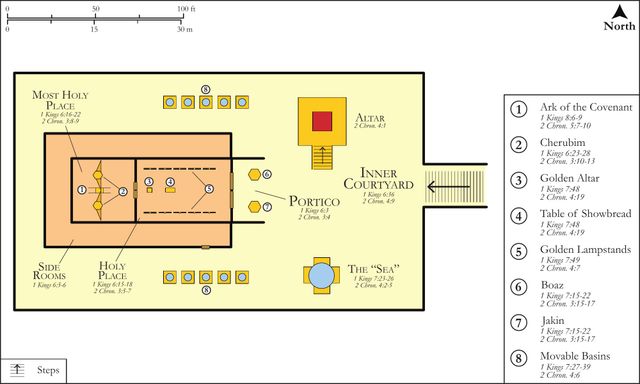
The timber-work was very fine, and yet, within, it was overlaid with pure gold (Ch2 3:4), with fine gold (Ch2 3:5). and that embossed with palm-trees and chains. It was gold of Parvaim (Ch2 3:6), the best gold. The beams and posts, the walls and doors, were overlaid with gold, Ch2 3:7. The most holy place, which was ten yards square, was all overlaid with fine gold (Ch2 3:8), even the upper chambers, or rather the upper floor or roof - top, bottom, and sides, were all overlaid with gold. Every nail, or screw, or pin, with which the golden plates were fastened to the walls that were overlaid with them, weighed fifty shekels, or was worth so much, workmanship and all. A great many precious stones were dedicated to God (Ch1 29:2, Ch1 29:8), and these were set here and there, where they would show to the best advantage. The finest houses now pretend to no better garnishing than good paint on the roof and walls; but the ornaments of the temple were most substantially rich. It was set with precious stones, because it was a type of the new Jerusalem, which has no temple in it because it is all temple, and the walls, gates, and foundations of which are said to be of precious stones and pearls, Rev 21:18, Rev 21:19, Rev 21:21.
Continue studying 2 Chronicles 3:6 across the web’s major study libraries — every link below opens this exact verse, chapter, or book on the destination site.
Read & Compare
 BibleGatewayThis verse in more than 200 translations and 70 languages.
 Bible.comThe YouVersion reader — hundreds of translations, reading plans, and highlights.
 ESV.orgCrossway's official English Standard Version reader.
 NET BibleThe NET translation with 60,000+ translators' notes on every rendering decision.
 STEP BibleTyndale House's free study tool — original text, vocabulary, and scholarly resources.
 BibliaLogos Bible Software's free web reader.
 USCCBThe New American Bible (Revised Edition) with the U.S. bishops' study notes.
Commentaries
 BibleHub CommentariesDozens of classic commentaries on this verse, gathered on one page.
 StudyLightMore than 100 commentary sets — the largest collection on the web.
 BibleRefPlain-English commentary on what this verse means, verse by verse.
 Enduring WordDavid Guzik's free commentary on this chapter, widely used by Bible teachers.
 Bible Study ToolsVerse commentary alongside Greek and Hebrew study aids.
Original Language & Research
- BibleHub InterlinearThe verse word by word — original language, transliteration, and English.
- BibleHub LexiconEvery word's original-language definition and Strong's entry.
 Blue Letter BibleDeep-study tools — Strong's numbers, concordance, and word studies.
 SefariaThe Hebrew text with Rashi and centuries of Jewish commentary.
Sermons, Hymns & Audio


TrulyRandomVerse is not affiliated with these sites and doesn’t control their content. They’re linked because they’re genuinely useful.
Summary
Second Chronicles 3:6 provides a vivid description of the lavish adornment of Solomon's Temple, specifically detailing the application of "precious stones for beauty" and the use of "gold of Parvaim." This verse highlights the extraordinary opulence and meticulous attention to detail in the construction of God's dwelling place, emphasizing that the finest and most exotic materials were employed to reflect the incomparable glory and majesty of the Lord, thereby establishing the Temple as a magnificent edifice designed to inspire awe and facilitate worship.
Context
ShowHideLiterary Context
This verse is intricately woven into the detailed account of King Solomon's monumental undertaking: the construction of the First Temple in Jerusalem, as meticulously recorded in 2 Chronicles 3. The chapter commences by establishing the precise location and foundational dimensions of the Temple (2 Chronicles 3:1-3), subsequently transitioning into a granular description of the specific materials and architectural features. Verse 6 immediately follows the depiction of the Temple's elaborate porch and the extensive overlaying of the interior with pure gold (2 Chronicles 3:4-5), thereby setting the stage for the subsequent detailed descriptions of the cherubim, the veil, and the colossal pillars (2 Chronicles 3:7-17). Within this narrative flow, 2 Chronicles 3:6 serves as a crucial detail, powerfully illustrating the unparalleled splendor and sacred reverence intended for God's house, fitting seamlessly into the broader chronicle of Solomon's reign and his dedicated fulfillment of King David's divine vision for the Temple.
Historical & Cultural Context
The construction of the Temple by King Solomon, circa 960 BCE, represented a monumental national endeavor, symbolizing the zenith of Israelite power, wealth, and international influence during the United Monarchy. Like the Tabernacle before it, the Temple was far more than a mere functional building; it was built after the pattern God had given, as He charged Moses, "look that thou make them after their pattern, which was shewed thee in the mount," and as David received it, "by the spirit," meticulously designed to answer to the tangible presence of the LORD who would dwell in it. The lavish use of materials, including vast quantities of gold, silver, rare precious stones, and exotic woods, recalled the gold, silver, and precious stones freely offered for the Tabernacle, directly reflecting the glory of the LORD and the wealth of the reigning monarch. The sheer scale, unparalleled quality, and specificity of materials described for Solomon's Temple, particularly the enigmatic "gold of Parvaim," indicate an exceptional level of dedication and access to extensive, sophisticated trade networks. This era was characterized by significant international commerce, enabling Solomon to import exotic goods and employ highly skilled craftsmen, thereby underscoring the deep-seated cultural emphasis on offering the absolute finest to the divine, a practice profoundly ingrained in the religious landscape of the time.
Key Themes
ShowHide2 Chronicles 3:6 powerfully contributes to several overarching theological and narrative themes within the book of Chronicles and the broader biblical narrative. Firstly, it prominently highlights the theme of Excellence in Worship, unequivocally emphasizing that God is supremely worthy of the finest materials, the most meticulous craftsmanship, and the utmost dedication. Solomon's extravagant use of "precious stones" and "gold of Parvaim" demonstrates a profound commitment to honoring God with unparalleled beauty and quality, a principle consistently echoed throughout Scripture, as seen in the admonition to honor the Lord with your wealth. Secondly, the verse powerfully reinforces the theme of Divine Glory and Majesty. The Temple's breathtaking splendor was not intended for human glorification but was designed to be a physical, tangible manifestation of the invisible, incomparable glory of the God of Israel, inspiring profound awe and reverence in all who beheld it. This aligns perfectly with the biblical understanding of God's presence as inherently glorious and majestic, vividly portrayed in the detailed descriptions of the tabernacle's construction and completion in Exodus 40. Lastly, it eloquently speaks to the theme of Dedication and Sacrifice, showcasing the immense resources, time, and specialized skill invested by Solomon and the entire nation. This act of building was a corporate expression of profound devotion, reflecting Israel's unwavering commitment to their covenant God and His sacred dwelling among them, thereby fulfilling the divine architectural vision first articulated by King David in 1 Chronicles 22.
Exposition and Analysis
ShowHideKey Word Analysis
ShowHideThe KJV translates the Hebrew verb צָפָה (H6823, tsâphâh') as "garnished." This root primarily means "to sheet over (especially with metal)" or "to cover" or "overlay." In this context, it signifies the deliberate act of applying a decorative covering or overlay to the Temple, particularly with precious materials. It implies an aesthetic and protective intention, highlighting that the Temple's beauty was achieved through the application of exquisite finishes, reflecting a desire to make God's dwelling place visually splendid and glorious.
The Hebrew word זָהָב (H2091, zâhâb') refers to "gold," and figuratively, "something gold-colored (i.e. yellow), as oil, a clear sky." In 2 Chronicles 3:6, the repetition "gold was gold of Parvaim" emphasizes the material's purity, value, and specific, high-quality origin. Gold was the most precious metal, symbolizing wealth, purity, and divine glory. Its extensive use underscored the Temple's sacredness and the immense honor bestowed upon God.
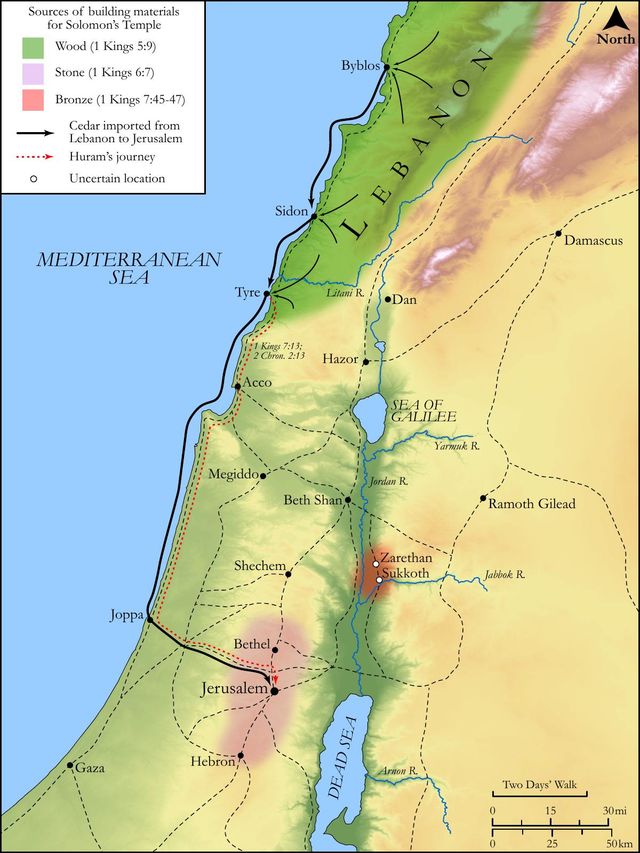
The term פַּרְוָ֑יִם (H6516, Parvayim') is of foreign origin and denotes an Oriental region renowned for its gold. Found only here in the Old Testament, its exact geographical location remains debated among scholars, with theories ranging from regions in the Arabian Peninsula (such as Yemen or Oman) to distant India. Regardless of its precise location, its inclusion here unequivocally emphasizes the exotic, distant, and superior quality of the gold. It signifies that the very best and most valuable materials, even from the farthest reaches of the known world, were meticulously sought out and brought to adorn the Temple, underscoring the unparalleled worthiness of God.
Verse Breakdown
ShowHide"And he garnished the house with precious stones for beauty:"
This initial clause vividly describes the intricate decorative work applied to the Temple. The pronoun "he" refers to King Solomon, who acted as the royal patron and meticulous overseer of the entire construction project. The "house" is unequivocally the Temple, the sacred dwelling place for the Ark of the Covenant and the manifestation of God's presence. The phrase "precious stones" (Hebrew: אֶבֶן יְקָרָה, ʾeven yĕqārâ) indicates highly valued, rare, and exquisite gems, far beyond ordinary building materials. The explicit purpose, "for beauty" (Hebrew: לְתִפְאָרָה, lĕtiphʾārâ), emphasizes the profound aesthetic dimension of this adornment, suggesting that the visual splendor was not merely incidental but an integral and intentional part of the Temple's design and its function in worship. This was a deliberate act to create a magnificent, awe-inspiring edifice that would reflect God's own glory.
"and the gold [was] gold of Parvaim."
This subsequent phrase precisely specifies the type and distinguished origin of the gold utilized, thereby highlighting its exceptional quality and rarity. The deliberate repetition of "gold" (Hebrew: הַזָּהָב זְהַב, hazzāhāḇ zĕhaḇ) serves to emphasize its unparalleled purity, immense value, and the sheer quantity employed. By identifying it as "gold of Parvaim," the Chronicler points to a source renowned among the nations for its superior quality, further underscoring the immense wealth, global reach, and profound dedication invested in the Temple's construction. This specific detail elevates the description beyond mere quantity, focusing instead on the unparalleled excellence and exotic nature of the materials chosen for God's sacred dwelling.
Literary Devices
ShowHide2 Chronicles 3:6 employs several potent literary devices to convey its profound message of divine magnificence and human devotion. Emphasis is powerfully achieved through the meticulous and detailed description of the materials, particularly the specific and unique mention of "gold of Parvaim." This precise detail highlights the rarity, supreme quality, and exotic origin of the gold, serving to underscore the extraordinary resources and unparalleled dedication committed to the Temple's construction. Symbolism is central to the verse, as the physical beauty and lavishness of the Temple are not ends in themselves but serve as a tangible, visible representation of God's own inherent glory, majesty, and holiness. The gleaming precious stones and the exotic, pure gold symbolize the immeasurable worth, splendor, and transcendent nature of the Divine, creating an environment meticulously designed to inspire profound awe, reverence, and worship. The verse also implicitly utilizes Hyperbole or extreme description; the level of opulence described would have been almost unimaginable to the average Israelite of the time, thereby magnifying the perception of God's boundless greatness and the king's unwavering devotion.
Theological and Thematic Connections
ShowHideThe lavish adornment of Solomon's Temple, as meticulously detailed in 2 Chronicles 3:6, profoundly illustrates the enduring biblical principle that God is supremely worthy of our absolute best. This was not about human ostentation or self-glorification, but rather about creating a dwelling place that suitably reflected the incomparable glory and transcendent majesty of the Almighty, serving as a physical testament to His supreme worth and holiness. The Temple's breathtaking beauty was, in itself, an act of worship—an offering of unparalleled excellence to the One who is Himself the ultimate source of all beauty, perfection, and truth. This dedication of the finest and most precious materials foreshadows the ultimate offering of Christ, the perfect sacrifice, and calls believers in every age to a life of consecrated excellence, where every aspect of our being—our time, talents, and resources—is offered to God as a beautiful, fragrant, and living sacrifice.
Reflection and Application
ShowHideThe exquisite detail presented in 2 Chronicles 3:6 serves as a profound challenge, prompting us to deeply consider the quality and nature of our own offering to God. While we no longer construct physical temples of stone and gold, the underlying principle of giving our "precious stones for beauty" and our "gold of Parvaim" remains profoundly relevant and spiritually resonant for contemporary believers. This verse calls us to a rigorous self-examination of our hearts and lives: are we genuinely offering God our best time, our most refined talents, our purest resources, and our deepest, most unreserved devotion? This is not an invitation to legalistic obligation or burdensome duty, but rather a joyful, spontaneous response to His supreme worth and immeasurable love. Just as the Temple's physical beauty was meticulously designed to reflect God's transcendent glory, our lives, as spiritual temples of the Holy Spirit (1 Corinthians 6:19), should be "garnished" and adorned with virtues, integrity, acts of selfless love, and faithful obedience that bring honor, beauty, and renown to His holy name. It encourages us to pursue excellence in all that pertains to our worship and service, recognizing that striving for beauty, quality, and perfection in our offerings can be a powerful and tangible act of reverence and adoration for the God who deserves nothing less than our absolute finest.
Questions for Reflection
ShowHideFAQ
ShowHideWhy was such immense expense and lavishness necessary for God's Temple?
ShowHideThe immense expense and extraordinary lavishness dedicated to Solomon's Temple, as vividly described in 2 Chronicles 3:6 and echoed throughout the broader Temple narratives, served multiple profound theological and practical purposes. Theologically, it was a tangible, visible expression of God's supreme worth, unparalleled majesty, and transcendent holiness. As David had said, the house to be built for the LORD "must be exceeding magnifical, of fame and of glory throughout all countries," and its grandeur, scale, and opulence directly reflected the power and glory of the God it was built for. For Israel, this meant constructing a structure that was unparalleled in its beauty, cost, and craftsmanship, unequivocally signifying that Yahweh was the one true God, infinitely superior to all other gods. It was an act of profound worship, an offering of the very best to the One who deserved nothing less. Practically, the Temple served as the central place of worship for the entire nation of Israel, a visible and enduring symbol of God's abiding presence among His people and the sacred covenant relationship He had established with them. Its breathtaking splendor would have inspired deep awe, reverence, and a profound sense of national pride, thereby reinforcing the identity and faith of the Israelite people. Furthermore, it fulfilled King David's heartfelt vision to build a magnificent "house of rest" for the Ark of the Covenant, a place truly worthy of God's dwelling (1 Chronicles 28:2).
What is "gold of Parvaim" and why is its mention significant?
ShowHide"Gold of Parvaim" (Hebrew: פַּרְוָ֑יִם, H6516) refers to a specific, highly prized type of gold, almost certainly sourced from a distant and renowned location. While the exact geographical origin of Parvaim remains a subject of ongoing scholarly debate—with theories pointing to various regions in the Arabian Peninsula (such as Yemen or Oman) or even as far as India—its profound significance lies in its implication of exceptional quality, purity, and rarity. The Chronicler's specific mention of "gold of Parvaim" in 2 Chronicles 3:6 is not merely a geographical detail; it powerfully underscores the fact that King Solomon spared no expense and went to extraordinary lengths to acquire the finest and most valuable materials available in the known world for God's sacred house. This precise detail emphasizes the unparalleled dedication, immense resources, and global reach committed to the Temple's construction, further highlighting the supreme value placed on God's dwelling place and His transcendent glory.
Christ-Centered Fulfillment
ShowHideThe lavish adornment of Solomon's Temple, with its "precious stones for beauty" and "gold of Parvaim" (2 Chronicles 3:6), finds its ultimate Christ-centered fulfillment not in a material building but profoundly in the person of Jesus Christ Himself. The Old Testament Temple, with all its splendor, was a shadow, a tangible representation and prophetic type of God's dwelling among His people (Hebrews 8:5). In Christ, God's glory did not merely dwell in a building, but was fully incarnated as a person. John the Apostle declares with profound theological insight that the Word became flesh and "tabernacled among us, and we have seen his glory, glory as of the only Son from the Father, full of grace and truth" (John 1:14). Jesus is the true and greater Temple, the ultimate and perfect place where God's presence is fully revealed, fully accessible, and perfectly reconciled to humanity. He even prophesied, "Destroy this temple, and in three days I will raise it up," speaking not of the stone edifice, but profoundly of the temple of his own body (John 2:19-21). Furthermore, through Christ's redemptive work, believers become living stones, spiritually built into a holy spiritual house, a "holy temple in the Lord" (Ephesians 2:21-22), where God's Holy Spirit now intimately dwells. The unparalleled beauty, infinite worth, and divine glory symbolized by the Temple's precious materials ultimately point to the infinite worth and transcendent glory of Christ, in whom "all the fullness of God was pleased to dwell" (Colossians 1:19). Ultimately, the eschatological vision of the New Jerusalem in Revelation reveals that there will be no need for a physical temple, "for its temple is the Lord God Almighty and the Lamb" (Revelation 21:22), perfectly fulfilling humanity's deepest longing for God's glorious and unveiled presence among His people forevermore.