


Exodus 15:8
Bible text: King James Version (1769 Blayney text) · Public domain
Bible text: King James Version with Strong's numbers · Public domain
Bible text: Berean Standard Bible · Public domain
Bible text: American Standard Version (1901) · Public domain
Bible text: World English Bible, Messianic edition · Public domain
Bible text: Geneva Bible (1599) · Public domain
Bible text: Young's Literal Translation · Public domain
- וּבְרוּחַu·ve·Ru·achand by [the] breath ofH7307Conj-w ¦ Prep-b ¦ N-fscNoun Singular Feminine Constructוּandבְbyרוּחַ[the] breath of
- אַפֶּיךָ'a·Pei·khayour nostrilsH639N-mdc ¦ 2msNoun Dual Masculine Constructאַפֶּיnostrilsךָyour
- נֶעֶרְמוּNe·'er·muthey were piled upH6192V-Niphal-Perf-3cpVerb Niphal Perfect 3rd Plural common gender
- מַיִםMa·yim[the] watersH4325N-mpNoun Plural Masculine Absolute
- נִצְּבוּni·tze·Vuthey stood upH5324V-Niphal-Perf-3cpVerb Niphal Perfect 3rd Plural common gender
- כְמוֹkhe·movlikeH3644PrepPreposition
- נֵדneda heapH5067N-msNoun Singular Masculine Absolute
- נֹזְלִיםno·ze·LimstreamsH5140V-Qal-Prtcpl-mpVerb Qal Participle Plural Masculine Absolute
- קָפְאוּka·fe·'Uthey congealedH7087V-Qal-Perf-3cpVerb Qal Perfect 3rd Plural common gender
- תְהֹמֹתte·ho·Mot[the] deepsH8415N-fpNoun Plural Feminine Absolute
- בְּלֶבbe·levin [the] heart ofH3820Prep-b ¦ N-mscNoun Singular Masculine Constructבְּinלֶב[the] heart of
- יָםYam[the] seaH3220N-msNoun Singular Masculine Absolute
English is a literal word-by-word gloss of the Hebrew, not the KJV's wording. Why?
This is the original text the KJV's translators worked from — each Hebrew word with its own literal English meaning in this verse, prepared by scholars at Tyndale House, Cambridge. The KJV translates whole sentences, not word by word, so its wording differs: one Hebrew word can become several English words, and the KJV may choose “the LORD” where the gloss reads “Yahweh”. Both are faithful — they answer different questions. For the KJV's own rendering, switch to the KJV text.
Details
See on the biblical-era maps

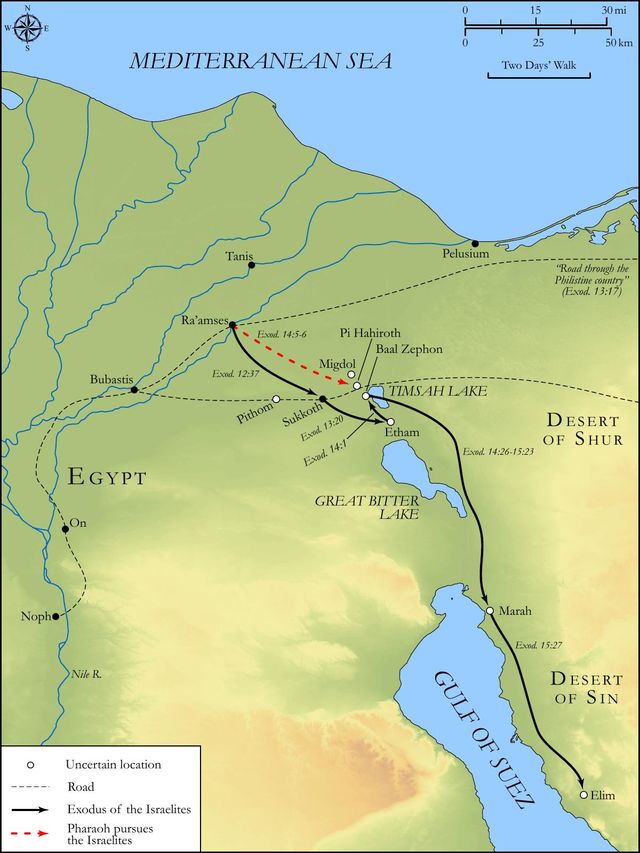
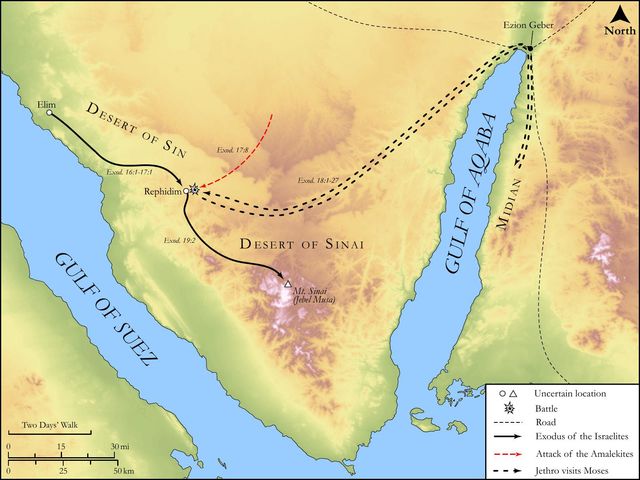
Study this verse
Public-domain commentary
Matthew Henry
From his Commentary on the Whole Bible. Henry comments on passages, not single verses — this entry covers Exodus 15:1–21. His four-level outline is real structure in the source text, so it is rendered as structure.
Having read how that complete victory of Israel over the Egyptians was obtained, here we are told how it was celebrated; those that were to hold their peace while the deliverance was in working (Exo 14:14) must not hold their peace now that it was wrought; the less they had to do then the more they had to do now. If God accomplishes deliverance by his own immediate power, it redounds so much the more to his glory. Moses, no doubt by divine inspiration, indited this song, and delivered it to the children of Israel, to be sung before they stirred from the place where they saw the Egyptians dead upon the shore. Observe, 1. They expressed their joy in God, and thankfulness to him, by singing; it is almost natural to us thus to give vent to our joy and the exultations of our spirit. By this instance it appears that the singing of psalms, as an act of religious worship, was used in the church of Christ before the giving of the ceremonial law, and therefore was no part of it, nor abolished with it. Singing is as much the language of holy joy as praying is of holy desire. 2. Moses, who had gone before them through the sea, goes before them in the song, and composes it for them. Note, Those that are active in public services should not be neuters in public praises. 3. When the mercy was fresh, and they were much affected with it, then they sang this song. Note, When we have received special mercy from God, we ought to be quick and speedy in our returns of praise to him, before time and the deceitfulness of our own hearts efface the good impressions that have been made. David sang his triumphant song in the day that the Lord delivered him, Sa2 22:1. Bis dat qui cito dat - He gives twice who gives quickly. 4. When they believed the Lord (Exo 14:31) then they sang this song: it was a song of faith; this connection is observed (Psa 106:12): Then believed they his words, they sang his praise. If with the heart man believes, thus confession must be made. Here is,
I.The song itself; and,
1.We may observe respecting this song, that it is,
(1.)An ancient song, the most ancient that we know of.
(2.)A most admirable composition, the style lofty and magnificent, the images lively and proper, and the whole very moving.
(3.)It is a holy song, consecrated to the honour of God, and intended to exalt his name and celebrate his praise, and his only, not in the least to magnify any man: holiness to the Lord is engraven in it, and to him they made melody in the singing of it.
(4.)It is a typical song. The triumphs of the gospel church, in the downfall of its enemies, are expressed in the song of Moses and the song of the Lamb put together, which are said to be sung upon a sea of glass, as this was upon the Red Sea, Rev 15:2, Rev 15:3.
2.Let us observe what Moses chiefly aims at in this song.
(1.)He gives glory to God, and triumphs in him; this is first in his intention (Exo 15:1): I will sing unto the Lord. Note, All our joy must terminate in God, and all our praises be offered up to him, the Father of lights and Father of mercies, for he hath triumphed. Note, All that love God triumph in his triumphs; what is his honour should be our joy. Israel rejoiced in God,
[1.]As their own God, and therefore their strength, song, and salvation, Exo 15:2. Happy therefore the people whose God is the Lord; they need no more to make them happy. They have work to do, temptations to grapple with, and afflictions to bear, and are weak in themselves; but he strengthens them: his grace is their strength. They are often in sorrow, upon many accounts, but in him they have comfort, he is their song; sin, and death, and hell, threaten them, but he is, and will be, their salvation: See Isa 12:2.
[2.]As their fathers' God. This they take notice of, because, being conscious to themselves of their own unworthiness and provocations, they had reason to think that what God had now done for them was for their fathers' sake, Deu 4:37. Note, The children of the covenant ought to improve their fathers' relation to God as their God for comfort, for caution, and for quickening.
[3.]As a God of infinite power (Exo 15:3): The Lord is a man of war, that is, well able to deal with all those that strive with their Maker, and will certainly be too hard for them.
[4.]As a God of matchless and incomparable perfection, Exo 15:11. This is expressed, First, More generally: Who is like unto thee, O Lord, among the gods! This is pure praise, and a high expression of humble adoration. - It is a challenge to all other gods to compare with him: "Let them stand forth, and pretend their utmost; none of them dare make the comparison." Egypt was notorious for the multitude of its gods, but the God of the Hebrews was too hard for them and baffled them all, Num 33:4; Deu. 32:23-39. The princes and potentates of the world are called gods, but they are feeble and mortal, none of them all comparable to Jehovah, the almighty and eternal God. - It is confession of his infinite perfection, as transcendent and unparalleled. Note, God is to be worshipped and adored as a being of such infinite perfection that there is none like him, nor any to be compared with him, as one that in all things has and must have the pre-eminence, Psa 89:6. Secondly, More particularly, 1. He is glorious in holiness; his holiness is his glory. It is that attribute which angels adore, Isa 6:3. His holiness appeared in the destruction of Pharaoh, his hatred of sin, and his wrath against obstinate sinners. It appeared in the deliverance of Israel, his delight in the holy seed, and his faithfulness to his own promise. God is rich in mercy - this is his treasure, glorious in holiness - this is his honour. Let us always give thanks at the remembrance of his holiness. 2. He is fearful in praises. That which is the matter of our praise, though it is joyful to the servants of God, is dreadful and very terrible to his enemies, Psa 66:1-3. Or it directs us in the manner of our praising God; we should praise him with a humble holy awe, and serve the Lord with fear. Even our spiritual joy and triumph must be balanced with a religious fear. 3. He is doing wonders, wondrous to all, being above the power and out of the common course of nature; especially wondrous to us, in whose favour they are wrought, who are so unworthy that we had little reason to expect them. They were wonders of power and wonders of grace; in both God was to be humbly adored.
(2.)He describes the deliverance they were now triumphing in, because the song was intended, not only to express and excite their thankfulness for the present, but to preserve and perpetuate the remembrance of this work of wonder to after-ages. Two things were to be taken notice of: -
[1.]The destruction of the enemy; the waters were divided, Exo 15:8. The floods stood upright as a heap. Pharaoh and all his hosts were buried in the waters. The horse and his rider could not escape (Exo 15:1), the chariots, and the chosen captains (Exo 15:4); they themselves went into the sea, and they were overwhelmed, Exo 15:19. The depths, the sea, covered them, and the proud waters went over the proud sinners; they sank like a stone, like lead (Exo 15:5, Exo 15:10), under the weight of their own guilt and God's wrath. Their sin had made them hard like a stone, and now they justly sink like a stone. Nay, the earth itself swallowed them (Exo 15:12); their dead bodies sank into the sands upon which they were thrown up, which sucked them in. Those whom the Creator fights against the whole creation is at war with. All this was the Lord's doing, and his only. It was an act of his power: Thy right hand, O Lord, not ours, has dashed in pieces the enemy, Exo 15:6. It was with the blast of thy nostrils (Exo 15:8), and thy wind (Exo 15:10), and the stretching out of thy right hand, Exo 15:12. It was an instance of his transcendent power - in the greatness of thy excellency; and it was the execution of his justice: Thou sentest forth thy wrath, Exo 15:7. This destruction of the Egyptians was made the more remarkable by their pride and insolence, and their strange assurance of success: The enemy said, I will pursue, Exo 15:9. Here is, First, Great confidence. When they pursue, they do not question but they shall overtake; and, when they overtake, they do not question but they shall overcome, and obtain so decisive a victory as to divide the spoil. Note, It is common for men to be most elevated with the hope of success when they are upon the brink of ruin, which makes their ruin so much the sorer. See Isa 37:24, Isa 37:25. Secondly, Great cruelty - nothing but killing, and slaying, and destroying, and this will satisfy his lust; and a barbarous lust that is which so much blood must be the satisfaction of. Note, It is a cruel hatred with which the church is hated; its enemies are bloody men. This is taken notice of here to show, 1. That God resists the proud, and delights to humble those who lift up themselves; he that says, "I will, and I will, whether God will or no," shall be made to know that wherein he deals proudly God is above him. 2. That those who thirst for blood shall have enough of it. Those who love to be destroying shall be destroyed; for we know who has said, Vengeance is mine, I will repay.
[2.]The protection and guidance of Israel (Exo 15:13): Thou in thy mercy hast led forth the people, led them forth out of the bondage Egypt, led them forth out of the perils of the Red Sea, Exo 15:19. But the children of Israel went on dry land. Note, The destruction of the wicked serves for a foil to set off the salvation of Israel, and to make it the more illustrious, Isa 45:13-15.
(3.)He sets himself to improve this wonderful appearance of God for them.
[1.]In order to quicken them to serve God: in consideration of this, I will prepare him habitation, Exo 15:2. God having preserved them, and prepared a covert for them under which they had been safe and easy, they resolve to spare no cost nor pains for the erecting of a tabernacle to his honour, and there they will exalt him, and mention, to his praise, the honour he had got upon Pharaoh. God had now exalted them, making them great and high, and therefore they will exalt him, by speaking of his infinite height and grandeur. Note, Our constant endeavour should be, by praising his name and serving his interests, to exalt God; and it is an advancement to us to be so employed.
[2.]In order to encourage them to trust in God. So confident is this Psalmist of the happy issue of the salvation which was so gloriously begun that he looks upon it as in effect finished already: "Thou hast guided them to thy holy habitation, Exo 15:13. Thou hast thus put them into the way to it, and wilt in due time bring them to the end of that way," for God's work is perfect; or, "Thou hast guided them to attend thy holy habitation in heaven with their praises." Note, Those whom God takes under his direction he will guide to his holy habitation in faith now, and in fruition shortly. Two ways this great deliverance was encouraging: - First, It was such an instance of God's power as would terrify their enemies, and quite dishearten them, Exo 15:14-16. The very report of the overthrow of the Egyptians would be more than half the over throw of all their other enemies; it would sink their spirits, which would go far towards the sinking of their powers and interests; he Philistines, Moabites, Edomites, and Canaanites (with each of which nations Israel was to grapple), would be alarmed by it, would be quite dispirited, and would conclude it was in vain to fight against Israel, when a God of such power fought for them. It had this effect; the Edomites were afraid of them (Deu 2:4), so were the Moabites (Num 22:3), and the Canaanites, Jos 2:9, Jos 2:10; Jos 5:1. Thus God sent his fear before them (Exo 23:27), and cut off the spirit of princes. Secondly, It was such a beginning of God's favour to them as gave them an earnest of he perfection of his kindness. This was but in order to something further: Thou shalt bring them in, Exo 15:17. If he thus bring them out of Egypt, notwithstanding their unworthiness, and the difficulties that lay in the way of their escape, doubtless he will bring them into Canaan; for has he begun (so begun), and will he not make an end? Note, Our experiences of God's power and favour should be improved for the support of our expectations. "Thou hast, therefore, not only thou canst, but we trust thou wilt," is good arguing. Thou wilt plant them in the place which thou has made for thee to dwell in. Note, It is good dwelling where God dwells, in his church on earth (Psa 27:4), in his church in heaven, Joh 17:24. Where he says, "This is my rest for ever," we should say, "Let it be ours." Lastly, The great ground of the encouragement which they draw from this work of wonder is, The Lord shall reign for ever and ever, Exo 15:18. They had now seen an end of Pharaoh's reign; but time itself shall not put a period to Jehovah's reign, which, like himself, is eternal, and not subject to change. Note, It is the unspeakable comfort of all God's faithful subjects, not only that he does reign universally and with an incontestable sovereignty, but that he will reign eternally, and there shall be no end of his dominion.
II.The solemn singing of this song, Exo 15:20, Exo 15:21.
Miriam (or Mary, it is the same name) presided in an assembly of the women, who (according to the softness of their sex, and the common usage of those times for expressing joy, with timbrels and dances) sang this song. Moses led the psalm, and gave it out for the men, and then Miriam for the women. Famous victories were wont to be applauded by the daughters of Israel (Sa1 18:6, Sa1 18:7); so was this. When God brought Israel out of Egypt, it is said (Mic 6:4), He sent before them Moses, Aaron, and Miriam, though we read not of any thing memorable that Miriam did but this. But those are to be reckoned great blessings to a people who assist them, and go before them, in praising God.
Continue studying Exodus 15:8 across the web’s major study libraries — every link below opens this exact verse, chapter, or book on the destination site.
Read & Compare
 BibleGatewayThis verse in more than 200 translations and 70 languages.
 Bible.comThe YouVersion reader — hundreds of translations, reading plans, and highlights.
 ESV.orgCrossway's official English Standard Version reader.
 NET BibleThe NET translation with 60,000+ translators' notes on every rendering decision.
 STEP BibleTyndale House's free study tool — original text, vocabulary, and scholarly resources.
 BibliaLogos Bible Software's free web reader.
 USCCBThe New American Bible (Revised Edition) with the U.S. bishops' study notes.
Commentaries
 BibleHub CommentariesDozens of classic commentaries on this verse, gathered on one page.
 StudyLightMore than 100 commentary sets — the largest collection on the web.
 BibleRefPlain-English commentary on what this verse means, verse by verse.
 Enduring WordDavid Guzik's free commentary on this chapter, widely used by Bible teachers.
 Bible Study ToolsVerse commentary alongside Greek and Hebrew study aids.
Original Language & Research
- BibleHub InterlinearThe verse word by word — original language, transliteration, and English.
- BibleHub LexiconEvery word's original-language definition and Strong's entry.
 Blue Letter BibleDeep-study tools — Strong's numbers, concordance, and word studies.
 SefariaThe Hebrew text with Rashi and centuries of Jewish commentary.
Sermons, Hymns & Audio


TrulyRandomVerse is not affiliated with these sites and doesn’t control their content. They’re linked because they’re genuinely useful.
Summary
Exodus 15:8, a pivotal declaration within the triumphant Song of Moses, powerfully recounts God's miraculous intervention at the Red Sea. It attributes the parting of the immense waters to the divine "blast of thy nostrils," portraying this as the irresistible force that gathered the floods, caused them to stand upright as solid heaps, and congealed the depths in the very heart of the sea. This verse vividly underscores God's absolute sovereignty over creation and His unparalleled power to deliver His people from seemingly insurmountable obstacles, transforming chaos into a path of salvation.
Context
ShowHideLiterary Context
Exodus 15:8 is an integral and climactic part of the "Song of Moses and Miriam" (Exodus 15:1-18), a communal hymn of praise and thanksgiving sung by the Israelites immediately following their miraculous deliverance from Pharaoh's army at the Red Sea. This song serves as the theological and emotional culmination of the Exodus narrative, particularly the dramatic events detailed in Exodus 14. Verse 8 specifically elaborates on the mechanics of this divine act, emphasizing God's direct, effortless, and overwhelming control over the natural elements. It sets the stage for the song's subsequent celebration of God's decisive victory over the Egyptians and His unwavering commitment to guide Israel. The verse reinforces the overarching themes of divine power, salvation, and the establishment of God's covenant relationship with His chosen people, serving as a foundational declaration of Yahweh's unique identity as the deliverer and warrior.
Historical & Cultural Context
The historical backdrop for Exodus 15:8 is the Israelites' dramatic escape from centuries of oppressive slavery in Egypt, an event that profoundly shaped their national identity and religious consciousness. Trapped between the formidable pursuing Egyptian chariots and the seemingly impassable Red Sea, the Israelites faced certain destruction, a moment of ultimate despair. In this dire predicament, God intervened supernaturally. The parting of the Red Sea was not merely a natural phenomenon but a profound demonstration of Yahweh's power, not only over the forces of nature but also over the might of Egypt and its pantheon of gods. This event unequivocally established Yahweh as the one true God, the mighty deliverer and warrior, a theme deeply ingrained in Israel's collective memory and celebrated in their worship, as vividly expressed in this very song. It marked the birth of Israel as a nation under God's direct rule.
Key Themes
ShowHideExodus 15:8 powerfully contributes to several key themes within the book of Exodus and the broader Pentateuch. Foremost among these is Divine Omnipotence and Sovereignty, showcasing God's absolute control over creation, where even the chaotic waters of the sea yield to His command. This act is a definitive demonstration of Divine Deliverance and Salvation, as God actively intervenes to rescue His people from bondage and certain death, transforming an impossible situation into a path of freedom. The verse also highlights God's character as a Divine Warrior, who fights on behalf of His covenant people, triumphing over their enemies (Exodus 14:14). Furthermore, it underscores the theme of Covenant Faithfulness, as God fulfills His promises to Abraham, Isaac, and Jacob by bringing their descendants out of Egypt. This miraculous display of power serves as a foundational revelation of God's character, inspiring awe, worship, and unwavering trust in His ability to overcome any obstacle for those He has chosen, a theme echoed throughout Israel's history, from the wilderness wanderings to the conquest of Canaan (e.g., Joshua 3:13-17).
Exposition and Analysis
ShowHideKey Word Analysis
ShowHideThe Hebrew word רוּחַ (rûwach, H7307) is rich in meaning, encompassing "wind," "breath," and "spirit." In the context of "the blast of thy nostrils," it functions as a powerful anthropomorphism, attributing a human physiological function to God to convey His intense, forceful, and immediate power. It suggests a mighty, divine wind or exhalation that is not merely a natural phenomenon but a direct emanation of God's sovereign will and presence, capable of manipulating the vast waters with effortless ease and demonstrating His life-giving or destructive force.
The Hebrew word נֵד (nêd, H5067) refers to a "mound" or "pile." When describing the "floods stood upright as an heap," it paints a striking visual image of the immense volume of water standing vertically on either side of the dry path. This term underscores the sheer magnitude and unnatural stability of the water walls, emphasizing the overwhelming power required to suspend such a colossal amount of liquid in defiance of gravity, making the impossible a tangible reality.
The Hebrew verb קָפָא (qâphâʼ, H7087) means "to shrink," "thicken," or "freeze/solidify." Its use here vividly describes the miraculous transformation of the turbulent sea into firm, stable walls of water. This word emphasizes the absolute defiance of natural laws, highlighting the supernatural nature of the event. The waters did not merely recede but became fixed and unmoving, like a solid mass, ensuring a secure and dry passage for the Israelites, demonstrating God's complete mastery over the elements.
Verse Breakdown
ShowHide"And with the blast of thy nostrils"
This opening phrase immediately establishes divine agency as the sole cause of the miracle. The "blast" (רוּחַ, rûwach) signifies God's powerful breath or wind, a direct emanation of His being. It is an anthropomorphic expression, attributing a human-like action to God to convey His immediate, personal, and overwhelming power, indicating that the miracle was not an impersonal force of nature but a direct, intentional act of God's sovereign will.
"the waters were gathered together"
This clause describes the initial effect of God's power. The vast, expansive waters of the Red Sea were not merely pushed aside but actively "gathered," implying a controlled and purposeful collection. This suggests a deliberate divine orchestration of the elements, bringing the chaotic waters into order according to His precise design, preparing the way for the next phase of the miracle.
"the floods stood upright as an heap"
This vivid imagery describes the miraculous formation of the water walls. The "floods" (נֹזְלִים, nozlim, flowing waters) did not just recede but "stood upright," defying gravity and natural laws. The simile "as an heap" (נֵד, nêd) further emphasizes the solid, stable, and immense nature of these water walls, illustrating their unnatural firmness and the sheer volume of water suspended in place, forming a clear, dry corridor.
"[and] the depths were congealed in the heart of the sea"
This final clause reinforces the miraculous stability and transformation of the parted waters. The "depths" (תְּהֹמֹת, tehomot, the deep, often associated with primeval chaos or the abyss) were "congealed" (קָפָא, qâphâʼ), meaning they became solidified or frozen. This indicates an absolute transformation, making the water as firm as ice or solid ground, allowing the Israelites to cross on dry land. The phrase "in the heart of the sea" emphasizes the central, most formidable part of the vast body of water, highlighting the magnitude of God's power even in its deepest, most unyielding parts.
Literary Devices
ShowHideExodus 15:8 is profoundly rich in Imagery, painting a vivid and unforgettable picture of God's awe-inspiring power and the miraculous event at the Red Sea. The verse employs striking Anthropomorphism in the phrase "the blast of thy nostrils," attributing a human physical action (breathing with force) to God. This device is not meant to imply God has a physical body, but rather to make His immense, personal, and effortless power comprehensible and impactful to human understanding. A powerful Simile is used in "stood upright as an heap," comparing the vertically standing waters to a solid mound or pile, which vividly emphasizes their unnatural stability, immense volume, and the defiance of natural laws. The description of "the depths were congealed" utilizes Hyperbole or extreme Metaphor to convey the miraculous and supernatural solidification of the water, defying all natural expectations and highlighting the unparalleled nature of God's intervention. These literary techniques collectively serve to magnify the divine power, the unparalleled nature of the deliverance, and to instill a sense of awe and wonder in the worshiper.
Theological and Thematic Connections
ShowHideExodus 15:8 profoundly articulates the themes of divine omnipotence and sovereignty over creation. It declares that God's power is not merely great but absolute, capable of suspending and solidifying the most formidable natural elements—the vast, chaotic waters of the sea—with a mere "blast" of His breath. This act establishes God as the ultimate deliverer, demonstrating His active intervention on behalf of His covenant people, Israel. It underscores His role as a divine warrior who fights for His own, transforming an impossible situation into a path of salvation. This miraculous display of power serves as a foundational revelation of God's character, inspiring awe, worship, and unshakeable trust in His ability to overcome any obstacle for those He loves, proving that His might is limitless and His commitment to His people unwavering.
Reflection and Application
ShowHideExodus 15:8 stands as an enduring testament to God's limitless power and His unwavering commitment to His people. For believers today, this verse offers profound encouragement when facing seemingly insurmountable obstacles, akin to the Israelites trapped at the Red Sea. It reminds us that no challenge, no "impassable sea" in our lives—whether it be financial hardship, relational brokenness, spiritual stagnation, or profound grief—is too great for the God whose mere breath can solidify oceans and carve a path through chaos. We are called to cultivate a faith that trusts in His active, supernatural intervention, knowing that He is not a distant deity but intimately involved in our struggles, capable of making a way where there appears to be none. This understanding should move us to profound worship and praise, recognizing that the same God who parted the Red Sea is our present help, able to deliver us from spiritual and physical bondage, and to lead us through our wildernesses to promised lands, always faithful to His redemptive purposes.
Questions for Reflection
ShowHideFAQ
ShowHideWhat does "the blast of thy nostrils" mean in Exodus 15:8, and is it literal?
ShowHideThe phrase "the blast of thy nostrils" is a powerful anthropomorphism, a literary device that attributes human characteristics or actions to God. It is not meant to be taken literally, implying that God has physical nostrils or breathes in a human sense. Instead, it is a vivid and poetic way to convey God's immense, immediate, and effortless power. The Hebrew word for "blast" (רוּחַ, rûwach) can mean "breath," "wind," or "spirit," suggesting a mighty divine wind or exhalation. Therefore, "the blast of thy nostrils" metaphorically represents the overwhelming force and sovereign will of God, demonstrating that a mere expression of His power was sufficient to manipulate the vast waters of the Red Sea, solidifying them and creating a path for His people. It emphasizes God's direct, personal, and irresistible control over creation, highlighting that the miracle was an act of divine will rather than a natural phenomenon.
Christ-Centered Fulfillment
ShowHideThe miraculous parting of the Red Sea, vividly described in Exodus 15:8, serves as a profound Old Testament type and shadow pointing to the ultimate deliverance accomplished through Jesus Christ. Just as God's "blast" created a path of salvation through the waters for Israel, Christ, by His divine power and sacrificial death, has opened a new and living way for humanity to escape the bondage of sin and death. The Red Sea crossing, often seen as a precursor to baptism, symbolizes the believer's identification with Christ's death and resurrection, passing through the waters from an old life of slavery to a new life of freedom in Him (1 Corinthians 10:1-2). The "congealed depths" that allowed safe passage foreshadow the stability and security found in Christ, who has conquered the chaotic forces of sin and evil, offering a firm foundation for all who believe. Through Christ's atoning work, the "depths" of our sin and the "floods" of judgment are overcome, and we are granted passage into God's presence, a spiritual reality far surpassing the physical deliverance at the sea. This ultimate fulfillment is realized as believers are buried with Him in baptism and raised with Him through faith in the power of God (Colossians 2:12), entering into the new covenant through the "new and living way" He consecrated for us through His blood (Hebrews 10:19-20).