


Esther 5:12
Bible text: King James Version (1769 Blayney text) · Public domain
Bible text: King James Version with Strong's numbers · Public domain
Bible text: Berean Standard Bible · Public domain
Bible text: American Standard Version (1901) · Public domain
Bible text: World English Bible, Messianic edition · Public domain
Bible text: Geneva Bible (1599) · Public domain
Bible text: Young's Literal Translation · Public domain
- וַיֹּאמֶרvai·yo·Merand he saidH559Conj-w ¦ V-Qal-ConsecImperf-3msVerb Qal Consecutive Imperfect 3rd Singular Masculineוַandיֹּאמֶרhe said
- הָמָןha·ManHamanH2001N-proper-mNoun Proper Masculine
- אַף'afalsoH637PrtParticle Interjection
- לֹאlo'notH3808NegParticle Negative
- הֵבִיאָהhe·vi·'Ahshe let come [anyone]H935V-Hiphil-Perf-3fsVerb Hiphil Perfect 3rd Singular Feminine
- אֶסְתֵּר'es·TerEstherH635N-proper-fNoun Proper Feminine
- הַמַּלְכָּהha·mal·Kahthe queenH4436Art ¦ N-fsNoun Singular Feminine Absoluteהַtheמַּלְכָּהqueen
- עִם'imwithH5973PrepPreposition
- הַמֶּלֶךְha·Me·lekhthe kingH4428Art ¦ N-msNoun Singular Masculine Absoluteהַtheמֶּלֶךְking
- אֶל'eltoH413PrepPreposition
- הַמִּשְׁתֶּהha·mish·Tehthe feastH4960Art ¦ N-msNoun Singular Masculine Absoluteהַtheמִּשְׁתֶּהfeast
- אֲשֶׁר'a·SherwhichH834RelParticle Relative
- עָשָׂתָה'a·Sa·tahshe had preparedH6213V-Qal-Perf-3fsVerb Qal Perfect 3rd Singular Feminine
- כִּיkithatH3588PrtParticle Conditional
- אִם'imexceptH518PrtParticle Conditional
- אוֹתִי'o·Ti<obj.> meH853DirObjM ¦ 1csParticle Object Indicatorאוֹתִ<obj.>יme
- וְגַםve·gamand alsoH1571Conj-w ¦ AdvAdverbוְandגַםalso
- לְמָחָרle·ma·Charfor tomorrowH4279Prep-l ¦ N-msNoun Singular Masculine Absoluteלְforמָחָרtomorrow
- אֲנִי'a·NiIH589Pro-1csPronoun Personal 1st Singular common gender
- קָרוּאka·ru'[am] invitedH7121V-Qal-PassPrtcpl-msVerb Qal Participle Passive Singular Masculine Absolute
- לָהּlahby herPrep-l ¦ 3fsSuffix Personal 3rd Singular Feminineלָbyהּher
- עִם'imwithH5973PrepPreposition
- הַמֶּלֶךְha·Me·lekhthe kingH4428Art ¦ N-msNoun Singular Masculine Absoluteהַtheמֶּלֶךְking
English is a literal word-by-word gloss of the Hebrew, not the KJV's wording. Why?
This is the original text the KJV's translators worked from — each Hebrew word with its own literal English meaning in this verse, prepared by scholars at Tyndale House, Cambridge. The KJV translates whole sentences, not word by word, so its wording differs: one Hebrew word can become several English words, and the KJV may choose “the LORD” where the gloss reads “Yahweh”. Both are faithful — they answer different questions. For the KJV's own rendering, switch to the KJV text.
Details
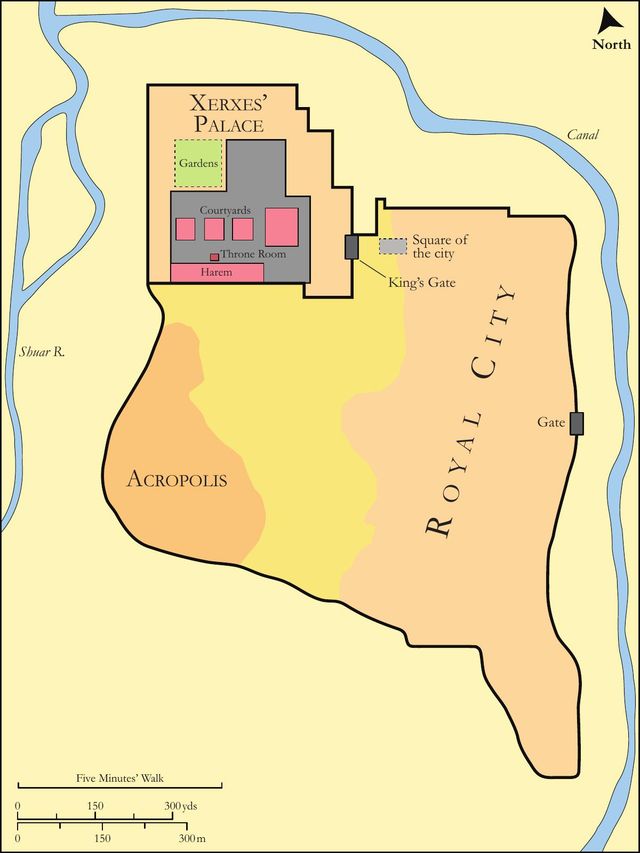
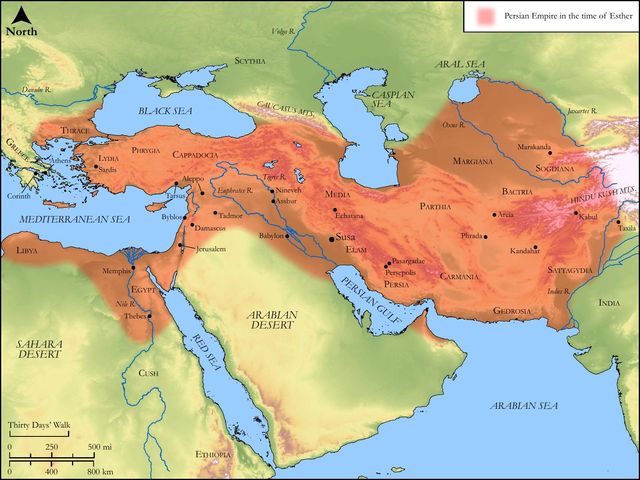
See on the biblical-era maps
Study this verse
Public-domain commentary
Matthew Henry
From his Commentary on the Whole Bible. Henry comments on passages, not single verses — this entry covers Esther 5:9–14. His three-level outline is real structure in the source text, so it is rendered as structure.
This account here given of Haman is a comment upon that of Solomon, Pro 21:24. Proud and haughty scorner is his name that deals in proud wrath. Never did any man more answer that name than Haman, in whom pride and wrath had so much the ascendant. See him,
I.Puffed up with the honour of being invited to Esther's feast.
He was joyful and glad of heart at it, Est 5:9. Observe with what a high gust he speaks of it (Est 5:12), how he values himself upon it, and how near he thinks it brings him to the perfection of felicity, that Esther the queen did let no man come with the king to the banquet but his mighty self, and he thought it was because she was exceedingly charmed with his conversation that the next day she had invited him also to come with the king; none so fit as he to bear the king company. Note, Self-admirers and self-flatterers are really self-deceivers. Haman pleased himself with the fancy that the queen, by this repeated invitation, designed to honour him, whereas really she designed to accuse him, and, in calling him to the banquet, did but call him to the bar. What magnifying glasses do proud men look at their faces in! And how does the pride of their heart deceive them! Oba 1:3.
II.Vexing and fretting at the slight that Mordecai put upon him, and thereby made uneasy to himself and to all about him.
1.Mordecai was as determined as ever: He stood not up, nor moved for him, Est 5:9. What he did was from a principle of conscience, and therefore he persevered in it, and would not cringe to Haman, no, not when he had reason to fear him and Esther herself complimented him. He knew God could and would deliver him and his people from the rage of Haman, without any such mean and sneaking expedients to mollify him. Those that walk in holy sincerity may walk in holy security, and go on in their work, not fearing what man can do unto them. He that walks uprightly walks surely.
2.Haman can as ill bear it as ever; nay, the higher he is lifted up, the more impatient is her of contempt and the more enraged at it.
(1.)It made his own spirit restless, and put him into a grievous agitation. He was full of indignation (Est 5:9) and yet refrained himself, Est 5:10. Gladly would he have drawn his sword and run Mordecai through for affronting him thus; but he hoped shortly to see him fall with all the Jews, and therefore with much ado prevailed with himself to forbear stabbing him. What a struggle had he in his own bosom between his anger, which required Mordecai's death immediately (O that I had of his flesh! I cannot be satisfied! Job 31:31), and his malice, which had determined to wait for the general massacre! Thus thorns and snares are in the way of the froward.
(2.)It made all his enjoyments sapless. This little affront which he received from Mordecai was the dead fly which spoiled all his pot of precious ointment; he himself owned in the presence of his wife and friends, to the everlasting reproach of a proud and discontented mind, that he had no comfort in his estate, preferment, and family, as long as Mordecai lived and had a place in the king's gate, Est 5:10-13. He took notice of his own riches and honours, the numerousness of his family, and the high posts to which he was advanced, that he was the darling of the prince and the idol of the court; and yet all this avails him nothing as long as Mordecai is unhanged. Those that are disposed to be uneasy will never want something or other to be uneasy at; and proud men, though they have much to their mind, yet, if they have not all to their mind, it is as nothing to them. The thousandth part of what Haman had would serve to make a humble modest man as much of a happiness as he expects from this world; and yet Haman complained as passionately as if he had been sunk into the lowest degree of poverty and disgrace.
III.Meditating revenge, and assisted therein by his wife and his friends, Est 5:14.
They saw how gladly he would dispense with his own resolution of deferring the slaughter till the time determined by the lot, and therefore advised him to take an earnest and foretaste of the satisfaction he then expected in the speedy execution of Mordecai; let him have that to please him at the moment; and having, as he thought, made sure the destruction of all the Jews, at the time appointed, he will not think scorn, for the present, to lay hands on Mordecai alone.
1.For the pleasing of his fancy they advise him to get a gallows ready, and have it set up before his own door, that, as soon as ever he could get the warrant signed, there might be no delay of the execution; he would not need so much as to stay the making of the gallows. This is very agreeable to Haman, who has the gallows made and fixed immediately; it must be fifty cubits high, or as near that as might be, for the greater disgrace of Mordecai and to make him a spectacle to every one that passed by; and it must be before Haman's door, that all men might take notice it was to the idol of his revenge that Mordecai was sacrificed and that he might feed his eyes with the sight.
2.For the gaining of his point they advise him to go early in the morning to the king, and get an order from him for the hanging of Mordecai, which, they doubted not, would be readily granted to one who was so much the king's favourite and who had so easily obtained an edict for the destruction of the whole nation of the Jews. There needed no feigned suggestion; it was enough if he let the king know that Mordecai, in contempt of the king's command, refused to reverence him. And now we leave Haman to go to bed, pleased with the thoughts of seeing Mordecai hanged the next day, and then going merrily to the banquet, and not dreaming of handselling his own gallows.
Continue studying Esther 5:12 across the web’s major study libraries — every link below opens this exact verse, chapter, or book on the destination site.
Read & Compare
 BibleGatewayThis verse in more than 200 translations and 70 languages.
 Bible.comThe YouVersion reader — hundreds of translations, reading plans, and highlights.
 ESV.orgCrossway's official English Standard Version reader.
 NET BibleThe NET translation with 60,000+ translators' notes on every rendering decision.
 STEP BibleTyndale House's free study tool — original text, vocabulary, and scholarly resources.
 BibliaLogos Bible Software's free web reader.
 USCCBThe New American Bible (Revised Edition) with the U.S. bishops' study notes.
Commentaries
 BibleHub CommentariesDozens of classic commentaries on this verse, gathered on one page.
 StudyLightMore than 100 commentary sets — the largest collection on the web.
 BibleRefPlain-English commentary on what this verse means, verse by verse.
 Enduring WordDavid Guzik's free commentary on this chapter, widely used by Bible teachers.
 Bible Study ToolsVerse commentary alongside Greek and Hebrew study aids.
Original Language & Research
- BibleHub InterlinearThe verse word by word — original language, transliteration, and English.
- BibleHub LexiconEvery word's original-language definition and Strong's entry.
 Blue Letter BibleDeep-study tools — Strong's numbers, concordance, and word studies.
 SefariaThe Hebrew text with Rashi and centuries of Jewish commentary.
Sermons, Hymns & Audio


TrulyRandomVerse is not affiliated with these sites and doesn’t control their content. They’re linked because they’re genuinely useful.
Summary
Esther 5:12 captures Haman at the apex of his self-congratulation, revealing his profound pride and inflated ego just moments before his dramatic and irreversible downfall commences. Having been uniquely honored with a private invitation to Queen Esther's banquet, and a subsequent invitation for the following day, Haman interprets these exclusive gestures as irrefutable proof of his supreme status and favor, completely oblivious to the fact that he is walking directly into a meticulously laid trap that will expose his wickedness and seal his doom.
Context
ShowHideLiterary Context
This verse immediately follows Haman's boastful recounting to his wife, Zeresh, and his friends, of his immense wealth, numerous children, and elevated position above all the king's princes and servants, as detailed in Esther 5:11. Queen Esther has just extended an extraordinary invitation to King Ahasuerus and Haman for a private banquet, an honor Haman perceives as an unparalleled validation of his supreme status. His words in Esther 5:12 are a direct continuation of this self-congratulatory monologue, emphasizing the exclusivity of the invitation. This moment of peak pride is strategically placed in the narrative, preceding the dramatic reversal of fortune that begins in Esther 6 and culminates in Haman's execution in Esther 7. The narrative tension is acutely felt here, as the reader is acutely aware of Esther's true intentions, while Haman remains tragically blind to the impending danger.
Historical & Cultural Context
The events of Esther unfold within the opulent and highly structured Persian Empire under King Ahasuerus (Xerxes I, 486-465 BC). Persian court life was characterized by strict hierarchies, elaborate etiquette, and the absolute power of the monarch. Banquets were not merely social gatherings but significant political events, often used to display wealth, power, and favor. An exclusive invitation from the queen, especially one that included only the king and one other individual, would have been an extraordinary mark of distinction, interpreted as the highest form of royal favor. For Haman, a high-ranking official, such an invitation would solidify his perceived preeminence among the king's advisors and underscore his unparalleled influence. The Jewish people, living in diaspora, were a vulnerable minority, subject to the whims of the empire's rulers and officials, making Haman's genocidal plot against them a terrifying existential threat.
Key Themes
ShowHideEsther 5:12 powerfully contributes to several overarching themes in the Book of Esther. The most prominent is Haman's Inflated Pride and Arrogance, which reaches its apex here. His singular focus on his own perceived importance and exclusivity at the queen's table showcases a dangerous level of hubris, a characteristic that biblical wisdom frequently warns precedes a great fall, as seen in Proverbs 16:18. This verse also highlights the theme of Deception and Strategic Maneuver, as Esther's invitation, seemingly an act of favor, is in fact a brilliant strategic trap. Haman, consumed by his pride, willingly walks into the very snare designed for him, illustrating how appearances can be deceiving and how arrogance can blind one to impending danger. Finally, the verse is saturated with Divine Orchestration and Dramatic Irony. While God is never explicitly mentioned in the Book of Esther, His providential hand is undeniably evident. Haman is at the peak of his self-congratulation, celebrating what he believes is his ultimate triumph, while simultaneously being drawn into the very situation that will lead to his spectacular destruction, a profound example of divine reversal.
Exposition and Analysis
ShowHideKey Word Analysis
ShowHideThis primitive root signifies not merely speaking, but often carries the connotation of declaring, boasting, or asserting with authority. In Haman's context, it underscores the declarative nature of his self-congratulation. He is not simply reporting facts but emphatically proclaiming his perceived status, highlighting his deep-seated need for validation and his unbridled arrogance. The word choice emphasizes the performative aspect of his pride.
Derived from the root "to drink," this term refers to a feast or drinking party, often associated with celebration and social status in the courts of the kings of that day. The fact that Haman is invited to such an exclusive "banquet" is the precise source of his pride. It represents a public affirmation of his preeminence, a symbol of royal favor that he interprets as unparalleled and definitive proof of his supreme importance.
This word means "to call out to," "to address by name," or "to summon." In this context, it specifically denotes being formally summoned as a guest. Haman's emphasis on being "invited" (and re-invited) highlights the personal and exclusive nature of the queen's gesture, which he views as a unique privilege. This invitation, which he sees as the ultimate honor, is ironically the very mechanism by which his downfall will be initiated.
Verse Breakdown
ShowHide"Haman said moreover, Yea"
This opening phrase immediately sets the tone of Haman's unbridled self-satisfaction and enthusiastic affirmation. The "moreover" suggests he's continuing a line of thought, adding another point to his boastful monologue, indicating his deep pleasure and pride in the recent events. The "Yea" (or "Indeed") reinforces his confident and emphatic declaration.
"Esther the queen did let no man come in with the king unto the banquet that she had prepared but myself"
This clause is the core of Haman's boast. He emphasizes the absolute exclusivity of his invitation to the queen's private banquet. The phrase "no man...but myself" highlights his perceived unique favor and status above all other officials and nobles in the kingdom, reinforcing his inflated sense of self-importance. He views this as a singular honor, a testament to his unparalleled position and influence within the royal court.
"and to morrow am I invited unto her also with the king"
This second part of the clause further amplifies Haman's pride. Not only was he uniquely invited once, but he has received a second, equally exclusive invitation for the following day. This reiteration of his singular privilege confirms in his mind his unassailable position and the queen's special regard for him, cementing his hubris just before his dramatic fall. The repetition underscores his belief in his exceptional status.
Literary Devices
ShowHideEsther 5:12 is rich with Dramatic Irony. The audience is acutely aware of Esther's true intentions—that the banquet is a meticulously planned trap designed to expose Haman's wickedness and secure his downfall—while Haman remains blissfully ignorant, interpreting the invitation as the ultimate sign of his success and favor. This creates a powerful tension and anticipation for the reader, highlighting the tragic gap between Haman's perception and reality. Haman's overwhelming Hubris, or excessive pride, is the central driving force behind his misinterpretation of events. His self-exaltation blinds him to the true nature of the situation, making him a classic tragic figure whose fatal flaw leads directly to his demise. The narrative also employs Foreshadowing through Haman's boast; his peak of pride directly precedes his precipitous fall, reinforcing the biblical principle that "pride goes before destruction." The stark Contrast between Haman's internal perception of triumph and the external reality of Esther's strategic maneuver highlights the deceptive nature of appearances and the profound vulnerability of those consumed by arrogance.
Theological and Thematic Connections
ShowHideEsther 5:12 serves as a poignant theological illustration of the dangers of unchecked pride and the subtle, yet powerful, workings of divine providence. Haman's towering arrogance, displayed so vividly here, is a direct affront to God, who consistently opposes the proud and exalts the humble. The narrative, though not explicitly naming God, powerfully demonstrates His sovereign hand orchestrating events behind the scenes. Haman's self-congratulation is not just a character flaw; it is a spiritual blindness that prevents him from discerning the true nature of the queen's actions, leading him willingly into the very snare set for him. This verse underscores the biblical principle that human schemes, especially those rooted in malice and pride, are ultimately subject to the divine will, which can turn the tables on the wicked and bring about unexpected reversals of fortune for the protection of His people.
Reflection and Application
ShowHideEsther 5:12 offers profound lessons for contemporary believers. Haman's tragic story is a timeless warning against the insidious nature of pride. When we become consumed by our own achievements, status, or perceived importance, we become vulnerable to spiritual blindness, just as Haman was. His self-exaltation prevented him from seeing the reality of his situation, leading him to confidently walk into his own destruction. This should prompt us to cultivate genuine humility, recognizing that all our gifts and opportunities come from God, and to be wary of the subtle ways pride can creep into our hearts, leading to self-deception and isolation from both God and others. Furthermore, this passage reminds us that even when God's name is not explicitly mentioned, His sovereign hand is at work, orchestrating circumstances and turning the schemes of the wicked to accomplish His purposes. This provides immense comfort and assurance, especially when facing difficult or seemingly insurmountable challenges, knowing that God is always working, even in hidden ways, for the good of His people and the fulfillment of His divine plan.
Questions for Reflection
ShowHideFAQ
ShowHideWhy is Haman so confident and boastful in this verse?
ShowHideHaman's confidence stems from his interpretation of Queen Esther's exclusive invitation. He perceives being the only guest invited with the king to a private banquet, and then invited again for the next day, as the ultimate sign of his supreme favor and status within the Persian court. This fuels his already inflated ego and sense of self-importance, blinding him to the true, strategic nature of Esther's invitation. His boast reflects his belief that he has reached the pinnacle of power and influence, unmatched by any other official, reinforcing his profound hubris.
Does this verse suggest that Haman had any inkling of Esther's Jewish identity or her true intentions?
ShowHideNo, this verse strongly suggests that Haman had no inkling whatsoever of Esther's Jewish identity or her true intentions. His words are filled with unbridled self-satisfaction and pride, indicating complete unawareness that he is walking into a trap. If he had even the slightest suspicion, his demeanor would likely be one of caution or concern, not triumphal boasting. His blindness is a crucial element of the dramatic irony that permeates the Book of Esther, particularly leading up to his downfall in Esther 7.
Christ-Centered Fulfillment
ShowHideHaman's towering pride and self-exaltation in Esther 5:12 stands in stark contrast to the profound humility of Jesus Christ, who, "though he was in the form of God, did not count equality with God a thing to be grasped, but emptied himself, by taking the form of a servant, being born in the likeness of men" (Philippians 2:6-7). Haman sought to elevate himself and destroy God's people, embodying the spirit of the antichrist, while Christ, the true King, humbled Himself even to death on a cross to save His people from eternal destruction (Philippians 2:8). The dramatic reversal of Haman's fortunes, where his gallows became his own instrument of death, foreshadows the ultimate defeat of all evil and the triumph of God's righteous judgment, perfectly fulfilled in Christ's decisive victory over sin, death, and the devil through His resurrection (Colossians 2:15). While God's hand is hidden in Esther, orchestrating salvation through human agents, in Christ, God's saving plan is made gloriously manifest, for He is "the image of the invisible God" (Colossians 1:15), the visible revelation of the Father's love and sovereign purpose to redeem and protect His people through His Son.