


1 Samuel 15:20
Bible text: King James Version (1769 Blayney text) · Public domain
Bible text: King James Version with Strong's numbers · Public domain
Bible text: Berean Standard Bible · Public domain
Bible text: American Standard Version (1901) · Public domain
Bible text: World English Bible, Messianic edition · Public domain
Bible text: Geneva Bible (1599) · Public domain
Bible text: Young's Literal Translation · Public domain
- וַיֹּאמֶרvai·Yo·merand he saidH559Conj-w ¦ V-Qal-ConsecImperf-3msVerb Qal Consecutive Imperfect 3rd Singular Masculineוַandיֹּאמֶרhe said
- שָׁאוּלsha·'UlSaulH7586N-proper-mNoun Proper Masculine
- אֶל'eltoH413PrepPreposition
- שְׁמוּאֵלshe·mu·'ElSamuelH8050N-proper-mNoun Proper Masculine
- אֲשֶׁר'a·SherthatH834RelParticle Relative
- שָׁמַעְתִּיsha·Ma'·tiI listenedH8085V-Qal-Perf-1csVerb Qal Perfect 1st Singular common gender
- בְּקוֹלbe·Kolto [the] voice ofH6963Prep-b ¦ N-mscNoun Singular Masculine Constructבְּtoקוֹל[the] voice of
- יְהוָהYah·wehYahwehH3068N-properNoun Proper Title
- וָאֵלֵךְva·'e·Lekhand I wentH1980Conj-w ¦ V-Qal-ConsecImperf-1csVerb Qal Consecutive Imperfect 1st Singular common genderוָandאֵלֵךְI went
- בַּדֶּרֶךְba·De·rekhon the journeyH1870Prep-b ¦ N-csNoun Singular common gender Absoluteבַּon theדֶּרֶךְjourney
- אֲשֶׁר'a·SherwhichH834RelParticle Relative
- שְׁלָחַנִיshe·la·Cha·nihe sent meH7971V-Qal-Perf-3ms ¦ 1csVerb Qal Perfect 3rd Singular Masculineשְׁלָחַhe sentנִיme
- יְהוָהYah·wehYahwehH3068N-properNoun Proper Title
- וָאָבִיאva·'a·Vi'and I broughtH935Conj-w ¦ V-Hiphil-ConsecImperf-1csVerb Hiphil Consecutive Imperfect 1st Singular common genderוָandאָבִיאI brought
- אֶת'et<obj.>H853DirObjMParticle Object Indicator
- אֲגַג'a·GagAgagH90N-proper-mNoun Proper Masculine
- מֶלֶךְMe·lekh[the] king ofH4428N-mscNoun Singular Masculine Construct
- עֲמָלֵק'a·ma·LekAmalekH6002N-properNoun Proper Location
- וְאֶתve·'Etand <obj.>H853Conj-w ¦ DirObjMParticle Object Indicatorוְandאֶת<obj.>
- עֲמָלֵק'a·ma·LekAmalekH6002N-properNoun Proper Location
- הֶחֱרַמְתִּיhe·che·Ram·tiI totally destroyedH2763V-Hiphil-Perf-1csVerb Hiphil Perfect 1st Singular common gender
English is a literal word-by-word gloss of the Hebrew, not the KJV's wording. Why?
This is the original text the KJV's translators worked from — each Hebrew word with its own literal English meaning in this verse, prepared by scholars at Tyndale House, Cambridge. The KJV translates whole sentences, not word by word, so its wording differs: one Hebrew word can become several English words, and the KJV may choose “the LORD” where the gloss reads “Yahweh”. Both are faithful — they answer different questions. For the KJV's own rendering, switch to the KJV text.
Details
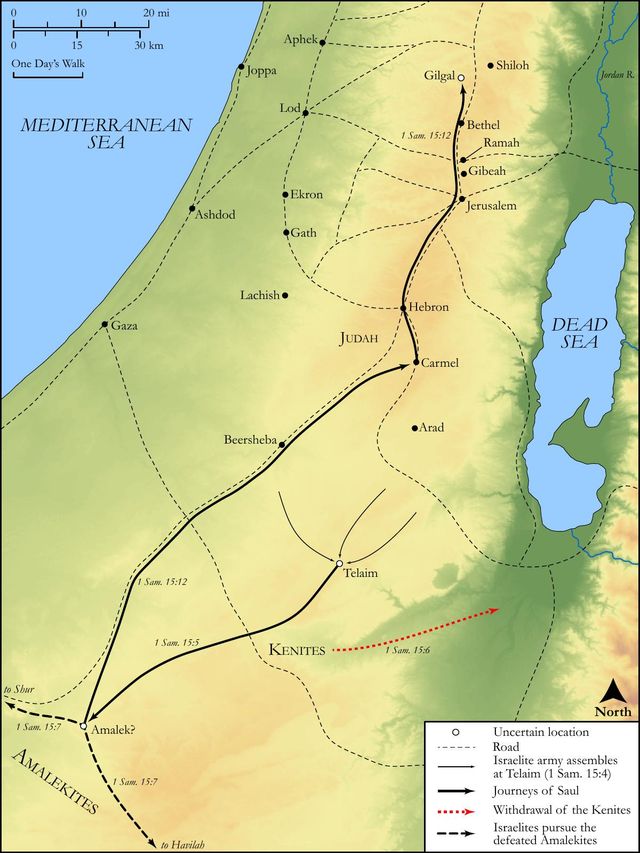
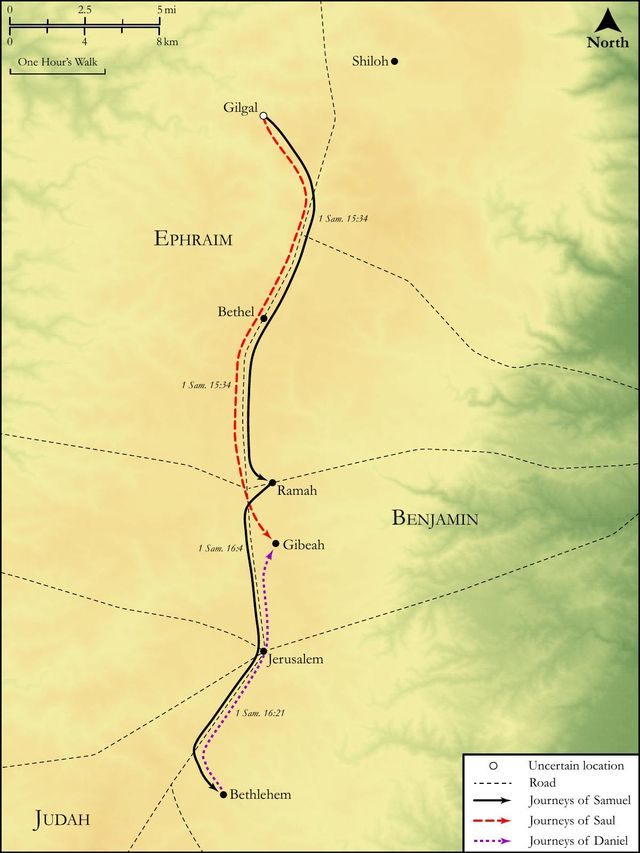
See on the biblical-era maps
Study this verse
Public-domain commentary
Matthew Henry
From his Commentary on the Whole Bible. Henry comments on passages, not single verses — this entry covers 1 Samuel 15:10–23. His three-level outline is real structure in the source text, so it is rendered as structure.
Saul is here called to account by Samuel concerning the execution of his commission against the Amalekites; and remarkable instances we are here furnished with of the strictness of the justice of God and the treachery and deceitfulness of the heart of man. We are here told,
I.What passed between God and Samuel, in secret, upon this occasion, Sa1 15:10, Sa1 15:11.
1.God determines Saul's rejection, and acquaints Samuel with it: It repenteth me that I have set up Saul to be king. Repentance in God is not, as it is in us, a change of his mind, but a change of his method or dispensation. He does not alter his will, but wills an alteration. The change was in Saul: He has turned back from following me; this construction God put upon the partiality of his obedience, and the prevalency of his covetousness. And hereby he did himself make God his enemy. God repented that he had given Saul the kingdom and the honour and power that belonged to it: but he never repented that he had given any man wisdom and grace, and his fear and love; these gifts and callings of God are without repentance.
2.Samuel laments and deprecates it. It grieved Samuel that Saul had forfeited God's favour, and that God had resolved to cast him off; and he cried unto the Lord all night, spent a whole night in interceding for him, that this decree might not go forth against him. When others were in their beds sleeping, he was upon his knees praying and wrestling with God. He did not thus deprecate his own exclusion from the government; nor was he secretly pleased, as many a one would have been, that Saul, who succeeded him, was so soon laid aside, but on the contrary prayed earnestly for his establishment, so far was he from desiring that woeful day. The rejection of sinners is the grief of good people; God delights not in their death, nor should we.
II.What passed between Samuel and Saul in public.
Samuel, being sent of God to him with these heavy tidings, went, as Ezekiel, in bitterness of soul, to meet him, perhaps according to an appointment when Saul went forth on this expedition, for Saul had come to Gilgal (Sa1 15:12), the place where he was made king (Sa1 11:15), and were now he would have been confirmed if he had approved himself well in the trial of his obedience. But Samuel was informed that Saul had set up a triumphal arch, or some monument of his victory, at Carmel, a city in the mountains of Judah, seeking his own honour more than the honour of God, for he set up this place (or hand, as the word is) for himself (he had more need to have been repenting of his sin and making his peace with God than boasting of his victory), and also that he had marched in great state to Gilgal, for this seems to be intimated in the manner of expression: He has gone about, and passed on, and gone down, with a great deal of pomp and parade. There Samuel gave him the meeting, and,
1.Saul makes his boast to Samuel of his obedience, because that was the thing by which he was now to signalize himself (Sa1 15:13): "Blessed be thou of the Lord, for thou sendest me upon a good errand, in which I have had great success, and I have performed the commandment of the Lord." It is very likely, if his conscience had now flown in his face at this time and charged him with disobedience, he would not have been so forward to proclaim his disobedience; for by this he hoped to prevent Samuel's reproving him. Thus sinners think, by justifying themselves, to escape being judged of the Lord; whereas the only way to do that is by judging ourselves. Those that boast most of their religion may be suspected of partiality and hypocrisy in it.
2.Samuel convicts him by a plain demonstration of his disobedience. "Hast thou performed the commandment of the Lord? What means then the bleating of the sheep?" Sa1 15:14. Saul would needs have it thought than God Almighty was wonderfully beholden to him for the good service he had done; but Samuel shows him that God was so far from being a debtor to him that he had just cause of action against him, and produces for evidence the bleating of the sheep, and the lowing of the oxen, which perhaps Saul appointed to bring up the rear of his triumph, but Samuel appears to them as witnesses against him. He needed not go far to disprove his professions. The noise the cattle made (like the rust of silver, Jam 5:3) would be a witness against him. Note, It is no new thing for the plausible professions and protestations of hypocrites to be contradicted and disproved by the most plain and undeniable evidence. Many boast of their obedience to the command of God; but what mean then their indulgence of the flesh, their love of the world, their passion and uncharitableness, and their neglect of holy duties, which witness against them?
3.Saul insists upon his own justification against this charge, Sa1 15:15. The fact he cannot deny; the sheep and oxen were brought from the Amalekites. But,
(1.)It was not his fault, for the people spared them; as if they durst have done it without the express orders of Saul, when they knew it was against the express orders of Samuel. Note, Those that are willing to justify themselves are commonly very forward to condemn others, and to lay the blame upon any rather than take it to themselves. Sin is a brat that nobody cares to have laid at his doors. It is the sorry subterfuge of an impenitent heart, that will not confess its guilt, to lay the blame on those that were tempters, or partners, or only followers in it.
(2.)It was with a good intention: "It was to sacrifice to the Lord thy God. He is thy God, and thou wilt not be against any thing that is done, as this is, for his honour." This was a false plea, for both Saul and the people designed their own profit in sparing the cattle. But, if it had been true, it would still have been frivolous, for God hates robbery for burnt-offering. God appointed these cattle to be sacrificed to him in the field, and therefore will give those no thanks that bring them to be sacrificed at his altar; for he will be served in his own way, and according to the rule he himself has prescribed. Nor will a good intention justify a bad action.
4.Samuel overrules, or rather overlooks, his plea, and proceeds, in God's name, to give judgment against him. He premises his authority. What he was about to say was what the Lord had said to him (Sa1 15:16), otherwise he would have been far from passing so severe a censure upon him. Those who complain that their ministers are too harsh with them should remember that, while they keep to the word of God, they are but messengers, and must say as they are bidden, and therefore be willing, as Saul himself here was, that they should say on. Samuel delivers his message faithfully.
(1.)He reminds Saul of the honour of God had done him in making him king (Sa1 15:17), when he was little in his own sight. God regarded the lowness of his state and rewarded the lowliness of his spirit. Note, Those that are advanced to honour and wealth ought often to remember their mean beginnings, that they may never think highly of themselves, but always study to do great things for the God that had advanced them.
(2.)He lays before him the plainness of the orders he was to execute (Sa1 15:18): The Lord sent thee on a journey; so easy was the service, and so certain the success, that it was rather to be called a journey than a war. The work was honourable, to destroy the sworn enemies of God and Israel; and had he denied himself, and set aside the consideration of his own profit so far as to have destroyed all that belonged to Amalek, he would have been no loser by it at last, nor have gone this warfare on his own charges. God would no doubt have made it up to him, so that he should have no need of spoil. And therefore,
(3.)He shows him how inexcusable he was in aiming to make a profit of this expedition, and to enrich himself by it (Sa1 15:19): "Wherefore then didst thou fly upon the spoil, and convert that to thy own use which was to have been destroyed for God's honour?" See what evil the love of money is the root of; but see what is the sinfulness of sin, and that in it which above any thing else makes it evil in the sight of the Lord. It is disobedience: Thou didst not obey the voice of the Lord.
5.Saul repeats his vindication of himself, as that which, in defiance of conviction, he resolved to abide by, Sa1 15:20, Sa1 15:21. He denies the charge (Sa1 15:20): "Yea, I have obeyed, I have done all I should do;" for he had done all which he thought he needed to do, so much wiser was he in his own eyes than God himself. God bade him kill all, and yet he puts in among the instances of his obedience that he brought Agag alive, which he thought was as good as if he had killed him. Thus carnal deceitful hearts think to excuse themselves from God's commandments with their own equivalents. He insists upon it that he has utterly destroyed the Amalekites themselves, which was the main thing intended; but, as to the spoil, he owns it should have been utterly destroyed; so that he knew his Lord's will, and was under no mistake about the command. But he thought that would be wilful waste; the cattle of the Midianites was taken for a prey in Moses's time (Num 31:32, etc.), and why not the cattle of the Amalekites now? Better it should be prey to the Israelites than to the fowls of the air and the wild beasts; and therefore he connived at the people's carrying it away. But it was their doing and not his; and, besides, it was for sacrifice to the Lord here at Gilgal, whither they were now bringing them. See what a hard thing it is to convince the children of disobedience of their sin and to strip them of their fig-leaves.
6.Samuel gives a full answer to his apology, since he did insist upon it, Sa1 15:22, Sa1 15:23. He appeals to his own conscience: Has the Lord as great delight in sacrifices as in obedience? Though Saul was not a man of any great acquaintance with religion, yet he could not but know this,
(1.)That nothing is so pleasing to God as obedience, no, not sacrifice and offering, and the fat of rams. See here what we should seek and aim at in all the exercises of religion, even acceptance with God, that he may delight in what we do. If God be well pleased with us and our services, we are happy, we have gained our point, but otherwise to what purpose is it? Isa 1:11. Now here we are plainly told that humble, sincere, and conscientious obedience to the will of God, is more pleasing and acceptable to him than all burnt-offerings and sacrifices. A careful conformity to moral precepts recommends us to God more than all ceremonial observances, Mic 6:6-8; Hos 6:6. Obedience is enjoyed by the eternal law of nature, but sacrifice only by a positive law. Obedience was the law of innocency, but sacrifice supposes sin come into the world, and is but a feeble attempt to take that away which obedience would have prevented. God is more glorified and self more denied by obedience than by sacrifice. It is much easier to bring a bullock or lamb to be burnt upon the altar than to bring every high thought into obedience to God and the will subject to his will. Obedience is the glory of angels (Psa 103:20), and it will be ours.
(2.)That nothing is so provoking to God as disobedience, setting up our wills in competition with his. This is here called rebellion and stubbornness, and is said to be as bad as witchcraft and idolatry, Sa1 15:23. It is as bad to set up other gods as to live in disobedience to the true God. Those that are governed by their own corrupt inclinations, in opposition to the command of God, do, in effect, consult the teraphim (as the word here is for idolatry) or the diviners. It was disobedience that made us all sinners (Rom 5:19), and this is the malignity of sin, that it is the transgression of the law, and consequently it is enmity to God, Rom 8:7. Saul was a king, but if he disobey the command of God, his royal dignity and power will not excuse him from the guilt of rebellion and stubbornness. It is not the rebellion of the people against their prince, but of a prince against God, that this text speaks of.
7.He reads his doom: in short, "Because thou has rejected the word of the Lord, hast despised it (so the Chaldee), hast made nothing of it (so the Septuagint), hast cast off the government of it, therefore he has rejected thee, despised and made nothing of thee, but cast thee off from being king. He that made thee king has determined to unmake thee again." Those are unfit and unworthy to rule over men who are not willing that God should rule over them.
Historical interpretation
Four Centuries of Reception
3 surviving comments on this verse. Each one is dated, so this reads as a timeline rather than a list.
Select a marker to jump to its quote. Markers stagger vertically where authors wrote within a few decades of each other.
And when Saul was charged with negligence and a breach of the law, he did not benefit his cause by alleging his conduct on other matters. For a defense on one count will not operate to obtain an acquittal on another count. But if all things should be done according to law and justice, one must defend himself in those particulars wherein he is accused and must either disprove the past or else confess it with the promise that he will desist and do so no more. But if he is guilty of the crime and will not confess, but in order to conceal the truth speaks on other points instead of the one in question, he shows plainly that he has acted amiss and is conscious of his delinquency.
Finally, because he never had this eye of discretion, he who by God’s judgment first deserved to rule over the people of Israel was cast out of his kingdom like something dark out of a healthy body. Having been deceived by the darkness and error of this light, he decided that his own sacrifices were more acceptable to God than obedience to Samuel’s command, and in the very act by which he had hoped that he would propitiate the divine majesty he committed sin instead.
And Saul said to Samuel: "Rather, I have obeyed the voice of the Lord," etc. How much this response of Saul suits the stubbornness of the rebellious proud ones is very easily evident from what was previously explained. For there are those who, convicted either by the reading of the Holy Scripture or by the speech of teachers, and reproved for their committed faults, prefer to seek an increase of their sins by excusing themselves rather than humbly seeking remedy.
Continue studying 1 Samuel 15:20 across the web’s major study libraries — every link below opens this exact verse, chapter, or book on the destination site.
Read & Compare
 BibleGatewayThis verse in more than 200 translations and 70 languages.
 Bible.comThe YouVersion reader — hundreds of translations, reading plans, and highlights.
 ESV.orgCrossway's official English Standard Version reader.
 NET BibleThe NET translation with 60,000+ translators' notes on every rendering decision.
 STEP BibleTyndale House's free study tool — original text, vocabulary, and scholarly resources.
 BibliaLogos Bible Software's free web reader.
 USCCBThe New American Bible (Revised Edition) with the U.S. bishops' study notes.
Commentaries
 BibleHub CommentariesDozens of classic commentaries on this verse, gathered on one page.
 StudyLightMore than 100 commentary sets — the largest collection on the web.
 BibleRefPlain-English commentary on what this verse means, verse by verse.
 Enduring WordDavid Guzik's free commentary on this chapter, widely used by Bible teachers.
 Bible Study ToolsVerse commentary alongside Greek and Hebrew study aids.
Original Language & Research
- BibleHub InterlinearThe verse word by word — original language, transliteration, and English.
- BibleHub LexiconEvery word's original-language definition and Strong's entry.
 Blue Letter BibleDeep-study tools — Strong's numbers, concordance, and word studies.
 SefariaThe Hebrew text with Rashi and centuries of Jewish commentary.
Sermons, Hymns & Audio


TrulyRandomVerse is not affiliated with these sites and doesn’t control their content. They’re linked because they’re genuinely useful.
Summary
In 1 Samuel 15:20, King Saul, facing the prophet Samuel's confrontation over his incomplete obedience to God's command regarding the Amalekites, defiantly declares his full compliance. He asserts that he has faithfully followed the Lord's instructions, traveled the appointed path, captured Agag, the king of Amalek, and utterly destroyed the Amalekites. This self-justifying statement stands in stark contradiction to the divine revelation given to Samuel and the observable evidence of Saul's partial obedience, revealing a profound self-deception and a fundamental misunderstanding of true faithfulness to God.
Context
ShowHideLiterary Context
This verse is a critical turning point within the broader narrative of 1 Samuel 15, which chronicles Saul's decisive failure as king. The chapter opens with Samuel delivering a direct and unambiguous command from the LORD to Saul: "Now go and attack Amalek, and utterly destroy all that they have; do not spare them, but kill both man and woman, child and infant, ox and sheep, camel and donkey" (1 Samuel 15:3). This was a cherem command, a divine decree for total devotion to God through destruction, leaving no spoils. Saul mobilizes his army and attacks, but then deviates significantly from the command, sparing King Agag and the choicest of the livestock (1 Samuel 15:8-9). God reveals Saul's disobedience and expresses regret over making him king to Samuel (1 Samuel 15:10-11). Saul's declaration in 1 Samuel 15:20 is his immediate, defensive retort to Samuel's pointed question about the sound of sheep and oxen, setting the stage for Samuel's iconic rebuke about obedience being superior to sacrifice and the subsequent pronouncement of Saul's rejection as king (1 Samuel 15:22-23).
Historical & Cultural Context
The Amalekites were a long-standing, persistent, and particularly malicious enemy of Israel, first attacking them in the wilderness after the Exodus, preying on the weak and straggling (Exodus 17:8-16). Because of their unprovoked aggression against God's chosen people, God had sworn to utterly blot out their memory (Exodus 17:14) and commanded Israel to remember and execute this judgment (Deuteronomy 25:17-19). The command to "utterly destroy" (Hebrew: cherem) was a unique form of holy war, where all spoils and living beings were devoted to God, typically through destruction, to prevent defilement, personal gain, or the adoption of pagan practices. For Saul to spare Agag, a king, was likely an attempt to gain prestige (a defeated king as a trophy for a triumphal procession) or for political reasons (to show mercy, or to use him as a pawn). Sparing the livestock, even under the guise of offering sacrifices, was a direct violation of the cherem decree, demonstrating a prioritization of human reasoning and perceived benefit over explicit divine command. This act also reveals a cultural understanding of kingship, where a king might expect to take spoils of war, contrasting sharply with God's unique demands for Israel's king to operate under divine law.
Key Themes
ShowHideThis verse powerfully illustrates the theme of partial obedience as complete disobedience in God's eyes. Saul's fervent self-justification and profound self-deception are prominently displayed, as he attempts to rationalize his actions and present a false narrative of faithfulness to Samuel and, perhaps, to himself. The passage highlights the nature of true obedience, emphasizing that God desires complete, unreserved submission to His will, not merely outward conformity or actions performed for personal gain, perceived piety, or human approval. It also touches upon the sovereignty of God and His absolute right to set the terms of obedience for His covenant people, even for a king. Saul's ultimate failure to obey completely leads directly to the rejection of his kingship, underscoring the severe consequences of disobedience for those in positions of leadership and responsibility, a theme powerfully articulated in Samuel's declaration in 1 Samuel 15:23.
Exposition and Analysis
ShowHideKey Word Analysis
ShowHideThis verb (H559) means "to say (used with great latitude); answer, appoint, avouch, bid, boast self, call, certify, challenge, charge, [phrase] (at the, give) command(-ment), commune, consider, declare, demand, [idiom] desire, determine, [idiom] expressly, [idiom] indeed, [idiom] intend, name, [idiom] plainly, promise, publish, report, require, say, speak (against, of), [idiom] still, [idiom] suppose, talk, tell, term, [idiom] that is, [idiom] think, use (speech), utter, [idiom] verily, [idiom] yet." Saul's use of this word here is not merely a simple statement but a forceful declaration, an attempt to "certify" his actions and "declare" his innocence, despite the clear evidence to the contrary. It conveys a sense of self-assurance, even boastfulness, in his own perceived righteousness.
This verb (H8085) means "to hear intelligently (often with implication of attention, obedience, etc.; causatively, to tell, etc.); [idiom] attentively, call (gather) together, [idiom] carefully, [idiom] certainly, consent, consider, be content, declare, [idiom] diligently, discern, give ear, (cause to, let, make to) hear(-ken, tell), [idiom] indeed, listen, make (a) noise, (be) obedient, obey, perceive, (make a) proclaim(-ation), publish, regard, report, shew (forth), (make a) sound, [idiom] surely, tell, understand, whosoever (heareth), witness." Saul's claim to have "obeyed" (perfect tense, indicating a completed action) is ironic. While he physically "heard" the command, his subsequent actions demonstrate a failure to "hear intelligently" or "obey" in the full sense of the word, which implies complete compliance and submission to the will of the LORD (H3068).
This noun (H1870) means "from דָּרַךְ; a road (as trodden); figuratively, a course of life or mode of action, often adverb; along, away, because of, [phrase] by, conversation, custom, (east-) ward, journey, manner, passenger, through, toward, (high-) (path-) way(-side), whither(-soever)." Saul claims to have "gone the way" (H3212, yâlak) which the LORD (H3068) sent him. While he did embark on the military "journey" or "road" to Amalek, his "course of life or mode of action" deviated from the divine instruction. His claim of following the "way" is true in part (the physical journey) but false in its most crucial, figurative sense (the moral and spiritual path of complete obedience).
This verb (H2763) means "a primitive root; to seclude; specifically (by a ban) to devote to religious uses (especially destruction); physical and reflexive, to be blunt as to the nose; make accursed, consecrate, (utterly) destroy, devote, forfeit, have a flat nose, utterly (slay, make away)." Saul's assertion that he "utterly destroyed" the Amalekites is the most direct lie. The word châram carries the weight of a sacred ban, signifying complete and total destruction, often for the purpose of consecration to God. Saul's sparing of Agag (H90, H4428) and the best of the livestock directly contradicts this meaning, revealing his attempt to redefine or diminish the severity of God's command to fit his disobedient actions.
Verse Breakdown
ShowHide"And Saul said unto Samuel,"
This opening clause establishes the direct confrontation between the disobedient king and the prophet acting as God's messenger. It sets a tense, immediate tone for Saul's defensive response.
"Yea, I have obeyed the voice of the LORD,"
Saul begins with an emphatic affirmation, "Yea" (literally "Indeed" or "Surely"), asserting his complete compliance with God's command. This bold, declarative statement is intended to deflect Samuel's implied accusation and project an image of faithfulness, possibly even convincing himself of his own righteousness.
"and have gone the way which the LORD sent me,"
This clause acknowledges a degree of initial, outward obedience. Saul did indeed mobilize his army and proceed to fight the Amalekites as commanded. This partial truth is strategically used to bolster his overall claim of obedience, masking the crucial areas where he failed to follow through on the divine instruction.
"and have brought Agag the king of Amalek,"
This is a critical and damning admission. Instead of "utterly destroying" Agag as explicitly commanded, Saul "brought" him, implying capture and preservation. This act was a clear, direct violation of the cherem command, revealing Saul's self-serving motives, perhaps desiring a triumphal procession or a valuable hostage, rather than God's glory.
"and have utterly destroyed the Amalekites."
This final clause is the most blatant falsehood and the pinnacle of Saul's self-deception. While he did destroy many Amalekites, his claim of having "utterly destroyed" them is directly contradicted by the presence of Agag and the spared livestock, which Samuel immediately points out. This statement reveals Saul's attempt to redefine "utterly destroyed" to fit his actions, or his profound inability to perceive his own disobedience.
Literary Devices
ShowHideThe primary literary device at play in 1 Samuel 15:20 is Dramatic Irony. The audience, having just witnessed Saul's actions in 1 Samuel 15:8-9, possesses knowledge that Saul himself seems to lack or willfully ignores. Saul's confident assertion of complete obedience, therefore, is dramatically ironic, highlighting his profound self-deception and the vast chasm between his perception of reality and the actual truth. There is also a strong element of Verbal Irony in Saul's use of the phrase "utterly destroyed" (חָרַם, charam), as he employs the very term that defines the command he failed to fully execute, twisting its meaning to justify his partial obedience. Furthermore, Saul's statement that he "brought Agag" can be seen as a Euphemism, subtly masking the disobedience of sparing the king rather than explicitly stating he did not kill him. This entire exchange functions as a powerful Contrast between true, complete obedience and partial, self-serving compliance, setting the stage for Samuel's subsequent, devastating rebuke.
Theological and Thematic Connections
ShowHideSaul's audacious declaration in 1 Samuel 15:20 serves as a profound theological lesson on the nature of obedience and the insidious danger of self-deception. It unequivocally underscores that God does not accept partial obedience or human-generated rationalizations for disobedience. For God, obedience is not merely about performing some aspects of a command while neglecting others; it demands complete, humble submission to His will, without reservation, reinterpretation, or personal gain. Saul's failure demonstrates that human intentions, even if seemingly pious (like offering sacrifices from the spoils), cannot supersede God's explicit commands. This narrative emphasizes that true faith is demonstrated through a humble and complete surrender to divine authority, recognizing God's wisdom and sovereignty above one's own understanding or perceived benefits. It is a stark reminder that what we deem "good enough" or "close enough" is often, in God's eyes, outright disobedience.
Reflection and Application
ShowHideThe account of Saul's self-deception and partial obedience in 1 Samuel 15:20 offers a timeless and piercing mirror for believers today. We, too, are susceptible to the subtle trap of selective obedience, convincing ourselves that our actions are acceptable to God even when we knowingly fall short of His clear commands. This passage challenges us to engage in honest, introspective examination of our hearts and motives: Are we truly striving to obey God fully, or are we rationalizing our compromises, sparing our own "Agags" (our cherished sins, comfortable habits, worldly gains, or personal preferences) while outwardly claiming to be faithful? This verse calls us to profound humility, urging us to confess our shortcomings and seek genuine repentance rather than attempting to justify or minimize them. It compels us to cultivate a spirit of complete and joyful surrender to God's Word, trusting implicitly that His ways are always perfect, holy, and ultimately for our good, even when they require personal sacrifice or seem counterintuitive to our human logic and desires.
Questions for Reflection
ShowHideFAQ
ShowHideWhy was it so important for Saul to "utterly destroy" the Amalekites, including their king and livestock?
ShowHideThe command to "utterly destroy" (Hebrew: cherem) the Amalekites was a divine judgment against a people who had shown persistent, unprovoked hostility towards Israel and, by extension, against God Himself. The Amalekites were the first to attack Israel after their exodus from Egypt, striking at the weakest and most vulnerable among them (Exodus 17:8-16). God had sworn to blot out their memory (Exodus 17:14) and commanded Israel to remember their wickedness and execute this judgment (Deuteronomy 25:17-19). The cherem was not merely a military strategy but a profound theological act of devotion, where the spoils of war were dedicated to God by complete destruction. This prevented Israel from profiting from or being corrupted by the wickedness of the defeated nation, ensuring purity and absolute reliance on God. For Saul to spare Agag and the best of the livestock was a direct violation of this sacred command, demonstrating a lack of full trust in God's judgment and a desire for personal gain or glory over divine obedience.
Christ-Centered Fulfillment
ShowHideSaul's tragic failure in 1 Samuel 15:20 vividly highlights humanity's pervasive struggle with perfect obedience, a struggle that finds its ultimate and glorious resolution in Jesus Christ. Where Saul offered partial obedience and self-justification, Jesus offered perfect, unwavering, and complete obedience to the Father's will, even to the agonizing point of death on a cross (Philippians 2:8). The cherem command given to Saul, signifying complete devotion to God through utter destruction of evil, foreshadows Christ's ultimate victory over sin, death, and the powers of darkness. Through His sacrifice and resurrection, Christ utterly destroyed the power of the enemy, disarming principalities and powers and triumphing over them (Colossians 2:15). Unlike Saul, who sought to preserve what was deemed valuable by human standards for personal gain, Christ surrendered all, fulfilling the Father's will completely and perfectly, becoming the Lamb of God who truly takes away the sin of the world (John 1:29). His perfect obedience is graciously imputed to believers, covering our own failures to obey and making us righteous before God (Romans 5:19). Thus, Saul's sin of partial obedience profoundly underscores our desperate need for a Savior whose obedience was absolute, redemptive, and eternally sufficient.