


Numbers 31:32
Bible text: King James Version (1769 Blayney text) · Public domain
Bible text: King James Version with Strong's numbers · Public domain
Bible text: Berean Standard Bible · Public domain
Bible text: American Standard Version (1901) · Public domain
Bible text: World English Bible, Messianic edition · Public domain
Bible text: Geneva Bible (1599) · Public domain
Bible text: Young's Literal Translation · Public domain
- וַיְהִיvay·Hiand it wasH1961Conj-w ¦ V-Qal-ConsecImperf-3msVerb Qal Consecutive Imperfect 3rd Singular Masculineוַandיְהִיit was
- הַמַּלְקוֹחַha·mal·Ko·achthe bootyH4455Art ¦ N-msNoun Singular Masculine Absoluteהַtheמַּלְקוֹחַbooty
- יֶתֶרYe·ter[the] remainder ofH3499N-mscNoun Singular Masculine Construct
- הַבָּזha·Bazthe plunderH957Art ¦ N-msNoun Singular Masculine Absoluteהַtheבָּזplunder
- אֲשֶׁר'a·SherwhichH834RelParticle Relative
- בָּזְזוּba·ze·Zuthey had plunderedH962V-Qal-Perf-3cpVerb Qal Perfect 3rd Plural common gender
- עַם'am[the] people ofH5971N-mscNoun Singular Masculine Construct
- הַצָּבָאha·tza·Va'the armyH6635Art ¦ N-msNoun Singular Masculine Absoluteהַtheצָּבָאarmy
- צֹאןTzonsheepH6629N-csNoun Singular common gender Absolute
- שֵׁשׁsheshsixH8337Adj-cscAdjective Numerical Singular common gender Construct
- מֵאוֹתme·'othundred<s>H3967Adj-fpAdjective Numerical Plural Feminine Absolute
- אֶלֶף'E·lefthousandH505Adj-csAdjective Numerical Singular common gender Absolute
- וְשִׁבְעִיםve·shiv·'Imand seventyH7657Conj-w ¦ Adj-mpAdjective Numerical Plural Masculine Absoluteוְandשִׁבְעִיםseventy
- אֶלֶף'E·lefthousandH505Adj-csAdjective Numerical Singular common gender Absolute
- וַחֲמֵשֶׁתva·cha·me·shetand fiveH2568Conj-w ¦ Adj-cscAdjective Numerical Singular common gender Constructוַandחֲמֵשֶׁתfive
- אֲלָפִים'a·la·Fimthousand<s>H505Adj-cpAdjective Numerical Plural common gender Absolute
English is a literal word-by-word gloss of the Hebrew, not the KJV's wording. Why?
This is the original text the KJV's translators worked from — each Hebrew word with its own literal English meaning in this verse, prepared by scholars at Tyndale House, Cambridge. The KJV translates whole sentences, not word by word, so its wording differs: one Hebrew word can become several English words, and the KJV may choose “the LORD” where the gloss reads “Yahweh”. Both are faithful — they answer different questions. For the KJV's own rendering, switch to the KJV text.
Details
See on the biblical-era map
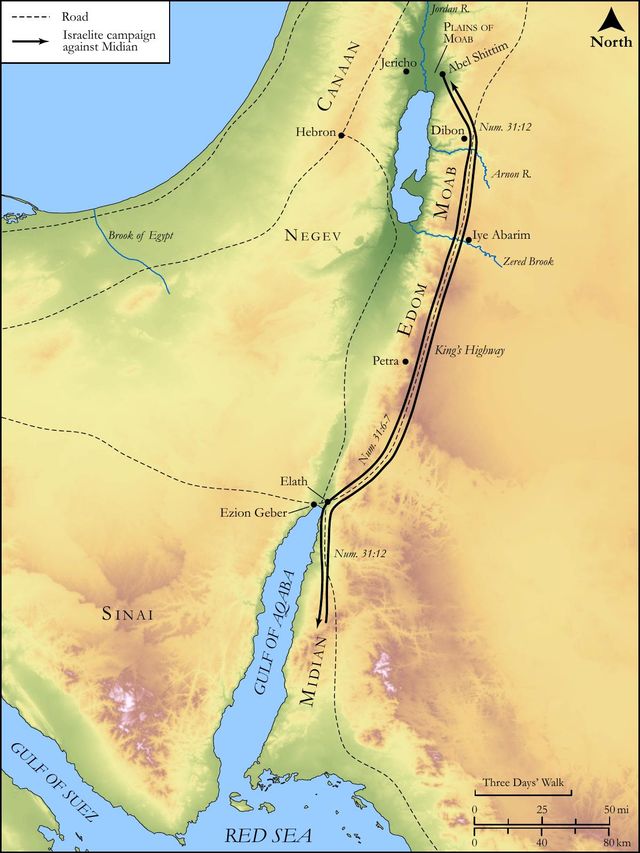
Study this verse
Continue studying Numbers 31:32 across the web’s major study libraries — every link below opens this exact verse, chapter, or book on the destination site.
Read & Compare
 BibleGatewayThis verse in more than 200 translations and 70 languages.
 Bible.comThe YouVersion reader — hundreds of translations, reading plans, and highlights.
 ESV.orgCrossway's official English Standard Version reader.
 NET BibleThe NET translation with 60,000+ translators' notes on every rendering decision.
 STEP BibleTyndale House's free study tool — original text, vocabulary, and scholarly resources.
 BibliaLogos Bible Software's free web reader.
 USCCBThe New American Bible (Revised Edition) with the U.S. bishops' study notes.
Commentaries
 BibleHub CommentariesDozens of classic commentaries on this verse, gathered on one page.
 StudyLightMore than 100 commentary sets — the largest collection on the web.
 BibleRefPlain-English commentary on what this verse means, verse by verse.
 Enduring WordDavid Guzik's free commentary on this chapter, widely used by Bible teachers.
 Bible Study ToolsVerse commentary alongside Greek and Hebrew study aids.
Original Language & Research
- BibleHub InterlinearThe verse word by word — original language, transliteration, and English.
- BibleHub LexiconEvery word's original-language definition and Strong's entry.
 Blue Letter BibleDeep-study tools — Strong's numbers, concordance, and word studies.
 SefariaThe Hebrew text with Rashi and centuries of Jewish commentary.
Sermons, Hymns & Audio


TrulyRandomVerse is not affiliated with these sites and doesn’t control their content. They’re linked because they’re genuinely useful.
Summary
Numbers 31:32 provides a meticulous accounting of a specific portion of the vast spoils acquired by the Israelite army following their divinely orchestrated punitive war against the Midianites. This verse precisely itemizes 675,000 sheep, serving as a powerful testament to the overwhelming scale of Israel's victory, the comprehensive nature of God's judgment upon Midian for their wickedness, and His abundant and faithful provision for His covenant people as they journeyed through the wilderness toward the Promised Land.
Context
ShowHideLiterary Context
Numbers 31:32 is found within the detailed account of Israel's war against the Midianites, a narrative spanning the entirety of Numbers 31. This conflict is a direct divine mandate, a "vengeance of the LORD" (Numbers 31:3) against Midian for their role in seducing Israel into idolatry and sexual immorality at Baal-peor, as vividly recounted in Numbers 25. The chapter begins with God's explicit command to Moses to "avenge the children of Israel of the Midianites" (Numbers 31:1-2). The subsequent narrative describes a swift, decisive, and miraculous victory, with no Israelite casualties (Numbers 31:7). Following the battle, Moses, Eleazar the priest, and the tribal leaders meticulously oversee the counting and division of the immense spoils, which included human captives, livestock, and precious metals. Verses Numbers 31:25-47 delineate the precise instructions for distributing the plunder, with specific portions designated as a "tribute to the LORD" (Numbers 31:28). Therefore, verse 32 provides a specific, staggering enumeration of the sheep, highlighting the sheer quantity of acquired wealth and the thoroughness of the divinely empowered victory.
Historical & Cultural Context
The war against Midian was not a typical territorial conquest but a unique, divinely ordained act of retribution for Midian's spiritual and moral corruption of Israel. Among the nations, warfare frequently involved the complete destruction of enemy populations and the seizure of their assets as "spoils" or "booty." This practice, while appearing harsh to modern sensibilities, was a common aspect of ancient military campaigns and, in this biblical context, served as a direct instrument of divine judgment. Midian, a nomadic people, possessed substantial wealth primarily in livestock, which was a fundamental measure of prosperity in an agrarian and pastoral society. The immense number of sheep and other animals captured would have represented a colossal economic windfall for the Israelites, providing crucial sustenance and resources as they prepared for their impending entry into the Promised Land. The meticulous counting and division of spoils also reflect the highly organized nature of Israel's tribal society and the paramount importance of priestly oversight in ensuring that God's commands regarding war and its aftermath were precisely and obediently followed.
Key Themes
ShowHideNumbers 31:32 contributes significantly to several overarching themes present throughout the book of Numbers and the Pentateuch. Firstly, it powerfully illustrates Divine Justice and Retribution. The war was not arbitrary but a direct consequence of Midian's active role in leading Israel into grievous sin, demonstrating God's unwavering commitment to holiness and His just judgment against wickedness that threatens His covenant people and their purity. Secondly, it highlights God's Abundant Provision. The staggering quantity of livestock, particularly the 675,000 sheep, underscores God's boundless capacity to supply richly for His people's needs, even through the unexpected context of warfare. This abundance was crucial for sustaining the massive Israelite population in the wilderness and preparing them for their future in Canaan. Thirdly, the detailed enumeration and subsequent division of the spoils, as meticulously outlined in Numbers 31:27-47, emphasize the theme of Order, Obedience, and Meticulousness. God's commands extend to every detail of Israelite life, including the handling of war gains, reinforcing the critical importance of precise adherence to His instructions and the dedication of a portion back to Him as an act of worship and acknowledgment of His absolute sovereignty. The entire chapter, including this verse, serves as a powerful reminder of the consequences of disobedience and the blessings of faithful adherence to God's covenant.
Exposition and Analysis
ShowHideKey Word Analysis
ShowHideThis term (H4455, מַלְקוֹחַ) refers to spoil or prey taken from an enemy, encompassing all movable property, including livestock, precious metals, and garments. It literally means "that which is taken" or "captured." In this context, it emphasizes the material gains of the Israelite victory, which were a direct result of God's judgment and provision. The use of "booty" alongside "prey" in the KJV text highlights the comprehensive nature of the captured assets, signifying everything seized in the military engagement.
The Hebrew word (H3499, יֶתֶר) signifies an excess, superiority, remainder, or residue. In Numbers 31:32, "the rest of the prey" clarifies that this specific enumeration refers to the portion of the spoils that remained after the initial collection and perhaps any immediate needs or allocations. It denotes the bulk of the captured wealth that was subject to the meticulous division process, highlighting that what is being counted is the substantial, leftover portion of the total capture.
This collective Hebrew term (H6629, צֹאן) refers to small cattle, specifically encompassing both sheep and goats. In Scripture, sheep were a primary form of wealth, as with Job, whose substance was seven thousand sheep, providing essential resources such as meat, milk, wool, and skins. The staggering number specified (675,000) underscores the immense scale of Midianite wealth and, by extension, the overwhelming abundance of the plunder for Israel. It signifies not merely a military victory but a significant economic transfer and a profound act of divine provision for the sustenance of the Israelite nation in the wilderness.
Verse Breakdown
ShowHide"And the booty, [being] the rest of the prey which the men of war had caught"
This opening clause establishes the subject of the verse: the material wealth seized by the Israelite soldiers during their military campaign against Midian. The phrase "the rest of the prey" specifies that this is the remaining, substantial portion of the captured goods, distinguishing it from any initial, perhaps uncounted, gains or those already set aside. It emphasizes that this was the tangible, physical wealth directly acquired by the victorious Israelite forces, destined for meticulous division.
"was six hundred thousand and seventy thousand and five thousand sheep"
This precise, yet cumulatively vast, enumeration details the specific type and quantity of livestock. The sum of 675,000 sheep highlights the enormous scale of the Midianite flocks and the thoroughness of the Israelite victory. This number is not merely a statistic but a powerful demonstration of God's abundant provision for His people, designed to sustain them in the wilderness and prepare them for the challenges and settlement of the Promised Land. It underscores the divine blessing accompanying Israel's obedience in executing God's judgment.
Literary Devices
ShowHideNumbers 31:32 employs several literary devices to convey its profound message. The most prominent is Enumeration, which is the detailed and precise listing of items or numbers. This meticulous counting of the spoils, particularly the sheep, underscores the thoroughness of the Israelite victory and the vastness of the acquired wealth. The sheer magnitude of the numbers, such as "six hundred thousand and seventy thousand and five thousand sheep," might also be interpreted as a form of Hyperbole, a deliberate exaggeration for emphasis. While the figures could be literal, such large numbers may also be meant to convey overwhelming abundance, power, or divine favor, rather than strict statistical accuracy. This emphasis serves to highlight the extraordinary nature of God's provision and the completeness of His judgment against Midian. Furthermore, the detailed listing of the spoils throughout Numbers 31 creates a strong sense of Verisimilitude, lending credibility and realism to the narrative by presenting it with concrete, specific details, even if the exact figures are primarily intended to convey a sense of immensity and divine blessing.
Theological and Thematic Connections
ShowHideNumbers 31:32, in its detailed account of the vast spoils, serves as a powerful testament to God's multifaceted character. It demonstrates His absolute sovereignty over nations and His unwavering commitment to justice, even when it involves severe retribution against those who actively oppose or corrupt His people. Simultaneously, it showcases His incredible faithfulness and abundant provision for Israel, transforming the enemy's wealth into a source of sustenance and blessing for His chosen nation. This act of divine transfer underscores that all resources ultimately belong to God, and He can use any means, even the spoils of war, to care for His covenant people. It also highlights the importance of obedience in all matters, as the meticulous division of spoils was part of God's precise command, reinforcing the principle that God's blessing often follows faithful adherence to His will and that a portion of all gains is due back to Him.
Reflection and Application
ShowHideWhile the historical context of Numbers 31:32 is unique to ancient Israel's divinely sanctioned warfare, its underlying principles offer profound spiritual insights for believers today. The passage reminds us that God is a God of both righteous judgment and abundant provision. Just as He acted decisively against Midian's wickedness, He continues to act against sin and evil in the world, ultimately bringing about justice in His perfect timing. For us, this translates into a call to align ourselves with God's holiness, recognizing that there are spiritual battles to be fought against sin, temptation, and the forces of darkness. We are called to participate in God's redemptive work by standing for righteousness and truth. Furthermore, the immense provision of sheep speaks to God's boundless capacity to meet our needs, often in unexpected and overwhelming ways. We are encouraged to trust in His faithfulness, knowing that He is our ultimate provider, even in challenging circumstances, and that His resources are limitless. This passage invites us to reflect on the "spoils" of our spiritual victories – the freedom from sin, the growth in grace, the spiritual blessings that come from walking in obedience to Christ. It challenges us to acknowledge God as the source of all good things and to live lives marked by profound gratitude, diligent stewardship of all He entrusts to us, and a willing dedication of a portion of our "gains" back to Him in worship and service.
Questions for Reflection
ShowHideFAQ
ShowHideWhy was this war against Midian commanded by God, and what does it tell us about divine justice?
ShowHideThe war against Midian, as meticulously detailed in Numbers 31, was a direct and explicit command from God to Moses, serving as a divinely ordained punitive expedition. Its primary cause was Midian's insidious role in seducing Israel into idolatry and sexual immorality at Baal-peor, which resulted in a devastating plague that claimed the lives of 24,000 Israelites. This act was far more than a mere military conquest; it was the execution of divine judgment against a people who had actively sought to corrupt God's covenant people and draw them away from Him. It profoundly tells us that God is holy and righteous, and He will not tolerate blatant sin and spiritual rebellion, especially when it directly threatens the purity and faithfulness of His chosen people. His justice is comprehensive, addressing both the sin itself and its instigators, ensuring the sanctity of His covenant community and demonstrating His unyielding opposition to evil.
Are the numbers of captured livestock in Numbers 31:32 to be taken literally, or are they symbolic?
ShowHideThe numbers presented in Numbers 31:32 (specifically 675,000 sheep, alongside other livestock and human captives in the surrounding verses) are indeed extraordinarily large. While some scholars interpret such figures as a form of symbolic hyperbole, intended to convey immense scale, overwhelming abundance, or divine favor rather than precise statistical counts, many others take them as literal, given the meticulous and detailed accounting that follows in the chapter. Regardless of whether the exact number is strictly literal or primarily a rhetorical emphasis on vastness, the undeniable message is that the amount of spoil was colossal. This underscores the overwhelming nature of the Israelite victory and the extraordinary abundance of God's provision for His people, transforming the wealth of their enemies into their sustenance. The subsequent meticulous division of these spoils, with specific portions for the soldiers, the congregation, and a tribute to the Lord, further suggests a real, tangible quantity, even if the precise enumeration might have been presented for maximum impact and to highlight the miraculous nature of the victory.
What is the broader significance of the spoils of war for ancient Israel, beyond just material gain?
ShowHideFor ancient Israel, the spoils of war, as vividly depicted in Numbers 31:32, carried multifaceted significance that extended far beyond mere material gain. Firstly, they were a tangible and undeniable sign of God's victory and faithfulness. The ability to defeat a formidable enemy and acquire such vast wealth demonstrated unequivocally that God was fighting on their behalf and fulfilling His covenant promises to provide for and protect them. Secondly, the spoils represented profound divine provision. For a nomadic people traversing the wilderness, livestock and other goods were absolutely essential for survival, sustenance, and future prosperity, highlighting God's meticulous care for their physical needs. Thirdly, the meticulous division and the dedication of a specific portion as a "tribute to the LORD" (Numbers 31:28) underscored the crucial principles of obedience, stewardship, and worship. It served as a powerful reminder to Israel that all blessings ultimately come from God, and a portion was to be consecrated back to Him, acknowledging His absolute sovereignty and supporting the priesthood and the tabernacle. Thus, the spoils were not just plunder but a profound spiritual lesson in God's power, His abundant provision, and the people's sacred responsibility to honor Him with their gains.
Christ-Centered Fulfillment
ShowHideNumbers 31:32, with its vivid depiction of divine judgment, decisive victory, and abundant spoils, finds its ultimate fulfillment and profound spiritual resonance in the person and redemptive work of Jesus Christ. Just as God commanded vengeance against Midian for their corruption of Israel, so too did God's perfect justice demand a reckoning for the pervasive sin that corrupted all humanity. Christ, as the Lamb of God who takes away the sin of the world, became the ultimate and perfect sacrifice, satisfying divine justice on the cross. His death was the decisive and complete victory over the forces of sin, death, and the devil, disarming and triumphing over them publicly (Colossians 2:15). The "booty" or "spoils" of Christ's victory are not material possessions but the immeasurable spiritual blessings and eternal freedom He bestows upon His people. Having led captivity captive, He ascended on high and "gave gifts unto men" (Ephesians 4:8). These gifts include complete forgiveness of sins, imputed righteousness, eternal life, the indwelling Holy Spirit, and the promise of resurrection. We, as believers, are the beneficiaries of this spiritual plunder, rescued from the dominion of darkness and wonderfully translated into His marvelous light (Colossians 1:13). The abundance of sheep in Numbers 31:32 foreshadows the immeasurable spiritual wealth that is ours in Christ, who through His death destroyed "him that had the power of death, that is, the devil" and delivered "them who through fear of death were all their lifetime subject to bondage" (Hebrews 2:14-15). Thus, the ancient victory over Midian points forward to the glorious and complete triumph of our Lord, whose victory provides an eternal abundance of grace, salvation, and spiritual riches for all who believe.