


Numbers 31:28
Bible text: King James Version (1769 Blayney text) · Public domain
Bible text: King James Version with Strong's numbers · Public domain
Bible text: Berean Standard Bible · Public domain
Bible text: American Standard Version (1901) · Public domain
Bible text: World English Bible, Messianic edition · Public domain
Bible text: Geneva Bible (1599) · Public domain
Bible text: Young's Literal Translation · Public domain
- וַהֲרֵמֹתָva·ha·re·mo·Taand you will raiseH7311Conj-w ¦ V-Hiphil-ConsecPerf-2msVerb Hiphil Consecutive Perfect 2nd Singular Masculineוַandהֲרֵמֹתָyou will raise
- מֶכֶסMe·khesa taxH4371N-msNoun Singular Masculine Absolute
- לַיהוָהla·Yah·wehfor YahwehH3068Prep-l ¦ N-properNoun Proper TitleלַforיהוָהYahweh
- מֵאֵתme·'Etfrom withH854Prep-m ¦ PrepPrepositionמֵfromאֵתwith
- אַנְשֵׁי'an·Shei[the] men ofH582N-mpcNoun Plural Masculine Construct
- הַמִּלְחָמָהha·mil·cha·Mah<the> warH4421Art ¦ N-fsNoun Singular Feminine Absoluteהַ<the>מִּלְחָמָהwar
- הַיֹּצְאִיםhai·yo·tze·'Imwho went outH3318Art ¦ V-Qal-Prtcpl-mpVerb Qal Participle Plural Masculine Absoluteהַwhoיֹּצְאִיםwent out
- לַצָּבָאla·tza·Va'to <the> warH6635Prep-l ¦ N-msNoun Singular Masculine Absoluteלַto <the>צָּבָאwar
- אֶחָד'e·ChadoneH259Adj-fscAdjective Numerical Singular Feminine Construct
- נֶפֶשׁNe·feshpersonH5315N-fsNoun Singular Feminine Absolute
- מֵחֲמֵשׁme·cha·Meshfrom [the] fiveH2568Prep-m ¦ Adj-cscAdjective Numerical Singular common gender Constructמֵfromחֲמֵשׁ[the] five
- הַמֵּאוֹתha·me·'ot<the> hundred<s>H3967Art ¦ Adj-fpAdjective Numerical Plural Feminine Absoluteהַ<the>מֵּאוֹתhundred<s>
- מִןminfromH4480PrepPreposition
- הָאָדָםha·'a·Dam<the> humankindH120Art ¦ N-msNoun Singular Masculine Absoluteהָ<the>אָדָםhumankind
- וּמִןu·minand fromH4480Conj-w ¦ PrepPrepositionוּandמִןfrom
- הַבָּקָרha·ba·Karthe cattleH1241Art ¦ N-csNoun Singular common gender Absoluteהַtheבָּקָרcattle
- וּמִןu·minand fromH4480Conj-w ¦ PrepPrepositionוּandמִןfrom
- הַחֲמֹרִיםha·cha·mo·Rimthe donkeysH2543Art ¦ N-cpNoun Plural common gender Absoluteהַtheחֲמֹרִיםdonkeys
- וּמִןu·minand fromH4480Conj-w ¦ PrepPrepositionוּandמִןfrom
- הַצֹּאןha·Tzonthe sheepH6629Art ¦ N-csNoun Singular common gender Absoluteהַtheצֹּאןsheep
English is a literal word-by-word gloss of the Hebrew, not the KJV's wording. Why?
This is the original text the KJV's translators worked from — each Hebrew word with its own literal English meaning in this verse, prepared by scholars at Tyndale House, Cambridge. The KJV translates whole sentences, not word by word, so its wording differs: one Hebrew word can become several English words, and the KJV may choose “the LORD” where the gloss reads “Yahweh”. Both are faithful — they answer different questions. For the KJV's own rendering, switch to the KJV text.
Details
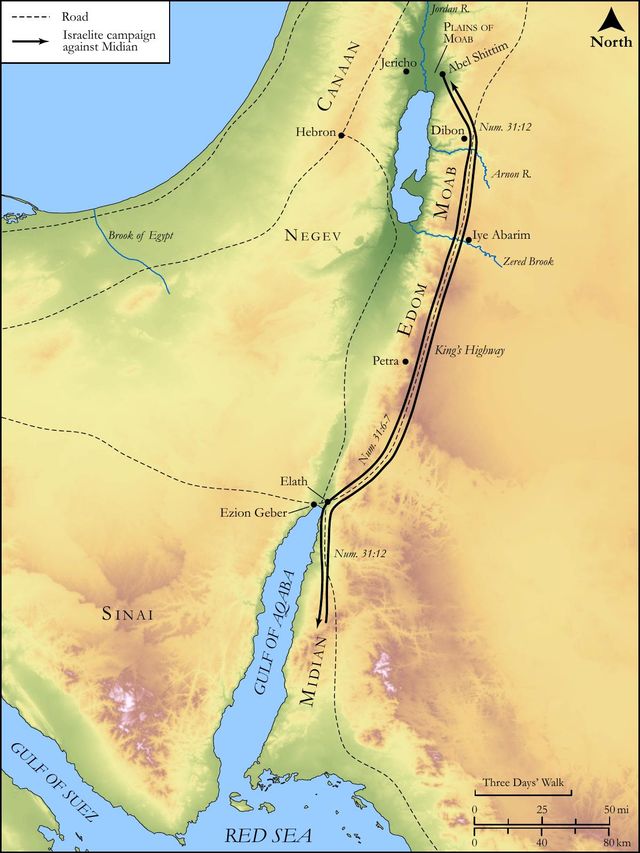
See on the biblical-era map
Study this verse
Continue studying Numbers 31:28 across the web’s major study libraries — every link below opens this exact verse, chapter, or book on the destination site.
Read & Compare
 BibleGatewayThis verse in more than 200 translations and 70 languages.
 Bible.comThe YouVersion reader — hundreds of translations, reading plans, and highlights.
 ESV.orgCrossway's official English Standard Version reader.
 NET BibleThe NET translation with 60,000+ translators' notes on every rendering decision.
 STEP BibleTyndale House's free study tool — original text, vocabulary, and scholarly resources.
 BibliaLogos Bible Software's free web reader.
 USCCBThe New American Bible (Revised Edition) with the U.S. bishops' study notes.
Commentaries
 BibleHub CommentariesDozens of classic commentaries on this verse, gathered on one page.
 StudyLightMore than 100 commentary sets — the largest collection on the web.
 BibleRefPlain-English commentary on what this verse means, verse by verse.
 Enduring WordDavid Guzik's free commentary on this chapter, widely used by Bible teachers.
 Bible Study ToolsVerse commentary alongside Greek and Hebrew study aids.
Original Language & Research
- BibleHub InterlinearThe verse word by word — original language, transliteration, and English.
- BibleHub LexiconEvery word's original-language definition and Strong's entry.
 Blue Letter BibleDeep-study tools — Strong's numbers, concordance, and word studies.
 SefariaThe Hebrew text with Rashi and centuries of Jewish commentary.
Sermons, Hymns & Audio


TrulyRandomVerse is not affiliated with these sites and doesn’t control their content. They’re linked because they’re genuinely useful.
Summary
Numbers 31:28 outlines a precise divine directive given to Moses following Israel's decisive victory over the Midianites. From the substantial spoils of war, a specific "tribute" was to be collected from the portion allocated to the warriors and then consecrated to the LORD. This required contribution, set at a ratio of "one soul of five hundred" from both human captives and various categories of livestock, served as a tangible acknowledgment of God's supreme sovereignty over the victory and the resulting abundance, ensuring a sacred portion was dedicated to Him and His service.
Context
ShowHideLiterary Context
Numbers 31:28 is situated within the detailed instructions for managing the immense spoil acquired from the Midianites. The preceding narrative, from Numbers 31:1-24, recounts the divinely mandated war itself, the initial taking of plunder, including captives, livestock, and goods, and Moses' subsequent commands regarding the purification of the spoil. The immediate context, Numbers 31:25-27, details the division of the spoil into two equal halves: one for the warriors who participated in the battle and the other for the rest of the congregation. Verse 28 then specifies the "tribute" to be taken only from the warriors' half, with the following verses, Numbers 31:29-30, clarifying that this tribute was designated for Eleazar the priest and the Levites, respectively, thereby ensuring their provision and sustenance.
Historical & Cultural Context
The war against Midian, meticulously described in Numbers 31, was not a typical geopolitical conflict but a divinely commanded punitive expedition. Its impetus stemmed from Midian's role in enticing Israel into idolatry and sexual immorality at Baal-peor, an event detailed in Numbers 25:1-9. Among the nations round about, the appropriation of war spoils was a common practice, with plunder often becoming the personal property of the conquering monarch or distributed among soldiers. However, Israel's unique covenant relationship with Yahweh meant that their practices, governed by Mosaic Law, often involved the consecration of certain spoils—either through complete destruction (herem) or by dedicating a portion for the Tabernacle or priesthood. This act of levying a tribute from the spoil in Numbers 31 reflects a distinct theological understanding where even the gains of war were subject to divine ownership and served as a mechanism for supporting the nation's religious apparatus.
Key Themes
ShowHideThis verse significantly contributes to several enduring themes within the book of Numbers and the Pentateuch. Firstly, it powerfully underscores Divine Sovereignty and Provision, emphasizing that all victories, material gains, and indeed, all blessings, ultimately originate from God and must be acknowledged through dedicated offerings. Secondly, it highlights the theme of Holiness and Consecration, demonstrating that even the spoils of a divinely sanctioned war required ritual purification and the setting apart of a portion as holy to the Lord, thereby maintaining Israel's distinct identity as a consecrated nation. Thirdly, it reinforces the crucial principle of Support for the Priesthood and Levites. As the Levites had no tribal land inheritance, as established in Numbers 18:20-24, this tribute directly provided for those who served in the Tabernacle, ensuring their sustenance and enabling them to focus solely on their sacred duties without being burdened by secular concerns.
Exposition and Analysis
ShowHideKey Word Analysis
ShowHideThis primitive root signifies "to be high actively, to rise or raise." In this context, it denotes the act of imposing or collecting a mandatory contribution. It implies a formal, authoritative act of setting apart or elevating a portion for a specific purpose, underscoring the divine authority behind the command to collect the tribute. It is not a suggestion but a divinely ordained requirement.
This term refers to a fixed portion, assessment, or toll, often based upon a census or enumeration. Here, it specifically denotes a sacred contribution or levy designated "unto the LORD." Unlike a voluntary offering, mekeç signifies a mandatory, divinely ordained portion, emphasizing God's inherent claim over all things, including the spoils of war. Its usage implies a precise calculation and systematic collection, reflecting the meticulous nature of God's commands regarding what is due to Him.
While often translated as "soul" in a spiritual sense, nephesh in this context broadly refers to a living creature or being, encompassing both humans and animals. Here, it specifically denotes human captives taken as part of the war spoil, as clarified by the subsequent mention of "persons." Its inclusion alongside various livestock (beeves, asses, sheep) highlights the comprehensive nature of the plunder and the meticulous detail with which God commanded its division and the setting apart of His portion, even from human lives.
Verse Breakdown
ShowHide"And levy a tribute unto the LORD"
This opening clause establishes the divine command and identifies the ultimate recipient of the designated portion. The verb "levy" (from rûwm) indicates a mandatory imposition, not a voluntary gift, highlighting the authoritative nature of God's instruction. The phrase "unto the LORD" clarifies the sacred purpose of this imposition, distinguishing it from a secular tax and emphasizing that this portion is set apart for God's direct use or for those who serve Him.
"of the men of war which went out to battle"
This specifies the source of the tribute. It was to be taken exclusively from the share of the spoil that belonged to the warriors who actively participated in the battle. This highlights their direct involvement in the victory and their responsibility to acknowledge God's hand in their success. It also implies that the congregation's share (mentioned in Numbers 31:27) had a different, though related, tribute structure (Numbers 31:30).
"one soul of five hundred"
This provides the precise ratio for the tribute. For every 500 "souls" (living beings), one was to be set aside for the LORD. This extremely small ratio (0.2%) emphasizes that while God claims a portion, it is a symbolic rather than an economically burdensome amount, designed to acknowledge His ownership without unduly depleting the warriors' rightful share. It underscores the principle of a "firstfruits" or consecrated portion, however small, representing the whole.
"[both] of the persons, and of the beeves, and of the asses, and of the sheep"
This clause details the specific categories of spoil from which the "one of five hundred" tribute was to be taken. It explicitly includes human captives ("persons," referring to the female and child captives spared in the battle) alongside various types of livestock. This comprehensive list demonstrates that God's claim extends over all forms of material gain from the victory, from the most valuable human life to the most common animal, reinforcing the principle of His all-encompassing sovereignty and the meticulousness of His commands.
Literary Devices
ShowHideNumbers 31:28 employs several literary devices to convey its profound message. Enumeration is prominently featured through the detailed listing of the categories of spoil: "persons, and of the beeves, and of the asses, and of the sheep." This meticulous cataloging emphasizes the comprehensive nature of the plunder and the precise, systematic approach God commanded for its division and the collection of His due. Symbolism is also at play, as the "tribute" itself, however small in proportion, powerfully symbolizes God's ultimate ownership and the Israelites' acknowledgment of His absolute sovereignty over their victory and all material possessions. The act of setting aside a portion, even a minute one, serves as a potent symbolic gesture of consecration and gratitude. Furthermore, the use of "soul" (nephesh) as a Metonymy for "person" or "captive" highlights the inherent vitality and identity of the individuals, even within the context of war spoils, underscoring that these are living beings, not mere commodities.
Theological and Thematic Connections
ShowHideNumbers 31:28 encapsulates profound theological truths about divine ownership, human stewardship, and the support of sacred ministry. It teaches that even in the midst of war and material gain, God's ultimate sovereignty is to be acknowledged. The tribute, though small in proportion, served as a powerful declaration that the victory was His, and the spoils were His to command. This principle extends beyond war, applying to all aspects of life: every blessing, every success, and every resource is ultimately a gift from God, and a portion is to be returned to Him in gratitude and worship. This dedication of resources, particularly for the support of the priesthood, underscores the biblical model of providing for those who dedicate their lives to spiritual service, ensuring that the work of the Lord can continue unhindered.
Reflection and Application
ShowHideNumbers 31:28, though rooted in an ancient military context, offers enduring principles for believers today. It calls us to cultivate a profound sense of gratitude and recognition that all we possess and all our successes are ultimately gifts from God. Just as the warriors were to acknowledge God's hand in their victory by setting aside a portion of their spoil, so too are we called to acknowledge His provision in our lives, whether through our income, talents, or time. This prompts us to consider how we steward the resources entrusted to us, recognizing that we are not ultimate owners but faithful managers. Furthermore, the verse highlights the timeless importance of supporting those who minister spiritually. Just as the ancient tribute provided for the priests, our contributions to the church and to those who serve in ministry enable the ongoing proclamation of the Gospel and the spiritual nourishment of the community. It challenges us to live with open hands, ready to give back to the One who has given us everything, fostering a spirit of generosity that reflects God's own character and trusts in His continued provision.
Questions for Reflection
ShowHideFAQ
ShowHideWhy did God command this specific war against Midian?
ShowHideThe war against Midian was not a territorial conquest but a divinely commanded punitive expedition. Its primary cause was Midian's role in enticing Israel to idolatry and sexual immorality at Baal-peor, as detailed in Numbers 25:1-9. This incident led to a plague that killed 24,000 Israelites, and God commanded Moses to take vengeance on Midian for their treachery, which had caused Israel to stumble and incur divine wrath.
Who received this "tribute" from the warriors' share?
ShowHideAccording to Numbers 31:29, the "tribute unto the LORD" from the warriors' share was given directly to Eleazar the priest. This specific portion was designated for the high priest, symbolizing the dedication of the first and best to God through His representative. A separate, larger portion from the congregation's share was given to the Levites, as described in Numbers 31:30, ensuring comprehensive support for all those dedicated to Tabernacle service.
What was the theological purpose of taking a "tribute" from war spoil?
ShowHideThe tribute served multiple theological purposes. Firstly, it was a tangible act of acknowledging God's ultimate sovereignty and ownership over the victory and all the spoils. It declared that the success in battle was not by Israel's might but by divine intervention. Secondly, it was a means of consecrating a portion of the spoil, making it holy to the Lord and reinforcing the principle that all things ultimately belong to Him. Thirdly, it provided for the material support of the priesthood and Levites, who were dedicated to God's service and had no tribal land inheritance, thus enabling them to fulfill their sacred duties on behalf of the nation without distraction.
Christ-Centered Fulfillment
ShowHideNumbers 31:28, with its emphasis on a tribute levied for the Lord from the spoils of victory, finds its ultimate and profound fulfillment in Jesus Christ. While the Old Testament tribute involved a portion of material possessions and captives, Christ's victory on the cross represents the ultimate triumph over sin, death, and the powers of darkness (Colossians 2:15). In this victory of eternal significance, humanity, once held captive by sin, becomes the "spoil" of Christ, redeemed not with perishable things like silver or gold, but with His precious blood (1 Peter 1:18-19). We, as believers, are then presented as a "tribute" to God, consecrated and set apart through Christ, no longer our own but bought with a price (1 Corinthians 6:19-20). Our very lives become a "living sacrifice, holy and acceptable to God" (Romans 12:1), a spiritual act of worship that far surpasses any material offering. Furthermore, just as the ancient tribute supported the priesthood, Christ, our great High Priest (Hebrews 4:14), establishes a New Covenant ministry, and believers are called to support the spread of His Gospel and the work of His church, ensuring that the message of His victory continues to transform lives (1 Corinthians 9:14). Thus, the principle of acknowledging God's sovereignty through dedicated giving is transformed and elevated in Christ, calling us to offer our whole selves in grateful response to His ultimate sacrifice.