


Numbers 31:29
Bible text: King James Version (1769 Blayney text) · Public domain
Bible text: Berean Standard Bible · Public domain
Bible text: American Standard Version (1901) · Public domain
Bible text: World English Bible, Messianic edition · Public domain
Bible text: Geneva Bible (1599) · Public domain
Bible text: Young's Literal Translation · Public domain
- מִמַּחֲצִיתָםmi·ma·cha·tzi·Tamfrom their halfH4276Prep-m ¦ N-fsc ¦ 3mpNoun Singular Feminine Constructמִfromמַּחֲצִיתָhalfםtheir
- תִּקָּחוּti·Ka·chuyou will take [it]H3947V-Qal-Imperf-2mpVerb Qal Imperfect 2nd Plural Masculine
- וְנָתַתָּהve·na·ta·Tahand you will give [it]H5414Conj-w ¦ V-Qal-ConsecPerf-2msVerb Qal Consecutive Perfect 2nd Singular Masculineוְandנָתַתָּהyou will give [it]
- לְאֶלְעָזָרle·'el·'a·Zarto EleazarH499Prep-l ¦ N-proper-mNoun Proper MasculineלְtoאֶלְעָזָרEleazar
- הַכֹּהֵןha·ko·Henthe priestH3548Art ¦ N-msNoun Singular Masculine Absoluteהַtheכֹּהֵןpriest
- תְּרוּמַתte·ru·Mat[the] contribution ofH8641N-fscNoun Singular Feminine Construct
- יְהוָהYah·wehYahwehH3068N-properNoun Proper Title
English is a literal word-by-word gloss of the Hebrew, not the KJV's wording. Why?
This is the original text the KJV's translators worked from — each Hebrew word with its own literal English meaning in this verse, prepared by scholars at Tyndale House, Cambridge. The KJV translates whole sentences, not word by word, so its wording differs: one Hebrew word can become several English words, and the KJV may choose “the LORD” where the gloss reads “Yahweh”. Both are faithful — they answer different questions. For the KJV's own rendering, switch to the KJV text.
Details
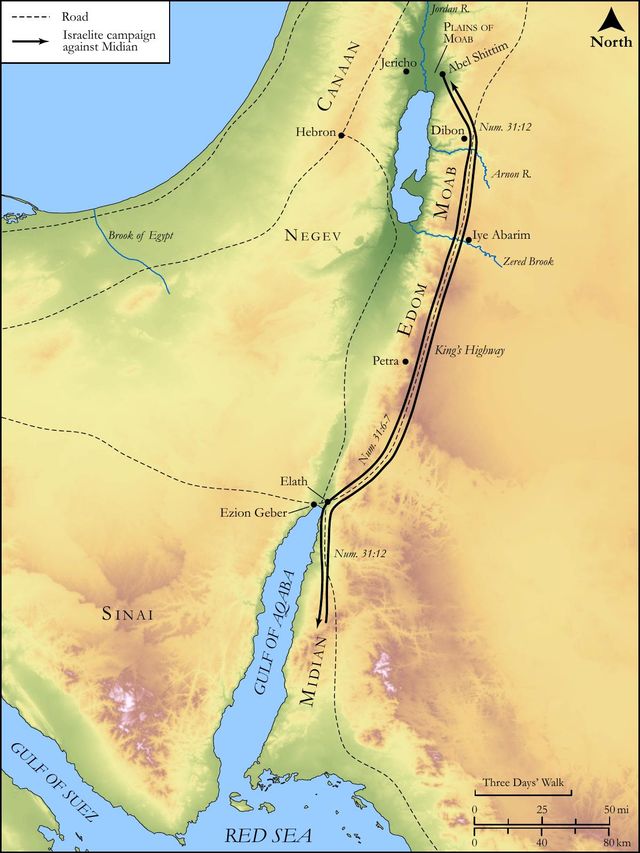
See on the biblical-era map
Study this verse
Continue studying Numbers 31:29 across the web’s major study libraries — every link below opens this exact verse, chapter, or book on the destination site.
Read & Compare
 BibleGatewayThis verse in more than 200 translations and 70 languages.
 Bible.comThe YouVersion reader — hundreds of translations, reading plans, and highlights.
 ESV.orgCrossway's official English Standard Version reader.
 NET BibleThe NET translation with 60,000+ translators' notes on every rendering decision.
 STEP BibleTyndale House's free study tool — original text, vocabulary, and scholarly resources.
 BibliaLogos Bible Software's free web reader.
 USCCBThe New American Bible (Revised Edition) with the U.S. bishops' study notes.
Commentaries
 BibleHub CommentariesDozens of classic commentaries on this verse, gathered on one page.
 StudyLightMore than 100 commentary sets — the largest collection on the web.
 BibleRefPlain-English commentary on what this verse means, verse by verse.
 Enduring WordDavid Guzik's free commentary on this chapter, widely used by Bible teachers.
 Bible Study ToolsVerse commentary alongside Greek and Hebrew study aids.
Original Language & Research
- BibleHub InterlinearThe verse word by word — original language, transliteration, and English.
- BibleHub LexiconEvery word's original-language definition and Strong's entry.
 Blue Letter BibleDeep-study tools — Strong's numbers, concordance, and word studies.
 SefariaThe Hebrew text with Rashi and centuries of Jewish commentary.
Sermons, Hymns & Audio


TrulyRandomVerse is not affiliated with these sites and doesn’t control their content. They’re linked because they’re genuinely useful.
Summary
Numbers 31:29 details a precise divine mandate for the distribution of spoils acquired from the victorious campaign against the Midianites. This verse specifically instructs that a designated portion from the warriors' half of the plunder be set apart and given to Eleazar the High Priest, to be presented as a sacred "heave offering" to the Lord. This act served not only to acknowledge God's ultimate sovereignty over all victory and provision but also to ensure the ongoing sustenance and support of the Levitical priesthood, reinforcing the sanctity of their service and the divine order within Israel.
Context
ShowHideLiterary Context
Numbers 31:29 is intricately woven into the narrative of Israel's punitive war against Midian, a conflict divinely commanded as an act of vengeance for Midian's role in the Baal Peor apostasy (Numbers 31:1-2). Following a decisive victory and the capture of immense spoils—including persons, livestock, and precious metals—Moses, Eleazar, and the tribal leaders received meticulous instructions from the Lord concerning the purification and equitable distribution of the plunder. The spoils were bifurcated into two equal halves: one for the 12,000 warriors who engaged in battle, and the other for the rest of the congregation of Israel. From each of these halves, a specific tribute was required for the Lord. Verse 29 particularly addresses the portion from the warriors' half, a remarkably small fraction (one out of every five hundred, as stipulated in Numbers 31:28), which was to be given to the priests, with Eleazar designated as the direct recipient. This precise accounting and the dedication of spoils underscore the divine order, the sanctity of all things related to Israel's covenant relationship with God, and the principle of offering firstfruits even from extraordinary gains.
Historical & Cultural Context
The practice of dedicating a portion of war spoils to deities was a widespread custom among the nations round about, reflecting the common belief that military success was granted by divine power. However, Israel's system, as delineated in the Mosaic Law, possessed unique ethical and theological foundations. This specific war against Midian was not merely a territorial conquest but a divinely ordained act of judgment against Midian for their instigation of Israel's idolatry and immorality at Peor (Numbers 25:1-18). Consequently, the spoils were not simply plunder but the material outcome of a holy war, requiring ritual purification and sacred dedication. The Levitical priesthood, including the High Priest Eleazar, was consecrated for sacred service and, unlike the other tribes, did not inherit land (Numbers 18:20). Their sustenance was divinely ordained to come from offerings and tithes provided by the people, ensuring their full devotion to spiritual duties. This particular "heave offering" from the war spoils served as another vital means of supporting the priestly class, thereby reinforcing their indispensable role in Israel's worship and national life.
Key Themes
ShowHideNumbers 31:29 contributes significantly to several foundational themes pervasive throughout the book of Numbers and the wider Pentateuch. Firstly, it powerfully reinforces the theme of Divine Sovereignty and Providence, unequivocally affirming that all victory, wealth, and material blessings ultimately emanate from the Lord. The act of setting aside a portion for Him is a tangible acknowledgment of God as the supreme giver and owner of all things, even the spoils of war. Secondly, it highlights the crucial theme of Support for the Priesthood and the Levitical System. The detailed instructions for contributions to the priests and Levites, consistently emphasized throughout Numbers 18, were designed to ensure that those consecrated for Tabernacle service were adequately provided for, enabling them to focus entirely on their sacred responsibilities without distraction. Thirdly, the concept of Sanctification and Holiness is central. By dedicating a portion of the spoils to God, the entire plunder was symbolically consecrated and made permissible for the Israelites' use, reinforcing the principle that God's portion must be honored first to sanctify the whole. This also ties into the overarching theme of Obedience to Divine Command, as Moses and the people meticulously followed God's specific and intricate instructions for handling the spoils of this holy war.
Exposition and Analysis
ShowHideKey Word Analysis
ShowHideThis primitive root (H3947) carries a wide semantic range, encompassing "to take," "to accept," "to receive," or "to seize." In the context of Numbers 31:29, the imperative "Take" signifies a direct divine command, emphasizing the authoritative nature of the instruction to set apart a specific portion of the spoils. It implies an act of appropriation and separation, where a designated part is actively removed from the larger whole for a specific, sacred purpose. This verb underscores the active obedience required of Moses and Eleazar in executing God's will regarding the plunder.
Derived from the root רוּᆷ (rum), meaning "to lift up" or "to raise," tᵉrûwmâh (H8641) denotes a dedicated contribution, a "raised portion," or a "gift" specifically set apart for sacred purposes. While some offerings involved a physical lifting, the core meaning signifies a consecrated portion separated from common use for holy use, acknowledging divine ownership and provision. It was typically designated for the maintenance of the Tabernacle (and later, the Temple) and its ministers, representing a tangible act of worship and dedication to the Lord.
This term (H3068) refers to the self-Existent or Eternal God, the covenant name of God, Jehovah or Yahweh. The phrase "of the LORD" (Hebrew, la-YHWH') emphasizes that the "heave offering" is not merely a payment or a tax to the priesthood, but a direct dedication to God Himself. It signifies divine ownership and the sacred purpose of the contribution. The spoils, though won by human hands, are ultimately seen as gifts from the Lord, and a portion is returned to Him as an act of worship, gratitude, and acknowledgment of His ultimate sovereignty over all things.
Verse Breakdown
ShowHide"Take [it] of their half"
This initial clause refers to the portion of the war spoils allocated to the 12,000 Israelite warriors who directly participated in the battle against Midian. As meticulously detailed in Numbers 31:27, the total plunder was divided into two equal halves: one for the warriors and one for the rest of the congregation. From the warriors' half, a very small, precise fraction—specifically, one out of every five hundred persons or animals, as stipulated in Numbers 31:28—was to be taken. This precise instruction highlights the meticulousness of God's commands, the principle of tithing or offering even from extraordinary gains, and the divine claim on a portion of all blessings.
"and give it unto Eleazar the priest"
This segment specifies the designated recipient of the consecrated portion. Eleazar, as the High Priest and successor to Aaron (Numbers 20:28), served as the chief spiritual leader, the representative of the entire priesthood, and the administrator of all offerings dedicated to the Lord. This direct instruction to give the offering to Eleazar underscored his central role in the priestly administration and ensured that the consecrated portion was handled by the authorized spiritual leader, reinforcing the hierarchical structure of Israel's religious system and the importance of proper stewardship of sacred contributions. The offering was specifically for the sustenance and support of the priestly class, enabling them to fulfill their sacred duties in the Tabernacle.
"[for] an heave offering of the LORD"
This final phrase defines the intrinsic nature and ultimate purpose of the contribution. It was not merely a tax, a secular gift, or a human-initiated tribute, but a terumah, a sacred "heave offering" directly to Yahweh. This designation signifies that the offering was consecrated, irrevocably set apart from common use, and dedicated solely to God's service. It served as a tangible expression of Israel's gratitude for divine victory and provision, acknowledging God's ultimate ownership of all wealth and His sovereign right to receive a portion of it for the maintenance of His sanctuary and the support of His ministers. It transformed a material act into a spiritual declaration of dependence and worship.
Literary Devices
ShowHideNumbers 31:29 masterfully employs several literary devices to convey its profound message. The verse is characterized by its Legal Language and Prescriptive Tone, typical of the Mosaic Law, issuing a direct and unambiguous command ("Take... and give"). This imperative mood underscores the divine authority behind the instruction and its non-negotiable nature, emphasizing the meticulous obedience required of Israel. Furthermore, the phrase "heave offering of the LORD" functions as Metonymy, where the offering itself stands for the broader act of dedication, consecration, and the acknowledgment of God's supreme sovereignty. The physical act of "heaving" or setting aside a portion Symbolizes the spiritual act of consecration and gratitude, forging a tangible link between material wealth and spiritual devotion. The entire process of dividing and dedicating the spoils also serves as a Type or foreshadowing, pointing to broader, enduring principles of divine ownership, faithful stewardship, and the support of God's sacred work throughout salvation history.
Theological and Thematic Connections
ShowHideNumbers 31:29 encapsulates profound theological truths that transcend its immediate historical and military context. It powerfully articulates the foundational principle of divine ownership: all blessings, including material wealth, military victories, and even the spoils of war, ultimately originate from the Lord and are His alone. The command to set aside a portion, even from extraordinary gains, serves as a tangible act of worship and gratitude, acknowledging God's sovereignty over every facet of life. This dedication also highlights the divine provision for those consecrated for sacred service, establishing a foundational principle for supporting ministry. Just as the priests were sustained by the offerings of the people, so too are those who dedicate their lives to proclaiming God's Word and serving His church to be supported by the community of faith, enabling them to fulfill their calling without distraction. This verse, therefore, stands as a testament to God's divine order, His rightful claim on His people's resources, and His faithful care for His ministers.
Reflection and Application
ShowHideNumbers 31:29, though rooted in the ancient context of Israel's military campaigns, offers enduring and transformative principles for believers today. It calls us to a profound acknowledgment that all we possess—our financial resources, our unique talents, our precious time, and even our most significant successes—are ultimately precious gifts entrusted to us by God. The act of setting aside a portion as a "heave offering" is a powerful and timeless reminder to cultivate a "firstfruits" mentality, honoring God with the very best of what He has generously given us, rather than offering Him mere leftovers. This principle extends far beyond mere financial giving; it encompasses dedicating our entire lives as a living sacrifice of gratitude and worship to Him. Furthermore, the verse profoundly underscores the vital importance of supporting those who faithfully minister God's Word. Just as Eleazar and the priests were sustained by the offerings of the people, those who serve in full-time ministry today are to be supported by the church, enabling them to devote themselves fully and without distraction to their sacred calling. Our giving, therefore, becomes a tangible act of partnership in God's ongoing work, reflecting our unwavering trust in His abundant provision and our deep commitment to the advancement of His kingdom.
Questions for Reflection
ShowHideFAQ
ShowHideWhy was the offering given to Eleazar specifically, and not just "the priests"?
ShowHideEleazar was the High Priest at this time, having succeeded his father Aaron (Numbers 20:28). As the High Priest, he served as the chief spiritual leader, the ultimate administrator of all sacred offerings, and the primary overseer of duties related to the Tabernacle. While the offering ultimately benefited the entire priestly class (the sons of Aaron), giving it directly to Eleazar centralized the sacred contributions and ensured proper administration and distribution according to divine protocol. It underscored his unique authority, immense responsibility, and preeminent role in handling matters pertaining to the Lord's portion and the sanctity of the Tabernacle service.
What was the exact amount of the "heave offering" from the warriors' half?
ShowHideNumbers 31:28 precisely specifies the amount: "And levy a tribute unto the LORD of the men of war which went out to battle: one soul of five hundred, both of the persons, and of the beeves, and of the asses, and of the sheep." This means that for every 500 individuals (captives), cattle, donkeys, or sheep in the warriors' half of the spoils, one was to be meticulously set aside as a "heave offering" for the Lord, to be given to Eleazar. This was a remarkably small fraction, emphasizing the symbolic nature of the offering as a profound acknowledgment of God's sovereignty rather than a significant economic burden on the warriors.
How does this "heave offering" relate to other offerings in the Old Testament?
ShowHideThe "heave offering" (Hebrew: terumah) was a broad category for various contributions set apart for sacred purposes, primarily for the upkeep and maintenance of the Tabernacle (and later, the Temple) and for the sustenance of the priests and Levites. It could be voluntary, such as the generous contributions for the Tabernacle's construction (Exodus 25:2), or mandated, like the tithe of grain, new wine, and oil (Deuteronomy 18:4). Unlike sin offerings, burnt offerings, or peace offerings, which had specific atoning, worship, or fellowship purposes and often involved the sacrifice of an animal on the altar, the terumah was primarily a consecrated gift of resources. While distinct in its immediate purpose and form, it shared the overarching theological theme of dedication to God and supporting the essential infrastructure of Israel's divinely ordained worship system.
Christ-Centered Fulfillment
ShowHideNumbers 31:29, with its profound emphasis on a "heave offering of the LORD" presented to the priest, finds its ultimate and perfect Christ-centered fulfillment in the New Covenant. The entire Old Testament system of offerings and a mediating priesthood served as a prophetic shadow, pointing forward to the singular, ultimate, and perfect sacrifice of Jesus Christ. He is the true and final "heave offering," not merely a portion of war spoils, but God's own beloved Son, willingly "lifted up" on the cross as the perfect, once-for-all sacrifice for the sins of the world (John 3:14 and Hebrews 9:14). Through His singular, redemptive act, Christ perfectly fulfilled all the requirements and typological shadows of the Old Testament sacrificial system, including the very concept of a consecrated offering to God. Furthermore, just as Eleazar received the offering for the sustenance of the Old Covenant priesthood, Christ, as our Great High Priest, eternally interceding for us at the right hand of God (Hebrews 4:14), now receives the "spiritual sacrifices" of His redeemed people—our bodies presented as living, holy, and acceptable sacrifices (Romans 12:1) and our continuous praises and good deeds (Hebrews 13:15-16). In the New Covenant, all believers are wonderfully incorporated into a "royal priesthood" (1 Peter 2:9), called to offer themselves and their material resources for the advancement of God's kingdom. Our giving, therefore, is not merely a legalistic duty but a joyful, Spirit-empowered response to Christ's ultimate offering, enabling the global spread of the Gospel and the faithful support of those called to full-time ministry, just as the Old Testament offerings sustained the Levitical system (2 Corinthians 9:7).