


Numbers 31:3
- וַיְדַבֵּרvay·da·Berand he spokeH1696Conj-w ¦ V-Piel-ConsecImperf-3msVerb Piel Consecutive Imperfect 3rd Singular Masculineוַandיְדַבֵּרhe spoke
- מֹשֶׁהmo·ShehMosesH4872N-proper-mNoun Proper Masculine
- אֶל'eltoH413PrepPreposition
- הָעָםha·'Amthe peopleH5971Art ¦ N-msNoun Singular Masculine Absoluteהָtheעָםpeople
- לֵאמֹרle·Mor<to> sayingH559Prep-l ¦ V-Qal-InfVerb Qal Infinitive Constructלֵ<to>אמֹרsaying
- הֵחָלְצוּhe·chal·Tzube equippedH2502V-Niphal-Imp-2mpVerb Niphal Imperative 2nd Plural Masculine
- מֵאִתְּכֶםme·'i·te·Khemfrom with <the> youH854Prep-m ¦ Prep ¦ 2mpPreposition Definiteמֵfromאִתְּwith <the>כֶםyou
- אֲנָשִׁים'a·na·ShimmenH582N-mpNoun Plural Masculine Absolute
- לַצָּבָאla·tza·Va'for <the> warH6635Prep-l ¦ N-msNoun Singular Masculine Absoluteלַfor <the>צָּבָאwar
- וְיִהְיוּve·yih·Yuso they may beH1961Conj-w ¦ V-Qal-ConjImperf-3mpVerb Qal Conjunction+Imperfect 3rd Plural Masculineוְsoיִהְיוּthey may be
- עַל'alonH5921PrepPreposition
- מִדְיָןmid·YanMidianH4080N-properNoun Proper Location
- לָתֵתla·Tetto giveH5414Prep-l ¦ V-Qal-InfVerb Qal Infinitive Constructלָtoתֵתgive
- נִקְמַתnik·mat[the] vengeance ofH5360N-fscNoun Singular Feminine Construct
- יְהוָהYah·wehYahwehH3068N-properNoun Proper Title
- בְּמִדְיָןbe·mid·Yanon MidianH4080Prep-b ¦ N-properNoun Proper LocationבְּonמִדְיָןMidian
English is a literal word-by-word gloss of the Hebrew, not the KJV's wording. Why?
This is the original text the KJV's translators worked from — each Hebrew word with its own literal English meaning in this verse, prepared by scholars at Tyndale House, Cambridge. The KJV translates whole sentences, not word by word, so its wording differs: one Hebrew word can become several English words, and the KJV may choose “the LORD” where the gloss reads “Yahweh”. Both are faithful — they answer different questions. For the KJV's own rendering, switch to the KJV text.
Details
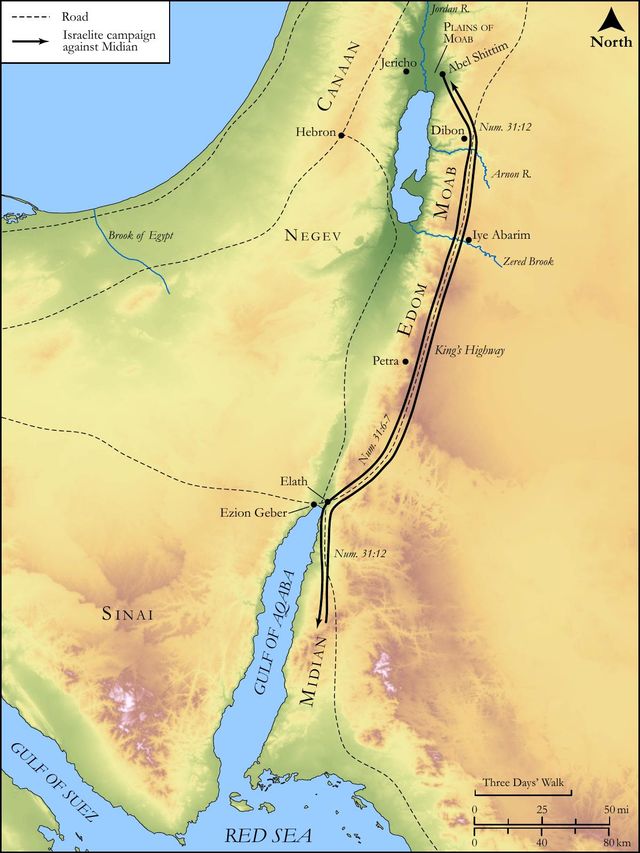
See on the biblical-era map
Study this verse
Continue studying Numbers 31:3 across the web’s major study libraries — every link below opens this exact verse, chapter, or book on the destination site.
Read & Compare
 BibleGatewayThis verse in more than 200 translations and 70 languages.
 Bible.comThe YouVersion reader — hundreds of translations, reading plans, and highlights.
 ESV.orgCrossway's official English Standard Version reader.
 NET BibleThe NET translation with 60,000+ translators' notes on every rendering decision.
 STEP BibleTyndale House's free study tool — original text, vocabulary, and scholarly resources.
 BibliaLogos Bible Software's free web reader.
 USCCBThe New American Bible (Revised Edition) with the U.S. bishops' study notes.
Commentaries
 BibleHub CommentariesDozens of classic commentaries on this verse, gathered on one page.
 StudyLightMore than 100 commentary sets — the largest collection on the web.
 BibleRefPlain-English commentary on what this verse means, verse by verse.
 Enduring WordDavid Guzik's free commentary on this chapter, widely used by Bible teachers.
 Bible Study ToolsVerse commentary alongside Greek and Hebrew study aids.
Original Language & Research
- BibleHub InterlinearThe verse word by word — original language, transliteration, and English.
- BibleHub LexiconEvery word's original-language definition and Strong's entry.
 Blue Letter BibleDeep-study tools — Strong's numbers, concordance, and word studies.
 SefariaThe Hebrew text with Rashi and centuries of Jewish commentary.
Sermons, Hymns & Audio


TrulyRandomVerse is not affiliated with these sites and doesn’t control their content. They’re linked because they’re genuinely useful.
Summary
Numbers 31:3 records Moses' solemn directive to the Israelite people, a divinely mandated command to prepare for a punitive expedition against the Midianites. This instruction was not driven by human desire for conquest or retribution, but by God's righteous judgment against Midian for their role in enticing Israel into egregious idolatry and sexual immorality at Baal-Peor, thereby necessitating a purification of the covenant community and a vindication of the Lord's holy name.
Context
ShowHideLiterary Context
Numbers 31:3 immediately follows the catastrophic plague detailed in Numbers 25, which resulted in the death of 24,000 Israelites due to their participation in cultic prostitution and idolatry with Moabite and Midianite women at Baal-Peor. The command to wage war against Midian is explicitly framed as a divine instruction to "avenge the LORD" (Numbers 31:2), establishing it as a direct, punitive consequence for this profound spiritual betrayal. This act of judgment also serves as a crucial cleansing before the new generation, enumerated in Numbers 26, prepares to enter the Promised Land, underscoring the absolute necessity of holiness and covenant fidelity for inheriting God's promises.
Historical & Cultural Context
The Midianites were a semi-nomadic people, descendants of Abraham through Keturah (Genesis 25:2), inhabiting regions east of the Jordan River and extending towards the Gulf of Aqaba. While historically they had complex interactions with Israel, including familial ties through Moses' father-in-law Jethro, their role in the Baal-Peor incident transformed them into a primary adversary. The command to "avenge the LORD" aligns with the ancient Near Eastern concept of "holy war" or herem, where God commanded His people to execute judgment on nations whose sin had reached its full measure. This was not a conventional war of territorial expansion but a divinely ordained act of retribution and purification, distinct from modern warfare and deeply rooted in God's unique covenant relationship with Israel and His absolute holiness.
Key Themes
ShowHideThis verse powerfully contributes to several overarching themes within the book of Numbers and the broader Pentateuch. Foremost among them is Divine Justice and Retribution, demonstrating God's active intervention to punish sin, especially when His covenant and holiness are violated. It vividly illustrates the Consequences of Idolatry and Immorality, showing the severe repercussions for both those who entice others into sin (Midian) and those who succumb (Israel). The concept of Holy War (or herem) emerges as a specific instrument of divine judgment, emphasizing that Israel, in this instance, was acting as an agent of God's wrath, not their own. Finally, it reinforces the critical theme of Covenant Fidelity and Purity, as the elimination of the Midianite influence was essential for Israel to maintain its distinctiveness and prepare for its inheritance in the Promised Land, free from corrupting influences.
Exposition and Analysis
ShowHideKey Word Analysis
ShowHideThis word (H1696) signifies not merely speaking, but often carries the nuance of arranging, commanding, or declaring with authority. When Moses "spake" this command, it implies a formal, authoritative pronouncement, indicating that the directive originated from God and was delivered through His appointed leader, establishing the divine mandate behind the impending war.
The root (H2502) means "to pull off," "strip," or "deliver," but in this context, it signifies "to equip for fight" or "to prepare." The command to "arm some of yourselves" indicates a specific preparation for military action, emphasizing that this was a deliberate and organized response, not a spontaneous outburst. It implies a selection of individuals specifically designated and equipped for this sacred mission.
While the KJV translates it as "avenge," the underlying Hebrew noun (H5360) is "avengement" or "vengeance." Coupled with the verb "nâthan" (H5414, "to give"), the phrase literally means "to give avengement." This is not human revenge but divine retribution, the execution of God's justice. It signifies the restoration of God's violated honor and the righteous consequence for the profound offense committed against His holiness and covenant.
Verse Breakdown
ShowHide"And Moses spake unto the people, saying"
This opening phrase immediately establishes the divine authority behind the command. Moses, as God's chosen prophet and mediator, is the conduit through whom God's will is communicated. The instruction is therefore not a human initiative but a direct divine imperative, relayed to the entire community of Israel.
"Arm some of yourselves unto the war"
This clause indicates a specific, rather than universal, mobilization. It implies a selection of individuals, a contingent of warriors, rather than the entire able-bodied male population. This suggests a targeted punitive expedition, emphasizing its unique nature as a sacred mission of judgment rather than a typical war of conquest or defense.
"and let them go against the Midianites"
This specifies the precise target of the divine judgment. The Midianites are singled out due to their direct and insidious role in leading Israel into idolatry and immorality at Baal-Peor. This distinguishes them from the Moabites, who were also involved but are not the primary target of this particular "avenging" action, highlighting Midian's unique culpability in God's eyes.
"and avenge the LORD of Midian"
This is the core purpose and theological justification for the war. The conflict is not for Israel's territorial gain or personal vendetta, but to "avenge" or vindicate the honor, holiness, and covenant of YHWH, which were profoundly profaned by Midian's actions. It underscores that the ultimate offense was against God Himself, and the ensuing judgment is a manifestation of His righteous character and His unwavering commitment to upholding His covenant.
Literary Devices
ShowHideThe verse employs several significant literary devices that underscore its theological weight. The most prominent is Divine Mandate, where the command originates directly from God, communicated through Moses, thereby emphasizing its absolute authority and non-negotiable nature for Israel. This is further reinforced by the use of Anthropomorphism in the phrase "avenge the LORD," which attributes a human-like action (being avenged) to God. This device powerfully conveys that God's honor and holiness were deeply offended by Midian's actions, necessitating a visible act of vindication. Additionally, the verse functions as a clear example of Retribution Theology, directly linking a specific sin (Midian's corruption of Israel at Baal-Peor) with a direct, divinely ordained punishment (the war). This highlights the biblical principle that actions have consequences, particularly in the context of God's covenant and His moral law.
Theological and Thematic Connections
ShowHideNumbers 31:3 profoundly underscores the biblical truth that God is a God of absolute holiness and righteous justice, who does not tolerate sin, especially that which seeks to corrupt His chosen people and profane His name. The command to "avenge the LORD" reveals God's active involvement in human history, demonstrating that His patience with wickedness has limits and that He will ultimately bring judgment upon those who persistently rebel against Him and lead others into sin. This divine retribution is not arbitrary but is a necessary outworking of His character, ensuring the purity of His covenant community and the vindication of His honor. While the specific execution of judgment through physical warfare was unique to ancient Israel's historical context, the underlying principle of God's unwavering justice remains eternally true, reminding us of the gravity of sin and the certainty of divine reckoning.
Reflection and Application
ShowHideWhile believers in the New Covenant are not called to wage physical wars of vengeance, the principles embedded in Numbers 31:3 remain profoundly relevant for spiritual formation and ethical living. This passage serves as a stark reminder of the gravity of sin, especially idolatry and immorality, and the severe consequences that follow spiritual compromise. It calls us to a deep reverence for God's holiness and a steadfast commitment to spiritual purity, recognizing that engaging with the world's corrupting influences can lead to spiritual death. Just as Israel was called to be set apart, believers today are called to be distinct from the world, engaging in spiritual warfare against the forces that seek to draw us away from God. We are to trust in God's ultimate justice, knowing that He will, in His perfect timing, address all wickedness and vindicate His name, even as we are called to extend grace and forgiveness in our personal interactions.
Questions for Reflection
ShowHideFAQ
ShowHideWhy did God command such a violent act against the Midianites?
ShowHideGod commanded this act of judgment against the Midianites primarily because of their direct and insidious role in leading Israel into idolatry and sexual immorality at Baal-Peor (Numbers 25). This was not an act of arbitrary violence but a divinely ordained "holy war" (herem), an execution of God's righteous judgment against a people whose wickedness had reached a tipping point and who actively sought to corrupt God's covenant people. It was a unique historical instance where Israel acted as an instrument of divine justice to vindicate God's holiness and purify the community, rather than for territorial expansion or personal revenge. This type of command is distinct from modern warfare and must be understood within the specific theological and historical context of ancient Israel's unique covenant relationship with God.
Is the concept of "avenging the LORD" relevant for Christians today, given the New Testament emphasis on love and forgiveness?
ShowHideWhile Christians are explicitly commanded in the New Testament not to take personal revenge (Romans 12:19) and to love their enemies, the underlying principle of God's justice and His ultimate vindication remains highly relevant. "Avenge the LORD" in Numbers 31:3 speaks to God's righteous response to sin and His commitment to upholding His holiness. For believers today, this translates into a call for spiritual vigilance against sin and idolatry, recognizing that God is indeed a God of justice who will ultimately judge all unrighteousness. Our "warfare" is spiritual, not physical, against spiritual forces of evil (Ephesians 6:12), and we trust that God will bring about His perfect justice in His timing, culminating in the final judgment (Revelation 20:12).
Christ-Centered Fulfillment
ShowHideThe command to "avenge the LORD of Midian" finds its ultimate and profound fulfillment in the person and work of Jesus Christ. While ancient Israel's act was a physical manifestation of God's justice against a specific earthly enemy, Christ's mission was to address the root cause of all sin and rebellion against God—humanity's fallen nature and the spiritual forces of evil. Jesus, as the perfect Lamb of God who takes away the sin of the world, fully absorbed God's righteous wrath against sin on the cross, thereby "avenging" God's holiness not by destroying the sinner, but by providing atonement for sin. Through His death and resurrection, Christ triumphed over the spiritual "Midianites"—Satan, sin, and death—disarming the powers and authorities and making a public spectacle of them (Colossians 2:15). He is the one through whom God's justice is ultimately satisfied and His honor fully vindicated, not through human warfare, but through divine sacrifice. Furthermore, Christ will return as the righteous judge, the one who "strikes down the nations" and "treads the winepress of the fury of the wrath of God Almighty" (Revelation 19:11-16), bringing final and perfect justice to all who have defied God, thus completing the ultimate "avenging of the LORD" in cosmic scope.