


Numbers 31:4
- אֶלֶף'E·lefone thousandH505Adj-csAdjective Numerical Singular common gender Absolute
- לַמַּטֶּהla·ma·Tehto the tribeH4294Prep-l ¦ N-msNoun Singular Masculine Absoluteלַto theמַּטֶּהtribe
- אֶלֶף'E·lefone thousandH505Adj-csAdjective Numerical Singular common gender Absolute
- לַמַּטֶּהla·ma·Tehto the tribeH4294Prep-l ¦ N-msNoun Singular Masculine Absoluteלַto theמַּטֶּהtribe
- לְכֹלle·Kholfor allH3605Prep-l ¦ N-mscNoun Singular Masculine Constructלְforכֹלall
- מַטּוֹתma·Tot[the] tribes ofH4294N-fpcNoun Plural Feminine Construct
- יִשְׂרָאֵלYis·ra·'ElIsraelH3478N-properNoun Proper Location
- תִּשְׁלְחוּtish·le·Chuyou will send outH7971V-Qal-Imperf-2mpVerb Qal Imperfect 2nd Plural Masculine
- לַצָּבָאla·tza·Va'to <the> warH6635Prep-l ¦ N-msNoun Singular Masculine Absoluteלַto <the>צָּבָאwar
English is a literal word-by-word gloss of the Hebrew, not the KJV's wording. Why?
This is the original text the KJV's translators worked from — each Hebrew word with its own literal English meaning in this verse, prepared by scholars at Tyndale House, Cambridge. The KJV translates whole sentences, not word by word, so its wording differs: one Hebrew word can become several English words, and the KJV may choose “the LORD” where the gloss reads “Yahweh”. Both are faithful — they answer different questions. For the KJV's own rendering, switch to the KJV text.
Details
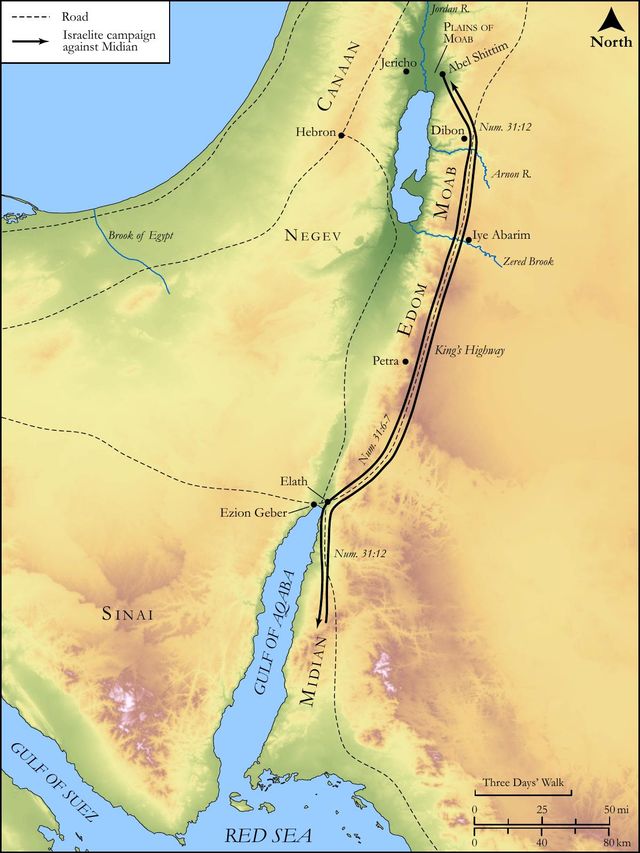
See on the biblical-era map
Study this verse
Continue studying Numbers 31:4 across the web’s major study libraries — every link below opens this exact verse, chapter, or book on the destination site.
Read & Compare
 BibleGatewayThis verse in more than 200 translations and 70 languages.
 Bible.comThe YouVersion reader — hundreds of translations, reading plans, and highlights.
 ESV.orgCrossway's official English Standard Version reader.
 NET BibleThe NET translation with 60,000+ translators' notes on every rendering decision.
 STEP BibleTyndale House's free study tool — original text, vocabulary, and scholarly resources.
 BibliaLogos Bible Software's free web reader.
 USCCBThe New American Bible (Revised Edition) with the U.S. bishops' study notes.
Commentaries
 BibleHub CommentariesDozens of classic commentaries on this verse, gathered on one page.
 StudyLightMore than 100 commentary sets — the largest collection on the web.
 BibleRefPlain-English commentary on what this verse means, verse by verse.
 Enduring WordDavid Guzik's free commentary on this chapter, widely used by Bible teachers.
 Bible Study ToolsVerse commentary alongside Greek and Hebrew study aids.
Original Language & Research
- BibleHub InterlinearThe verse word by word — original language, transliteration, and English.
- BibleHub LexiconEvery word's original-language definition and Strong's entry.
 Blue Letter BibleDeep-study tools — Strong's numbers, concordance, and word studies.
 SefariaThe Hebrew text with Rashi and centuries of Jewish commentary.
Sermons, Hymns & Audio


TrulyRandomVerse is not affiliated with these sites and doesn’t control their content. They’re linked because they’re genuinely useful.
Summary
Numbers 31:4 articulates a precise divine mandate for the composition of the Israelite army, specifying that one thousand men from each of the twelve tribes are to be conscripted for the punitive war against the Midianites. This instruction underscores the corporate responsibility of the entire nation in executing God's righteous judgment, reflecting both the meticulous nature of divine commands and the unified obedience required of God's covenant people as they prepared for future conquests and the establishment of justice within the Promised Land.
Context
ShowHideLiterary Context
This verse is deeply embedded within the concluding chapters of the Book of Numbers, immediately following the devastating incident at Baal-Peor detailed in Numbers 25. There, the Midianites, in league with the Moabites, had enticed Israel into idolatry and sexual immorality, resulting in a divine plague that claimed 24,000 lives. God's command to "Avenge the children of Israel of the Midianites" is given to Moses in Numbers 31:2, serving as one of Moses' final acts of leadership before his death and Israel's entry into Canaan. The meticulous instruction for the army's composition in Numbers 31:4, followed by its swift and faithful execution in Numbers 31:5-6, highlights the divine authority behind the campaign and the nation's unified obedience. This punitive expedition functions as a crucial act of spiritual and moral cleansing, preparing Israel for the impending conquest of the land.
Historical & Cultural Context
The events of Numbers 31 unfold on the plains of Moab, east of the Jordan River, with Israel poised to enter the Promised Land. The Midianites were a prominent nomadic people, known for their extensive trade networks but also for their opportunistic raids and, critically, their role in corrupting Israel at Baal-Peor. The concept of a "holy war" or divinely sanctioned retribution was present in the ancient Near East, yet for Israel, it was uniquely tied to Yahweh's covenant justice and holiness. The tribal structure of Israel was not merely a social arrangement but a fundamental aspect of their national and religious identity, with each tribe possessing distinct territories and responsibilities. The precise requirement for "a thousand" from each tribe reflects a highly organized and unified military mobilization, characteristic of a divinely ordered campaign rather than a spontaneous tribal skirmish. This specific numerical contribution ensured that the entire nation participated in this act of justice, emphasizing communal accountability and solidarity in upholding the covenant and demonstrating their readiness for the challenges of conquest.
Key Themes
ShowHideNumbers 31:4 significantly contributes to several overarching theological and narrative themes within the Pentateuch. Firstly, it powerfully illustrates the theme of Divine Command and Obedience, emphasizing that this war was not a human initiative but a direct, specific order from the Lord, demanding precise execution from His people. Secondly, the mandate for "Of every tribe a thousand" underscores the principle of Corporate Responsibility and Unity. No single tribe was exempt; all participated equally in this divinely sanctioned mission, demonstrating the solidarity required for God's purposes and reflecting the unified identity of the "tribes of Israel" (Numbers 31:4). Thirdly, the campaign is a profound act of Justice and Retribution against a people who had actively sought to corrupt God's chosen nation, serving as a stark reminder of the severe consequences of opposing God and leading His people astray, as vividly depicted in the judgment described in Numbers 25:9. Finally, this meticulously organized military action also functions as Preparation for Conquest, serving as a proving ground for Israel's military might and their reliance on God's power as they prepared for the greater challenges of conquering Canaan.
Exposition and Analysis
ShowHideKey Word Analysis
ShowHideThis term, often translated as "rod" or "staff," figuratively refers to a "branch" or "tribe," signifying a distinct family or clan unit that collectively forms a larger division of Israel. In this context, maṭṭeh emphasizes the organized, genealogical structure of Israel, where each tribal division was expected to contribute its share, reinforcing the corporate nature of the nation's identity and responsibilities. The repetition of "every tribe" and "all the tribes" highlights the comprehensive nature of the conscription.
While 'eleph can sometimes denote a "clan" or "family unit" (as in Judges 6:15), in the context of military conscription and the subsequent total of 12,000 chosen men (12 tribes x 1,000), it unequivocally refers to a literal numerical unit. This precision underscores the meticulous nature of God's commands and the highly structured organization of Israel's tribal society for warfare, reflecting a divinely ordered census and mobilization.
This word signifies a "mass of persons (or figuratively, things), especially regularly organized for war (an army)." It implies a full-scale, organized military campaign, not merely a skirmish or raid. The use of tsâbâʼ emphasizes the seriousness and significance of the undertaking, which was a divinely sanctioned punitive expedition. It denotes a strategic engagement with clear objectives, distinguishing it from less formal conflicts and underscoring its nature as a "holy war" where God's justice was being executed through His people.
Verse Breakdown
ShowHide"Of every tribe a thousand"
This initial clause specifies the exact quota of soldiers to be drawn from each of the twelve tribes of Israel. It emphasizes a principle of equal contribution and shared burden, ensuring that the responsibility for executing God's judgment was distributed equitably across the entire nation, rather than falling disproportionately on a few. This detail highlights the structured and unified nature of Israel's tribal society under divine command.
"throughout all the tribes of Israel"
This phrase reinforces the universality of the command, leaving no tribe exempt from participation. It underscores the corporate identity and responsibility of Israel as a whole, acting as a single entity in response to God's directive. This collective action was crucial for demonstrating national obedience and solidarity in fulfilling the divine mandate, emphasizing that the sin of Baal-Peor had affected the entire nation, and thus the response to it must also be national.
"shall ye send to the war"
This final clause states the purpose and destination of the assembled force. It is a direct command for military deployment, indicating that the chosen men are to be dispatched for the specific punitive campaign against the Midianites. The active verb "send" (H7971, shâlach) implies a deliberate and authorized dispatch of troops, highlighting Moses' role as the executor of God's will and the seriousness of the mission as a divinely sanctioned act of retribution.
Literary Devices
ShowHideNumbers 31:4 employs several literary devices to convey its message with clarity and emphasis. The most prominent is Precision and Specificity, evident in the exact numerical requirement ("a thousand") and the explicit inclusion of "every tribe" and "all the tribes of Israel." This meticulous detail underscores the divine origin of the command and the highly organized, intentional nature of God's plans. This precision also serves to highlight the Unity and Corporate Responsibility of the Israelite nation, as no tribe is excused from participating in this divinely mandated act of justice. The phrase "shall ye send to the war" functions as a Direct Command or Imperative, emphasizing the non-negotiable nature of the divine instruction given to Moses and, through him, to the people. Furthermore, the selection of a specific, limited force (12,000 men) for a significant punitive campaign can be seen as a form of Symbolism, suggesting that victory would not be achieved by overwhelming numbers but by God's power working through a consecrated and obedient remnant, a principle echoed in other biblical narratives such as Gideon's victory with a much smaller army (Judges 7:2-7).
Theological and Thematic Connections
ShowHideNumbers 31:4 is a powerful testament to God's absolute sovereignty and His unwavering commitment to justice, even when it involves severe retribution against those who corrupt His people. It reveals that God's plans are often precise, demanding specific acts of obedience and corporate participation from His covenant community. The call for "a thousand from every tribe" underscores the principle that the entire community is implicated in upholding God's righteousness and is responsible for participating in the spiritual and moral battles that arise. This passage teaches that God works through His people to accomplish His purposes, and their unity and obedience are paramount. It also highlights the seriousness of sin, particularly that which leads God's people astray and violates the covenant, and God's unwavering commitment to cleanse and protect His covenant relationship. The meticulous planning of this "holy war" demonstrates that God's judgment is not arbitrary but is carefully ordered and executed.
Reflection and Application
ShowHideNumbers 31:4, while describing a literal military campaign in ancient Israel, offers profound and enduring principles for contemporary believers. It reminds us that God's purposes are precise and often require the unified, corporate action of His people. Just as each tribe contributed equally to fulfilling God's command for justice against the Midianites, so too are believers today called to unite in purpose and action to advance God's kingdom and contend for righteousness in a world still marred by sin. This verse challenges us to consider our individual and collective roles within the larger body of Christ: are we contributing our "thousand" – our unique gifts, resources, time, and efforts – to the collective mission of the church? It also prompts reflection on the nature of God's justice, reminding us that while we live in an age of grace and are called to love our enemies, God remains perfectly just and will ultimately bring recompense for all evil. Our "war" is now primarily spiritual, against sin, spiritual forces of evil, and the brokenness of the world, requiring the same corporate commitment, disciplined obedience to divine instruction, and reliance on God's power.
Questions for Reflection
ShowHideFAQ
ShowHideWhy did God command such a specific number of men (1,000 from each tribe) for this war?
ShowHideThe command for "a thousand from every tribe" (totaling 12,000 men) highlights several key aspects of God's character and purposes. Firstly, it emphasizes the precision and intentionality of God's commands. This was not an arbitrary gathering but a divinely ordered, meticulously planned military operation, demonstrating God's sovereign control over even the details of His people's actions. Secondly, it underscored the corporate responsibility and unity of the entire nation. By requiring a contingent from every tribe, God ensured that all Israel participated in this act of justice, demonstrating their solidarity and shared commitment to upholding the covenant. It prevented any single tribe from bearing the full burden or from being exempt, fostering national cohesion. Thirdly, it may have served a symbolic purpose, showing that victory was not dependent on overwhelming numbers but on God's power working through a consecrated and obedient force. This specific number was sufficient for the task, demonstrating God's ability to achieve His purposes through a chosen, disciplined force, a principle echoed later in the story of Gideon's army (Judges 7:2-7).
Was this war against the Midianites a "holy war," and how should Christians understand such Old Testament commands today?
ShowHideYes, the war against the Midianites in Numbers 31 was indeed a "holy war" or a divinely commanded punitive expedition. It was not for territorial expansion but was an act of divine retribution for Midian's role in seducing Israel into idolatry and immorality at Baal-Peor (Numbers 25). For Christians, understanding such Old Testament commands requires careful theological discernment. We recognize that these were specific commands given to ancient Israel within a unique covenant context, often involving the execution of God's temporal judgment on nations. The New Testament reveals a profound shift in the nature of God's people (the church, not a geopolitical nation-state) and the nature of their warfare. Our "warfare" is now primarily spiritual, against "spiritual forces of evil" (Ephesians 6:12), not against flesh and blood. While the principles of God's justice, His hatred of sin, and the need for His people's obedience remain eternal, the methods and context of "holy war" have been transformed by the coming of Christ. We are called to contend for righteousness through spiritual means, prayer, the proclamation of the gospel, and living lives of holiness (2 Corinthians 10:3-5).
Christ-Centered Fulfillment
ShowHideNumbers 31:4, with its emphasis on a precisely chosen, unified force executing divine judgment, finds its ultimate Christ-centered fulfillment not in a literal military campaign, but in the spiritual reality of God's kingdom and the redemptive work of Christ. Jesus Christ is the ultimate "sent one" (John 3:17) who came to deal definitively with the root of all corruption and sin, not merely its manifestations. While the Old Testament war cleansed Israel physically from a corrupting influence, Christ's sacrifice on the cross is the definitive act of cleansing, taking away the sin of the world and purifying His people from all unrighteousness (Hebrews 9:14). The corporate unity demanded in Numbers 31:4 foreshadows the profound unity of the church, the body of Christ, where every member, like "a thousand from every tribe," contributes their unique gifts and callings to the spiritual mission of God's kingdom (Ephesians 4:16). Furthermore, the concept of divine retribution, executed through human instruments in the Old Testament, points to Christ as the ultimate judge who will one day execute final, perfect justice against all evil (John 5:22). Thus, the precision, unity, and purpose of the Old Testament army find their greater spiritual reality in Christ's redemptive work and the ongoing mission of His unified church, which is called to wage spiritual warfare against the forces of darkness (Ephesians 6:10-18).