


Numbers 31:5
- וַיִּמָּסְרוּvai·yi·ma·se·Ruand they were selectedH4560Conj-w ¦ V-Niphal-ConsecImperf-3mpVerb Niphal Consecutive Imperfect 3rd Plural Masculineוַandיִּמָּסְרוּthey were selected
- מֵאַלְפֵיme·'al·Feifrom [the] thousands ofH505Prep-m ¦ N-cpcNoun Plural common gender Constructמֵfromאַלְפֵי[the] thousands of
- יִשְׂרָאֵלYis·ra·'ElIsraelH3478N-properNoun Proper Location
- אֶלֶף'E·lefone thousandH505Adj-csAdjective Numerical Singular common gender Absolute
- לַמַּטֶּהla·ma·Tehto the tribeH4294Prep-l ¦ N-msNoun Singular Masculine Absoluteלַto theמַּטֶּהtribe
- שְׁנֵיםshe·neimtwo [plus]H8147Adj-cdAdjective Numerical Dual common gender Absolute
- עָשָׂר'a·SartenH6240Adj-csAdjective Numerical Singular common gender Absolute
- אֶלֶף'E·lefthousandH505Adj-csAdjective Numerical Singular common gender Absolute
- חֲלוּצֵיcha·lu·Tzeiarmed [men] ofH2502V-Qal-PassPrtcpl-mpVerb Qal Participle Passive Plural Masculine Construct
- צָבָאtza·Va'warH6635N-msNoun Singular Masculine Absolute
English is a literal word-by-word gloss of the Hebrew, not the KJV's wording. Why?
This is the original text the KJV's translators worked from — each Hebrew word with its own literal English meaning in this verse, prepared by scholars at Tyndale House, Cambridge. The KJV translates whole sentences, not word by word, so its wording differs: one Hebrew word can become several English words, and the KJV may choose “the LORD” where the gloss reads “Yahweh”. Both are faithful — they answer different questions. For the KJV's own rendering, switch to the KJV text.
Details
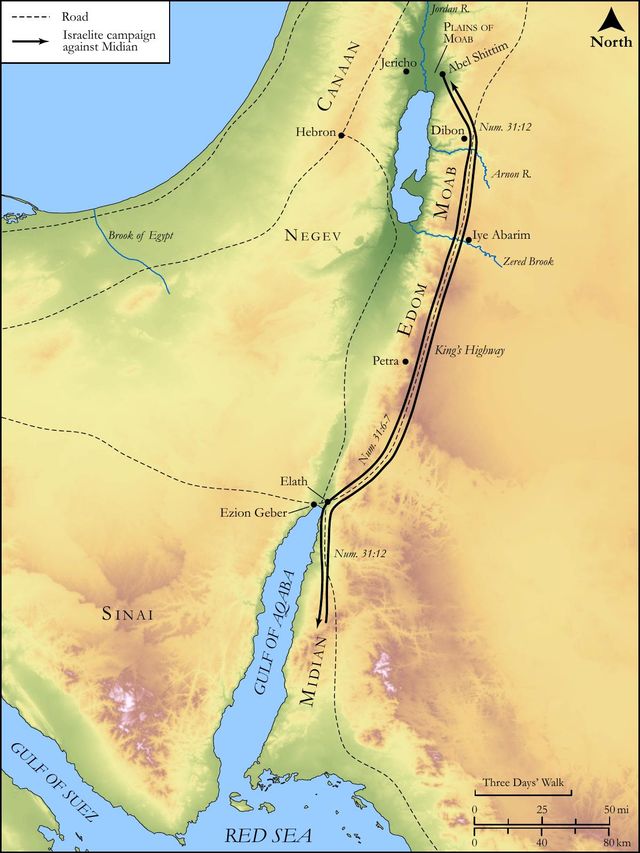
See on the biblical-era map
Study this verse
Continue studying Numbers 31:5 across the web’s major study libraries — every link below opens this exact verse, chapter, or book on the destination site.
Read & Compare
 BibleGatewayThis verse in more than 200 translations and 70 languages.
 Bible.comThe YouVersion reader — hundreds of translations, reading plans, and highlights.
 ESV.orgCrossway's official English Standard Version reader.
 NET BibleThe NET translation with 60,000+ translators' notes on every rendering decision.
 STEP BibleTyndale House's free study tool — original text, vocabulary, and scholarly resources.
 BibliaLogos Bible Software's free web reader.
 USCCBThe New American Bible (Revised Edition) with the U.S. bishops' study notes.
Commentaries
 BibleHub CommentariesDozens of classic commentaries on this verse, gathered on one page.
 StudyLightMore than 100 commentary sets — the largest collection on the web.
 BibleRefPlain-English commentary on what this verse means, verse by verse.
 Enduring WordDavid Guzik's free commentary on this chapter, widely used by Bible teachers.
 Bible Study ToolsVerse commentary alongside Greek and Hebrew study aids.
Original Language & Research
- BibleHub InterlinearThe verse word by word — original language, transliteration, and English.
- BibleHub LexiconEvery word's original-language definition and Strong's entry.
 Blue Letter BibleDeep-study tools — Strong's numbers, concordance, and word studies.
 SefariaThe Hebrew text with Rashi and centuries of Jewish commentary.
Sermons, Hymns & Audio


TrulyRandomVerse is not affiliated with these sites and doesn’t control their content. They’re linked because they’re genuinely useful.
Summary
Numbers 31:5 meticulously outlines the formation of the Israelite military force dispatched for the punitive expedition against the Midianites. This verse precisely details a divinely mandated levy, specifying that "a thousand of every tribe" was selected, culminating in a formidable total of "twelve thousand armed for war." This systematic mobilization underscores Israel's corporate obedience to God's command for vengeance, reflecting both divine justice against Midian's egregious sin and the unified readiness of God's covenant people to execute His righteous judgment.
Context
ShowHideLiterary Context
Numbers 31:5 is positioned immediately after God's explicit directive to Moses to take "vengeance for the children of Israel of the Midianites" before Moses's impending death, as recorded in Numbers 31:1-2. This divine command serves as a direct consequence of the calamitous incident at Baal-peor, detailed in Numbers 25, where Midianite women enticed Israelite men into idolatry and sexual immorality, resulting in a devastating plague that claimed 24,000 lives (Numbers 25:9). The selection and organization of the army in verse 5 demonstrate Israel's prompt and structured response to this divine mandate, effectively transitioning the narrative from the immediate aftermath of sin and plague to the decisive execution of divine judgment. This mobilization sets the stage for the ensuing military campaign and the subsequent distribution of spoils, emphasizing the fulfillment of God's righteous indignation against those who sought to corrupt His covenant people.
Historical & Cultural Context
The punitive war against Midian, as described in Numbers 31, was not a typical territorial conquest but a unique act of "holy war" (Hebrew: ḥerem), specifically commanded by Yahweh as retribution for Midian's profound role in the Baal-peor apostasy. In the ancient Near East, military levies were a common practice, but Israel's mobilization was distinct due to its divine impetus and specific, representative composition. The concept of "a thousand of every tribe" reflects a highly organized and equitable military structure, ensuring that all twelve tribes participated in this collective act of covenant fidelity and judgment. This was not merely a human strategic decision but a divinely ordained response to a severe spiritual and moral transgression. The setting is the plains of Moab, just prior to Israel's entry into Canaan, making this a final, significant act of purification and obedience under Moses's leadership before the transition to Joshua. The meticulous accounting of the troops also reflects the administrative precision characteristic of the Mosaic law and the wilderness narratives, underscoring the divine order in Israel's actions.
Key Themes
ShowHideThis verse contributes significantly to several overarching themes present throughout the book of Numbers and the wider Pentateuch. Firstly, it powerfully illustrates Divine Justice and Retribution, demonstrating God's unwavering holiness and His commitment to judging wickedness, especially when it directly threatens the purity and covenant relationship of His chosen people. The war is a direct consequence of Midian's deliberate seduction of Israel into idolatry, highlighting that God's patience has limits and that sin has severe repercussions, as echoed in Deuteronomy 32:35. Secondly, the selection of "a thousand of every tribe" emphasizes Unified and Organized Action within the Israelite community. This was a collective endeavor, underscoring the solidarity and shared responsibility of all tribes in executing God's command, demonstrating that the entire nation was accountable to God and participated in His purposes, a principle seen in instances like Joshua 22:20. Finally, the prompt assembly of "twelve thousand armed for war" highlights the theme of Obedience and Readiness. Moses and the Israelites swiftly and precisely obeyed God's instructions, showcasing the importance of being prepared and willing to carry out God's will, even when it involves difficult or violent tasks, as part of their covenant obligations, a concept central to the blessings promised for obedience in Deuteronomy 28.
Exposition and Analysis
ShowHideKey Word Analysis
ShowHideThis term (H505), appearing twice in the verse, carries significant weight. While it literally means "a thousand," in biblical Hebrew, ʼeleph can also refer to a clan, a family unit, or a military division of indeterminate size. In the phrase "out of the thousands of Israel," it likely refers to the larger tribal divisions or extended family units from which the specific contingent was drawn. The second instance, "a thousand of every tribe," however, specifies a precise numerical contingent of 1,000 men, indicating a uniform and exact levy from each of the twelve tribes. This dual usage emphasizes both the broad base of the Israelite population from which the army was drawn and the exact numerical composition of the final fighting force.
The root châlats (H2502) means "to pull off," "to strip," or "to deliver." By implication, it refers to being "equipped" or "prepared for fight." In this context, it signifies that the men were not merely present but were specifically selected, stripped of non-essentials, and fully equipped and prepared for combat. This implies a disciplined, professional, and consecrated force, set apart for the sacred task of executing divine judgment. It speaks to their readiness and the seriousness of their mobilization.
The word tsâbâʼ (H6635) refers to a "mass of persons," especially "organized for war" (an army or host). It can also imply a "campaign" or "warfare." When combined with "armed" (châlats), it forms the phrase "armed for war," emphasizing the specific purpose and nature of this assembled force. They were not merely a gathering of men, but a structured military body, consecrated and ready for the specific mission of battle and divine retribution.
Verse Breakdown
ShowHide"So there were delivered out of the thousands of Israel"
This opening clause indicates the source and nature of the military levy. The verb "delivered" (from H4560 mâsar, "to commit, deliver") suggests a formal, organized selection and commissioning process. The army was not self-assembled but was "handed over" or "furnished" from the larger "thousands" (clans or divisions) of the Israelite population, implying a top-down, authoritative directive from Moses, acting on God's command.
"a thousand of [every] tribe"
This specifies the precise, equitable, and representative nature of the levy. Each of the twelve tribes was required to contribute an identical contingent of 1,000 men. This uniformity underscores the corporate responsibility of the entire nation in fulfilling God's command and demonstrates the unity of Israel in executing divine judgment, ensuring no single tribe bore a disproportionate burden or was excluded from the sacred mission.
"twelve thousand armed for war"
This final clause states the total strength of the expeditionary force and their specific purpose. The sum of 12,000 (12 tribes x 1,000 men/tribe) represents a significant and formidable army for a punitive expedition. The phrase "armed for war" (Hebrew: ḥālûṣê ṣābāʾ) emphasizes their readiness, equipment, and dedicated purpose for battle, highlighting that this was a serious military operation undertaken with full preparation and divine sanction.
Literary Devices
ShowHideThe text employs several literary devices to convey its profound message. Numerical Precision is strikingly evident in the exact specification of "a thousand of every tribe" and the total of "twelve thousand," which underscores the meticulous planning and divine order behind the military operation, contrasting sharply with chaotic, spontaneous warfare. This precision also highlights the Symbolism of the twelve tribes, representing the entire unified nation of Israel acting in concert under God's command. The repeated use of the number "thousand" (Hebrew ʾeleph) creates a sense of Emphasis on the scale and organized nature of the levy. Furthermore, the passage functions as a narrative of Divine Command and Fulfillment, where God's explicit instruction in Numbers 31:1-2 is immediately and precisely carried out by Moses and the Israelites, showcasing their obedience and the efficacy of God's word. The detailed accounting also serves as a form of Verisimilitude, lending credibility and historical weight to the narrative.
Theological and Thematic Connections
ShowHideNumbers 31:5 stands as a powerful testament to God's unwavering holiness and His commitment to justice, even when it necessitates severe judgment. The meticulous organization of the Israelite army for a punitive expedition against Midian highlights that God does not tolerate sin that seeks to corrupt His covenant people. This act of "holy war" underscores the purity required of Israel and the dire consequences for those who lead them astray. The corporate participation of all twelve tribes in this mission reinforces the concept of national accountability and unity in executing God's will. It demonstrates that God's people are called to be instruments of His righteousness, whether through obedience in prosperity or through participation in judgment against evil. This passage reminds us that God is actively involved in the affairs of humanity, upholding His moral standards and ensuring that justice ultimately prevails.
Reflection and Application
ShowHideWhile Numbers 31:5 describes a specific historical military campaign, its underlying principles offer profound spiritual insights for believers today. The passage reminds us that God is holy and just, and He takes sin, especially that which seeks to corrupt His people, with utmost seriousness. Just as Israel was called to confront external influences that led them into idolatry and immorality, Christians are called to be vigilant against spiritual corruption in all its forms. This involves not only personal holiness but also a corporate commitment within the community of faith to uphold biblical truth and resist the schemes of the enemy. The unity and organized action of the twelve tribes serve as a powerful model for the church, emphasizing that we are a collective body, each part contributing to God's purposes. We are called to be prepared ("armed for war") for spiritual battles, not with physical weapons, but with the full armor of God (Ephesians 6:11-17), standing firm against spiritual darkness and actively participating in God's redemptive plan for the world. Our readiness involves obedience, discernment, and a commitment to purity, reflecting God's character in a fallen world and contending for the faith.
Questions for Reflection
ShowHideFAQ
ShowHideWhy was such a specific and large army required for this punitive expedition against Midian?
ShowHideThe precise levy of "a thousand of every tribe" totaling "twelve thousand armed for war" underscores the gravity and divine mandate of the mission. This was not a minor skirmish but a divinely commanded act of judgment against Midian for their profound role in corrupting Israel at Baal-peor, which led to a devastating plague. The large, representative force ensured that the entire nation participated in this act of corporate obedience and purification, demonstrating a unified response to God's holiness and justice. It also reflects the scale of the Midianite threat and the thoroughness required for the execution of God's judgment, as described in the subsequent verses of Numbers 31, which detail the complete defeat of Midian's kings and the taking of spoils. This meticulous organization highlights the divine order in Israel's military actions, contrasting with the chaotic nature of their enemies.
Christ-Centered Fulfillment
ShowHideWhile Numbers 31:5 describes a physical army engaged in a punitive war, its theological undercurrents find profound fulfillment in Christ. The concept of a divinely commissioned force executing judgment foreshadows Christ as the ultimate executor of God's righteous judgment against sin and evil. Unlike the Israelite army, whose victory was partial and temporary, Christ's victory on the cross was decisive and eternal, for He "disarmed the rulers and authorities and put them to open shame, by triumphing over them in him" (Colossians 2:15). He is the true "Lamb of God, who takes away the sin of the world!" (John 1:29), bearing the full wrath of God against sin, thereby fulfilling the need for vengeance and purification in a way no earthly war could. Furthermore, the unity of the twelve tribes "armed for war" for God's purposes finds its spiritual counterpart in the Church, the unified body of Christ, which is called to engage in spiritual warfare not with carnal weapons but with divine power, "for the weapons of our warfare are not of the flesh but have divine power to destroy strongholds" (2 Corinthians 10:3-5). Believers, through Christ, are equipped with the "armor of God" (Ephesians 6:11) to stand against the schemes of the devil, participating in Christ's ongoing triumph over sin and death, and ultimately looking forward to the day when Christ, the righteous warrior, will return to execute final judgment and establish His eternal kingdom, as depicted in Revelation 19:11-16.