


Numbers 31:31
Bible text: King James Version (1769 Blayney text) · Public domain
Bible text: Berean Standard Bible · Public domain
Bible text: American Standard Version (1901) · Public domain
Bible text: World English Bible, Messianic edition · Public domain
Bible text: Geneva Bible (1599) · Public domain
Bible text: Young's Literal Translation · Public domain
- וַיַּעַשׂvai·Ya·'asand he didH6213Conj-w ¦ V-Qal-ConsecImperf-3msVerb Qal Consecutive Imperfect 3rd Singular Masculineוַandיַּעַשׂhe did
- מֹשֶׁהmo·ShehMosesH4872N-proper-mNoun Proper Masculine
- וְאֶלְעָזָרve·'el·'a·Zarand EleazarH499Conj-w ¦ N-proper-mNoun Proper MasculineוְandאֶלְעָזָרEleazar
- הַכֹּהֵןha·ko·Henthe priestH3548Art ¦ N-msNoun Singular Masculine Absoluteהַtheכֹּהֵןpriest
- כַּאֲשֶׁרka·'a·Sherjust asH834Prep-k ¦ RelParticle Relativeכַּjustאֲשֶׁרas
- צִוָּהtzi·Vahhe had commandedH6680V-Piel-Perf-3msVerb Piel Perfect 3rd Singular Masculine
- יְהוָהYah·wehYahwehH3068N-properNoun Proper Title
- אֶת'et<obj.>H853DirObjMParticle Object Indicator
- מֹשֶׁהmo·ShehMosesH4872N-proper-mNoun Proper Masculine
English is a literal word-by-word gloss of the Hebrew, not the KJV's wording. Why?
This is the original text the KJV's translators worked from — each Hebrew word with its own literal English meaning in this verse, prepared by scholars at Tyndale House, Cambridge. The KJV translates whole sentences, not word by word, so its wording differs: one Hebrew word can become several English words, and the KJV may choose “the LORD” where the gloss reads “Yahweh”. Both are faithful — they answer different questions. For the KJV's own rendering, switch to the KJV text.
Details
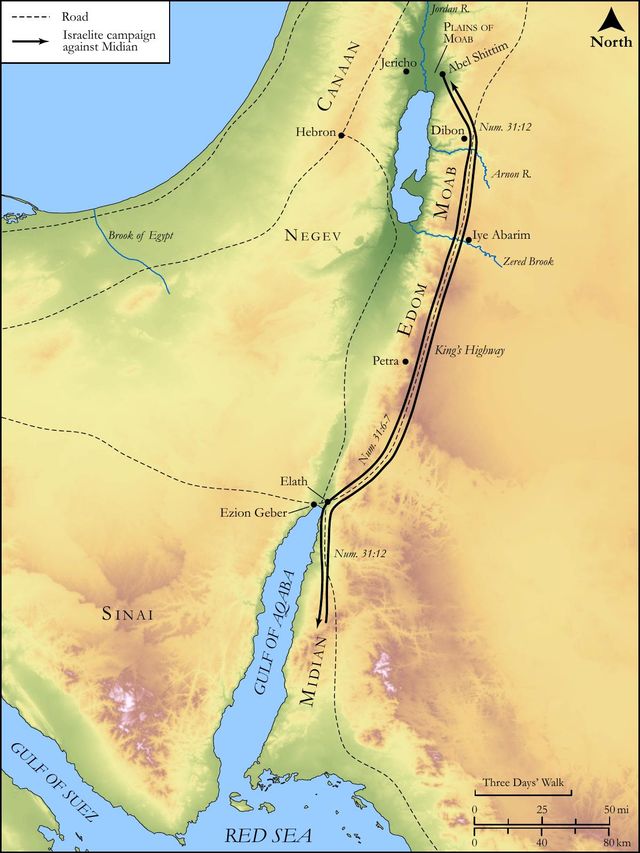
See on the biblical-era map
Study this verse
Continue studying Numbers 31:31 across the web’s major study libraries — every link below opens this exact verse, chapter, or book on the destination site.
Read & Compare
 BibleGatewayThis verse in more than 200 translations and 70 languages.
 Bible.comThe YouVersion reader — hundreds of translations, reading plans, and highlights.
 ESV.orgCrossway's official English Standard Version reader.
 NET BibleThe NET translation with 60,000+ translators' notes on every rendering decision.
 STEP BibleTyndale House's free study tool — original text, vocabulary, and scholarly resources.
 BibliaLogos Bible Software's free web reader.
 USCCBThe New American Bible (Revised Edition) with the U.S. bishops' study notes.
Commentaries
 BibleHub CommentariesDozens of classic commentaries on this verse, gathered on one page.
 StudyLightMore than 100 commentary sets — the largest collection on the web.
 BibleRefPlain-English commentary on what this verse means, verse by verse.
 Enduring WordDavid Guzik's free commentary on this chapter, widely used by Bible teachers.
 Bible Study ToolsVerse commentary alongside Greek and Hebrew study aids.
Original Language & Research
- BibleHub InterlinearThe verse word by word — original language, transliteration, and English.
- BibleHub LexiconEvery word's original-language definition and Strong's entry.
 Blue Letter BibleDeep-study tools — Strong's numbers, concordance, and word studies.
 SefariaThe Hebrew text with Rashi and centuries of Jewish commentary.
Sermons, Hymns & Audio


TrulyRandomVerse is not affiliated with these sites and doesn’t control their content. They’re linked because they’re genuinely useful.
Summary
Numbers 31:31 serves as a succinct yet profound conclusion to the detailed account of Israel's punitive war against Midian and the subsequent intricate instructions for handling the spoils. This verse powerfully affirms the faithful and complete execution of God's specific commands by Moses and Eleazar the priest, underscoring the paramount importance of precise obedience within the covenant relationship between God and His people. It highlights the diligent adherence of Israel's leadership to divine directives, ensuring that even in the aftermath of warfare, the principles of holiness, justice, and consecration to the LORD were meticulously upheld, thereby validating the entire process as divinely sanctioned and executed.
Context
ShowHideLiterary Context
Numbers 31:31 brings to a definitive close a significant narrative segment detailing Israel's divinely commanded war against the Midianites. The preceding verses (Numbers 31:1-20) describe the military campaign itself, the decisive victory, and the initial, somewhat flawed, handling of the captives and plunder, which prompted divine intervention. God then provides precise instructions through Moses and Eleazar for the purification of the people and the spoils (Numbers 31:21-24), followed by an intricate system for the division of the vast plunder among the warriors, the congregation, and as a "tribute" to the LORD for the priests and Levites (Numbers 31:25-30). Verse 31 acts as the final, authoritative statement, confirming that these complex and specific divine directives, particularly those outlined from Numbers 31:25-30, were meticulously followed by the appointed leaders. This concluding affirmation validates the entire process as divinely sanctioned and perfectly executed, emphasizing the narrative's focus on obedience to God's detailed commands.
Historical & Cultural Context
The war against Midian was not merely a territorial conflict but a divinely commanded act of judgment against a people who had actively led Israel into idolatry and sexual immorality at Baal-peor. This historical backdrop underscores the seriousness of the Midianite threat to Israel's spiritual purity and covenant faithfulness, making the ensuing judgment a necessary act of divine justice. Culturally, warfare among the nations often involved the taking of extensive spoils, including people, animals, and material goods, with the victors typically claiming all. However, unlike typical practices, God's commands in Numbers 31 introduced unique regulations concerning purification (e.g., the use of fire and water for different types of items, as seen in Numbers 31:21-24) and a highly structured system for the fair sharing of goods. This system ensured that a significant portion was consecrated to the LORD, reflecting Israel's unique status as a holy nation under divine law, where even military actions and their aftermath were governed by spiritual principles and divine order.
Key Themes
ShowHideThis verse powerfully reinforces several key themes prevalent throughout the book of Numbers and the Pentateuch. Foremost among these is Unwavering Obedience to God's revealed will. The simple declaration that "Moses and Eleazar... did as the LORD commanded" highlights that faithful execution of divine instruction is paramount, even when the commands are detailed, complex, or seemingly mundane. This echoes the principle that "to obey is better than sacrifice" (1 Samuel 15:22). Another significant theme is Divine Authority and Leadership. Moses, as the primary recipient of God's commands, and Eleazar, as the high priest responsible for the nation's spiritual integrity and the handling of sacred offerings, exemplify leadership that is entirely subservient to God's authority. Their joint action signifies the harmonious integration of civil and spiritual leadership under God's ultimate sovereignty. Finally, the verse speaks to Order and Holiness. God's meticulous instructions for the division and purification of the spoils ensured that chaos was averted and that the spoils, even from war, were brought into a state of ritual purity and consecrated appropriately, maintaining the holiness of the Israelite community as a whole, as seen in the detailed distribution in Numbers 31:25-30.
Exposition and Analysis
ShowHideKey Word Analysis
ShowHideFrom a primitive root; to do or make, in the broadest sense and widest application; accomplish, advance, appoint, apt, be at, become, bear, bestow, bring forth, bruise, be busy, [idiom] certainly, have the charge of, commit, deal (with), deck, [phrase] displease, do, (ready) dress(-ed), (put in) execute(-ion), exercise, fashion, [phrase] feast, (fight-) ing man, [phrase] finish, fit, fly, follow, fulfill, furnish, gather, get, go about, govern, grant, great, [phrase] hinder, hold (a feast), [idiom] indeed, [phrase] be industrious, [phrase] journey, keep, labour, maintain, make, be meet, observe, be occupied, offer, [phrase] officer, pare, bring (come) to pass, perform, pracise, prepare, procure, provide, put, requite, [idiom] sacrifice, serve, set, shew, [idiom] sin, spend, [idiom] surely, take, [idiom] thoroughly, trim, [idiom] very, [phrase] vex, be (warr-) ior, work(-man), yield, use. In this context, it signifies the active, complete, and diligent execution of the divine instructions. It implies not merely an acknowledgment or a partial attempt, but a full and faithful carrying out of all that was commanded, emphasizing the thoroughness of their compliance.
From a primitive root; (intensively) to constitute, enjoin; appoint, (for-) bid, (give a) charge, (give a, give in, send with) command(-er, -ment), send a messenger, put, (set) in order. This verb denotes a direct, authoritative, and specific directive from a superior, in this case, from God Himself. The repeated use of this root throughout the chapter (e.g., Numbers 31:2, Numbers 31:25) underscores the divine origin and binding nature of the instructions given to Moses, which then become the absolute standard for action.
Verse Breakdown
ShowHide"And Moses and Eleazar the priest"
This phrase identifies the two pivotal figures responsible for the execution of God's commands. Moses, as the divinely appointed leader and lawgiver, received the instructions directly from the LORD. Eleazar, as the high priest, held primary responsibility for matters of ritual purity, sacred offerings, and the spiritual well-being of the nation. Their joint mention emphasizes the unity of their leadership and the comprehensive nature of the tasks, encompassing both civil administration and spiritual oversight, ensuring that all aspects of God's law were addressed.
"did"
This simple yet profound verb confirms the decisive action taken by Moses and Eleazar. It signifies that the complex and detailed instructions outlined in the preceding verses were not merely heard or understood, but actively put into practice. This "doing" implies diligence, faithfulness, and the successful, complete, and accurate completion of the mandated tasks, demonstrating their full compliance with God's will.
"as the LORD commanded Moses"
This concluding clause serves as the ultimate validation and justification for their actions. It explicitly states that their conduct was in perfect alignment with the divine will, leaving no room for human interpretation or deviation. The phrase "the LORD commanded Moses" highlights the ultimate source of authority (YHWH, the covenant God) and the divinely appointed channel of revelation (Moses), reinforcing the divine origin and absolute authority of the instructions. This underscores the paramount theme of obedience as the proper and necessary response to God's sovereign word.
Literary Devices
ShowHideNumbers 31:31, though brief, employs several effective literary devices that enhance its impact. It functions as a powerful Narrative Fulfillment statement, providing a definitive closure and confirmation that the preceding divine directives have been fully and faithfully implemented. This simple declaration serves to tie up a significant narrative thread, assuring the reader that God's will was accomplished precisely as intended. The verse also utilizes Emphasis through Brevity and Placement. Its succinctness, following a lengthy and detailed exposition of commands, draws immediate and sharp attention to the core message: the absolute importance of obedience. Placed at the very end of the chapter, it acts as a concluding Affirmation of Obedience, powerfully reinforcing this central theme of the Pentateuch. Furthermore, the phrase "as the LORD commanded Moses" is a recurring Formulaic Expression throughout the Old Testament, creating a sense of continuity and highlighting the consistent pattern of divine command followed by human compliance (or non-compliance), thereby imbuing the actions of Moses and Eleazar with divine sanction and historical significance.
Theological and Thematic Connections
ShowHideNumbers 31:31 offers a profound theological statement on the nature of God's relationship with His people and the essence of faithful leadership. It underscores the divine expectation of complete and unreserved obedience to God's revealed will, not merely as a legalistic duty, but as an expression of profound trust, reverence, and covenant faithfulness. The meticulous adherence of Moses and Eleazar to even the most intricate details demonstrates that true worship and service involve diligently carrying out God's specific instructions, ensuring that the community remains holy, ordered, and blessed according to His design. This verse reminds us that God's commands are not arbitrary but are given for the ultimate well-being, spiritual integrity, and flourishing of His people, and that faithful leadership is characterized by humble submission to His sovereign authority and a commitment to executing His word without deviation.
Reflection and Application
ShowHideNumbers 31:31, in its straightforward declaration, provides a timeless and powerful lesson for believers today. It calls us to consider the depth of our own obedience to God's Word in every facet of our lives. Just as Moses and Eleazar diligently followed specific, detailed instructions regarding purification, division of spoils, and consecration, we are called to live in accordance with God's revealed will in our personal conduct, our financial stewardship, our relationships, our vocational pursuits, and our communal responsibilities within the church and society. The verse challenges us to move beyond mere intellectual assent to God's commands and into active, diligent, and complete execution of them. It teaches that true spiritual leadership, whether in the church, in our homes, or in the marketplace, involves humbly seeking God's instructions through His Word and prayer, and then acting upon them with unwavering integrity and faithfulness. Our obedience is not about earning favor or salvation, but about demonstrating our profound love, trust, and devotion to the God who knows what is best for us and for the advancement of His kingdom. It is a joyful response to His grace and a testament to our reliance on His wisdom and sovereignty.
Questions for Reflection
ShowHideFAQ
ShowHideWhy is this verse so short and seemingly simple after such complex instructions?
ShowHideThe brevity and simplicity of Numbers 31:31 are precisely what make it so powerful and effective. Following a lengthy and intricate set of commands for purification and the division of spoils (detailed from Numbers 31:21-30), this verse serves as a concise, authoritative concluding statement. Its purpose is not to add more detail but to confirm the successful and complete execution of all that was commanded. It acts as a narrative "seal," affirming that God's will was perfectly accomplished through His chosen leaders. This succinctness emphasizes the paramount importance of obedience: the outcome of all the detailed instructions is simply that "they did as the LORD commanded," highlighting that the ultimate measure of faithfulness is not the complexity of the command, but the integrity of its fulfillment.
What was the specific significance of Eleazar's role alongside Moses in this context?
ShowHideEleazar, as the high priest, played a crucial and distinct role alongside Moses, signifying the integration of spiritual and civil authority in Israel's leadership. While Moses received the direct commands from the LORD and oversaw the general administration, Eleazar's presence was essential for matters pertaining to ritual purity and the sacred. In Numbers 31, he was specifically instructed by God to teach the people the laws of purification for the spoils (Numbers 31:21-24). Furthermore, the "tribute" or "heave offering" from the warriors' half of the spoils was specifically designated for Eleazar the priest, and the Levites received a portion from the congregation's half (Numbers 31:28-30). His involvement ensured that the handling of the spoils, particularly the purification rituals and the allocation of sacred portions, adhered to the divine standards of holiness and was spiritually legitimate. His joint action with Moses underscored that God's law encompasses all aspects of life, requiring both administrative and priestly oversight for its complete and holy fulfillment.
Christ-Centered Fulfillment
ShowHideNumbers 31:31, with its emphasis on perfect obedience to divine command, powerfully foreshadows the ultimate and complete obedience of Jesus Christ. Moses and Eleazar, though faithful and exemplary in their adherence to God's will, were imperfect shadows of the One who would perfectly embody and execute the Father's will in every aspect of His life, ministry, and sacrificial death. Jesus, the true and greater Moses, did not merely "do as the LORD commanded" but perfectly lived out and fulfilled the Father's will, declaring, "I always do what pleases him" (John 8:29). Unlike the temporary purification rituals overseen by Eleazar, Jesus, as our eternal High Priest (Hebrews 4:14-16), offered Himself as the spotless sacrifice, thereby accomplishing a perfect and eternal purification for all who believe (Hebrews 9:11-14). His obedience, even to the point of death on the cross (Philippians 2:8), not only fulfilled the law but also secured for us the ultimate "spoils" of spiritual victory: forgiveness of sins, eternal life, and reconciliation with God. In Christ, God's commands are not just externally obeyed but internally fulfilled, transforming hearts and bringing us into perfect alignment with the divine will, enabling us to live lives of true obedience through His Spirit.