


Matthew 26:49
Bible text: King James Version (1769 Blayney text) · Public domain
Bible text: Berean Standard Bible · Public domain
Bible text: American Standard Version (1901) · Public domain
Bible text: World English Bible, Messianic edition · Public domain
Bible text: Geneva Bible (1599) · Public domain
Bible text: Young's Literal Translation · Public domain
- καὶkaiAndG2532CONJConjunction
- εὐθέωςeutheōsimmediatelyG2112ADVAdverb
- προσελθὼνproselthōnhaving come upG4334V-2AAP-NSMVerb 2nd Aorist Active Participle Nominative Singular Masculine
- τῷtō<the>G3588T-DSMDefinite article Dative Singular Masculine
- ἸησοῦIēsouto JesusG2424N-DSM-PNoun Dative Singular Masculine Individual
- εἶπεν·eipenhe saidG2036V-2AAI-3SVerb 2nd Aorist Active Indicative 3rd Singular
- χαῖρεchaireGreetingsG5463V-PAM-2SVerb Present Active Imperative 2nd Singular
- ῥαββίrhabbiRabbiG4461N-VSM-TNoun Vocative Singular Masculine Person Gentilic
- καὶkaiandG2532CONJConjunction
- κατεφίλησενkatephilēsenkissedG2705V-AAI-3SVerb Aorist Active Indicative 3rd Singular
- αὐτόνautonHimG846P-ASMPersonal pronoun Accusative Singular Masculine
English is a literal word-by-word gloss of the Greek, not the KJV's wording. Why?
This is the original text the KJV's translators worked from — each Greek word with its own literal English meaning in this verse, prepared by scholars at Tyndale House, Cambridge. The KJV translates whole sentences, not word by word, so its wording differs: one Greek word can become several English words, and the KJV may choose “charity” where the gloss reads “love”. Both are faithful — they answer different questions. For the KJV's own rendering, switch to the KJV text.
Details
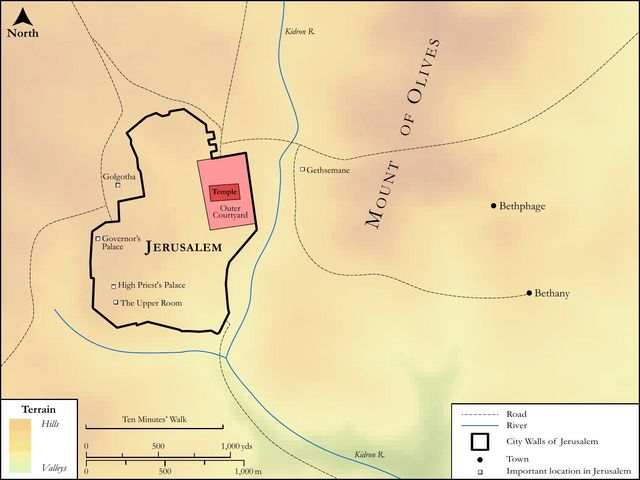
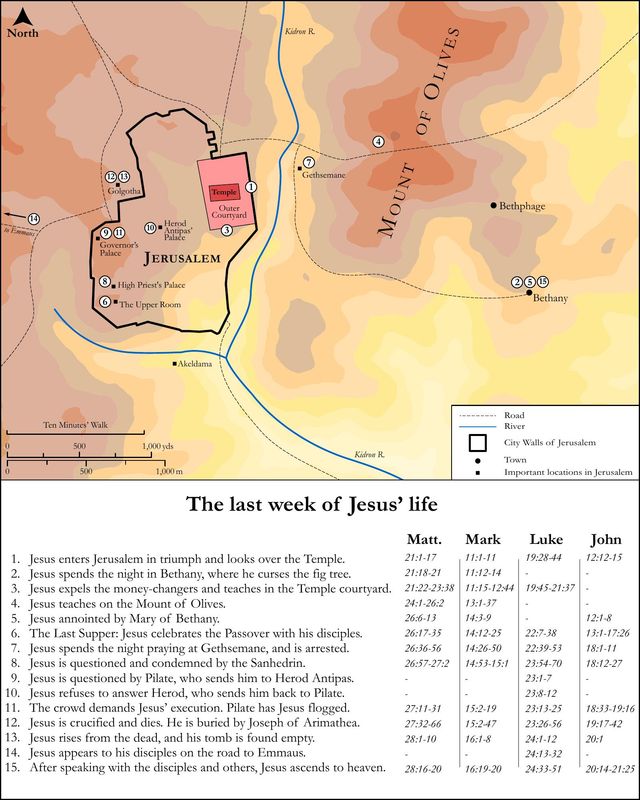
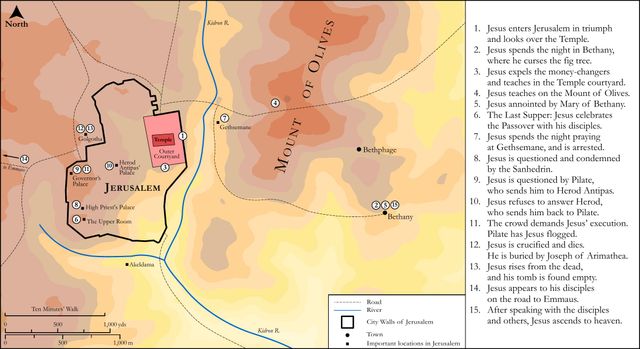
See on the biblical-era maps
Study this verse
Historical interpretation
Ten Centuries of Reception
9 surviving comments on this verse. Each one is dated, so this reads as a timeline rather than a list.
Select a marker to jump to its quote. Markers stagger vertically where authors wrote within a few decades of each other.
(Serm. de Symb. ad Catech. 6.) Exult, Christian, you have gained by this bargain of your enemies; what Judas sold, and what the Jews bought, belongs to you.
If it be asked why Judas betrayed Jesus with a kiss, according to some it was because He desired to keep up the reverence due to his Master, and did not dare to make an open assault upon Him; according to others, it was out of fear that if he came as an avowed enemy, he might be the cause of His escape, which he believed Jesus had it in His power to effect. But I think that all betrayers of truth love to assume the guise of truth, and to use the sign of a kiss. Like Judas also, all heretics call Jesus Rabbi, and receive from Him mild answer.
There is a certain order to the different facets of Christ’s suffering. But the reason for Judas’s kiss was that we might discern all our enemies and those who we know would delight in raging against us. The Lord does not resist his kiss.
At any rate, "While He yet spake, lo, Judas, one of the twelve, came, and with him a great multitude with swords and staves, from the chief priests and elders of the people." Seemly surely are the instruments of the priests! "with swords and staves" do they come against Him! And Judas, it is said, with them, one of the twelve. Again he calleth him "of the twelve," and is not ashamed. Now he that betrayed Him gave them a sign, saying, "Whomsoever I shall kiss, that same is He, hold Him fast." Oh! what depravity had the traitor's soul received. For with what kind of eyes did he then look at his Master? with what mouth did he kiss Him? Oh! accursed purpose; what did he devise? What did he dare? What sort of sign of betrayal did he give? Whomsoever I shall kiss, he saith. He was emboldened by his Master's gentleness, which more than all was sufficient to shame him, and to deprive him of all excuse for that he was betraying one so meek.
But wherefore doth He say this? Because often when seized by them He had gone out through the midst, without their knowing it. Nevertheless, then also this would have been done, if it had not been His own will that He should be taken. It was at least with a view to teach them this, that He then blinded their eyes, and Himself asked, "Whom seek ye?" And they knew Him not, though being with lanterns and torches, and having Judas with them. Afterwards, as they had said, "Jesus;" He saith, "I am He" whom ye seek: and here again, "Friend, wherefore art thou come?"
For after having shown His own strength, then at once He yielded Himself. But John saith, that even to the very moment He continued to reprove him, saying, "Judas, betrayest thou the Son of Man with a kiss?" Art thou not ashamed even of the form of the betrayal? saith He. Nevertheless, forasmuch as not even this checked him, He submitted to be kissed, and gave Himself up willingly; and they laid their hands on Him, and seized Him that night on which they ate the passover, to such a degree did they boil with rage, and were mad. However, they would have had no strength, unless He had Himself suffered it. Yet this delivers not Judas from intolerable punishment, but even more exceedingly condemns him, for that though he had received such proof of His power, and lenity, and meekness, and gentleness, he became fiercer than any wild beast.
Or, because whenever they had hitherto attempted to seize Him, He had escaped them they knew not how; as also He might then have done had He been so minded.
(Verse 49.) And immediately coming to Jesus, he said, Hail, Rabbi! And he kissed him. Shameless indeed and wickedly confident, to call the master and to throw a kiss to the one he was handing over. Nevertheless, the disciple still has something of discretion, as he does not openly hand him over to the persecutors, but through the sign of a kiss. This is the sign that God placed on Cain, so that whoever found him would not kill him (Genesis 4).
One of the twelve, by association of name, not of desert. This shows the monstrous wickedness of the man who from the dignity of the Apostleship became the traitor. To show that it was out of envy that they seized Him, it is added, A great multitude sent by the Chief Priests and elders of the people.
Or, after Friend, for what thou art come, that do, is understood. Then came they, and laid their hands on Jesus, and held him. Then, that is, when He suffered them, for ofttimes they would have done it, but were not able.
The Lord suffered the traitor's kiss, not to teach us to dissemble, but that He might not seem to shrink from His betrayal.
(non occ.) Having said above that the Lord offered Himself of His own accord to His pursuers, the Evangelist proceeds to relate how He was seized by them.
Continue studying Matthew 26:49 across the web’s major study libraries — every link below opens this exact verse, chapter, or book on the destination site.
Read & Compare
 BibleGatewayThis verse in more than 200 translations and 70 languages.
 Bible.comThe YouVersion reader — hundreds of translations, reading plans, and highlights.
 ESV.orgCrossway's official English Standard Version reader.
 NET BibleThe NET translation with 60,000+ translators' notes on every rendering decision.
 STEP BibleTyndale House's free study tool — original text, vocabulary, and scholarly resources.
 BibliaLogos Bible Software's free web reader.
 USCCBThe New American Bible (Revised Edition) with the U.S. bishops' study notes.
Commentaries
 BibleHub CommentariesDozens of classic commentaries on this verse, gathered on one page.
 StudyLightMore than 100 commentary sets — the largest collection on the web.
 BibleRefPlain-English commentary on what this verse means, verse by verse.
 Enduring WordDavid Guzik's free commentary on this chapter, widely used by Bible teachers.
 Bible Study ToolsVerse commentary alongside Greek and Hebrew study aids.
Original Language & Research
- BibleHub InterlinearThe verse word by word — original language, transliteration, and English.
- BibleHub LexiconEvery word's original-language definition and Strong's entry.
 Blue Letter BibleDeep-study tools — Strong's numbers, concordance, and word studies.
 CNTR CollationThe earliest Greek manuscripts of this verse, collated letter by letter.
Sermons, Hymns & Audio


TrulyRandomVerse is not affiliated with these sites and doesn’t control their content. They’re linked because they’re genuinely useful.
Summary
Matthew 26:49 captures the chilling and pivotal moment of Judas Iscariot's betrayal of Jesus in the Garden of Gethsemane. With a deceptive show of affection and respect, Judas identifies Jesus to the armed crowd by means of a kiss and a seemingly reverent greeting, thereby initiating the sequence of events that would lead to Jesus' arrest, trial, and crucifixion, fulfilling ancient prophecies and demonstrating the profound depths of human treachery.
Context
ShowHideLiterary Context
This verse immediately follows Jesus' agonizing prayer in the Garden of Gethsemane, where He wrestled with the Father's will and ultimately submitted to it, even to the point of death. Jesus had just awakened His disciples, informing them that the betrayer was at hand (Matthew 26:46). Judas's arrival with a large crowd, armed with swords and clubs, is the direct fulfillment of Jesus' words. The preceding verse, Matthew 26:48, explicitly states Judas's prearranged signal: "Whomsoever I shall kiss, that same is he: hold him fast." Thus, Matthew 26:49 describes the precise execution of this pre-meditated act of treachery, marking the transition from Jesus' private suffering to His public passion.
Historical & Cultural Context
In ancient Near Eastern culture, a kiss was a common and significant gesture of greeting, affection, and respect, especially between friends, family members, or a disciple and their teacher. It signified intimacy and trust. The title "Rabbi" (rendered "master" in KJV) was a Hebrew honorific meaning "my great one" or "my teacher," used for esteemed religious instructors. Judas's use of both the kiss and the respectful title, therefore, would have appeared outwardly as a normal, even affectionate, greeting from a disciple to his beloved teacher. This cultural understanding deepens the profound hypocrisy and perversity of Judas's act, transforming a symbol of loyalty and love into the instrument of ultimate betrayal. The armed crowd accompanying Judas indicates the official nature of the arrest, likely sent by the Sanhedrin, the Jewish high court, underscoring the political and religious conspiracy against Jesus.
Key Themes
ShowHideThe central theme in Matthew 26:49 is betrayal, specifically the profound and shocking treachery of a trusted insider. This act highlights the theme of hypocrisy, as Judas employs gestures of affection and respect to mask his malicious intent, illustrating the deceptive nature of sin. The event also powerfully underscores divine sovereignty and the fulfillment of prophecy, as Jesus had foretold His betrayal multiple times (e.g., Matthew 26:21 and John 13:18), and it aligns with Old Testament predictions concerning the Messiah's suffering at the hands of a close friend (Psalm 41:9). Finally, the scene emphasizes Jesus' foreknowledge and passive obedience, as He willingly submits to this act of betrayal, knowing full well its purpose and ultimate outcome, thereby demonstrating His unwavering commitment to His redemptive mission.
Exposition and Analysis
ShowHideKey Word Analysis
ShowHideThis adverb signifies immediacy and swiftness. It emphasizes the promptness with which Judas executed his pre-arranged signal upon arriving, highlighting his determined and unhesitating commitment to the betrayal. It conveys a sense of urgency and directness in his action.
A common Greek greeting, literally meaning "rejoice" or "be well." While typically a benevolent salutation, its use by Judas in this context is deeply ironic and perverse. It is a polite, even joyful, address used to initiate an act of profound malice, underscoring the hypocrisy of the betrayer.
This verb is an intensified form of the common Greek word for "kiss" (phileō). The prefix "kata-" suggests an earnest, fervent, or repeated kissing, indicating a deep display of affection or reverence. The use of this stronger verb further amplifies the horrific irony of Judas's act, transforming a gesture of profound love and intimacy into the ultimate sign of treachery and death.
Verse Breakdown
ShowHide"And forthwith he came to Jesus"
This phrase immediately establishes the rapid and direct nature of Judas's approach. "Forthwith" (euthéōs) emphasizes the swiftness and determination with which Judas executed his pre-arranged signal, leaving no room for hesitation or second thoughts on his part. He moved purposefully towards Jesus, ready to fulfill his treacherous agreement.
"and said, Hail, master"
Judas's verbal greeting is a chilling display of hypocrisy. "Hail" (chaírō), a common and generally benevolent greeting, combined with "master" (rhabbí), a title of deep respect for a teacher, creates a stark contrast with his true intentions. This seemingly reverent address serves as part of his pre-arranged signal, a polite facade for a malicious act.
"and kissed him"
This is the climactic and most infamous part of the betrayal. The act of kissing (kataphiléō), an intensified form implying a fervent or repeated kiss, was a customary sign of deep affection, respect, and intimacy in that culture. By using this gesture as the pre-arranged signal for Jesus' identification and arrest, Judas transforms a symbol of love and trust into the ultimate instrument of deceit and treachery, forever imprinting the "kiss of Judas" into human history as an idiom for betrayal.
Literary Devices
ShowHideMatthew 26:49 is rich in Irony, both verbal and situational. The verbal irony is evident in Judas's greeting, "Hail, master," where a salutation of well-wishing and respect is uttered as a prelude to an act of profound harm. The situational irony lies in the Symbolism of the kiss. What is universally understood as a gesture of love, affection, and intimacy is perverted into the pre-arranged sign of betrayal and death. This creates a stark Contrast between outward appearance and inner reality, highlighting Judas's profound hypocrisy. The scene also employs Foreshadowing, as Jesus had repeatedly spoken of His impending betrayal, making this moment the grim fulfillment of His words. The directness of "forthwith" adds a sense of Dramatic Urgency to the narrative, emphasizing the swift, unhesitating nature of the treachery.
Theological and Thematic Connections
ShowHideThe betrayal of Jesus by Judas Iscariot, as depicted in Matthew 26:49, is a profound theological event that speaks volumes about the nature of sin, divine sovereignty, and the cost of discipleship. It underscores the reality that even those closest to God can fall prey to covetousness and spiritual blindness, leading to the ultimate act of treachery. Yet, this dark moment is simultaneously part of God's sovereign plan for redemption. While Judas acted with his own free will and evil intent, his actions unwittingly served to bring about the very sacrifice necessary for humanity's salvation. This paradox reveals God's ability to weave even the darkest human acts into His perfect redemptive tapestry. The scene also highlights the depth of Jesus' humility and obedience, as He willingly submits to this betrayal, knowing its purpose and outcome.
Reflection and Application
ShowHideThe scene of Judas's betrayal in Matthew 26:49 offers a sobering mirror for self-examination and a powerful call to genuine discipleship. It compels us to consider the authenticity of our own outward expressions of faith and affection. Do our words and gestures truly align with the intentions of our hearts, or do we, like Judas, sometimes employ a facade of piety while harboring motives that contradict our professed loyalty to Christ? This passage reminds us that true allegiance is not merely spoken or displayed through customary gestures, but is demonstrated by consistent obedience and uncompromised devotion. It also serves as a stark warning against the insidious nature of sin, particularly greed and spiritual compromise, which can lead even a close follower of Jesus down a path of ultimate destruction. In a world where appearances can be deceiving, the "kiss of Judas" calls us to cultivate discernment, to guard our hearts, and to ensure that our love for Christ is sincere, unwavering, and demonstrated through faithful action, not merely empty words or gestures.
Questions for Reflection
ShowHideFAQ
ShowHideWhy did Judas use a kiss to betray Jesus?
ShowHideJudas used a kiss because it was a common and culturally significant gesture of greeting, affection, and respect between friends, family members, and especially between a disciple and their teacher in ancient Near Eastern society. By prearranging this intimate gesture as the signal (as stated in Matthew 26:48), Judas ensured that Jesus would be clearly identified in the darkness of the Garden of Gethsemane without confusion among the crowd sent to arrest Him. The choice of a kiss made the betrayal even more heinous, as it perverted a symbol of love and trust into an instrument of treachery.
Was Judas's betrayal necessary for God's plan of salvation?
ShowHideFrom a divine perspective, Judas's betrayal was indeed part of God's sovereign plan, as it fulfilled Old Testament prophecies (e.g., Psalm 41:9) and was foretold by Jesus Himself (Matthew 26:21). However, this does not absolve Judas of his personal responsibility or guilt. God, in His infinite wisdom, can use even the wicked acts of humanity to accomplish His righteous purposes, without Himself being the author of evil. Judas acted out of his own free will, driven by greed and spiritual darkness, and was justly condemned for his treachery (Matthew 26:24). God's plan incorporated, but did not necessitate, Judas's specific evil choice; rather, it demonstrated God's ultimate control and ability to bring good out of evil.
Christ-Centered Fulfillment
ShowHideThe betrayal of Jesus by Judas Iscariot in Matthew 26:49 stands as a poignant and powerful moment in the Christ-centered narrative of salvation. Far from being an unforeseen tragedy, this act of treachery was a divinely orchestrated step towards the cross, fulfilling ancient prophecies that spoke of the Messiah being betrayed by a close companion (Psalm 41:9). Jesus, the Lamb of God, who takes away the sin of the world (John 1:29), willingly submitted to this betrayal, demonstrating His profound humility and obedience to the Father's will (Philippians 2:8). He did not resist the kiss of death, but rather embraced it as part of the path to Calvary, where He would offer Himself as the perfect sacrifice for the sins of humanity. Thus, Judas's wicked deed, though born of human depravity, ultimately served to usher in the moment of ultimate redemption, revealing the depth of Christ's love and His unwavering commitment to securing eternal life for all who believe (John 3:16). This scene underscores that even in the darkest moments of human sin and betrayal, Christ remains sovereign, faithfully pursuing His redemptive mission to bring glory to God and salvation to His people.