


Matthew 26:50
Bible text: King James Version (1769 Blayney text) · Public domain
Bible text: King James Version with Strong's numbers · Public domain
Bible text: Berean Standard Bible · Public domain
Bible text: American Standard Version (1901) · Public domain
Bible text: World English Bible, Messianic edition · Public domain
Bible text: Geneva Bible (1599) · Public domain
Bible text: Young's Literal Translation · Public domain
- ὉHo<the>G3588T-NSMDefinite article Nominative Singular Masculine
- δὲdeAndG1161CONJConjunction
- ἸησοῦςIēsousJesusG2424N-NSM-PNoun Nominative Singular Masculine Individual
- εἶπενeipensaidG2036V-2AAI-3SVerb 2nd Aorist Active Indicative 3rd Singular
- αὐτῷ·autōto himG846P-DSMPersonal pronoun Dative Singular Masculine
- ἑταῖρεhetaireFriendG2083N-VSMNoun Vocative Singular Masculine
- ἐφ᾽eph᾽[do] forG1909PREPPreposition
- ὃhowhatG3739R-ASNRelative pronoun Accusative Singular Neuter
- πάρειpareiyou are comeG3918V-PAI-2SVerb Present Active Indicative 2nd Singular
- τότεtoteThenG5119ADVAdverb
- προσελθόντεςproselthonteshaving come to [him]G4334V-2AAP-NPMVerb 2nd Aorist Active Participle Nominative Plural Masculine
- ἐπέβαλονepebalonthey laidG1911V-2AAI-3PVerb 2nd Aorist Active Indicative 3rd Plural
- τὰςtas<the>G3588T-APFDefinite article Accusative Plural Feminine
- χεῖραςcheirashandsG5495N-APFNoun Accusative Plural Feminine
- ἐπὶepionG1909PREPPreposition
- τὸνton<the>G3588T-ASMDefinite article Accusative Singular Masculine
- ἸησοῦνIēsounJesusG2424N-ASM-PNoun Accusative Singular Masculine Individual
- καὶkaiandG2532CONJConjunction
- ἐκράτησανekratēsanseizedG2902V-AAI-3PVerb Aorist Active Indicative 3rd Plural
- αὐτόνautonHimG846P-ASMPersonal pronoun Accusative Singular Masculine
English is a literal word-by-word gloss of the Greek, not the KJV's wording. Why?
This is the original text the KJV's translators worked from — each Greek word with its own literal English meaning in this verse, prepared by scholars at Tyndale House, Cambridge. The KJV translates whole sentences, not word by word, so its wording differs: one Greek word can become several English words, and the KJV may choose “charity” where the gloss reads “love”. Both are faithful — they answer different questions. For the KJV's own rendering, switch to the KJV text.
Details
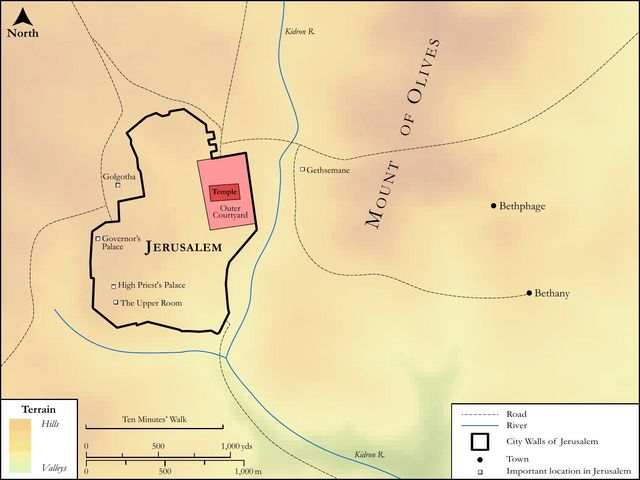
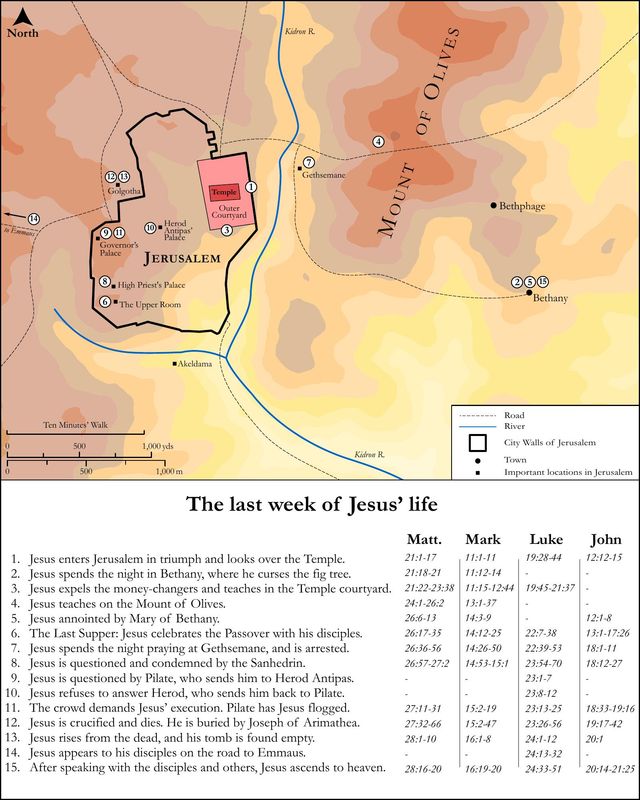
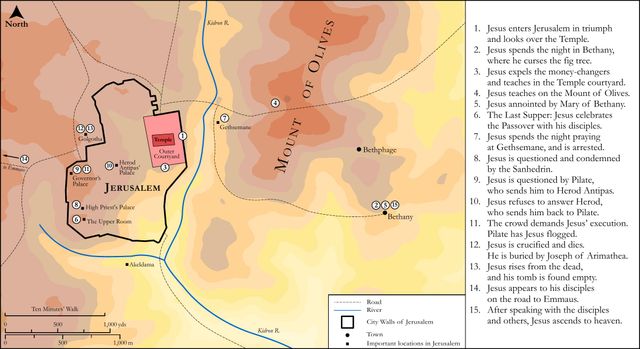
See on the biblical-era maps
Study this verse
Historical interpretation
Ten Centuries of Reception
13 surviving comments on this verse. Each one is dated, so this reads as a timeline rather than a list.
Select a marker to jump to its quote. Markers stagger vertically where authors wrote within a few decades of each other.
(Serm. de Symb. ad Catech. 6.) Exult, Christian, you have gained by this bargain of your enemies; what Judas sold, and what the Jews bought, belongs to you.
But I think that all betrayers of the truth, pretending to love the truth and using the sign of a kiss as a mark of affection, betray the Word of God. Cloaked in belligerence, brandishing clubs and the swords of battle and proffering insults, his enemies desire to take hold of him. And the traitor says to Jesus, "Master." Indeed, all heretics, like Judas, address Jesus in the same way, "Master." They kiss him even as Judas did. Jesus speaks peacefully to them all, since they are all Judases who betray him: "Judas, is it with a kiss that you betray the Son of man?" As for Judas, he is reproached by Christ for his false friendship. "Friend, why are you here?" We hear of no one who is good called by that name in the Scriptures. Moreover, to the wicked and the one not wearing a wedding garment he says, "Friend, how did you get in here without a wedding garment?" Wicked too is that man in the parable of the denarius who hears the words, "Friend, I am doing you no wrong; did you not agree with me for a denarius? Take what belongs to you, and go. I choose to give to this last as I give to you."
And Jesus said unto him, Friend, wherefore art thou come? He says, Friend, upbraiding his hypocrisy; for in Scripture we never find this term of address used to any of the good, but as above, Friend, how camest thou in hither? (Matt. 22:12.) and, Friend, I do thee no wrong. (Matt. 20:13.)
The apostle cuts off the ear of the slave of the high priest; that is, a disciple of Christ cuts off a disobedient ear from a man in the priesthood. What was once incapable of hearing the truth is now cut off.
As to what he tells Judas, “Do what you have to do,” he authorizes his own betrayal by that very statement. For he who had it within his power to call upon twelve thousand legions of angels against his betrayers would have found it so much easier to oppose the plans and artifices of one man. At length he says to Pilate, “You would have no power over me unless it had been given you.” He thus gives power against himself when he says, “Do what you have to do.” In other words, because the crime of what is willed is counterbalanced by what is perpetuated, Judas would accomplish in deed what he had already done in his will.
At any rate, "While He yet spake, lo, Judas, one of the twelve, came, and with him a great multitude with swords and staves, from the chief priests and elders of the people." Seemly surely are the instruments of the priests! "with swords and staves" do they come against Him! And Judas, it is said, with them, one of the twelve. Again he calleth him "of the twelve," and is not ashamed. Now he that betrayed Him gave them a sign, saying, "Whomsoever I shall kiss, that same is He, hold Him fast." Oh! what depravity had the traitor's soul received. For with what kind of eyes did he then look at his Master? with what mouth did he kiss Him? Oh! accursed purpose; what did he devise? What did he dare? What sort of sign of betrayal did he give? Whomsoever I shall kiss, he saith. He was emboldened by his Master's gentleness, which more than all was sufficient to shame him, and to deprive him of all excuse for that he was betraying one so meek.
But wherefore doth He say this? Because often when seized by them He had gone out through the midst, without their knowing it. Nevertheless, then also this would have been done, if it had not been His own will that He should be taken. It was at least with a view to teach them this, that He then blinded their eyes, and Himself asked, "Whom seek ye?" And they knew Him not, though being with lanterns and torches, and having Judas with them. Afterwards, as they had said, "Jesus;" He saith, "I am He" whom ye seek: and here again, "Friend, wherefore art thou come?"
For after having shown His own strength, then at once He yielded Himself. But John saith, that even to the very moment He continued to reprove him, saying, "Judas, betrayest thou the Son of Man with a kiss?" Art thou not ashamed even of the form of the betrayal? saith He. Nevertheless, forasmuch as not even this checked him, He submitted to be kissed, and gave Himself up willingly; and they laid their hands on Him, and seized Him that night on which they ate the passover, to such a degree did they boil with rage, and were mad. However, they would have had no strength, unless He had Himself suffered it. Yet this delivers not Judas from intolerable punishment, but even more exceedingly condemns him, for that though he had received such proof of His power, and lenity, and meekness, and gentleness, he became fiercer than any wild beast.
Or, because whenever they had hitherto attempted to seize Him, He had escaped them they knew not how; as also He might then have done had He been so minded.
(Verse 50.) And Jesus said to him: Friend, why have you come? Then they drew near and laid hands on Jesus, and seized him. The word 'Friend' should be understood either in the opposite sense, or certainly according to what we have read above: Friend, how did you enter here without a wedding garment? (Matt. XXII, 12)?
(non occ.) He says, Wherefore art thou come? as much as to say, Thy kiss is a snare for Me; I know wherefore thou art come; thou feignest thyself My friend, being indeed My betrayer.
One of the twelve, by association of name, not of desert. This shows the monstrous wickedness of the man who from the dignity of the Apostleship became the traitor. To show that it was out of envy that they seized Him, it is added, A great multitude sent by the Chief Priests and elders of the people.
Or, after Friend, for what thou art come, that do, is understood. Then came they, and laid their hands on Jesus, and held him. Then, that is, when He suffered them, for ofttimes they would have done it, but were not able.
The Lord suffered the traitor's kiss, not to teach us to dissemble, but that He might not seem to shrink from His betrayal.
. Do you see the weapons of the chief priests? Staves and swords! So peaceful were they, and possessed of such a spirit of meekness! The evangelist says, "one of the twelve," marveling that though Judas had been chosen and ranked among the first, yet he gave himself to the devil. So you, too, O man, be fearful though you may be among the most intimate of the Lord’s friends, lest you become careless and lazy and fall away. Judas gave a sign because it was night and they were not able to identify Jesus. For those who came to arrest Him were not from the multitude, but were servants of the high priest, who perhaps did not know Jesus at all. But the disciple reveals the Master to them with a kiss. For Judas knew the Lord’s love for mankind, and hence was emboldened to kiss Him. The Lord was patient even to the last moment, eager to win Judas by His long-suffering. Even so Judas was not brought to reason, whereupon the Lord caused the servants of the high priest to fall, as John says (Jn. 18:5-6), so that in falling down they would recognize His power. But even so they did not desist from their brazenness, whereupon Jesus gives Himself over to them. He calls Judas "friend," deriding and disparaging him for supposedly giving Him a friend’s kiss. "Wherefore art thou come?" means "For what reason have you come here? As a friend? Then there was no need to come with swords. As an enemy? Then why do you kiss Me?" Thus He rebukes him as a treacherous deceiver.
(non occ.) Having said above that the Lord offered Himself of His own accord to His pursuers, the Evangelist proceeds to relate how He was seized by them.
Continue studying Matthew 26:50 across the web’s major study libraries — every link below opens this exact verse, chapter, or book on the destination site.
Read & Compare
 BibleGatewayThis verse in more than 200 translations and 70 languages.
 Bible.comThe YouVersion reader — hundreds of translations, reading plans, and highlights.
 ESV.orgCrossway's official English Standard Version reader.
 NET BibleThe NET translation with 60,000+ translators' notes on every rendering decision.
 STEP BibleTyndale House's free study tool — original text, vocabulary, and scholarly resources.
 BibliaLogos Bible Software's free web reader.
 USCCBThe New American Bible (Revised Edition) with the U.S. bishops' study notes.
Commentaries
 BibleHub CommentariesDozens of classic commentaries on this verse, gathered on one page.
 StudyLightMore than 100 commentary sets — the largest collection on the web.
 BibleRefPlain-English commentary on what this verse means, verse by verse.
 Enduring WordDavid Guzik's free commentary on this chapter, widely used by Bible teachers.
 Bible Study ToolsVerse commentary alongside Greek and Hebrew study aids.
Original Language & Research
- BibleHub InterlinearThe verse word by word — original language, transliteration, and English.
- BibleHub LexiconEvery word's original-language definition and Strong's entry.
 Blue Letter BibleDeep-study tools — Strong's numbers, concordance, and word studies.
 CNTR CollationThe earliest Greek manuscripts of this verse, collated letter by letter.
Sermons, Hymns & Audio


TrulyRandomVerse is not affiliated with these sites and doesn’t control their content. They’re linked because they’re genuinely useful.
Summary
Matthew 26:50 captures the deeply poignant moment of Jesus' arrest in the Garden of Gethsemane, immediately following Judas Iscariot's infamous kiss of betrayal. This verse records Jesus' profound, yet serene, question to Judas, exposing the betrayer's true intent, followed by the swift and forceful apprehension of Jesus by the accompanying crowd. It marks the culmination of Judas's treachery and the beginning of Jesus' passion, highlighting His willing submission to the divine plan even in the face of profound injustice.
Context
ShowHideLiterary Context
This verse is situated at a critical juncture in Matthew's Passion narrative, directly after Jesus' agonizing prayer in Gethsemane where He fully submits to the Father's will, declaring, "Nevertheless, not as I will, but as you will" Matthew 26:39. Immediately preceding this verse, Judas has arrived with a large contingent, identified Jesus with a kiss, and Jesus has confronted him with the words, "Friend, do what you have come for" Matthew 26:49. Matthew 26:50 then details the immediate aftermath of this betrayal, showing the crowd's violent seizure of Jesus, which sets the stage for the subsequent trials and crucifixion. The narrative flow emphasizes Jesus' composure and sovereign control even as events unfold according to God's predetermined plan.
Historical & Cultural Context
The arrest of Jesus took place under the cover of night, a common tactic for apprehending individuals without causing public disturbance, especially during the Passover festival when Jerusalem was crowded with pilgrims. The crowd accompanying Judas consisted of temple guards and possibly Roman soldiers, sent by the chief priests and elders, indicating an official, though illicit, operation sanctioned by the Jewish religious authorities Matthew 26:47. The use of "swords and clubs" suggests an expectation of resistance, perhaps reflecting the authorities' fear of Jesus' popular support. The Garden of Gethsemane, located at the foot of the Mount of Olives, was a familiar place for Jesus and His disciples, making it an ideal, secluded spot for the clandestine arrest. The betrayal by a "friend" or "companion" (as Jesus calls Judas) carried a particularly heavy cultural weight, violating deep-seated norms of loyalty and trust, reminiscent of prophetic laments over betrayal by trusted associates (e.g., Psalm 41:9).
Key Themes
ShowHideThis verse powerfully contributes to several overarching themes in Matthew's Gospel. Firstly, it underscores the theme of Divine Sovereignty and Fulfillment of Prophecy. Despite the human agency of betrayal and violence, Jesus' calm demeanor and His question to Judas indicate His full awareness that these events are part of God's redemptive plan, not a chaotic accident. His arrest is a necessary step towards the atonement He will accomplish on the cross, fulfilling numerous Old Testament prophecies regarding the suffering Messiah (e.g., Isaiah 53). Secondly, it highlights Jesus' Willing Submission and Humility. Even though He possesses the power to summon "more than twelve legions of angels" Matthew 26:53, Jesus offers no resistance, demonstrating His perfect obedience to the Father's will and His unwavering commitment to His mission to save humanity. This voluntary surrender contrasts sharply with the violent actions of His captors and the impulsive resistance of Peter Matthew 26:51. Finally, the interaction with Judas emphasizes the theme of Betrayal and its Consequences, presenting the stark reality of human sin and the tragic outcome of rejecting divine love, even from within the closest circle.
Exposition and Analysis
ShowHideKey Word Analysis
ShowHideThis word (G2083) denotes a "comrade" or "fellow," but not necessarily an intimate friend (for which philos would be used). In this context, Jesus' use of hetaîros to address Judas is laden with irony and sorrow. It highlights the incongruity of Judas's treacherous act coming from one who was a companion and disciple. It serves as a poignant reminder of the broken bond and the gravity of the betrayal, a final, piercing address that underscores the tragic nature of the moment.
The verb (G4334) means "to approach" or "come near." In this context, it describes the physical movement of the crowd towards Jesus. The use of the plural "they" emphasizes the collective, organized nature of the apprehension, indicating that it was not a random act but a coordinated effort by a group sent to seize Him.
This word (G2902) means "to use strength, i.e., seize or retain (literally or figuratively)." It conveys the forceful, decisive action of the crowd in apprehending Jesus. It implies a firm grip, a taking hold with authority and power, reflecting the intent to secure Him and prevent any escape or resistance. This contrasts with Jesus' own willing surrender.
Verse Breakdown
ShowHide"And Jesus said unto him, ‹Friend, wherefore art thou come?›"
Jesus' direct address to Judas, using the term "Friend," is deeply ironic and rhetorical. It is not a question born of ignorance, but a profound query that exposes Judas's motive and the ultimate purpose of his presence: to betray Jesus. This question serves as a final, direct confrontation of Judas's conscience, highlighting the gravity of his actions and the tragic choice he has made. It underscores Jesus' full awareness of the situation and His sovereign control even in the face of betrayal.
"Then came they, and laid hands on Jesus, and took him."
This clause describes the immediate and forceful action of the crowd. The phrase "laid hands on Jesus" signifies an act of apprehension and seizure, indicating the physical restraint and capture of Jesus. The subsequent "and took him" confirms the successful completion of their mission to arrest Him. The swiftness of these actions, following Jesus' words, emphasizes the sudden and decisive nature of the arrest, marking the transition from verbal confrontation to physical captivity.
Literary Devices
ShowHideMatthew 26:50 employs several powerful literary devices. The most prominent is Irony, specifically Dramatic Irony, as Jesus addresses Judas as "Friend" (Greek: hetaîros). The audience knows Judas's true intent, making Jesus' seemingly benign address a cutting indictment of the betrayer's treachery. This term, not implying deep intimacy, underscores the tragic incongruity of a "companion" delivering the kiss of betrayal. Another device is Rhetorical Question ("wherefore art thou come?"). Jesus does not ask this question for information, but to challenge Judas, to expose his purpose, and perhaps to offer a final, silent plea for repentance. It highlights the moral bankruptcy of Judas's act. Finally, the narrative employs Conciseness and Directness in describing the arrest ("Then came they, and laid hands on Jesus, and took him"). The rapid succession of verbs creates a sense of immediacy and inevitability, emphasizing the swift, unresisting capture of Jesus, which contrasts with the preceding dialogue and highlights the decisive turning point in the Passion narrative.
Theological and Thematic Connections
ShowHideMatthew 26:50 is a profound theological statement on divine sovereignty amidst human sin. Jesus' calm acceptance of His betrayal and arrest underscores that these events were not accidental but part of God's predetermined plan for redemption. His willingness to be "taken" demonstrates His perfect obedience to the Father and His commitment to His mission as the Suffering Servant, whose sacrifice would atone for the sins of the world. This moment reveals that even the darkest acts of human treachery are ultimately subject to God's overarching purposes, leading not to defeat, but to the ultimate victory of the cross and resurrection.
Reflection and Application
ShowHideMatthew 26:50 offers profound lessons for believers navigating betrayal, injustice, and the unfolding of God's will in their lives. Jesus' response to Judas, marked by a poignant question rather than anger or resistance, teaches us to confront treachery with a divine perspective, recognizing that even the most painful human actions can be woven into God's larger, redemptive tapestry. It calls us to cultivate a spirit of submission to God's sovereignty, trusting that His purposes will prevail even when circumstances seem chaotic or unjust. Furthermore, Jesus' question "wherefore art thou come?" serves as a powerful personal challenge, prompting us to examine our own motives and the true purpose behind our actions, especially in our relationship with Christ and His body. Are we coming to Him with genuine devotion, or with hidden agendas that ultimately lead to spiritual betrayal? This verse invites us to embrace humility, surrender to God's plan, and maintain faithfulness even when it demands personal sacrifice, knowing that true victory is found in obedience to His will.
Questions for Reflection
ShowHideFAQ
ShowHideWhy did Jesus call Judas "Friend" despite knowing he was betraying Him?
ShowHideJesus' address to Judas as "Friend" (Greek: hetaîros) is laden with profound irony and sorrow. It was not a term of intimate affection (like philos), but rather a formal address for a companion or comrade. By using this term, Jesus highlighted the tragic incongruity of a fellow disciple, one who had shared His ministry and table, committing such a heinous act of betrayal. It served as a final, piercing confrontation of Judas's conscience, exposing the gravity of his choice and demonstrating Jesus' full awareness of the betrayal, even as He extended a final, silent opportunity for Judas to reconsider. It underscores Jesus' sovereign control and His willingness to endure betrayal as part of God's redemptive plan, just as Psalm 41:9 prophesied.
Did Jesus resist His arrest, or did He willingly surrender?
ShowHideMatthew 26:50, along with other Gospel accounts, clearly indicates that Jesus willingly surrendered to His arrest. While one of His disciples (Peter, as identified in John 18:10) did attempt to resist by drawing a sword, Jesus immediately rebuked him, stating that He could call on "more than twelve legions of angels" if He wished, but that doing so would prevent the fulfillment of the Scriptures Matthew 26:52-54. His calm question to Judas and His lack of physical resistance demonstrate His perfect obedience to the Father's will and His voluntary submission to the divine plan for His suffering and death, as He Himself declared in John 10:18, "No one takes it from me, but I lay it down of my own accord."
Christ-Centered Fulfillment
ShowHideMatthew 26:50, depicting Jesus' willing submission to betrayal and arrest, profoundly illuminates His Christ-centered fulfillment of God's redemptive plan. Jesus, the sinless Son of God, allows Himself to be "taken" by the very people He came to save, embodying the ultimate act of self-sacrificial love. His calm demeanor and the rhetorical question to Judas, "Friend, wherefore art thou come?", not only expose the depth of human sin but also underscore Jesus' full knowledge and sovereign control over the unfolding events. This moment foreshadows His ultimate role as the Lamb of God, who willingly goes to the slaughter for the sins of the world, just as Isaiah 53:7 prophesied. His unresisting surrender in Gethsemane is the necessary prelude to His atoning death on the cross, where He would bear the full weight of humanity's sin, including the sin of betrayal. Therefore, this verse is not merely a historical account of an arrest, but a powerful testament to the Messiah's deliberate and loving journey towards Calvary, securing reconciliation and eternal life for all who believe in Him, as celebrated in passages like Romans 5:8 and 2 Corinthians 5:21.