


Mark 16:5
- καὶkaiAndG2532CONJConjunction
- εἰσελθοῦσαιeiselthousaihaving enteredG1525V-2AAP-NPFVerb 2nd Aorist Active Participle Nominative Plural Feminine
- εἰςeisintoG1519PREPPreposition
- τὸtotheG3588T-ASNDefinite article Accusative Singular Neuter
- μνημεῖονmnēmeiontombG3419N-ASNNoun Accusative Singular Neuter
- εἶδονeidonthey sawG1492V-2AAI-3PVerb 2nd Aorist Active Indicative 3rd Plural
- νεανίσκονneaniskona young manG3495N-ASMNoun Accusative Singular Masculine
- καθήμενονkathēmenonsittingG2521V-PNP-ASMVerb Present Middle Or Passive Deponent Participle Accusative Singular Masculine
- ἐνenonG1722PREPPreposition
- τοῖςtoistheG3588T-DPNDefinite article Dative Plural Neuter
- δεξιοῖςdexioisrightG1188A-DPNAdjective Dative Plural Neuter
- περιβεβλημένονperibeblēmenonhaving clothed himself inG4016V-RMP-ASMVerb Perfect Middle Participle Accusative Singular Masculine
- στολὴνstolēna robeG4749N-ASFNoun Accusative Singular Feminine
- λευκὴνleukēnwhiteG3022A-ASFAdjective Accusative Singular Feminine
- καὶkaiandG2532CONJConjunction
- ἐξεθαμβήθησανexethambēthēsanthey were greatly amazedG1568V-API-3PVerb Aorist Passive Indicative 3rd Plural
English is a literal word-by-word gloss of the Greek, not the KJV's wording. Why?
This is the original text the KJV's translators worked from — each Greek word with its own literal English meaning in this verse, prepared by scholars at Tyndale House, Cambridge. The KJV translates whole sentences, not word by word, so its wording differs: one Greek word can become several English words, and the KJV may choose “charity” where the gloss reads “love”. Both are faithful — they answer different questions. For the KJV's own rendering, switch to the KJV text.
Details
See on the biblical-era map
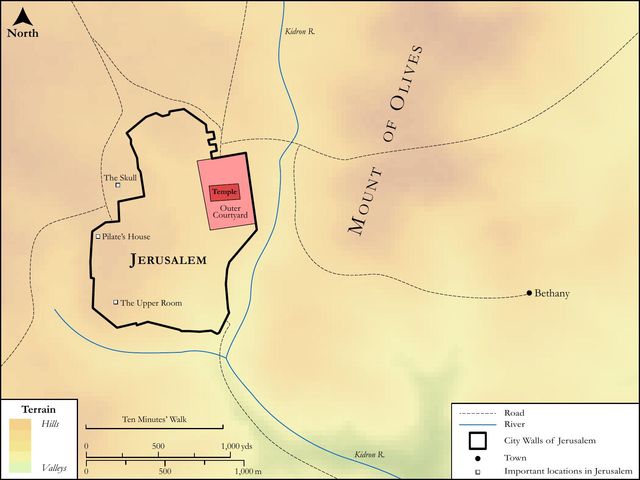
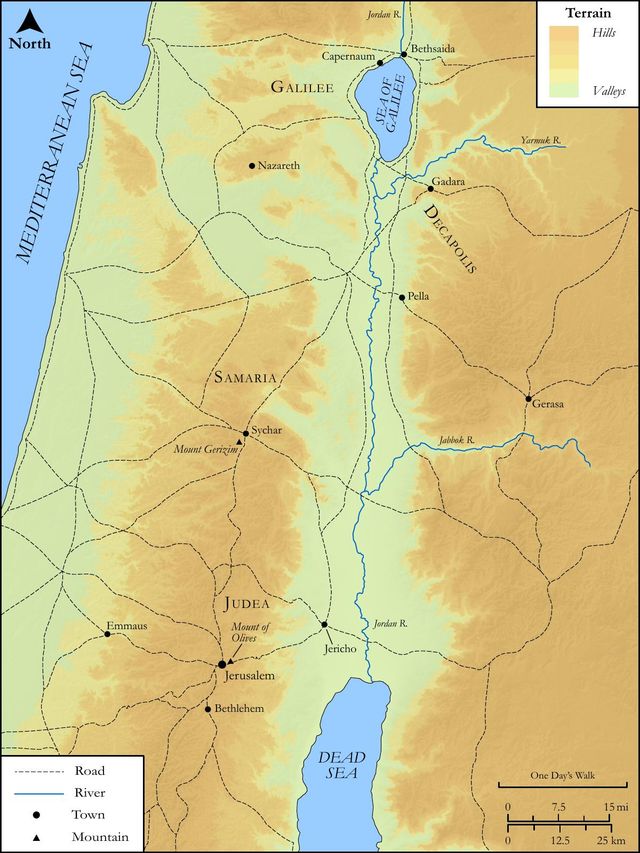
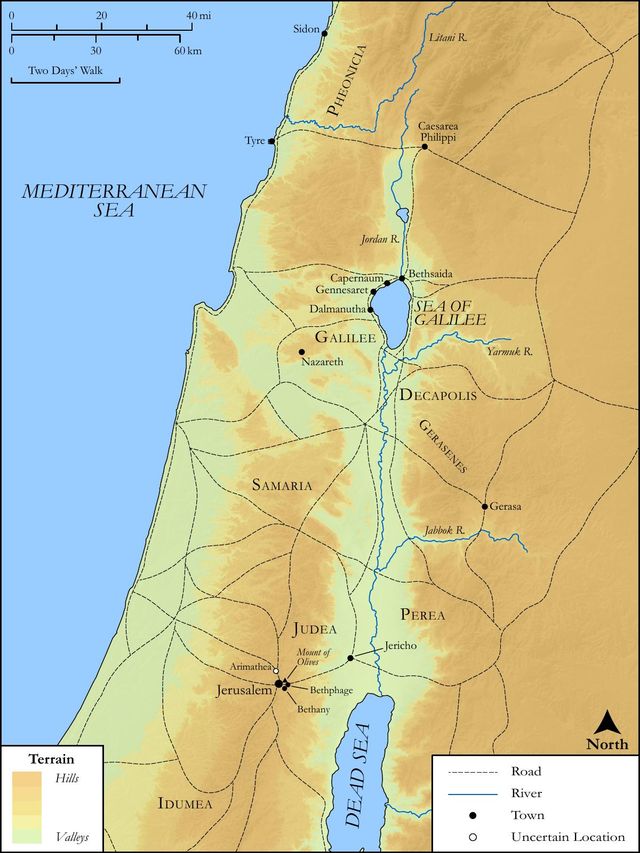
Study this verse
Public-domain commentary
Matthew Henry
From his Commentary on the Whole Bible. Henry comments on passages, not single verses — this entry covers Mark 16:1–8. His four-level outline is real structure in the source text, so it is rendered as structure.
Never was there such a sabbath since the sabbath was first instituted as this was, which the first words of this chapter tell us was now past; during all this sabbath our Lord Jesus lay in the grave. It was to him a sabbath of rest, but a silent sabbath, it was to his disciples a melancholy sabbath, spent in tears and fears. Never were the sabbath services in the temple such an abomination to God, though they had been often so, as they were now, when the chief priests, who presided in them, had their hands full of blood, the blood of Christ. Well, this sabbath is over, and the first day of the week is the first day of a new world. We have here,
I.The affectionate visit which the good women that had attended Christ, now made it to his sepulchre - not a superstitious one, but a pious one. They set out from their lodgings very early in the morning, at break of day, or sooner; but either they had a long walk, or they met with some hindrance, so that it was sun-rising by the time they got to the sepulchre. The had bought sweet spices too, and came not only to bedew the dead body with their tears (for nothing could more renew their grief than this), but to perfume it with their spices, Mar 16:1. Nicodemus had bought a very large quantity of dry spices, myrrh and aloes, which served to dry the wounds, and dry up the blood, Joh 19:39. But these good women did not think that enough; they bought spices, perhaps of another kind, some perfumed oils, to anoint him. Note, The respect which others have showed to Christ's name, should not hinder us from showing our respect to it.
II.The care they were in about the rolling away of the stone, and the superseding of that care (Mar 16:3, Mar 16:4); They said among themselves, as they were coming along, and now drew near the sepulchre, Who shall roll us away the stone from the door of the sepulchre? For it was very great, more than they with their united strength could move. They should have thought of this before they came out, and then discretion would have bid them not go, unless they had those to go with them, who could do it. And there was another difficulty much greater than this, to be got over, which they knew nothing of, to wit, a guard of soldiers set to keep the sepulchre; who, had they come before they were frightened away, would have frightened them away. But their gracious love to Christ carried them to the sepulchre; and see how by the time they came thither, both these difficulties were removed, both the stone which they knew of, and the guard which they knew not of. They saw that the stone was rolled away, which was the first thing that amazed them. Note, They who are carried by a holy zeal, to seek Christ diligently, will find the difficulties that lie in their way strangely to vanish, and themselves helped over them beyond their expectation.
III.The assurance that was given them by an angel, that the Lord Jesus was risen from the dead, and had taken leave of his sepulchre, and had left him there to tell those so who came thither to enquire after him.
1.They entered into the sepulchre, at least, a little way in, and saw that the body of Jesus was not there where they had left it the other night. He, who by his death undertook to pay our debt, in his resurrection took out our acquittance, for it was a fair and legal discharge, by which it appealed that his satisfaction was accepted for all the purposes for which it was intended, and the matter in dispute was determined by an incontestable evidence that he was the Son of God.
2.They saw a young man sitting on the right side of the sepulchre. The angel appeared in the likeness of a man, of a young man; for angels, though created in the beginning, grow not old, but are always the same perfection of beauty and strength; and so shall glorified saints be, when they are as the angels. This angel was sitting on the right hand as they went into the sepulchre, clothed with a long white garment, a garment down to the feet, such as great men were arrayed with. The sight of him might justly have encouraged them, but they were affrighted. Thus many times that which should be matter of comfort to us, through our own mistakes and misapprehensions proves a terror to us.
3.He silences their fears by assuring them that here was cause enough for triumph, but none for trembling (Mar 16:6); He saith to them, Be not affrighted. Note, As angels rejoice in the conversation of sinners, so they do also in the consolation of sinners. Be not affrighted, for, (1.) "Ye are faithful lovers of Jesus Christ, and therefore, instead of being confounded, out to be comforted. Ye seek Jesus of Nazareth, which was crucified." Note, The enquiries of believing souls after Christ, have a particular regard to him as crucified (Co1 2:2), that they may know him, and the fellowship of his sufferings. His being lifted up from the earth, is that which draws all men unto him. Christ's cross is the ensign to which the Gentiles seek. Observe, He speaks of Jesus as one that was crucified; "The thing is past, that scene is over, ye must not dwell so much upon the sad circumstances of his crucifixion as to be unapt to believe the joyful news of his resurrection. He was crucified in weakness, yet that doth not hinder but that he may be raised in power, and therefore ye that seek him, be not afraid of missing of him." He was crucified, but he is glorified; and the shame of his sufferings is so far from lessening the glory of his exaltation, that that glory perfectly wipes away all the reproach of his sufferings. And therefore after his entrance upon his glory, he never drew any veil over his sufferings, nor was shy of having his cross spoken of. The angel here that proclaims his resurrection, calls him Jesus that was crucified. He himself owns (Rev 1:18), I am he that liveth, and was dead; and he appears in the midst of the praises of the heavenly host as a Lamb that had been slain, Rev 5:6. (2.) "It will therefore be good news to you, to hear that, instead of anointing him dead, you may rejoice in him living. He is risen, he is not here, not dead, but alive again. We cannot as yet show you him, but hereafter you will see him, and you may here see the place where they laid him. You see he is gone hence, not stolen either by his enemies or by his friends, but risen."
4.He orders them to give speedy notice of this to his disciples. Thus they were made the apostles of the apostles, which was a recompence of their affection and fidelity to him, in attending him on the cross, to the grave, and in the grave. They first came, and were first served; no other of the disciples durst come near his sepulchre, or enquire after him; so little danger was there of their coming by night to steal him away, that none came near him but a few women, who were not able so much as to roll away the stone.
(1.)They must tell the disciples, that he is risen. It is a dismal time with them, their dear Master is dead, and all their hopes and joys are buried in his grave; they look upon their cause as sunk, and themselves ready to fall an easy prey into the hands of their enemies, so that there remains no more spirit in them, they are perfectly at their wits' end, and every one is contriving how to shift for himself. "O, go quickly to them," said the angel, "tell them that their Master is risen; this will put some life and spirit into them, and keep them from sinking into despair." Note,
[1.]Christ is not ashamed to own his poor disciples, no, not now that he is in his exalted state; his preferment doth not make him shy of them, for he took early care to have it notified to them.
[2.]Christ is not extreme to mark what they do amiss, whose hearts are upright with him. The disciples had very unkindly deserted him, and yet he testified this concern for them.
[3.]Seasonable comforts shall be sent to those that are lamenting after the Lord Jesus, and he will find a time to manifest himself to them.
(2.)They must be sure to tell Peter. This is particularly taken notice of by this evangelist, who is supposed to have written by Peter's direction. If it were told the disciples, it would be told Peter, for, as a token of his repentance for disowning his Master, he still associated with his disciples; yet he is particularly named: Tell Peter, for,
[1.]It will be good news to him, more welcome to him than to any of them; for he is in sorrow for sin, and no tidings can be more welcome to true penitents than to hear of the resurrection of Christ, because he rose again for their justification.
[2.]He will be afraid, lest the joy of this good news do not belong to him. Had the angel said only, Go, tell his disciples, poor Peter would have been ready to sigh, and say, "But I doubt I cannot look upon myself as one of them, for I disowned him, and deserve to be disowned by him;" to obviate that, "Go to Peter by name, and tell him, he shall be as welcome as any of the rest to see him in Galilee." Note, A sight of Christ will be very welcome to a true penitent, and a true penitent shall be very welcome to a sight of Christ, for there is joy in heaven concerning him.
(3.)They must appoint them all, and Peter by name, to give him the meeting in Galilee, as he said unto you, Mat 26:32. In their journey down into Galilee they would have time to recollect themselves, and call to mind what he had often said to them there, that he should suffer and die, and the third day be raised again; whereas while they were at Jerusalem, among strangers and enemies, they could not recover themselves from the fright they had been in, nor compose themselves to the due entertainment of better tidings. Note,
[1.]All the meetings between Christ and his disciples are of his own appointing.
[2.]Christ never forgets his appointment, but will be sure to meet his people with the promised blessing in every place where he records his name.
[3.]In all meetings between Christ and his disciples, he is the most forward. He goes before you.
IV.The account which the women did bring of this to the disciples (Mar 16:8); They went out quickly, and ran from the sepulchre, to make all the haste they could to the disciples, trembling and amazed. See how much we are enemies to ourselves and our own comfort, in not considering and mixing faith with that Christ hath said to us. Christ had often told them, that the third day he would rise again; had they given that its due notice and credit, they would have come to the sepulchre, expecting to have found him risen, and would have received the news of it with a joyful assurance, and not with all this terror and amazement. But, being ordered to tell the disciples, because they were to tell it to all the world, they would not tell it to any one else, they showed not any thing of it to any man that they met by the way, for they were afraid, afraid it was too good news to be true. Note, Our disquieting fears often hinder us from doing that service to Christ and to the souls of men, which if faith and the joy of faith were strong, we might do.
Historical interpretation
Eight Centuries of Reception
11 surviving comments on this verse. Each one is dated, so this reads as a timeline rather than a list.
Select a marker to jump to its quote. Markers stagger vertically where authors wrote within a few decades of each other.
After the sadness of the sabbath, a happy day dawns upon them, which holds the chief place amongst days, for in it the chief light shines forth, and the Lord rises in triumph. Wherefore it is said, And when the sabbath was past, Mary Magdalene, and Mary the mother of James and Salome, had bought sweet spices.
By very early in the morning, (Luke 24:1. diluculo Vulg.) he means what another Evangelist expresses by at the dawning. But the dawn is the time between the darkness of night, and the brightness of day, in which the salvation of man is coming forth with a happy closeness, to be declared in the Church, just as the sun, when he is rising and the light is near, sends before him the rosy dawn, that with prepared eyes she may bear to see the graciousness of his glorious brightness, when the time of our Lord's resurrection has dawned; that then the whole Church, after the example of the women, may sing the praises of Christ, since He has quickened the race of man after the pattern of His resurrection, since He has given life, and has poured upon them the light of belief.
The white robe is also true joy, now that the enemy is driven away, the kingdom won, the King of Peace sought for and found and never let go by us. This young man then shows an image of the Resurrection to them who feared death. But their being frightened shows that eye hath not seen, nor ear heard, neither have entered into the heart of man to conceive the things which God hath prepared for them that love Him. (1 Cor 2:9) There follows, And he saith unto them, Be not affrighted.
For there is no fear in love. Why should they fear, who had found Him whom they sought?
But the bitter root of the Cross has disappeared. The flower of life has burst forth with its fruits, that is, He who lay in death has risen in glory. Wherefore he adds, He is risen; he is not here.
But immortality is shown to mortals as1 due to thankfulness, that we may understand what we were, and that we may know what we are to be. There follows, But go your way, tell his disciples and Peter that he goeth before you into Galilee. The women are ordered to tell the Apostles, that as by a woman death was announced, so also might life rising again. But He says specially unto Peter, because he had shown himself unworthy of being a disciple, since he had thrice denied his Master; but past sins cease to hurt us when they cease to be pleasing to us.
This sentence is but short in the number of syllables, but the promise is vast in its greatness. Here is the fountain of our joy, and the source of everlasting life is prepared. Here all that are scattered are brought together, and the contrite hearts are healed. There, he says, ye shall see Him, but not as ye have seen Him.
This also is spoken of the life to come, in which grief and groaning will flee away. For the women prefigure before the resurrection all that is to happen to them after the resurrection, namely, they flee away from death and fear. There follows, Neither said they any thing to any man, for they were afraid.
Mark tells us that the women entered the sepulcher, and there saw a young man sitting on the right side, covered with a long white garment, and that they were frightened. In Matthew's version, the stone was already rolled away from the sepulcher and the angel was sitting upon it. The explanation may be that Matthew has simply said nothing about the angel whom they saw when they entered into the sepulcher, and that Mark has said nothing about the one whom they saw sitting outside upon the stone. In this way they would have seen two angels, and have assumed two separate angelic reports.
(Con. Evang. iii. 24) Either let us suppose that Matthew was silent about that Angel, whom they saw on entering, whilst Mark said nothing of him, whom they saw outside sitting on the stone, so that they saw two and heard severally from two, the things which the Angels said concerning Jesus; or we must understand by entering into the sepulchre, their coming within some inclosure, by which it is probable that the place was surrounded a little space before the stone, by the cutting out of which the burial place had been made, so that they saw sitting on the right hand in that space him whom Matthew designates as sitting on the stone.
(occ. ap. Chrysologum, serm. 82) The women in this place run abroad with womanly devotion, for they do not bring Him faith as though He were alive, but ointments as to one dead; and they prepare the service of their grief for Him as buried, not the joys of heavenly triumph for Him as risen.
(Chrysologus ubi sup.) Your breast was darkened, your eyes shut, and therefore ye did not before see the glory of the opened sepulchre. It goes on: And they looked, and saw that the stone was rolled away.
(Chrysologus ubi sup.) Great indeed by its office rather than its size, for it can shut in and throw open the body of the Lord.
(Chrysologus ubi sup.) The women, then, entered the sepulchre, that being buried with Christ, they might rise again from the tomb with Christ. They see the young man, that is, they see the time of the Resurrection, for the Resurrection has no old age, and the period, in which man knows neither birth nor death, admits of no decay, and requires no increase. Wherefore what they saw was a young man, not an old man, nor an infant, but the age of joy.
(Chrysologus ubi sup.) Again, they saw a young man sitting on the right, because the Resurrection has nothing sinister in it. They also see him dressed in a long white robe; that robe is not from mortal fleece, but of living virtue, blazing with heavenly light, not of an earthly dye, as saith the Prophet, Thou deckest thyself with light as with a garment; and of the just it is said, Then shall the righteous shine forth as the sun. (Ps. 104:2) (Matt. 13:43)
(Chrysologus ubi sup.) The Angel indeed sits on the sepulchre, the women fly from it; he, on account of his heavenly substance, is confident, they are troubled because of their earthly frame. He who cannot die, cannot fear the tomb, but the women both fear from what was then done, and still, as being mortals, fear the sepulchre as mortals are wont.
(Chrysologus ubi sup.) It is said also in a marked manner, that they said nothing to any one, because it is the part of women to hear, and not to speak, to learn, not to teach.
But we must note what it means that the angel is seen sitting on the right side. For what is designated by the left except the present life, and what by the right except eternal life? Hence it is written in the Song of Songs: "His left hand is under my head, and his right hand shall embrace me." Since therefore our Redeemer had already passed beyond the corruption of the present life, rightly the angel who had come to announce his eternal life was sitting on the right. He appeared covered with a white robe because he announced the joys of our festival. For the brightness of the garment proclaims the splendor of our solemnity. Should we say ours, or his? But to speak more truly, let us say both his and ours. For that resurrection of our Redeemer was both our festival, because it brought us back to immortality, and the festival of the angels, because by calling us back to heavenly things it filled up their number. Therefore at his own and our festival the angel appeared in white garments, because while we are brought back to heavenly things through the Lord's resurrection, the losses of the heavenly homeland are repaired.
(Hom. in Evan. 21) But if we believe on Him who is dead, and are filled with the sweet smell of virtue, and seek the Lord with the fame of good works, we come to His sepulchre with spices. There follows: And very early in the morning the first day of the week, they came unto the sepulchre at the rising of the sun.
(ubi sup.) But the women who came with spices see the Angels; because those minds who come to the Lord with their virtues, through holy desires, see the heavenly citizens. Wherefore it goes on: And entering into the sepulchre, they saw a young man sitting on the right side, clothed in a long white garment; and they were affrighted.
(ubi sup.) But what is meant by the left hand, but this present life, and what by the right, but everlasting life? Because then our Redeemer had already gone through the decay of this present life, fitly did the Angel, who had come to announce His everlasting life, sit on the right hand.
(ubi sup.) Or else, he appeared covered with a white robe, because he announced the joys of our festivity, for the whiteness of the robe shows the splendour of our solemnity.
(ubi sup.) As though he had said, Let them fear, who love not the coming of the inhabitants of heaven; let them fear, who, weighed down with carnal desires, despair that they can ever attain to their company; but why should ye fear, ye who see your own fellow citizens.
(ubi sup.) But let us hear what the Angel adds; Ye seek Jesus of Nazareth. Jesus means the Saviour, but at that time there may have been many a Jesus, not indeed really, but in name, therefore the place Nazareth is added, that it might be evident of what Jesus it was spoken. And immediately he subjoins the reason, Which was crucified.
(ubi sup.) He is not here, is spoken of His carnal presence, for He was not absent from any place as to the presence of His majesty.
(ubi sup.) If again the Angel had not expressly named him who had denied his Master, he would not have dared to come amongst the disciples; he is therefore called by name, lest he should despair on account of his denial.
(ubi sup.) For Galilee means 'a passing over;' for our Redeemer had already passed from His Passion to His resurrection, from death unto life, and we shall have joy in seeing the glory of His resurrection, if only we pass over from vice to the heights of virtue. He then who is announced at the tomb, is shown in 'passing over,' because He who is first known in mortification of the flesh, is seen in this passing over of the soul.
Why a “young man”? The resurrection of the dead, as the apostle declares, will be “unto the fullness of the measure of the stature of Christ,” that is, in the season of youth, which needs no further development and which is free from all defect, complete in every respect, having fullness of strength.
And entering into the tomb, they saw a young man sitting on the right side, clothed in a white robe, and they were amazed. Entering from the east into that round house carved in the rock, they saw an angel sitting on the southern part of that place, where the body of Jesus had been laid, for this was indeed on the right side. For surely the body, lying supine with its head towards the west, must have its right side towards the south. Matthew writes that they first saw the angel who rolled back the stone from the door of the tomb sitting upon the stone, who commanded them to enter the place where the Lord had been laid and to see that He had already risen from the dead. Luke writes that entering the tomb, they found two angels standing there. Therefore, the women who came with spices saw the angels, for indeed those minds see the heavenly citizens who, with virtues, travel to God through holy desires. We must note, indeed, what it means that the angel is seen sitting on the right hand. For what is signified by the left but the present life? And by the right but eternal life? Hence it is written: "His left hand is under my head, and his right hand shall embrace me." (Cant. II). For the Church places the left hand of God, namely the prosperity of the present life, as under the head, which it presses with the intention of supreme love. But God's right hand embraces it, because under its eternal bliss it is wholly contained with devotion. Therefore, because our Redeemer had already passed beyond the corruption of the present life, rightly did the angel who came to announce His eternal life sit at the right. He appeared clothed in a white robe because he announced the joys of our festivity. For the whiteness of the garment signifies the splendor of our festivity. Let us say ours or his? But to more truly confess, let us say both his and ours. For the resurrection of our Redeemer was both our festivity because it restored us to immortality, and the festivity of angels, because by bringing us back to the heavens, it fulfilled their number. Therefore, in his and our festivity, the angel appeared in white garments, because as we are led back to heaven through the resurrection of the Lord, the losses of the heavenly homeland are repaired. But now, let us hear him who addresses the women who come.
(in Marc. 4, 45) As then the women show the great fervency of their love, by coming very early in the morning to the sepulchre, as the history relates, according to the mystical sense an example is given to us, that with a shining face, and shaking off the darkness of wickedness, we may be careful to offer the fragrance of good works and the sweetness of prayer to the Lord.
(ubi sup.) Or else, by this phrase is meant the first day from the day of sabbaths, or rests, which were kept on the sabbath. There follows: And they said among themselves, Who shall roll us away the stone from the door of the sepulchre?
(ubi sup.) Matthew shows clearly enough, that the stone was rolled away by an Angel. This rolling away of the stone means mystically the opening of the Christian sacraments, which were held under the veil of the letter of the law; for the law was written on stone. It goes on: For it was very great.
(ubi sup.) Now they saw a young man sitting on the right side, that is, on the south part of the place where the body was laid. For the body, which was lying on its back, and had its head to the west, must have had its right to the south.
For they do not understand the greatness and dignity of the wisdom of Christ. But they came according to the custom of the Jews to anoint the body of Christ, that it might remain sweet-smelling, and might not burst forth into moisture, for spices have the property of drying up, and absorb the moisture of the body, so that they keep the body from corruption.
He says, On the first of the sabbaths, (μιᾱς σαββάτων.) that is, on the first of the days of the week. For the days of the week are called sabbaths, and by the word 'una' is meant 'prima.'
Though Matthew says that the Angel was sitting on the stone, whilst Mark relates that the women entering into the sepulchre saw a young man sitting, yet we need not wonder, for they afterwards saw sitting within the sepulchre the same Angel as sat without on the stone.
But some say the women mentioned by Matthew were different from those in Mark. But Mary Magdalene was with all parties, from her burning zeal and ardent love.
For he does not blush at the Cross, for in it is the salvation of men, and the beginning of the Blessed.
As if he had said, Do ye wish to be certain of His resurrection, he adds, Behold the place where they laid him. This too was the reason why he had rolled away the stone, that he might show the the place.
That is, they trembled because of the vision of Angels, and were amazed because of the resurrection.
Either on account of the Jews, or else they said nothing because the fear of the vision prevented them.
(ord. ex Bedâ.) For these religious women after the burial of the Lord, as long as it was lawful to work, that is, up to sunset, prepared ointment, as Luke says. (Luke 23:56) And because they could not finish their work from the shortness of the time, when the sabbath was over, that is, at sunset, as soon as the time for working came round again, they hastened to buy spices, as Mark says, that they might go in the morning to anoint the body of Jesus. Neither could they come to the sepulchre on the evening of the sabbath, for night prevented them. Wherefore it goes on: And very early in the morning the first day of the week, they came unto the sepulchre at the rising of the sun.
Continue studying Mark 16:5 across the web’s major study libraries — every link below opens this exact verse, chapter, or book on the destination site.
Read & Compare
 BibleGatewayThis verse in more than 200 translations and 70 languages.
 Bible.comThe YouVersion reader — hundreds of translations, reading plans, and highlights.
 ESV.orgCrossway's official English Standard Version reader.
 NET BibleThe NET translation with 60,000+ translators' notes on every rendering decision.
 STEP BibleTyndale House's free study tool — original text, vocabulary, and scholarly resources.
 BibliaLogos Bible Software's free web reader.
 USCCBThe New American Bible (Revised Edition) with the U.S. bishops' study notes.
Commentaries
 BibleHub CommentariesDozens of classic commentaries on this verse, gathered on one page.
 StudyLightMore than 100 commentary sets — the largest collection on the web.
 BibleRefPlain-English commentary on what this verse means, verse by verse.
 Enduring WordDavid Guzik's free commentary on this chapter, widely used by Bible teachers.
 Bible Study ToolsVerse commentary alongside Greek and Hebrew study aids.
Original Language & Research
- BibleHub InterlinearThe verse word by word — original language, transliteration, and English.
- BibleHub LexiconEvery word's original-language definition and Strong's entry.
 Blue Letter BibleDeep-study tools — Strong's numbers, concordance, and word studies.
 CNTR CollationThe earliest Greek manuscripts of this verse, collated letter by letter.
Sermons, Hymns & Audio


TrulyRandomVerse is not affiliated with these sites and doesn’t control their content. They’re linked because they’re genuinely useful.
Summary
Mark 16:5 vividly describes the women's astonishing discovery upon entering Jesus' tomb on resurrection morning. Instead of finding the body they expected to anoint, they encountered a mysterious young man, radiant in white, seated in a position of authority. This unexpected divine encounter, set against the backdrop of an empty tomb, immediately filled them with profound awe and fear, signaling that an extraordinary, supernatural event had transpired.
Context
ShowHideLiterary Context
This verse is a pivotal moment in Mark's abbreviated resurrection narrative, immediately following the women's arrival at the tomb and their discovery that the massive stone had been rolled away (Mark 16:1-4). The preceding verses establish their intent to anoint Jesus' body, highlighting their expectation of finding a corpse. The sudden appearance of a "young man" inside the sepulchre, rather than the expected deceased, creates a dramatic shift in the narrative, setting the stage for the angelic announcement of Jesus' resurrection in the subsequent verses (Mark 16:6-7). This abrupt transition from sorrowful duty to divine revelation underscores the unexpected and miraculous nature of the resurrection event.
Historical & Cultural Context
First-century Jewish burial practices involved wrapping the deceased in linen cloths, often with spices, and placing the body in a rock-hewn tomb, which would then be sealed with a large stone. The women's visit on the "first day of the week" (Sunday) was consistent with Jewish custom, as they would have observed the Sabbath rest. Their intention to anoint the body was a final act of devotion and respect, a common practice to honor the dead. The tomb itself, a "sepulchre" (Greek: mnēmeîon), was typically a dark, enclosed space. The presence of a figure "sitting on the right side" would have been significant; in Jewish and Roman cultures, the right hand or side often symbolized a place of honor, authority, or power, further emphasizing the importance of the messenger and his divine origin.
Key Themes
ShowHideMark 16:5 contributes significantly to several overarching themes in Mark's Gospel. The Empty Tomb is paramount, serving as irrefutable evidence that Jesus' body is no longer there, thereby validating the resurrection. The Divine Messenger theme is introduced through the "young man," who, though not explicitly called an angel here, functions as one, delivering God's truth about Christ's triumph over death. This aligns with other biblical accounts where angels mediate divine messages, such as in the birth narratives or at the resurrection in Matthew 28:5. Furthermore, the women's reaction of being "affrighted" (terrified) highlights the common human response to encountering the holy or divine, a recurring motif throughout Scripture whenever ordinary individuals confront the supernatural power of God, as seen when the disciples witnessed Jesus' transfiguration in Mark 9:6. This verse thus powerfully underscores the supernatural reality of the resurrection and its profound impact on those who first encountered it.
Exposition and Analysis
ShowHideKey Word Analysis
ShowHideThis primary verb means "to see" literally or figuratively, but in its perfect tense (as implied here by the aorist, conveying a completed action of seeing), it can also mean "to know" or "to perceive." The women's act of seeing was not merely optical; it was an encounter that led to a profound, immediate realization of something utterly unexpected and deeply significant, shifting their understanding of the situation from mourning to awe.
While literally meaning a "youth" or "young man" (typically under forty), in the context of resurrection narratives and parallel accounts (Matthew 28:2-5), this term is understood to refer to a divine, angelic being. Mark's choice of "young man" might emphasize his human-like appearance, making the encounter more immediate and relatable, yet his subsequent actions and appearance (white garment, authoritative position) firmly establish his supernatural nature.
This verb means "to astonish utterly" or "to greatly amaze." It conveys a stronger sense than simple fear, suggesting a profound shock, terror, and overwhelming astonishment that leaves one utterly bewildered and disoriented. This reaction is a common biblical response to encounters with the divine or supernatural, indicating the profound impact of the unexpected revelation on the women.
Verse Breakdown
ShowHide"And entering into the sepulchre"
This clause describes the women's decisive action of entering the tomb, an act predicated on their discovery that the stone had been rolled away. Their entry signifies a transition from the outside world of sorrow and expectation to the inner sanctum of the tomb, where their preconceived notions would be dramatically challenged. It sets the immediate physical scene for the revelation.
"they saw a young man sitting on the right side"
This is the core of the verse's revelation. The women's expectation of a corpse is shattered by the sight of a living figure. The description "young man" (an angel in disguise) immediately introduces a supernatural element. His position "sitting on the right side" is highly significant, symbolizing a place of honor, authority, and divine approval. This posture suggests a calm, authoritative presence, in stark contrast to the women's emotional state.
"clothed in a long white garment"
This detail further emphasizes the young man's divine nature and purity. The "long white garment" (Greek: stolē leukē) is often associated with heavenly beings, purity, victory, and divine glory in biblical literature. It sets him apart from ordinary human beings and underscores the sacredness and significance of the encounter. The garment is not merely clothing but an indicator of his identity and message.
"and they were affrighted"
This final clause captures the women's immediate and powerful emotional response. The Greek word conveys a sense of being utterly astonished, terrified, and overwhelmed. Their fear is not just from seeing a stranger in a tomb, but from the realization that they are in the presence of something holy, powerful, and entirely unexpected, signaling the profound, awe-inspiring nature of the resurrection event.
Literary Devices
ShowHideMark's concise narrative in this verse effectively employs several literary devices. Symbolism is prominent, particularly with the "long white garment" (stolē leukē), which universally symbolizes purity, heavenly origin, and divine glory, immediately signaling the young man's supernatural identity. The act of "sitting on the right side" also carries symbolic weight, representing a position of honor, authority, and divine favor, foreshadowing the authoritative message he is about to deliver. The narrative also uses Dramatic Irony, as the women enter the tomb expecting to perform a mournful burial rite, while the reader, aware of Jesus' earlier prophecies, anticipates the resurrection. This contrast heightens the impact of their unexpected discovery. Finally, the women's reaction of being "affrighted" serves as a powerful Emotional Indicator, conveying the profound awe and terror that accompanies a direct encounter with the divine, a common motif in biblical encounters with angels or God's presence.
Theological and Thematic Connections
ShowHideMark 16:5 is a foundational verse for understanding the reality and impact of the resurrection. The encounter with the "young man" (angel) in the empty tomb serves as God's direct, supernatural confirmation that Jesus has indeed conquered death. This moment shifts the narrative from human despair and expectation of death to divine revelation and the promise of new life. The women's fear is a natural human response to the holy, but it precedes the joyous and world-altering news of Christ's triumph. Theologically, it underscores God's active involvement in human history, intervening miraculously to validate His Son's identity and mission. This event is not merely a historical footnote but the cornerstone of Christian faith, demonstrating God's ultimate power over sin and death, and initiating the new covenant era.
Reflection and Application
ShowHideMark 16:5 invites us to consider our own expectations when approaching moments of apparent finality or despair. The women came to the tomb expecting to find a dead body, prepared for a mournful task, only to be met with a divine messenger and the profound reality of resurrection. This challenges us to look beyond our limited human perspectives and be open to God's unexpected interventions. In our lives, we often encounter "tombs"—situations that seem hopeless, dead ends, or places of profound sorrow. This verse reminds us that God's power is not confined by our expectations or by the apparent finality of circumstances. The "affrighted" reaction of the women is relatable; encountering divine truth, especially when it shatters our preconceived notions, can be overwhelming. Yet, this initial fear quickly gives way to the most glorious news imaginable. For us, this means embracing the transformative power of the resurrection, allowing it to reframe our understanding of suffering, loss, and even death, and to infuse our lives with hope and purpose. It calls us to anticipate God's miraculous work even in the darkest of places.
Questions for Reflection
ShowHideFAQ
ShowHideWhy does Mark refer to the figure as a "young man" instead of an "angel"?
ShowHideMark's Gospel often presents events concisely and dramatically. While parallel accounts in Matthew 28:2-5 and Luke 24:4 explicitly identify the figures at the tomb as angels, Mark's use of "young man" (Greek: neanískos) might serve several purposes. It could emphasize the figure's human-like appearance, making the encounter more immediate and relatable for the women. It also allows the divine nature to be revealed more through his clothing (long white garment) and authoritative position (sitting on the right side), and especially through the message he delivers in Mark 16:6-7. This choice maintains a sense of mystery and awe, highlighting the supernatural without immediately resorting to the explicit term "angel."
Christ-Centered Fulfillment
ShowHideMark 16:5, though focusing on the women's encounter with an angelic messenger, profoundly points to the Christ-centered fulfillment of God's redemptive plan. The "young man" in the tomb, radiant in white and seated in authority, is not merely a random figure; he is God's appointed herald of Christ's victory. His presence in an empty tomb is the divine affirmation that Jesus, the Lamb of God who takes away the sin of the world (John 1:29), has indeed triumphed over death and the grave. This moment fulfills the Old Testament prophecies of a Messiah who would suffer, die, and rise again (Isaiah 53:10-12). The empty tomb and the angelic announcement are the irrefutable evidence that Jesus' sacrifice was accepted by God, validating His claim to be the Son of God with power (Romans 1:4). The women's fear quickly gives way to the astonishing truth that Jesus is alive, inaugurating a new era where death no longer holds its sting (1 Corinthians 15:55-57). Thus, this verse serves as a powerful testament to the resurrection, the cornerstone of Christian faith, and the ultimate display of Christ's triumph and His ongoing reign as Lord.