


Matthew 26:32
Bible text: King James Version (1769 Blayney text) · Public domain
Bible text: Berean Standard Bible · Public domain
Bible text: American Standard Version (1901) · Public domain
Bible text: World English Bible, Messianic edition · Public domain
Bible text: Geneva Bible (1599) · Public domain
Bible text: Young's Literal Translation · Public domain
- μετὰmetaAfterG3326PREPPreposition
- δὲdehoweverG1161CONJConjunction
- τὸto<the>G3588T-ASNDefinite article Accusative Singular Neuter
- ἐγερθῆναίegerthēnaito raiseG1453V-APNVerb Aorist Passive Infinitive
- μεmeMeG3165P-1ASPersonal pronoun Accusative 1st Singular
- προάξωproaxōI will go beforeG4254V-FAI-1SVerb Future Active Indicative 1st Singular
- ὑμᾶςhumasyouG4771P-2APPersonal pronoun Accusative 2nd Plural
- εἰςeisintoG1519PREPPreposition
- τὴνtēn<the>G3588T-ASFDefinite article Accusative Singular Feminine
- ΓαλιλαίανGalilaianGalileeG1056N-ASF-LNoun Accusative Singular Feminine Location
English is a literal word-by-word gloss of the Greek, not the KJV's wording. Why?
This is the original text the KJV's translators worked from — each Greek word with its own literal English meaning in this verse, prepared by scholars at Tyndale House, Cambridge. The KJV translates whole sentences, not word by word, so its wording differs: one Greek word can become several English words, and the KJV may choose “charity” where the gloss reads “love”. Both are faithful — they answer different questions. For the KJV's own rendering, switch to the KJV text.
Details
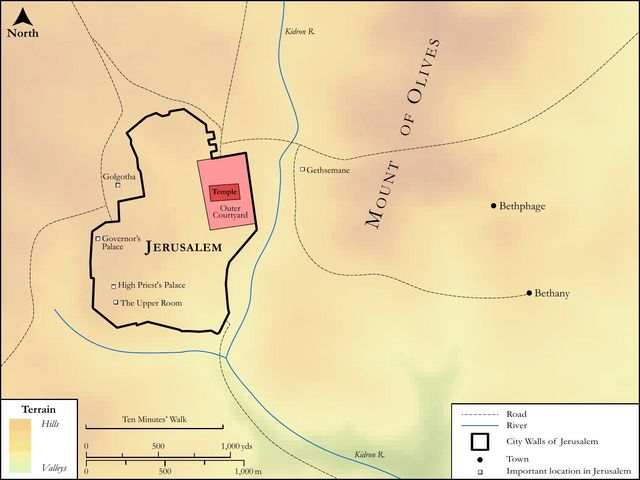
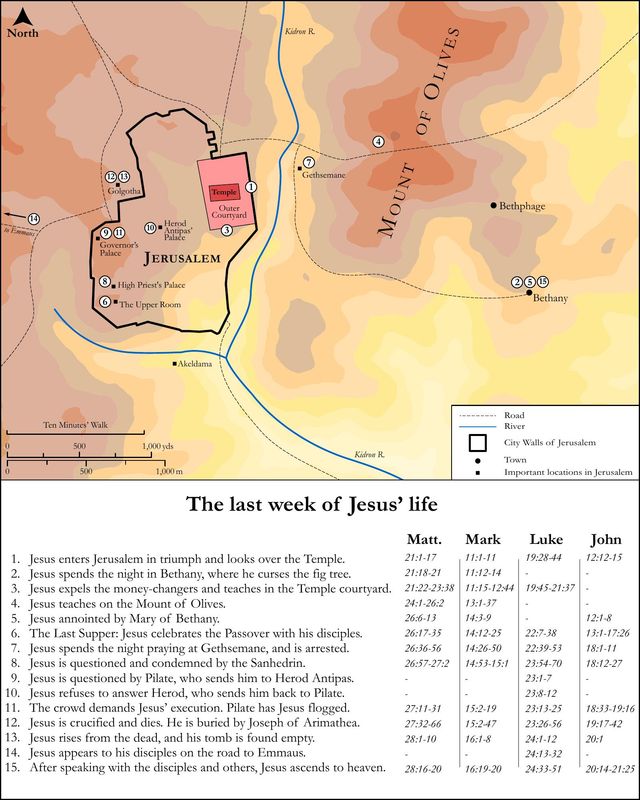
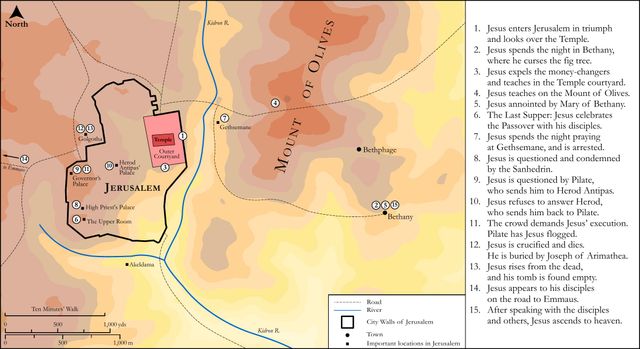
See on the biblical-era maps
Study this verse
Historical interpretation
Ten Centuries of Reception
12 surviving comments on this verse. Each one is dated, so this reads as a timeline rather than a list.
Select a marker to jump to its quote. Markers stagger vertically where authors wrote within a few decades of each other.
Also He foretels this to them, that they who now were somewhat dispersed in consequence of the offence, should be after gathered together by Christ rising again, and going before them into Galilee of the Gentiles.
Whence the other disciples were offended in Jesus, but Peter was not only offended, but what is much more, was suffered to deny Him thrice.
Hereby He shows that men confirmed by the powers of the Divine mysteries, are exalted to heavenly glory in a common joy and gladness.
The credit of this prediction is supported by the authority of old prophecy; It is written, I will smite the shepherd, and the sheep of the flock shall he scattered abroad.
But Peter was carried so far by his zeal and affection for Christ, that he regarded neither the weakness of his flesh nor the truth of the Lord's words; as if what He spake must not come to pass, Peter answered and said unto him, Though all should be offended because of thee, yet will I never be offended.
"And when they had sung an hymn, they went out unto the Mount of Olives." Let them hear this, as many as, like swine eating at random, rudely spurn the natural table, and rise up in drunkenness, whereas it were meet to give thanks, and end with an hymn.
Hear this, as many as wait not again for the last prayer of the mysteries, for this is a symbol of that. He gave thanks before He gave it to His disciples, that we also may give thanks. He gave thanks, and sang an hymn after the giving, that we also may do this selfsame thing.
But for what reason doth He go forth unto the mountain? Making Himself manifest, that He may be taken, in order not to seem to hide himself. For He hastened to go to the place which was also known to Judas.
Then "He saith unto them, All ye shall be offended in me." After this He mentions also a prophecy, "For it is written, I will smite the shepherd, and the sheep shall be scattered abroad:" at once persuading them ever to give heed to the things that are written, and at same time making it plain that He was crucified, according to God's purpose; and by everything showing He was no alien from the old covenant, nor from the God preached therein, but that what is done is a dispensation, and that the prophets all proclaimed all things beforehand from the beginning that are comprised in the matter, so that they be quite confident about the better things also.
And He teaches us to know what the disciples were before the crucifixion, what after the crucifixion. For indeed they who, when He was crucified, were not able so much as to stand their ground, these after His death were mighty, and stronger than adamant.
And this self-same thing is a demonstration of His death, the fright and cowardice, I mean, of His disciples. For if when so many things have been both done and said, still some are shameless, and say that He was not crucified; if none of these things had come to pass, to what pitch of wickedness would they not have proceeded? So for this reason, not by His own sufferings only, but by what took place with respect to the disciples, He confirms the word concerning His death, and by the mysteries also, in every way confounding those that are diseased with the pest of Marcion. For this reason He suffers even the chief apostle to deny Him. But if He was not bound nor crucified, whence sprung the fear to Peter, and to the rest of the apostles.
He suffers them not however, on the other hand, to wait until the sorrows, but what saith He? "But after I am risen again, I will go before you into Galilee." For not from Heaven doth He appear at once, neither will He depart into any distant country, but in the same nation, in which He had also been crucified, nearly in the same place, so as hereby again to assure them that He that was crucified was the very same that rose again, and in this way to comfort them more abundantly when in sorrow. Therefore also He said "in Galilee," that being freed from the fears of the Jews they might believe His saying. For which cause indeed He appeared there.
"But Peter answered and said, Though all men should be offended because of Thee, yet will I never be offended."
What sayest thou, O Peter? the prophet said, "The sheep shall be scattered;" Christ hath confirmed the saying, and sayest thou, No? Is not what passed before enough, when Thou saidst, "Far be it from Thee," and thy mouth was stopped? For this then He suffers him to fall, teaching him thereby to believe Christ in all things, and to account His declaration more trustworthy than one's own conscience. And the rest too reaped no small benefit from his denial, having come to know man's weakness, and God's truth. For when He foretells anything, we must no longer be subtle, nor lift up ourselves above the common sort. For, "thy rejoicing," it is said, "thou shall have in thyself, and not in another." For where he should have prayed, and have said, Help us, that we be not cut off, he is confident in himself, and saith, "Though all men should be offended in Thee, yet will I never;" though all should undergo this, I shall not undergo it, which led him on by little and little to self-confidence. Christ then, out of a desire to put down this, permitted his denial.
Hence we learn a great doctrine, that a man's willingness is not sufficient, unless any one receive the succor from above; and that again we shall gain nothing by the succor from above, if there be not a willingness. And both these things do Judas and Peter show; for the one, though he had received much help, was profited nothing, because he was not willing, neither contributed his part; but this one, though he was ready in mind, because he received no assistance, fell. For indeed of these two things is virtue's web woven.
Let them hear this, who like swine with no thought but of eating rise from the table drunk, when they should have given thanks, and closed with a hymn. Let them hear who will not tarry for the final prayer in the sacred mysteries; for the last prayer of the mysteries represents that hymn. He gave thanks before He delivered the holy mysteries to the disciples, that we also might give thanks; He sung a hymn after He had delivered them, that we also should do the like.
In this we see what the disciples were both before and after the cross. They who could not stand with Christ whilst He was crucified, became after the death of Christ harder than adamant. This flight and fear of the disciples is a demonstration of Christ's death against those who are infected with the heresy of Marcion. If the had been neither bound nor crucified, whence arose the terror of Peter and the rest?
He produces this prophecy to teach them to attend to the things that are written, and to show that His crucifixion was according to the counsel of God, and (as He does throughout) that He was not a stranger to the Old Testament, but that it prophesied of Him. But He did not suffer them to continue in sorrow, but announces glad tidings, saying, When I am risen again, I will go before you into Galilee. After His resurrection He does not appear to them immediately from heaven, nor depart into any far country, but in the very same nation in which He was crucified, almost in the very place, giving them thereby assurance, that He who was crucified was the same as He who rose again, thereby to cheer their cast-down countenances. He fixes upon Galilee, that, being delivered from fear of the Jews, they might believe what He spoke to them.
What sayest thou, Peter? The Prophet says, The sheep shall be scattered abroad, and Christ has confirmed it, yet thou sayest, Never. When He said, One of you shall betray me, thou fearedst for thyself, although thou wert not conscious of such a thought; now when He openly affirms, All ye shall be offended, you deny it. But because when he was relieved of the anxiety he had concerning the betrayal, he grew confident concerning the rest, he therefore says thus, I will never be offended.
[I suppose also that Peter fell into these words through ambition and boastfulness. And they had disputed at supper which of them should be greatest, whence we see that the love of empty glory disturbed them much. And so to deliver him from such passions, Christ withdrew His aid from him. Moreover observe how after the resurrection, taught by his fall he speaks to Christ more humbly, and does not any more resist His words. All this his fall wrought for him; for before he had attributed all to himself, when he ought rather to have said, I will not deny Thee if Thou succour me with Thy aid. But afterwards he shows that every thing is to be ascribed to God; Why look ye so earnestly upon us, as though by our own power and holiness we had made this man to walk?]q (Act 3:12.) Hence then we learn the great doctrine, that man's wish is not enough, unless he enjoys Divine support.
(Verse 32.) For it is written: I will strike the shepherd, and the sheep of the flock will be scattered. But after I have been raised, I will go ahead of you into Galilee. This is also written in different words by the prophet Zachariah; and (if I am not mistaken) it is said by the voice of the prophet to God: Strike the shepherd, and the sheep of the flock will be scattered (Zech. 13:7). In the sixty-eighth Psalm, which is completely devoted to the Lord, this meaning is also in agreement: For those whom you have struck, they have pursued. But the good shepherd is struck, so that he may lay down his life for his sheep; and out of many flocks of errors, one flock is made, and one shepherd (John. X) . This testimony is further explained in the book that we wrote about the Best Way of Interpretation.
After this example of the Saviour, whosoever is filled and is drunken upon the bread and cup of Christ, may praise God and ascend the Mount of Olives, where is refreshment after toil, solace of grief, and knowledge of the true light.
He foretels what they should suffer, that they might not after it had befallen them despair of salvation; but doing penitence might be set free.
And He adds emphatically this night, (1 These. 5:7.) because as they that are drunken are drunken by night, so they that are scandalized are scandalized by night, and in the dark.
This is found in Zacharias in words different; it is said to God in the person of the Prophet, Smite the shepherd, and the sheep will be scattered abroad. (Zech. 13:7.) The good Shepherd is smitten, that He may lay down His life for His sheep, and that of many flocks of divers errors should be made one flock, and one Shepherd.
It is not wilfulness, not falsehood, but the Apostle's faith, and ardent attachment towards the Lord his Saviour.
He did not leave the disciples with sad expressions but proclaimed the resurrection to them ahead of time, freeing them from grief, and he promised to go ahead of them into Galilee. In this way he shows that he is about to desert the Jews and go to the Gentiles.
What the One affirms by His power of foreknowledge, the other denies through love; whence we may take a practical lesson, that in proportion as we are confident of the warmth of our faith, we should be in fear of the weakness of our flesh. Peter seems culpable, first, because he contradicted the Lord's words; secondly, because he set himself before the rest; and thirdly, because he attributed every thing to himself as though he had power to persevere strenuously. His fall then was permitted to heal this in him; not that he was driven to deny, but left to himself, and so convinced of the frailty of his human nature.p
(in Luc. 22:39.) Beautifully after the disciples have been filled with the Sacraments of His Body and Blood, and, commended to the Father in a hymn of pious intercession, does He lead them into the mount of Olives; thus by type teaching us how we ought, by the working of His Sacraments, and the aid of His intercession, mount up to the higher gifts of the virtues and the graces of the Holy Spirit, with which we are anointed in our hearts.
This hymn may be that thanksgiving which in John, (c. 17.) Our Lord offers up to the Father, when He lifted up His eyes and prayed for His disciples, and those who should believe through their word. This is that of which the Psalm speaks, The poor shall eat and be filled, they shall praise the Lord.] (Ps. 22:26.)
Peter understood the Lord to have foretold that he should deny Him under terror of death, and therefore he declares that though death were imminent, nothing could shake him from his faith; and the other Apostles in like manner in the warmth of their zeal, valued not the infliction of death, but human presumption is vain without Divine aid.
. As God He foretells what will be. To avoid offending them by seeming to accuse them, He says, "It is written, I will smite the shepherd, and the sheep shall be scattered abroad" (Zechariah 13:7), thus implying, It is I Who have held you together and My departure from you will scatter you. The Father is said to "smite" the Son, in that the Jews crucified the Lord in accordance with the Father’s plan of salvation, hence, with His consent. It is said that the Father smote, because He was able to prevent it, yet did not. Then Jesus takes away their grief by announcing to them the good tidings, saying, "I shall rise and go before you, that is, precede you, into Galilee." By this He shows that He will leave Jerusalem and go to the Gentiles, for Gentiles dwelt in Galilee.
(non occ.) But in support of the opinion of other saints, that Judas did receive the sacraments from Christ, it is to be said, that the words with you may refer to the greater part of them, and not necessarily to the whole.
Continue studying Matthew 26:32 across the web’s major study libraries — every link below opens this exact verse, chapter, or book on the destination site.
Read & Compare
 BibleGatewayThis verse in more than 200 translations and 70 languages.
 Bible.comThe YouVersion reader — hundreds of translations, reading plans, and highlights.
 ESV.orgCrossway's official English Standard Version reader.
 NET BibleThe NET translation with 60,000+ translators' notes on every rendering decision.
 STEP BibleTyndale House's free study tool — original text, vocabulary, and scholarly resources.
 BibliaLogos Bible Software's free web reader.
 USCCBThe New American Bible (Revised Edition) with the U.S. bishops' study notes.
Commentaries
 BibleHub CommentariesDozens of classic commentaries on this verse, gathered on one page.
 StudyLightMore than 100 commentary sets — the largest collection on the web.
 BibleRefPlain-English commentary on what this verse means, verse by verse.
 Enduring WordDavid Guzik's free commentary on this chapter, widely used by Bible teachers.
 Bible Study ToolsVerse commentary alongside Greek and Hebrew study aids.
Original Language & Research
- BibleHub InterlinearThe verse word by word — original language, transliteration, and English.
- BibleHub LexiconEvery word's original-language definition and Strong's entry.
 Blue Letter BibleDeep-study tools — Strong's numbers, concordance, and word studies.
 CNTR CollationThe earliest Greek manuscripts of this verse, collated letter by letter.
Sermons, Hymns & Audio


TrulyRandomVerse is not affiliated with these sites and doesn’t control their content. They’re linked because they’re genuinely useful.
Summary
In this pivotal moment at the Last Supper, Jesus, facing imminent betrayal and crucifixion, offers His disciples a profound promise of future hope and restoration. Despite foretelling their scattering and His own suffering, He declares that after His resurrection, He will precede them into Galilee, signaling not only His triumph over death but also His unwavering commitment to reunite and re-commission His faltering followers in a familiar place of new beginnings.
Context
ShowHideLiterary Context
This verse is uttered by Jesus immediately following His somber prediction that all His disciples will fall away and be scattered that very night, a prophecy He grounds in the Old Testament scripture from Zechariah 13:7. The disciples, particularly Peter, vehemently deny this possibility, asserting their loyalty. Against this backdrop of impending failure, betrayal, and suffering for both Jesus and His followers, Matthew 26:32 stands as a beacon of hope—a divine assurance of resurrection and subsequent reunion, promising that their current crisis is not the end of their relationship or mission. It directly anticipates the post-resurrection appearances described later in Matthew's Gospel, particularly in Matthew 28:7-10.
Historical & Cultural Context
The setting is the Last Supper, likely held in an upper room in Jerusalem, during the Passover festival. This was a time of intense religious and political tension, with the Jewish leadership seeking to arrest Jesus and the Roman authorities maintaining a watchful presence. Galilee, in contrast to Jerusalem, was the primary region of Jesus' public ministry, a place where He had called His first disciples and performed many miracles. It was a region often viewed with some disdain by the Judean religious elite (John 1:46), yet it was the spiritual home for many of the disciples. Jesus' instruction to meet them there after His resurrection is significant; it signifies a return to familiar ground, a place of renewed commission away from the hostile environment of Jerusalem, and perhaps a fresh start for a scattered and disillusioned group.
Key Themes
ShowHideMatthew 26:32 powerfully contributes to several overarching themes in Matthew and the broader New Testament. Firstly, it underscores the certainty of Jesus' resurrection, presenting it not as a mere possibility but as a guaranteed future event that will fundamentally alter their current trajectory of despair. Secondly, it highlights the theme of divine restoration and grace; despite the disciples' impending desertion, Jesus' promise of reunion in Galilee demonstrates His unwavering commitment to them, offering a path to reconciliation and renewed purpose after their failure. This foreshadows the post-resurrection re-commissioning of Peter and the other disciples. Thirdly, it reinforces Jesus' role as the Good Shepherd (John 10:11); even after being "struck" and His "sheep" scattered, He promises to "go before" them, indicating His continued leadership and guidance. Finally, it subtly points to the fulfillment of prophecy, not just the prophecy of scattering in Zechariah 13:7, but also the broader divine plan for His resurrection and the subsequent establishment of His kingdom through His re-gathered followers.
Exposition and Analysis
ShowHideKey Word Analysis
ShowHideThis particle serves as an adversative or continuative conjunction. In this context, it introduces a strong contrast or transition. Following the dire prediction of the disciples' scattering and Jesus' own suffering, "but" pivots the discourse from impending darkness to a future hope. It signals a divine intervention that will reverse the apparent defeat, emphasizing the certainty of what follows despite the preceding bleak pronouncement.
This verb means "to waken," "to rouse," or "to raise up," often from sleep, lying down, or death. Here, it unequivocally refers to Jesus' resurrection from the dead. The passive voice ("I am risen again") implies divine agency—God the Father will raise Him. This word is central to the Christian message, signifying Christ's triumph over sin and death, and it is the foundational promise upon which all Christian hope rests.
Literally meaning "to lead forward" or "to precede." This is more than merely arriving first. It implies leadership, guidance, and setting the pace. Jesus will not just meet them in Galilee; He will lead them there, re-establishing His role as their Shepherd and guide. This word carries significant pastoral weight, assuring the disciples that even after their failure and His death, He will continue to be their leader, directing their path and purpose.
A region in northern Palestine, often called "the heathen circle" due to its mixed population. It was the primary setting for Jesus' public ministry and the home of most of His disciples. By specifying Galilee as the meeting place, Jesus indicates a return to the familiar, a place of new beginnings away from the hostile Jerusalem, and a symbolic re-gathering of His flock in the very region where He first called them.
Verse Breakdown
ShowHide"But after I am risen again,"
This clause introduces a profound shift from the immediate sorrow and impending crisis to a future filled with hope. The resurrection is presented not as a possibility but as a definite, divinely ordained event. It is the crucial turning point that transforms the narrative of suffering and scattering into one of triumph and restoration. This promise underscores Jesus' foreknowledge and divine authority over life and death.
"I will go before you into Galilee."
This is a direct, personal promise of reunion and continued leadership. "I will go before you" (proágō) emphasizes Jesus' role as the Shepherd leading His flock, even after their desertion. Galilee, the familiar ground of their initial calling and ministry, symbolizes a fresh start, a place where the scattered disciples can be re-gathered, re-commissioned, and begin to understand the new reality of the resurrected Christ and their ongoing mission. It is a promise of grace, forgiveness, and renewed purpose for those who are about to fail Him.
Literary Devices
ShowHideMatthew 26:32 employs several significant literary devices. Foreshadowing is prominent, as Jesus explicitly predicts His resurrection and a future meeting, setting the stage for the post-resurrection appearances in Matthew 28. There is also a strong element of Irony; just as the disciples are about to abandon Jesus, He promises to "go before" them, demonstrating His unwavering faithfulness despite their impending unfaithfulness. The mention of "Galilee" serves as powerful Symbolism. It represents a return to their origins, a place of new beginnings, and a contrast to the hostile Jerusalem, signifying a fresh start and renewed commission for the disciples after their period of failure and despair. This promise also functions as a Dramatic Contrast, immediately following the somber prediction of scattering, it injects a ray of hope and divine assurance into a moment of profound tension and impending tragedy.
Theological and Thematic Connections
ShowHideMatthew 26:32 is a profound testament to Jesus' divine foresight, His triumph over death, and His unwavering commitment to His disciples. It highlights the central truth of the Christian faith: the resurrection is not merely an event but the foundation of all hope and the guarantee of God's redemptive plan. Despite the disciples' impending failure and the seeming defeat of the cross, Jesus' promise assures them—and us—that His victory is certain, and His grace extends beyond human weakness. It speaks to the restorative nature of God, who does not abandon His people in their brokenness but actively works to re-gather, restore, and re-commission them for His purposes.
Reflection and Application
ShowHideThis verse offers immense comfort and profound challenge for believers today. In moments of personal failure, doubt, or spiritual scattering, we are reminded that Christ's faithfulness far surpasses our own. Just as He promised to re-gather His disciples despite their desertion, He promises to meet us in our brokenness, offering restoration and new beginnings. The "Galilee" in our lives might be a place of renewed commitment after a period of spiritual wandering, a fresh call to ministry after a setback, or simply the quiet assurance of His presence when we feel most alone. This promise encourages us to look beyond our present trials and failures to the certain hope of Christ's triumph and His continued leadership in our lives. It calls us to trust in His sovereign plan, knowing that even our darkest moments are not the end, but often the prelude to a glorious resurrection and renewed purpose under His guidance.
Questions for Reflection
ShowHideFAQ
ShowHideWhy did Jesus choose Galilee as the meeting place instead of Jerusalem?
ShowHideJesus chose Galilee for several significant reasons. Firstly, it was the primary region of His public ministry and the home of most of His disciples, making it familiar and less hostile than Jerusalem, which was the center of religious and political opposition. Meeting in Galilee allowed for a more intimate and less conspicuous reunion, away from the immediate dangers and scrutiny of the Jewish authorities. Secondly, Galilee symbolized a fresh start and a return to the roots of their calling. Much of Jesus' initial ministry and the disciples' training took place there. This return to Galilee after the resurrection signified a new beginning for the scattered and disheartened disciples, a place for re-gathering and re-commissioning before the global mission outlined in Matthew 28:19-20. It underscored the idea that even after profound failure and loss, God offers restoration and renewed purpose in familiar, grace-filled surroundings.
Christ-Centered Fulfillment
ShowHideMatthew 26:32 is a powerful Christ-centered declaration, revealing Jesus as the ultimate fulfiller of God's redemptive plan. His promise to rise again and "go before" His disciples into Galilee is a direct foreshadowing of His victory over death, an event central to the Gospel message and the foundation of Christian faith (1 Corinthians 15:3-4). This promise not only anticipates His literal resurrection appearances, as recorded in Matthew 28:16-20, but also prefigures His ongoing role as the Head of the Church, the Good Shepherd who continually leads His flock (John 10:11). The "going before" into Galilee symbolizes Christ's pioneering work, paving the way for His followers into a new era of ministry empowered by His resurrection. It points to Him as the firstfruits of those who have fallen asleep (1 Corinthians 15:20), guaranteeing that just as He rose, so too will His followers experience new life and ultimate triumph. Thus, Matthew 26:32 is not merely a logistical instruction but a profound theological statement affirming Christ's sovereignty over death and His unwavering commitment to gather and lead His redeemed people into their eternal purpose, culminating in His ascension and ongoing intercession for them (Hebrews 7:25).