


Mark 1:29
Bible text: King James Version (1769 Blayney text) · Public domain
Bible text: King James Version with Strong's numbers · Public domain
Bible text: Berean Standard Bible · Public domain
Bible text: American Standard Version (1901) · Public domain
Bible text: World English Bible, Messianic edition · Public domain
Bible text: Geneva Bible (1599) · Public domain
Bible text: Young's Literal Translation · Public domain
- ΚαὶKaiAndG2532CONJConjunction
- εὐθὺςeuthusimmediatelyG2112ADVAdverb
- ἐκekout ofG1537PREPPreposition
- τῆςtēstheG3588T-GSFDefinite article Genitive Singular Feminine
- συναγωγῆςsunagōgēssynagogueG4864N-GSFNoun Genitive Singular Feminine
- ἐξελθόντεςexelthontesthey going outG1831V-2AAP-NPMVerb 2nd Aorist Active Participle Nominative Plural Masculine
- ἦλθονēlthonthey cameG2064V-2AAI-3PVerb 2nd Aorist Active Indicative 3rd Plural
- εἰςeisintoG1519PREPPreposition
- τὴνtēntheG3588T-ASFDefinite article Accusative Singular Feminine
- οἰκίανoikianhouseG3614N-ASFNoun Accusative Singular Feminine
- ΣίμωνοςSimōnosof SimonG4613N-GSM-PNoun Genitive Singular Masculine Individual
- καὶkaiandG2532CONJConjunction
- ἈνδρέουAndreouAndrewG406N-GSM-PNoun Genitive Singular Masculine Individual
- μετὰmetawithG3326PREPPreposition
- ἸακώβουIakōbouJamesG2385N-GSM-PNoun Genitive Singular Masculine Individual
- καὶkaiandG2532CONJConjunction
- ἸωάννουIōannouJohnG2491N-GSM-PNoun Genitive Singular Masculine Individual
English is a literal word-by-word gloss of the Greek, not the KJV's wording. Why?
This is the original text the KJV's translators worked from — each Greek word with its own literal English meaning in this verse, prepared by scholars at Tyndale House, Cambridge. The KJV translates whole sentences, not word by word, so its wording differs: one Greek word can become several English words, and the KJV may choose “charity” where the gloss reads “love”. Both are faithful — they answer different questions. For the KJV's own rendering, switch to the KJV text.
Details
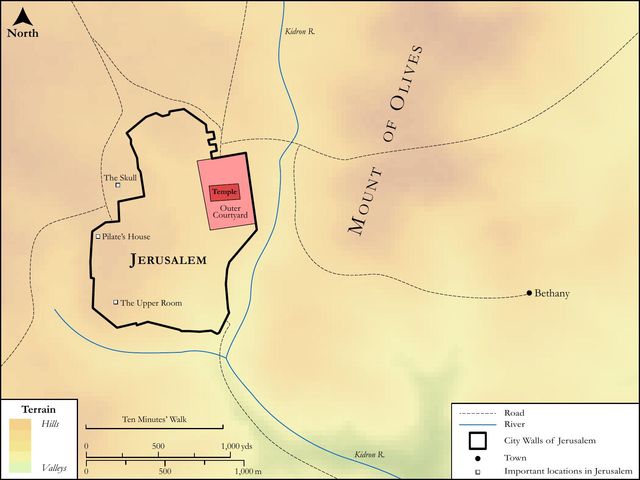
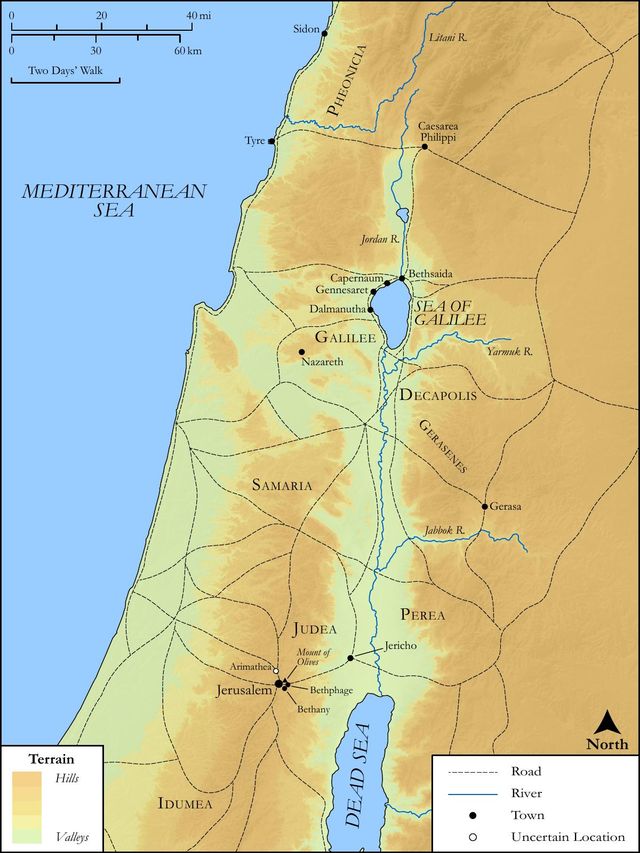
See on the biblical-era maps
Study this verse
Public-domain commentary
Matthew Henry
From his Commentary on the Whole Bible. Henry comments on passages, not single verses — this entry covers Mark 1:29–39. His three-level outline is real structure in the source text, so it is rendered as structure.
In these verses, we have,
I.A particular account of one miracle that Christ wrought, in the cure of Peter's wife's mother, who was ill of a fever. This passage we had before, in Matthew. Observe,
1.When Christ had done that which spread his fame throughout all parts, he did not then sit still, as some think that they may lie in bed when their name is up. No, he continued to do good, for that was it he aimed at, and not his own honour. Nay, those who are in reputation, had need be busy and careful to keep it up.
2.When he came out of the synagogue, where he had taught and healed with a divine authority, yet he conversed familiarly with the poor fishermen that attended him, and did not think it below him. Let the same mind, the same lowly mind, be in us, that was in him.
3.He went into Peter's house, probably invited thither to such entertainment as a poor fisherman could give him, and he accepted of it. The apostles left all for Christ; so far as that what they had should not hinder them from him, yet not so, but that they might use it for him.
4.He cured his mother-in-law, who was sick. Wherever Christ comes, he comes to do good, and will be sure to pay richly for his entertainment. Observe, How complete the cure was; when the fever left her, it did not, as usual, leave her weak, but the same hand that healed her, strengthened her, so that she was able to minister to them; the cure is in order to that, to fit for action, that we may minister to Christ, and to those that are his for his sake.
II.A general account of many cures he wrought - diseases healed, devils expelled.
It was on the evening of the sabbath, when the sun did set, or was set; perhaps many scrupled bringing their sick to him, till the sabbath was over, but their weakness therein was no prejudice to them in applying to Christ. Though he proved it lawful to heal on the sabbath days, yet, if any stumbled at it, they were welcome at another time. Now observe,
1.How numerous the patients were; All the city was gathered at the door, as beggars for a dole. That one cure in the synagogue occasioned this crowding after him. Others speeding well with Christ should quicken us in our enquiries after him. Now the Sun of righteousness rises with healing under his wings; to him shall the gathering of the people be. Observe, How Christ was flocked after in a private house, as well as in the synagogue; wherever he is, there let his servants, his patients, be. And in the evening of the sabbath, when the public worship is over, we must continue our attendance upon Jesus Christ; he healed, as Paul preached, publicly, and from house to house.
2.How powerful the Physician was; he healed all that were brought to him, though ever so many. Nor was it some one particular disease, that Christ set up for the cure of, but he healed those that were sick of divers diseases, for his word was a panpharmacon - a salve for every sore. And that miracle particularly which he wrought in the synagogue, he repeated in the house at night; for he cast out many devils, and suffered not the devils to speak, for he made them know who he was, and that silenced them. Or, He suffered them not to say that they knew him (so it may be read); he would not permit any more of them to say, as they did (Mar 1:24), I know thee, who thou art.
III.His retirement to his private devotion (Mar 1:35); He prayed, prayed alone; to set us an example of secret prayer.
Though as God he was prayed to, as man he prayed. Though he was glorifying God, and doing good, in his public work, yet he found time to be alone with his Father; and thus it became him to fulfil all righteousness. Now observe,
1.The time when Christ prayed.
(1.)It was in the morning, the morning after the sabbath day. Note, When a sabbath day is over and past, we must not think that we may intermit our devotion till the next sabbath: no, though we go not to the synagogue, we must go to the throne of grace, every day in the week; and the morning after the sabbath particularly, that we may preserve the good impressions of the day. This morning was the morning of the first day of the week, which afterward he sanctified, and made remarkable, by another sort of rising early.
(2.)It was early, a great while before day. When others were asleep in their beds, he was praying, as a genuine Son of David, who seeks God early, and directs his prayer in the morning; nay, and at midnight will rise to give thanks. It has been said, The morning is a friend to the Muses - Aurora Musis amica; and it is no less so to the Graces. When our spirits are most fresh and lively, then we should take time for devout exercises. He that is the first and best, ought to have the first and best.
2.The place where he prayed; He departed into a solitary place, either out of town, or some remote garden or out-building. Though he was in no danger of distraction, or of temptation to vain-glory, yet he retired, to set us an example to his own rule, When thou prayest enter into thy closet. Secret prayer must be made secretly. Those that have the most business in public, and of the best kind, must sometimes be alone with God; must retire into solitude, there to converse with God, and keep up communion with him.
IV.His return to his public work.
The disciples thought they were up early, but found their Master was up before them, and they enquired which way he went, followed him to his solitary place, and there found him at prayer, Mar 1:36, Mar 1:37. They told him that he was much wanted, that there were a great many patients waiting for him; All men seek for thee. They were proud that their Master was become so popular already, and would have him appear in public, yet more in that place, because it was their own city; and we are apt to be partial to the places we know and are interested in. "No," saith Christ, "Capernaum must not have the monopoly of the Messiah's preaching and miracles. Let us go into the next towns, the villages that lie about here, that I may preach there also, and work miracles there, for therefore came I forth, not to be constantly resident in one place, but to go about doing good." Even the inhabitants of the villages in Israel shall rehearse the righteous acts of the Lord, Jdg 5:11. Observe, Christ had still an eye to the end wherefore he came forth, and closely pursued that; nor will he be drawn by importunity, or the persuasions of his friends, to decline from that; for (Mar 1:39) he preached in their synagogues throughout all Galilee, and, to illustrate and confirm his doctrine, he cast out devils. Note, Christ's doctrine is Satan's destruction.
Historical interpretation
Nine Centuries of Reception
6 surviving comments on this verse. Each one is dated, so this reads as a timeline rather than a list.
Select a marker to jump to its quote. Markers stagger vertically where authors wrote within a few decades of each other.
Moreover, Capernaum is mystically interpreted the town of consolation, and the sabbath as rest. The man with an evil spirit is healed by rest and consolation, that the place and time may agree with his healing. This man with an unclean spirit is the human race, in which uncleanness reigned from Adam to Moses; for they sinned without law, and perished without law. (v. Rom. 5:14. 2:12) And he, knowing the Holy One of God, is ordered to hold his peace, for they knowing God did not glorify him as God, but rather served the creature than the Creator. (1:21.25) The spirit tearing the man came out of him. When salvation is near, temptation is at hand also. Pharaoh, when about to leti Israel go, pursues Israel; the devil, when despised, rises up to create scandals.
For the fever means intemperance, from which, we the sons of the synagoguek, by the hand of discipline, and by the lifting up of our desires, are healed, and minister to the will of Him who heals us.
Such eye-witnesses the Lord in infancy found; no different ones had He in adult age. Peter alone do I find-through (the mention of) his "mother-in-law" ,-to have been married.
(v. Vict. Ant. e Cat. in Marc. c. 1:32) But the disciples, knowing that they were to receive a benefit by that means, without waiting for the evening prayed that Peter's mother should be healed. Wherefore there follows, who immediately tell him of her.
And immediately, leaving the synagogue, they entered the house of Simon, etc. If we have said that the man freed from the demon signifies a mind cleansed from impure thoughts, consequently a woman afflicted with fever but cured by the command of the Lord shows the flesh restrained from the fervor of its concupiscence by the precepts of continence. For all bitterness, and wrath, and indignation, and clamor, and blasphemy (Ephesians IV), is the fury of an unclean spirit. Indeed, fornication, impurity, lust, evil concupiscence, and covetousness (which is idolatry [Ephesians V]), are to be understood as the fever of seductive flesh. And immediately they told him about her, and approaching, he lifted her up, taking her by the hand. In the Gospel of Luke, it is written that they asked him on her behalf, and standing over her, he rebuked the fever. For sometimes the Savior, when asked, sometimes voluntarily heals the sick, showing himself always to grant the prayers of the faithful against the passions of vices, and sometimes to give to them not understanding what they are asking, or to grant them what they piously ask for even if not understood, just as the Psalmist requests: Who can understand his errors? Cleanse me from secret faults, O Lord (Psalm XIX).
(in Marc. i. 7) First, it was right that the serpent's tongue should be shut up, that it might not spread any more venom; then that the woman, who was first seduced, should be healed from the fever of carnal concupiscence. Wherefore it is said, And forthwith, when they were come out of the synagogue, &c.
(ubi sup.) But in the Gospel of Luke it is written, that they besought him for her. (Luke 4:38.) For the Saviour sometimes after being asked, sometimes of His own accord, heals the sick, showing that He always assents to the prayers of the faithful, when they pray also against bad passions, and some times gives them to understand things which they do not understand at all, or else, when they pray unto Him dutifully, forgives their want of understanding; as the Psalmist begs of God, Cleanse me, O Lord, from my secret faults. (Ps. 19:12) Wherefore He heals her at their request; for there follows, And he came and took her by the hand, and lifted her up.
(in Marc. i. 6, 8) But in that He gives most profusely His gifts of healing and doctrine on the sabbath day, He teaches, that He is not under the Law, but above the Law, and does not choose the Jewish sabbath, but the true sabbath, and our rest is pleasing to the Lord, if, in order to attend to the health of our souls, we abstain from slavish work, that is, from all unlawful things. It goes on, and immediately the fever left her, &c. The health which is conferred at the command of the Lord, returns at once entire, accompanied with such strength, that she is able to minister to those, of whose help she had before stood in need. Again, if we suppose that the man delivered from the devil means, in the moral way of interpretation, the soul purged from unclean thoughts, fitly does the woman cured of a fever by the command of God mean the flesh, restrained from the heat of its concupiscence by the precepts of continence.
He retired then as the custom was on the sabbath-day about evening to eat in His disciples' house. But she who ought to have ministered was prevented by a fever. Wherefore it goes on, But Simon's wife's mother was lying sick of a fever.
By this it is signified, that God will heal a sick man, if he ministers to the Saints, through love to Christ.
But he has a fever who is angry, and in the unruliness of his anger stretches forth his hands to do hurt; but if reason restrains his hands, he will arise, and so serve reason.
Continue studying Mark 1:29 across the web’s major study libraries — every link below opens this exact verse, chapter, or book on the destination site.
Read & Compare
 BibleGatewayThis verse in more than 200 translations and 70 languages.
 Bible.comThe YouVersion reader — hundreds of translations, reading plans, and highlights.
 ESV.orgCrossway's official English Standard Version reader.
 NET BibleThe NET translation with 60,000+ translators' notes on every rendering decision.
 STEP BibleTyndale House's free study tool — original text, vocabulary, and scholarly resources.
 BibliaLogos Bible Software's free web reader.
 USCCBThe New American Bible (Revised Edition) with the U.S. bishops' study notes.
Commentaries
 BibleHub CommentariesDozens of classic commentaries on this verse, gathered on one page.
 StudyLightMore than 100 commentary sets — the largest collection on the web.
 BibleRefPlain-English commentary on what this verse means, verse by verse.
 Enduring WordDavid Guzik's free commentary on this chapter, widely used by Bible teachers.
 Bible Study ToolsVerse commentary alongside Greek and Hebrew study aids.
Original Language & Research
- BibleHub InterlinearThe verse word by word — original language, transliteration, and English.
- BibleHub LexiconEvery word's original-language definition and Strong's entry.
 Blue Letter BibleDeep-study tools — Strong's numbers, concordance, and word studies.
 CNTR CollationThe earliest Greek manuscripts of this verse, collated letter by letter.
Sermons, Hymns & Audio


TrulyRandomVerse is not affiliated with these sites and doesn’t control their content. They’re linked because they’re genuinely useful.
Summary
Mark 1:29 immediately follows Jesus' powerful public ministry in the Capernaum synagogue, detailing His swift transition from this formal religious setting to the intimate domestic sphere of Simon (Peter) and Andrew's home. Accompanied by James and John, this verse sets the stage for further private ministry, demonstrating Jesus' continuous commitment to healing and fellowship beyond the confines of public display and highlighting the immediate, purposeful nature of His early Galilean ministry.
Context
ShowHideLiterary Context
This verse is deeply embedded in the unfolding narrative of Jesus' early ministry in Capernaum. It directly follows a pivotal moment where Jesus' authoritative teaching and a dramatic exorcism in the synagogue (Mark 1:21-28) astonished the crowds. The phrase "And forthwith" (Greek: euthéōs) is a hallmark of Mark's Gospel, emphasizing the rapid, dynamic progression of Jesus' actions and the urgency of His mission. The movement from the public synagogue to a private home sets the scene for the subsequent healing of Simon's mother-in-law (Mark 1:30-31), illustrating that Jesus' ministry was not confined to formal religious spaces but extended seamlessly into everyday life. Furthermore, the presence of James and John alongside Simon and Andrew reinforces the nascent community of disciples Jesus had recently called to follow Him along the Sea of Galilee, as recounted in Mark 1:16-20. This intimate gathering underscores the growing bond between Jesus and His chosen followers.
Historical & Cultural Context
Capernaum, a bustling fishing village on the Sea of Galilee, served as Jesus' primary base of operations during His Galilean ministry, making it a significant setting for many of His miracles and teachings. The synagogue was not merely a place of worship but the central hub of Jewish community life, serving as a school, a court, and a social gathering place. Jesus' teaching and exorcism within this public forum would have created significant public stir and established His authority. The transition from the synagogue to a private home, specifically that of Simon and Andrew, reflects the common practice of hospitality in ancient Jewish society, where homes were opened to guests, especially religious teachers and their entourages. This move also highlights a contrast between public proclamation and private, personal care, demonstrating Jesus' holistic approach to ministry that addressed both communal and individual needs. The home, or oikía, was the fundamental unit of society, a place of refuge, family life, and intimate fellowship, providing a stark yet complementary setting to the public synagogue.
Key Themes
ShowHideMark 1:29 contributes to several overarching themes within the Gospel. Firstly, it emphasizes Jesus' Continuous and Holistic Ministry, illustrating that His divine authority and compassionate work were not limited to formal religious settings but permeated all aspects of life, from public teaching to private care. Secondly, it underscores the theme of Discipleship and Fellowship, as Jesus immediately engages with His newly called disciples in an intimate domestic setting, fostering a deeper bond and demonstrating the communal nature of His mission. This highlights the importance of shared life and personal connection in the journey of following Christ. Thirdly, the verse subtly introduces the theme of Hospitality, as the home of Simon and Andrew becomes a space for Jesus and His disciples, foreshadowing the early Christian practice of opening homes for ministry and fellowship, as seen throughout the New Testament, such as in Acts 2:46. Finally, it reinforces The Humanity and Accessibility of Jesus, showing that despite His divine power and authority displayed in the synagogue, He fully participated in the everyday lives of His disciples, entering their homes and sharing their private spaces, thereby bridging the divine and the mundane.
Exposition and Analysis
ShowHideKey Word Analysis
ShowHideThis adverb, appearing over 40 times in Mark's Gospel, is a stylistic hallmark, conveying a sense of urgency, immediate action, and rapid progression. In Mark 1:29, it emphasizes the seamless and swift transition from the synagogue to the house, underscoring Jesus' active, purposeful, and unceasing ministry. It creates a dynamic narrative pace, reflecting the energetic and decisive nature of God's kingdom breaking into the world.
Derived from "out" (ek) and "to come/go" (érchomai), this verb denotes the act of issuing or departing from a place. Here, it specifically marks the departure from the synagogue, signifying a change in setting from a public, formal, and religious space to a private, intimate, and domestic one. This movement highlights the expansive nature of Jesus' ministry, which transcends institutional boundaries.
This primary verb signifies "to come or go" and, in this context, specifically "to enter." It describes Jesus and His disciples' deliberate movement into Simon and Andrew's house. This act of entering is significant, as it marks a shift from public demonstration of authority to private engagement and care, indicating Jesus' willingness to bring His presence and power into the everyday lives and homes of His followers.
Verse Breakdown
ShowHide"¶ And forthwith,"
This opening phrase, characteristic of Mark's Gospel, signals an immediate and direct continuation of the narrative from the preceding events in the synagogue. It emphasizes the rapid, unceasing momentum of Jesus' ministry, leaving no time for delay or pause.
"when they were come out of the synagogue,"
This clause establishes the point of departure, marking the conclusion of Jesus' public teaching and exorcism in the Capernaum synagogue. It signifies a transition from a formal, public religious setting to a different environment, demonstrating that Jesus' work was not confined to specific sacred spaces.
"they entered into the house of Simon and Andrew,"
This describes the destination and the new, intimate setting for Jesus' ongoing ministry. The choice of Simon (Peter) and Andrew's home, two of Jesus' newly called disciples, underscores the growing relationship between Jesus and His followers, emphasizing fellowship and the personal nature of His interactions. It also highlights the theme of hospitality within the early Christian community.
"with James and John."
This specifies the companions accompanying Jesus into the house. The presence of James and John, completing the quartet of the first disciples called by Jesus, reinforces the formation of Jesus' inner circle and the communal aspect of His ministry. It suggests a shared experience and continued instruction for these foundational followers.
Literary Devices
ShowHideMark 1:29 effectively employs several literary devices. The most prominent is Markan Immediacy, conveyed through the adverb "forthwith" (Greek: euthéōs). This recurring motif throughout the Gospel of Mark propels the narrative forward with a sense of urgency and dynamism, emphasizing the active and purposeful nature of Jesus' ministry and the rapid unfolding of God's kingdom. There is also a clear Contrast established between the public, formal setting of the synagogue and the private, intimate space of Simon and Andrew's home. This contrast highlights the dual nature of Jesus' ministry: His public proclamation of authority and His private, compassionate care for individuals. Furthermore, the inclusion of "Simon and Andrew, with James and John" demonstrates Universal Reach and the formation of a core group of disciples, signaling the communal aspect of following Jesus and setting the stage for future intimate teachings and miracles within this close-knit fellowship.
Theological and Thematic Connections
ShowHideMark 1:29 reveals profound theological truths about the nature of Jesus' ministry and the call to discipleship. His immediate transition from the public display of power in the synagogue to the private setting of a home underscores that God's work is not confined to sacred buildings or formal services but permeates every aspect of human life. Jesus' willingness to enter the ordinary domestic space of His disciples demonstrates His accessibility, humility, and desire for deep, personal relationship. It foreshadows the Christian understanding that the presence of Christ can transform any place into holy ground, making the mundane sacred. This verse also highlights the early church's emphasis on hospitality and fellowship, where homes became centers for ministry, teaching, and community, reflecting the very pattern set by Jesus Himself.
Reflection and Application
ShowHideMark 1:29 offers a powerful reminder that authentic faith is not compartmentalized but integrates seamlessly into every sphere of life. Jesus did not leave His ministry or His divine presence at the synagogue door; He brought it directly into the home, into the everyday rhythms of His disciples' lives. This challenges believers today to consider how they embody their faith beyond formal church services. It calls us to cultivate a holistic spirituality where our homes become places of hospitality, fellowship, and continued ministry, reflecting the welcoming spirit of Simon and Andrew. Just as Jesus moved from public proclamation to private care, we are encouraged to balance our public witness with genuine, personal relationships, demonstrating Christ's love and truth in intimate settings. Moreover, the immediacy of Jesus' actions in this verse inspires us to embrace continuous service, recognizing that opportunities for ministry and compassion are always present, even after formal gatherings or structured events. Our lives, like the home of Simon and Andrew, are meant to be open vessels for God's purposes, transforming ordinary spaces into extraordinary encounters with the divine.
Questions for Reflection
ShowHideFAQ
ShowHideWhy is "forthwith" (Greek: euthéōs) so prominent in Mark's Gospel?
ShowHideThe frequent use of "forthwith" (Greek: euthéōs) is a distinctive stylistic feature of Mark's Gospel, appearing over 40 times. It serves several purposes. Firstly, it creates a sense of urgency and rapid movement, reflecting the dynamic and decisive nature of Jesus' ministry. Mark portrays Jesus as a man of action, constantly on the move, bringing the Kingdom of God with power and immediacy. Secondly, it emphasizes the authority of Jesus' words and deeds; things happen "at once" when He commands. Thirdly, it contributes to the narrative's fast pace, drawing the reader quickly from one event to the next, underscoring the compressed and intense period of Jesus' public ministry. This stylistic choice effectively conveys the powerful and unstoppable advance of God's plan through Christ.
What is the significance of Jesus entering a private home after His public ministry in the synagogue?
ShowHideJesus' transition from the public synagogue to a private home in Mark 1:29 carries significant meaning. It demonstrates that Jesus' ministry was not confined to formal religious institutions but extended into the everyday lives of people. It highlights His accessibility and humanity, showing that despite His divine authority, He was willing to enter ordinary domestic spaces and engage with individuals personally. This act also underscores the importance of fellowship and community in His ministry, as He gathers with His newly called disciples in an intimate setting. Furthermore, it foreshadows the role of homes as centers for early Christian community, teaching, and healing, as seen in the Book of Acts, such as Acts 2:46. It illustrates that God's transformative presence is not limited to sacred buildings but can be found and experienced anywhere.
Who were Simon, Andrew, James, and John, and why are they mentioned together here?
ShowHideSimon (later called Peter), Andrew, James, and John were among the first disciples Jesus called to follow Him, as recounted in Mark 1:16-20. Simon and Andrew were brothers, as were James and John (the sons of Zebedee). All four were fishermen by trade. Their mention together in Mark 1:29 signifies that they constituted the core group of Jesus' earliest followers and were part of His inner circle. Their presence in Simon and Andrew's home immediately after the synagogue ministry emphasizes the nascent community forming around Jesus. It highlights the personal nature of discipleship and the importance of shared life and intimate fellowship in the journey of following Christ. This group would often be present for key events in Jesus' ministry, receiving special instruction and witnessing His miracles.
Christ-Centered Fulfillment
ShowHideMark 1:29, though seemingly a simple geographical transition, beautifully prefigures the profound Christ-centered fulfillment of God's redemptive plan. Jesus' immediate movement from the public synagogue, where He demonstrated His divine authority and power, to the private home of Simon and Andrew, speaks volumes about His incarnational mission. This act foreshadows the ultimate truth that the Son of God did not merely visit humanity from a distance but chose to "tabernacle among us" (John 1:14), entering into the very fabric of human existence, with all its ordinariness and intimacy. His entry into the disciples' home symbolizes His desire to dwell not just in temples made with hands, but within the hearts and lives of His followers, transforming individual homes and communities into outposts of His Kingdom. This willingness to bridge the gap between the sacred and the mundane, between public proclamation and private presence, culminates in His atoning work, which opens the way for God to truly dwell with humanity, making us "fellow citizens with the saints and members of the household of God" (Ephesians 2:19). Just as He entered Simon's house, Christ continually seeks to enter our "house" – our lives, our families, our everyday spaces – to bring healing, fellowship, and the transformative power of His presence, fulfilling the promise of Revelation 3:20 to dine with those who open the door to Him.