


Judges 15:13
- וַיֹּאמְרוּvai·Yo·me·ruand they saidH559Conj-w ¦ V-Qal-ConsecImperf-3mpVerb Qal Consecutive Imperfect 3rd Plural Masculineוַandיֹּאמְרוּthey said
- לוֹloto <the> himPrep-l ¦ 3msSuffix Personal 3rd Singular Masculineלto <the>וֹhim
- לֵאמֹרle·Mor<to> sayingH559Prep-l ¦ V-Qal-InfVerb Qal Infinitive Constructלֵ<to>אמֹרsaying
- לֹאlo'In-H3808NegParticle Negative
- כִּיkideedH3588PrtParticle Conditional
- אָסֹר'a·Sorcertainly <to bind>H631V-Qal-InfAbsVerb Qal Infinitive Absolute
- נֶאֱסָרְךָne·'e·sa·re·Khawe will bind youH631V-Qal-Imperf-1cp ¦ 2msVerb Qal Imperfect 1st Plural common genderנֶאֱסָרְwe will bindךָyou
- וּנְתַנּוּךָu·ne·ta·Nu·khaand we will give youH5414Conj-w ¦ V-Qal-ConsecPerf-1cp ¦ 2msVerb Qal Consecutive Perfect 1st Plural common genderוּandנְתַנּוּwe will giveךָyou
- בְיָדָםve·ya·Damin their handH3027Prep-b ¦ N-csc ¦ 3mpNoun Singular common gender Constructבְinיָדָhandםtheir
- וְהָמֵתve·ha·Metand certainly <to kill>H4191Conj-w ¦ V-Hiphil-InfAbsVerb Hiphil Infinitive Absoluteוְandהָמֵתcertainly <to kill>
- לֹאlo'notH3808NegParticle Negative
- נְמִיתֶךָne·mi·Te·khawe will kill youH4191V-Hiphil-Imperf-1cp ¦ 2msVerb Hiphil Imperfect 1st Plural common genderנְמִיתֶwe will killךָyou
- וַיַּאַסְרֻהוּvai·ya·'as·Ru·huand they bound himH631Conj-w ¦ V-Qal-ConsecImperf-3mp ¦ 3msVerb Qal Consecutive Imperfect 3rd Plural Masculineוַandיַּאַסְרֻthey boundהוּhim
- בִּשְׁנַיִםbish·Na·yimwith twoH8147Prep-b ¦ N-cdNoun Dual common gender Absoluteבִּwithשְׁנַיִםtwo
- עֲבֹתִים'a·vo·TimropesH5688N-mpNoun Plural Masculine Absolute
- חֲדָשִׁיםcha·da·ShimnewH2319Adj-mpAdjective Plural Masculine Absolute
- וַיַּעֲלוּהוּvai·ya·'a·Lu·huand they brought up himH5927Conj-w ¦ V-Hiphil-ConsecImperf-3mp ¦ 3msVerb Hiphil Consecutive Imperfect 3rd Plural Masculineוַandיַּעֲלוּthey brought upהוּhim
- מִןminfromH4480PrepPreposition
- הַסָּלַעha·Sa·la'the rockH5553Art ¦ N-msNoun Singular Masculine Absoluteהַtheסָּלַעrock
English is a literal word-by-word gloss of the Hebrew, not the KJV's wording. Why?
This is the original text the KJV's translators worked from — each Hebrew word with its own literal English meaning in this verse, prepared by scholars at Tyndale House, Cambridge. The KJV translates whole sentences, not word by word, so its wording differs: one Hebrew word can become several English words, and the KJV may choose “the LORD” where the gloss reads “Yahweh”. Both are faithful — they answer different questions. For the KJV's own rendering, switch to the KJV text.
Details
See on the biblical-era map
Study this verse
Public-domain commentary
Matthew Henry
From his Commentary on the Whole Bible. Henry comments on passages, not single verses — this entry covers Judges 15:9–17. His two-level outline is real structure in the source text, so it is rendered as structure.
Here is, I. Samson violently pursued by the Philistine. They went up in a body, a more formidable force than they had together when Samson smote them hip and thigh; and they pitched in Judah, and spread themselves up and down the country, to find out Samson, who they heard had come this way, Jdg 15:9. When the men of Judah, who had tamely submitted to their yoke, pleaded that they had paid their tribute, and that none of their tribe had given them any offence, they freely own they designed nothing in this invasion but to seize Samson; they would fight neither against small nor great, but only that judge of Israel (Jdg 15:10), to do to him as he has done to us, that is, to smite his hip and thigh, as he did ours - an eye for an eye. Here was an army sent against one man, for indeed he was himself an army. Thus a whole band of men was sent to seize our Lord Jesus, that blessed Samson, though a tenth part would have served now that his hour had come, and ten times as many would have done nothing if he had not yielded.
II.Samson basely betrayed and delivered up by the men of Judah, Jdg 15:11.
Of Judah were they? Degenerate branches of that valiant tribe! Utterly unworthy to carry in their standard the lion of the tribe of Judah. Perhaps they were disaffected to Samson because he was not of their tribe. Out of a foolish fondness for their forfeited precedency, they would rather be oppressed by Philistines than rescued by a Danite. Often has the church's deliverance been obstructed by such jealousies and pretended points of honour. Rather it was because they stood in awe of the Philistines, and were willing, at any rate, to get them out of their country. If their spirits had not been perfectly cowed and broken by their sins and troubles, and they had not been given up to a spirit of slumber, they would have taken this fair opportunity to shake off the Philistine's yoke. If they had had the least spark of ingenuousness and courage remaining in them, having so brave a man as Samson was to head them, they would now have made one bold struggle for the recovery of their liberty; but no marvel if those that had debased themselves to hell in the worship of their dung-hill gods (Isa 57:9) thus debased themselves to the dust, in submission to their insulting oppressors. Sin dispirits men, nay, it infatuates them, and hides from their eyes the things that belong to their peace. Probably Samson went into the border of that country to offer his service, supposing his brethren would have understood how that God by his hand would deliver them, as Moses did, Act 7:25. But they thrust him from them, and very disingenuously,
1.Blamed him for what he had done against the Philistines, as if he had done them a great injury. Such ungrateful returns have those often received that have done the best service imaginable to their country. Thus our Lord Jesus did many good works, and for these they were ready to stone him.
2.They begged of him that he would suffer them to bind him, and deliver him up to the Philistines. Cowardly unthankful wretches! Fond of their fetters and in love with servitude! Thus the Jews delivered up our Saviour, under pretence of a fear lest the Romans should come and take away their place and nation. With what a sordid servile spirit do they argue, Knowest thou not that the Philistines rule over us? And whose fault was that? They knew they had no right to rule over them, nor would they have been sold into their hands if they had not first sold themselves to work wickedness.
III.Samson tamely yielding to be bound by his countrymen, and delivered into the hands of his enraged enemies, Jdg 15:12, Jdg 15:13.
Now easily could he have beaten them off, and kept the top of his rock against these 3000 men, and none of them all could, or durst, have laid hands on him; but he patiently submitted,
1.That he might give an example of great meekness, mixed with great strength and courage; as one that had rule over his own spirit, he knew how to yield as well as how to conquer.
2.That, by being delivered up to the Philistine, he might have an opportunity of making a slaughter among them.
3.That he might be a type of Christ, who, when he had shown what he could do, in striking those down that came to seize him, yielded to be bound and led as a lamb to the slaughter. Samson justified himself in what he had done against the Philistines: "As they did to me, so I did to them; it was a piece of necessary justice, and they ought not to retaliate it upon me, for they began." He covenants with the men of Judah that, if he put himself into their hands, they should not fall upon him themselves, because then he should be tempted to fall upon them, which he was very loth to do. This they promised him (Jdg 15:13), and then he surrendered. The men of Judah, being his betrayers, were in effect his murderers; they would not kill him themselves, but they did that which was worse, they delivered him into the hands of the uncircumcised Philistines, who they knew would do worse than kill him, would abuse and torment him to death. Perhaps they thought, as some think Judas did when he betrayed Christ, that he would by his great strength deliver himself out of their hands; but no thanks to them if he had delivered himself, and, if they thought he would do so, they might of themselves have thought this again, that he could and would deliver them too if they would adhere to him and make him their head. Justly is their misery prolonged who, to oblige their worst enemies, thus abuse their best friend. Never were men so infatuated except those who thus treated our blessed Saviour.
IV.Samson making his part good against the Philistines, even when he was delivered into their hands, fast pinioned with two new cords.
The Philistines, when they had him among them, shouted against him (Jdg 15:14), so triumphing in their success, and insulting over him. If God had not tied their hands faster than the men of Judah had tied his, they would have shot at him (as their archers did at Saul) to dispatch him immediately, rather than have shouted at him, and given him time to help himself. But their security and joy were a presage of their ruin. When they shouted against him as a man run down, confident that all was their own, then the Spirit of the Lord came upon him, came mightily upon him, inspired him with more than ordinary strength and resolution. Thus fired,
1.He presently got clear of his bonds. The two new cords, upon the first struggle he gave, broke, and were melted (as the original word is) from off his hands, no doubt to the great amazement and terror of those that shouted against him, whose shouts were hereby turned into shrieks. Observe, When the Spirit of the Lord came upon him, his cords were loosed. Where the Spirit of the Lord is there is liberty, and those are free indeed who are thus freed. This typified the resurrection of Christ by the power of the Spirit of holiness. In it he loosed the bands of death, and its cords, the grave-clothes, fell from his hands without being loosed, as Lazarus's were, because it was impossible that the mighty Saviour should be holden of them; and thus he triumphed over the powers of darkness that shouted against him, as if they had him sure.
2.He made a great destruction among the Philistines, who all gathered about him to make sport with him, Jdg 15:15. See how poorly he was armed: he had no better weapon than the jaw-bone of an ass, and yet what execution he did with it! he never laid it out of his hand till he had with it laid 1000 Philistines dead upon the spot; and thus that promise was more than accomplished. One of you shall chase a thousand, Jos 23:10. A jaw-bone was an inconvenient thing to grasp, and, one would think, might easily be wrested out of his hand, and a few such blows as he gave with it might have crushed and broken it, and yet it held good to the last. Had it been the jaw-bone of a lion, especially that which he himself had slain, it might have helped to heighten his fancy and to make him think himself the more formidable; but to take the bone of that despicable animal was to do wonders by the foolish things of the world, that the excellency of the power might be of God and not of man. One of David's worthies slew 300 Philistines at once, but it was with a spear, Ch1 11:11. Another slew of them till his hand was weary and stuck to his sword, Sa2 23:10. But they all came short of Samson. What could be thought too hard, too much, for him to do, on whom the Spirit of the Lord came mightily! Through God we shall do valiantly. It was strange the men of Judah did not now come in to his aid: cowards can strike a falling enemy. But he was to be a type of him that trod the wine-press alone.
V.Samson celebrating his own victory, since the men of Judah would not do even that for him.
He composed a short song, which he sang to himself, for the daughters of Israel did not meet him, as afterwards they did Saul, to sing, with more reason, Samson hath slain his thousands. The burden of this song was, With the jaw-bone of an ass, heaps upon heaps, have I slain a thousand men, Jdg 15:16. The same word in Hebrew (chamor) signifies both an ass and a heap, so that this is an elegant paronomasia, and represents the Philistines falling as tamely as asses. He also gave a name to the place, to perpetuate the Philistines' disgrace, Jdg 15:17. Ramath-lehi, the lifting up of the jaw-bone. Yet he did not vain-gloriously carry the bone about with him for a show, but threw it away when he had done with it. So little were relics valued then.
Historical interpretation
Historical reception
1 surviving comment on this verse from the historical church.
But Samson did not forgive the Philistines their wrong, nor rest content with this measure of vengeance, but he slew them with a great slaughter, and many of them fell by the sword. And he retired to Etam, a torrent in the wilderness, where was a rock, a stronghold of the tribe of Judah. Now the Philistines, not daring to attack him, nor scale the steep heights on which this fortress stood, began to assail with threats of war the tribe of Judah: but when they saw that the plea of the men of Judah was a good one, that it was neither just nor fair nor expedient for them to destroy their own subjects and tributaries, especially for another man's fault, they took counsel, and required that the author of the outrage should be delivered up to them, in order that his countrymen might be exonerated from the consequences of it.
These terms being imposed upon them, the men of Judah gathered together three thousand of their tribe and went up to him, and premising that they were subject to the Philistines, and obliged to obey them, not willingly but by terror, they thus sought to turn away from themselves the odium of their act, throwing it upon those by whom they were constrained. Wherefore he thus replied, What kind of Justice is it, O children of Abraham, that the satisfaction I have taken for my bride first over-reached and then torn from me should be injurious to me, and that I may not safely avenge this private injury? Have ye so turned your minds to the low offices of slaves, as to become the ministers of the insolence of others, and to turn your arms against yourselves? If I must perish, because I gave free vent to my grief, I had rather perish by the hand of the Philistines. My home has been attempted, my wife tampered with, if I have not been allowed to live without harm from them, at least let my own countrymen be free from the guilt of my death. I did but requite the injury I had received, I did not inflict one. Judge ye whether it was an equal return. They complain of the loss of their home, I of the loss of my wife; compare the sheaves of corn, with a companion of the marriage bed. They have sanctioned my grief by avenging my injuries. Consider to what an office they have appointed you. They desire you to put to death that man, whom they themselves have judged worthy to be avenged on those who wronged him, and to whose vengeance they ministered. But if your necks are thus bowed down to these proud men, deliver me into the hand of the enemy, slay me not yourselves; I refuse not to die, but I shrink from implicating you in my death. If from fear ye comply with their insolence, bind my hands with chains: though unarmed they will break their bonds and find a weapon for themselves. They will assuredly consider that you have satisfied the imposed condition, if you deliver me alive into their hands.
When they heard this, though three thousand men had come up, they swore to him that they would make no attempt on his life, only he must submit to be bound, in order that they might formally surrender him, and so keep clear of the crime of which they were accused.
Continue studying Judges 15:13 across the web’s major study libraries — every link below opens this exact verse, chapter, or book on the destination site.
Read & Compare
 BibleGatewayThis verse in more than 200 translations and 70 languages.
 Bible.comThe YouVersion reader — hundreds of translations, reading plans, and highlights.
 ESV.orgCrossway's official English Standard Version reader.
 NET BibleThe NET translation with 60,000+ translators' notes on every rendering decision.
 STEP BibleTyndale House's free study tool — original text, vocabulary, and scholarly resources.
 BibliaLogos Bible Software's free web reader.
 USCCBThe New American Bible (Revised Edition) with the U.S. bishops' study notes.
Commentaries
 BibleHub CommentariesDozens of classic commentaries on this verse, gathered on one page.
 StudyLightMore than 100 commentary sets — the largest collection on the web.
 BibleRefPlain-English commentary on what this verse means, verse by verse.
 Enduring WordDavid Guzik's free commentary on this chapter, widely used by Bible teachers.
 Bible Study ToolsVerse commentary alongside Greek and Hebrew study aids.
Original Language & Research
- BibleHub InterlinearThe verse word by word — original language, transliteration, and English.
- BibleHub LexiconEvery word's original-language definition and Strong's entry.
 Blue Letter BibleDeep-study tools — Strong's numbers, concordance, and word studies.
 SefariaThe Hebrew text with Rashi and centuries of Jewish commentary.
Sermons, Hymns & Audio


TrulyRandomVerse is not affiliated with these sites and doesn’t control their content. They’re linked because they’re genuinely useful.
Summary
Judges 15:13 narrates the pivotal moment where Samson, the divinely empowered judge, willingly submits to being bound by his own countrymen, the men of Judah. This act, driven by Judah's fear of Philistine retaliation and their agreement not to kill Samson themselves, sets the stage for a dramatic display of divine power. Bound with new cords and led from his stronghold, Samson's apparent surrender is a strategic maneuver that ultimately facilitates God's plan for further deliverance against the Philistines.
Context
ShowHideLiterary Context
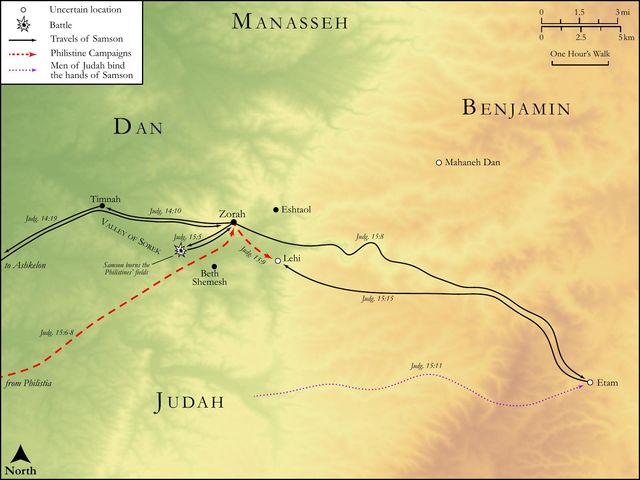
This verse is a direct consequence of Samson's previous acts of vengeance against the Philistines, detailed in Judges 15:1-8. His burning of their fields and the subsequent great slaughter provoked a severe Philistine reprisal, leading them to demand Samson's capture. Three thousand men from Judah, fearing for their own safety and communities, confront Samson at the "rock of Etam" (mentioned in Judges 15:8 and Judges 15:11), urging him to surrender to prevent further conflict. Samson's agreement to be bound by them, on the condition that they do not personally kill him, highlights the precarious position of Judah, caught between their deliverer and their oppressors. This submission is a strategic maneuver, setting the stage for the miraculous deliverance described immediately after in Judges 15:14.
Historical & Cultural Context
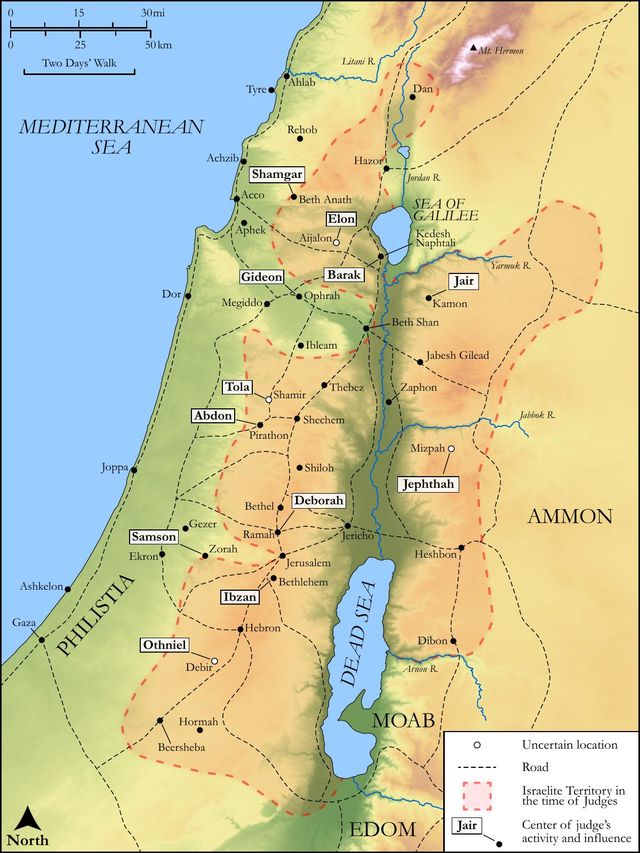
The period of the Judges was marked by a recurring cycle of apostasy, foreign oppression, and God raising up deliverers. At this specific juncture, the Philistines were a dominant regional power, exerting significant military and political control over Israelite territories, particularly Judah. The men of Judah's willingness to hand over Samson reflects their subjugated status and their pragmatic, fear-driven desire to avoid further Philistine wrath, which had been explicitly threatened (as seen in Judges 15:11). This contrasts sharply with the ideal of a united, faithful Israel fighting for its freedom under God's guidance. The "rock of Etam" likely served as a natural fortress or hideout, making Samson's departure from it a significant act of vulnerability. The use of "new cords" signifies a human attempt to ensure absolute security, a common practice for binding prisoners, underscoring the perceived strength and reliability of the restraint.
Key Themes
ShowHideJudges 15:13 powerfully illustrates several recurring themes within the book of Judges and the broader biblical narrative. Firstly, it underscores the theme of Israel's spiritual and moral decline, particularly Judah's fear-driven compromise with their oppressors rather than trusting in God's deliverance, a pattern seen throughout the book (e.g., Judges 2:11-19). Secondly, it showcases Samson's apparent submission as a paradoxical act that ultimately serves God's larger purpose. His willingness to be bound is not weakness but a strategic move orchestrated by divine providence, setting the stage for a dramatic display of God's power, reminiscent of the Spirit of the Lord empowering him in earlier exploits (e.g., Judges 14:6). Finally, the verse highlights divine orchestration amidst human failure, demonstrating that even in moments of betrayal and vulnerability, God remains sovereign, using human actions—even those born of fear—to advance His plan for Israel's deliverance.
Exposition and Analysis
ShowHideKey Word Analysis
ShowHideThis verb signifies "to yoke or hitch; to fasten in any sense, to tie." In this context, it emphasizes the thoroughness and security of the binding. The men of Judah intended to make Samson absolutely secure, ensuring he could not escape and thus appeasing the Philistines. This word highlights the human effort to contain Samson's power, setting up the dramatic contrast with the divine power that immediately follows in the subsequent verses.
Derived from a root meaning "to be new or fresh," this adjective, applied to the cords, is crucial. It implies unused, fresh, and therefore maximally strong and reliable. Old, worn cords might break easily, but new ones represent the strongest possible human restraint. This detail serves to magnify the miracle of Samson's subsequent breaking of them, proving that his strength was not merely human but divinely given, overpowering even the most robust human efforts.
This primitive word refers to the "hand," but is used with great latitude to signify power, means, direction, control, or possession. In the phrase "deliver thee into their hand," it denotes the transfer of authority and control over Samson from the men of Judah to the Philistines. It underscores Samson's transition from a position of relative freedom to one of captivity, subject to the power of his enemies, facilitated by his own people.
Verse Breakdown
ShowHide"And they spake unto him, saying, No; but we will bind thee fast, and deliver thee into their hand:"
This clause reveals the men of Judah's response to Samson's condition (that they not kill him). Their "No" indicates their agreement to his terms, but their subsequent declaration clarifies their intent: they will bind him securely and hand him over to the Philistines. This highlights their fear and their desperate attempt to avoid conflict with the Philistines, even at the cost of betraying their own divinely appointed deliverer.
"but surely we will not kill thee."
This is the crucial promise Samson extracted from his countrymen. It reflects his trust in God's plan for his life and his understanding that his ultimate fate was not in human hands. It also underscores the moral dilemma of the men of Judah, who are willing to facilitate his capture but draw a line at direct murder, perhaps out of some residual sense of kinship or fear of divine retribution themselves.
"And they bound him with two new cords, and brought him up from the rock."
This final clause describes the immediate execution of the agreement. The use of "two new cords" emphasizes the thoroughness of their binding, signifying their determination to fulfill their promise to the Philistines. Being "brought up from the rock" signifies Samson's transition from a place of refuge to a state of vulnerability and captivity, orchestrated by his own people. This physical action sets the stage for the dramatic display of divine power that immediately follows.
Literary Devices
ShowHideJudges 15:13 employs several potent literary devices. Irony is prominent, as Samson, the divinely appointed deliverer of Israel, is bound and handed over to his enemies by his own people. This act of betrayal by those he is meant to save starkly contrasts with his mission and highlights the deep spiritual malaise within Israel. There is also strong Foreshadowing in the mention of "two new cords." This seemingly insurmountable restraint immediately sets the expectation for a miraculous intervention, making Samson's subsequent breaking of them (in Judges 15:14) all the more impactful and a clear demonstration of divine power. Furthermore, Symbolism is at play: the "new cords" symbolize human attempts to control or contain divine power, which are ultimately futile. The "rock" from which Samson is brought up can symbolize a place of perceived security or even divine protection, from which he willingly descends into a vulnerable state, trusting in a higher power.
Theological and Thematic Connections
ShowHideThis verse profoundly illustrates the tension between human fear and divine sovereignty. The men of Judah, driven by fear of the Philistines, choose a path of compromise and betrayal, demonstrating a profound lack of faith in God's ability to deliver them through Samson. Their actions reflect the spiritual malaise of Israel during the period of the Judges, where reliance on human expediency often overshadowed trust in divine intervention. Yet, even in this moment of human failure and apparent vulnerability for Samson, God's overarching plan remains intact. Samson's willing submission, rather than being a sign of defeat, is a strategic step in God's unfolding purpose to humble the Philistines through him. This highlights a recurring biblical theme: God often works through seemingly weak or compromised situations to display His power and fulfill His purposes, demonstrating that His strength is made perfect in weakness.
Reflection and Application
ShowHideJudges 15:13 serves as a poignant reminder that even those appointed by God may face betrayal and opposition from unexpected sources, including their own community. The men of Judah's actions challenge us to examine our own responses when faced with fear and pressure. Are we quick to compromise our convictions or abandon those God has called to lead, simply to maintain a fragile peace or avoid discomfort? This passage calls us to a deeper trust in God's sovereignty, even when circumstances appear dire or when we are seemingly at the mercy of others. Samson's willingness to be bound, despite his immense strength, teaches us that true strength often lies in submission to God's will, even if it means temporary vulnerability. It encourages us to remember that God can use even our moments of apparent weakness or betrayal by others to manifest His power and advance His ultimate purposes.
Questions for Reflection
ShowHideFAQ
ShowHideWhy did the men of Judah not defend Samson against the Philistines?
ShowHideThe men of Judah did not defend Samson primarily out of fear and pragmatism. They were under significant Philistine oppression and feared severe retaliation if they protected Samson. The Philistines had explicitly threatened to burn them and their homes if Samson was not delivered (see Judges 15:11). Their actions reflect a desire to appease their oppressors and preserve their own lives and communities, rather than trusting in God's power to deliver them through Samson. This highlights the spiritual decline and lack of faith prevalent in Israel during the period of the Judges, where tribal disunity and self-preservation often overshadowed national solidarity and trust in God.
Was Samson's agreement to be bound a sign of weakness or a strategic move?
ShowHideSamson's agreement to be bound was not a sign of weakness but a strategic and faith-filled move, orchestrated by divine providence. Samson was fully aware of his supernatural strength, which was activated by the Spirit of the Lord (e.g., Judges 14:6). By allowing himself to be bound by his own people, he created the perfect scenario for a public and undeniable demonstration of God's power. His submission was a calculated act that set the stage for his miraculous breaking of the cords and subsequent defeat of the Philistines, proving that no human restraint could thwart God's purpose for him.
Christ-Centered Fulfillment
ShowHideJudges 15:13, with Samson's willing submission to be bound and delivered by his own people into the hands of his enemies, powerfully foreshadows the greater Deliverer, Jesus Christ. Like Samson, Jesus was betrayed by His own people, the Jewish leaders and crowds, who chose to hand Him over to the Roman authorities rather than defend Him (see Matthew 26:47-50 and John 18:28-40). Just as Samson willingly allowed himself to be bound, knowing divine power would ultimately prevail, Christ willingly submitted to arrest, trial, and crucifixion, even though He possessed all power and could have called legions of angels (see Matthew 26:53). His apparent weakness and humiliation on the cross were not defeat but the very means by which God achieved the ultimate victory over sin and death (see Philippians 2:8 and Colossians 2:15). Samson's breaking of the "new cords" symbolizes Christ's breaking of the bonds of death and the power of the enemy, emerging victorious from the grave (see Acts 2:24). Thus, Samson's experience in Judges 15:13 serves as a prophetic type, pointing to the Lamb of God who, through His voluntary submission and apparent vulnerability, achieved eternal deliverance for all who believe.