


Judges 15:10
- וַיֹּאמְרוּvai·yo·me·Ruand they saidH559Conj-w ¦ V-Qal-ConsecImperf-3mpVerb Qal Consecutive Imperfect 3rd Plural Masculineוַandיֹּאמְרוּthey said
- אִישׁ'ish[the] man ofH376N-mscNoun Singular Masculine Construct
- יְהוּדָהye·hu·DahJudahH3063N-properNoun Proper Location
- לָמָהla·Mah<to> why?H4100Prep-l ¦ InterrogPronoun Interrogativeלָ<to>מָהwhy?
- עֲלִיתֶם'a·li·Temhave you come upH5927V-Qal-Perf-2mpVerb Qal Perfect 2nd Plural Masculine
- עָלֵינוּ'a·Lei·nuon usH5921Prep ¦ 1cpPreposition Definiteעָלֵיonנוּus
- וַיֹּאמְרוּvai·yo·me·Ruand they saidH559Conj-w ¦ V-Qal-ConsecImperf-3mpVerb Qal Consecutive Imperfect 3rd Plural Masculineוַandיֹּאמְרוּthey said
- לֶאֱסוֹרle·'e·Sorto bindH631Prep-l ¦ V-Qal-InfVerb Qal Infinitive Constructלֶtoאֱסוֹרbind
- אֶת'et<obj.>H853DirObjMParticle Object Indicator
- שִׁמְשׁוֹןshim·shOnSamsonH8123N-proper-mNoun Proper Masculine
- עָלִינוּ'a·Li·nuwe have come upH5927V-Qal-Perf-1cpVerb Qal Perfect 1st Plural common gender
- לַעֲשׂוֹתla·'a·Sotto doH6213Prep-l ¦ V-Qal-InfVerb Qal Infinitive Constructלַtoעֲשׂוֹתdo
- לוֹloto <the> himPrep-l ¦ 3msSuffix Personal 3rd Singular Masculineלto <the>וֹhim
- כַּאֲשֶׁרka·'a·Sherjust asH834Prep-k ¦ RelParticle Relativeכַּjustאֲשֶׁרas
- עָשָׂה'A·sahhe didH6213V-Qal-Perf-3msVerb Qal Perfect 3rd Singular Masculine
- לָנוּLa·nuto <the> usPrep-l ¦ 1cpSuffix Personal 1st Plural common genderלָto <the>נוּus
English is a literal word-by-word gloss of the Hebrew, not the KJV's wording. Why?
This is the original text the KJV's translators worked from — each Hebrew word with its own literal English meaning in this verse, prepared by scholars at Tyndale House, Cambridge. The KJV translates whole sentences, not word by word, so its wording differs: one Hebrew word can become several English words, and the KJV may choose “the LORD” where the gloss reads “Yahweh”. Both are faithful — they answer different questions. For the KJV's own rendering, switch to the KJV text.
Details
See on the biblical-era map
Study this verse
Public-domain commentary
Matthew Henry
From his Commentary on the Whole Bible. Henry comments on passages, not single verses — this entry covers Judges 15:9–17. His two-level outline is real structure in the source text, so it is rendered as structure.
Here is, I. Samson violently pursued by the Philistine. They went up in a body, a more formidable force than they had together when Samson smote them hip and thigh; and they pitched in Judah, and spread themselves up and down the country, to find out Samson, who they heard had come this way, Jdg 15:9. When the men of Judah, who had tamely submitted to their yoke, pleaded that they had paid their tribute, and that none of their tribe had given them any offence, they freely own they designed nothing in this invasion but to seize Samson; they would fight neither against small nor great, but only that judge of Israel (Jdg 15:10), to do to him as he has done to us, that is, to smite his hip and thigh, as he did ours - an eye for an eye. Here was an army sent against one man, for indeed he was himself an army. Thus a whole band of men was sent to seize our Lord Jesus, that blessed Samson, though a tenth part would have served now that his hour had come, and ten times as many would have done nothing if he had not yielded.
II.Samson basely betrayed and delivered up by the men of Judah, Jdg 15:11.
Of Judah were they? Degenerate branches of that valiant tribe! Utterly unworthy to carry in their standard the lion of the tribe of Judah. Perhaps they were disaffected to Samson because he was not of their tribe. Out of a foolish fondness for their forfeited precedency, they would rather be oppressed by Philistines than rescued by a Danite. Often has the church's deliverance been obstructed by such jealousies and pretended points of honour. Rather it was because they stood in awe of the Philistines, and were willing, at any rate, to get them out of their country. If their spirits had not been perfectly cowed and broken by their sins and troubles, and they had not been given up to a spirit of slumber, they would have taken this fair opportunity to shake off the Philistine's yoke. If they had had the least spark of ingenuousness and courage remaining in them, having so brave a man as Samson was to head them, they would now have made one bold struggle for the recovery of their liberty; but no marvel if those that had debased themselves to hell in the worship of their dung-hill gods (Isa 57:9) thus debased themselves to the dust, in submission to their insulting oppressors. Sin dispirits men, nay, it infatuates them, and hides from their eyes the things that belong to their peace. Probably Samson went into the border of that country to offer his service, supposing his brethren would have understood how that God by his hand would deliver them, as Moses did, Act 7:25. But they thrust him from them, and very disingenuously,
1.Blamed him for what he had done against the Philistines, as if he had done them a great injury. Such ungrateful returns have those often received that have done the best service imaginable to their country. Thus our Lord Jesus did many good works, and for these they were ready to stone him.
2.They begged of him that he would suffer them to bind him, and deliver him up to the Philistines. Cowardly unthankful wretches! Fond of their fetters and in love with servitude! Thus the Jews delivered up our Saviour, under pretence of a fear lest the Romans should come and take away their place and nation. With what a sordid servile spirit do they argue, Knowest thou not that the Philistines rule over us? And whose fault was that? They knew they had no right to rule over them, nor would they have been sold into their hands if they had not first sold themselves to work wickedness.
III.Samson tamely yielding to be bound by his countrymen, and delivered into the hands of his enraged enemies, Jdg 15:12, Jdg 15:13.
Now easily could he have beaten them off, and kept the top of his rock against these 3000 men, and none of them all could, or durst, have laid hands on him; but he patiently submitted,
1.That he might give an example of great meekness, mixed with great strength and courage; as one that had rule over his own spirit, he knew how to yield as well as how to conquer.
2.That, by being delivered up to the Philistine, he might have an opportunity of making a slaughter among them.
3.That he might be a type of Christ, who, when he had shown what he could do, in striking those down that came to seize him, yielded to be bound and led as a lamb to the slaughter. Samson justified himself in what he had done against the Philistines: "As they did to me, so I did to them; it was a piece of necessary justice, and they ought not to retaliate it upon me, for they began." He covenants with the men of Judah that, if he put himself into their hands, they should not fall upon him themselves, because then he should be tempted to fall upon them, which he was very loth to do. This they promised him (Jdg 15:13), and then he surrendered. The men of Judah, being his betrayers, were in effect his murderers; they would not kill him themselves, but they did that which was worse, they delivered him into the hands of the uncircumcised Philistines, who they knew would do worse than kill him, would abuse and torment him to death. Perhaps they thought, as some think Judas did when he betrayed Christ, that he would by his great strength deliver himself out of their hands; but no thanks to them if he had delivered himself, and, if they thought he would do so, they might of themselves have thought this again, that he could and would deliver them too if they would adhere to him and make him their head. Justly is their misery prolonged who, to oblige their worst enemies, thus abuse their best friend. Never were men so infatuated except those who thus treated our blessed Saviour.
IV.Samson making his part good against the Philistines, even when he was delivered into their hands, fast pinioned with two new cords.
The Philistines, when they had him among them, shouted against him (Jdg 15:14), so triumphing in their success, and insulting over him. If God had not tied their hands faster than the men of Judah had tied his, they would have shot at him (as their archers did at Saul) to dispatch him immediately, rather than have shouted at him, and given him time to help himself. But their security and joy were a presage of their ruin. When they shouted against him as a man run down, confident that all was their own, then the Spirit of the Lord came upon him, came mightily upon him, inspired him with more than ordinary strength and resolution. Thus fired,
1.He presently got clear of his bonds. The two new cords, upon the first struggle he gave, broke, and were melted (as the original word is) from off his hands, no doubt to the great amazement and terror of those that shouted against him, whose shouts were hereby turned into shrieks. Observe, When the Spirit of the Lord came upon him, his cords were loosed. Where the Spirit of the Lord is there is liberty, and those are free indeed who are thus freed. This typified the resurrection of Christ by the power of the Spirit of holiness. In it he loosed the bands of death, and its cords, the grave-clothes, fell from his hands without being loosed, as Lazarus's were, because it was impossible that the mighty Saviour should be holden of them; and thus he triumphed over the powers of darkness that shouted against him, as if they had him sure.
2.He made a great destruction among the Philistines, who all gathered about him to make sport with him, Jdg 15:15. See how poorly he was armed: he had no better weapon than the jaw-bone of an ass, and yet what execution he did with it! he never laid it out of his hand till he had with it laid 1000 Philistines dead upon the spot; and thus that promise was more than accomplished. One of you shall chase a thousand, Jos 23:10. A jaw-bone was an inconvenient thing to grasp, and, one would think, might easily be wrested out of his hand, and a few such blows as he gave with it might have crushed and broken it, and yet it held good to the last. Had it been the jaw-bone of a lion, especially that which he himself had slain, it might have helped to heighten his fancy and to make him think himself the more formidable; but to take the bone of that despicable animal was to do wonders by the foolish things of the world, that the excellency of the power might be of God and not of man. One of David's worthies slew 300 Philistines at once, but it was with a spear, Ch1 11:11. Another slew of them till his hand was weary and stuck to his sword, Sa2 23:10. But they all came short of Samson. What could be thought too hard, too much, for him to do, on whom the Spirit of the Lord came mightily! Through God we shall do valiantly. It was strange the men of Judah did not now come in to his aid: cowards can strike a falling enemy. But he was to be a type of him that trod the wine-press alone.
V.Samson celebrating his own victory, since the men of Judah would not do even that for him.
He composed a short song, which he sang to himself, for the daughters of Israel did not meet him, as afterwards they did Saul, to sing, with more reason, Samson hath slain his thousands. The burden of this song was, With the jaw-bone of an ass, heaps upon heaps, have I slain a thousand men, Jdg 15:16. The same word in Hebrew (chamor) signifies both an ass and a heap, so that this is an elegant paronomasia, and represents the Philistines falling as tamely as asses. He also gave a name to the place, to perpetuate the Philistines' disgrace, Jdg 15:17. Ramath-lehi, the lifting up of the jaw-bone. Yet he did not vain-gloriously carry the bone about with him for a show, but threw it away when he had done with it. So little were relics valued then.
Historical interpretation
Historical reception
1 surviving comment on this verse from the historical church.
But Samson did not forgive the Philistines their wrong, nor rest content with this measure of vengeance, but he slew them with a great slaughter, and many of them fell by the sword. And he retired to Etam, a torrent in the wilderness, where was a rock, a stronghold of the tribe of Judah. Now the Philistines, not daring to attack him, nor scale the steep heights on which this fortress stood, began to assail with threats of war the tribe of Judah: but when they saw that the plea of the men of Judah was a good one, that it was neither just nor fair nor expedient for them to destroy their own subjects and tributaries, especially for another man's fault, they took counsel, and required that the author of the outrage should be delivered up to them, in order that his countrymen might be exonerated from the consequences of it.
These terms being imposed upon them, the men of Judah gathered together three thousand of their tribe and went up to him, and premising that they were subject to the Philistines, and obliged to obey them, not willingly but by terror, they thus sought to turn away from themselves the odium of their act, throwing it upon those by whom they were constrained. Wherefore he thus replied, What kind of Justice is it, O children of Abraham, that the satisfaction I have taken for my bride first over-reached and then torn from me should be injurious to me, and that I may not safely avenge this private injury? Have ye so turned your minds to the low offices of slaves, as to become the ministers of the insolence of others, and to turn your arms against yourselves? If I must perish, because I gave free vent to my grief, I had rather perish by the hand of the Philistines. My home has been attempted, my wife tampered with, if I have not been allowed to live without harm from them, at least let my own countrymen be free from the guilt of my death. I did but requite the injury I had received, I did not inflict one. Judge ye whether it was an equal return. They complain of the loss of their home, I of the loss of my wife; compare the sheaves of corn, with a companion of the marriage bed. They have sanctioned my grief by avenging my injuries. Consider to what an office they have appointed you. They desire you to put to death that man, whom they themselves have judged worthy to be avenged on those who wronged him, and to whose vengeance they ministered. But if your necks are thus bowed down to these proud men, deliver me into the hand of the enemy, slay me not yourselves; I refuse not to die, but I shrink from implicating you in my death. If from fear ye comply with their insolence, bind my hands with chains: though unarmed they will break their bonds and find a weapon for themselves. They will assuredly consider that you have satisfied the imposed condition, if you deliver me alive into their hands.
When they heard this, though three thousand men had come up, they swore to him that they would make no attempt on his life, only he must submit to be bound, in order that they might formally surrender him, and so keep clear of the crime of which they were accused.
Continue studying Judges 15:10 across the web’s major study libraries — every link below opens this exact verse, chapter, or book on the destination site.
Read & Compare
 BibleGatewayThis verse in more than 200 translations and 70 languages.
 Bible.comThe YouVersion reader — hundreds of translations, reading plans, and highlights.
 ESV.orgCrossway's official English Standard Version reader.
 NET BibleThe NET translation with 60,000+ translators' notes on every rendering decision.
 STEP BibleTyndale House's free study tool — original text, vocabulary, and scholarly resources.
 BibliaLogos Bible Software's free web reader.
 USCCBThe New American Bible (Revised Edition) with the U.S. bishops' study notes.
Commentaries
 BibleHub CommentariesDozens of classic commentaries on this verse, gathered on one page.
 StudyLightMore than 100 commentary sets — the largest collection on the web.
 BibleRefPlain-English commentary on what this verse means, verse by verse.
 Enduring WordDavid Guzik's free commentary on this chapter, widely used by Bible teachers.
 Bible Study ToolsVerse commentary alongside Greek and Hebrew study aids.
Original Language & Research
- BibleHub InterlinearThe verse word by word — original language, transliteration, and English.
- BibleHub LexiconEvery word's original-language definition and Strong's entry.
 Blue Letter BibleDeep-study tools — Strong's numbers, concordance, and word studies.
 SefariaThe Hebrew text with Rashi and centuries of Jewish commentary.
Sermons, Hymns & Audio


TrulyRandomVerse is not affiliated with these sites and doesn’t control their content. They’re linked because they’re genuinely useful.
Summary
Judges 15:10 captures a poignant and pivotal moment in the Samson narrative, starkly revealing the compromised and fearful posture of the men of Judah under Philistine oppression. When confronted by their own tribe, the Philistines unequivocally declare their purpose: to apprehend Samson and exact precise retribution for his recent destructive acts against them. This exchange underscores the profound spiritual and political decline within Israel, where tribal disunity and a pervasive lack of faith-filled courage led to a willingness to appease oppressors rather than defend their divinely appointed deliverer.
Context
ShowHideLiterary Context
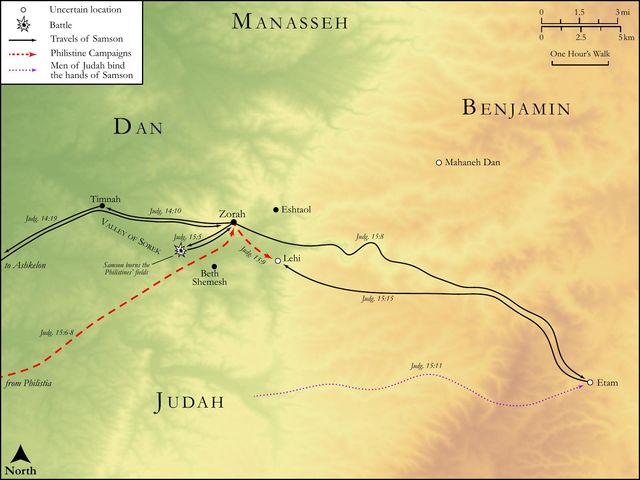
This verse is strategically placed within the tumultuous narrative of Samson, one of Israel's judges, whose life is characterized by a recurring cycle of divine empowerment, personal moral failings, and isolated acts of resistance against the Philistines. Immediately preceding this exchange, Samson, driven by personal vengeance after his Philistine wife was given to another man, had unleashed a devastating retaliatory attack, setting fire to the Philistine grain fields, vineyards, and olive groves (Judges 15:1-5). This significant economic blow prompted the Philistines to retaliate by burning Samson's wife and her father, to which Samson responded with further vengeance, slaughtering many Philistines (Judges 15:6-8). The Philistines' subsequent military expedition to Lehi in Judah, as described in this verse, is a direct consequence of Samson's escalating actions, setting the stage for the men of Judah's fearful capitulation and Samson's subsequent binding.
Historical & Cultural Context
The period of the Judges (approximately 1200-1000 BCE) was marked by a distinct lack of centralized Israelite authority, recurring cycles of apostasy, divine judgment through oppression, repentance, and temporary deliverance. The Philistines, a formidable maritime people who had settled along the southwestern coast of Canaan, were a dominant regional power, frequently subjugating the Israelite tribes. Their military superiority, particularly their advanced iron weaponry, gave them a significant strategic advantage over the Israelites. The men of Judah's submissive questioning ("Why are ye come up against us?") rather than a defiant stand, vividly reflects the harsh reality of their subjugation and their deep-seated fear of Philistine reprisal. Culturally, the Philistines' stated motive, "to do to him as he hath done to us," powerfully echoes the ancient Near Eastern principle of lex talionis (the law of retaliation), where justice often involved reciprocal action, though here it is applied as a national justification for vengeance rather than a legal code for individual offenses.
Key Themes
ShowHideJudges 15:10 profoundly underscores several recurring themes prevalent within the book of Judges and the broader biblical narrative. Firstly, Retaliation and Vengeance are central, as the Philistines explicitly articulate their desire for proportional payback, perpetuating a destructive cycle of violence that stands in stark contrast to divine justice and mercy. Secondly, the verse highlights Israelite Weakness and Compromise, particularly among the men of Judah. Their immediate concern is not the Philistine invasion of their territory or the defense of their divinely gifted deliverer, but rather an attempt to placate the oppressors. This reveals a profound lack of courage, national unity, and spiritual conviction, a pervasive issue during this era where "every man did what was right in his own eyes" (Judges 21:25). Finally, the verse emphasizes Samson's Isolated Stand. Unlike earlier judges who rallied tribes to fight against oppressors, Samson operates largely alone, his actions provoking reactions that often leave him to bear the consequences without the support of his own people, highlighting the fragmented and spiritually compromised state of Israel.
Exposition and Analysis
ShowHideKey Word Analysis
ShowHideThis term refers to an individual man or male person. In this context, it emphasizes the specific individuals from the tribe of Judah who confront the Philistines. Their identity as "men" of Judah, a tribe meant to embody strength and leadership, highlights the stark contrast with their fearful and compromising actions in this verse, underscoring their failure to act as champions for their people or their divinely appointed deliverer.
Meaning "to ascend" or "to go up," this verb is used by both the men of Judah in their question ("Why are ye come up?") and by the Philistines in their answer ("To bind Samson are we come up"). It denotes an intentional movement into a territory, often with hostile or purposeful intent. The repetition of this word underscores the Philistines' deliberate incursion and the men of Judah's recognition of an invading force, yet their response is one of inquiry rather than resistance.
Meaning "to yoke or hitch," and by analogy, "to fasten in any sense." The Philistines' explicit purpose to "bind" Samson reveals their intent to physically restrain and incapacitate him, thereby neutralizing his formidable strength. This specific action signifies not merely defeat, but control, humiliation, and the removal of a direct threat, foreshadowing Samson's eventual capture and loss of freedom.
Meaning "to do or make, in the broadest sense and widest application." This verb is used by the Philistines to justify their actions: "to do to him as he hath done to us." It signifies a reciprocal action, a direct response to Samson's prior deeds. The use of this word emphasizes the Philistines' perception of their actions as a direct and justified consequence of Samson's previous acts of vengeance, perpetuating a cycle of retribution.
Verse Breakdown
ShowHide"And the men of Judah said, Why are ye come up against us?"
This opening clause immediately establishes a tone of apprehension and subservience. The men of Judah, representing a significant Israelite tribe, do not confront the Philistine invaders with defiance or a call to arms. Instead, they express a fearful curiosity, seeking to understand the specific grievance. Their question is an attempt to ascertain the Philistines' intentions, hoping to diffuse the situation or perhaps even cooperate with the oppressors to protect themselves. This speaks volumes about the spiritual and political degradation within Israel, where the oppressor is questioned rather rather than resisted.
"And they answered, To bind Samson are we come up"
The Philistines' response is direct, unambiguous, and focused. They are not there for general conquest or plunder, but for a specific target: Samson. Their stated intention to "bind" him indicates a clear desire to neutralize his supernatural strength and remove him as a threat, perhaps even to parade him as a symbol of their dominance. This clarifies their immediate objective and sets the stage for the subsequent betrayal by the men of Judah.
"to do to him as he hath done to us."
This concluding statement provides the explicit justification for the Philistines' actions. It is a clear declaration of their intent to exact retribution, a direct response to Samson's prior acts of vengeance (burning their harvest, slaughtering their men). This phrase encapsulates the principle of reciprocal justice, or lex talionis, applied here in a national context, perpetuating the destructive cycle of violence that defines much of the Judges period.
Literary Devices
ShowHideThe verse effectively employs Dialogue to advance the plot and reveal character. The direct exchange between the men of Judah and the Philistines immediately exposes Judah's fearful and compromising nature, contrasting sharply with the Philistines' clear and vengeful intent. There is a strong element of Irony present: the very people Samson is meant to deliver are more concerned with appeasing their oppressors than defending their divinely appointed deliverer. This highlights the tragic state of Israel's spiritual and national decline. The Philistines' declaration "To bind Samson" serves as clear Foreshadowing, anticipating Samson's eventual capture and the loss of his freedom later in the narrative. Furthermore, the explicit statement "to do to him as he hath done to us" functions as a narrative embodiment of the Lex Talionis principle, driving the plot through a cycle of escalating retribution.
Theological and Thematic Connections
ShowHideJudges 15:10 offers a stark theological reflection on the profound consequences of spiritual and moral decline within a covenant people. The men of Judah's willingness to compromise and prioritize temporal peace over righteous resistance reveals a deep-seated lack of faith in God's power to deliver, a recurring and tragic theme throughout the book of Judges. Their fear of man, rather than the fear of God, leads them to betray their own kinsman and divinely appointed deliverer. The Philistines' pursuit of vengeance, though understandable from a human perspective, powerfully illustrates the destructive cycle of retribution that characterizes a world operating without divine intervention and grace. This passage implicitly contrasts human attempts at self-appointed justice with God's ultimate sovereignty and His prerogative to execute justice and vengeance in His own time and way. It reminds us that true deliverance comes not from human appeasement or endless cycles of retaliation, but from God's redemptive plan and His call for His people to trust and obey Him.
Reflection and Application
ShowHideThis passage serves as a powerful cautionary tale for believers today, highlighting the insidious dangers of spiritual compromise and the debilitating effects of fear. The men of Judah's response to the Philistines is a vivid illustration of prioritizing comfort and self-preservation over faithfulness and courageous conviction. In a world that often pressures us to compromise our biblical convictions, to appease prevailing cultural norms, or to remain silent in the face of injustice, the story of Judah's capitulation reminds us of the profound spiritual cost of such choices. We are called to stand firm in our faith, trusting in God's sovereignty and His unwavering ability to deliver, rather than succumbing to fear or engaging in destructive cycles of vengeance. Instead of seeking to "do to others as they have done to us," followers of Christ are called to a higher standard of love, forgiveness, and reconciliation, actively breaking the cycle of animosity. This narrative also underscores the vital importance of unity within the body of Christ; just as Judah's disunity and self-interest left Samson isolated, so too can disunity and a lack of mutual support among believers weaken our collective witness and ability to stand against spiritual opposition.
Questions for Reflection
ShowHideFAQ
ShowHideWhy didn't the men of Judah defend Samson, who was a deliverer for Israel?
ShowHideThe men of Judah did not defend Samson primarily due to a complex combination of factors: pervasive fear of their Philistine overlords, the harsh reality of their political subjugation, and a profound lack of national and spiritual unity. They were under the oppressive rule of the Philistines, and confronting them would have invited severe retaliation against their entire tribe. Unlike earlier judges who successfully rallied tribes for a unified stand against oppressors, the period of Judges was marked by tribal fragmentation and a widespread spiritual decline, where "every man did what was right in his own eyes" (Judges 21:25). The men of Judah prioritized their own immediate safety and the appeasement of their overlords over defending a divinely appointed, albeit unconventional, deliverer. This decision highlights their spiritual weakness and a tragic failure to trust in God's power for deliverance.
What is lex talionis and how does it apply to the Philistines' statement in this verse?
ShowHideLex talionis is a Latin term meaning "law of retaliation," often summarized by the phrase "an eye for an eye, a tooth for a tooth." It is a principle of retributive justice where punishment is proportionate to the offense. In the Mosaic Law (e.g., Exodus 21:23-25), it served to limit vengeance and ensure justice was not excessive, preventing disproportionate retaliation. In Judges 15:10, the Philistines' statement, "to do to him as he hath done to us," is a clear application of this principle, though not as a legal code, but as a justification for national vengeance. Samson had inflicted significant damage on them (burning their harvest, slaughtering their men), and they sought to inflict proportionate harm on him. This illustrates how the principle, when applied outside of divine or legal bounds and driven by human anger, can perpetuate a destructive cycle of violence between individuals or nations.
Christ-Centered Fulfillment
ShowHideJudges 15:10, with its depiction of a compromised people and a solitary deliverer facing retribution, finds profound Christ-centered fulfillment. Samson, though a flawed and morally ambiguous figure, was a deliverer raised by God, yet he was ultimately rejected and handed over by his own people to his enemies. This grim reality powerfully foreshadows Jesus Christ, the ultimate and perfect Deliverer, who "came to his own, and his own people did not receive him" (John 1:11). Just as the men of Judah, out of fear and self-preservation, sought to appease their oppressors by binding Samson, so too did the Jewish religious leaders, fearing Roman reprisal and prioritizing their own earthly power, hand Jesus over to be crucified (John 19:15). The Philistines' desire for "an eye for an eye" retribution contrasts sharply with Christ's redemptive mission. While the fallen world demands vengeance and perpetuates cycles of retaliation, Christ broke this destructive cycle by offering Himself as the perfect, atoning sacrifice, absorbing the wrath due to humanity and offering radical forgiveness instead (Romans 5:8). He taught His followers to "turn the other cheek" and "love your enemies" (Matthew 5:38-48), fundamentally reorienting the concept of justice away from human retaliation toward divine grace, mercy, and reconciliation. Unlike Samson, who was physically bound and ultimately died with his enemies, Christ willingly submitted to being bound, crucified, and died, but rose again in glorious triumph over sin, death, and the grave, offering true and eternal liberation to all who believe in Him (Hebrews 2:14-15).