


Job 21:28
- כִּיkiforH3588PrtParticle Conditional
- תֹאמְרוּto·me·Ruyou sayH559V-Qal-Imperf-2mpVerb Qal Imperfect 2nd Plural Masculine
- אַיֵּה'ai·Yehwhere?H346InterrogParticle Interrogative
- בֵיתveit[is the] house ofH1004N-mscNoun Singular Masculine Construct
- נָדִיבna·Diva noble [person]H5081N-msNoun Singular Masculine Absolute
- וְאַיֵּהve·'ai·Yehand where?H346Conj-w ¦ InterrogParticle Interrogativeוְandאַיֵּהwhere?
- אֹהֶל'O·hel[is the] tent ofH168N-mscNoun Singular Masculine Construct
- מִשְׁכְּנוֹתmish·ke·Not[the] dwelling places ofH4908N-fpcNoun Plural Feminine Construct
- רְשָׁעִיםre·sha·'Imwicked [people]H7563N-mpNoun Plural Masculine Absolute
English is a literal word-by-word gloss of the Hebrew, not the KJV's wording. Why?
This is the original text the KJV's translators worked from — each Hebrew word with its own literal English meaning in this verse, prepared by scholars at Tyndale House, Cambridge. The KJV translates whole sentences, not word by word, so its wording differs: one Hebrew word can become several English words, and the KJV may choose “the LORD” where the gloss reads “Yahweh”. Both are faithful — they answer different questions. For the KJV's own rendering, switch to the KJV text.
Details
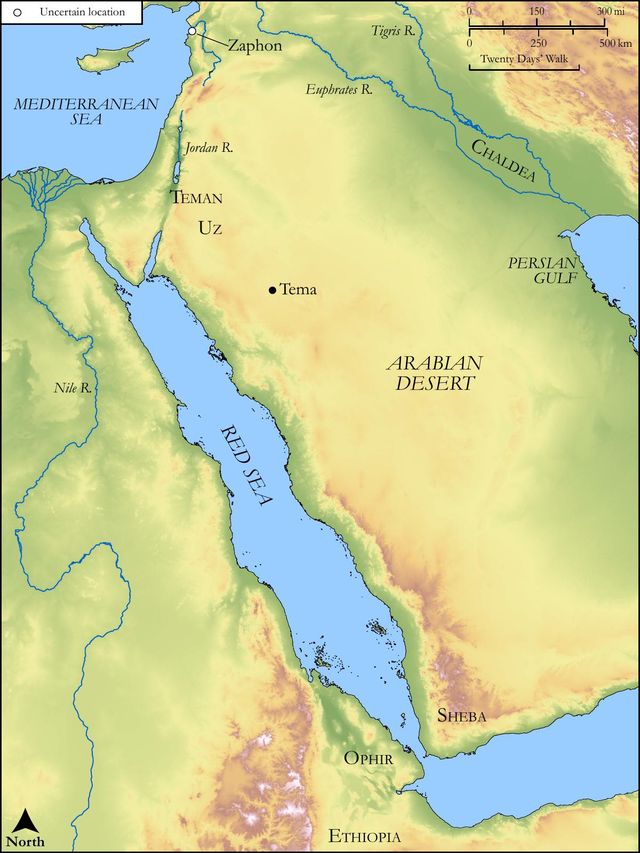
See on the biblical-era map
Study this verse
Public-domain commentary
Matthew Henry
From his Commentary on the Whole Bible. Henry comments on passages, not single verses — this entry covers Job 21:27–34. His two-level outline is real structure in the source text, so it is rendered as structure.
In these verses,
I.Job opposes the opinion of his friends, which he saw they still adhered to, that the wicked are sure to fall into such visible and remarkable ruin as Job had now fallen into, and none but the wicked, upon which principle they condemned Job as a wicked man. "I know your thoughts," says Job (Job 21:27); "I know you will not agree with me; for your judgments are tinctured and biassed by your piques and prejudices against me, and the devices which you wrongfully imagine against my comfort and honour: and how can such men be convinced?" Job's friends were ready to say, in answer to his discourse concerning the prosperity of the wicked, "Where is the house of the prince? Job 21:28. Where is Job's house, or the house of his eldest son, in which his children were feasting? Enquire into the circumstances of Job's house and family, and then ask, Where are the dwelling-places of the wicked? and compare them together, and you will soon see that Job's house is in the same predicament with the houses of tyrants and oppressors, and may therefore conclude that doubtless he was such a one."
II.He lays down his own judgment to the contrary, and, for proof of it, appeals to the sentiments and observations of all mankind.
So confident is he that he is in the right that he is willing to refer the cause to the next man that comes by (Job 21:29): "Have you not asked those that go by the way - any indifferent person, any that will answer you? I say not, as Eliphaz (Job 5:1), to which of the saints, but to which of the children of men will you turn? Turn to which you will, and you will find them all of my mind, that the punishment of sinners is designed more for the other world than for this, according to the prophecy of Enoch, the seventh from Adam, Jde 1:14. Do you not know the tokens of this truth, which all that have made any observations upon the providences of God concerning mankind in this world can furnish you with?" Now,
1.What is it that Job here asserts? Two things: - (1.) That impenitent sinners will certainly be punished in the other world, and, usually, their punishment is put off until then. (2.) That therefore we are not to think it strange if they prosper greatly in this world and fall under no visible token of God's wrath. Therefore they are spared now, because they are to be punished then; therefore the workers of iniquity flourish, that they may be destroyed for ever, Psa 92:7. The sinner is here supposed, [1.] To live in a great deal of power, so as to be not only the terror of the mighty in the land of the living (Eze 32:27), but the terror of the wise and good too, whom he keeps in such awe that none dares declare his way to his face, Job 21:31. None will take the liberty to reprove him, to tell him of the wickedness of his way, and what will be in the end thereof; so that he sins securely, and is not made to know either shame or fear. The prosperity of fools destroys them, by setting them (in their own conceit) above reproofs, by which they might be brought to that repentance which alone will prevent their ruin. Those are marked for destruction that are let alone in sin, Hos 4:17. And, if none dares declare his way to his face, much less dare any repay him what he has done and make him refund what he has obtained by injustice. He is one of those great flies which break through the cobwebs of the law, that hold only the little ones. This emboldens sinners in their sinful ways that they can brow-beat justice and make it afraid to meddle with them. But there is a day coming when those shall be told of their faults who now would not bear to hear of them, those shall have their sins set in order before them, and their way declared to their face, to their everlasting confusion, who would not have it done here, to their conviction, and those who would not repay the wrongs they had done shall have them repaid to them. [2.] To die, and be buried in a great deal of pomp and magnificence, Job 21:32, Job 21:33. There is no remedy; he must die; that is the lot of all men; but every thing you can think of shall be done to take off the reproach of death. First, He shall have a splendid funeral - a poor thing for any man to be proud of the prospect of; yet with some it passes for a mighty thing. Well, he shall be brought to the grave in state, surrounded with all the honours of the heralds' office and all the respect his friends can then pay to his remains. The rich man died, and was buried, but no mention is made of the poor man's burial, Luk 16:22. Secondly, He shall have a stately monument erected over him. He shall remain in the tomb with a Hic jacet - Here lies, over him, and a large encomium. Perhaps it is meant of the embalming of his body to preserve it, which was a piece of honour anciently done by the Egyptians to their great men. He shall watch in the tomb (so the word is), shall abide solitary and quiet there, as a watchman in his tower. Thirdly, The clods of the valley shall be sweet to him; there shall be as much done as can be with rich odours to take off the noisomeness of the grave, as by lamps to set aside the darkness of it, which perhaps was referred to in the foregoing phrase of watching in the tomb. But it is all a jest; what is the light, or what the perfume, to a man that is dead? Fourthly, It shall be alleged, for the lessening of the disgrace of death, that it is the common lot: He has only yielded to fate, and every man shall draw after him, as there are innumerable before him. Note, Death is the way of all the earth: when we are to cross that darksome valley we must consider, 1. That there are innumerable before us; it is a tracked road, which may help to take off the terror of it. To die is ire ad plures - to go to the great majority. 2. That every man shall draw after us. As there is a plain track before, so there is a long train behind; we are neither the first nor the last that pass through that dark entry. Every one must go in his own order, the order appointed of God.
2.From all this Job infers the impertinency of their discourses, Job 21:34. (1.) Their foundation is rotten, and they went upon a wrong hypothesis: "In your answers there remains falsehood; what you have said stands not only unproved but disproved, and lies under such an imputation of falsehood as you cannot clear it from." (2.) Their building was therefore weak and tottering: "You comfort me in vain. All you have said gives me no relief; you tell me that I shall prosper again if I turn to God, but you go upon this presumption, that piety shall certainly be crowned with prosperity, which is false; and therefore how can your inference from it yield me any comfort?" Note, Where there is not truth there is little comfort to be expected.
Historical interpretation
Historical reception
2 surviving comments on this verse. Each one is dated, so this reads as a timeline rather than a list.
The weak desire to thrive in this world’s fortune. They dread scourges as evils of great magnitude. In the case of those they see smitten, they measure the offence by the punishment. For those they see struck with the rod, they suppose them to have displeased God. Hence blessed Job’s friends were persuaded that he, whom they beheld under the rod, had been ungodly, that is, as reckoning that if he had not been ungodly, his “dwelling places would have remained.” But no one thinks so except he who still travails with the weariness of infirmity, who firmly sets the footstep of his thoughts in the gratification of the present life, who is not taught to pass on with perfect desires to the eternal land. Hence, it is well added, “Ask every one of them that go by the way. You will know that he understands this same, because the wicked is reserved to the day of destruction, and he is brought to the day of wrath.” Often the patience of God long suffers with those whom it already condemns to a foreknown punishment. It suffers those to go on thriving whom it sees still committing worse things. One who sees the pit of condemnation to which they are going is viewed as nothing to them. The wicked multiply here things that must be abandoned. But one who is wedded to the glory of the present life counts it great happiness to thrive here according to his wishes, though hereafter he is driven to undergo eternal punishment. Therefore, that person only sees it as nothing for the wicked to thrive, who has already removed his heart from the love of the present world. Hence, in speaking of the future condemnation of the wicked, it is rightly premised, “Ask every one of them that go by the way, and you will know that he understands this.” For he is called a “wayfarer,” who minds that the present life is to him only a way and not a native land, who thinks it beneath him to fix his heart on the love of this passing state of being, who longs not to continue in a transitory scene of things but to reach the eternal world.
67. The weak, that desire to thrive in this world’s fortune, and as evils of great magnitude so dread scourges, in the case of those, whom they see smitten, measure offence by the punishment; for those, whom they see struck with the rod, they suppose have displeased God. Hence blessed Job’s friends were persuaded that he, whom they be held under the rod, had been ungodly, i.e. as reckoning that if he had not been ungodly, his ‘dwelling-places would have remained:’ but no man thinks so, saving he who still travails with the weariness of infirmity, who sets fast the footstep of his thoughts in the gratification of the present life, who is not taught to pass on with perfect desires to the eternal land.
Continue studying Job 21:28 across the web’s major study libraries — every link below opens this exact verse, chapter, or book on the destination site.
Read & Compare
 BibleGatewayThis verse in more than 200 translations and 70 languages.
 Bible.comThe YouVersion reader — hundreds of translations, reading plans, and highlights.
 ESV.orgCrossway's official English Standard Version reader.
 NET BibleThe NET translation with 60,000+ translators' notes on every rendering decision.
 STEP BibleTyndale House's free study tool — original text, vocabulary, and scholarly resources.
 BibliaLogos Bible Software's free web reader.
 USCCBThe New American Bible (Revised Edition) with the U.S. bishops' study notes.
Commentaries
 BibleHub CommentariesDozens of classic commentaries on this verse, gathered on one page.
 StudyLightMore than 100 commentary sets — the largest collection on the web.
 BibleRefPlain-English commentary on what this verse means, verse by verse.
 Enduring WordDavid Guzik's free commentary on this chapter, widely used by Bible teachers.
 Bible Study ToolsVerse commentary alongside Greek and Hebrew study aids.
Original Language & Research
- BibleHub InterlinearThe verse word by word — original language, transliteration, and English.
- BibleHub LexiconEvery word's original-language definition and Strong's entry.
 Blue Letter BibleDeep-study tools — Strong's numbers, concordance, and word studies.
 SefariaThe Hebrew text with Rashi and centuries of Jewish commentary.
Sermons, Hymns & Audio


TrulyRandomVerse is not affiliated with these sites and doesn’t control their content. They’re linked because they’re genuinely useful.
Summary
Job 21:28 encapsulates Job's rhetorical question, quoting the conventional wisdom of his friends, who rigidly assert that the wicked must inevitably suffer immediate and visible judgment. This verse sets the stage for Job's profound challenge to their simplistic retribution theology, as he prepares to present his own uncomfortable observations about the frequent prosperity and peaceful end of the wicked in this life, directly contradicting their dogmatic expectations of divine justice.
Context
ShowHideLiterary Context
Job 21:28 is embedded within Job's final and most forceful speech in the dialogue section of the book, specifically in Job 21. This chapter serves as Job's direct rebuttal to Zophar's previous arguments in Job 20, which vehemently insisted on the swift and certain downfall of the wicked. Job 21:28 functions as a rhetorical device, where Job quotes the very assumption his friends hold—that the wicked's ruin is obvious and immediate—only to systematically dismantle it with empirical evidence from his own observations. He is not asking the question himself, but rather articulating the prevailing, yet flawed, theological premise of his accusers, setting up a stark contrast with the reality he is about to describe regarding the prosperity of the wicked.
Historical & Cultural Context
In the ancient Near East, a prevalent understanding of divine justice, often termed "retribution theology," posited a direct and immediate correlation between one's moral conduct and one's earthly prosperity or suffering. Righteousness was believed to lead to blessings (wealth, health, progeny, long life), while wickedness was thought to result in curses (poverty, sickness, death, ruin). This worldview provided a seemingly neat explanation for the complexities of life and suffering. The "prince" (נָדִיב, nâdîyb) in this context refers to a person of significant power, influence, or nobility. The expectation was that even such a powerful individual, if wicked, would face conspicuous divine judgment, with their "house" and "dwelling places" (מִשְׁכְּנוֹת, mishk'nowt) being utterly destroyed as a public demonstration of God's justice. Job's challenge directly confronts this deeply ingrained cultural and theological assumption, which was a cornerstone of his friends' arguments.
Key Themes
ShowHideJob 21:28 is pivotal in developing several profound themes within the book of Job. Firstly, it underscores the challenge to conventional wisdom, as Job directly confronts the rigid and simplistic retribution theology espoused by his friends. He highlights the glaring discrepancies between this dogma and observable reality, forcing a reconsideration of how divine justice operates. Secondly, the verse introduces the central theme of the prosperity of the wicked, which Job elaborates on throughout Job 21:7-13. Contrary to his friends' expectations, Job observes that wicked individuals often flourish, accumulate wealth, and enjoy security and long lives, even dying peacefully. This uncomfortable truth is a recurring tension in biblical literature, explored further in Psalm 73 and Jeremiah 12:1-4. Finally, Job's rhetorical question implicitly raises the profound theological problem of the mystery of divine justice, questioning why God allows the wicked to prosper and the righteous to suffer, thereby challenging the immediate and visibly transparent application of God's justice on Earth.
Exposition and Analysis
ShowHideKey Word Analysis
ShowHideThe Hebrew word אָמַר (ʼâmar) is a primitive root meaning "to say" or "to speak," used with great latitude. In Job 21:28, its use in "For ye say" (H559) is crucial, indicating that Job is directly quoting or paraphrasing the dogmatic assertions of his friends. This highlights that the following statement is not Job's personal belief but the conventional, yet flawed, theological premise he is about to refute.
The Hebrew word נָדִיב (nâdîyb) denotes someone "voluntary" or "generous," and by extension, a "grandee," "noble," or "prince" (H5081). In this context, it refers to a person of high rank, power, or influence. Job's friends would expect that even such a powerful individual, if wicked, would face conspicuous and immediate divine judgment, with their "house" utterly destroyed as a public demonstration of God's justice. The inclusion of the "prince" emphasizes that no one, regardless of status, should escape this immediate retribution in their theology.
The Hebrew word מִשְׁכָּן (mishkân), derived from the root שָׁכַן (shakan, "to dwell"), refers to a "residence," "habitation," or "tabernacle" (H4908). While the KJV translates it as "dwelling places" (plural), the underlying Hebrew noun is singular, referring to a secure, established abode. The friends' expectation is that the homes and livelihoods of the wicked, particularly those of powerful "princes," should be utterly destroyed and desolated, leaving no trace of their prosperity. Job's use of this term underscores the visible and tangible signs of ruin his friends expect to see, which he then challenges with his own observations.
Verse Breakdown
ShowHide"For ye say"
This introductory phrase is critical, signaling that Job is directly quoting or articulating the rigid theological premise held by his friends. It sets up a rhetorical confrontation, highlighting the dogmatic certainty of their position regarding divine retribution, which Job is about to dismantle. This is not Job's personal conviction but the conventional wisdom he is challenging.
"Where [is] the house of the prince?"
This is a rhetorical question, posed by Job as if it were asked by his friends. It expresses their expectation of visible, immediate judgment upon the powerful wicked. They anticipate that the "house" (representing lineage, wealth, security, and legacy) of any wicked leader or influential person should be demonstrably ruined, a clear and public sign of divine displeasure and punishment.
"and where [are] the dwelling places of the wicked?"
This second rhetorical question reiterates and amplifies the first, broadening the scope from the specific "prince" to the general category of "the wicked." The "dwelling places" signify their established, secure homes and livelihoods, emphasizing permanence and stability. The friends' implied question is, "Where are the obvious signs of their desolation and ruin?" They expect to see the wicked dispossessed, their homes destroyed, and their prosperity vanished, as a clear testament to God's immediate justice.
Literary Devices
ShowHideJob 21:28 masterfully employs several literary devices to convey its message and set the stage for Job's argument. The most prominent is Rhetorical Question, where Job poses questions not to elicit information, but to make a forceful point and challenge the underlying assumptions of his friends. By asking "Where [is] the house of the prince? and where [are] the dwelling places of the wicked?", Job highlights the friends' expectation of visible and immediate judgment, an expectation he is about to show is often unmet in reality. This also creates a strong sense of Irony, as Job is quoting their own unfulfilled expectations against them, subtly mocking the disconnect between their theology and observable life. The verse also uses Direct Speech (or quotation), as Job explicitly states "For ye say," indicating he is directly citing his opponents' viewpoint. This technique allows him to articulate their position clearly and precisely before systematically dismantling it with empirical evidence. Finally, there is an implied Antithesis between the friends' rigid theological framework (wickedness leads to immediate ruin) and Job's impending observations (the wicked often prosper), setting up the central conflict and tension of the chapter.
Theological and Thematic Connections
ShowHideJob 21:28 serves as a crucial point of tension in the biblical narrative, highlighting the profound theological problem of theodicy – the question of how a good and omnipotent God can allow evil and suffering, particularly when the wicked seem to prosper. Job's observation challenges a simplistic understanding of divine justice that demands immediate, visible retribution in this life. It forces the reader to grapple with the mystery of God's ways, acknowledging that His justice is not always meted out according to human expectations or timelines. This verse underscores that God's justice is ultimately perfect and will prevail, but its full manifestation may extend beyond our earthly experience, residing in His sovereign plan and ultimate judgment. It calls for a deeper trust in God's character, even when circumstances appear to contradict our preconceived notions of His intervention, paving the way for a more mature understanding of divine providence.
Reflection and Application
ShowHideJob 21:28, though a rhetorical question from Job, encapsulates a timeless human struggle: reconciling observable reality with our understanding of divine justice. It profoundly challenges us to hold our theological frameworks with humility, acknowledging that God's ways are often mysterious and that true justice may not be fully realized until eternity. This verse encourages us to look beyond simplistic, cause-and-effect explanations for life's complexities, warning against the danger of judging others' spiritual standing based solely on their outward circumstances, whether prosperity or suffering. Instead, it calls for a deeper faith in God's ultimate righteousness and His perfect timing, even when circumstances on Earth seem to contradict our expectations. It reminds us that our finite minds cannot fully grasp the infinite wisdom of God, and that true spiritual maturity involves trusting His character and sovereign plan even amidst unresolved questions and apparent inconsistencies in the world around us.
Questions for Reflection
ShowHideFAQ
ShowHideDoes Job 21:28 mean God doesn't punish the wicked?
ShowHideNo, Job 21:28 does not mean God doesn't punish the wicked. Rather, it highlights Job's observation that God's judgment on the wicked is not always immediate, visible, or comprehensive in this earthly life, directly challenging the simplistic "retribution theology" held by his friends. The Bible consistently affirms God's ultimate justice and that He will indeed judge the wicked, but often in His own timing and in ways that transcend human expectations. Job's point is that the wicked often prosper for extended periods, even dying peacefully, which contradicts the friends' belief in immediate, obvious divine retribution. This verse sets up a deeper theological discussion about the mystery of divine justice and the timing of God's ultimate judgment.
How does this verse relate to the rest of the Bible's teaching on justice?
ShowHideJob 21:28 introduces a tension that is explored throughout the Bible. While many passages affirm that God blesses the righteous and punishes the wicked (e.g., Deuteronomy 28), other texts, like Psalm 73, Jeremiah 12:1, and Malachi 3:15, openly grapple with the reality that the wicked often prosper in this life. The Bible ultimately resolves this tension by pointing to a future day of reckoning, a final judgment where God will render to each person according to their deeds (Romans 2:6; Revelation 20:12). Thus, Job 21:28 contributes to a more nuanced and profound understanding of God's justice, which operates on an eternal timetable, not solely within the confines of our immediate earthly experience.
Christ-Centered Fulfillment
ShowHideThe tension articulated in Job 21:28—the perplexing prosperity of the wicked and the apparent delay of divine justice—finds its ultimate resolution and profoundest meaning in the person and work of Jesus Christ. While Job wrestled with the mystery of why the righteous suffer and the wicked flourish, Christ embodies the righteous sufferer, enduring unimaginable pain and injustice on the cross, though He was without sin (1 Peter 2:22). His suffering demonstrates that suffering is not always a direct consequence of personal sin, shattering the very retribution theology Job's friends upheld. Furthermore, Jesus' teachings reveal that God "makes His sun rise on the evil and on the good, and sends rain on the just and on the unjust" (Matthew 5:45), confirming Job's observation of common grace extended to all, wicked and righteous alike, in this present age. The ultimate judgment, which Job's friends expected to be immediate, is revealed in the New Testament to be a future event, entrusted to Christ Himself, who will return as the righteous Judge (John 5:22; Acts 17:31). The cross, therefore, is not only the ultimate demonstration of God's justice against sin but also the ultimate display of His patience and mercy, delaying full judgment to offer salvation. In Christ, we see the perfect justice of God satisfied, and the promise of a new heavens and new earth where righteousness dwells (2 Peter 3:13), finally resolving the tension of the wicked's prosperity by ushering in an eternal state of perfect justice and peace.