


Job 21:29
- הֲלֹאha·Lo'¿ notH3808Interrog ¦ NegParticle Negativeהֲ¿לֹאnot
- שְׁאֶלְתֶּםShe·'el·temhave you askedH7592V-Qal-Perf-2mpVerb Qal Perfect 2nd Plural Masculine
- עוֹבְרֵיov·rei[those who] pass by ofH5674V-Qal-Prtcpl-mpVerb Qal Participle Plural Masculine Construct
- דָרֶךְDa·rekh[the] roadH1870N-csNoun Singular common gender Absolute
- וְאֹתֹתָםve·'o·to·Tamand their signsH226Conj-w ¦ N-fpc ¦ 3mpNoun Plural Feminine Constructוְandאֹתֹתָsignsםtheir
- לֹאlo'notH3808NegParticle Negative
- תְנַכֵּרוּte·na·Ke·rudo you recognize?H5234V-Piel-Imperf-2mpVerb Piel Imperfect 2nd Plural Masculine
English is a literal word-by-word gloss of the Hebrew, not the KJV's wording. Why?
This is the original text the KJV's translators worked from — each Hebrew word with its own literal English meaning in this verse, prepared by scholars at Tyndale House, Cambridge. The KJV translates whole sentences, not word by word, so its wording differs: one Hebrew word can become several English words, and the KJV may choose “the LORD” where the gloss reads “Yahweh”. Both are faithful — they answer different questions. For the KJV's own rendering, switch to the KJV text.
Details
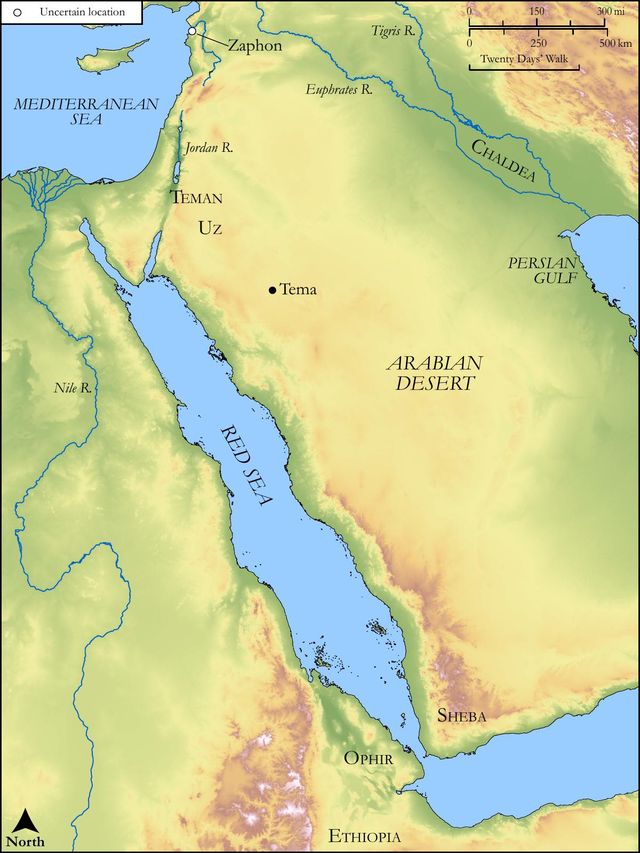
See on the biblical-era map
Study this verse
Public-domain commentary
Matthew Henry
From his Commentary on the Whole Bible. Henry comments on passages, not single verses — this entry covers Job 21:27–34. His two-level outline is real structure in the source text, so it is rendered as structure.
In these verses,
I.Job opposes the opinion of his friends, which he saw they still adhered to, that the wicked are sure to fall into such visible and remarkable ruin as Job had now fallen into, and none but the wicked, upon which principle they condemned Job as a wicked man. "I know your thoughts," says Job (Job 21:27); "I know you will not agree with me; for your judgments are tinctured and biassed by your piques and prejudices against me, and the devices which you wrongfully imagine against my comfort and honour: and how can such men be convinced?" Job's friends were ready to say, in answer to his discourse concerning the prosperity of the wicked, "Where is the house of the prince? Job 21:28. Where is Job's house, or the house of his eldest son, in which his children were feasting? Enquire into the circumstances of Job's house and family, and then ask, Where are the dwelling-places of the wicked? and compare them together, and you will soon see that Job's house is in the same predicament with the houses of tyrants and oppressors, and may therefore conclude that doubtless he was such a one."
II.He lays down his own judgment to the contrary, and, for proof of it, appeals to the sentiments and observations of all mankind.
So confident is he that he is in the right that he is willing to refer the cause to the next man that comes by (Job 21:29): "Have you not asked those that go by the way - any indifferent person, any that will answer you? I say not, as Eliphaz (Job 5:1), to which of the saints, but to which of the children of men will you turn? Turn to which you will, and you will find them all of my mind, that the punishment of sinners is designed more for the other world than for this, according to the prophecy of Enoch, the seventh from Adam, Jde 1:14. Do you not know the tokens of this truth, which all that have made any observations upon the providences of God concerning mankind in this world can furnish you with?" Now,
1.What is it that Job here asserts? Two things: - (1.) That impenitent sinners will certainly be punished in the other world, and, usually, their punishment is put off until then. (2.) That therefore we are not to think it strange if they prosper greatly in this world and fall under no visible token of God's wrath. Therefore they are spared now, because they are to be punished then; therefore the workers of iniquity flourish, that they may be destroyed for ever, Psa 92:7. The sinner is here supposed, [1.] To live in a great deal of power, so as to be not only the terror of the mighty in the land of the living (Eze 32:27), but the terror of the wise and good too, whom he keeps in such awe that none dares declare his way to his face, Job 21:31. None will take the liberty to reprove him, to tell him of the wickedness of his way, and what will be in the end thereof; so that he sins securely, and is not made to know either shame or fear. The prosperity of fools destroys them, by setting them (in their own conceit) above reproofs, by which they might be brought to that repentance which alone will prevent their ruin. Those are marked for destruction that are let alone in sin, Hos 4:17. And, if none dares declare his way to his face, much less dare any repay him what he has done and make him refund what he has obtained by injustice. He is one of those great flies which break through the cobwebs of the law, that hold only the little ones. This emboldens sinners in their sinful ways that they can brow-beat justice and make it afraid to meddle with them. But there is a day coming when those shall be told of their faults who now would not bear to hear of them, those shall have their sins set in order before them, and their way declared to their face, to their everlasting confusion, who would not have it done here, to their conviction, and those who would not repay the wrongs they had done shall have them repaid to them. [2.] To die, and be buried in a great deal of pomp and magnificence, Job 21:32, Job 21:33. There is no remedy; he must die; that is the lot of all men; but every thing you can think of shall be done to take off the reproach of death. First, He shall have a splendid funeral - a poor thing for any man to be proud of the prospect of; yet with some it passes for a mighty thing. Well, he shall be brought to the grave in state, surrounded with all the honours of the heralds' office and all the respect his friends can then pay to his remains. The rich man died, and was buried, but no mention is made of the poor man's burial, Luk 16:22. Secondly, He shall have a stately monument erected over him. He shall remain in the tomb with a Hic jacet - Here lies, over him, and a large encomium. Perhaps it is meant of the embalming of his body to preserve it, which was a piece of honour anciently done by the Egyptians to their great men. He shall watch in the tomb (so the word is), shall abide solitary and quiet there, as a watchman in his tower. Thirdly, The clods of the valley shall be sweet to him; there shall be as much done as can be with rich odours to take off the noisomeness of the grave, as by lamps to set aside the darkness of it, which perhaps was referred to in the foregoing phrase of watching in the tomb. But it is all a jest; what is the light, or what the perfume, to a man that is dead? Fourthly, It shall be alleged, for the lessening of the disgrace of death, that it is the common lot: He has only yielded to fate, and every man shall draw after him, as there are innumerable before him. Note, Death is the way of all the earth: when we are to cross that darksome valley we must consider, 1. That there are innumerable before us; it is a tracked road, which may help to take off the terror of it. To die is ire ad plures - to go to the great majority. 2. That every man shall draw after us. As there is a plain track before, so there is a long train behind; we are neither the first nor the last that pass through that dark entry. Every one must go in his own order, the order appointed of God.
2.From all this Job infers the impertinency of their discourses, Job 21:34. (1.) Their foundation is rotten, and they went upon a wrong hypothesis: "In your answers there remains falsehood; what you have said stands not only unproved but disproved, and lies under such an imputation of falsehood as you cannot clear it from." (2.) Their building was therefore weak and tottering: "You comfort me in vain. All you have said gives me no relief; you tell me that I shall prosper again if I turn to God, but you go upon this presumption, that piety shall certainly be crowned with prosperity, which is false; and therefore how can your inference from it yield me any comfort?" Note, Where there is not truth there is little comfort to be expected.
Historical interpretation
Historical reception
2 surviving comments on this verse. Each one is dated, so this reads as a timeline rather than a list.
The weak desire to thrive in this world’s fortune. They dread scourges as evils of great magnitude. In the case of those they see smitten, they measure the offence by the punishment. For those they see struck with the rod, they suppose them to have displeased God. Hence blessed Job’s friends were persuaded that he, whom they beheld under the rod, had been ungodly, that is, as reckoning that if he had not been ungodly, his “dwelling places would have remained.” But no one thinks so except he who still travails with the weariness of infirmity, who firmly sets the footstep of his thoughts in the gratification of the present life, who is not taught to pass on with perfect desires to the eternal land. Hence, it is well added, “Ask every one of them that go by the way. You will know that he understands this same, because the wicked is reserved to the day of destruction, and he is brought to the day of wrath.” Often the patience of God long suffers with those whom it already condemns to a foreknown punishment. It suffers those to go on thriving whom it sees still committing worse things. One who sees the pit of condemnation to which they are going is viewed as nothing to them. The wicked multiply here things that must be abandoned. But one who is wedded to the glory of the present life counts it great happiness to thrive here according to his wishes, though hereafter he is driven to undergo eternal punishment. Therefore, that person only sees it as nothing for the wicked to thrive, who has already removed his heart from the love of the present world. Hence, in speaking of the future condemnation of the wicked, it is rightly premised, “Ask every one of them that go by the way, and you will know that he understands this.” For he is called a “wayfarer,” who minds that the present life is to him only a way and not a native land, who thinks it beneath him to fix his heart on the love of this passing state of being, who longs not to continue in a transitory scene of things but to reach the eternal world.
68. For often the patience of God bears for long with those, whom it already condemns to punishments foreknown; it suffers those to go on thriving, whom it sees still committing worse things. For whereas He sees to what pit of condemnation they are going on, He esteems to be as nothing to them, that the wicked multiply here things which must be abandoned. But he that is wedded to the glory of the present life, counts it great happiness to thrive here according to his wish, though he be driven hereafter to undergo eternal punishment. Therefore that man only sees it to be nothing for the wicked man to thrive, who has already removed the step of his heart from the love of the present world. Hence, in speaking of the after condemnation of the wicked man, it is rightly premised, Ask anyone of the wayfarers, and ye shall "now that he understandeth these same things. For he is called a ‘wayfarer,’ who minds that the present life is to him a way and not a native land, who thinks it beneath him to fix his heart on the love of this passing state of being, who longs, not to continue in a transitory scene of things, but to reach the eternal world. For he that does not aim to be a wayfarer in this world, is far from setting at nought this world’s good fortune, and when he sees those things which he himself covets abounding to others, he wonders. Hence the Prophet David, as he had already passed in heart from the love of the present world, in describing the glory of the wicked man, said; I have seen the wicked in great power, and spreading like a green bay tree. [Ps. 37, 35. 36.] But because he did not submit his heart to this world, he justly looked down upon him, saying; I passed on, but, lo, he was not. For the wicked man would have been something in his esteem, if he had not himself passed on in the bent of his mind from this present scene. But this man, who [Oxf. Mss. read ‘qui’] to one not ‘passing by’ would have been something great, to one ‘passing by’ in mind, how little he was, was shewn; in that whilst everlasting retribution is thought on, it is seen how little present glory is. Hence Moses, when he was seeking the glory of heavenly contemplation, said, I will now pass on, and see this great sight. [Ex. 3, 3] For except he had withdrawn the footstep of the heart from the love of the world, he would never have been able to understand things above. Hence Jeremiah entreating for the sorrow of his heart to be taken thought on, saith, All ye that pass by, Behold and see if there be any sorrow like unto my sorrow! [Lam. 1, 12] For they who do not pass through the present life like a way, but think on it as their country, are unskilled to take in with the mind’s eye the sorrow of heart of the Elect. These persons therefore the Prophet looks out, that they may view his sorrow, whose it was not to have set fast their mind in this world. Hence it is said by Solomon, Open thy mouth for the dumb, and in the cause of all such as are passing by. For those are called ‘the dumb,’ who never set themselves against the Preacher’s words by gainsaying them; who are also persons ‘passing by,’ in that they disdain to fix the bent of their mind in the love of the present life. Therefore that the bad man is being ‘reserved for the day of perdition,’ and ‘brought to the day of fury,’ this thing there is none but he who is ‘a wayfarer’ that understandeth, in that he that has set his heart in the present scene of things does not find out the punishments that follow the wicked man.
Continue studying Job 21:29 across the web’s major study libraries — every link below opens this exact verse, chapter, or book on the destination site.
Read & Compare
 BibleGatewayThis verse in more than 200 translations and 70 languages.
 Bible.comThe YouVersion reader — hundreds of translations, reading plans, and highlights.
 ESV.orgCrossway's official English Standard Version reader.
 NET BibleThe NET translation with 60,000+ translators' notes on every rendering decision.
 STEP BibleTyndale House's free study tool — original text, vocabulary, and scholarly resources.
 BibliaLogos Bible Software's free web reader.
 USCCBThe New American Bible (Revised Edition) with the U.S. bishops' study notes.
Commentaries
 BibleHub CommentariesDozens of classic commentaries on this verse, gathered on one page.
 StudyLightMore than 100 commentary sets — the largest collection on the web.
 BibleRefPlain-English commentary on what this verse means, verse by verse.
 Enduring WordDavid Guzik's free commentary on this chapter, widely used by Bible teachers.
 Bible Study ToolsVerse commentary alongside Greek and Hebrew study aids.
Original Language & Research
- BibleHub InterlinearThe verse word by word — original language, transliteration, and English.
- BibleHub LexiconEvery word's original-language definition and Strong's entry.
 Blue Letter BibleDeep-study tools — Strong's numbers, concordance, and word studies.
 SefariaThe Hebrew text with Rashi and centuries of Jewish commentary.
Sermons, Hymns & Audio


TrulyRandomVerse is not affiliated with these sites and doesn’t control their content. They’re linked because they’re genuinely useful.
Summary
Job 21:29 encapsulates Job's impassioned appeal to empirical observation and common human experience, directly challenging his friends' rigid retribution theology. He urges them to consult those with extensive life experience, implying that their collective observations would confirm the perplexing reality that the wicked often prosper and escape immediate earthly judgment. This verse serves as a powerful rhetorical question, designed to expose the inadequacy of his friends' simplistic cause-and-effect framework for understanding divine justice in the face of observable truth.
Context
ShowHideLiterary Context
Job 21 is Job's final and most forceful response to the third cycle of speeches from his friends, specifically countering Zophar's last assertion in Job 20 that the wicked are invariably and swiftly punished. Throughout Job 21, Job systematically dismantles this conventional wisdom by presenting a stark counter-narrative: the wicked often live long, prosperous lives, die peacefully, and leave a flourishing legacy for their descendants, seemingly untouched by divine wrath. This verse, therefore, acts as a rhetorical climax, where Job challenges his interlocutors to move beyond their inherited dogmas and acknowledge the undeniable empirical evidence that contradicts their theological framework. It marks a critical shift in Job's argument, from defending his personal innocence to directly refuting the very foundation of his friends' understanding of God's governance based on the observable realities of the world.
Historical & Cultural Context
The ancient Near East was largely dominated by a pervasive belief in immediate divine retribution, often termed "retribution theology." This deeply ingrained doctrine posited a direct correlation between one's moral conduct and one's earthly circumstances: righteousness brought prosperity and blessings, while wickedness inevitably led to suffering and calamity, typically within one's lifetime. This belief system provided a seemingly logical explanation for the vagaries of human experience and affirmed the justice of the gods. Job's friends—Eliphaz, Bildad, and Zophar—are staunch adherents to this prevailing worldview. Job 21:29 radically challenges this deeply held cultural and theological assumption by appealing to the common observations of "them that go by the way"—a phrase referring to travelers, merchants, or simply experienced individuals whose extensive journeys would expose them to the diverse and often contradictory realities of life, including the perplexing prosperity of the wicked. This appeal to empirical evidence over unquestioned traditional wisdom was a profoundly subversive act in that cultural milieu.
Key Themes
ShowHideThis verse powerfully contributes to several overarching themes that permeate the book of Job. Foremost, it highlights the profound mystery of divine justice, demonstrating that God's ways are often inscrutable to human understanding and do not always conform to predictable patterns of immediate reward or punishment. It directly confronts the prevailing retribution theology, exposing its inadequacy in explaining the complexities of human suffering and prosperity; Job forces his friends to acknowledge the uncomfortable truth that the wicked often flourish, a theme also wrestled with by the psalmist in Psalm 73. Furthermore, the verse underscores the theme of human observation versus dogmatic tradition, as Job urges his friends to rely on what they can plainly see in the world rather than clinging to unexamined, inherited theological assumptions. This challenge to conventional wisdom and the call for a deeper, more nuanced understanding of God's governance are central to Job's profound struggle.
Exposition and Analysis
ShowHideKey Word Analysis
ShowHideDerived from H7592, this verb means "to inquire," "to request," or "to demand." In this context, Job is not merely suggesting a casual inquiry but a serious, almost challenging consultation. He implies that if his friends were truly to "ask" those with broad experience, they would receive a consistent and undeniable answer that contradicts their rigid theological framework. The verb carries the weight of seeking authoritative information or counsel.
This word signifies a "signal," "mark," "sign," "proof," or "evidence." It can also refer to an omen or a miracle. Here, Job uses ʼôwth to refer to the undeniable, empirical facts and observable realities that travelers or experienced individuals would have gathered concerning the actual state of affairs in the world. It emphasizes the tangible, verifiable data that stands in stark contrast to the friends' abstract and unproven theological assertions about immediate divine retribution.
Verse Breakdown
ShowHide"Have ye not asked them that go by the way?"
This is a powerful rhetorical question, a direct challenge to Job's friends. "Them that go by the way" refers to travelers, merchants, or any individuals whose extensive journeys and experiences have exposed them to a broad spectrum of life's realities beyond their immediate, perhaps insular, community. Job implies that these individuals, having seen much of the world, would readily confirm his observation that the wicked often prosper, directly contradicting the friends' simplistic theology of immediate retribution. It is an appeal to the collective wisdom of empirical evidence over theoretical dogma.
"and do ye not know their tokens,"
This clause continues the rhetorical challenge, building upon the previous one. "Their tokens" refers to the signs, proofs, or undeniable evidence that these experienced travelers would possess. Job suggests that the observations of these individuals would provide readily available and widely known empirical facts—observable realities—that the wicked frequently escape immediate earthly retribution. This emphasizes the self-evident nature of the evidence that contradicts the friends' rigid and unyielding view of divine justice.
Literary Devices
ShowHideJob 21:29 masterfully employs several potent literary devices to convey Job's exasperation and the strength of his argument. The most prominent is Rhetorical Question, as Job poses two questions not for literal answers, but to provoke deep thought and highlight the obviousness of his point, implying his friends' willful ignorance. This technique creates a sense of challenge and frustration. There is also a strong Appeal to Common Experience (a form of Appeal to Authority), as Job invokes "them that go by the way," suggesting that their collective observations constitute a form of undeniable wisdom or evidence that should compel his friends to reconsider. This stands in stark contrast to the friends' reliance on inherited, unexamined tradition. Furthermore, an element of Irony is present: Job, the one suffering unjustly, is the one urging his supposedly wise friends to open their eyes to a reality that directly contradicts their theological certainties. The "tokens" themselves function as Empirical Evidence or Proof, underscoring the factual and observable nature of Job's argument against the friends' abstract theological framework.
Theological and Thematic Connections
ShowHideJob 21:29 profoundly challenges the simplistic understanding of divine justice prevalent in ancient Israel and, indeed, in many theological frameworks today. It forces the reader to grapple with the perplexing reality that God's justice is not always immediate or visibly dispensed in this life, particularly concerning the wicked. This verse emphasizes that God's ways are higher and more complex than human expectations, demanding a faith that trusts in ultimate justice even when present circumstances seem to contradict it. It highlights the inherent tension between observable reality and theological dogma, urging a more nuanced and humble approach to understanding God's governance of the world. The prosperity of the wicked is a recurring biblical problem that tests the faith of the righteous and prompts deeper theological reflection on the nature of God's timing, His sovereignty, and the full scope of His redemptive and judicial plan.
Reflection and Application
ShowHideJob 21:29 serves as a powerful and enduring reminder for believers to approach theological understanding with profound humility and a courageous willingness to confront uncomfortable truths. It cautions against the dangers of rigid, formulaic doctrines that fail to account for the intricate complexities of life and the mysterious, often inscrutable, ways of God. We are encouraged to observe the world around us critically, acknowledging that not all suffering is a direct consequence of personal sin, nor is all prosperity an immediate sign of divine favor. This verse challenges us to move beyond simplistic cause-and-effect thinking and to embrace the deeper, often hidden, dimensions of God's justice and sovereignty. Ultimately, it calls us to cultivate a steadfast trust in God's ultimate righteousness, even when immediate circumstances seem to contradict our expectations, and to find comfort in the knowledge that His justice, though sometimes delayed from our limited human perspective, is always certain, perfect, and will be fully revealed in His timing. It also fosters empathy for those who suffer unjustly, affirming that their plight is real and not necessarily a mark of divine displeasure.
Questions for Reflection
ShowHideFAQ
ShowHideDoes Job 21:29 suggest that God is unjust or uncaring about evil?
ShowHideNo, Job 21:29 does not suggest that God is unjust or uncaring about evil. Instead, it highlights Job's profound struggle with the timing and visible manifestation of God's justice in this present life. Job is not questioning God's ultimate righteousness or His eventual judgment of the wicked, but rather the simplistic notion that divine retribution is always immediate and empirically observable. The verse underscores the mystery of God's ways, implying that His justice operates on a different timetable and according to a wisdom far beyond human comprehension. The book of Job ultimately affirms God's sovereignty and perfect justice, even if His methods do not always align with human expectations, as powerfully revealed in God's direct addresses to Job in Job 38 through Job 41.
Who are "them that go by the way" and why are their "tokens" important?
ShowHide"Them that go by the way" refers to travelers, merchants, or simply individuals who possess extensive life experience and have observed the world beyond their immediate, localized community. Their "tokens" are the signs, proofs, or empirical evidence they have gathered from their widespread observations. Job appeals to their collective experience because they would have witnessed the real-world phenomenon of the wicked often prospering and escaping immediate earthly punishment, which directly contradicts the rigid retribution theology held by Job's friends. Their observations serve as a form of common wisdom or undeniable fact that Job uses to challenge the friends' dogmatic, unexamined assumptions about how God operates in the world.
How does Job 21:29 relate to the broader biblical theme of the prosperity of the wicked?
ShowHideJob 21:29 is a pivotal verse in the Bible's exploration of the "prosperity of the wicked," a challenging theme that often tests the faith of the righteous and prompts deep theological reflection. It directly confronts the idea that God's justice is always immediately visible in earthly rewards and punishments. This perplexing problem is also wrestled with in other significant biblical texts, such as Psalm 73, where the psalmist confesses his envy of the wicked until he gains a divine perspective on their ultimate, inevitable end. Similarly, Jeremiah 12:1 poses a direct question to God about this very issue. The consistent biblical answer is not that God is unjust, but that His justice is ultimate, comprehensive, and will be fully realized, often in the eschatological future, rather than always in the present life.
Christ-Centered Fulfillment
ShowHideWhile Job 21:29 highlights the perplexing reality of the wicked prospering in this life, it implicitly points forward to the ultimate and perfect justice revealed in the person and work of Jesus Christ. Job's profound struggle with the apparent delay of divine retribution finds its ultimate resolution in the New Testament's comprehensive revelation of God's full redemptive and judicial plan. The "tokens" or empirical evidence that Job seeks concerning the true nature of divine justice are ultimately provided in the person and work of Jesus Christ. He is the Lamb of God who takes away the sin of the world, bearing the ultimate penalty for wickedness on the cross, thereby demonstrating God's perfect justice and boundless mercy simultaneously. The prosperity of the wicked, which so troubled Job, is unequivocally temporary; the New Testament assures us of a coming day of final judgment where every knee will bow and every tongue confess that Jesus Christ is Lord, and everyone will give an account of themselves to God. Thus, the apparent injustice Job observes is not a flaw in God's character but a temporary reality within a larger divine narrative that culminates in Christ's final triumph over evil and the establishment of His eternal kingdom, where righteousness dwells. Job's wrestling with this profound theological problem prepares the way for a deeper appreciation of the cross as the ultimate demonstration of God's justice and the resurrection as the unshakeable guarantee of future judgment and eternal righteousness.