


Job 8:22
- שֹׂנְאֶיךָso·ne·'Ei·kha[those who] hate youH8130V-Qal-Prtcpl-mp ¦ 2msVerb Qal Participle Plural Masculine Constructשֹׂנְאֶי[those who] hateךָyou
- יִלְבְּשׁוּyil·be·shuthey will be clothedH3847V-Qal-Imperf-3mpVerb Qal Imperfect 3rd Plural Masculine
- בֹשֶׁתVo·shetshameH1322N-fsNoun Singular Feminine Absolute
- וְאֹהֶלve·'O·heland [the] tent ofH168Conj-w ¦ N-mscNoun Singular Masculine Constructוְandאֹהֶל[the] tent of
- רְשָׁעִיםre·sha·'Imwicked [people]H7563N-mpNoun Plural Masculine Absolute
- אֵינֶנּוּ'ei·Ne·nuthere not [will be] itH369N-msc ¦ 3msNoun Singular Masculine Constructאֵינֶthere not [will be]נּוּit
English is a literal word-by-word gloss of the Hebrew, not the KJV's wording. Why?
This is the original text the KJV's translators worked from — each Hebrew word with its own literal English meaning in this verse, prepared by scholars at Tyndale House, Cambridge. The KJV translates whole sentences, not word by word, so its wording differs: one Hebrew word can become several English words, and the KJV may choose “the LORD” where the gloss reads “Yahweh”. Both are faithful — they answer different questions. For the KJV's own rendering, switch to the KJV text.
Details
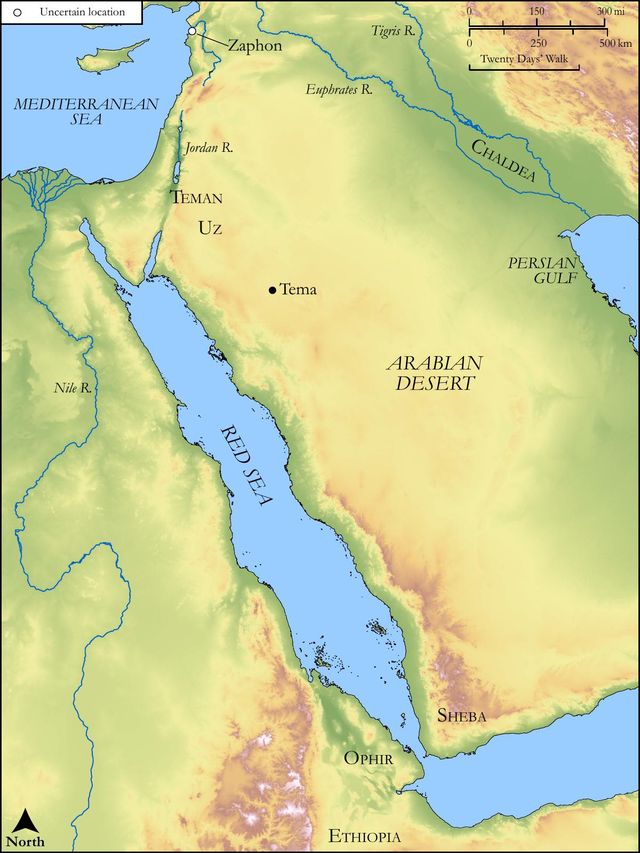
See on the biblical-era map
Study this verse
Public-domain commentary
Matthew Henry
From his Commentary on the Whole Bible. Henry comments on passages, not single verses — this entry covers Job 8:20–22.
Bildad here, in the close of his discourse, sums up what he has to say in a few words, setting before Job life and death, the blessing and the curse, assuring him that as he was so he should fare, and therefore they might conclude that as he fared so he was. 1. On the one hand, if he were a perfect upright man, God would not cast him away, Job 8:20. Though now he seemed forsaken of God, he would yet return to him, and by degrees would turn his mourning into dancing (Psa 30:11) and comforts should flow in upon him so plentifully that his mouth should be filled with laughing, Job 8:21. So affecting should the happy change be, Psa 126:2. Those that loved him would rejoice with him; but those that hated him, and had triumphed in his fall, would be ashamed of their insolence, when they should see him restored to his former prosperity. Now it is true that God will not cast away an upright man; he may be cast down for a time, but he shall not be cast away for ever. It is true that, if not in this world, yet in another, the mouth of the righteous shall be filled with rejoicing. Though their sun should set under a cloud, yet it shall rise again clear, never more to be clouded; though they go mourning to the grave, that shall not hinder their entrance into the joy of their Lord. It is true that the enemies of the saints will be clothed with shame when they see them crowned with honour. But it does not therefore follow that, if Job were not perfectly restore to his former prosperity, he would forfeit the character of a perfect man. 2. On the other hand, if he were a wicked man and an evil-doer, God would not help him, but leave him to perish in his present distresses (Job 8:20), and his dwelling-place should come to nought, (Job 8:22). And here also it is true that God will not help the evil-doers; they throw themselves out of his protection, and forfeit his favour. He will not take the ungodly by the hand (so it is in the margin), will not have fellowship and communion with them; for what communion can there be between light and darkness? He will not lend them his hand to pull them out of the miseries, the eternal miseries, into which they have plunged themselves; they will then stretch out their hand to him for help, but it will be too late: he will not take them by the hand. Between us and you there is a great gulf fixed. It is true that the dwelling-place of the wicked, sooner or later, will come to nought. Those only who make God their dwelling-place are safe for ever, Psa 90:1; Psa 91:1. Those who make other things their refuge will be disappointed. Sin brings ruin on persons and families. Yet to argue (as Bildad, I doubt, slyly does) that because Job's family was sunk, and he himself at present seemed helpless, therefore he certainly was an ungodly wicked man, was neither just nor charitable, as long as there appeared no other evidence of his wickedness and ungodliness. Let us judge nothing before the time, but wait till the secrets of all hearts shall be made manifest, and the present difficulties of Providence be solved to universal and everlasting satisfaction, when the mystery of God shall be finished.
Historical interpretation
Historical reception
2 surviving comments on this verse. Each one is dated, so this reads as a timeline rather than a list.
90. ‘Confusion clothes’ the enemies of the good in the final Judgment; for when they see before the eyes of their mind their past misdeeds running over in excess to them, their own guilt clothes them on every side, weighing them down. For they then bear the memory of their doings in punishment, who now, as though strangers to the faculty of reason, sin with hearts full of joy. There they see how greatly they should have eschewed all that they loved. There they see how woful that was, which they now hug themselves for in their sin. Then guilt spreads a cloud over the mind, and conscience pierces itself with the darts of its remembrances. Who then can adequately estimate how exceeding great will be the confusion of the wicked Then, when both the Judge Eternal is discerned without, and sin is set in review before the eyes within? who are on this account brought to such a pass, because they loved transient things alone. And hence it is rightly added upon that;
And the tents of the wicked shall not abide.
91. For a tent is put together that the body may be preserved from heat and cold. What then is here set forth by the name of a dwelling-place, save the building of earthly prosperity, whereby the wicked are multiplying above their heads things to fall, that they may shelter themselves from the exigencies of the present life as from heat and rain. Thus they go about to rise in honours, lest they should appear contemptible. They pile up the good things of earth, and heap them high, lest they ever come to pine with the cold of want. They scorn to take thought of what is to come, and busy themselves with all their heart, that nought may be lacking in the present scene of things. They aim to spread their name, that they may not live unknown, and if every thing is forthcoming to their hearts’ content, they regard themselves as proof in all things, and blessed in their condition. Thus in the place where they rear a dwelling-place of the interior, there surely they have their tents fixed. They bear crosses with impatience, they rejoice in prosperity without restraint. They mind alone the things that are before them, nor do they draw their breath by the yearning after their heavenly home in the remembrance thereof. They are glad that the good things are theirs, which their heart is bent on having; and there, where they rest in the body, they bury the soul too, making it a thing extinct, in that being slain with the instrument of worldly solicitude, that pile of earthly things, which they heap together hunting for them without, they are always carrying on them within in thought.
92. But contrariwise the good neither take the blessings offered them here below as any thing great, nor very much dread the ills brought upon them. But both whilst they use present advantages, they forecast inconveniences to come, and when they lament for present evils, they are comforted in the love of the good things to follow. And they are cheered by temporal support, just as a wayfarer enjoys a bed in a stable; he stops and hurries to be off; he rests still in the body, but is going forward to something else in imagination. But sometimes they even long to meet with afflictions, they shrink from finding all go well in transient things, lest by the delightfulness of the journey, they be hindered in arriving at their home; lest they arrest the step of the heart on the pathway of their pilgrimage, and one day come in view of the heavenly land without a recompense. They delight to be little accounted of, nor do they grieve to be in affliction and necessity. Thus they that never fortify themselves against the adversities of the present time, as it were will not have a tent against the heat and rain. And hence Peter is justly rebuked, because when he was not yet confirmed in perfectness of heart, upon the brightness of ‘Truth’ being made known, he goes about to set up a tent upon earth. [Matt. 17, 4] And thus the righteous are indifferent to build themselves up here below, where they know themselves to be but pilgrims and strangers. For because they desire to have joy in their own, they refuse to be happy in what belongs to another. But the unrighteous, the further they are removed from the inheritance of the eternal Country, fix the foundations of the heart so much the deeper in the earth. It is hence that in the very beginning of man's creation Enoch is born seventh in the elect family. It is hence that Cain calls his firstborn son Enoch, and names the city that he built after him. [Gen. 4, 17] For ‘Enoch’ is rendered ‘Dedication.’ And so the wicked dedicate themselves in the beginning. For in this life, which is first, they plant the root of the heart, that they may flourish here to their content, and wither root and branch to the Country that follows after. But to the righteous, Enoch is born the seventh, in that the festal dedication of their lives is kept for the end. It is hence, as Paul testifies, Abraham dwells in tents [so Vulg.], for he looked for a city which hath foundations, whose builder and maker is God. [Heb. 11, 9] It is hence that Jacob goes humbly [Vulg. like E.V. paullatim] following the flocks of sheep, and Esau coming to meet him lords it with a throng of numerous attendants, in that here both the Elect are without pride, and the lost swell with satisfaction in the good things of the flesh. Hence the Lord saith to Israel, If thou shalt choose one from the people of the land and set him for a king over thee, he shall not multiply horses and horsemen to himself. [Deut. 17, 15. 16.] And yet the first king ‘chosen from among his brethren,’ so soon as he had attained the height of power, chose for himself three thousand horsemen; he immediately launched into pride, burst forth in the building up of the height he had attained, in that without he could not keep under on a level of equality all that made his spirit within rise high above the level of others. That rich man had as it were erected for himself a fenced dwelling place, who said, Soul, thou hast much goods laid up for many years: take thine ease, eat, drink, and be merry. [Luke 12, 19] But because that dwelling is not bottomed upon the foundation of Truth, he heard at the same moment, Thou fool, this night thy soul shall be required of thee: then whose shall these things be, which thou hast prepared? [ver. 20] Therefore it is well said, And the dwelling-place of the wicked shall come to nought. In that the lovers of this fleeting life, whilst they diligently build themselves up in present things, are suddenly hurried into eternity.
Therefore, when all the elect are replenished with the delight of clear vision, they internally spring forth into the joy of laughter. We call it shouting when we conceive such joy in the heart as we cannot express through the force of words. Yet the heart’s triumph expresses itself with a voice that external words cannot express. Now the mouth is correctly said to be filled with laughter, the lips with shouting, since in that eternal land, when the mind of the righteous is borne away in transport, the tongue is lifted up in the song of praise. And they, because they see so many inexpressible things, shout in laughter, for without understanding it, they resound with all the love that they feel.… “Confusion clothes” the enemies of the good in the final judgment, for when they see in the mind’s eye their past misdeeds flooding their banks, their own guilt covers them on every side, weighing them down. For they then bear the memory of their actions in punishment, who now, as though strangers to the faculty of reason, sin with hearts full of joy. There they see how greatly they should have eschewed all that they loved. There they see how woeful that was which they now embrace in their sin.
Continue studying Job 8:22 across the web’s major study libraries — every link below opens this exact verse, chapter, or book on the destination site.
Read & Compare
 BibleGatewayThis verse in more than 200 translations and 70 languages.
 Bible.comThe YouVersion reader — hundreds of translations, reading plans, and highlights.
 ESV.orgCrossway's official English Standard Version reader.
 NET BibleThe NET translation with 60,000+ translators' notes on every rendering decision.
 STEP BibleTyndale House's free study tool — original text, vocabulary, and scholarly resources.
 BibliaLogos Bible Software's free web reader.
 USCCBThe New American Bible (Revised Edition) with the U.S. bishops' study notes.
Commentaries
 BibleHub CommentariesDozens of classic commentaries on this verse, gathered on one page.
 StudyLightMore than 100 commentary sets — the largest collection on the web.
 BibleRefPlain-English commentary on what this verse means, verse by verse.
 Enduring WordDavid Guzik's free commentary on this chapter, widely used by Bible teachers.
 Bible Study ToolsVerse commentary alongside Greek and Hebrew study aids.
Original Language & Research
- BibleHub InterlinearThe verse word by word — original language, transliteration, and English.
- BibleHub LexiconEvery word's original-language definition and Strong's entry.
 Blue Letter BibleDeep-study tools — Strong's numbers, concordance, and word studies.
 SefariaThe Hebrew text with Rashi and centuries of Jewish commentary.
Sermons, Hymns & Audio


TrulyRandomVerse is not affiliated with these sites and doesn’t control their content. They’re linked because they’re genuinely useful.
Summary
Job 8:22, a declaration from Bildad the Shuhite, articulates a core tenet of ancient retribution theology: those who oppose the righteous will inevitably face profound public humiliation, and all that the wicked establish will ultimately dissolve into nothingness. Within his first discourse to Job, this verse serves as a forceful assertion of divine justice, implying that Job's immense suffering must stem from unconfessed sin, and that only repentance can lead to restoration and escape from such a dire fate.
Context
ShowHideLiterary Context
This verse serves as the concluding and emphatic statement of Bildad's initial speech in the book of Job, specifically Job chapter 8. Following Eliphaz's more subtle accusations, Bildad presents a more rigid and dogmatic defense of traditional wisdom. He begins by questioning Job's integrity, suggesting that God does not pervert justice (Job 8:3). He then posits that Job's children must have sinned to have perished (Job 8:4), and conversely, if Job himself is pure and seeks God, he will be restored to prosperity and joy (Job 8:5-7). Bildad's entire argument is predicated on the belief that suffering is a direct, predictable consequence of sin, and therefore, Job's affliction is undeniable proof of his guilt. Verse 22 acts as the culmination of this argument, providing a stark, universal principle of the fate awaiting those who are wicked or who set themselves against the righteous.
Historical & Cultural Context
Bildad's theological framework is deeply embedded in the ancient Near Eastern concept of retribution, a prevalent worldview where divine justice was understood to operate in a straightforward, immediate, and observable manner. In this cultural paradigm, material prosperity, health, and social standing were widely interpreted as clear indicators of divine favor and righteousness, while suffering, illness, or misfortune were almost invariably seen as direct punishments for sin or moral transgression. This perspective, while containing a foundational truth about God's justice, often failed to account for the complexities of human experience, the role of testing, or the suffering of the innocent. It fostered a legalistic approach to faith, where adherence to external laws was believed to guarantee blessings, and any deviation resulted in curses. Bildad, like Job's other companions, struggles to reconcile Job's apparent righteousness with his profound suffering, leading them to misapply this retribution principle dogmatically, unable to conceive of an innocent sufferer.
Key Themes
ShowHideJob 8:22 powerfully contributes to several overarching themes within the book of Job. The most prominent is Divine Retribution, which forms the bedrock of the friends' arguments; they firmly believe God's justice is always immediate and visible, punishing the wicked and rewarding the righteous. This verse specifically highlights Public Shame and Humiliation, as to be "clothed with shame" is a vivid idiom for complete and undeniable disgrace, implying the public exposure and ruin of the wicked's reputation and status. Furthermore, the declaration that "the dwelling place of the wicked shall come to nought" emphasizes The Ephemeral Nature of Wickedness and its achievements. It suggests that all the wicked build—their power, wealth, and legacy—is ultimately transient and destined for utter destruction, contrasting sharply with the enduring stability Bildad promises to the upright if they return to God (Job 8:6). This theme resonates deeply with other wisdom literature, such as the frequent contrasts found in Psalm 37 between the fleeting prosperity of the wicked and the enduring inheritance of the righteous.
Exposition and Analysis
ShowHideKey Word Analysis
ShowHideThis primitive root means "to wrap around, i.e., to put on a garment or clothe (oneself, or another), literally or figuratively." In this context, its use in "clothed with shame" is figurative, emphasizing the complete and inescapable envelopment of the person by shame, making it their defining characteristic and public appearance. It signifies a profound, visible, and inescapable state.
This noun refers to "shame (the feeling and the condition, as well as its cause)." It encompasses both the internal experience of disgrace and its external manifestation, often implying public humiliation and confusion. When one is "clothed" with bôsheth, it means their disgrace is not merely a private feeling but a public, undeniable reality that covers them entirely, stripping them of honor and dignity.
This word signifies "a non-entity; generally used as a negative particle." It conveys the idea of "nothing," "non-existent," or "without." When applied to "the dwelling place of the wicked," it denotes utter annihilation, emptiness, and complete disappearance. It implies that not only will the wicked themselves be destroyed, but everything they have built—their legacy, power, and very existence—will dissolve into nothingness, leaving no trace behind. This term underscores the complete and irreversible destruction of the wicked's influence and achievements.
Verse Breakdown
ShowHide"They that hate thee shall be clothed with shame"
This clause pronounces a severe judgment upon the adversaries of the "thee," which in Bildad's argument refers to the righteous individual, implicitly Job if he were to repent. The powerful imagery of being "clothed with shame" denotes a public, complete, and inescapable humiliation. It suggests that those who harbor animosity or actively oppose the upright will ultimately face a profound reversal of fortune, where their malicious intentions or actions will lead to their own disgrace and public exposure. This is a statement of divine vindication for the righteous and undeniable public disgrace for their enemies.
"and the dwelling place of the wicked shall come to nought"
This second clause describes the ultimate and comprehensive fate of the wicked. "The dwelling place" (Hebrew: ʼôhel) represents more than just a physical house; it encompasses all that the wicked have accumulated—their security, their power, their legacy, their lineage, and their entire sphere of influence and accomplishments. The phrase "shall come to nought" (Hebrew: ʼayin) signifies its utter destruction, disappearance, and non-existence. It means that all the wicked have built will be dismantled, their achievements rendered meaningless, and their very memory erased, emphasizing the transient and ultimately futile nature of a life lived apart from God's righteousness.
Literary Devices
ShowHideJob 8:22 employs several potent literary devices to convey its message with striking force. The most prominent is Metaphor, vividly expressed in the phrase "clothed with shame," which portrays shame not merely as an internal emotion but as an external garment that completely envelops and defines a person. This imagery underscores the public, inescapable, and all-consuming nature of the wicked's disgrace. The verse also utilizes Parallelism, specifically Synthetic Parallelism, where the second line ("and the dwelling place of the wicked shall come to nought") expands upon and intensifies the thought of the first line ("They that hate thee shall be clothed with shame"). While both clauses speak of the wicked's downfall, the second broadens the scope from personal humiliation to the complete annihilation of their legacy and influence. Furthermore, the phrase "shall come to nought" functions as a powerful Hyperbole, emphasizing the absolute and irreversible destruction of the wicked's achievements, suggesting an utter dissolution into non-existence that transcends mere ruin. These devices combine to create a forceful and memorable declaration of divine retribution, characteristic of ancient wisdom literature.
Theological and Thematic Connections
ShowHideWhile Bildad's application of this principle to Job was ultimately flawed and challenged by the narrative's unfolding, the underlying biblical truth concerning God's ultimate justice and the consequences of unrepentant wickedness remains profound. The Bible consistently affirms that evil will not triumph indefinitely and that God will ultimately set all things right, often in ways beyond human comprehension. This verse, therefore, speaks to the assurance that though the wicked may flourish for a time, their prosperity is fleeting, and their ultimate end is destruction and disgrace. For the righteous, it offers a promise of vindication and hope that their adversaries will not prevail, reinforcing the wisdom of living righteously, as the path of wickedness leads to ruin, while the path of the righteous leads to lasting peace and stability rooted in God's eternal character.
Reflection and Application
ShowHideJob 8:22, though spoken from a theological premise that the book itself ultimately refines, compels us to reflect deeply on the nature of divine justice and the ultimate destiny of those who set themselves against God's ways or His people. It challenges us to examine where our trust is placed: in transient earthly achievements and fleeting power, or in the enduring righteousness that comes from God alone. While we must exercise caution against applying a simplistic retribution theology to every instance of suffering, the verse serves as a potent reminder that God is indeed just and that there are eternal consequences for unrepentant wickedness. It encourages us to persevere in righteousness, even when facing adversity or witnessing the apparent, temporary prosperity of the wicked, knowing that God's ultimate judgment will bring about a reversal of fortunes, where all hidden things will be revealed, and true, perfect justice will prevail. It calls us to align our lives with God's character and truth, seeking His approval and eternal kingdom rather than the fleeting accolades or temporary gains of the world, for only what is built on His truth will endure.
Questions for Reflection
ShowHideFAQ
ShowHideWhat is Bildad's main point in Job 8:22, and is it accurate in the broader biblical context?
ShowHideBildad's main point in Job 8:22 is to assert a rigid, predictable system of divine retribution: those who "hate thee" (meaning the righteous) will inevitably be clothed with shame, and the "dwelling place of the wicked" will come to nought. He uses this principle as a foundational argument to suggest that Job's immense suffering must be a direct consequence of his sin, implying that if Job repents and seeks God, he will be restored. While the Bible consistently affirms God's ultimate justice and the eventual downfall of the wicked (e.g., Psalm 37:1-2), Bildad's application of this principle is flawed in Job's specific case. The book of Job ultimately refutes the simplistic notion that all suffering is a direct, linear result of personal sin, demonstrating that God's ways are far more complex, multifaceted, and often beyond human comprehension (Job 40:1-2). Thus, while Bildad's theology contains elements of truth about God's character and justice, his dogmatic and narrow application to Job's unique circumstances proves to be inaccurate and insufficient to explain the mystery of suffering.
Christ-Centered Fulfillment
ShowHideWhile Job 8:22 speaks of the shame and destruction awaiting the wicked, its ultimate and most profound fulfillment is found in the person and redemptive work of Jesus Christ. The "shame" spoken of by Bildad is a powerful foreshadowing of the ultimate disgrace and decisive defeat of sin, death, and the devil through Christ's atoning sacrifice. On the cross, Jesus, the perfectly righteous one, willingly bore the ultimate shame and curse of humanity, becoming sin for us (2 Corinthians 5:21) so that we, through faith, might be clothed with His spotless righteousness. His resurrection then signaled the decisive "coming to nought" of the dwelling place of the wicked—the kingdom of darkness, its power over humanity, and the works of the devil. The cross and resurrection represent the ultimate vindication of God's justice, not merely through a simplistic retribution model, but through a redemptive act that utterly disarmed and triumphed over the spiritual powers of evil (Colossians 2:15). Thus, those who "hate" God and His Anointed One will indeed ultimately be clothed with eternal shame, and their works and kingdoms will come to nought, for Christ has established an eternal, indestructible kingdom that will never be overthrown (Daniel 2:44). In Christ, the promise of the righteous being eternally vindicated and the wicked being utterly shamed is perfectly and eternally realized, not just as a principle, but as a historical, cosmic, and redemptive reality.