


Isaiah 37:21
Bible text: King James Version (1769 Blayney text) · Public domain
Bible text: King James Version with Strong's numbers · Public domain
Bible text: Berean Standard Bible · Public domain
Bible text: American Standard Version (1901) · Public domain
Bible text: World English Bible, Messianic edition · Public domain
Bible text: Geneva Bible (1599) · Public domain
Bible text: Young's Literal Translation · Public domain
- וַיִּשְׁלַחvai·yish·Lachand he sentH7971Conj-w ¦ V-Qal-ConsecImperf-3msVerb Qal Consecutive Imperfect 3rd Singular Masculineוַandיִּשְׁלַחhe sent
- יְשַׁעְיָהוּye·sha'·Ya·huIsaiahH3470N-proper-mNoun Proper Masculine
- בֶןven[the] son ofH1121N-mscNoun Singular Masculine Construct
- אָמוֹץ'a·MotzAmozH531N-proper-mNoun Proper Masculine
- אֶל'eltoH413PrepPreposition
- חִזְקִיָּהוּchiz·ki·Ya·huHezekiahH2396N-proper-mNoun Proper Masculine
- לֵאמֹרle·Mor<to> sayingH559Prep-l ¦ V-Qal-InfVerb Qal Infinitive Constructלֵ<to>אמֹרsaying
- כֹּהkohthusH3541AdvAdverb
- אָמַר'a·Marhe saysH559V-Qal-Perf-3msVerb Qal Perfect 3rd Singular Masculine
- יְהוָהYah·wehYahwehH3068N-properNoun Proper Title
- אֱלֹהֵי'e·lo·Hei[the] God ofH430N-mpcNoun Plural Masculine Construct
- יִשְׂרָאֵלYis·ra·'ElIsraelH3478N-properNoun Proper Location
- אֲשֶׁר'a·SherthatH834RelParticle Relative
- הִתְפַּלַּלְתָּhit·pa·Lal·tayou have prayedH6419V-Hithpael-Perf-2msVerb Hithpael Perfect 2nd Singular Masculine
- אֵלַי'e·Laito meH413Prep ¦ 1csPreposition Definiteאֵלַtoיme
- אֶל'elconcerningH413PrepPreposition
- סַנְחֵרִיבsan·che·RivSennacheribH5576N-proper-mNoun Proper Masculine
- מֶלֶךְMe·lekh[the] king ofH4428N-mscNoun Singular Masculine Construct
- אַשּׁוּר'a·ShurAssyriaH804N-properNoun Proper Location
English is a literal word-by-word gloss of the Hebrew, not the KJV's wording. Why?
This is the original text the KJV's translators worked from — each Hebrew word with its own literal English meaning in this verse, prepared by scholars at Tyndale House, Cambridge. The KJV translates whole sentences, not word by word, so its wording differs: one Hebrew word can become several English words, and the KJV may choose “the LORD” where the gloss reads “Yahweh”. Both are faithful — they answer different questions. For the KJV's own rendering, switch to the KJV text.
Details
See on the biblical-era map
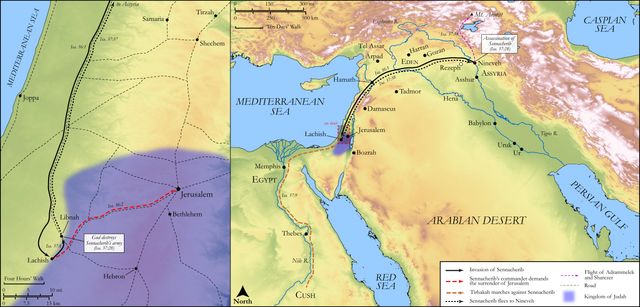
Study this verse
Public-domain commentary
Matthew Henry
From his Commentary on the Whole Bible. Henry comments on passages, not single verses — this entry covers Isaiah 37:21–38.
We may here observe, 1. That those who receive messages of terror from men with patience, and send messages of faith to God by prayer, may expect messages of grace and peace from God for their comfort, even when they are most cast down. Isaiah sent a long answer to Hezekiah's prayer in God's name, sent it in writing (for it was too long to be sent by word of mouth), and sent it by way of return to his prayer, relation being thereunto had: "Whereas thou hast prayed to me, know, for thy comfort, that thy prayer is heard." Isaiah might have referred him to the prophecies he had delivered (particularly that ch. 10) and bid him pick out an answer from thence; but, that he might have abundant consolation, a message is sent him on purpose. The correspondence between earth and heaven is never let fall on God's side. 2. Those who magnify themselves, especially who magnify themselves against God and his people, do really vilify themselves, and made themselves contemptible, in the eyes of all wise men: "The virgin, the daughter of Zion, has despised Sennacherib, and all his impotent malice and menaces; she knows that, while she preserves her integrity, she is sure of the divine protection, and that though the enemy may bark he cannot bite. All his threats are a jest; it is all but brutum fulmen - a mere flash," 3. Those who abuse the people of God affront God himself; and he takes what is said and done against them as said and done against himself: "Whom hast thou reproached? Even the Holy One of Israel, whom thou hast therefore reproached because he is a Holy One." And it aggravated the indignity Sennacherib did to God that he not only reproached him himself, but set his servants on to do the same: By thy servants, the abjects, thou hast reproached me. 4. Those who boast of themselves and their own achievements reflect upon God and his providence: "Thou hast said, I have digged, and drunk water; I have done mighty feats, and will do more; and wilt not own that I have done it," Isa 37:24-26. The most active men are no more than God makes them, and God makes them no more than of old he designed to make them: "What I have formed of ancient times, in an eternal counsel, now have I brought to pass" (for God does all according to the counsel of his will), "that thou shouldst be to lay waste defenced cities; it is therefore intolerable arrogance to make it thy own doing." 5. All the malice, and all the motions and projects, of the church's enemies, are under the cognizance and check of the church's God. Sennacherib was active and quick, here, and there, and every where, but God knew his going out and coming in, and had always an eye upon him, Isa 37:28. And that was not all; he had a hand upon him too, a strict hand, a strong hand, a hook in his nose and a bridle in his lips, with which, though he was very headstrong and unruly, he could and would turn him back by the way which he came, Isa 37:29. Hitherto he shall come and no further. God had signed Sennacherib's commission against Judah (Isa 10:6); here he supersedes it. He has frightened them, but he must not hurt them, and therefore is discharged from going any further; nay, his commitment is here signed, by which he is clapped up, to answer for what he had done beyond his commission. 6. God is his people's bountiful benefactor, as well as their powerful protector, both a sun and a shield to those that trust in him. Jerusalem shall be defended (Isa 37:35), the besiegers shall not come into it, no, nor come before it with any regular attack, but they shall be routed before they begin the siege, Isa 37:33. But this is not all; God will return in mercy to his people, and will do them good. Their land shall be more than ordinarily fruitful, so that their losses shall be abundantly repaired; they shall not feel any of the ill effects either of the enemies' wasting the country or of their own being taken off from husbandry. But the earth, as at first, shall bring forth of itself, and they shall live and live plentifully upon its spontaneous productions. The blessing of the Lord can, when he pleases, make rich without the hand of the diligent. And let them not think that the desolations of their country would excuse them from observing the sabbatical year, which happened (as it should seem) the year after, and when they were not to plough or sow; no, though they had not now their usual stock beforehand for that year, yet they must religiously observe it, and depend upon God to provide for them. God must be trusted in the way of duty. 7. There is no standing before the judgments of God when they come with commission. (1.) The greatest numbers cannot stand before them: one angel shall, in one night, lay a vast army of men dead upon the spot, when God commissions him so to do, Isa 37:36. Here are 185,000 brave soldiers in an instant turned into so many dead corpses. Many think the 76th Psalm was penned upon occasion of this defeat, where from the spoiling of the stout-hearted, and sending them to sleep their long sleep (Isa 37:5), it is inferred that God is more glorious and excellent than the mountains of prey (Isa 37:4), and that he, even he, is to be feared, Isa 37:7. Angels are employed, more than we are aware of, as ministers of God's justice, to punish the pride and break the power of wicked men. (2.) The greatest men cannot stand before them: The great king, the king of Assyria, looks very little when he is forced to return, not only with shame, because he cannot accomplish what he had projected with so much assurance, but with terror and fear, lest the angel that had destroyed his army should destroy him; yet he is made to look less when his own sons, who should have guarded him, sacrificed him to his idol, whose protection he sought, Isa 37:37, Isa 37:38. God can quickly stop their breath who breathe out threatenings and slaughter against his people, and will do it when they have filled up the measure of their iniquity; and the Lord is known by these judgments which he executes, known to be a God that resists the proud. Many prophecies were fulfilled in this providence, which should encourage us, as far as they look further, and are designed as common and general assurances of the safety of the church and of all that trust in God, to depend upon God for the accomplishment of them. He that has delivered does and will deliver. Lord, forgive our enemies; but, so let all thy enemies perish, O Lord!
Historical interpretation
Historical reception
2 surviving comments on this verse. Each one is dated, so this reads as a timeline rather than a list.
(v. 21 seqq.) However, Isaiah (also known as Josiah), the son of Amos, sent to Hezekiah saying: Thus says the Lord God of Israel: concerning what you asked me about Sennacherib, the king of Assyria, this is the word that the Lord spoke about him: He has despised you and mocked you, O virgin daughter of Zion. After you, the daughter of Jerusalem has shaken her head. Whom did you reproach and blaspheme? Against whom did you raise your voice and lift your eyes in pride, to the Holy One of Israel? You reproached the Lord in the hand of your servants and said: In the multitude of my chariots I have ascended (Al. I will ascend) the height of the mountains, the peaks of Lebanon, and I will cut down its lofty cedars, and its chosen fir trees, and I will enter the height of its summit, the Carmel of its cliff. I dug and drank water, and I dried up with the sole of my foot all the rivers of the banks. Because Hezekiah prayed to the Lord so boldly, and did not send to Isaiah, as he had sent before, the Prophet himself does not go to him, but sends messengers to him, who would say to him in the words of God: concerning Sennacherib, against whom you pray, this is the Lord's sentence: The virgin of Zion and the daughter of Jerusalem (who is called virgin and daughter because, while all the nations worship the idols of dead men, she alone preserves the purity of the religion of God and the worship of the one divinity) has derided you and despised you; and in order not to incite greater blasphemy against you, she did not respond immediately, but after you departed, she moved her head, certain of vengeance and secure in punishment. And she spoke these words: You have not sinned against me, but against the Lord; and it is not for your own sake, but for the sake of your servants, that the pride of the blasphemer becomes greater. For you have said that you would ascend to the heights of the mountains and the peaks of Mount Lebanon in your chariots, and cut down its tall cedars and its firs. This we can take either metaphorically of all nations and their rulers, or of Jerusalem, which is interpreted as Lebanon, so that its cedars and firs refer to the powerful and the nobles; but the height of its summit and the leap of Carmel refer to the Temple. For he had said above: Have you not heard what the kings of Assyria have done to all the lands that they have destroyed? Therefore, you will not be able to be saved. And what he infers: I dug and drank water, and I dried up with the sole of my foot all the streams of the ramparts, according to the story, this can be understood that, due to the multitude of the army, he has dried up all the rivers so that he is compelled to dig wells for himself. According to the translation: he has devastated all the peoples who are sometimes described by the names of waters with his own army. For whom alone they translated the Seventy, and I made the bridge (i.e. the powerful one, or the power), and I made the waters deserted, and all the congregation of waters: so that no nation might have any unpassable way for itself, but that it might trample the waters underfoot above all the peoples.
Because Hezekiah prayed to the Lord so boldly and did not send for Isaiah, as he had done previously, the prophet did not visit him in person but sent messengers who spoke to him the words of God: “This is the sentence of the Lord on Sennacherib, against whom you prayed: the virgin of Zion and daughter of Jerusalem”—who is called virgin and daughter because, with all the other nations worshiping the idols of dead men, she alone preserved the purity of the religion of God and the worship of one divinity—“has mocked and despised you. And lest she provoke you to greater blasphemy, she did not respond in your presence, but wagged her head behind you, immune from vengeance, secure from punishment. She also said this: ‘It is not against me that you have rebelled but against the Lord. Nor did you do it yourself, but through your servants, that the arrogance of your blasphemy might be greater. For you said that with the multitude of your chariots you would ascend the heights of the mountains and the yokes of Lebanon, and that you would fell the highest of its cedars and firs.’ ” We should read this metaphorically as concerning all the Gentiles and their princes, or as concerning Jerusalem, which Lebanon represents, such that we would refer her cedars and firs to the rulers and aristocrats but the height of her summit and the forest of her Carmel to the temple. For he had said above: “Have you not heard what the kings of Assyria did to all the earth, destroying it? Therefore, neither can you be liberated.” And because he adds: “I dug a well and drank water and dried up with my footsteps all the rivers of Egypt,” it can be understood in accordance with history that all the streams ran dry before the multitude of the army, thus making it necessary to dig wells. This means that by means of his army he destroyed all the peoples, who are sometimes known under the name of “waters,” as only the Seventy translated: “And I made a bridge and I turned the desert into waters and all the congregations of the waters.” None of the nations were impassable to themselves, of course, but he trampled with his foot on all the waters of the people.
Continue studying Isaiah 37:21 across the web’s major study libraries — every link below opens this exact verse, chapter, or book on the destination site.
Read & Compare
 BibleGatewayThis verse in more than 200 translations and 70 languages.
 Bible.comThe YouVersion reader — hundreds of translations, reading plans, and highlights.
 ESV.orgCrossway's official English Standard Version reader.
 NET BibleThe NET translation with 60,000+ translators' notes on every rendering decision.
 STEP BibleTyndale House's free study tool — original text, vocabulary, and scholarly resources.
 BibliaLogos Bible Software's free web reader.
 USCCBThe New American Bible (Revised Edition) with the U.S. bishops' study notes.
Commentaries
 BibleHub CommentariesDozens of classic commentaries on this verse, gathered on one page.
 StudyLightMore than 100 commentary sets — the largest collection on the web.
 BibleRefPlain-English commentary on what this verse means, verse by verse.
 Enduring WordDavid Guzik's free commentary on this chapter, widely used by Bible teachers.
 Bible Study ToolsVerse commentary alongside Greek and Hebrew study aids.
Original Language & Research
- BibleHub InterlinearThe verse word by word — original language, transliteration, and English.
- BibleHub LexiconEvery word's original-language definition and Strong's entry.
 Blue Letter BibleDeep-study tools — Strong's numbers, concordance, and word studies.
 SefariaThe Hebrew text with Rashi and centuries of Jewish commentary.
Sermons, Hymns & Audio


TrulyRandomVerse is not affiliated with these sites and doesn’t control their content. They’re linked because they’re genuinely useful.
Summary
Isaiah 37:21 marks a pivotal moment in the historical narrative of King Hezekiah's reign, presenting God's immediate, direct, and authoritative response to Hezekiah's fervent prayer for deliverance. Following Sennacherib's audacious and blasphemous challenge against the living God of Israel, this verse introduces the divine oracle delivered through the prophet Isaiah, affirming the Lord's attentive ear to His people's cries and setting the stage for one of the most dramatic acts of divine intervention in Old Testament history, thereby underscoring God's unwavering faithfulness, supreme sovereignty, and commitment to His covenant.
Context
ShowHideLiterary Context
Isaiah 37:21 immediately follows King Hezekiah's desperate and humble prayer offered in the temple, meticulously recorded in Isaiah 37:15-20. Faced with the seemingly insurmountable Assyrian military might and Sennacherib's contemptuous, blasphemous letter, Hezekiah had taken the letter before the Lord, spreading it out as a profound act of trust, lament, and supplication. This verse serves as the divine answer, swift and authoritative, delivered through the revered prophet Isaiah. It dramatically shifts the narrative trajectory from human despair and earnest petition to divine assurance and the imminent execution of God's will, thereby setting the stage for the miraculous deliverance of Jerusalem detailed in the subsequent verses and powerfully demonstrating the efficacy of faithful prayer and God's steadfast faithfulness to His covenant people.
Historical & Cultural Context
The events of Isaiah 37 are set during a critical juncture in Judah's history, specifically around 701 BC. The Neo-Assyrian Empire, under the formidable King Sennacherib, represented the dominant superpower of that day, renowned for its ruthless military campaigns, systematic deportation of conquered peoples, and highly effective siege warfare. By this point, Sennacherib had already laid waste to numerous fortified cities in Judah, and Jerusalem stood as his final, strategic target. His campaign included sophisticated psychological warfare, employing a high-ranking official, the Rabshakeh, to demoralize the inhabitants and openly blaspheme Judah's God, Yahweh, asserting that He was no more capable of delivering His people than the gods of the nations Assyria had already subdued, as vividly depicted in Isaiah 36. Hezekiah's act of spreading the threatening letter before the Lord in the temple was a culturally significant gesture, a profound appeal to God's honor and covenant promises in the face of an existential threat to both his kingdom and the very worship of the one true God.
Key Themes
ShowHideThis verse powerfully contributes to several overarching themes woven throughout the book of Isaiah and the broader biblical narrative. Firstly, it profoundly highlights the Efficacy of Prayer, demonstrating unequivocally that God hears and responds to the earnest cries of His people, particularly in moments of national crisis and existential threat. Hezekiah's heartfelt prayer is met with an immediate divine oracle, underscoring the active, responsive relationship between the sovereign God and His faithful servants. Secondly, it adamantly reinforces God's Sovereignty Over Nations, asserting that even the mightiest earthly empires, such as the formidable Assyrian Empire, are ultimately mere instruments, subject to the supreme will and judgment of the LORD God of Israel. Sennacherib's arrogance and blasphemy are directly challenged by God's authoritative declaration, setting the stage for divine judgment and vindication. Lastly, it emphasizes Divine Protection and Deliverance, as the verse initiates God's explicit promise to actively intervene and defend Jerusalem, showcasing His unwavering commitment to His chosen city and people, a theme that resonates deeply within Isaiah's broader prophecies of salvation and judgment.
Exposition and Analysis
ShowHideKey Word Analysis
ShowHideFrom the roots יָשַׁע (yashaʻ, "to save") and יָהּ (Yah, a shortened form of Yahweh), the name Isaiah means "Jah has saved" or "The LORD is salvation." This etymological meaning is profoundly significant in this specific context, as Isaiah, whose very name embodies the concept of salvation, is divinely chosen as the messenger through whom God declares His saving intervention for Jerusalem. His name itself serves as a prophetic foreshadowing of the divine deliverance that is about to unfold, reinforcing the overarching message of hope and God's redemptive power.
This is the sacred, ineffable covenant name of God, YHWH, derived from the verb הָיָה (hayah, "to be"), signifying "the self-Existent" or "Eternal." Its prominent use here, "Thus saith the LORD God of Israel," emphasizes God's personal, unchanging, and covenantal relationship with Israel. It asserts His unique identity as the sovereign, living God who acts powerfully and decisively in human history, standing in stark contrast to the impotent, man-made deities of Assyria, and underscores the absolute authority and certainty of the message delivered through Isaiah.
A primitive root meaning "to judge (officially or mentally); by extension, to intercede, pray." Hezekiah's action was not merely a casual request but an earnest, formal, and deeply spiritual act of intercession and supplication. The verb implies a profound engagement with God, a heartfelt plea for divine judgment against the oppressor (Sennacherib) and for miraculous deliverance for his people. This highlights the active, intercessory, and faith-filled nature of true prayer, which, when offered in humble reliance, moves the sovereign God to respond powerfully.
Verse Breakdown
ShowHide"Then Isaiah the son of Amoz sent unto Hezekiah, saying,"
This opening clause establishes the immediate narrative sequence and the divine initiative, demonstrating God's swift and direct response to Hezekiah's prayer. The prophet Isaiah, identified by his lineage as "the son of Amoz," serves as the divinely appointed and authoritative messenger, bridging the gap between God's sovereign will and human understanding. This act of "sending" underscores the divine origin and the authoritative nature of the message that is about to be delivered, emphasizing that it is not human counsel but a divine pronouncement.
"Thus saith the LORD God of Israel,"
This is a classic and potent prophetic formula, a declarative statement that unequivocally authenticates the message as originating directly from God Himself. It emphasizes that the words are not Isaiah's own opinions, interpretations, or counsel, but the infallible, unalterable word of "the LORD God of Israel." This phrase highlights His unique, exclusive covenant relationship with His people and His supreme, unchallenged authority over all creation and all nations. It immediately confers divine weight, certainty, and absolute truthfulness to the ensuing oracle.
"Whereas thou hast prayed to me against Sennacherib king of Assyria:"
This crucial clause directly and explicitly links God's forthcoming response to Hezekiah's specific, heartfelt prayer. It confirms beyond doubt that God heard Hezekiah's petition against the formidable and blasphemous Assyrian king. The phrase "against Sennacherib" underscores the defensive, judgmental, and vindicating nature of God's impending action, indicating that the divine intervention will be a direct consequence of the king's arrogance and blasphemy, and a powerful vindication of God's holy name and His covenant people. It powerfully validates the efficacy and power of Hezekiah's faith-filled intercession.
Literary Devices
ShowHideIsaiah 37:21 employs several significant literary devices that amplify its theological and narrative impact. The most prominent is the Divine Oracle Formula, "Thus saith the LORD God of Israel," which immediately establishes the absolute authority, divine origin, and infallible nature of the message. This formula is a hallmark of prophetic literature, signaling that the words are not human but God's own, thereby lending immense weight and certainty to the prophecy. The verse also functions as a crucial Narrative Bridge, seamlessly connecting Hezekiah's desperate, faith-filled prayer (in the preceding verses, Isaiah 37:15-20) with God's promised deliverance and subsequent action (in the verses that follow). This creates a clear sense of cause and effect, highlighting the direct correlation between faithful prayer and divine response. Furthermore, there is a profound element of Dramatic Irony, as Sennacherib's overconfidence, his contemptuous letter, and his blasphemy (detailed in Isaiah 36) are about to be met with an utterly unexpected and devastating divine reversal, the initiation of which is conveyed by this very declaration. The swiftness of God's response, conveyed by the opening "Then Isaiah... sent," adds to the dramatic tension and powerfully highlights God's immediate attentiveness and readiness to act.
Theological and Thematic Connections
ShowHideIsaiah 37:21 serves as a profound theological statement on the very nature of God and His active, intimate relationship with humanity. It unequivocally declares God's direct and personal involvement in human affairs, particularly in response to the faithful prayers of His people. The emphatic phrase "Thus saith the LORD God of Israel" underscores His immutable covenant faithfulness and His unique identity as the sovereign, living ruler over all nations, even those seemingly invincible. This verse is a powerful testament to the truth that God is not a distant, indifferent deity but one who hears, deeply cares, and decisively intervenes in the course of history. It demonstrates that true spiritual power and ultimate security lie not in military might, political maneuvering, or human strength, but in humble, dependent reliance upon the Almighty. This divine response to Hezekiah's prayer foreshadows God's ultimate deliverance for His people, not just from earthly enemies, but from the far greater spiritual enemies of sin, death, and spiritual bondage.
Reflection and Application
ShowHideIsaiah 37:21 offers immense encouragement, profound theological insight, and practical guidance for believers navigating the complexities and challenges of life today. In a world often dominated by overwhelming challenges—be they personal struggles, national crises, or global uncertainties—this verse serves as a powerful reminder that our ultimate recourse and unwavering hope lie in a sovereign God who not only hears but actively responds to prayer. Hezekiah's exemplary faith teaches us to bring our deepest fears, our seemingly impossible situations, and even the blasphemies directed against God's name directly to Him in humble, fervent, and persistent prayer. We are assured that God is not indifferent to our struggles but is actively engaged, attentive, and deeply compassionate toward the cries of His children. This passage cultivates a deep, abiding trust in God's boundless power to intervene, even when all human solutions are exhausted, fostering a spirit of radical dependence upon Him rather than self-reliance. It calls us to cultivate a consistent, vibrant prayer life, confident that our prayers are not merely words spoken into the void, but a direct, potent appeal to the One who holds all power, authority, and the ultimate destiny of all things in His hands.
Questions for Reflection
ShowHideFAQ
ShowHideWhat was the immediate context of Hezekiah's prayer that prompted God's response in Isaiah 37:21?
ShowHideThe immediate context was the overwhelming and imminent military threat posed by Sennacherib, the formidable king of Assyria. Sennacherib had already conquered numerous fortified cities of Judah and was poised to launch a decisive attack on Jerusalem. He sent a deeply insulting and blasphemous letter to Hezekiah, challenging the power of the God of Israel and demanding the city's surrender. In response to this existential threat and direct affront to God's honor, Hezekiah took this threatening letter into the Temple, spread it out before the Lord, and poured out his heart in a fervent prayer for divine deliverance and for God to vindicate His own holy name against the Assyrian king's arrogant boasts, as meticulously detailed in Isaiah 37:15-20. Isaiah 37:21 is God's direct, immediate, and authoritative answer to that specific, faith-filled prayer.
Why is it significant that the message comes through Isaiah, "the son of Amoz"?
ShowHideThe identification of Isaiah as "the son of Amoz" is highly significant as it establishes his prophetic lineage, authenticity, and divine authority. More importantly, Isaiah was God's chosen and preeminent prophet for this critical era, renowned for his powerful messages of both impending judgment and glorious salvation. His very name, "Isaiah," meaning "The LORD is salvation," is particularly poignant and prophetic in this context, as he is the divinely appointed messenger of God's promised salvation and miraculous deliverance for Jerusalem. God's deliberate choice to deliver His authoritative answer through a prophet underscores the divine origin and absolute certainty of the message, reinforcing that it is not mere human counsel but a direct, infallible word from the Almighty. This highlights the indispensable role of prophets as God's authoritative spokespersons throughout the Old Testament, as exemplified in passages like Deuteronomy 18:18.
What does "Thus saith the LORD God of Israel" signify in this verse?
ShowHideThis phrase is a powerful, foundational, and common prophetic formula used throughout the Old Testament to declare that the ensuing message originates directly from God Himself, not from the prophet's personal wisdom, opinions, or interpretations. The full title, "The LORD God of Israel," emphasizes several profound truths: God's unique and exclusive covenant relationship with His people, Israel; His absolute identity as the one true, living God (in contrast to the false deities of other nations); and His supreme, unchallenged sovereignty over all creation and human affairs. It signifies that the words that follow are divinely inspired, infallible, and carry the full weight of God's authority, power, and unalterable will. It stands in sharp contrast to Sennacherib's reliance on his own military strength and the impotent gods of other nations, asserting that the God of Israel is the ultimate power who hears and acts decisively on behalf of His people, as vividly demonstrated in the contest on Mount Carmel in 1 Kings 18:39.
Christ-Centered Fulfillment
ShowHideIsaiah 37:21, with its profound declaration of God's immediate and decisive response to Hezekiah's desperate prayer and His promise of miraculous deliverance from the overwhelming Assyrian threat, finds its ultimate and most glorious fulfillment in the person and work of Jesus Christ. Just as God the Father heard Hezekiah's intercession and acted decisively to save Jerusalem from a physical enemy, so too does God the Father hear the prayers of His people through the ultimate and perfect intercessor, Jesus Christ. Christ is the greater Isaiah, whose very name, "Jesus" (from the Hebrew Yeshua), means "The LORD saves," perfectly embodying the salvation that Isaiah's name prefigured and proclaimed. He is the divine messenger, the eternal Word made flesh, through whom the Father speaks His ultimate, definitive word of salvation to all humanity (John 1:14). While God delivered Jerusalem from a temporal, physical enemy, Christ delivers His people from the infinitely greater and eternal enemies of sin, death, and the power of the devil (Hebrews 2:14-15). Hezekiah's humble act of spreading the threatening letter before the Lord prefigures Christ's own continuous intercessory work, where He continually pleads for His people before the Father's throne, ensuring their eternal security (Romans 8:34). The miraculous defeat of Sennacherib's formidable army by the Angel of the Lord (Isaiah 37:36) powerfully foreshadows Christ's ultimate and decisive victory over all opposing powers, securing eternal deliverance and spiritual triumph for all who trust in Him (Colossians 2:15). Thus, Isaiah 37:21 stands as a powerful testament to God's unwavering readiness to save, a promise fully and perfectly realized in the person and redemptive work of Jesus Christ, our ultimate Deliverer, Sovereign Lord, and faithful Intercessor.