


Ezekiel 27:3
- וְאָמַרְתָּve·'a·mar·Taand you will sayH559Conj-w ¦ V-Qal-ConsecPerf-2msVerb Qal Consecutive Perfect 2nd Singular Masculineוְandאָמַרְתָּyou will say
- לְצוֹרle·Tzorto TyreH6865Prep-l ¦ N-properNoun Proper LocationלְtoצוֹרTyre
- הַיֹּשֶׁבֶתhai·yo·she·vo·teithat sitsH3427Art ¦ V-Qal-Prtcpl-fsVerb Qal Participle Singular Feminine Absoluteהַthatיֹּשֶׁבֶתsits
- עַל'alatH5921PrepPreposition
- מְבוֹאֹתme·vo·'Ot[the] entrances ofH3997N-fpcNoun Plural Feminine Construct
- יָםYam[the] seaH3220N-msNoun Singular Masculine Absolute
- רֹכֶלֶתro·Khe·let[the] traderH7402V-Qal-Prtcpl-fsVerb Qal Participle Singular Feminine Absolute
- הָעַמִּיםha·'a·Mimof the peoplesH5971Art ¦ N-mpNoun Plural Masculine Absoluteהָof theעַמִּיםpeoples
- אֶל'eltoH413PrepPreposition
- אִיִּים'i·YimislandsH339N-mpNoun Plural Masculine Absolute
- רַבִּיםra·BimmanyH7227Adj-mpAdjective Plural Masculine Absolute
- כֹּהkohthusH3541AdvAdverb
- אָמַר'a·Marhe saysH559V-Qal-Perf-3msVerb Qal Perfect 3rd Singular Masculine
- אֲדֹנָי'a·do·Nai[the] LordH136N-properNoun Proper Title
- יְהוִהYah·wehYahwehH3069N-properNoun Proper Title
- צוֹרTzorO TyreH6865N-properNoun Proper Location
- אַתְּ'atyouH859Pro-2fsPronoun Personal 2nd Singular Feminine
- אָמַרְתְּ'a·Martyou have saidH559V-Qal-Perf-2fsVerb Qal Perfect 2nd Singular Feminine
- אֲנִי'a·NiIH589Pro-1csPronoun Personal 1st Singular common gender
- כְּלִילַתke·Li·lat[am] perfect ofH3632Adj-fscAdjective Singular Feminine Construct
- יֹפִיYo·fibeautyH3308N-msNoun Singular Masculine Absolute
English is a literal word-by-word gloss of the Hebrew, not the KJV's wording. Why?
This is the original text the KJV's translators worked from — each Hebrew word with its own literal English meaning in this verse, prepared by scholars at Tyndale House, Cambridge. The KJV translates whole sentences, not word by word, so its wording differs: one Hebrew word can become several English words, and the KJV may choose “the LORD” where the gloss reads “Yahweh”. Both are faithful — they answer different questions. For the KJV's own rendering, switch to the KJV text.
Details
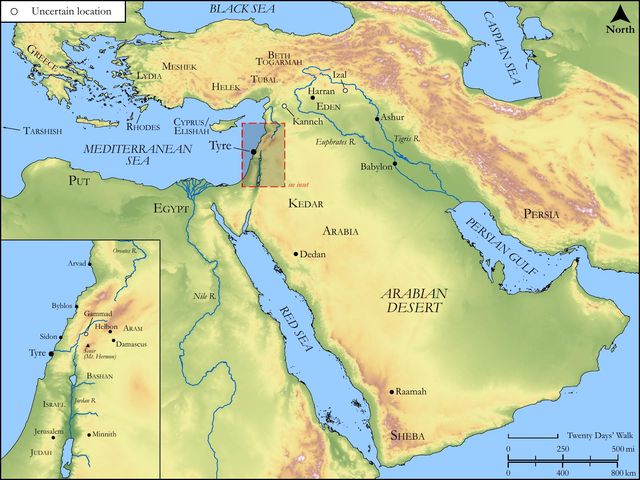
See on the biblical-era map
Study this verse
Public-domain commentary
Matthew Henry
From his Commentary on the Whole Bible. Henry comments on passages, not single verses — this entry covers Ezekiel 27:1–25. His four-level outline is real structure in the source text, so it is rendered as structure.
Here, I. The prophet is ordered to take up a lamentation for Tyrus, Eze 27:2. It was yet in the height of its prosperity, and there appeared not the least symptom of its decay; yet the prophet must lament it, because its prosperity is its snare, is the cause of its pride and security, which will make its fall the more grievous. Even those that live at ease are to be lamented if they be not preparing for trouble. He must lament it because its ruin is hastening on apace; it is sure, it is near; and though the prophet foretel it, and justify God in it, yet he must lament it. Note, We ought to mourn for the miseries of other nations, as well as for our own, out of an affection for mankind in general; it is a part of the honour we owe to all men to bewail their calamities, even those which they have brought upon themselves by their own folly.
II.He is directed what to say, and to say it in the name of the Lord Jehovah, a name not unknown in Tyre, and which shall be better known, Eze 26:6.
1.He must upbraid Tyre with her pride: O Tyrus! thou hast said, I am of perfect beauty (Eze 27:3), of universal beauty (so the word is), every way accomplished, and therefore every where admired. Zion, that had the beauty of holiness, is called indeed the perfection of beauty (Psa 50:2); that is the beauty of the Lord. But Tyre, because well-built and well-filled with money and trade, will set up for a perfect beauty. Note, It is the folly of the children of this world to value themselves on the pomp and pleasure they live in, to call themselves beauties for the sake of them, and, if in these they excel others, to think themselves perfect. But God takes notice of the vain conceits men have of themselves in their prosperity when the mind is lifted up with the condition, and often, for the humbling of the spirit, finds a way to bring down the estate. Let none reckon themselves beautified any further than they are sanctified, nor say that they are of perfect beauty till they come to heaven.
2.He must upbraid Tyre with her prosperity, which was the matter of her pride. In elegies it is usual to insert encomiums of those whose fall we lament; the prophet, accordingly, praises Tyre for all that she had that was praiseworthy. He has nothing to say of her religion, her piety, her charity, her being a refuge to the distressed or using her interest to do good offices among her neighbours; but she lived great, and had a great trade, and all the trading part of mankind made court to her. The prophet must describe her height and magnificence, that God may be the more glorified in her fall, as the God who looks upon every one that is proud and abases him, hides the proud in the dust together, and binds their faces in secret, Job 40:12.
(1.)The city of Tyre was advantageously situated, at the entry of the sea (Eze 27:3), having many commodious harbours each way, not as cities seated on rivers, which the shipping can come but one way to. It stood at the east end of the Mediterranean, very convenient for trade by land into all the Levant parts; so that she became a merchant of the people for many isles. Lying between Greece and Asia, it became the great emporium, or mart-town, the rendezvous of merchants from all parts: They borders are in the heart of the seas, Eze 27:4. It was surrounded with water, which was a great advantage to its trade; it was the darling of the sea, laid in its bosom, in its heart. Note, It is a great convenience, upon many accounts, to live in an island: seas are the most ancient land-mark, not which our fathers have set, but the God of our fathers, and which cannot be removed as other land-marks may, nor so easily got over. The people so situated may the more easily dwell alone, if they please, as not reckoned among the nations, and yet, if they please, may the more easily traffic abroad and keep a correspondence with the nations. We therefore of this island must own that he who determines the bounds of men's habitations has determined well for us.
(2.)It was curiously built, according as the fashion then was; and, being a city on a hill, it made a glorious show and tempted the ships that sailed by into her ports (Eze 27:4): They builders have perfected thy beauty; they have so improved in architecture that nothing appears in the buildings of Tyre that can be found fault with; and yet it wants that perfection of beauty into which the Lord does and will build up his Jerusalem.
(3.)It had its haven replenished with abundance of gallant ships, Isa 33:21. The ship-carpenters did their part, as well as the house-carpenters theirs. The Tyrians are thought to be the first that invented the art of navigation; at least they improved it, and brought it to as great a perfection perhaps as it could be without the loadstone.
[1.]They made the boards, or planks, for the hulk of the ship, of fir-trees fetched from Senir, a mount in the land of Israel, joined with Hermon, Sol 4:8. Planks of fir were smooth and light, but not so lasting as our English oak.
[2.]They had cedars from Lebanon, another mountain of Israel, for their masts, Eze 27:5.
[3.]They had oaks from Bashan (Isa 2:13), to make oars of; for it is probable that their ships were mostly galleys, that go with oars. The people of Israel built few ships for themselves, but they furnished the Tyrians with timber for shipping. Thus one country uses what another produced, and so they are serviceable one to another, and cannot say to each other, I have no need of thee.
[4.]Such magnificence did they affect in building their ships that they made the very benches of ivory, which they fetched from the isles of Chittim, from Italy or Greece, and had workmen from the Ashurites or Assyrians to make them, so rich would they have their state-rooms in their ships to be.
[5.]So very prodigal were they that they made their sails of fine linen fetched from Egypt, and that embroidered too, Eze 27:7. Or it may be meant of their flags (which they hoisted to notify what city they belonged to), which were very costly. The word signifies a banner as well as a sail.
[6.]They hung those rooms on ship-board with blue and purple, the richest cloths and richest colours they could get from the isles they traded with. For though Tyre was itself famous for purple, which is therefore called the Tyrian dye, yet they must have that which was far-fetched.
(4.)These gallant ships were well-manned, by men of great ingenuity and industry. The pilots and masters of the ships, that had command in their fleets, were of their own city, such as they could put a confidence in (Eze 27:8): Thy wise men, O Tyrus! that were in thee, were thy pilots. But, for common sailors, they had men from other countries; The inhabitants of Arvad and Zidon were thy mariners. These came from cities hear them; Zidon was sister to Tyre, not two leagues off, to the northward; there they bred able seamen, which it is the interest of the maritime powers to support and give all the countenance they can to. They sent to Gebal in Syria for calkers, or strengtheners of the clefts or chinks, to stop them when the ships come home, after long voyages, to be repaired. To do this they had the ancients and wise men (Eze 27:9); for there is more need of wisdom and prudence to repair what has gone to decay than to build anew. In public matters there is occasion for the ancients and wise men to be the repairers of the breaches and the restorers of paths to dwell in. Nay, all the countries they traded with were at their service, and were willing to send men into their pay, to put their youths apprentice in Tyre, or to put them on board their fleets; so that all the ships in the sea with their mariners were ready to occupy thy merchandise. Those that give good wages shall have hands at command.
(5.)Their city was guarded by a military force that was very considerable, Eze 27:10, Eze 27:11. The Tyrians were themselves wholly given to trade; but it was necessary that they should have a good army on foot, and therefore they took those of other states into their pay, such as were fittest for service, though they had them from afar (which perhaps was their policy), from Persia, Lud, and Phut. These bore their arms when there was occasion, and in time of peace hung up the shield and buckler in the armoury, as it were to proclaim peace, and let the world know that they had at present no need of them, but they were ready to be taken down whenever there was occasion for them. Their walls were guarded by the man of Arvad; their towers were garrisoned by the Gammadim, robust men, that had a great deal of strength in their arms; yet the vulgar Latin renders it pygmies, men no longer than one's arm. They hung their shields upon the walls in their magazines or places of arms; or hung them out upon the walls of the city, that none might dare to approach them, seeing how well provided they were with all things necessary for their own defence. "Thus they set forth thy comeliness (Eze 27:10), and made they beauty perfect," Eze 27:11. It contributed as much as any thing to the glory of Tyre that it had those of all the surrounding nations in its service, except the land of Israel (though it lay next them), which furnished them with timber, but we do not find that it furnished them with men; that would have trenched upon the liberty and dignity of the Jewish nation, Ch2 2:17, Ch2 2:18. It was also the glory of Tyre that it had such a militia, so fit for service, and in constant pay, and such an armoury, like that in the tower of David, where hung the shields of mighty men, Sol 4:4. It is observable that there and here the armouries are said to be furnished with shields and helmets, defensive arms, not with swords and spears, offensive, though it is probable that there were such, to intimate that the military force of a people must be intended only for their own protection and not to invade and annoy their neighbours, to secure their own right, not to encroach upon the rights of others.
(6.)They had a vast trade and a correspondence with all parts of the known world. Some nations they dealt with in one commodity and some in another, according as either its products or its manufactures were, and the fruits of nature or art were, with which it was blessed. This is very much enlarged upon here, as that which was the principal glory of Tyre, and which supported all the rest. We do not find any where in scripture so many nations named together as are here; so that this chapter, some think, gives much light to the first account we have of the settlement of the nations after the flood, Gen. 10. The critics have abundance of work here to find out the several places and nations spoken of. Concerning many of them their conjectures are different and they leave us in the dark and at much uncertainty; it is well that it is not material. Modern surveys come short of explaining the ancient geography. And therefore we will not amuse ourselves here with a particular enquiry either concerning the traders or the goods they traded in. We leave it to the critical expositors, and observe that only which is improvable.
[1.]We have reason to think that Ezekiel knew little, of his own knowledge, concerning the trade of Tyre. He was a priest, carried away captive far enough from the neighbourhood of Tyre, we may suppose when he was young, and there he had been eleven years. And yet he speaks of the particular merchandises of Tyre as nicely as if he had been comptroller of the custom-house there, by which it appears that he was divinely inspired in what he spoke and wrote. It is God that saith this, Eze 27:3.
[2.]This account of the trade of Tyre intimates to us that God's eye is upon men, and that he takes cognizance of what they do when they are employed in their worldly business, not only when they are at church, praying and hearing, but when they are in their markets and fairs, and upon the exchange, buying and selling, which is a good reason why we should in all our dealings keep a conscience void of offence, and have our eye always upon him whose eye is always upon us.
[3.]We may here observe the wisdom of God, and his goodness, as the common Father of mankind, in making one country to abound in one commodity and another in another, and all more or less serviceable either to the necessity or to the comfort or ornament of human life. Non omis fert omnia tellus - One land does not supply all the varieties of produce. Providence dispenses its gifts variously, some to each, and all to none, that there may be a mutual commerce among those whom God has made of one blood, though they are made to dwell on all the face of the earth, Act 17:26. Let every nations therefore thank God for the productions of its country; though they be not so rich as those of others, yet there is use for them in the public service of the world.
[4.]See what a blessing trade and merchandise are to mankind, especially when followed in the fear of God, and with a regard not only to private advantage, but to a common benefit. The earth is full of God's riches, Psa 104:24. There is a multitude of all kinds of riches in it (as it is here, Eze 27:12), gathered off its surface and dug out of its bowels. The earth is also full of the fruits of men's ingenuity and industry, according as their genius leads them. Now by exchange and barter these are made more extensively useful; thus what can be spared is helped off, and what is wanted is fetched in, in lieu of it, from the most distant countries. Those that are not tradesmen themselves have reason to thank God for tradesmen and merchants, by whom the productions of other countries are brought to our hands, as those of our own are by our husbandmen.
[5.]Besides the necessaries that are here traded in, see what abundance of things are here mentioned that only serve to please fancy, and are made valuable only by men's humour and custom; and yet God allows us to use them, and trade in them, and part with those things for them which we can spare that are of an intrinsic worth much beyond them. Here are horns of ivory and ebony (Eze 27:15), that are brought for a present, exposed to sale, and offered in exchange, or (as some think) presented to the city, or the great men of it, to obtain their favour. Here are emeralds, coral, and agate (Eze 27:16), all precious stones, and gold (Eze 27:22), which the world could better be without than iron and common stones. Here are, to please the taste and smell, the chief of all spices (Eze 27:22), cassia and calamus (Eze 27:19), and, for ornament, purple, broidered work, and fine linen (Eze 27:16), precious clothes for chariots (Eze 27:20), blue clothes (which Tyre was famous for), broidered work, and chests of rich apparel, bound with rich cords, and made of cedar, a sweet wood to perfume the garments kept in them, Eze 27:24. Upon the review of this invoice, or bill of parcels, we may justly say, What a great many things are here that we have no need of, and can live very comfortably without!
[6.]It is observable that Judah and the land of Israel were merchants in Tyre too; in a way of trade they were allowed to converse with the heathen. But they traded mostly in wheat, a substantial commodity, and necessary, wheat of Minnith and Pannag, two countries in Canaan famous for the best wheat, as some think. The whole land indeed was a land of wheat (Deu 8:8); it had the fat of kidneys of wheat, Deu 32:14. Tyre was maintained by corn fetched from the land of Israel. They traded likewise in honey, and oil, and balm, or rosin; all useful things, and not serving to pride or luxury. And the land which these were the staple commodities of was that which was the glory of all lands, which God reserved for his peculiar people, not those that traded in spices and precious stones; and the Israel of God must reckon themselves well provided for if they have food convenient; for those that are acquainted with the delights of the children of God will not set their hearts on the delights of the sons and daughters of men, or the treasures of kings and provinces. We find indeed that the New Testament Babylon trades in such things as Tyre traded in, Rev 18:12, Rev 18:13. For, notwithstanding its pretensions to sanctity, it is a mere worldly interest.
[7.]Though Tyre was a city of great merchandise, and they got abundance by buying and selling, importing commodities from one place and exporting them to another, yet manufacture-trades were not neglected. The wares of their own making, and a multitude of such wares, are here spoken of, Eze 27:16, Eze 27:18. It is the wisdom of a nation to encourage art and industry, and not to bear hard upon the handicraft-tradesmen; for it contributes much to the wealth and honour of a nation to send abroad wares of their own making, which may bring them in the multitude of all riches.
[8.]All this made Tyrus very great and very proud: The ships of Tarshish did sing of thee in they market (Eze 27:25); thou wast admired and cried up by all the nations that had dealings with thee; for thou wast replenished in wealth and number of people, wast beautified, and made very glorious, in the midst of the seas. Those that grow very rich are cried up as very glorious; for riches are glorious things in the eyes of carnal people, Gen 31:1.
Historical interpretation
Historical reception
3 surviving comments on this verse. Each one is dated, so this reads as a timeline rather than a list.
(Verse 35, 36, and following) And I will bring you into a desert of peoples, and there I will judge you face to face. Just as I contended with your fathers in the desert of the land of Egypt, so I will judge you, says the Lord. And I will subject you to my scepter, and I will bring you into the bonds of the covenant, and I will choose from among you the transgressors and the wicked: from their place of residence I will bring them out, and they will not enter the land of Israel, and you will know that I am the Lord. Thus says the Lord: I will do for you who are in Babylon, and now serve idols, what I did for your ancestors in Egypt. I will lead you into the desert of the peoples, and there I will judge you face to face, just as I contended with them in judgment when they came out of Egypt. And after I have judged you, I will subject you to my scepter and rule, and I will make a covenant with you and bring you into your land with the bonds of love, so that bound by my love, you will never be able to depart from me. But I will choose from among you the transgressors and the wicked, who persist in the hardness of their hearts in evil deeds, not for possession, but for rejection. And I will indeed bring them out of the land of their dwelling, so that when they are brought out, they will not enter the land of Israel; but they will perish in various regions. And by the distinction between good and evil, you shall know that I am the Lord, who judges all things. The rest of the discourse hastens, and we briefly go through each point, in order to provide only the meaning to the readers.
(Verse 27, 29 onwards) Therefore speak to the house of Israel, son of man, and tell them: Thus says the Lord God: Moreover, your fathers have blasphemed against me and have treated me with contempt, even as they spurned me. And I brought them into the land that I had lifted my hand to give them ((Vulgate adds: that land)): they saw every high hill and every leafy tree, and there they offered their sacrifices and presented there the irritation of their offerings, and they placed there the fragrance of their sweetness, and they poured out their ((Vulgate is silent on this)) libations there. And I said to them, 'What is the high place to which you are going?' And its name was called the High Place until this day. Therefore speak to the house of Israel, son of man, and say to them, 'Thus says the Lord God: As for your fathers, they have provoked Me to anger by their iniquities, by the fact that they have fallen away from Me. So I brought them into the land that I had lifted My hand in an oath to give them.' They saw every high hill and every leafy tree, and there they offered their sacrifices. They also presented there the provocation of their gifts, and they set there their pleasing aroma, and they poured out there their drink offerings. And I said to them: What is abbana, because you enter there? And they called its name abbana until this day. I wanted, he said, to scatter them in the wilderness, and to give them not good precepts, so that they would sacrifice to idols what they should have offered to me, and consecrate all their first-fruits to them by fire, so that I might kill them and destroy them. But when he says, I wanted, he shows that he did not do what he wanted. And that which follows: 'And they shall know that I am the Lord,' is not found in the Septuagint. For it did not seem fitting to them to know after their destruction that he himself is the Lord. But you, son of man, speak again to them, that is, to the elders of the house of Israel, who have come to inquire of you: Your fathers, from whom you have descended, have also blasphemed against me and held me in contempt; after I brought them into the land which I had given them to possess, they turned against me to provoke me. For when they saw every high hill and leafy tree, they would sacrifice on the mountains and in the groves and thickets, and offer victims to the idols, and pour out libations. And when I saw this, I said to them: What is this, Bama? for it is called high: or why do you enter into such a place which you have chosen for yourselves in all the hills, so that even today these places are called Bamoth, and the ancient error retains its original name? Regarding Bama, which we translate as excelsum, there is an error in the Septuagint edition, where it is written as ἀββανὰ, which does not resonate in the Hebrew language. Bama can mean 'in which' if the two syllables are divided into two words, but in the present context, that sense does not fit. However, wherever it is written in the Books of Kings and Chronicles: 'The people still sacrificed and offered incense on the high places,' Bama in the singular and Bamoth in the plural mean 'high places.'
(Verse 3.) O Tyre, you have said, 'I am of perfect beauty' (or you have said, 'I have surrounded myself with beauty') and situated in the heart of the sea. The first crime of Tyre is if it seems to have any good, to not attribute it to God, but to itself, and to value all the beauty that comes from diverse regions as its own accomplishment and virtue. For it has said, 'I am of perfect beauty' or 'I have surrounded myself with beauty,' although it is situated in the heart, that is, in the middle of the sea, and it moves like an island, and it is tossed and broken by the crashing waves. But as for the heart of the sea, it signifies the middle, and that prophetic speech demonstrates: Therefore we will not fear, when the earth is troubled, and the mountains are carried into the heart of the sea. Their waters have roared and been troubled. But our Lord is also said to descend into the heart of the earth, that is, into the middle, and to the underworld. But true and perfect beauty is found in no one but the body of Christ, which is interpreted as the Church, and is gathered by the virtues of many saints. And he himself speaks to the bride: You are all beautiful, my love, and there is no blemish in you (Canticles 4:7).
Continue studying Ezekiel 27:3 across the web’s major study libraries — every link below opens this exact verse, chapter, or book on the destination site.
Read & Compare
 BibleGatewayThis verse in more than 200 translations and 70 languages.
 Bible.comThe YouVersion reader — hundreds of translations, reading plans, and highlights.
 ESV.orgCrossway's official English Standard Version reader.
 NET BibleThe NET translation with 60,000+ translators' notes on every rendering decision.
 STEP BibleTyndale House's free study tool — original text, vocabulary, and scholarly resources.
 BibliaLogos Bible Software's free web reader.
 USCCBThe New American Bible (Revised Edition) with the U.S. bishops' study notes.
Commentaries
 BibleHub CommentariesDozens of classic commentaries on this verse, gathered on one page.
 StudyLightMore than 100 commentary sets — the largest collection on the web.
 BibleRefPlain-English commentary on what this verse means, verse by verse.
 Enduring WordDavid Guzik's free commentary on this chapter, widely used by Bible teachers.
 Bible Study ToolsVerse commentary alongside Greek and Hebrew study aids.
Original Language & Research
- BibleHub InterlinearThe verse word by word — original language, transliteration, and English.
- BibleHub LexiconEvery word's original-language definition and Strong's entry.
 Blue Letter BibleDeep-study tools — Strong's numbers, concordance, and word studies.
 SefariaThe Hebrew text with Rashi and centuries of Jewish commentary.
Sermons, Hymns & Audio


TrulyRandomVerse is not affiliated with these sites and doesn’t control their content. They’re linked because they’re genuinely useful.
Summary
Ezekiel 27:3 initiates a profound lamentation over the ancient city-state of Tyre, a dominant maritime power renowned for its extensive trade networks and strategic location. The verse vividly captures Tyre's self-perception as a city of unparalleled splendor and self-sufficiency, boasting of its "perfect beauty" derived from immense wealth and global commercial influence. This declaration of self-exaltation sets the stage for the divine pronouncements of judgment that follow, revealing the Lord GOD's sovereign response to human pride and misplaced trust in material prosperity.
Context
ShowHideLiterary Context
Ezekiel 27 is meticulously crafted as an extended lamentation, or dirge, over Tyre, immediately following the direct prophecy of its destruction in Ezekiel 26. This chapter employs a vivid and intricate allegorical metaphor, portraying Tyre as a magnificent, perfectly constructed ship that sails the vast seas, accumulating immense riches from every corner of the known world. Verse 3 serves as the opening address of this lament, directly confronting Tyre's self-perception and its identity as a global merchant. It precisely sets the tone by highlighting the city's hubris and its foundational role in international commerce, which directly precedes the detailed, almost poetic, description of its impressive yet ultimately doomed commercial enterprise and its catastrophic demise. The lamentation format underscores the tragic and inevitable fall of a once-glorious entity.
Historical & Cultural Context
Tyre (modern-day Sur, Lebanon) was a preeminent Phoenician city-state strategically located on the eastern Mediterranean coast, comprising both an island fortress and a mainland settlement. From the second millennium BCE onward, it flourished as the undisputed hub for international maritime trade, controlling vast commercial routes and engaging in extensive commerce with nations across the Mediterranean, the Near East, and beyond. Its legendary wealth stemmed from its renowned purple dye industry (Tyrian purple), highly prized cedar timber, exceptional skilled artisans, and an expansive network of colonies and trading posts. This verse masterfully encapsulates the very essence of Tyre's identity as a commercial titan, whose unparalleled economic prowess and formidable naval strength cultivated a deep-seated sense of security and profound pride, leading it to believe it was utterly invincible and entirely self-sufficient.
Key Themes
ShowHideThis foundational verse introduces several critical themes that permeate Ezekiel's broader prophecies against Tyre and other nations. Firstly, it starkly highlights Pride and Self-Exaltation, as Tyre's audacious declaration, "I am of perfect beauty," reveals an arrogant and inflated self-assessment. This hubris stems from its belief that its prosperity, strategic position, and material accomplishments made it inherently superior and entirely independent of divine favor. This pervasive motif of human arrogance preceding a fall is a recurring warning throughout biblical literature, powerfully echoed in passages such as Proverbs 16:18. Secondly, the verse unequivocally emphasizes Material Wealth and Global Trade as the very foundation of Tyre's identity and its overweening pride, describing it as "a merchant of the people for many isles." This underscores how its vast and intricate commercial network brought immense riches and unparalleled influence, shaping its worldview. Finally, Tyre's boast implicitly but powerfully foreshadows Divine Judgment, as the authoritative declaration "Thus saith the Lord GOD" signals that the true Sovereign will directly challenge Tyre's self-proclaimed perfection and orchestrate its inevitable downfall, demonstrating that ultimate power, true beauty, and lasting dominion belong to Him alone, a theme further developed with chilling detail in Ezekiel 28.
Exposition and Analysis
ShowHideKey Word Analysis
ShowHideA primitive root meaning "to sit down; by implication, to dwell, to remain." In this context, it powerfully emphasizes Tyre's fixed, established, and seemingly unassailable position at the "entry of the sea." This word conveys a sense of permanence, stability, and strategic advantage, implying that Tyre's geographical location was a pivotal factor in its perceived invincibility and unparalleled prosperity. It highlights the city's settled, dominant, and enduring presence in the maritime world.
A primitive root meaning "to travel for trading." This term precisely identifies Tyre's primary industry and the very source of its legendary wealth. It portrays Tyre not merely as a city engaged in trade, but as embodying the very essence of commerce itself, actively traveling, navigating, and engaging in extensive mercantile activities across vast distances. This reinforces its global reach, its economic power, and the commercial identity that fueled its profound pride.
A potent combination of H3632 (kâlîyl), meaning "complete; as noun, the whole, perfect," and H3308 (yŏphîy), meaning "beauty." Together, this phrase signifies Tyre's audacious claim of absolute, unblemished perfection and aesthetic splendor. Tyre's self-assessment is not merely about possessing beauty, but about being entirely complete, flawless, and self-sufficient in its own eyes, needing nothing and lacking nothing. This expresses the pinnacle of its self-exaltation, its perceived invincibility, and its spiritual arrogance.
Verse Breakdown
ShowHide"And say unto Tyrus, O thou that art situate at the entry of the sea,"
This opening command from the Lord GOD to the prophet Ezekiel immediately sets the stage for the divine message directed at Tyre. The descriptive phrase "situate at the entry of the sea" instantly identifies Tyre's critically important geographical and strategic position. It highlights its prime location as a natural gateway to maritime trade, an ideal harbor, and a dominant force in naval commerce, which served as the bedrock of its immense power and far-reaching influence in the ancient world.
"which art a merchant of the people for many isles,"
This clause further elaborates on Tyre's core identity, unequivocally emphasizing its role as a global commercial powerhouse. As a "merchant of the people," Tyre facilitated trade for numerous nations and diverse peoples, extending its commercial reach to "many isles" (a synecdoche for coastal regions, islands, and distant lands across the Mediterranean and beyond). This underscores the vastness and complexity of its trade network, the immense wealth it accumulated, and its central, indispensable role in the ancient world's economy, all of which significantly contributed to its inflated self-perception of grandeur and invincibility.
"Thus saith the Lord GOD;"
This declarative statement serves as a powerful divine authentication of the entire prophetic message. It unequivocally asserts that the subsequent words are not merely Ezekiel's human observations or opinions, but a direct, authoritative revelation from the sovereign God, Yahweh (H3069), the Lord (H136). This phrase elevates the prophecy from a human lament to a divinely inspired pronouncement, underscoring the absolute authority, certainty, and inevitability of the judgment that is to follow.
"O Tyrus, thou hast said, I am of perfect beauty."
This is the climactic and most revealing declaration of the verse, exposing Tyre's profound self-exaltation and deep-seated hubris. Tyre's boast, "I am of perfect beauty," signifies its belief in its own inherent completeness, absolute flawlessness, and utter self-sufficiency. It reflects a pride rooted in its material wealth, its strategic advantage, and its perceived invincibility, demonstrating a complete disregard for any reliance on a higher power. This statement encapsulates the spiritual arrogance that consistently precedes and provokes divine judgment throughout biblical narrative.
Literary Devices
ShowHideEzekiel 27:3 masterfully employs several powerful literary devices to convey its profound message of pride and impending judgment. Personification is central to the verse, as Tyre is directly addressed as if it were a sentient being capable of speech and self-assessment, boldly declaring, "I am of perfect beauty." This imbues the city with a distinct, arrogant character, vividly emphasizing its inflated self-perception. The phrase "entry of the sea" skillfully utilizes metonymy, where "entry" stands for the strategic access and unparalleled control Tyre held over vital maritime routes and global commerce. The description of Tyre as "a merchant of the people for many isles" employs hyperbole to underscore the vastness and unparalleled scope of its commercial empire, effectively highlighting its global reach and economic dominance. Finally, the entire verse functions as an apostrophe, a direct and dramatic address to an inanimate object (the city of Tyre) as if it were present and capable of hearing, intensifying the prophetic condemnation and setting a somber, yet powerful, tone for the extended lamentation that follows.
Theological and Thematic Connections
ShowHideEzekiel 27:3 profoundly illustrates the timeless biblical theme of human pride and self-exaltation, particularly when such arrogance is rooted in material prosperity, worldly achievements, and perceived invincibility. Tyre's audacious boast of "perfect beauty" reflects a pervasive human tendency to find ultimate security, identity, and worth in self-made success, accumulated wealth, or temporal power, rather than in the sovereign God. This misplaced confidence represents a recurring theological concern throughout Scripture, as it directly challenges God's supreme authority, His position as the ultimate source of all blessings, and the very definition of true beauty. The divine response, "Thus saith the Lord GOD," immediately contrasts Tyre's self-assertion with the ultimate authority of the Creator, foreshadowing the inevitable judgment that awaits those who elevate themselves above Him. This serves as a timeless and poignant warning against the spiritual dangers of hubris and materialism, powerfully reminding us that true completeness, lasting security, and enduring beauty are found only in humble submission to God.
Reflection and Application
ShowHideEzekiel 27:3 stands as a potent and enduring mirror for both societies and individuals in every age. In a contemporary world that frequently measures worth by economic prowess, physical appearance, or self-achieved success, Tyre's boast, "I am of perfect beauty," resonates with striking relevance. This verse challenges us to critically examine the underlying foundations of our own sense of "perfect beauty" or completeness. Are we, much like ancient Tyre, prone to deriving our identity, security, and pride from our accomplishments, our material possessions, our social influence, or even our physical attributes? The prophetic voice of Ezekiel powerfully reminds us that such self-exaltation, while superficially empowering, ultimately leads to a spiritual, and often literal, fall. True and lasting beauty, genuine security, and profound completeness are not found in what we accumulate or achieve, but rather in our humble recognition of God's absolute sovereignty and His sustaining grace. This passage serves as a powerful call to shift our gaze from self-admiration to divine adoration, understanding deeply that all true worth, enduring glory, and authentic beauty originate solely from Him.
Questions for Reflection
ShowHideFAQ
ShowHideWhat was Tyre known for in the ancient world?
ShowHideTyre was renowned as a preeminent Phoenician maritime city-state, famous for its unparalleled wealth, extensive trade networks, and formidable naval power. It was strategically located on the Mediterranean coast, serving as a vital hub for international commerce, exporting highly valuable goods such as the coveted purple dye (Tyrian purple), prized cedar timber, and exquisite craftsmanship by its skilled artisans. Its commercial reach extended across the entire Mediterranean basin, making it a dominant economic and political force, precisely as highlighted by its description as "a merchant of the people for many isles" in Ezekiel 27:3.
Why is Tyre's statement "I am of perfect beauty" so significant?
ShowHideThis statement is profoundly significant because it encapsulates Tyre's deep-seated pride and profound self-exaltation. "Perfect beauty" (Hebrew: kâlîyl yŏphîy) implies absolute completeness, inherent flawlessness, and utter self-sufficiency in Tyre's own estimation. It reveals a city that firmly believed its prosperity, strategic location, and immense material wealth made it invincible and inherently beautiful, needing no external help or divine intervention. This hubris directly challenges God's sovereignty and sets the stage for the dramatic divine judgment that inevitably follows, as the Lord GOD will powerfully demonstrate that true power, lasting beauty, and ultimate authority belong to Him alone. It stands as a classic biblical example of pride preceding a fall, a consistent and vital theme seen throughout Scripture, as articulated in Proverbs 16:18.
Christ-Centered Fulfillment
ShowHideEzekiel 27:3, with Tyre's audacious boast of "perfect beauty" rooted in its self-achieved glory and material wealth, finds its profound Christ-centered fulfillment in the stark contrast between human pride and divine humility, and between fleeting worldly beauty and the true, redemptive beauty of Christ. While Tyre exalted itself, believing it lacked nothing and was complete in its own splendor, Christ, in astonishing humility, "though he was in the form of God, did not count equality with God a thing to be grasped, but emptied himself, by taking the form of a servant, being born in the likeness of men" (Philippians 2:6-7). The "perfect beauty" Tyre claimed was external, superficial, and ultimately destined for destruction; yet, the true and eternal beauty of God is perfectly revealed in Christ's sacrificial love on the cross, which offers eternal life and spiritual transformation to all who believe. He is the one who truly makes us "complete" and "perfect," not through our own works or self-exaltation, but solely "in him" (Colossians 2:10). The impending judgment against Tyre for its self-exaltation foreshadows the ultimate judgment of all who reject God's sovereignty and rely on their own strength, but it also gloriously highlights the divine alternative: the humble King who offers true, lasting beauty, spiritual completeness, and eternal redemption to all who turn from self-reliance to Him, the very "radiance of the glory of God and the exact imprint of his nature" (Hebrews 1:3).