


2 Chronicles 31:6
Bible text: King James Version (1769 Blayney text) · Public domain
Bible text: King James Version with Strong's numbers · Public domain
Bible text: Berean Standard Bible · Public domain
Bible text: American Standard Version (1901) · Public domain
Bible text: World English Bible, Messianic edition · Public domain
Bible text: Geneva Bible (1599) · Public domain
Bible text: Young's Literal Translation · Public domain
- וּבְנֵיu·ve·Neiand [the] people ofH1121Conj-w ¦ N-mpcNoun Plural Masculine Constructוּandבְנֵי[the] people of
- יִשְׂרָאֵלYis·ra·'ElIsraelH3478N-properNoun Proper Location
- וִיהוּדָהvi·hu·Dahand JudahH3063Conj-w ¦ N-properNoun Proper LocationוִandיהוּדָהJudah
- הַיּוֹשְׁבִיםhai·yo·she·Vimwho dweltH3427Art ¦ V-Qal-Prtcpl-mpVerb Qal Participle Plural Masculine Absoluteהַwhoיּוֹשְׁבִיםdwelt
- בְּעָרֵיbe·'a·Reiin [the] cities ofH5892Prep-b ¦ N-mpcNoun Plural Masculine Constructבְּinעָרֵי[the] cities of
- יְהוּדָהye·hu·DahJudahH3063N-properNoun Proper Location
- גַּםgamalsoH1571AdvAdverb
- הֵםHemtheyH1992Pro-3mpPronoun Personal 3rd Plural Masculine
- מַעְשַׂרma'·Sara tithe ofH4643N-mscNoun Singular Masculine Construct
- בָּקָרba·Karherd[s]H1241N-csNoun Singular common gender Absolute
- וָצֹאןva·Tzonand flock[s]H6629Conj-w ¦ N-csNoun Singular common gender Absoluteוָandצֹאןflock[s]
- וּמַעְשַׂרu·ma'·Sarand a tithe ofH4643Conj-w ¦ N-mscNoun Singular Masculine Constructוּandמַעְשַׂרa tithe of
- קָדָשִׁיםka·da·Shimholy thingsH6944N-mpNoun Plural Masculine Absolute
- הַמְקֻדָּשִׁיםham·ku·da·Shimwhich were consecratedH6942Art ¦ V-Pual-PassPrtcpl-mpVerb Pual Participle Passive Plural Masculine Absoluteהַwhichמְקֻדָּשִׁיםwere consecrated
- לַיהוָהla·Yah·wehto YahwehH3068Prep-l ¦ N-properNoun Proper TitleלַtoיהוָהYahweh
- אֱלֹהֵיהֶם'e·lo·hei·Hemtheir GodH430N-mpc ¦ 3mpNoun Plural Masculine ConstructאֱלֹהֵיGodהֶםtheir
- הֵבִיאוּhe·Vi·'uthey broughtH935V-Hiphil-Perf-3cpVerb Hiphil Perfect 3rd Plural common gender
- וַיִּתְּנוּvai·yi·te·Nuand they madeH5414Conj-w ¦ V-Qal-ConsecImperf-3mpVerb Qal Consecutive Imperfect 3rd Plural Masculineוַandיִּתְּנוּthey made
- עֲרֵמוֹתa·re·MotheapsH6194N-fpNoun Plural Feminine Absolute
- עֲרֵמוֹתa·re·MotheapsH6194N-fpNoun Plural Feminine Absolute
English is a literal word-by-word gloss of the Hebrew, not the KJV's wording. Why?
This is the original text the KJV's translators worked from — each Hebrew word with its own literal English meaning in this verse, prepared by scholars at Tyndale House, Cambridge. The KJV translates whole sentences, not word by word, so its wording differs: one Hebrew word can become several English words, and the KJV may choose “the LORD” where the gloss reads “Yahweh”. Both are faithful — they answer different questions. For the KJV's own rendering, switch to the KJV text.
Details
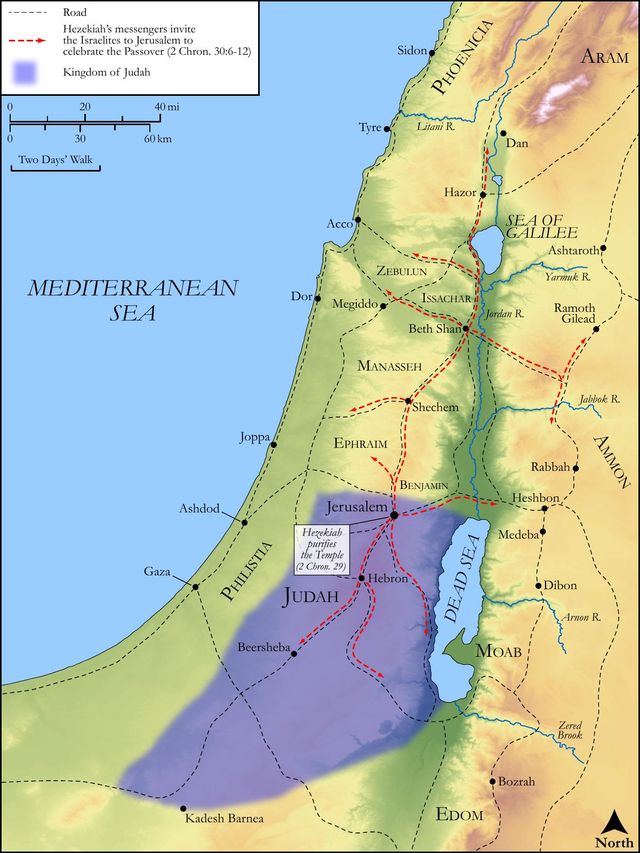
See on the biblical-era map
Study this verse
Public-domain commentary
Matthew Henry
From his Commentary on the Whole Bible. Henry comments on passages, not single verses — this entry covers 2 Chronicles 31:1–10. His two-level outline is real structure in the source text, so it is rendered as structure.
We have here an account of what was done after the passover. What was wanting in the solemnities of preparation for it before was made up in that which is better, a due improvement of it after. When the religious exercises of a Lord's day or a communion are finished we must not think that then the work is done. No, then the hardest part of our work begins, which is to exemplify the impressions of the ordinance upon our minds in all the instances of a holy conversation. So it was here; when all this was finished there was more to be done.
I.They applied themselves with vigour to destroy all the monuments of idolatry, Ch2 31:1.
The king had done what he could of this kind (Kg2 18:4), but the people could discover those profane relics which escaped the eye of the king's officers, and therefore they went out to see what they could do, Ch2 31:1. This was done immediately after the passover. Note, The comfort of communion with God should kindle in us a holy zeal and indignation against sin, against every thing that is offensive to God. If our hearts have been made to burn within us at an ordinance, that spirit of burning will consume the dross of corruption. What have I now to do any more with idols? Their zeal here in destroying the images and groves, the high places and altars, appeared,
1.In that they did this, not only in the cities of Judah and Benjamin, but in those of Ephraim and Manasseh. Some think that those cities are meant which had come under the protection and the jurisdiction of the kings of Judah. Others think that, Hoshea king of Israel not forbidding it, their zeal carried them out to the destruction of idolatry even in many parts of his kingdom. At least those that came out of Ephraim and Manasseh to keep the passover (as many did, Ch2 30:18) destroyed all their own images and groves, and did the like for as many more as they had influence upon or could make interest in for leave to do it. We should not only reform ourselves, but do all we can to reform others too.
2.They destroyed all: they utterly destroyed all; they spared none through favour or affection either to the images or to their worshippers; though ever so ancient, ever so costly, ever so beautiful, and ever so well patronised, yet they must all be destroyed. Note, Those that sincerely set themselves against sin will set themselves against all sin.
3.They would not return to their houses, though they had been long absent, till this was done. They could not be easy, nor think themselves safe, in their cities, as long as the images and groves, those betrayers and destroyers of their country, were left standing. Perhaps the prophet Isaiah pointed to this when, a little before, he spoke of a day in which men should cast away the very idols that they themselves had made. So surprising was this blessed change, Isa 2:20; Isa 31:6, Isa 31:7.
II.Hezekiah revived and restored the courses of the priests and Levites, which David had appointed and which had of late been put out of course, Ch2 31:2. The temple service was put into its proper method again, to run in the old channel. Every man was made to know his work, his place, his time, and what was expected from him. Note, Good order contributes much to the carrying on of a good work. The priests were appointed in their courses for burnt-offerings and peace-offerings; the Levites in their courses were some to minister to the priests, others to give thanks and praise. See Ch1 23:4, Ch1 23:5. And all this in the gates or courts of the tents of the Lord. The temple is here called a tent because the temple privileges are movable things and this temple was shortly to be removed.
III.He appropriated a branch of the revenue of his crown to the maintenance and support of the altar.
Though the people were to be at the charge of the daily offerings, and those on the sabbaths, new moons, and feasts, yet, rather than they should be burdened with the expense, he allowed out of his own estate, or out of his exchequer, for all those offerings, Ch2 31:3. It was a generous act of piety, wherein he consulted both God's honour and his people's ease, as a faithful servant to him and a tender father to them. Let princes and great men reckon that well bestowed, and set out to the best interest, which they give for the support and encouragement of religion in their country.
IV.He issued out an order to the inhabitants of Jerusalem first, Ch2 31:4 (that those who were nearest the temple, and both saved and got by being so, might give a good example to others), but which was afterwards extended to, or at least admitted by, the cities of Judah, that they should carefully pay in their dues, according to the law, to the priests and Levites. This had been long neglected, which made the work to be neglected (for a scandalous maintenance makes a scandalous ministry); but Hezekiah, having himself been liberal, might with a good grace require his subjects to be just to the temple service. And observe the end he aims at in recovering and restoring to the priests and Levites their portion, that they might be encouraged in the law of the Lord, in the study of it, and in doing their duty according to it. Observe here,
1.It is fit that ministers should be not only maintained, but encouraged, that they should not only be kept to do their work, but that they should also have wherewith to live comfortably, that they may do it with cheerfulness.
2.Yet they are to be maintained, not in idleness, pride, and luxury, but in the law of the Lord, in their observance of it themselves and in teaching others the good knowledge of it.
V.The people thereupon brought in their tithes very readily.
They wanted nothing but to be called upon; and therefore, as soon as the commandment came abroad, the first-fruits and all the holy things were duly brought in, Ch2 31:5, Ch2 31:6. What the priests had occasion for, for themselves and their families, they made use of, and the overplus was laid in heaps, Ch2 31:6. All harvest-time they were increasing these heaps, as the fruits of the earth were gathered in; for God was to have his dues out of them all. Though a prescription may be pleaded for a modus decimandi - tenth proportion, yet it cannot be pleaded pro non decminado - for the omission of the tenth. When harvest ended they finished their heaps, Ch2 31:7. Now here we have,
1.The account given to Hezekiah concerning those heaps. He questioned the priests and Levites concerning them, why they did not use what was paid in, but hoarded it up thus, (Ch2 31:9), to which it was answered that they had made use of all they had occasion for, for the maintenance of themselves and their families and for their winter store, and that this was that which was left over and above, Ch2 31:10. They did not hoard these heaps for covetousness, but to show what plentiful provision God by his law had made for them, if they could but have it collected and brought in, and that those who conscientiously give God his dues out of their estates bring a blessing upon all they have: Since they began to bring in the offerings the Lord has blessed his people. See for this Hag 2:19. "Try me," says God, "if you will not otherwise trust me, whether, upon your bringing the tithes into the store-house, you have not a blessing poured out upon you," Mal 3:10, Mal 3:11; Eze 44:30.
2.The acknowledgment which the king and princes made of it, Ch2 31:8. They gave thanks to God for his good providence, which gave them something to bring, and his good grace, which gave them hearts to bring it. And they also blessed the people, that is, commended them for their doing well now, without reproaching them for their former neglects. It is observable that after they had tasted the sweetness of God's ordinance, in the late comfortable passover, they were thus free in maintaining the temple service. Those that experience the benefit of a settled ministry will not grudge the expense of it.
Continue studying 2 Chronicles 31:6 across the web’s major study libraries — every link below opens this exact verse, chapter, or book on the destination site.
Read & Compare
 BibleGatewayThis verse in more than 200 translations and 70 languages.
 Bible.comThe YouVersion reader — hundreds of translations, reading plans, and highlights.
 ESV.orgCrossway's official English Standard Version reader.
 NET BibleThe NET translation with 60,000+ translators' notes on every rendering decision.
 STEP BibleTyndale House's free study tool — original text, vocabulary, and scholarly resources.
 BibliaLogos Bible Software's free web reader.
 USCCBThe New American Bible (Revised Edition) with the U.S. bishops' study notes.
Commentaries
 BibleHub CommentariesDozens of classic commentaries on this verse, gathered on one page.
 StudyLightMore than 100 commentary sets — the largest collection on the web.
 BibleRefPlain-English commentary on what this verse means, verse by verse.
 Enduring WordDavid Guzik's free commentary on this chapter, widely used by Bible teachers.
 Bible Study ToolsVerse commentary alongside Greek and Hebrew study aids.
Original Language & Research
- BibleHub InterlinearThe verse word by word — original language, transliteration, and English.
- BibleHub LexiconEvery word's original-language definition and Strong's entry.
 Blue Letter BibleDeep-study tools — Strong's numbers, concordance, and word studies.
 SefariaThe Hebrew text with Rashi and centuries of Jewish commentary.
Sermons, Hymns & Audio


TrulyRandomVerse is not affiliated with these sites and doesn’t control their content. They’re linked because they’re genuinely useful.
Summary
This verse vividly describes the overwhelming and joyful response of the people of Judah, including a remnant from the northern kingdom of Israel, to King Hezekiah's sweeping spiritual reforms. Following the cleansing and reconsecration of the Temple and the national celebration of Passover, the people spontaneously brought immense quantities of tithes from their livestock and other sacred offerings. These contributions, described as being "laid by heaps," were designated to support the restored Temple service and the Levitical priesthood, serving as a tangible manifestation of a profound national revival and a renewed commitment to God's covenant commands.
Context
ShowHideLiterary Context
2 Chronicles 31:6 is situated within the broader narrative of King Hezekiah's reign, specifically detailing the practical outcomes of his comprehensive religious reforms. Chapters 29 and 30 describe Hezekiah's initial actions: the cleansing and reconsecration of the defiled Temple, followed by a nationwide celebration of Passover, which drew participants from both Judah and the remnants of the northern kingdom. The people's enthusiastic response in chapter 31, bringing their tithes and offerings, is presented as a direct and tangible consequence of this spiritual awakening. The verses immediately preceding 2 Chronicles 31:6 recount the people's spontaneous destruction of idolatrous altars and high places, while the subsequent verses detail the administrative organization of these abundant offerings and the provision made for the priests and Levites, highlighting the practical implementation and sustainability of the revival.
Historical & Cultural Context
King Hezekiah reigned in Judah during the late 8th century BCE (c. 715-686 BCE), a period marked by the formidable power of the Assyrian Empire. His father, Ahaz, had led Judah into deep idolatry and politically compromising alliances, moving away from exclusive worship of Yahweh. Hezekiah's reforms were a radical and courageous departure, aiming to restore pure Yahwistic worship and adherence to the Mosaic covenant. Tithing was a fundamental aspect of Israelite law, commanded in the Pentateuch (e.g., Leviticus 27:30-33, Numbers 18:21-24, Deuteronomy 14:22-29). These contributions were essential for supporting the Levites and priests, who, lacking tribal land inheritance, were wholly dedicated to Temple service. The mention of "children of Israel and Judah" signifies that even after the fall of the northern kingdom (Israel) to Assyria in 722 BCE, a remnant from those tribes had either migrated south or remained in Judah, participating in this national spiritual restoration.
Key Themes
ShowHideThis verse powerfully illustrates several key themes central to the book of Chronicles and biblical theology. Firstly, it underscores the theme of revival and restoration, demonstrating how genuine repentance and a return to God's commands lead to tangible acts of obedience and generosity. The people's overflowing contributions are a direct fruit of the spiritual awakening under Hezekiah, echoing the principle found in Malachi 3:10. Secondly, it highlights the importance of supporting God's ministry and His servants. The tithes were crucial for sustaining the priests and Levites, enabling them to fulfill their sacred duties without distraction, a principle also seen in 1 Corinthians 9:13-14. Finally, the sheer volume of the offerings, "laid by heaps," emphasizes the theme of abundant and joyful giving, portraying it not as a reluctant duty but as an exuberant expression of faith and gratitude, reflecting the heart of generosity described in 2 Corinthians 9:7.
Exposition and Analysis
ShowHideKey Word Analysis
ShowHideMeaning "a tenth; especially a tithe." This term refers to a tenth part, specifically a tenth of one's agricultural produce or livestock, which was legally and religiously prescribed as an offering to God. Its purpose was primarily for the support of the Levites and priests, who served in the sanctuary. The consistent mention of "tithe" here emphasizes the systematic and obedient nature of the giving, reflecting adherence to Mosaic Law, not merely spontaneous gifts.
Meaning "a sacred place or thing; rarely abstract, sanctity." This word implies something set apart, made holy, or dedicated exclusively for sacred use or to God. In this context, it distinguishes these offerings from common goods, highlighting their sacred purpose and the people's recognition of God's ownership over all things. It signifies a deliberate act of devotion and reverence, indicating items consecrated (H6942, qâdash) unto the Lord.
Meaning "a heap; specifically, a sheaf." This plural noun, used twice in rapid succession in the Hebrew text ("heaps, heaps"), vividly conveys the immense volume and overflowing abundance of the offerings. It speaks to the extraordinary generosity and enthusiasm of the people, far exceeding a mere dutiful contribution, indicating a spontaneous and exuberant act of worship and profound spiritual commitment.
Verse Breakdown
ShowHide"And [concerning] the children of Israel and Judah, that dwelt in the cities of Judah"
This clause specifies the broad scope of the contributors. It includes not only the people of the southern kingdom of Judah (H3063, Yᵉhûwdâh) but also a remnant of the northern kingdom of Israel (H3478, Yisrâʼêl) who had either migrated south or remained in the territory of Judah after the Assyrian conquest. This indicates a broad, unified response to Hezekiah's reforms, transcending old political divisions and highlighting a national spiritual revival among all God's people (H1121, bên, "children").
"they also brought in the tithe of oxen and sheep"
This details a primary form of their contributions. Livestock (H1241, bâqâr, "oxen" and H6629, tsôʼn, "sheep") constituted a significant portion of wealth in an agrarian society and were a common form of tithing (H4643, maʻăsêr), as stipulated in Mosaic Law. The act of bringing them in (H935, bôwʼ) signifies active participation and obedience to God's commands regarding the sustenance of His ministers.
"and the tithe of holy things which were consecrated unto the LORD their God"
Beyond livestock, the people also brought "holy things" (H6944, qôdesh). This likely refers to other dedicated offerings, such as firstfruits of grain, wine, or oil, or other items specifically set apart for sacred use in the Temple. The phrase "consecrated unto the LORD (H3068, Yᵉhôvâh) their God (H430, ʼĕlôhîym)" underscores the sacred nature and divine destination of these gifts, acknowledging God's sovereignty and their devotion.
"and laid [them] by heaps"
This powerful concluding phrase describes the sheer quantity and manner of the offerings. The image of "heaps" (H6194, ʻârêm) conveys an overwhelming abundance, far beyond what was merely required, suggesting a joyful, spontaneous, and overflowing generosity that was a direct result of their revived spiritual state and deep gratitude, as they "laid" (H5414, nâthan) them down.
Literary Devices
ShowHideThe verse employs Hyperbole through the vivid imagery of "laid them by heaps," emphasizing the extraordinary abundance of the offerings. This exaggerated description powerfully conveys the people's overflowing generosity and enthusiasm, which likely exceeded literal storage capacity but vividly communicated the depth of their commitment. This Imagery creates a strong visual of immense piles of contributions, underscoring the extraordinary nature of their giving. The repetition of "tithe" (of oxen and sheep, and the tithe of holy things) serves as a form of Anaphora or Repetition, reinforcing the systematic and comprehensive nature of their giving, covering various categories of their wealth. The mention of "children of Israel and Judah" also functions as Synecdoche, where a part (the remnant of Israel) represents the whole (the unified people of God responding to revival), highlighting the broad scope of the spiritual awakening and Hezekiah's inclusive vision.
Theological and Thematic Connections
ShowHideThis passage powerfully illustrates the principle that genuine spiritual revival invariably leads to tangible expressions of obedience and generosity. When hearts are turned back to God, the natural outflow is a desire to honor Him with one's substance and to support His work and His appointed ministers. The "heaps" of offerings are not merely a record of financial transactions but a visible testament to a transformed community, demonstrating that true worship encompasses not only ritual but also sacrificial giving. This act of tithing and offering was an acknowledgment of God's sovereignty over all creation and a practical means of sustaining the covenant community's spiritual infrastructure, ensuring the continuation of Temple worship and the instruction of God's law. It reflects a profound understanding that God provides for His work through the faithfulness of His people, and that such faithfulness brings blessing.
Reflection and Application
ShowHide2 Chronicles 31:6 serves as a profound challenge and encouragement for believers today. It reminds us that our spiritual health is often reflected in our generosity and commitment to supporting God's kingdom work. Just as the Israelites responded to Hezekiah's reforms with open hands and hearts, we are called to consider how we steward the resources God has entrusted to us. Are we giving grudgingly, or with the joyful abundance that characterized the people who "laid them by heaps"? This verse encourages us to see our giving not as a burdensome obligation but as an act of worship, a tangible expression of our gratitude for God's blessings, and a vital means of enabling the spread of the Gospel and the care of those who minister. It prompts us to examine whether our generosity truly reflects a heart transformed by revival, understanding that our contributions directly enable the ongoing work of ministry, teaching, and outreach in our communities and globally, ensuring that God's work is sustained and flourishes.
Questions for Reflection
ShowHideFAQ
ShowHideWhat is the significance of "tithe" in this context?
ShowHideThe "tithe" (Hebrew maʻăsêr) in 2 Chronicles 31:6 refers to the biblical command for Israelites to give a tenth of their produce or livestock to God. This was not merely a donation but a prescribed act of worship and obedience, serving as the primary means of supporting the Levites and priests who had no land inheritance and were dedicated to the Temple service. Hezekiah's reforms re-established this practice, and the people's enthusiastic response demonstrated their renewed commitment to God's covenant and His appointed system for maintaining worship. This systematic giving ensured the financial stability of the religious infrastructure, allowing the ministers to focus on their sacred duties, as outlined in passages like Numbers 18:21.
Why did people bring "heaps" of offerings, and what does it signify?
ShowHideThe phrase "laid them by heaps" (Hebrew ʻârêm, plural ʻârêmôt) signifies an extraordinary, overflowing abundance of offerings, far exceeding the minimum required. It indicates a spontaneous, joyful, and fervent response from the people, driven by genuine spiritual revival rather than mere obligation. This abundance was so great that special provisions had to be made to store and manage it, as detailed in 2 Chronicles 31:10-11. It signifies a transformed heart, where generosity becomes a natural outflow of gratitude and renewed devotion to God, demonstrating the powerful impact of Hezekiah's reforms on the national psyche and spiritual life.
Who were the "children of Israel and Judah" mentioned in the verse?
ShowHideThe "children of Israel and Judah" refers to the inhabitants of the southern kingdom of Judah, as well as a remnant of the northern kingdom of Israel. After the Assyrian conquest of the northern kingdom in 722 BCE, many Israelites were deported, but some remained in the land or migrated south into Judah. During Hezekiah's reign, efforts were made to include these remaining Israelites in the national spiritual revival, particularly in the celebration of Passover, as described in 2 Chronicles 30:1-12. This inclusion highlights Hezekiah's vision for a unified people of God, transcending the political division that had existed for centuries, and underscores the broad impact of the revival on all who identified with God's covenant people.
Christ-Centered Fulfillment
ShowHideWhile 2 Chronicles 31:6 describes the Old Testament pattern of supporting God's work through the tithes and offerings for the Temple and its ministers, it ultimately points forward to the ultimate and perfect offering of Jesus Christ. The "holy things" consecrated to the Lord foreshadow the one who was truly set apart and consecrated for God's redemptive purposes – Jesus Himself, the Lamb of God who takes away the sin of the world. His life, death, and resurrection constitute the ultimate act of giving, a sacrifice so abundant and complete that it establishes a new covenant, fulfilling all previous requirements for atonement. Under the New Covenant, the emphasis shifts from physical tithes to a spiritual offering of our lives in worship, motivated by the immeasurable generosity of Christ. Believers are called to give not out of obligation, but out of a heart transformed by grace, reflecting the boundless love of God who gave His only Son for our salvation. Our giving, whether of resources, time, or talent, becomes an act of worship, a response to the indescribable gift of Christ, and a means of participating in the ongoing mission of His church, which is now the living temple of God's Spirit (1 Corinthians 3:16).