


2 Chronicles 31:10
Bible text: King James Version (1769 Blayney text) · Public domain
Bible text: King James Version with Strong's numbers · Public domain
Bible text: Berean Standard Bible · Public domain
Bible text: American Standard Version (1901) · Public domain
Bible text: World English Bible, Messianic edition · Public domain
Bible text: Geneva Bible (1599) · Public domain
Bible text: Young's Literal Translation · Public domain
- וַיֹּאמֶרvai·Yo·merand he saidH559Conj-w ¦ V-Qal-ConsecImperf-3msVerb Qal Consecutive Imperfect 3rd Singular Masculineוַandיֹּאמֶרhe said
- אֵלָיו'e·Lavto himH413Prep ¦ 3msPrepositionאֵלָיtoוhim
- עֲזַרְיָהוּ'a·zar·Ya·huAzariahH5838N-proper-mNoun Proper Masculine
- הַכֹּהֵןha·ko·Henthe priestH3548Art ¦ N-msNoun Singular Masculine Absoluteהַtheכֹּהֵןpriest
- הָרֹאשׁha·Roshthe headH7218Art ¦ N-msNoun Singular Masculine Absoluteהָtheרֹאשׁhead
- לְבֵיתle·Veitof [the] house ofH1004Prep-l ¦ N-mscNoun Singular Masculine Constructלְofבֵית[the] house of
- צָדוֹקtza·DokZadokH6659N-proper-mNoun Proper Masculine
- וַיֹּאמֶרVai·yo·merand he saidH559Conj-w ¦ V-Qal-ConsecImperf-3msVerb Qal Consecutive Imperfect 3rd Singular Masculineוַandיֹּאמֶרhe said
- מֵהָחֵלme·ha·Chelfrom when beganH2490Prep-m ¦ V-Hiphil-InfVerb Hiphil Infinitive Constructמֵfromהָחֵלwhen began
- הַתְּרוּמָהha·te·ru·Mahthe contributionH8641Art ¦ N-fsNoun Singular Feminine Absoluteהַtheתְּרוּמָהcontribution
- לָבִיאla·Vi'to bringH935Prep-l ¦ V-Hiphil-InfVerb Hiphil Infinitive Constructלָtoבִיאbring
- בֵיתveit[the] house ofH1004N-mscNoun Singular Masculine Construct
- יְהוָהYah·wehYahwehH3068N-properNoun Proper Title
- אָכוֹל'a·Kholwe have eatenH398V-Qal-InfAbsVerb Qal Infinitive Absolute
- וְשָׂבוֹעַve·sa·Vo·a'and we have been satisfiedH7646Conj-w ¦ V-Qal-InfAbsVerb Qal Infinitive Absoluteוְandשָׂבוֹעַwe have been satisfied
- וְהוֹתֵרve·ho·Terand we have had more than enoughH3498Conj-w ¦ V-Hiphil-InfAbsVerb Hiphil Infinitive Absoluteוְandהוֹתֵרwe have had more than enough
- עַד'adtoH5704PrepPreposition
- לָרוֹבla·Rovto abundanceH7230Prep-l ¦ N-msNoun Singular Masculine Absoluteלָtoרוֹבabundance
- כִּיkiforH3588PrtParticle Conditional
- יְהוָהYah·wehYahwehH3068N-properNoun Proper Title
- בֵּרַךְbe·Rakhhe has blessedH1288V-Piel-Perf-3msVerb Piel Perfect 3rd Singular Masculine
- אֶת'et<obj.>H853DirObjMParticle Object Indicator
- עַמּוֹa·Mohis peopleH5971N-msc ¦ 3msNoun Singular Masculine Constructעַמּpeopleוֹhis
- וְהַנּוֹתָרve·ha·no·Tarand <the> [what] remainsH3498Conj-w ¦ Art ¦ V-Niphal-Prtcpl-msVerb Niphal Participle Singular Masculine Absoluteוְandהַ<the>נּוֹתָר[what] remains
- אֶת'et<obj.>H853DirObjMParticle Object Indicator
- הֶהָמוֹןhe·ha·Monthe abundanceH1995Art ¦ N-msNoun Singular Masculine Absoluteהֶtheהָמוֹןabundance
- הַזֶּהha·Zeh<the> thisH2088Art ¦ PrtParticle Demonstrativeהַ<the>זֶּהthis
English is a literal word-by-word gloss of the Hebrew, not the KJV's wording. Why?
This is the original text the KJV's translators worked from — each Hebrew word with its own literal English meaning in this verse, prepared by scholars at Tyndale House, Cambridge. The KJV translates whole sentences, not word by word, so its wording differs: one Hebrew word can become several English words, and the KJV may choose “the LORD” where the gloss reads “Yahweh”. Both are faithful — they answer different questions. For the KJV's own rendering, switch to the KJV text.
Details
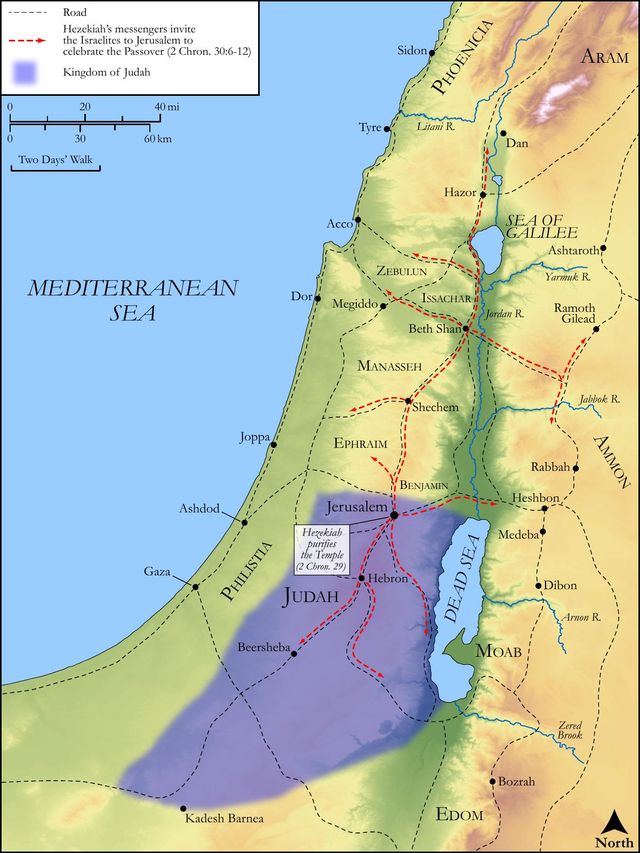
See on the biblical-era map
Study this verse
Public-domain commentary
Matthew Henry
From his Commentary on the Whole Bible. Henry comments on passages, not single verses — this entry covers 2 Chronicles 31:1–10. His two-level outline is real structure in the source text, so it is rendered as structure.
We have here an account of what was done after the passover. What was wanting in the solemnities of preparation for it before was made up in that which is better, a due improvement of it after. When the religious exercises of a Lord's day or a communion are finished we must not think that then the work is done. No, then the hardest part of our work begins, which is to exemplify the impressions of the ordinance upon our minds in all the instances of a holy conversation. So it was here; when all this was finished there was more to be done.
I.They applied themselves with vigour to destroy all the monuments of idolatry, Ch2 31:1.
The king had done what he could of this kind (Kg2 18:4), but the people could discover those profane relics which escaped the eye of the king's officers, and therefore they went out to see what they could do, Ch2 31:1. This was done immediately after the passover. Note, The comfort of communion with God should kindle in us a holy zeal and indignation against sin, against every thing that is offensive to God. If our hearts have been made to burn within us at an ordinance, that spirit of burning will consume the dross of corruption. What have I now to do any more with idols? Their zeal here in destroying the images and groves, the high places and altars, appeared,
1.In that they did this, not only in the cities of Judah and Benjamin, but in those of Ephraim and Manasseh. Some think that those cities are meant which had come under the protection and the jurisdiction of the kings of Judah. Others think that, Hoshea king of Israel not forbidding it, their zeal carried them out to the destruction of idolatry even in many parts of his kingdom. At least those that came out of Ephraim and Manasseh to keep the passover (as many did, Ch2 30:18) destroyed all their own images and groves, and did the like for as many more as they had influence upon or could make interest in for leave to do it. We should not only reform ourselves, but do all we can to reform others too.
2.They destroyed all: they utterly destroyed all; they spared none through favour or affection either to the images or to their worshippers; though ever so ancient, ever so costly, ever so beautiful, and ever so well patronised, yet they must all be destroyed. Note, Those that sincerely set themselves against sin will set themselves against all sin.
3.They would not return to their houses, though they had been long absent, till this was done. They could not be easy, nor think themselves safe, in their cities, as long as the images and groves, those betrayers and destroyers of their country, were left standing. Perhaps the prophet Isaiah pointed to this when, a little before, he spoke of a day in which men should cast away the very idols that they themselves had made. So surprising was this blessed change, Isa 2:20; Isa 31:6, Isa 31:7.
II.Hezekiah revived and restored the courses of the priests and Levites, which David had appointed and which had of late been put out of course, Ch2 31:2. The temple service was put into its proper method again, to run in the old channel. Every man was made to know his work, his place, his time, and what was expected from him. Note, Good order contributes much to the carrying on of a good work. The priests were appointed in their courses for burnt-offerings and peace-offerings; the Levites in their courses were some to minister to the priests, others to give thanks and praise. See Ch1 23:4, Ch1 23:5. And all this in the gates or courts of the tents of the Lord. The temple is here called a tent because the temple privileges are movable things and this temple was shortly to be removed.
III.He appropriated a branch of the revenue of his crown to the maintenance and support of the altar.
Though the people were to be at the charge of the daily offerings, and those on the sabbaths, new moons, and feasts, yet, rather than they should be burdened with the expense, he allowed out of his own estate, or out of his exchequer, for all those offerings, Ch2 31:3. It was a generous act of piety, wherein he consulted both God's honour and his people's ease, as a faithful servant to him and a tender father to them. Let princes and great men reckon that well bestowed, and set out to the best interest, which they give for the support and encouragement of religion in their country.
IV.He issued out an order to the inhabitants of Jerusalem first, Ch2 31:4 (that those who were nearest the temple, and both saved and got by being so, might give a good example to others), but which was afterwards extended to, or at least admitted by, the cities of Judah, that they should carefully pay in their dues, according to the law, to the priests and Levites. This had been long neglected, which made the work to be neglected (for a scandalous maintenance makes a scandalous ministry); but Hezekiah, having himself been liberal, might with a good grace require his subjects to be just to the temple service. And observe the end he aims at in recovering and restoring to the priests and Levites their portion, that they might be encouraged in the law of the Lord, in the study of it, and in doing their duty according to it. Observe here,
1.It is fit that ministers should be not only maintained, but encouraged, that they should not only be kept to do their work, but that they should also have wherewith to live comfortably, that they may do it with cheerfulness.
2.Yet they are to be maintained, not in idleness, pride, and luxury, but in the law of the Lord, in their observance of it themselves and in teaching others the good knowledge of it.
V.The people thereupon brought in their tithes very readily.
They wanted nothing but to be called upon; and therefore, as soon as the commandment came abroad, the first-fruits and all the holy things were duly brought in, Ch2 31:5, Ch2 31:6. What the priests had occasion for, for themselves and their families, they made use of, and the overplus was laid in heaps, Ch2 31:6. All harvest-time they were increasing these heaps, as the fruits of the earth were gathered in; for God was to have his dues out of them all. Though a prescription may be pleaded for a modus decimandi - tenth proportion, yet it cannot be pleaded pro non decminado - for the omission of the tenth. When harvest ended they finished their heaps, Ch2 31:7. Now here we have,
1.The account given to Hezekiah concerning those heaps. He questioned the priests and Levites concerning them, why they did not use what was paid in, but hoarded it up thus, (Ch2 31:9), to which it was answered that they had made use of all they had occasion for, for the maintenance of themselves and their families and for their winter store, and that this was that which was left over and above, Ch2 31:10. They did not hoard these heaps for covetousness, but to show what plentiful provision God by his law had made for them, if they could but have it collected and brought in, and that those who conscientiously give God his dues out of their estates bring a blessing upon all they have: Since they began to bring in the offerings the Lord has blessed his people. See for this Hag 2:19. "Try me," says God, "if you will not otherwise trust me, whether, upon your bringing the tithes into the store-house, you have not a blessing poured out upon you," Mal 3:10, Mal 3:11; Eze 44:30.
2.The acknowledgment which the king and princes made of it, Ch2 31:8. They gave thanks to God for his good providence, which gave them something to bring, and his good grace, which gave them hearts to bring it. And they also blessed the people, that is, commended them for their doing well now, without reproaching them for their former neglects. It is observable that after they had tasted the sweetness of God's ordinance, in the late comfortable passover, they were thus free in maintaining the temple service. Those that experience the benefit of a settled ministry will not grudge the expense of it.
Continue studying 2 Chronicles 31:10 across the web’s major study libraries — every link below opens this exact verse, chapter, or book on the destination site.
Read & Compare
 BibleGatewayThis verse in more than 200 translations and 70 languages.
 Bible.comThe YouVersion reader — hundreds of translations, reading plans, and highlights.
 ESV.orgCrossway's official English Standard Version reader.
 NET BibleThe NET translation with 60,000+ translators' notes on every rendering decision.
 STEP BibleTyndale House's free study tool — original text, vocabulary, and scholarly resources.
 BibliaLogos Bible Software's free web reader.
 USCCBThe New American Bible (Revised Edition) with the U.S. bishops' study notes.
Commentaries
 BibleHub CommentariesDozens of classic commentaries on this verse, gathered on one page.
 StudyLightMore than 100 commentary sets — the largest collection on the web.
 BibleRefPlain-English commentary on what this verse means, verse by verse.
 Enduring WordDavid Guzik's free commentary on this chapter, widely used by Bible teachers.
 Bible Study ToolsVerse commentary alongside Greek and Hebrew study aids.
Original Language & Research
- BibleHub InterlinearThe verse word by word — original language, transliteration, and English.
- BibleHub LexiconEvery word's original-language definition and Strong's entry.
 Blue Letter BibleDeep-study tools — Strong's numbers, concordance, and word studies.
 SefariaThe Hebrew text with Rashi and centuries of Jewish commentary.
Sermons, Hymns & Audio


TrulyRandomVerse is not affiliated with these sites and doesn’t control their content. They’re linked because they’re genuinely useful.
Summary
Second Chronicles 31:10 captures a pivotal moment during King Hezekiah's extensive spiritual reformation, as Azariah, the chief priest, reports an overwhelming surplus of provisions brought into the Temple. His declaration confirms that the people's renewed obedience in faithfully bringing their tithes and offerings resulted in a miraculous overflow, far exceeding the needs of the priests and Levites. This abundance serves as undeniable evidence of the Lord's tangible blessing upon His faithful people and powerfully underscores the divine principle that God honors and multiplies the generosity of those who sacrificially support His work.
Context
ShowHideLiterary Context
This verse is strategically placed within the Chronicler's detailed account of King Hezekiah's sweeping religious reforms, spanning from 2 Chronicles 29 through 2 Chronicles 31. Following the profound spiritual decline and idolatry under his father, King Ahaz, Hezekiah initiated a radical return to Yahweh worship. This revival began with the cleansing and rededication of the Temple (as seen in 2 Chronicles 29), followed by the restoration of the long-neglected Passover celebration (2 Chronicles 30). Crucially, Hezekiah then commanded the people to bring their prescribed portions for the priests and Levites, as mandated by the Mosaic Law (2 Chronicles 31:4). The people responded with extraordinary zeal, bringing in vast quantities of grain, wine, oil, honey, and tithes of everything they produced (2 Chronicles 31:5-6). Azariah's statement in 2 Chronicles 31:10 is a direct and authoritative answer to Hezekiah's inquiry in 2 Chronicles 31:9, where the king asks about the immense, overflowing piles of offerings. Azariah's response unequivocally confirms that this superabundance is a direct, divinely orchestrated result of the people's faithful and generous giving, serving as tangible proof of God's immediate blessing.
Historical & Cultural Context
Hezekiah's reign (c. 715-686 BC) marked a critical turning point after a period of intense spiritual apostasy under King Ahaz, who had not only closed the Temple but actively promoted pagan worship and idolatry throughout Judah. Hezekiah's reforms represented a profound national repentance and a radical return to the covenant stipulations of Yahweh worship. Culturally, the systematic support of the Levitical priesthood through tithes and offerings was not merely a religious custom but a foundational pillar of Israelite society. This system, outlined in the Mosaic Law (e.g., Numbers 18:21-24), ensured the proper functioning of the Temple, the maintenance of its services, and the spiritual instruction of the people, as the Levites had no tribal land inheritance and were wholly dedicated to sacred service. The overwhelming and prolonged response described in 2 Chronicles 31:7-8 indicates a deep societal repentance and a renewed, widespread commitment to God's commands, standing in stark contrast to the neglect of these duties in previous generations. The mention of "storehouses" reflects the practical necessity of gathering, organizing, and managing these vast contributions to sustain the large number of priests and Levites serving in Jerusalem and throughout the land of Judah.
Key Themes
ShowHideThis verse powerfully encapsulates several key theological themes central to the Chronicler's narrative and Hezekiah's reformation. Foremost is the theme of Divine Blessing in Response to Obedience. The extraordinary abundance described is not merely a natural outcome of a good harvest but is explicitly declared by Azariah as a direct, supernatural outpouring of God's favor: "for the LORD hath blessed his people." This resonates deeply with the Deuteronomic principle that faithful obedience to God's covenant commands invariably leads to blessing and prosperity (e.g., Deuteronomy 28:1-14). Another significant theme is the Power of Generosity and Faithfulness. The people's willing hearts and sacrificial giving, motivated by Hezekiah's righteous leadership, served as the catalyst for this divine provision. This demonstrates that human faithfulness in stewardship opens the channels for God's overflowing supply, a principle consistently affirmed throughout Scripture, notably in later prophetic appeals like Malachi 3:10. Finally, the verse highlights God's Abundant Provision, emphasizing that His supply is not merely sufficient but often superabundant ("we have had enough to eat, and have left plenty," "this great store"), demonstrating His boundless goodness and His ability to provide far beyond human expectation when His people honor Him with their substance.
Exposition and Analysis
ShowHideKey Word Analysis
ShowHideVerse Breakdown
ShowHide"And Azariah the chief priest of the house of Zadok answered him, and said,"
This opening clause establishes the speaker's authoritative position and the formal context of the statement as a direct response to King Hezekiah's inquiry, as recorded in 2 Chronicles 31:9. Azariah, identified as the chief priest from the esteemed priestly line of Zadok, held a position of significant spiritual and administrative leadership, lending immense weight, credibility, and official validation to his testimony. His answer is presented not as a casual observation but as a formal, divinely informed report.
"Since [the people] began to bring the offerings into the house of the LORD,"
This phrase precisely identifies the specific action that initiated the remarkable outcome. It highlights the people's renewed, collective obedience and their commitment to their covenant obligations, particularly their duty to support the Temple ministry and its personnel. The temporal marker "since... began" emphasizes a clear and direct cause-and-effect relationship between the people's faithfulness in giving and the subsequent, immediate blessing.
"we have had enough to eat, and have left plenty:"
This clause describes the immediate, tangible, and abundant result of the people's offerings. It indicates that the provisions were not merely sufficient for the sustenance of the priests and Levites ("enough to eat") but also yielded a significant and undeniable surplus ("left plenty"). This demonstrates God's immediate, generous, and overflowing provision, exceeding basic needs and providing beyond expectation.
"for the LORD hath blessed his people;"
This is the theological lynchpin and interpretive key of the entire verse. Azariah explicitly attributes the abundance not to human ingenuity, agricultural prowess, or fortuitous circumstances, but directly to the divine hand. This statement elevates the physical overflow into a profound spiritual testimony, affirming that the abundance is a direct manifestation of God's favor and blessing upon His obedient people. It powerfully underscores the principle that divine blessing is the ultimate and sovereign source of true prosperity and well-being.
"and that which is left [is] this great store."
This concluding clause reiterates and emphatically emphasizes the sheer magnitude of the surplus. The "great store" refers to the vast, overflowing piles of leftover provisions that initially prompted Hezekiah's inquiry. It serves as a visual, tangible, and quantitative confirmation of the extraordinary abundance, solidifying Azariah's testimony of God's overflowing and undeniable blessing.
Literary Devices
ShowHideThe verse employs several potent literary devices to convey its profound message. Testimony is central, as Azariah's statement functions as a direct, authoritative, and divinely inspired witness to God's faithfulness and provision. His words are not a mere observation but a declarative affirmation of divine action. The strategic repetition of terms related to abundance—"enough," "plenty," and "great store"—creates a powerful sense of Emphasis and underscores the overwhelming, superabundant nature of God's provision. This cumulative effect highlights the extraordinary and undeniable blessing. There is a clear Cause and Effect relationship meticulously established: the people's obedience in faithfully bringing offerings (the cause) directly leads to God's blessing and abundant provision (the effect). This reinforces the Deuteronomic theology of blessings for covenant faithfulness. Finally, the verse contains an explicit Attribution of Agency, directly naming "the LORD" as the one who "hath blessed his people," leaving no ambiguity about the divine source of the prosperity and ensuring all glory is directed to God.
Theological and Thematic Connections
ShowHideThis verse is a profound testament to the enduring biblical principle that God responds to the obedience, faithfulness, and generosity of His people with abundant blessing. It vividly illustrates the covenant faithfulness of God, who delights in providing for those who honor Him with their substance and prioritize His kingdom. The overflowing storehouses are not merely a physical phenomenon but a visible, tangible sign of an invisible divine hand at work, affirming that God is never outdone in generosity. This narrative serves as a powerful reminder that true security, provision, and prosperity come from trusting in God's promises and actively participating in His work, rather than relying solely on human effort, ingenuity, or limited resources. It emphasizes that when God's people are faithful in their stewardship, He ensures that His work is sustained and His servants are well-provided for, often beyond their expectations.
Reflection and Application
ShowHide2 Chronicles 31:10 offers a timeless and profoundly encouraging message for believers today, powerfully underscoring the vital connection between faithful stewardship and divine provision. It challenges us to deeply consider our own generosity and obedience, reminding us that our giving is not merely a financial transaction but a profound act of worship, trust, and partnership with God that He honors. When we faithfully contribute to the work of God's kingdom—whether through our tithes, offerings, time, talents, or spiritual gifts—we are actively creating channels for His blessings to flow, not only into our own lives but also into the ministries, communities, and people we support. This verse encourages us to give cheerfully, sacrificially, and expectantly, knowing with certainty that God is able to provide "exceedingly abundantly above all that we ask or think" (Ephesians 3:20). It calls us to trust that God's economy operates on principles of radical generosity and divine multiplication, ensuring that His work never lacks resources when His people are obedient. Ultimately, it invites us to experience the profound joy, peace, and security of living under the open windows of heaven, where God's provision is not just sufficient, but gloriously overflowing.
Questions for Reflection
ShowHideFAQ
ShowHideWhat does 2 Chronicles 31:10 teach us about God's character?
ShowHide2 Chronicles 31:10 profoundly reveals several key aspects of God's character. First, it demonstrates His unwavering faithfulness to His covenant promises, particularly those related to blessing obedience (as seen throughout Deuteronomy 28). Second, it showcases His boundless generosity and abundance, as He provides not just "enough" but "plenty" and a "great store," far exceeding human needs and expectations. Third, it highlights His divine responsiveness to His people's sincere repentance, renewed commitment, and obedience. The overflow is presented as a direct, tangible, and immediate result of the people's renewed dedication to Him. Finally, it underscores His ultimate sovereignty as the singular, ultimate source of all true blessing, explicitly stated by Azariah: "for the LORD hath blessed his people."
How does this verse relate to the concept of tithing today?
ShowHideWhile 2 Chronicles 31:10 describes the specific context of Old Testament offerings for the Temple and its ministers, it powerfully illustrates the underlying, enduring principle of tithing and generous giving: that God blesses His people when they faithfully support His work and honor Him with their firstfruits. Just as the offerings sustained the priests and Levites then, our giving today supports the church, its ministries, and various missions that carry out God's redemptive work in the world. The verse affirms that God is not dependent on our resources, but He graciously chooses to involve us in His divine provision, and in doing so, He demonstrates His faithfulness to provide for us in return. It echoes the challenge found in Malachi 3:10, where God invites His people to "test me in this... and see if I will not throw open the floodgates of heaven and pour out so much blessing that there will not be room enough to store it." It encourages a spirit of cheerful, trusting, and proactive generosity, rooted in the confidence that God will ensure His work is sustained and His people are abundantly cared for.
Christ-Centered Fulfillment
ShowHideWhile 2 Chronicles 31:10 describes a remarkable physical blessing under the Old Covenant, it powerfully foreshadows and finds its ultimate, spiritual fulfillment in Christ. Jesus is the ultimate "offering" and "heave offering" (Hebrews 10:10) who, through His perfect, once-for-all sacrifice on the cross, provided an immeasurable and eternal "great store" of spiritual blessings for His people, far exceeding any temporal or earthly provision. Just as the people's obedience unlocked physical abundance, faith in Christ unlocks an infinitely greater spiritual abundance—complete salvation, radical forgiveness, eternal life, and "every spiritual blessing in the heavenly places" (Ephesians 1:3). The New Covenant principle of giving, rooted in grace, love, and the Spirit rather than law, leads to a different kind of "plenty" – an abundance of grace that enables us to be generous in turn, as 2 Corinthians 9:8 declares, "And God is able to make all grace abound to you, so that in all things at all times, having all that you need, you will abound in every good work." Christ Himself is our ultimate provision, the true bread of life who ensures we will never spiritually hunger (John 6:35), and the living water who ensures we will never spiritually thirst (John 4:14). In Him, the promise of God's abundant blessing for His people is fully and eternally realized, not merely in temporal provision, but in eternal life and spiritual riches beyond all measure.