


2 Chronicles 31:11
- וַיֹּאמֶרvai·Yo·merand he saidH559Conj-w ¦ V-Qal-ConsecImperf-3msVerb Qal Consecutive Imperfect 3rd Singular Masculineוַandיֹּאמֶרhe said
- יְחִזְקִיָּהוּye·chiz·ki·Ya·huHezekiahH2396N-proper-mNoun Proper Masculine
- לְהָכִיןle·ha·Khinto prepareH3559Prep-l ¦ V-Hiphil-InfVerb Hiphil Infinitive Constructלְtoהָכִיןprepare
- לְשָׁכוֹתle·sha·KhotroomsH3957N-fpNoun Plural Feminine Absolute
- בְּבֵיתbe·Veitin [the] house ofH1004Prep-b ¦ N-mscNoun Singular Masculine Constructבְּinבֵית[the] house of
- יְהוָהYah·wehYahwehH3068N-properNoun Proper Title
- וַיָּכִינוּvai·ya·Khi·nuand they prepared [them]H3559Conj-w ¦ V-Hiphil-ConsecImperf-3mpVerb Hiphil Consecutive Imperfect 3rd Plural Masculineוַandיָּכִינוּthey prepared [them]
English is a literal word-by-word gloss of the Hebrew, not the KJV's wording. Why?
This is the original text the KJV's translators worked from — each Hebrew word with its own literal English meaning in this verse, prepared by scholars at Tyndale House, Cambridge. The KJV translates whole sentences, not word by word, so its wording differs: one Hebrew word can become several English words, and the KJV may choose “the LORD” where the gloss reads “Yahweh”. Both are faithful — they answer different questions. For the KJV's own rendering, switch to the KJV text.
Details
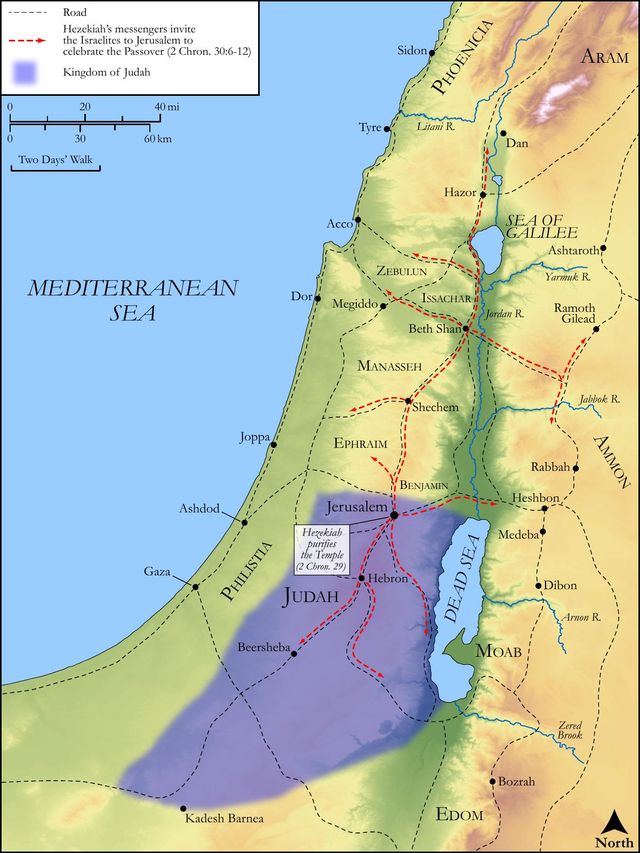
See on the biblical-era map
Study this verse
Public-domain commentary
Matthew Henry
From his Commentary on the Whole Bible. Henry comments on passages, not single verses — this entry covers 2 Chronicles 31:11–21. His three-level outline is real structure in the source text, so it is rendered as structure.
Here we have,
I.Two particular instances of the care of Hezekiah concerning church matters, having put them into good order, to keep them so. The tithes and other holy things being brought in, he provided,
1.That they should be carefully laid up, and not left exposed in loose heaps, liable to be wasted and embezzled. He ordered chambers to be made ready in some of the courts of the temple for store-chambers (Ch2 31:11), and into them the offerings were brought and there kept under lock and key, Ch2 31:12, Ch2 31:13. Treasures or store-keepers were appointed, who had the oversight of them, to see that moth and rust did not corrupt them nor thieves break through to steal. This wisdom of laying up the surplus in days of plenty we may learn from the ant, who provideth meat in summer. The laying up in store what was brought in was an encouragement to people to pay in their contributions. That will be given cheerfully by the public which appears to be well husbanded.
2.That they should be faithfully laid out, according to the uses they were intended for. Church treasures are not to be hoarded any longer than till there is occasion for them, lest even the rust should be a witness against those who hoard them. Officers were appointed, men (no doubt) of approved wisdom and faithfulness, to distribute the oblations of the Lord and the most holy things among the priests (Ch2 31:14), and to see that they all had a competent maintenance for themselves and their families. The law provided sufficient for them all, and therefore, if some had too little, it must be because others had too much; to prevent such inequality these officers were to go by some certain rule of proportion in the disposal of the incomes of the temple. It is said of the priests here (Ch2 31:18) that in their set office they sanctified themselves; in faith they sanctified themselves (so the word is), that is, as bishop Patrick explains it, they attended their ministry at the house of God, not doubting but they should be provided with all things necessary. Now, because they served God in that confidence, care was taken that they should not be made ashamed of their hope. Note, Those that sanctify themselves to God and his service in faith, believing that he will see them want for nothing that is good for them, shall certainly be fed. Out of the offerings of the Lord distribution was made,
(1.)To the priests in the cities (Ch2 31:15), who staid at home while their brethren went to Jerusalem, and did good there in teaching the good knowledge of the Lord. The preaching priests were maintained as well as the sacrificing priests, and those that abode by the stuff as well as those that warred the warfare.
(2.)To those that entered into the house of the Lord, all the males from three years old and upwards; for the male children even at that tender age, it seems, were allowed to come into the temple with their parents, and shared with them in this distribution, Ch2 31:16.
(3.)Even the Levites from twenty years old and upwards had their share, Ch2 31:17.
(4.)The wives and children of the priests and Levites had a comfortable maintenance out of those offerings, Ch2 31:18. In maintaining ministers, regard must be had to their families, that not they only, but theirs, may have food convenient. In some countries where ministers have their salary paid them by the state an addition is made to it upon the birth of a child.
(5.)The priests in the country, that lived in the fields of the suburbs, were not overlooked in this ministration, Ch2 31:19. Those also had their share who were inhabitants of the villages, though they might be supposed to live at a less expense.
II.A general character of Hezekiah's services for the support of religion, Ch2 31:20, Ch2 31:21.
1.His pious zeal reached to all the parts of his kingdom: Thus he did throughout all Judah; every part of the country, and not those only that lay next him, shared in the good fruits of his government.
2.He sincerely designed to please God, and approved himself to him in all he did: He wrought that which was good before the Lord his God; all his care was to do that which should be accepted of God, which was right (that is, agreeable to natural equity), and truth (that is, agreeable to divine revelation and his covenant with God), before the Lord; to do according to that law which is holy, just, and good.
3.What he began he went through with, prosecuted it with vigour, and did it with all his heart.
4.All his good intentions were brought to a good issue; whatever he did in the service of the house of God, and in the government of his kingdom, he prospered in it. Note, What is undertaken with a sincere regard to the glory of God will succeed to our own honour and comfort at last.
Continue studying 2 Chronicles 31:11 across the web’s major study libraries — every link below opens this exact verse, chapter, or book on the destination site.
Read & Compare
 BibleGatewayThis verse in more than 200 translations and 70 languages.
 Bible.comThe YouVersion reader — hundreds of translations, reading plans, and highlights.
 ESV.orgCrossway's official English Standard Version reader.
 NET BibleThe NET translation with 60,000+ translators' notes on every rendering decision.
 STEP BibleTyndale House's free study tool — original text, vocabulary, and scholarly resources.
 BibliaLogos Bible Software's free web reader.
 USCCBThe New American Bible (Revised Edition) with the U.S. bishops' study notes.
Commentaries
 BibleHub CommentariesDozens of classic commentaries on this verse, gathered on one page.
 StudyLightMore than 100 commentary sets — the largest collection on the web.
 BibleRefPlain-English commentary on what this verse means, verse by verse.
 Enduring WordDavid Guzik's free commentary on this chapter, widely used by Bible teachers.
 Bible Study ToolsVerse commentary alongside Greek and Hebrew study aids.
Original Language & Research
- BibleHub InterlinearThe verse word by word — original language, transliteration, and English.
- BibleHub LexiconEvery word's original-language definition and Strong's entry.
 Blue Letter BibleDeep-study tools — Strong's numbers, concordance, and word studies.
 SefariaThe Hebrew text with Rashi and centuries of Jewish commentary.
Sermons, Hymns & Audio


TrulyRandomVerse is not affiliated with these sites and doesn’t control their content. They’re linked because they’re genuinely useful.
Summary
Following a profound spiritual revival and an unprecedented celebration of Passover, 2 Chronicles 31:11 details King Hezekiah's practical and wise leadership in response to the overwhelming generosity of the people of Judah. The abundance of tithes and dedicated offerings brought to the Temple far exceeded the existing storage capacity, prompting Hezekiah to command the preparation of new, designated chambers within the sacred precinct to properly house these sacred provisions. This command underscores the necessity of good stewardship and order in managing the blessings of God and the tangible support for the Levites and priests serving in the Lord's house.
Context
ShowHideLiterary Context
This verse is strategically placed within the broader narrative of King Hezekiah's extensive religious reforms, which commenced with the purification of the Temple and the restoration of proper worship, as meticulously detailed in 2 Chronicles 29. This foundational act was swiftly followed by a nationwide call to celebrate Passover, an observance that had been tragically neglected for generations, a momentous event chronicled in 2 Chronicles 30. The spiritual fervor ignited by these reforms culminated in an extraordinary outpouring of generosity from the people, described in 2 Chronicles 31:5-10. The sheer volume of firstfruits, tithes, and dedicated gifts was so immense that the existing Temple facilities proved insufficient to contain them. Verse 11, therefore, serves as Hezekiah's immediate, decisive, and practical response to this blessed dilemma, setting the stage for the subsequent organization of the priestly and Levitical divisions and their sustained support, a theme further elaborated throughout the remainder of 2 Chronicles 31.
Historical & Cultural Context
King Hezekiah reigned over the Southern Kingdom of Judah during the late 8th century BCE, a period profoundly shaped by the spiritual apostasy of his father, King Ahaz, who had actively promoted idolatry and neglected the divinely ordained Temple worship. Hezekiah's reforms represented a radical and courageous departure from this decline, aiming to restore pure worship in accordance with the Mosaic Law. The Temple in Jerusalem functioned not only as the spiritual epicenter but also as the central economic and administrative hub for the tithes and offerings that were divinely mandated to sustain the priestly and Levitical classes, who, unlike other tribes, possessed no tribal land inheritance. The concept of "chambers" (לִשְׁכָּה, lishkah) within the Temple complex was a well-established architectural and functional feature, serving diverse purposes from the secure storage of sacred items and provisions to providing living quarters for priests and scribes. The unprecedented abundance of offerings necessitated the expansion or preparation of these existing structures, reflecting a profound cultural and theological understanding that divine blessing often manifested in material prosperity, which was then to be consecrated back to God's service.
Key Themes
ShowHideThe preparation of these chambers in response to the people's generosity powerfully illustrates several foundational themes. First, it vividly portrays Divine Blessing and Abundance, demonstrating God's unwavering faithfulness to pour out blessings upon a repentant and obedient people. The overflowing offerings are a tangible and undeniable sign of God's favor, echoing scriptural principles of generosity and divine provision found in passages such as the promise in Malachi 3:10. Second, Hezekiah's decisive command exemplifies Good Stewardship and Order. It was insufficient for the people merely to give; the king ensured that these sacred gifts were meticulously managed, securely stored, and equitably distributed, reflecting the paramount importance of meticulous organization and integrity in divine service. This administrative foresight is a hallmark of wise and godly leadership. Finally, this act signifies a profound Commitment to God's Work. The willingness to invest significant resources and effort into the physical infrastructure of the Temple underscores a deep-seated dedication not only to the act of worship itself but also to the practical, ongoing support of those ministering in God's house, recognizing that genuine spiritual revival has tangible, administrative implications for the entire community of faith.
Exposition and Analysis
ShowHideKey Word Analysis
ShowHideFrom the root meaning "strengthened of Jah," Hezekiah (H3169) is the name of the king of Judah who commanded the preparation of the chambers. His name itself, implying strength or fortification from God, resonates with his actions in restoring and fortifying the worship of the Lord in Judah. His leadership in this verse demonstrates the practical outworking of divine strengthening in administrative and spiritual reform.
The verb כּוּן (kûwn, H3559) is a primitive root meaning "to be erect" or "to stand perpendicular," and causatively, "to set up," "establish," "fix," or "make ready." In this context, Hezekiah's command was not a casual suggestion but a directive to firmly establish and make ready the necessary facilities. It implies intentionality, thoroughness, and a commitment to order, ensuring that the provisions were securely and properly housed for their sacred purpose.
The Hebrew word לִשְׁכָּה (lishkâh, H3957) refers to a specific room or hall within a building, often for storage, eating, or lodging. In the Temple context, these were purpose-built areas for sacred provisions. The use of this term emphasizes the king's intention for organized, reverent, and secure storage of the sacred provisions, reflecting careful planning and an understanding of the need for dedicated, proper spaces for God's work.
Verse Breakdown
ShowHide"Then Hezekiah commanded"
This opening clause immediately establishes King Hezekiah's decisive and authoritative leadership. Following the spiritual renewal and the people's spontaneous outpouring of generosity, Hezekiah recognized the critical practical need for infrastructure. His command demonstrates a leader who is not only spiritually sensitive to God's blessings but also administratively competent, ensuring that the fruit of revival is managed with order, foresight, and integrity.
"to prepare chambers in the house of the LORD"
This specifies the precise nature of Hezekiah's command—the creation, designation, or expansion of storage rooms. The phrase "in the house of the LORD" emphasizes that these were not ordinary storerooms but sacred spaces within the holy Temple complex, explicitly intended to house holy offerings. This action was a direct and necessary response to the overwhelming abundance of tithes and gifts, indicating that the existing facilities were insufficient. It powerfully underscores the practical implications of a thriving spiritual life and generous giving within the community.
"and they prepared [them]"
This concluding phrase indicates the immediate, diligent, and obedient response to Hezekiah's command. The collective "they" likely refers to the Temple officials, Levites, and skilled workers who were responsible for carrying out the king's directive. This swift execution signifies a unified commitment to the ongoing work of the Temple and the sustained support of its ministers, demonstrating that the spiritual fervor ignited by the revival extended seamlessly into practical, administrative tasks.
Literary Devices
ShowHideThe narrative in 2 Chronicles 31:11 employs Narrative Progression, presenting a clear and logical sequence of events: profound spiritual revival leads to an outpouring of abundant giving, which in turn necessitates practical administrative solutions. This verse functions as a pivotal point, seamlessly transitioning the narrative from the initial outpouring of devotion and generosity to the organized, systematic management of the Temple's newly abundant resources. There is an implicit Contrast with the preceding reigns of spiritual neglect and disorder, particularly that of King Ahaz, where the Temple facilities and the support for its ministers had fallen into disrepair and disuse. Hezekiah's actions stand in stark opposition to this past spiritual apathy and administrative chaos. Furthermore, the "chambers" themselves function as powerful Symbolism, representing not merely physical storage spaces but also the king's profound commitment to order, meticulous stewardship, and the tangible manifestation of a renewed covenant relationship with God. They symbolize the essential infrastructure required for sustaining spiritual life and service within the community of faith.
Theological and Thematic Connections
ShowHide2 Chronicles 31:11 offers profound theological insights into the nature of divine blessing, human responsibility, and the practical outworking of faith. It teaches that genuine spiritual revival is not merely an emotional or ephemeral experience but inevitably leads to tangible expressions of generosity and a deep commitment to supporting God's work. The overwhelming abundance of offerings powerfully demonstrates God's faithfulness to bless His people when they turn back to Him in repentance and obedience, and Hezekiah's response highlights the human responsibility to manage these blessings with wisdom, order, and integrity. This verse underscores that meticulous stewardship is an integral and indispensable part of worship, ensuring that resources are available to sustain those dedicated to ministry and to facilitate the ongoing, orderly worship of God. It is a powerful testament to the principle that when God's people are faithful in their giving, God provides abundantly, and wise, godly leadership ensures these provisions are handled righteously for His glory and the good of His people.
Reflection and Application
ShowHideThis passage from 2 Chronicles 31:11 serves as a profound and enduring model for believers and church leaders today. It powerfully reminds us that spiritual fervor, when truly authentic and God-breathed, will inevitably manifest in tangible and practical ways, including sacrificial generosity and a renewed commitment to God's kingdom. When God moves among His people, stirring hearts to give abundantly, it creates a "problem" of blessing—an overflow that demands wise, diligent, and orderly administration. Just as King Hezekiah meticulously ensured that the Temple had adequate and organized facilities for the unprecedented influx of offerings, so too must churches, ministries, and individual believers today prioritize good stewardship of all the resources—financial, material, and human—that God graciously entrusts to them. This involves not only unwavering transparency and accountability in handling funds but also proactive planning, strategic organization, and the establishment of robust systems that can effectively manage, protect, and distribute God's blessings for the furtherance of His kingdom. Our physical infrastructures, organizational structures, and administrative practices should always be prepared to accommodate and facilitate the spiritual work God is doing among us, reflecting our deep commitment to order, faithfulness, and the ongoing support of those called to full-time ministry.
Questions for Reflection
ShowHideFAQ
ShowHideWhat was the significance of preparing "chambers" in the Temple, and why was it necessary?
ShowHideThe preparation of new "chambers" (storage rooms) in the Temple, as commanded by Hezekiah in 2 Chronicles 31:11, was highly significant and absolutely necessary. It was a direct and practical response to the overwhelming abundance of tithes and offerings brought by the people of Judah. Following Hezekiah's extensive religious reforms and the revival of true worship, the people's spontaneous and generous giving (detailed in 2 Chronicles 31:5-10) far exceeded the existing Temple capacity. These chambers were essential for properly organizing, securely storing, and protecting the sacred provisions—such as grain, wine, oil, and other dedicated gifts—which were vital for sustaining the priests and Levites who served in the Temple. This act signified Hezekiah's excellent leadership in practical administration, demonstrating that the outpouring of spiritual devotion must be matched with meticulous stewardship and order, thereby facilitating the ongoing and orderly service of God and ensuring the welfare of those ministering in His house.
Christ-Centered Fulfillment
ShowHideThe preparation of chambers in the Temple in 2 Chronicles 31:11, necessitated by the overwhelming abundance of offerings, beautifully foreshadows the ultimate spiritual abundance found in Christ. While Hezekiah's chambers were physical spaces designed for the orderly storage of material provisions, Jesus Christ is the ultimate "storehouse" of all spiritual blessings and the very fullness of God. In Him, "all the treasures of wisdom and knowledge are hidden" (Colossians 2:3), and it pleased God that "in Him dwells all the fullness of the Godhead bodily" (Colossians 2:9). The material overflow experienced in Hezekiah's day points prophetically to the spiritual overflow of grace and truth that comes exclusively through Jesus Christ, from whose "fullness we have all received, grace upon grace" (John 1:16). Moreover, just as the physical chambers supported the earthly Temple ministry and sustained its workers, Christ, as the head of the Church, provides all that is needed for His spiritual body to function and thrive. The "chambers" of the New Covenant are not physical rooms but the hearts of believers, indwelt by the Holy Spirit, where God's manifold grace is received and then distributed through spiritual gifts for the building up of the saints and the equipping of the church for ministry (Ephesians 4:7-12). Thus, the order, provision, and abundance seen in Hezekiah's Temple reforms point forward to the perfect provision, spiritual order, and enduring sustenance established in the Church through Christ, who is the true and living Temple.