


2 Chronicles 12:4
- וַיִּלְכֹּדvai·yil·Kodand he capturedH3920Conj-w ¦ V-Qal-ConsecImperf-3msVerb Qal Consecutive Imperfect 3rd Singular Masculineוַandיִּלְכֹּדhe captured
- אֶת'et<obj.>H853DirObjMParticle Object Indicator
- עָרֵי'a·Rei[the] cities ofH5892N-mpcNoun Plural Masculine Construct
- הַמְּצֻרוֹתha·me·tzu·Rot<the> fortificationsH4694Art ¦ N-fpNoun Plural Feminine Absoluteהַ<the>מְּצֻרוֹתfortifications
- אֲשֶׁר'a·SherwhichH834RelParticle Relative
- לִיהוּדָהli·hu·Dah[belonged] to JudahH3063Prep-l ¦ N-properNoun Proper Locationלִ[belonged] toיהוּדָהJudah
- וַיָּבֹאvai·ya·Vo'and he cameH935Conj-w ¦ V-Qal-ConsecImperf-3msVerb Qal Consecutive Imperfect 3rd Singular Masculineוַandיָּבֹאhe came
- עַד'adtoH5704PrepPreposition
- יְרוּשָׁלִָםye·ru·sha·LimJerusalemH3389N-properNoun Proper Location
English is a literal word-by-word gloss of the Hebrew, not the KJV's wording. Why?
This is the original text the KJV's translators worked from — each Hebrew word with its own literal English meaning in this verse, prepared by scholars at Tyndale House, Cambridge. The KJV translates whole sentences, not word by word, so its wording differs: one Hebrew word can become several English words, and the KJV may choose “the LORD” where the gloss reads “Yahweh”. Both are faithful — they answer different questions. For the KJV's own rendering, switch to the KJV text.
Details
See on the biblical-era map
Study this verse
Public-domain commentary
Matthew Henry
From his Commentary on the Whole Bible. Henry comments on passages, not single verses — this entry covers 2 Chronicles 12:1–12. His four-level outline is real structure in the source text, so it is rendered as structure.
Israel was very much disgraced and weakened by being divided into two kingdoms; yet the kingdom of Judah, having both the temple and the royal city, both the house of David and the house of Aaron, might have done very well if they had continued in the way of their duty; but here we have all out of order there.
I.Rehoboam and his people left God:
He forsook the law of the Lord, and so in effect forsook God, and all Israel with him, Ch2 12:1. He had his happy triennium, when he walked in the way of David and Solomon (Ch2 11:17), but it expired, and he grew remiss in the worship of God; in what instances we are not told, but he fell off, and Judah with him, here called Israel, because they walked in the evil ways into which Jeroboam had drawn the kingdom of Israel. Thus he did when he had established the kingdom and strengthened himself. As long as he thought his throne tottered he kept to his duty, that he might make God his friend; but, when he found it stood pretty firmly, he thought he had no more occasion for religion; he was safe enough without it. Thus the prosperity of fools destroys them. Jeshurun waxed fat and kicked. When men prosper, and are in no apprehension of troubles, they are ready to say to God, Depart from us.
II.God quickly brought troubles upon them, to awaken them, and recover them to repentance, before their hearts were hardened.
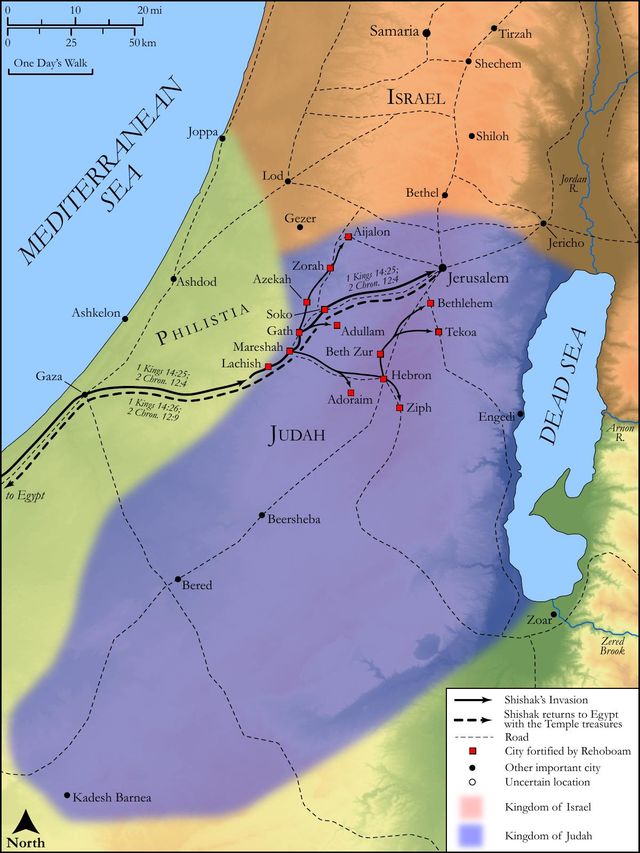
It was but in the fourth year of Rehoboam that they began to corrupt themselves, and in the fifth year the king of Egypt came up against them with a vast army, took the fenced cities of Judah, and came against Jerusalem, Ch2 12:2, Ch2 12:3, Ch2 12:4. This great calamity coming upon them so soon after they began to desert the worship of God, by a hand they had little reason to suspect (having had a great deal of friendly correspondence with Egypt in the last reign), and coming with so much violence that all the fenced cities of Judah, which Rehoboam had lately fortified and garrisoned and on which he relied much for the safety of his kingdom, fell immediately into the hands of the enemy, without making any resistance, plainly showed that it was from the Lord, because they had transgressed against him.
III.Lest they should not readily or not rightly understand the meaning of this providence, God by the word explains the rod, Ch2 12:5.
When the princes of Judah had all met at Jerusalem, probably in a great council of war, to concert measures for their own safety in this critical juncture, he sent a prophet to them, the same that had brought them an injunction from God not to fight against the ten tribes (Ch2 11:2), Shemaiah by name; he told them plainly that the reason why Shishak prevailed against them was not because they had been impolitic in the management of their affairs (which perhaps the princes in this congress were at this time scrutinizing), but because they had forsaken God. God never leaves any till they first leave him.
IV.The rebukes both of the word and of the rod being thus joined, the king and princes humbled themselves before God for their iniquity, penitently acknowledged the sin, and patiently accepted the punishment of it, saying, The Lord is righteous, Ch2 12:6. "We have none to blame but ourselves; let God be clear when he judgeth." Thus it becomes us, when we are under the rebukes of Providence, to justify God and judge ourselves. Even kings and princes must either bend or break before God, either be humbled or be ruined.
V.Upon the profession they made of repentance God showed them some favour, saved them from ruin, and yet left them under some remaining fears of the judgment, to prevent their revolt again.
1.God, in mercy, prevented the destruction they were now upon the brink of. Such a vast and now victorious army as Shishak had, having made themselves masters of all the fenced cities, what could be expected but that the whole country, and even Jerusalem itself, would in a little time be theirs? But when God saith, Here shall the proud waves be stayed, the most threatening force strangely dwindles and becomes impotent. Here again the destroying angel, when he comes to Jerusalem, is forbidden to destroy it: "My wrath shall not be poured out upon Jerusalem; not at this time, not by this hand, not utterly to destroy it," Ch2 12:7, Ch2 12:12. Note, Those that acknowledge God righteous in afflicting them shall find him gracious. Those that humble themselves before him shall find favour with him. So ready is the God of mercy to take the first occasion to show mercy. If we have humbled hearts under humbling providences, the affliction has done its work, and it shall either be removed or the property of it altered.
2.He granted them some deliverance, not complete, but in part; he gave them some advantages against the enemy, so that they recruited a little; he gave them deliverance for a little while, so some. They reformed but partially, and for a little while, soon relapsing again; and, as their reformation was, so was their deliverance. Yet it is said (Ch2 12:12), in Judah things went well, and began to look with a better face.
(1.)In respect of piety. There were good things in Judah (so it is in the margin), good ministers, good people, good families, who were made better by the calamities of their country. Note, In times of great corruption and degeneracy it is some comfort if there be a remnant among whom good things ar found; this is a ground of hope in Israel.
(2.)In respect of prosperity. In Judah things went ill when all the fenced cities were taken (Ch2 12:4), but when they repented the posture of their affairs altered, and things went well. Note, If things do not go so well as we could wish, yet we have reason to take notice of it with thankfulness if they go better than was to have been expected, better than formerly, and better than we deserved. We should own God's goodness if he do but grant us some deliverance.
3.Yet he left them to smart sorely by the hand of Shishak, both in their liberty and in their wealth.
(1.)In their liberty (Ch2 12:8): They shall be his servants (that is, they shall lie much at his mercy and be put under contribution by him, and some of them perhaps be taken prisoners and held in captivity by him), that they may know my service, and the service of the kingdoms of the countries. They complained, it may be, of the strictness of their religion, and forsook the law of the Lord (Ch2 12:1) because they thought it a yoke to hard, too heavy, upon them. "Well," saith God, "let them better themselves if they can; let the neighbouring princes rule them awhile, since they are not willing that I should rule them, and let them try how they like that. They might have served God with joyfulness and gladness of heart, and would not; let them serve their enemies then in hunger and thirst (Deu 28:47, Deu 28:48), till they think of returning to their first Master, for then it was better with them," Hos 2:7. This, some think, is the meaning of Eze 20:24, Eze 20:25. Because they despised my statutes, I gave them statutes that were not good. Note,
[1.]The more God's service is compared with other services the more reasonable and easy it will appear.
[2.]Whatever difficulties or hardships we may imagine there are in the way of obedience, it is better a thousand times to go through them than to expose ourselves to the punishment of disobedience. Are the laws of temperance thought hard? The effects of intemperance will be much harder. The service of virtue is perfect liberty; the service of lust is perfect slavery.
(2.)In their wealth. The king of Egypt plundered both the temple and the exchequer, the treasuries of both which Solomon left very full; but he took them away; yea, he took all, all he could lay his hands on, Ch2 12:9. This was what he came for. David and Solomon, who walked in the way of God, filled the treasuries, one by war and the other by merchandise; but Rehoboam, who forsook the law of God, emptied them. The taking away of the golden shields, and the substituting of brazen ones in their place (Ch2 12:9-11), we had an account of before, Kg1 14:25-28.
Continue studying 2 Chronicles 12:4 across the web’s major study libraries — every link below opens this exact verse, chapter, or book on the destination site.
Read & Compare
 BibleGatewayThis verse in more than 200 translations and 70 languages.
 Bible.comThe YouVersion reader — hundreds of translations, reading plans, and highlights.
 ESV.orgCrossway's official English Standard Version reader.
 NET BibleThe NET translation with 60,000+ translators' notes on every rendering decision.
 STEP BibleTyndale House's free study tool — original text, vocabulary, and scholarly resources.
 BibliaLogos Bible Software's free web reader.
 USCCBThe New American Bible (Revised Edition) with the U.S. bishops' study notes.
Commentaries
 BibleHub CommentariesDozens of classic commentaries on this verse, gathered on one page.
 StudyLightMore than 100 commentary sets — the largest collection on the web.
 BibleRefPlain-English commentary on what this verse means, verse by verse.
 Enduring WordDavid Guzik's free commentary on this chapter, widely used by Bible teachers.
 Bible Study ToolsVerse commentary alongside Greek and Hebrew study aids.
Original Language & Research
- BibleHub InterlinearThe verse word by word — original language, transliteration, and English.
- BibleHub LexiconEvery word's original-language definition and Strong's entry.
 Blue Letter BibleDeep-study tools — Strong's numbers, concordance, and word studies.
 SefariaThe Hebrew text with Rashi and centuries of Jewish commentary.
Sermons, Hymns & Audio


TrulyRandomVerse is not affiliated with these sites and doesn’t control their content. They’re linked because they’re genuinely useful.
Summary
This verse concisely narrates the swift and devastating military campaign of Shishak, King of Egypt, against the southern kingdom of Judah. It details his successful conquest of the fortified cities that King Rehoboam had meticulously built and strengthened, culminating in Shishak's direct advance to Jerusalem. The rapid fall of these seemingly impregnable defenses serves as a profound testament to divine judgment upon Judah for their widespread unfaithfulness to the Lord, powerfully illustrating the utter futility of human reliance and strategic planning when God's protection is withdrawn.
Context
ShowHideLiterary Context
This verse is strategically placed within the narrative of King Rehoboam's reign, immediately following the division of the united monarchy. The preceding chapters, particularly 2 Chronicles 10 and 2 Chronicles 11, establish the political fragmentation and Rehoboam's initial efforts to secure his kingdom by fortifying numerous cities throughout Judah, as explicitly listed in 2 Chronicles 11:5-12. However, the narrative takes a sharp turn in 2 Chronicles 12:1, revealing Judah's profound apostasy and abandonment of the Lord's law. The subsequent invasion by Shishak, introduced in 2 Chronicles 12:2-3, is presented not merely as a geopolitical event but as a direct, divinely ordained consequence of this unfaithfulness, intended to humble the people. Therefore, 2 Chronicles 12:4 marks the devastating progression of this judgment, showcasing the rapid collapse of Judah's human-made defenses in the face of God's discipline.
Historical & Cultural Context
Shishak, widely identified with Pharaoh Sheshonk I of Egypt's 22nd Dynasty, launched a well-documented military campaign into Canaan around 925 BCE. This invasion represented a significant geopolitical shift, reasserting Egyptian dominance in the region after the decline of the united Israelite monarchy under Solomon. In the ancient Near East, "fenced cities" (fortified cities) were vital defensive structures, serving as strategic strongholds to protect trade routes, agricultural lands, and populations. Their construction was a massive undertaking, requiring immense resources, labor, and engineering prowess, and thus symbolized a king's power, foresight, and ability to provide security for his realm. The fact that Shishak was able to "take" these cities, often through siege warfare or overwhelming force, indicates a highly successful and overwhelming military campaign. This historical reality underscores the severity of the threat to Judah's sovereignty and very existence, demonstrating the profound vulnerability of the kingdom despite its extensive fortifications.
Key Themes
ShowHideThe fall of Judah's "fenced cities" powerfully illustrates several core theological and narrative themes within Chronicles. Firstly, it highlights the Consequences of Disobedience: Judah's security, meticulously built upon physical fortifications and military strength, crumbled rapidly and decisively when their spiritual foundation was compromised by their forsaking of the Lord's covenant. Secondly, it underscores Divine Sovereignty and Judgment: Shishak's invasion is not portrayed as a random act of aggression but as an instrument of God's righteous discipline. This demonstrates that even powerful foreign kings and their armies are ultimately under God's control, used by Him to bring about His purposes and humble those who defy His law, as seen in the broader narrative of God's interaction with nations throughout 2 Chronicles. Lastly, the verse powerfully conveys the Futility of Human Reliance: Despite Rehoboam's extensive efforts in fortifying the land, as meticulously detailed in 2 Chronicles 11, these "fenced cities" offered no ultimate protection against a divinely ordained judgment. This reinforces the timeless biblical principle articulated in Psalm 127:1, that "unless the Lord builds the house, those who build it labor in vain." Human strength and strategic planning are ultimately insufficient without God's blessing and protective hand, a truth echoed in Proverbs 21:31.
Exposition and Analysis
ShowHideKey Word Analysis
ShowHideA primitive root meaning "to catch (in a net, trap or pit); generally, to capture or occupy." In this military context, lâkad denotes the decisive act of conquest and seizure. It signifies not merely an attack, but a successful and complete taking possession of the cities, implying overwhelming force and the inability of the defenders to resist. The simplicity of the verb underscores the swiftness and effectiveness of Shishak's campaign.
Meaning "a hemming in, i.e. (objectively) a mound (of siege), or (subjectively) a rampart (of protection), (abstractly) fortification." This term refers to a fortified place, a stronghold, or a city equipped with strong defensive walls and possibly other siege-resistant structures. Its use here emphasizes the significant investment and strategic importance of these cities, highlighting the irony that even such robust defenses could not withstand the invasion.
Meaning "celebrated; Jehudah (or Judah), the name of five Israelites; also of the tribe descended from the first, and of its territory." This refers to the southern kingdom, comprising the tribes of Judah and Benjamin, which remained loyal to the Davidic dynasty after the kingdom's division. Its inclusion specifies the target of Shishak's campaign, underscoring that the judgment was directly upon God's covenant people who had strayed.
Verse Breakdown
ShowHide"And he took the fenced cities"
This opening clause immediately establishes the success of Shishak's military campaign. The "fenced cities" refer to the strategically important, heavily fortified urban centers that King Rehoboam had diligently built and provisioned throughout Judah (as detailed in 2 Chronicles 11). The act of "taking" them implies a systematic conquest, not just isolated skirmishes, indicating the overwhelming nature of the Egyptian invasion and, more profoundly, the withdrawal of divine protection from Judah.
"which [pertained] to Judah"
This clarifying phrase specifies the geographical and political scope of the invasion. These were not foreign territories but cities within the southern kingdom, directly under the authority of Rehoboam. The loss of these cities represented a significant blow to Judah's territorial integrity, economic resources, and national morale, directly impacting the very heart of the kingdom and emphasizing that the divine judgment was specifically directed at God's unfaithful covenant people.
"and came to Jerusalem"
This final clause marks the dramatic culmination of Shishak's successful campaign. Having systematically conquered the outlying fortifications, he had now cleared all major obstacles and arrived at the gates of the capital city. Jerusalem, the city of David, the seat of the Davidic dynasty, and the sacred location of the Temple, was now directly threatened. This signifies the ultimate vulnerability of Judah, as their last and most vital line of defense was now exposed, highlighting the severity and completeness of the divine discipline.
Literary Devices
ShowHideThe verse employs Narrative Progression, moving from the general conquest of the "fenced cities" to the specific and climactic arrival at "Jerusalem." This creates a sense of escalating tension and impending doom, emphasizing the relentless and successful nature of Shishak's campaign. A strong element of Irony is present: Rehoboam's diligent efforts to fortify Judah, as extensively detailed in 2 Chronicles 11, ultimately proved futile when divine favor was withdrawn due to the nation's unfaithfulness. The very "fenced cities" intended to provide security became symbols of Judah's vulnerability. Furthermore, the "fenced cities" themselves serve as Symbolism, representing human reliance on physical strength, strategic planning, and material defenses. Their rapid fall symbolizes the inadequacy and ultimate futility of human efforts when God's protection is removed due to covenant disobedience.
Theological and Thematic Connections
ShowHideThe fall of Judah's "fenced cities" serves as a profound theological statement on the nature of true security and the devastating consequences of covenant unfaithfulness. It powerfully illustrates that physical fortifications, military might, or human ingenuity, no matter how impressive or well-intentioned, offer no ultimate defense against divine judgment. When a people or an individual turns away from God's law and covenant, they forfeit the divine protection that is infinitely more potent than any earthly stronghold. God, in His absolute sovereignty, can use even powerful foreign nations and their armies as instruments of His discipline, reminding His people that their ultimate well-being, peace, and security are entirely dependent on their faithful relationship with Him, not on their material assets or strategic advantages. This event underscores a consistent Old Testament principle: blessings follow obedience, and curses or judgment follow disobedience, a foundational theme woven throughout the Deuteronomic history and the Chronicler's narrative.
Reflection and Application
ShowHideThe narrative of 2 Chronicles 12:4 offers a timeless and piercing lesson for individuals and communities in every age. It compels us to critically examine where we place our ultimate trust and security. Are our "fenced cities" built on material wealth, professional achievements, social status, intellectual prowess, or even our own perceived wisdom and control over our circumstances? This verse starkly reminds us that such human-made defenses, while perhaps offering temporary comfort or a sense of control, are ultimately vulnerable and will prove insufficient when our spiritual foundation is compromised. Just as Judah's physical walls could not protect them from the consequences of their unfaithfulness to God, so too our earthly safeguards can fail if we neglect our vital relationship with the Almighty. True security, lasting peace, and genuine prosperity are found not in what we can build, accumulate, or achieve, but in humble, unwavering reliance on the Lord, seeking His guidance, and diligently obeying His commands. This passage calls us to regularly assess the state of our hearts, to repent of any spiritual drift or misplaced trust, and to consciously re-anchor our lives in Christ, recognizing that He alone is our impregnable fortress and our eternal refuge.
Questions for Reflection
ShowHideFAQ
ShowHideWhy did God allow Shishak to conquer Judah's cities, especially after Rehoboam had fortified them so well?
ShowHideGod allowed Shishak's conquest as a direct consequence and instrument of divine discipline for Judah's widespread unfaithfulness. As 2 Chronicles 12:1 explicitly states, "when Rehoboam had established the kingdom, and had strengthened himself, he forsook the law of the LORD, and all Israel with him." The "fenced cities" that Rehoboam meticulously built and provisioned (see 2 Chronicles 11:5-12) were impressive human defenses, but they could not withstand God's righteous judgment. This event powerfully underscores the biblical principle that true security and lasting protection come from obedience and faithful reliance on God, not from human strength, strategic planning, or physical fortifications alone. God used Shishak to humble Judah and bring them back to a place of repentance, as is evident later in 2 Chronicles 12:6-7.
What is the significance of Shishak "coming to Jerusalem" after taking the fenced cities?
ShowHideShishak's advance to Jerusalem signifies the culmination of his successful campaign and the ultimate, profound vulnerability of Judah. Jerusalem was far more than just the political capital; it was the city of David, the sacred location of the Temple (God's dwelling place), and the powerful symbol of God's covenant with His people and the Davidic dynasty. The systematic fall of the "fenced cities" meant that there were no more significant physical obstacles between Shishak's overwhelming army and the very heart of the kingdom. His arrival at Jerusalem's gates represented the most severe and immediate threat to the Davidic line and the continued existence of Judah as a distinct, sovereign kingdom. This dramatic climax highlights the depth and completeness of God's disciplinary action against His unfaithful people, demonstrating that even the most sacred symbols and places are not immune to judgment when the people forsake the Lord.
Christ-Centered Fulfillment
ShowHideThe narrative of Judah's "fenced cities" falling to Shishak, a devastating consequence of their unfaithfulness, powerfully foreshadows the ultimate futility of all human attempts to secure salvation, righteousness, or protection apart from God. Just as King Rehoboam's meticulously constructed physical strongholds proved utterly inadequate against divine judgment, so too all human efforts, good works, religious rituals, or self-righteousness are entirely insufficient to stand against the righteous judgment for sin. However, in Christ, we find the true and eternal "fenced city," an impregnable fortress that no enemy, no sin, and no judgment can breach. He is our ultimate security, the one in whom "we have redemption through his blood, the forgiveness of sins, in accordance with the riches of God's grace" (Ephesians 1:7). Unlike the temporary, earthly defenses that failed Judah, Christ offers a salvation that is "eternal" (Hebrews 5:9) and a security from which His sheep "shall never perish; no one will snatch them out of my hand" (John 10:28). He is the true Lamb of God who takes away the sin of the world (John 1:29), thereby removing the very cause of divine judgment that afflicted Judah. In Him, we are "complete" (Colossians 2:10), finding our refuge, strength, and eternal safety not in our own works or fortifications, but in His perfect, finished work on the cross.