


1 Samuel 6:4
- וַיֹּאמְרוּvai·yo·me·Ruand they saidH559Conj-w ¦ V-Qal-ConsecImperf-3mpVerb Qal Consecutive Imperfect 3rd Plural Masculineוַandיֹּאמְרוּthey said
- מָהmahwhat?H4100InterrogPronoun Interrogative
- הָאָשָׁםha·'a·Sham[is] the guilt offeringH817Art ¦ N-msNoun Singular Masculine Absoluteהָ[is] theאָשָׁםguilt offering
- אֲשֶׁר'a·SherwhichH834RelParticle Relative
- נָשִׁיבna·Shivwe will send backH7725V-Hiphil-Imperf-1cpVerb Hiphil Imperfect 1st Plural common gender
- לוֹloto <the> himPrep-l ¦ 3msSuffix Personal 3rd Singular Masculineלto <the>וֹhim
- וַיֹּאמְרוּvai·yo·me·Ruand they saidH559Conj-w ¦ V-Qal-ConsecImperf-3mpVerb Qal Consecutive Imperfect 3rd Plural Masculineוַandיֹּאמְרוּthey said
- מִסְפַּרmis·Par[the] number ofH4557N-mscNoun Singular Masculine Construct
- סַרְנֵיsar·Nei[the] rulers ofH5633N-mpcNoun Plural Masculine Construct
- פְלִשְׁתִּיםfe·lish·Tim[the] PhilistinesH6430N-mpNoun Gentilic Plural Masculine Absolute
- חֲמִשָּׁהcha·mi·ShahfiveH2568N-csNoun Singular common gender Absolute
- טְחֹרֵיte·cho·Ritumors ofH2914N-mpcNoun Plural Masculine Construct
- זָהָבza·HavgoldH2091N-msNoun Singular Masculine Absolute
- וַחֲמִשָּׁהva·cha·mi·Shahand fiveH2568Conj-w ¦ N-csNoun Singular common gender Absoluteוַandחֲמִשָּׁהfive
- עַכְבְּרֵי'akh·be·Reimice ofH5909N-mpcNoun Plural Masculine Construct
- זָהָבza·HavgoldH2091N-msNoun Singular Masculine Absolute
- כִּיkiforH3588PrtParticle Conditional
- מַגֵּפָהma·ge·Faha plagueH4046N-fsNoun Singular Feminine Absolute
- אַחַת'a·ChatoneH259N-fsNoun Singular Feminine Absolute
- לְכֻלָּםle·khu·Lam[belongs] to all of themH3605Prep-l ¦ N-msc ¦ 3mpNoun Singular Masculine Constructלְ[belongs] toכֻלָּall ofםthem
- וּלְסַרְנֵיכֶםu·le·sar·nei·Khemand to your rulersH5633Conj-w ¦ Prep-l ¦ N-mpc ¦ 2mpNoun Plural Masculine Constructוּandלְtoסַרְנֵיrulersכֶםyour
English is a literal word-by-word gloss of the Hebrew, not the KJV's wording. Why?
This is the original text the KJV's translators worked from — each Hebrew word with its own literal English meaning in this verse, prepared by scholars at Tyndale House, Cambridge. The KJV translates whole sentences, not word by word, so its wording differs: one Hebrew word can become several English words, and the KJV may choose “the LORD” where the gloss reads “Yahweh”. Both are faithful — they answer different questions. For the KJV's own rendering, switch to the KJV text.
Details
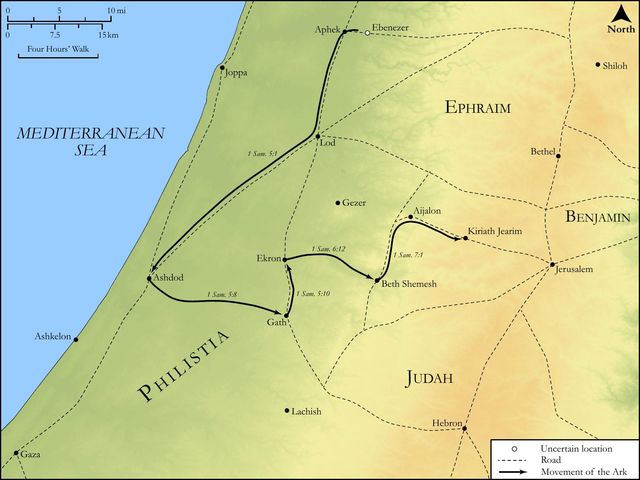
See on the biblical-era map
Study this verse
Public-domain commentary
Matthew Henry
From his Commentary on the Whole Bible. Henry comments on passages, not single verses — this entry covers 1 Samuel 6:1–9. His two-level outline is real structure in the source text, so it is rendered as structure.
The first words of the chapter tell us how long the captivity of the ark continued - it was in the country of the Philistines seven months. In the field of the Philistines (so it is in the original), from which some gather that, having tried it in all their cities, and found it a plague to the inhabitants of each, at length they sent it into the open fields, upon which mice sprang up out of the ground in great multitudes, and destroyed the corn which was now nearly ripe and marred the land. With that judgment they were plagued (Sa1 6:5), and yet it is not mentioned in the foregoing chapter; so God let them know that wherever they carried the ark, so long as they carried it captive, they should find it a curse to them. Cursed shalt thou be in the city, and cursed in the field, Deu 28:16. But, most take it to signify, as we render it, The country of the Philistines. Now, 1. Seven months Israel was punished with the absence of the ark, that special token of God's presence. How bare did the tabernacle look without it! How was the holy city now a desolation, and the holy land a wilderness! A melancholy time no doubt it was to the good people among them, particularly to Samuel; but they had this to comfort themselves with, as we have in the like distress when we are deprived of the comfort of public ordinances, that, wherever the ark is, the Lord is in his holy temple, the Lord's throne is in heaven, and by faith and prayer we may have access with boldness to him there. We may have God nigh unto us when the ark is at a distance. 2. Seven months the Philistines were punished with the presence of the ark; so long it was a plague to them, because they would not send it home sooner. Note, Sinners lengthen out their own miseries by obstinately refusing to part with their sins. Egypt's plagues would have been fewer than ten if Pharaoh's heart had not been hardened not to let the people go. But at length it is determined that the ark must be sent back; there is no remedy, they are undone if they detain it.
I.The priests and the diviners are consulted about it, Sa1 6:2.
They were supposed to be best acquainted both with the rules of wisdom and with the rites of worship and atonement. And the Israelites being their neighbours, and famed above all people for the institutions of their religion, they had no doubt the curiosity to acquaint themselves with their laws and usages; and therefore it was proper to ask them, What shall we do to the ark of Jehovah? All nations have had a regard to their priests, as the men whose lips keep knowledge. Had the Philistines diviners? We have divines, of whom we should enquire wherewith we shall come before the Lord and bow ourselves before the most high God.
II.They give their advice very fully, and seem to be very unanimous in it.
It was a wonder they did not, as friends to their country, give it, ex officio - officially, before they were asked.
1.They urge it upon them that it was absolutely necessary to send the ark back, from the example of Pharaoh and the Egyptians, Sa1 6:6. Some, it may be, were loth to yield, and were willing to try it out with the ark awhile longer, and to them they apply themselves: Wherefore do you harden your hearts, as the Egyptians and Pharaoh did? It seems they were well acquainted with the Mosaic history, and could cite precedents out of it. This good use we should make of the remaining records of God's judgments upon obstinate sinners, we should by them be warned not to harden our hearts as they did. It is much cheaper to learn by other people's experience than by our own. The Egyptians were forced at last to let Israel go; therefore let the Philistines yield in time to let the ark go.
2.They advise that, when they sent it back, they should send a trespass-offering with it, Sa1 6:3. Whatever the gods of other nations were, they knew the God of Israel was a jealous God, and how strict he was in his demands of sin-offerings and trespass-offerings from his own people; and therefore, since they found how highly he resented the affront of holding his ark captive, those with whom he had such a quarrel must in any wise return him a trespass-offering, and they could not expect to be healed upon any other terms. Injured justice demands satisfaction. So far natural light instructed men. But when they began to contrive what that satisfaction should be, they became wretchedly vain in their imaginations. But those who by wilful sin have imprisoned the truth in unrighteousness, as the Philistines did the ark (Rom 1:18), may conclude that there is no making their peace with him whom they have thus injured but by a sin-offering; and we know but one that can take away sin.
3.They direct that this trespass-offering should be an acknowledgement of the punishment of their iniquity, by which they might take shame to themselves as conquered and yielding, and guilty before God, and might give glory to the God of Israel as their mighty conqueror and most just avenger, Sa1 6:5. They must make images of the emerods, that is, of the swellings and sores with which they had been afflicted, so making the reproach of that shameful disease perpetual by their own act and deed (Psa 78:66), also images of the mice that had marred the land, owning thereby the almighty power of the God of Israel, who could chastise and humble them, even in the day of their triumph, by such small and despicable animals. These images must be made of gold, the most precious metal, to intimate that they would gladly purchase their peace with the God of Israel at any rate, and would not think it bought too dearly with gold, with much fine gold. The golden emerods must be, in number, five, according to the number of the lords, who, it is likely, were all afflicted with them, and were content thus to own it; it was advised that the golden mice should be five too, but, because the whole country was infested with them, it should seem, upon second thoughts, they sent more of them, according to the number both of the fenced cities and of the country villages, Sa1 6:18. Their priests reminded them that one plague was on them all; they could not blame one another, for they were all guilty, which they were plainly told by being all plagued. Their proposal to offer a trespass-offering for their offence was conformable enough to divine revelation at that time; but to send such things as these for trespass-offerings was very foreign, and showed them grossly ignorant of the methods of reconciliation appointed by the law of Moses; for there it appears all along that it is blood, and not gold, that makes atonement for the soul.
4.They encourage them to hope that hereby they would take an effectual course to get rid of the plague: You shall be healed, Sa1 6:3. For, it seems, the disease obstinately resisted all the methods of cure their physicians had prescribed. "Let them therefore send back the ark, and then," say they, "It shall be known to you why his hand is not removed from you, that is, by this it will appear whether it is for your detaining the ark that you are thus plagued; for, if it be, upon your delivering it up the plague will cease." God has sometimes put his people upon making such a trial, whether their reformation would not be their relief. Prove me now herewith, saith the Lord of hosts, Mal 3:10; Hag 2:18, Hag 2:19. Yet they speak doubtfully (Sa1 6:5): Peradventure he will lighten his hand from off you; as if now they began to think that the judgment might come from God's hand, and yet not be removed immediately upon the restitution of the ark; however that was the likeliest way to obtain mercy. Take away the cause and the effect will cease.
5.Yet they put them in a way to make a further trial whether it was the hand of the God of Israel that had smitten them with these plagues or no. They must, in honour of the ark, put it on a new cart or carriage, to be drawn by two milch-cows, that had calves daily sucking them (Sa1 6:7), unused to draw, and inclined to home, both for the sake of the crib where they were fed and of the calves they nourished, and, besides, altogether unacquainted with the road that led towards the land of Israel. They must have no one to lead or drive them, but must take their own way, which, in all reason, one might expect, would be home again; and yet, unless the God of Israel, after all the other miracles he has wrought, will work one more, and by an invisible power lead these cows, contrary to their natural instinct and inclination, to the land of Israel, and particularly to Beth-shemesh, they will retract their former opinion, and will believe it was not the hand of God that smote them, but it was a chance that happened to them, Sa1 6:8, Sa1 6:9. Thus did God suffer himself to be tempted and prescribed to, after he had been otherwise affronted, by these uncircumcised Philistines. Would they have been content that the honour of Dagon, their god, should be put upon such an issue as this? See how willing bad men are to shift off their convictions of the hand of God upon them, and to believe, when they are in trouble, that it is a chance that happens to them; and, if so, the rod has no voice which they are concerned to hear or heed.
Historical interpretation
Two Centuries of Reception
2 surviving comments on this verse. Each one is dated, so this reads as a timeline rather than a list.
Select a marker to jump to its quote. Markers stagger vertically where authors wrote within a few decades of each other.
We read in the first book of Kings [Samuel] that because of the damage done to the consecrated ark the foreigners were smitten on their hinder parts, so that they even suffered the dreadful fate of being gnawed alive by mice. This remains a perennial reproach on them, because no other was punished in this way. Similarly he afflicts sinners in the afterlife … they are so devoured by mice when the devil’s hostile troop surrounds them.
According to the number of the provinces of the Philistines, etc. According to the number of the five senses of the body, which you contaminated by looking back, whose fruits you all lost by poorly handling faith, now in all that you do by seeing, hearing, tasting, smelling, or touching, offer to Christ the most illustrious virtues due to him, such as patience, compunction, humility, and others.
Continue studying 1 Samuel 6:4 across the web’s major study libraries — every link below opens this exact verse, chapter, or book on the destination site.
Read & Compare
 BibleGatewayThis verse in more than 200 translations and 70 languages.
 Bible.comThe YouVersion reader — hundreds of translations, reading plans, and highlights.
 ESV.orgCrossway's official English Standard Version reader.
 NET BibleThe NET translation with 60,000+ translators' notes on every rendering decision.
 STEP BibleTyndale House's free study tool — original text, vocabulary, and scholarly resources.
 BibliaLogos Bible Software's free web reader.
 USCCBThe New American Bible (Revised Edition) with the U.S. bishops' study notes.
Commentaries
 BibleHub CommentariesDozens of classic commentaries on this verse, gathered on one page.
 StudyLightMore than 100 commentary sets — the largest collection on the web.
 BibleRefPlain-English commentary on what this verse means, verse by verse.
 Enduring WordDavid Guzik's free commentary on this chapter, widely used by Bible teachers.
 Bible Study ToolsVerse commentary alongside Greek and Hebrew study aids.
Original Language & Research
- BibleHub InterlinearThe verse word by word — original language, transliteration, and English.
- BibleHub LexiconEvery word's original-language definition and Strong's entry.
 Blue Letter BibleDeep-study tools — Strong's numbers, concordance, and word studies.
 SefariaThe Hebrew text with Rashi and centuries of Jewish commentary.
Sermons, Hymns & Audio


TrulyRandomVerse is not affiliated with these sites and doesn’t control their content. They’re linked because they’re genuinely useful.
Summary
After suffering devastating plagues due to the presence of the Ark of the Covenant, the Philistine lords consulted their priests and diviners to determine the appropriate "trespass offering" required to appease the God of Israel. Their counsel, recorded in this verse, prescribed five golden emerods (tumors) and five golden mice, corresponding to the number of the Philistine lords, as a symbolic act of restitution and a profound acknowledgment that a single, pervasive plague had afflicted their entire nation and its leadership.
Context
ShowHideLiterary Context
This verse is a pivotal moment following the Philistines' capture of the Ark of the Covenant, detailed in 1 Samuel 4:11. The narrative immediately preceding this verse describes the severe consequences of the Ark's presence in Philistine territory. Upon its arrival in Ashdod, the Philistine idol Dagon was twice found prostrate and broken before the Ark (1 Samuel 5:1-5). Concurrently, the inhabitants of Ashdod, and subsequently Gath and Ekron, were afflicted with severe plagues of tumors (often identified as bubonic plague) and widespread death (1 Samuel 5:6-12). Recognizing these calamities as divine judgment from the God of Israel, the Philistine lords, in their desperation, convened their religious experts to seek guidance on how to properly return the Ark and mitigate the divine wrath. This verse presents their specific, divinely-informed recommendation for the "trespass offering" that would accompany the Ark's return, setting the stage for the subsequent account of the Ark's journey back to Israelite territory in 1 Samuel 6:10-18.
Historical & Cultural Context
The Philistines were a powerful, non-Semitic people, likely of Aegean origin (Sea Peoples), who settled on the southwestern coast of Canaan around the 12th century BCE. Their political structure was a pentapolis, a confederation of five major city-states: Gaza, Ashdod, Ashkelon, Gath, and Ekron, each governed by a "lord" (Hebrew: seren). Their polytheistic religion included prominent deities like Dagon and Baal-zebub. The practice of offering votive images—replicas of afflicted body parts or the agents of affliction—to a deity was a common pagan custom in the ancient Near East. Such offerings were made in hopes of healing, appeasement, or as a thanksgiving for deliverance. The Philistines' choice of golden images of their afflictions (tumors/emerods and mice) aligns perfectly with this cultural practice, even as they adopted the Israelite concept of a "trespass offering" to address their perceived offense against Yahweh. The "emerods" (tumors/boils) and "mice" are widely interpreted by scholars as symptoms and vectors (rats/fleas) of bubonic plague, a devastating disease that would have caused immense suffering and death, thereby underscoring the severity and divine origin of God's judgment.
Key Themes
ShowHideThis verse powerfully articulates several profound themes central to the book of 1 Samuel and the broader biblical narrative. Firstly, it emphatically highlights the sovereignty and holiness of God. Even among a pagan nation that did not formally worship Him, Yahweh demonstrates His absolute power over their gods, their health, and their very existence, demanding profound respect for His sacred presence as embodied in the Ark. The Philistines' widespread suffering serves as an undeniable testament to God's active involvement in human affairs and His unyielding opposition to those who desecrate His holiness or challenge His authority. Secondly, the concept of divine judgment and retribution is vividly portrayed; the Philistines unequivocally understood their afflictions as direct, punitive consequences of their transgression against the God of Israel. Their desperate attempt at a "trespass offering" reflects a universal human recognition of the need for atonement or restitution when an offense has been committed against a divine power. Finally, the narrative underscores the recognition of Yahweh's power by foreign nations, a recurring motif throughout the Old Testament, seen in accounts like Pharaoh's experience in Exodus 7-12 or Nebuchadnezzar's eventual acknowledgment in Daniel 4. Despite their polytheistic beliefs, the Philistines were compelled to acknowledge the undeniable supremacy of the God of Israel, however reluctantly, demonstrating that God's glory is revealed to all peoples, not exclusively to His covenant nation.
Exposition and Analysis
ShowHideKey Word Analysis
ShowHideMeaning "guilt; by implication, a fault; also a sin-offering." In Israelite sacrificial law (e.g., Leviticus 5:14-19), an 'asham was a specific type of offering made to atone for unintentional sins or wrongs that involved a violation of God's holy things or quantifiable injury to another person, often requiring restitution in addition to the sacrifice. While the Philistines were not observing Mosaic Law, their use of this term indicates a conceptual understanding that their suffering was a direct consequence of an offense against the holy God of Israel, requiring a specific act of appeasement or restitution to avert further punishment.
Meaning "a boil or ulcer (from the inflammation), especially a tumorin the anus or pudenda (the piles)." In the context of the plagues described in 1 Samuel 5, this term is widely interpreted by scholars as buboes, the characteristic swellings associated with bubonic plague. The severity of the affliction is highlighted by its widespread nature among the Philistine population, indicating a divinely sent epidemic.
Meaning "a mouse (as nibbling)." This refers to field mice or rats. In the context of the plague, these animals are significant as known carriers of disease, particularly the fleas that transmit bubonic plague. Their inclusion in the offering suggests that the Philistines recognized them as agents of the plague, possibly also causing agricultural devastation, thus compounding their suffering and underscoring the comprehensive nature of God's judgment.
Verse Breakdown
ShowHide"Then said they, What [shall be] the trespass offering which we shall return to him?"
This opening clause reveals the Philistine lords' desperation and their consultation with their religious experts—priests and diviners—to understand the nature of the divine wrath they were experiencing. Their question directly uses the term "trespass offering," indicating that they perceived their actions against the Ark as an offense requiring specific restitution, a concept remarkably close to Israelite sacrificial theology, albeit applied through their own cultural lens. This highlights their dawning recognition of Yahweh's power and the need for a specific, prescribed remedy.
"They answered, Five golden emerods, and five golden mice, [according to] the number of the lords of the Philistines"
The response from the Philistine religious leaders is precise and culturally informed. The "five golden emerods" and "five golden mice" are symbolic votive offerings, representing the specific afflictions they endured and the agents of those afflictions. The number "five" is crucial, directly corresponding to the five principal Philistine city-states (Gaza, Ashdod, Ashkelon, Gath, and Ekron), each governed by a "lord." This signifies that the plague was comprehensive, affecting the entire Philistine confederation and its leadership. The use of gold indicates the value and seriousness of their offering, a costly attempt to appease the powerful God of Israel.
"for one plague [was] on you all, and on your lords"
This concluding clause provides the rationale for the specific offering. It emphasizes the universal nature of the judgment—a single, devastating plague had afflicted everyone, from the common people to the highest rulers, across all their territories. Therefore, the offering needed to be equally comprehensive and representative of the widespread suffering, acknowledging the God of Israel's pervasive power and the unity of their affliction. This statement underscores the Philistines' clear understanding that their collective suffering was a direct consequence of their collective offense against Yahweh.
Literary Devices
ShowHideThe passage employs several potent literary devices that enrich its theological message. Symbolism is paramount, as the golden emerods and mice are not merely gifts but potent representations of the very afflictions the Philistines suffered. By offering these images, they symbolically "returned" the plague to its source, hoping to remove the actual affliction and appease the offended deity. There is a profound irony in this scene: a pagan nation, through its own superstitious practices of votive offerings, is compelled to acknowledge the supremacy of Yahweh and even adopt a concept (the "trespass offering") from Israelite law. This highlights God's ability to use even the unlikeliest of circumstances and the flawed understanding of His adversaries to manifest His glory and enforce His holiness. Furthermore, the entire episode functions as a powerful theological demonstration, showcasing God's active intervention in history to defend His honor and the sanctity of His covenant symbols, proving His incomparable power over all other gods and nations.
Theological and Thematic Connections
ShowHideThis passage profoundly illustrates God's unyielding sovereignty and holiness, demonstrating that His power extends far beyond the boundaries of His covenant people. The Philistines, despite their paganism and their initial triumph in capturing the Ark, are utterly humbled by the God of Israel, who uses judgment to reveal His character and demand respect for His sacred presence. Their attempt at a "trespass offering," though rooted in pagan customs, reflects a universal human understanding that sin against a divine power incurs consequences and requires some form of restitution or appeasement. This forced acknowledgment of Yahweh's power by a foreign nation underscores that all peoples are ultimately accountable to the one true God, whether they recognize Him or not, and that His glory will ultimately be revealed to all the earth.
Reflection and Application
ShowHideThe Philistines' painful experience with the Ark of the Covenant serves as a stark reminder that God's holiness is not to be trifled with, and His divine warnings should never be ignored. Even those outside the covenant are subject to God's moral order and the consequences of violating His sacred principles. This narrative challenges us to consider our own reverence for God and His truth. Do we, like the Philistines, sometimes try to manage or appease God with external acts or superficial offerings when true repentance and acknowledgment of His sovereignty are required? The "plagues" in our own lives, whether personal struggles, societal crises, or spiritual emptiness, might be God's way of calling us to recognize His authority, confess our "trespasses," and seek genuine reconciliation. This passage compels us to move beyond mere appeasement to a heartfelt submission to the God who is sovereign over all, whose holiness demands our utmost respect and whose judgment, though severe, is always just and ultimately redemptive in its aim to reveal His glory and draw humanity into a right relationship with Him.
Questions for Reflection
ShowHideFAQ
ShowHideWhy did the Philistines offer golden images of emerods and mice?
ShowHideThis practice was a common form of votive offering in ancient Near Eastern pagan cultures. When afflicted by a disease or calamity, people would create an image of the affliction (e.g., a diseased organ, an animal causing a pestilence) and offer it to the deity believed to be responsible, or to a deity invoked for healing. The act symbolized the "return" of the plague to its source, or a plea for its removal, and served as an acknowledgment of the deity's power over the specific affliction. By making these images out of gold, the Philistines were signifying the great value and seriousness of their offering, reflecting the severity of the plague and their desperate desire to appease the God of Israel and persuade Him to remove His hand from them. This was their cultural way of performing a "trespass offering" to the God they had offended, demonstrating their recognition of His power even within their pagan framework.
What is the significance of the number five in their offering?
ShowHideThe number five holds direct significance because it corresponds precisely to the number of the principal Philistine city-states and their respective lords. The Philistine confederation, or pentapolis, consisted of five major cities: Gaza, Ashdod, Ashkelon, Gath, and Ekron. The plague had affected all these cities and their rulers, as stated in the verse: "for one plague [was] on you all, and on your lords." Therefore, offering five golden emerods and five golden mice was a symbolic representation that the entire Philistine nation, from its common people to its ruling elite, had been afflicted and was collectively seeking to make amends. It underscored the comprehensive nature of both the judgment and the offering, acknowledging that the God of Israel's hand had fallen upon their entire confederation, as described throughout 1 Samuel 5.
Christ-Centered Fulfillment
ShowHideThe Philistines' "trespass offering" of golden emerods and mice, though a pagan practice and a desperate attempt to appease an offended deity, profoundly foreshadows the ultimate and perfect atonement found in Jesus Christ. Their offering was external, symbolic, and temporary, rooted in a transactional understanding of divine appeasement. It underscored the universal human dilemma: how can sinful humanity stand before a holy God and escape judgment? The Philistines' desperate act points to humanity's inherent need for a true and lasting reconciliation. In Christ, we find the definitive "trespass offering" for all humanity. He did not offer gold or symbolic images, but His own sinless life and body on the cross, becoming the Lamb of God who takes away the sin of the world. Unlike the Philistines' offering, which merely aimed to avert a physical plague, Christ's sacrifice dealt with the spiritual plague of sin that afflicts all humanity (Romans 3:23). He bore the full weight of God's righteous wrath against sin, effectively becoming sin for us so that in Him we might become the righteousness of God (2 Corinthians 5:21). His precious blood, not perishable gold, is the ransom that secures our eternal redemption (1 Peter 1:18-19). Through His perfect and once-for-all sacrifice, Christ accomplished what no animal sacrifice or symbolic offering could (Hebrews 9:11-14), providing a complete and eternal propitiation for our sins (Romans 3:25), enabling us to approach a holy God not with fear of judgment, but with grace, peace, and the assurance of forgiveness.