


Numbers 31:50
Bible text: King James Version (1769 Blayney text) · Public domain
Bible text: King James Version with Strong's numbers · Public domain
Bible text: Berean Standard Bible · Public domain
Bible text: American Standard Version (1901) · Public domain
Bible text: World English Bible, Messianic edition · Public domain
Bible text: Geneva Bible (1599) · Public domain
Bible text: Young's Literal Translation · Public domain
- וַנַּקְרֵבva·nak·Revand we have brought nearH7126Conj-w ¦ V-Hiphil-ConsecImperf-1cpVerb Hiphil Consecutive Imperfect 1st Plural common genderוַandנַּקְרֵבwe have brought near
- אֶת'et<obj.>H853DirObjMParticle Object Indicator
- קָרְבַּןka·re·Ban[the] offering ofH7133N-mscNoun Singular Masculine Construct
- יְהוָהYah·wehYahwehH3068N-properNoun Proper Title
- אִישׁ'isheveryoneH376N-msNoun Singular Masculine Absolute
- אֲשֶׁר'a·Sher[that] whichH834RelParticle Relative
- מָצָאma·Tza'he foundH4672V-Qal-Perf-3msVerb Qal Perfect 3rd Singular Masculine
- כְלִיkhe·lian article ofH3627N-mscNoun Singular Masculine Construct
- זָהָבza·HavgoldH2091N-msNoun Singular Masculine Absolute
- אֶצְעָדָה'etz·'a·Dahan armletH685N-fsNoun Singular Feminine Absolute
- וְצָמִידve·tza·Midand a braceletH6781Conj-w ¦ N-msNoun Singular Masculine Absoluteוְandצָמִידa bracelet
- טַבַּעַתta·Ba·'ata signet-ringH2885N-fsNoun Singular Feminine Absolute
- עָגִיל'a·Gilan earringH5694N-msNoun Singular Masculine Absolute
- וְכוּמָזve·khu·Mazand an ornamentH3558Conj-w ¦ N-msNoun Singular Masculine Absoluteוְandכוּמָזan ornament
- לְכַפֵּרle·kha·Perto make atonementH3722Prep-l ¦ V-Piel-InfVerb Piel Infinitive Constructלְtoכַפֵּרmake atonement
- עַל'alonH5921PrepPreposition
- נַפְשֹׁתֵינוּnaf·sho·Tei·nuour selvesH5315N-fpc ¦ 1cpNoun Plural Feminine Constructנַפְשֹׁתֵיselvesנוּour
- לִפְנֵיlif·Nei<to> beforeH6440Prep-l ¦ N-mpcNoun Plural Masculine Constructלִ<to>פְנֵיbefore
- יְהוָהYah·wehYahwehH3068N-properNoun Proper Title
English is a literal word-by-word gloss of the Hebrew, not the KJV's wording. Why?
This is the original text the KJV's translators worked from — each Hebrew word with its own literal English meaning in this verse, prepared by scholars at Tyndale House, Cambridge. The KJV translates whole sentences, not word by word, so its wording differs: one Hebrew word can become several English words, and the KJV may choose “the LORD” where the gloss reads “Yahweh”. Both are faithful — they answer different questions. For the KJV's own rendering, switch to the KJV text.
Details
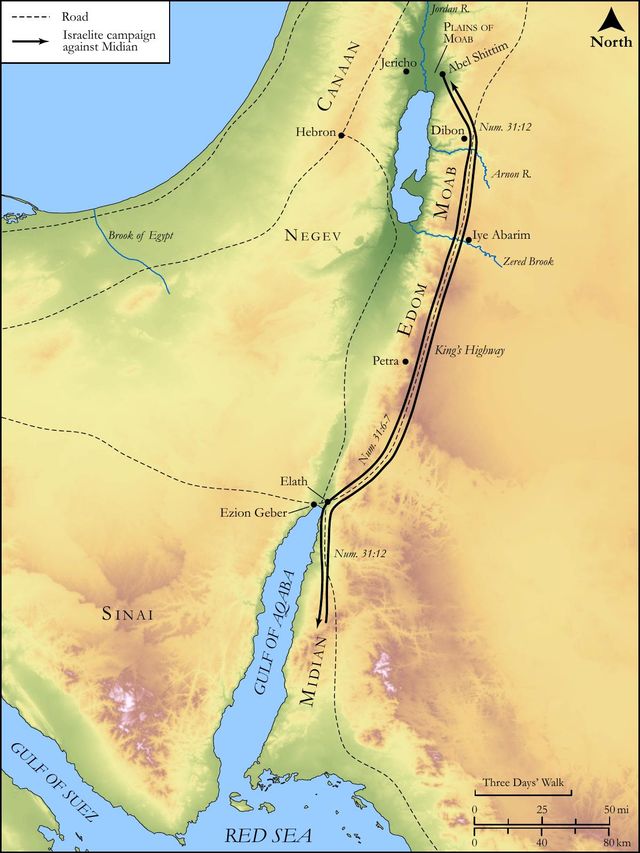
See on the biblical-era map
Study this verse
Continue studying Numbers 31:50 across the web’s major study libraries — every link below opens this exact verse, chapter, or book on the destination site.
Read & Compare
 BibleGatewayThis verse in more than 200 translations and 70 languages.
 Bible.comThe YouVersion reader — hundreds of translations, reading plans, and highlights.
 ESV.orgCrossway's official English Standard Version reader.
 NET BibleThe NET translation with 60,000+ translators' notes on every rendering decision.
 STEP BibleTyndale House's free study tool — original text, vocabulary, and scholarly resources.
 BibliaLogos Bible Software's free web reader.
 USCCBThe New American Bible (Revised Edition) with the U.S. bishops' study notes.
Commentaries
 BibleHub CommentariesDozens of classic commentaries on this verse, gathered on one page.
 StudyLightMore than 100 commentary sets — the largest collection on the web.
 BibleRefPlain-English commentary on what this verse means, verse by verse.
 Enduring WordDavid Guzik's free commentary on this chapter, widely used by Bible teachers.
 Bible Study ToolsVerse commentary alongside Greek and Hebrew study aids.
Original Language & Research
- BibleHub InterlinearThe verse word by word — original language, transliteration, and English.
- BibleHub LexiconEvery word's original-language definition and Strong's entry.
 Blue Letter BibleDeep-study tools — Strong's numbers, concordance, and word studies.
 SefariaThe Hebrew text with Rashi and centuries of Jewish commentary.
Sermons, Hymns & Audio


TrulyRandomVerse is not affiliated with these sites and doesn’t control their content. They’re linked because they’re genuinely useful.
Summary
Numbers 31:50 captures a profound moment of corporate gratitude and spiritual consecration by the Israelite military officers following their miraculous victory over the Midianites. Having conducted a census and discovered that not a single soldier had perished in the intense campaign, they spontaneously presented a voluntary offering of valuable gold ornaments from their spoils to the LORD. This "oblation" was given not as a sin offering, but as a unique "atonement for our souls," signifying an act of purification, acknowledgment of God's sovereign preservation of their lives, and a deep expression of reverence and dependence upon His divine protection.
Context
ShowHideLiterary Context
This verse stands near the close of the dramatic narrative of the divinely commanded war against Midian, a punitive expedition initiated due to Midian's role in enticing Israel into the Baal-peor apostasy, as detailed in Numbers 25:1-9. Following the decisive victory and Moses' meticulous instructions concerning the division of spoils and purification rituals outlined in Numbers 31:1-24, the military commanders undertook a census of their forces. The astonishing discovery that "there lacked not one man of us" (Numbers 31:49) served as the immediate catalyst for this extraordinary, voluntary offering. This act of thanksgiving stands as a powerful testament to God's faithfulness and Israel's recognition of His providential hand in their preservation, preceding the formal distribution of the spoils among the congregation and the Levites.
Historical & Cultural Context
The war against Midian was not merely a military conquest but a holy war, a divine judgment against those who had led Israel into idolatry and sexual immorality. Among the nations, the taking of spoils was a common practice, with a portion often dedicated to their gods. However, the Israelite practice, governed by the Mosaic Law, involved specific tithes from war booty for the sanctuary and the priesthood, as detailed in Numbers 31:25-47. The offering described in Numbers 31:50 transcends these prescribed tithes, representing a spontaneous, deeply personal, and costly act of devotion. The concept of "atonement" (כָּפַר, kâphar) in this specific context is crucial; it is not for specific sin but rather a purification or covering for the lives of those who had engaged in bloodshed, acknowledging the sanctity of life and God's ultimate ownership over it, even in divinely sanctioned warfare. It reflects a cultural understanding that engagement with death and the taking of life, even in a righteous cause, necessitated a ritual acknowledgment and purification to maintain a right standing with a holy God.
Key Themes
ShowHideThis verse powerfully underscores several key themes pervasive throughout the book of Numbers and the broader Pentateuch. Foremost is Divine Protection and Faithfulness, as God miraculously preserved every Israelite soldier in a fierce battle, highlighting His unwavering care for His covenant people. This unparalleled preservation elicits a profound response of Gratitude and Thanksgiving, manifested in a costly, Voluntary Offering of personal valuables. The act is described as making "atonement for our souls," which introduces the theme of Purification and Reconciliation. While not a sin offering in the typical sense, it signifies a desire to be ritually clean and in right relationship with God after engaging in warfare and bloodshed, acknowledging His sovereignty over life and death. This reflects an ongoing need for spiritual alignment and consecration before a holy God, even when acting under His direct command, echoing principles found in passages like Leviticus 16 concerning the need for ritual purity.
Exposition and Analysis
ShowHideKey Word Analysis
ShowHideFrom the root qârab (H7126), meaning "to approach" or "bring near," qorbân (H7133) refers to "something brought near the altar," specifically "a sacrificial present" or "offering." Unlike a burnt offering (olah) or sin offering (chattat), a qorbân could be a voluntary gift expressing homage, gratitude, or devotion. In this context, it emphasizes the freewill nature of the officers' offering, given out of a heart of thanksgiving rather than as a prescribed ritual or a response to specific transgression. It signifies a tangible expression of reverence and appreciation for God's extraordinary favor and miraculous preservation.
As a primitive root (H3722), kâphar fundamentally means "to cover (specifically with bitumen)," and figuratively, "to expiate or condone," "to placate or cancel." While often associated with covering sin (e.g., on the Day of Atonement), here its object is "our souls" (נֶפֶשׁ, nephesh), referring to their very lives. It is not an atonement for sin committed by the soldiers, but rather a purification or covering for their lives, acknowledging that even in divinely commanded warfare, the shedding of blood and exposure to death required a spiritual cleansing and recognition of God's sanctity and ownership over life. It was an act of consecration, ensuring they remained in right standing with the holy God after such an event, a recognition of their dependence on His grace for their continued existence.
From the root nâphash, meaning "to breathe," nephesh (H5315) properly refers to "a breathing creature" or, abstractly, "vitality." It is used very widely to denote the self, life, person, mind, or appetite. In the phrase "atonement for our souls" (nephesh), it refers to the very lives or persons of the soldiers. It signifies a holistic purification and dedication of their being before God, acknowledging that their continued existence was a direct result of His miraculous intervention and that their lives, having been preserved, were consecrated to Him.
Verse Breakdown
ShowHide"We have therefore brought an oblation for the LORD"
This clause highlights the officers' initiative and their clear purpose. The word "therefore" directly connects this act to the preceding verse, where they express awe at the fact that not a single man was lost in battle. Their offering is a direct, grateful response to this miraculous preservation, presented as a voluntary gift (qorbân) specifically dedicated to Yahweh, acknowledging Him as the singular source of their victory and preservation.
"what every man hath gotten, of jewels of gold, chains, and bracelets, rings, earrings, and tablets"
This specifies the nature and source of the offering. It was not a communal fund but a collection of personal war spoils, specifically valuable gold ornaments. The detailed enumeration of items—"jewels of gold, chains, and bracelets, rings, earrings, and tablets"—underscores the richness and personal value of the offering, indicating that these were significant possessions. This emphasizes the costly and heartfelt nature of their gratitude, demonstrating their willingness to give from their abundance with a willing spirit.
"to make an atonement for our souls before the LORD"
This crucial phrase states the spiritual purpose of the offering. As analyzed above, "atonement for our souls" refers to a purification or covering for their lives, not for specific sin. It is an act of recognizing God's sovereignty over life and death, acknowledging His grace in preserving them, and seeking to be ritually and spiritually clean in His sight after participating in warfare. It signifies their desire to remain in a right, consecrated relationship with God, demonstrating profound reverence and dependence.
Literary Devices
ShowHideThe verse employs several literary devices to convey its profound message. The detailed enumeration of the gold items—"jewels of gold, chains, and bracelets, rings, earrings, and tablets"—serves as Specific Detail and Accumulation, emphasizing the richness and personal value of the offering. This precise listing not only paints a vivid picture of the sheer quantity and quality of the gifts but also underscores the costly nature of their gratitude, highlighting that they gave from their most prized possessions. The immediate context of "not a single man was lost" (Numbers 31:49) functions as Hyperbole or Divine Intervention, as such an outcome in ancient warfare was virtually impossible by human standards, thereby magnifying the miraculous nature of God's protection and prompting the officers' extraordinary response. Finally, the phrase "atonement for our souls" uses Metonymy, where "souls" (נֶפֶשׁ, nephesh) stands for their very lives or persons, signifying a holistic purification and dedication of their entire being before God.
Theological and Thematic Connections
ShowHideNumbers 31:50 stands as a powerful testament to the principle that divine blessing and miraculous preservation should evoke a profound response of gratitude and dedication. The officers' offering, though not a prescribed sacrifice for specific sin, functions as a spontaneous act of propitiation, acknowledging God's sovereignty over life and death and seeking to remain in right standing with Him after engaging in warfare. This act foreshadows the broader biblical theme that all of life, including our very existence, is a gift from God, and therefore, our appropriate response is to offer ourselves and our possessions back to Him in worship and service. It highlights the pervasive need for purification and reconciliation in the presence of a holy God, even when one's actions are divinely sanctioned. This voluntary, costly offering serves as a model of wholehearted devotion, recognizing God's unmerited favor and responding with tangible expressions of thanks.
Reflection and Application
ShowHideThe officers' response in Numbers 31:50 provides a timeless lesson for believers today. When we experience God's remarkable protection, provision, or deliverance—whether from physical harm, financial distress, or spiritual danger—our hearts should be stirred to profound gratitude. This gratitude should not remain abstract but should prompt a tangible, costly response. Just as the officers gave from their valuable spoils, we are called to offer back to God from what He has graciously given us: our time, talents, resources, and even our very lives. This offering is not to earn His favor, but as a joyful acknowledgment of His sovereign goodness and a desire to remain in right relationship with Him. It reminds us that even when we are walking in God's will, there is an ongoing need for spiritual consecration and an awareness of His holiness, prompting us to seek His grace and live lives dedicated to His glory as a continuous act of worship.
Questions for Reflection
ShowHideFAQ
ShowHideWhat does "atonement for our souls" mean in this specific context, given it's not for a specific sin?
ShowHideIn Numbers 31:50, "atonement for our souls" (כָּפַר עַל נַפְשֹׁתֵינוּ) does not refer to covering a specific transgression or sin committed by the soldiers. Instead, it signifies a purification or covering for their lives (their "souls" or persons) after engaging in warfare and bloodshed. It acknowledges the sanctity of life and God's ultimate ownership over it. The offering served as a spiritual cleansing and an act of consecration, ensuring that the soldiers remained in right standing with a holy God after participating in an event that involved death and defilement, even though it was a divinely commanded war. It was a recognition of God's miraculous preservation of their lives (Numbers 31:49) and a way to express their reverence and dependence upon Him.
Why did the officers offer such valuable gold items, beyond the prescribed tithes from the spoils?
ShowHideThe officers offered valuable gold items—"jewels of gold, chains, and bracelets, rings, earrings, and tablets"—as a voluntary and costly expression of profound gratitude and devotion. While the Mosaic Law prescribed specific tithes from war spoils for the sanctuary and the Levites (Numbers 31:25-47), this offering was above and beyond that requirement. It was a spontaneous act, prompted by the astonishing fact that not a single Israelite soldier perished in the battle (Numbers 31:49). The high value of the items underscored the sincerity and depth of their thanksgiving, demonstrating a principle of giving from their abundance and with a willing heart, recognizing God's extraordinary favor and protection.
Christ-Centered Fulfillment
ShowHideThe "atonement for our souls" offered by the Israelite officers in Numbers 31:50, while a significant act of gratitude and purification, ultimately points forward to the perfect and singular atonement accomplished by Jesus Christ. The officers' offering was a human-initiated gift, a costly but limited act of covering for their lives after warfare. In contrast, Christ's sacrifice on the cross is the ultimate and all-sufficient "atonement for our sins" (Romans 3:25) and for our very lives, providing complete reconciliation with God. He is the true Lamb of God who takes away the sin of the world, offering His own life as a perfect and final sacrifice (Hebrews 9:26). The miraculous preservation of the Israelite soldiers in battle foreshadows the spiritual preservation and eternal life offered to all who believe in Christ, who delivers us from the ultimate enemy, sin and death (1 Corinthians 15:54-57). Our response to this ultimate divine protection and salvation is not merely gold ornaments, but the offering of our whole lives as a "living sacrifice, holy and pleasing to God" (Romans 12:1), in light of the immeasurable grace we have received through Him.