


Numbers 31:51
Bible text: King James Version (1769 Blayney text) · Public domain
Bible text: Berean Standard Bible · Public domain
Bible text: American Standard Version (1901) · Public domain
Bible text: World English Bible, Messianic edition · Public domain
Bible text: Geneva Bible (1599) · Public domain
Bible text: Young's Literal Translation · Public domain
- וַיִּקַּחvai·yi·Kachand he tookH3947Conj-w ¦ V-Qal-ConsecImperf-3msVerb Qal Consecutive Imperfect 3rd Singular Masculineוַandיִּקַּחhe took
- מֹשֶׁהmo·ShehMosesH4872N-proper-mNoun Proper Masculine
- וְאֶלְעָזָרve·'el·'a·Zarand EleazarH499Conj-w ¦ N-proper-mNoun Proper MasculineוְandאֶלְעָזָרEleazar
- הַכֹּהֵןha·ko·Henthe priestH3548Art ¦ N-msNoun Singular Masculine Absoluteהַtheכֹּהֵןpriest
- אֶת'et<obj.>H853DirObjMParticle Object Indicator
- הַזָּהָבha·za·Havthe goldH2091Art ¦ N-msNoun Singular Masculine Absoluteהַtheזָּהָבgold
- מֵאִתָּםme·'i·Tamfrom with <the> themH854Prep-m ¦ Prep ¦ 3mpPreposition Definiteמֵfromאִתָּwith <the>םthem
- כֹּלkoleveryH3605N-mscNoun Singular Masculine Construct
- כְּלִיke·Liarticle ofH3627N-mscNoun Singular Masculine Construct
- מַעֲשֶׂהma·'a·SehworkH4639N-msNoun Singular Masculine Absolute
English is a literal word-by-word gloss of the Hebrew, not the KJV's wording. Why?
This is the original text the KJV's translators worked from — each Hebrew word with its own literal English meaning in this verse, prepared by scholars at Tyndale House, Cambridge. The KJV translates whole sentences, not word by word, so its wording differs: one Hebrew word can become several English words, and the KJV may choose “the LORD” where the gloss reads “Yahweh”. Both are faithful — they answer different questions. For the KJV's own rendering, switch to the KJV text.
Details
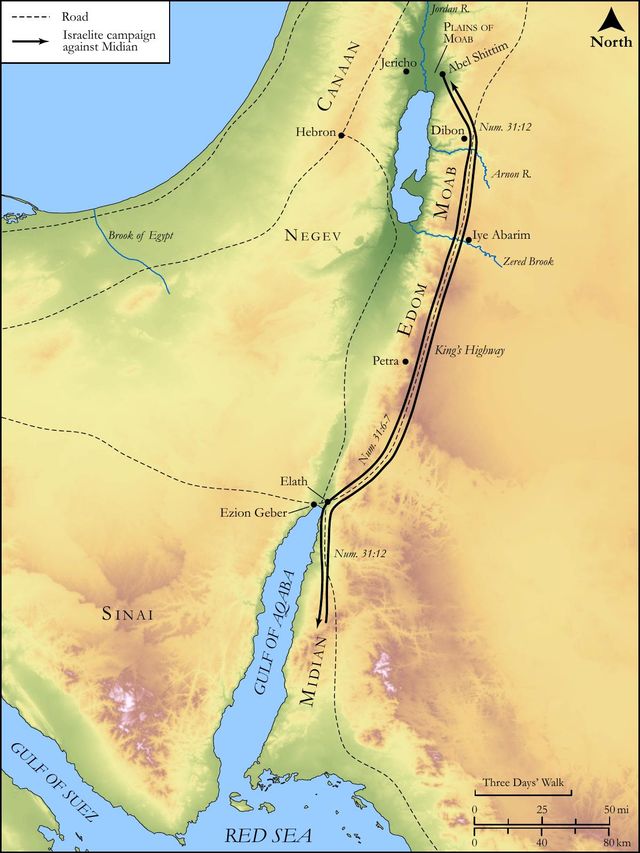
See on the biblical-era map
Study this verse
Continue studying Numbers 31:51 across the web’s major study libraries — every link below opens this exact verse, chapter, or book on the destination site.
Read & Compare
 BibleGatewayThis verse in more than 200 translations and 70 languages.
 Bible.comThe YouVersion reader — hundreds of translations, reading plans, and highlights.
 ESV.orgCrossway's official English Standard Version reader.
 NET BibleThe NET translation with 60,000+ translators' notes on every rendering decision.
 STEP BibleTyndale House's free study tool — original text, vocabulary, and scholarly resources.
 BibliaLogos Bible Software's free web reader.
 USCCBThe New American Bible (Revised Edition) with the U.S. bishops' study notes.
Commentaries
 BibleHub CommentariesDozens of classic commentaries on this verse, gathered on one page.
 StudyLightMore than 100 commentary sets — the largest collection on the web.
 BibleRefPlain-English commentary on what this verse means, verse by verse.
 Enduring WordDavid Guzik's free commentary on this chapter, widely used by Bible teachers.
 Bible Study ToolsVerse commentary alongside Greek and Hebrew study aids.
Original Language & Research
- BibleHub InterlinearThe verse word by word — original language, transliteration, and English.
- BibleHub LexiconEvery word's original-language definition and Strong's entry.
 Blue Letter BibleDeep-study tools — Strong's numbers, concordance, and word studies.
 SefariaThe Hebrew text with Rashi and centuries of Jewish commentary.
Sermons, Hymns & Audio


TrulyRandomVerse is not affiliated with these sites and doesn’t control their content. They’re linked because they’re genuinely useful.
Summary
Numbers 31:51 records the solemn act of Moses and Eleazar the priest collecting all the gold, specifically described as "wrought jewels," from the spoils of the victorious campaign against the Midianites. This collection was not merely an inventory of war plunder but a sacred offering, fulfilling a divine mandate to set apart a portion of the bounty as a special offering to the Lord. This dedication signified both profound gratitude for divine protection during the battle and an act of atonement for the lives of the Israelite warriors, underscoring God's ultimate ownership and the people's obedient response.
Context
ShowHideLiterary Context
Numbers 31 details the aftermath of a punitive war against Midian, a conflict divinely commanded due to Midian's role in enticing Israel into idolatry and sexual immorality at Baal-Peor, as recounted in Numbers 25. Following a decisive Israelite victory, the narrative shifts to meticulous instructions for the purification of the soldiers and the division of the vast spoils. Numbers 31:25-47 outlines the precise methodology for distributing the plunder between the warriors and the rest of the congregation. Crucially, specific portions from both shares were designated as a "heave offering" (terumah) for the Lord. Immediately preceding our verse, Numbers 31:50 explicitly states that the officers brought their gold as "an oblation for the LORD, to make an atonement for our souls," highlighting the sacrificial and redemptive nature of this particular offering. Numbers 31:51 then records the actual collection of this gold by the designated leaders, serving as the culmination of this specific divine instruction.
Historical & Cultural Context
The war against Midian was not a typical territorial dispute but a direct divine judgment, initiated because of Midian's enticement of Israel into grievous sin at Baal-Peor. This context underscores the severity of God's wrath against idolatry and His unwavering commitment to the holiness of His covenant people. Among the nations, spoils of war were typically considered the property of the victorious king or nation. However, for Israel, spoils were often viewed as belonging to Yahweh, the true King, and a portion was frequently consecrated to Him. The concept of "atonement" (כָּפַר, kaphar) in this context refers to a covering or expiation for sin, here specifically for the lives of the warriors preserved in battle. It acknowledges that even in victory, life is a gift from God and requires His favor and grace. The "wrought jewels" (כְּלִי זָהָב, keli zahav) would have been highly valuable and portable, representing significant wealth and a substantial offering in a society where such items were prominent indicators of status and prosperity.
Key Themes
ShowHideThe act described in Numbers 31:51 powerfully reinforces several core themes pervasive in the book of Numbers and the Pentateuch. Firstly, it highlights Divine Sovereignty and Ownership, asserting that all victories, wealth, and even life itself ultimately belong to God. The dedication of the gold acknowledges His supreme authority and provision, echoing the declaration found in Psalm 24:1. Secondly, the offering embodies Consecration and Holiness. By setting apart these valuable items, they were transformed from common spoils into holy objects dedicated for divine service, reinforcing Israel's call to be a holy nation set apart for God, as commanded in Leviticus 11:44-45. Thirdly, the explicit mention of "atonement for our souls" in the preceding verse emphasizes Gratitude and Expiation. It was an act of profound thanksgiving for divine protection and a symbolic covering for the lives spared in a divinely sanctioned war, demonstrating the Israelites' understanding that even their survival was by God's grace. Finally, the faithful execution of this command by Moses and Eleazar underscores the theme of Obedience and Faithful Leadership, demonstrating their commitment to upholding God's law and guiding the people in worship.
Exposition and Analysis
ShowHideKey Word Analysis
ShowHideThis verb (H3947) signifies "to take" in a broad sense, encompassing receiving, acquiring, or seizing. In this context, it implies an official and deliberate act of collection by Moses and Eleazar, not merely passive reception. It underscores their active role in fulfilling the divine mandate, highlighting the importance of leadership in orchestrating acts of worship and obedience.
The term (H2091) refers to the precious metal, often symbolizing wealth, purity, and value throughout the Old Testament. Its shimmering quality, as implied by its root, makes it a fitting representation of divine glory and the finest offerings. Here, it represents the material wealth plundered from the Midianites, now consecrated to the Lord, signifying the highest quality of offering.
This noun (H3627) is broad, meaning "something prepared," or any "apparatus," "implement," "vessel," or "weapon." In conjunction with "wrought" (H4639, maʻăseh, meaning "work" or "thing made"), it specifically refers to crafted articles or ornaments of gold. This emphasizes that the collected items were not raw ore but finished, valuable pieces, highlighting the quality and significance of the offering presented to the Lord. It suggests a deliberate selection of the most valuable and aesthetically pleasing items, reflecting the honor due to God.
Verse Breakdown
ShowHide"And Moses and Eleazar the priest took"
This clause identifies the two principal figures responsible for executing the divine command. Moses, as the supreme leader and mediator of the covenant, and Eleazar, as the high priest, represent the highest spiritual and temporal authority in Israel. Their joint action underscores the solemnity, official nature, and divine authorization of this collection. It highlights the importance of faithful, unified leadership in carrying out God's will and administering sacred offerings.
"the gold of them"
"Them" refers to the Israelite soldiers and officers who had participated in the war against Midian and had brought their share of the spoils as a voluntary offering, as detailed in Numbers 31:50. This gold was not confiscated but willingly presented by the people as a "heave offering" (terumah) to the Lord, indicating their participation in the act of atonement and gratitude. It signifies a communal act of worship and acknowledgment of divine grace.
"[even] all wrought jewels"
This specifies the particular type of gold collected. It was not just any gold, but specifically "wrought jewels" or "articles of gold" (כְּלִי זָהָב). This detail emphasizes the value, craftsmanship, and aesthetic quality of the items. These were likely personal ornaments, valuable artifacts, or finely crafted implements, now being consecrated to God. The phrase "all wrought jewels" indicates the comprehensive nature of the collection, reflecting the immense wealth plundered from the Midianites and the generosity of the offering, ensuring nothing of value was withheld from the Lord's portion.
Literary Devices
ShowHideThe verse employs Precision and Specificity in its description, meticulously naming the exact individuals (Moses and Eleazar) and the precise nature of the collected items ("wrought jewels"). This meticulous detail underscores the importance and sacredness of the act, reflecting the divine order and thoroughness expected in matters pertaining to God's commands. The use of Synecdoche can be observed where "wrought jewels" represents the entirety of the valuable gold spoils designated for the offering, focusing on the most refined and significant portion as representative of the whole. Furthermore, the act itself functions as Symbolism, where the collection of precious gold symbolizes the Israelites' profound gratitude, their act of atonement, and their recognition of God's ultimate ownership over all things, even the spoils of war. The very act of taking and dedicating these items transforms them from mundane plunder into sacred offerings, set apart for divine purposes.
Theological and Thematic Connections
ShowHideThe collection of gold in Numbers 31:51 serves as a powerful theological statement about God's absolute sovereignty and the appropriate human response to divine blessing and preservation. It reinforces the timeless biblical principle that all material possessions, especially those acquired through divine intervention and protection, ultimately belong to the Lord. This act of offering was not merely a tax or a tribute, but a sacred dedication—a tangible expression of profound gratitude and an acknowledgement of God's grace in sparing their lives in battle. It foreshadows the broader biblical truth that true worship involves the surrender of our most valuable possessions and our very selves to God, recognizing that He is the source of all good things and worthy of all praise. This principle extends beyond material wealth to encompass our time, talents, and lives, all to be consecrated for His glory as an act of worship.
Reflection and Application
ShowHideNumbers 31:51 offers profound insights for contemporary believers regarding stewardship, gratitude, and the sanctity of life. Just as the Israelites recognized God's hand in their victory and offered a portion of their spoils as atonement and thanksgiving, so too are we called to acknowledge God as the ultimate source of all our blessings—our material wealth, our health, our talents, and indeed, our very breath. This verse challenges us to move beyond a transactional view of faith to one of deep devotion and surrender, where our possessions are not merely ours but resources entrusted to us by God for His purposes. It encourages a spirit of generosity and intentional dedication, prompting us to consider how we can consecrate our "wrought jewels"—our most valuable resources, time, and abilities—back to the Lord in acts of worship, service, and support for His kingdom. This is not about earning favor, but about expressing heartfelt gratitude and living out our identity as stewards of God's abundant grace, recognizing that every good and perfect gift comes from Him.
Questions for Reflection
ShowHideFAQ
ShowHideWhat was the purpose of collecting these "wrought jewels" from the Midianite spoils?
ShowHideThe collection of these "wrought jewels" served a multifaceted purpose. Primarily, it was a direct fulfillment of God's command to set apart a portion of the spoils as a "heave offering" (terumah) to the Lord. As stated in Numbers 31:50, it was specifically designated "to make an atonement for our souls." This signifies an act of profound gratitude for God's preservation of the Israelite soldiers' lives during the intense battle, acknowledging that their survival was by divine grace. It also underscored God's ultimate ownership of all things, even the spoils of war, and served as an act of consecration, transforming the plunder into holy objects for divine service, likely for the Tabernacle's upkeep and adornment.
Why were Moses and Eleazar specifically involved in taking the gold?
ShowHideMoses and Eleazar the priest were the preeminent spiritual and temporal leaders of Israel at this time. Their involvement in personally collecting the gold underscored the immense importance and sacred nature of this act. Moses, as the mediator of the covenant and the one who received God's direct instructions, ensured the divine mandate was precisely followed. Eleazar, as the High Priest, represented the priestly authority and the sacred dimension of the offering, ensuring it was handled with the appropriate reverence and ritual purity. Their joint action legitimized the offering in the eyes of the people and demonstrated faithful obedience to God's detailed instructions regarding the spoils of war and the sanctuary's needs, as outlined in Numbers 31:25-47.
Does this act imply that God desired material wealth?
ShowHideWhile God certainly commanded the collection of this valuable gold, it is not because He needs material wealth in the human sense. The act primarily served as a demonstration of Israel's obedience, gratitude, and recognition of God's sovereignty. The gold was likely intended for the upkeep and adornment of the Tabernacle, which was the physical representation of God's presence among His people, as seen in the instructions for its construction in Exodus 25:1-9. By dedicating their most valuable possessions, the Israelites were expressing their devotion and acknowledging that all blessings flow from God. This principle is echoed throughout Scripture, emphasizing that our offerings are a response to God's generosity, not an attempt to fulfill His needs, as Psalm 50:10-12 clearly states.
Christ-Centered Fulfillment
ShowHideNumbers 31:51, with its emphasis on an offering for atonement and gratitude, finds its ultimate and most profound fulfillment in the person and work of Jesus Christ. The gold collected by Moses and Eleazar, offered as a symbolic covering for the lives of the Israelite warriors, points forward to the infinitely greater and perfect sacrifice of the Lamb of God, Jesus Christ, who truly "takes away the sin of the world." Unlike the temporary and partial atonement offered through material possessions, Christ's death on the cross provided a once-for-all, perfect atonement for the souls of all who believe. He is the ultimate "wrought jewel," the precious and spotless Lamb whose blood truly redeems us from the futility of our inherited ways and secures our eternal preservation. Furthermore, the act of dedication and consecration, where valuable items were set apart for God, foreshadows the call for believers in Christ to present their bodies as a living sacrifice, holy and acceptable to God. Our lives, redeemed and made holy by Christ, become the ultimate offering, a testament to His divine ownership and the immeasurable grace that secured our eternal salvation.